



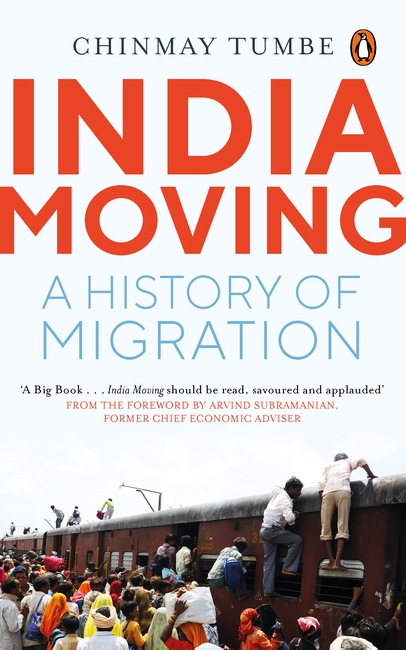
From adventure to indenture, martyrs to merchants, Partition to plantation, from Kashmir to Kerala, Japan to Jamaica and beyond,
the many facets of the great migrations of India and the world are mapped in India Moving, the first book
of its kind.
To understand how millions of people have moved-from, to and within India-the book embarks on a journey laced with evidence, argument and wit, providing insights into topics like the slave trade and migration of workers, travelling business communities such as the Marwaris, Gujaratis and Chettiars, refugee crises and the roots of contemporary mass migration from Bihar and Kerala, covering terrain that often includes diverse items such as mangoes, dosas and pressure cookers.
India Moving shows the scale and variety of Indian migration and argues that greater mobility is a prerequisite for maintaining the country’s pluralistic traditions.
Catagory: History
India and the World
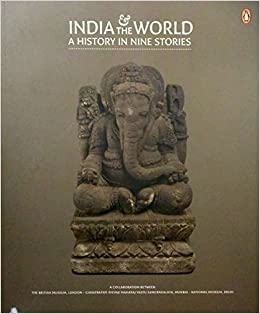
What is the earliest evidence of human history in India and how does that compare with other parts of the world? What was happening in India when the pyramids were being built in Egypt? What was different about Ashoka’s inscriptions when compared with the public inscriptions of other emperors? How have different civilizations pictured the divine? How did rulers promote themselves through grand court art and aesthetics? What have been the routes of civilizational exchange over land and sea that make India a part of the world? And have those exchanges always been peaceful? How have different countries and communities articulated their quest for freedom in recent history? Does everyone in the world perceive history and time in the same way?
Objects-be they coins, sculptures, documents or paintings-tell rich stories. India & the World accompanies a collaborative exhibition that creates dialogues between the world and India through a fascinating array of artefacts. On the one hand they reveal how different people have responded to situations in their own way, and on the other, they provide an understanding of the complex panorama of a deeply interconnected global history.
Staggering Forward
There is a paradigm shift in India’s politics. With his clean reputation, proven track record as chief minister of Gujarat and formidable leadership qualities on display, Narendra Modi seemed the right fit for the prime minister’s job, and just the man to turn the country around after the decade-long UPA rule by the modest and tongue-tied Manmohan Singh.
Prime Minister Modi’s first term, however, raises troubling questions. How has his strongman persona and social background impacted policymaking? Has Modi delivered on the high expectations to advance India’s national interest and security? Has the country’s role in the region, in Asia and the world changed, become more meaningful? What has been the effect of Modi’s India First foreign policy on neighbours, and with respect to raising India’s stock in the world and showing the Indian military has teeth? Especially with regard to the UUS, Russia and China.
Analysing Prime Minister Modi’s foreign and military policies in the context of India’s evolving socio-political and economic milieu, this book offers a critical perspective that helps explain why India has not progressed much towards becoming a consequential power. Argumentative and thought-provoking, Staggering Forward is a must-read to understand India’s foreign and national security policies since 2014.
Heart
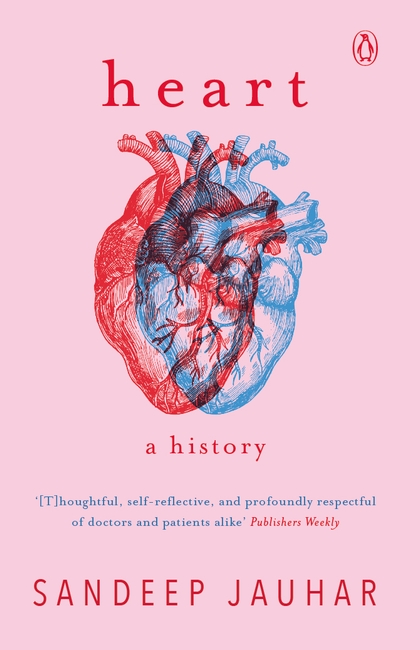
The spark of life, fount of emotion, house of the soul–the heart lies at the centre of every facet of our existence. It’s so bound up in our deepest feelings that it can physically change shape when we experience emotional trauma.
For centuries, the human heart seemed beyond our understanding: an inscrutable shuddering mass that was somehow the driver of emotion and the seat of the soul. As the cardiologist and bestselling author Sandeep Jauhar shows in Heart: A History, it was only recently that we demolished age-old taboos and devised the transformative procedures that have changed the way we live.
Deftly alternating between key historical episodes and his own work, combining his family’s own moving history of heart disease with gripping scenes from the operating theatre, Jauhar tells the colourful and little-known story of the doctors who risked their careers and the patients who risked their lives to know and heal our most vital organ. He introduces us to Daniel Hale Williams, the African American doctor who performed the world’s first open heart surgery in Gilded Age Chicago. We meet C. Walton Lillehei, who connected a patient’s circulatory system to a healthy donor’s, paving the way for the heart-lung machine. And we encounter Wilson Greatbatch, who saved millions by inventing the pacemaker?by accident. Jauhar deftly braids these tales of discovery, hubris, and sorrow with moving accounts of his family’s history of heart ailments and the patients he’s treated over many years. He also confronts the limits of medical technology, arguing that future progress will depend more on how we choose to live than on the devices we invent.
Affecting, engaging, and beautifully written, Heart: A History takes the full measure of the only organ that can move itself.
The Non Violent Struggle for Freedom 1905-1919
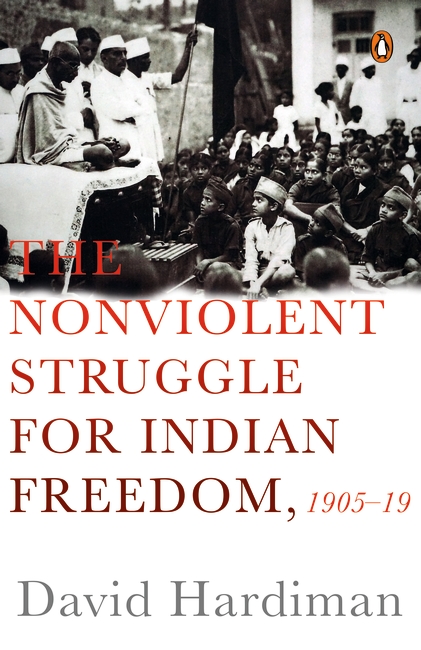
In recent years, there has been a surge of writing on the technique and practice of non-violent forms of resistance. Much of this has focused on movements that occurred after the end of the Second World War, many of which have been extremely successful. Although the fact that such a method of resistance was developed in its modern form by India is acknowledged, there has not until now been an authoritative history available to show exactly how this occurred.
This book provides such a study. Although non-violence is associated above all with the towering figure of M.K. Gandhi, David Hardiman shows that civil forms of resistance were already being practiced by nationalists in British-ruled India under the rubric of ‘passive resistance’. In this, there was no principled commitment to non-violence as such.
It was Gandhi, first in South Africa and then in India, who both evolved a technique that he called ‘satyagraha’ that he characterised in terms of its ‘non-violence’. In this, ‘non-violence’ was forged as both a new word in the English language, and as a new political concept.
The Non-violent Struggle for Freedom brings out in graphic detail exactly what this entailed, and the formidable difficulties that the pioneers of such resistance encountered in the years 1905-19.
The Mahabharata
This definitive and magnificent 10-volume unabridged translation is one of the rare English translations of full of the epic. Bibek Debroy makes the Mahabharata marvelously accessible to contemporary readers. Dispute over land and kingdom may lie at the heart of this story of war between cousins-the Pandavas and the Kouravas-but the Mahabharata is about conflicts of dharma. These conflicts are immense and various, singular and commonplace. Throughout the epic, characters face them with no clear indications of what is right and what is wrong; there are no absolute answers. Thus every possible human emotion features in the Mahabharata, the reason the epic continues to hold sway over our imagination.
In this superb and widely acclaimed translation of the complete Mahabharata, Bibek Debroy takes on a great journey with incredible ease. This is the fifth volume in the series.
The Mahabharata
This is the sixth book in the definitive and magnificent 10-volume unabridged translation of one of the rare English translations of the full epic. Bibek Debroy makes the Mahabharata marvellously accessible to contemporary readers. Dispute over land and kingdom may lie at the heart of this story of war between cousins-the Pandavas and the Kouravas-but the Mahabharata is about conflicts of dharma. These conflicts are immense and various, singular and commonplace. Throughout the epic, characters face them with no clear indications of what is right and what is wrong; there are no absolute answers. Thus every possible human emotion features in the Mahabharata, the reason the epic continues to hold sway over our imagination. In this superb and widely acclaimed translation of the complete Mahabharata, Bibek Debroy takes on a great journey with incredible ease.
The Mahabharata
The Mahabharata is one of the greatest stories ever told. Though the basic plot is widely known, there is much more to the epic than the dispute between the Kouravas and the Pandavas that led to the battle in Kurukshetra. It has innumerable sub-plots that accommodate fascinating meanderings and digressions, and it has rarely been translated in full, given itsformidable length of 80,000 shlokas or couplets. This magnificent 10-volume unabridged translation of the epic is based on the Critical Edition compiled at the Bhandarkar Oriental Research Institute.
With the ninth volume, the magnificent epic approaches its end. The war is over and Yudhishthira is crowned. Bhishma’s teachings that began in the eighth volume continue past the Shanti Parva into the Anushasana Parva.
Every conceivable human emotion figures in the Mahabharata, the reason why the epic continues to hold sway over our imagination. In this lucid, nuanced and confident translation, Bibek Debroy makes the Mahabharata marvellously accessible to contemporary readers.
The Man Who Saved India
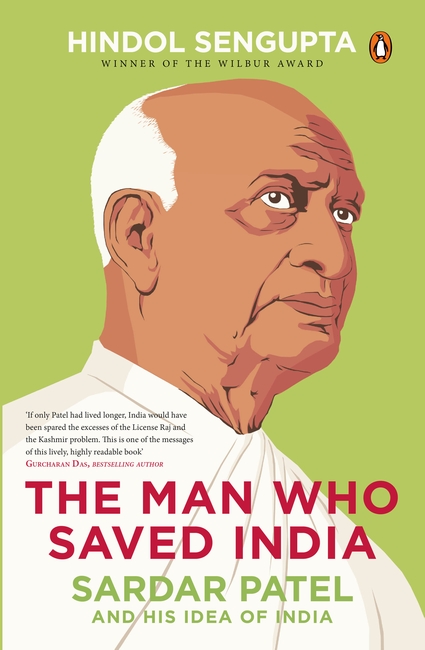
There is perhaps no political figure in modern history who did more to secure and protect the Indian nation than Sardar Vallabhbhai Patel. But, ironically, seventy years after Patel brought together piece by piece the map of India by fusing the princely states with British India to create a new democratic, independent nation, little is understood or appreciated about Patel’s enormous contribution to the making of India. Caricatured in political debate, all the nuances of Patel’s difficult life and the daring choices he made are often lost, or worse, used as mere polemic. If Mahatma Gandhi was the spiritual core of India’s freedom struggle and Jawaharlal Nehru its romantic idealism, it was Sardar Patel who brought in the vital pragmatism which held together the national movement and the first ideas of independent India. A naturally stoic man, Patel, unlike Gandhi or Nehru, wrote no personal history. He famously argued that its was better to create history than write it. This is why even his deepest misgivings and quarrels have been easily buried. But every warning that Patel left for India – from the dangers of allowing groups to create private militias to his thoughtful criticism on India’s approach to Kashmir, Pakistan and China – are all dangerously relevant today. It is impossible to read about Patel, who died in 1950, and not feel that had he lived on, India might have been a different country. It is also impossible to ignore Patel and understand not only what the idea of India is but also what it could have been, and might be in the future.
The Man Who Saved India is a sweeping, magisterial retelling of Sardar Patel’s story. With fiercely detailed and pugnacious anecdotes, multiple award-winning, best-selling writer Hindol Sengupta brings alive Patel’s determined life of struggle and his furious commitment to keep India safe. This book brings alive all the arguments, quarrels and clashes between some of the most determined people in Indian history and their battle to carve out an independent nation. Through ravages of a failing body broken by decades of abuse in and outside prison, Patel stands out in this book as the man who, even on his death bed, worked to save India. Hindol Sengupta’s The Man Who Saved India is destined to define Patel’s legacy for future generations.
Changemakers
Blurb:
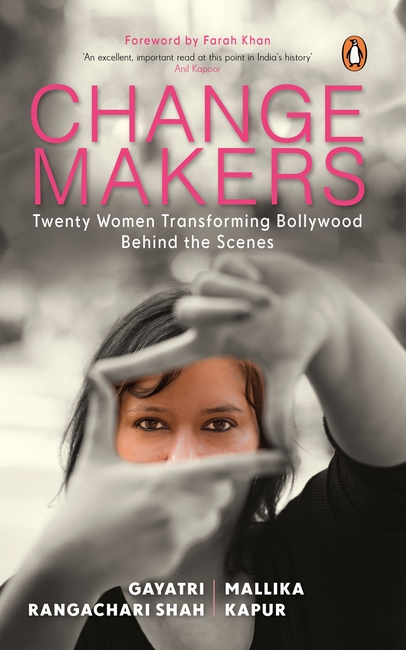
Since Bollywood’s earliest days, women have played a part in its success, both in front of the camera and away from it. Yet it has taken more than half a century for women to assert their presence in significant numbers in Bollywood. Today, Hindi cinema relies on a record number of women who work tirelessly, sometimes invisibly, to keep the world’s largest dream factory buzzing.
This book tells the story of twenty incredible women, many with no prior connections in the industry, who have carved successful careers despite significant challenges. They often work away from the public gaze-as studio heads, producers, directors, make-up artists, stylists, script writers, lyricists,editors, choreographers, stunt artists, set designers, and in the many other jobs that support the making of a movie. These women deserve to be applauded and their journeys acknowledged, as they transform Bollywood and in the process, create a new India.