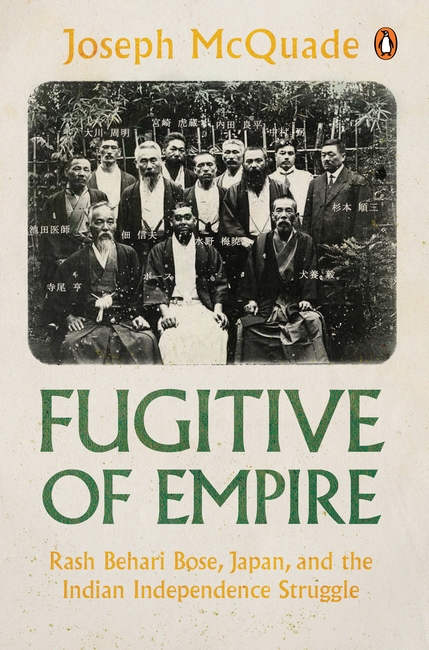
In 1912, Rash Behari Bose made his dramatic entrance into India’s anti-colonial freedom movement when he orchestrated a bomb attack against the British viceroy during a public procession in Delhi. Forced to
flee his homeland, Bose settled in Japan, becoming the most influential Indian in Tokyo and earning the affectionate title ‘Sensei’ among Japanese youth, military personnel, and far-right ultranationalists.
Throughout the 1920s and 1930s, Bose remained a perpetual thorn in the side of the British Empire as he built
and maintained a global network of anti-colonialists, radicals, smugglers, and intellectuals. After siding with Imperial Japan against his British adversaries during the Second World War, Bose died in 1945-just two years before India gained independence.
A complex, controversial, and often contradictory figure, Bose has been described as a committed democrat, an authoritarian, an advocate of religious harmony, a Hindu chauvinist, an anti-communist, a political pragmatist, an idealist, a Japanese collaborator, an anti-racist, a cultural conservative, a
Pan-Asianist, an Indian nationalist, and much more. Drawing on extensive archival research
from India, Japan, and the UK, this refreshing new biography brings to life the largely forgotten story of one of twentieth-century Asia’s most daring revolutionaries.

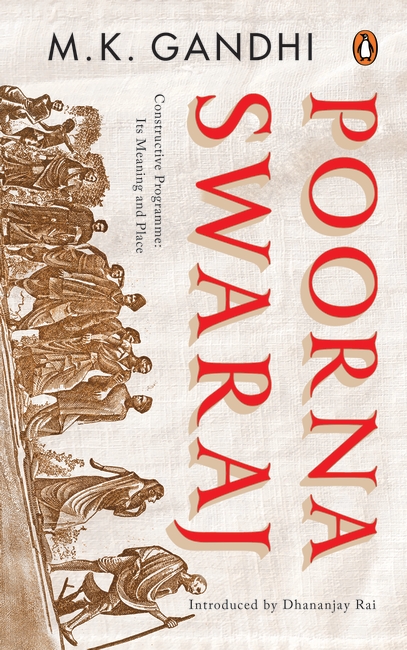
It contributes to current analyses of the health of liberal democracies-Rajmohan Gandhi
An impressive contribution to Gandhian studies-Bhikhu Parekh
This work merits attention-Gopal Guru
An extremely valuable and timely work-Prabhat Patnaik
Time and again, Mahatma Gandhi’s life, work and philosophy have played pivotal roles in bringing positive change in society. Poorna Swaraj, through its reading of the Constructive Programme: Its Meaning and Place, opens a window to his vision of attaining real and complete independence or ‘swaraj’ for India. With his ideas on communal unity, prohibition, basic education, emancipation of women, advisasis’ concerns, farmers’ distress, removal of untouchability, demystification of leprosy, the role of khadi, charkha, village and small-scale industries, among others, this book brings to light Gandhi’s road map for an egalitarian society.
This first critical edition, with a comprehensive contextual introduction by Dhananjay Rai, sets the backdrop for readers to understand Gandhi’s thoughts on making an ideal society. Amazingly relevant and thought-provoking, Poorna Swaraj is a must-read for students and scholars of history, social science, politics and Gandhian studies. An invaluable companion for policymakers and general readers, this book is a treasure trove.

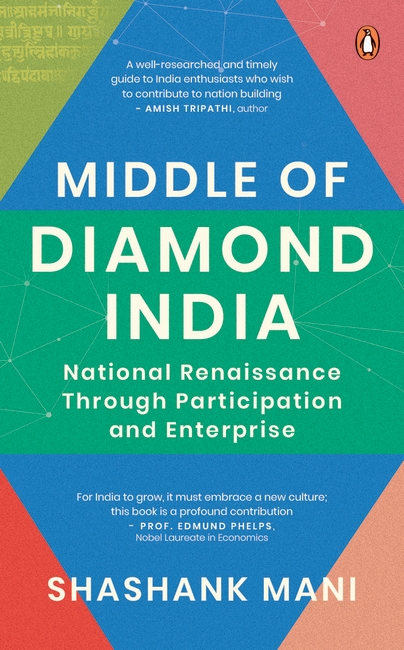
Middle of Diamond India proposes a revolutionary idea – that India has long ignored its largest and most talented segment, citizens in the Tier 2 and Tier 3 districts, its Middle.
The book reveals the hidden stories of those in its Middle who have been ignored owing to their location and language. By examining India’s revolutionary past, its culture, its citizens, its innovators, and its spirit, the book illuminates this Diamond shaped India.
Replete with characters, anecdotes, insights, research and accounts of an annual pilgrimage on a special train-Jagriti Yatra, and an enterprise ecosystem established in Deoria district, the book outlines a new vision of India focussed on its rising Middle. It proposes a Banyan Revolution over the coming twenty-five years of Amrit Kaal, using the tool of enterprise or Udyamita that can ignite a national renaissance.
The book argues that by recognizing and awakening the entrepreneurial vitality of those in small towns and districts, we can create meaning for millions of citizens and define a new modernity for India.

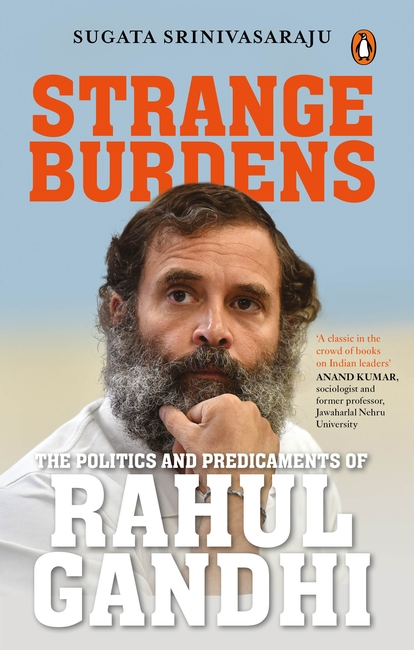
Strange Burdens is not a biography but a book of political commentary. It examines and analyses Rahul Gandhi’s ideas and leadership since he officially entered politics in March 2004. It journeys all the way to the conclusion of the Bharat Jodo Yatra in Srinagar on 30 January 2023 and captures the dilemmas of his
disqualification a couple of months later.
The narrative here crawls across two decades with the intention of understanding Rahul Gandhi’s politics and predicaments, confusions and contradictions, triteness and triumph, as well as his burdens and benignity. It is not the purpose of this book to understand his failures and successes in tabular columns but speculate in the best traditions of political commentary why he is where he is, both politically and as an individual. The book does not seek to answer questions about his suitability or unsuitability for a public role but is rather focused on how he has been caught in the currents of history. It is not a myth-busting or myth-making exercise, nor is it an inquisition; it is a pursuit of political insight.
Since the book is about Rahul Gandhi and the Congress party, it cannot not be about Narendra Modi and the Bharatiya Janata Party. Examining one automatically illuminates the other. The book looks at the contrasts and convergence of the two personalities and the two parties they represent.

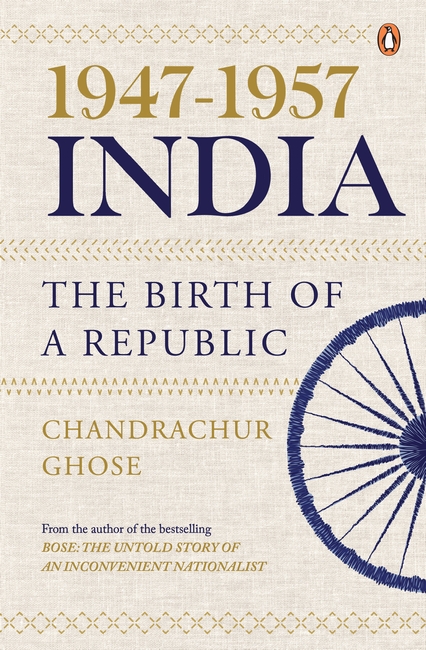
The story of a decade-1947 to 1957-that made and unmade India
The first decade after India’s independence, 1947-1957, was probably the most crucial in the nation’s history. Opening a window to this period, this book weaves a story out of the complex ideas and events that have largely remained beneath the surface of public discourse. The transfer of power, the framing of the Constitution and the formation of the governance machinery; the clash of ideas and ideologies among parties and personalities; the beginning of the disintegration of the Congress and the consolidation of political forces in the opposition; Nehru’s grappling with existential problems at home and his quest for global peace; the interplay between democratic ideals and ruthless power play-all these factors impinged on each other and shaped the new republic in its formative decade.
Thought-provoking, argumentative and unputdownable, 1947-1957, India: The Birth of a Republic is a must-read for anyone interested in Indian political history.

A prominent Viennese psychiatrist before the war, Viktor Frankl was uniquely able to observe the way that he and other inmates coped with the experience of being in Auschwitz. He noticed that it was the men who comforted others and who gave away their last piece of bread who survived the longest – and who offered proof that everything can be taken away from us except the ability to choose our attitude in any given set of circumstances.
The sort of person the prisoner became was the result of an inner decision and not of camp influences alone. Only those who allowed their inner hold on their moral and spiritual selves to subside eventually fell victim to the camp’s degenerating influence – while those who made a victory of those experiences turned them into an inner triumph.
Frankl came to believe that man’s deepest desire is to search for meaning and purpose. This outstanding work offers us all a way to transcend suffering and find significance in the art of living.

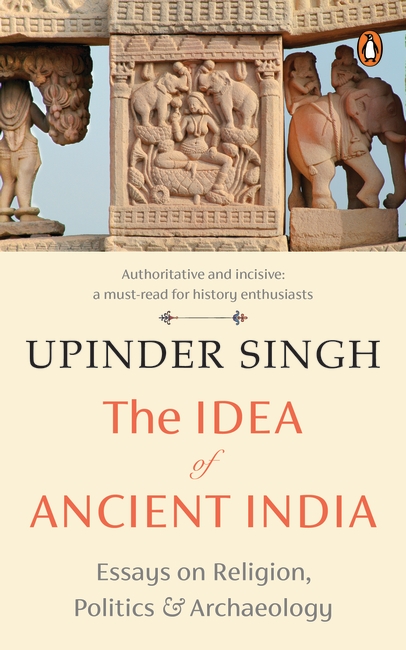
How can the complexities of ancient India be comprehended?
This book draws on a vast array of texts, inscriptions, archaeology, archival sources and art to delve into themes such as the history of regions and religions, archaeologists and the modern histories of ancient sites, the interface between political ideas and practice, violence and resistance, and the interactions between the Indian subcontinent and the wider world. It highlights recent approaches and challenges in reconstructing South Asia’s early history, and in doing so, brings out the exciting complexities of ancient India.
Authoritative and incisive, this revised Penguin edition-with two new chapters-is essential reading for students and scholars of ancient Indian history and for all those interested in India’s past.

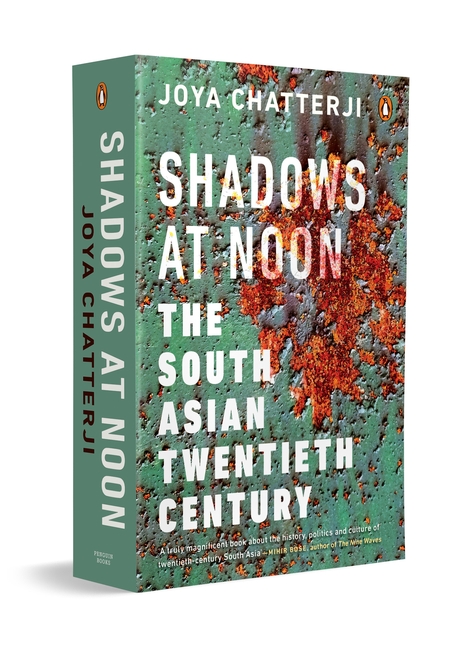
Shadows at Noon is an ambitious synthesis of decades of research and scholarship which explores the key strands of South Asian history in the twentieth century with clarity and authority. Unlike other narrative histories of the subcontinent that concentrate exclusively on politics, here food, leisure and the household are given equal importance to discussions of nationhood, the development of the state and patterns of migration.
While it tells the subcontinent’s story from the British Raj to independence and partition and on to the forging of the modern nations of India, Pakistan and Bangladesh, the book’s structure is thematic rather than chronological. Each of the chapters illuminates on overarching theme or sphere that has shaped South Asia over the course of the century. This format allows the reader to explore particular issues – such as the changing character of nationalism or food consumption – over time and in depth.
Shadows at Noon is a bold, innovative and personal work that pushes back against standard narratives of ‘inherent’ differences between India, Pakistan and Bangladesh. Its purpose is to make contemporary South Asia intelligible to readers who are fascinated by the subcontinent’s cultural vibrancy and diversity but are often perplexed by its social and political make-up. And it illuminates the many aspects that its people have in common rather than what divides them.

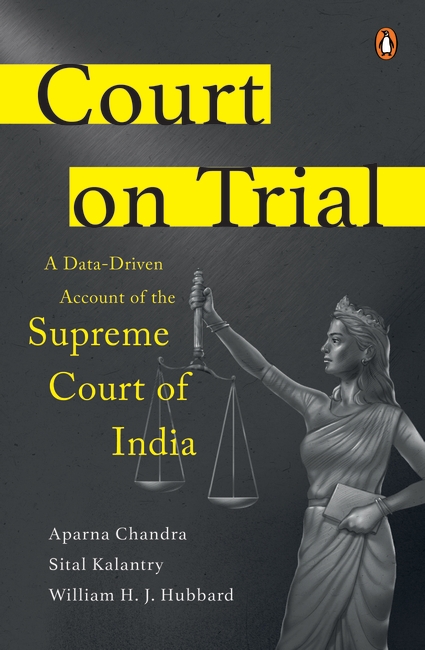
The Indian Supreme Court was established nearly seventy-five years ago as a core part of India’s constitutional project. Does the Court live up to the ideals of justice imagined by the framers of the Indian Constitution? Critics of the Supreme Court point out that it takes too long to adjudicate cases, a select group of senior advocates exercise disproportionate influence on the outcome of cases, the Chief Justice of India strategically assigns cases with an eye to outcome, and the self-appointments process-known as the collegium-is just another ‘old boy’s network’. Building on nearly a decade of original empirical research, this book examines these and other controversies plaguing the Supreme Court today. The authors provide an overview of the Supreme Court and its processes which are often shrouded in mystery, and present data-driven suggestions for improving the effectiveness and integrity of the Court.
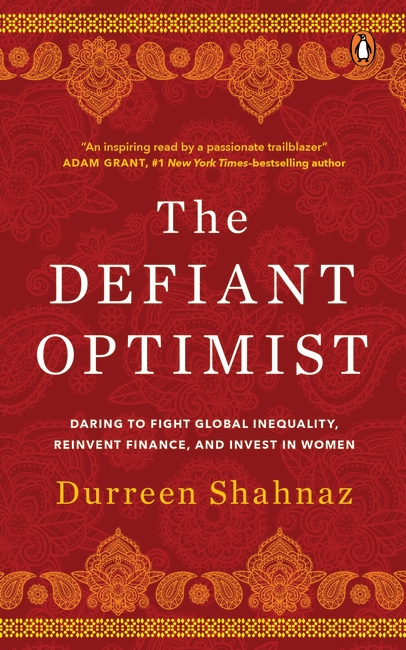
Global inequality is growing. Financial markets disenfranchise women, the 99 percent, and the planet itself. But what if we found the source of power and turned it inside out? What if we made the tools of the system available to all?
When she launched the world’s first stock exchange for social enterprises, Durreen Shahnaz started more than a new financial system; she sparked a movement. Defiant optimism-the stubborn belief that systems that enrich the few can be transformed for the good of the many-requires an indomitable spirit. In these pages, Shahnaz illuminates what investing in those excluded from networks of power and opportunity requires.
From growing up with constrained life chances, to working as the first Bangladeshi woman on Wall Street, to becoming a global leader in impact investing, Shahnaz takes us on a mesmerizing trek of innovation, compassion, and enterprise. We accompany her to villages in Bangladesh where she helps women entrepreneurs learn to proudly sign their names, and on visits to venture capitalists who walk past her to shake her male employees’ hands. We go to a garment factory where women labour for low wages, and to a town in India where microfinance offers women enough capital to run grocery stores and tailor shops. Along the way, the birth of her two daughters only fuels her relentless pursuit of a world where girls are valued. Finally, armed with financial backers and a plan, Shahnaz successfully launches the Women’s Livelihood Bond™ Series, the world’s first tradable financial product for investing in underserved women’s livelihoods.
Changing how systems work-and who they work for-isn’t for the faint of heart. But The Defiant Optimist offers strategies for placing women, the underserved, and the planet at the heart of systems. Together we can locate the levers of power and pull them defiantly in a new direction.