



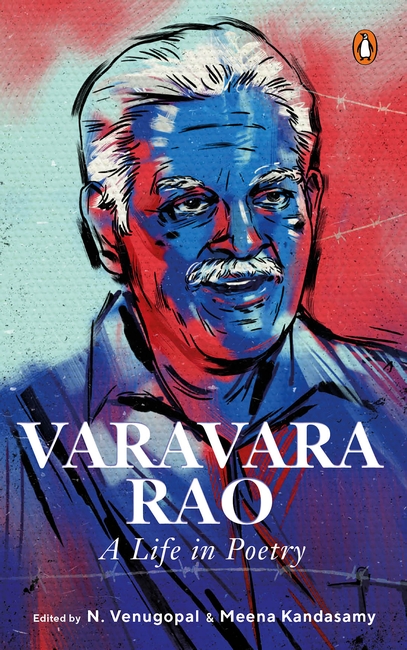
Varavara Rao: A Life in Poetry is the first-ever collection in English of poems by the Telugu poet, selected and translated from sixteen books that he has published. Having begun to write poetry in his early teens, Varavara Rao, now in his early eighties, continues to be a doyen of Telugu modern poets.
He was a consistent comrade-in-letters to all the social movements from the 1960s to the 2010s, and this volume is a capsule of momentous social history captured in his
poetic imagination.
The poems in the collection offer an artistic blend of tender response and thoughtful reaction to social realities, as well as an explosion of powerful emotions from a voice
sought to be subdued. Varavara Rao’s poetry, more than anything else, is an offering of solidarity to the voiceless, the underdog and the oppressed.
Catagory: Politics
A White Trail
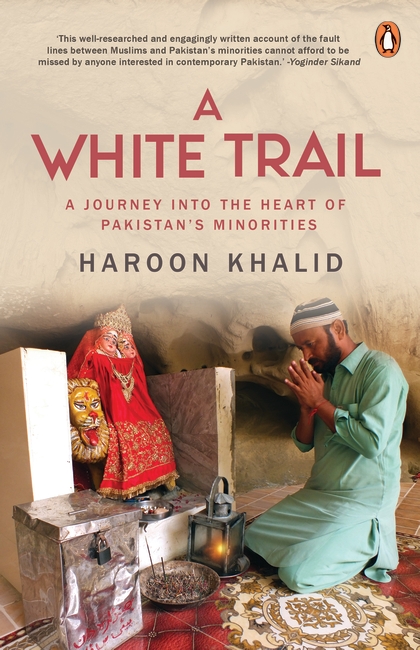
A travelogue and an ethnographic study that builds upon hundreds of oral testimonies, A White Trail tells the stories of the complex lived-realities of religious minorities in Pakistan-stories of their triumphs, insecurities, aspirations, marginalization and resilience. The book tells the tale of a group of young Hindu boys who came together to revive their festivals after decades of hidden celebrations. It narrates the story of the Sikh community in Nankana and how it began carving out an identity in a Muslim-dominated city. And it explores how the Christian community expresses its religious identity in a local, South-Asian flavour.
A White Trail is a journey through the different festivals of the five religious minorities of Pakistan, narrating the lives of the different communities in their own words. It reveals what it means to celebrate religious festivals under the shadow of rising intolerance, structural persecution and increased cases of religious violence.
Sovereigns of the Sea
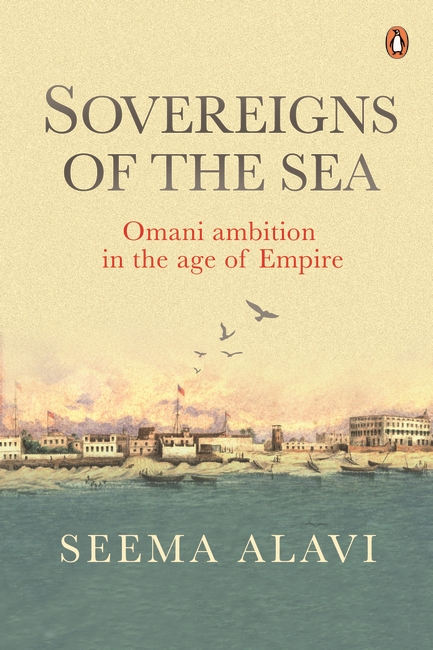
This definitive book on the Sultans of Oman is a thrilling historical account of their action-packed battles, daring expeditions, epic triumphs and ingenious politics in the long nineteenth century. It puts the optic of ‘micro-history’ on their fascinating lives as they navigated the geopolitics of their time and propelled the politics of the Western Indian Ocean. It offers a comprehensive and in-depth examination of the ambitions of the Omani patriarch Sultan Sayyid Said and his four sons and shows how integral they were to the political culture of the region.
Keeping a sensitive finger on the specific temporal and spatial moments in the maritime space that they navigated, it explores their key role in shaping the politics of the Ocean and nurturing the Omani Sultanate on their terms. The groundbreaking narrative sheds light on the role of the Sultans as agents of change, challenging the Eurocentric narrative that views the Indian Ocean as framed in the history of western imperialism and capitalism alone.
In addition to its academic rigour, the book is easy to read and engaging, making it an ideal resource for students, scholars and anyone with an interest in the history of the Indian Ocean, the Middle East and South Asia. Its fresh perspective and insightful analysis make it an invaluable contribution to the fast-growing field of Indian Ocean Studies.
The Quest for Modern Assam: A History
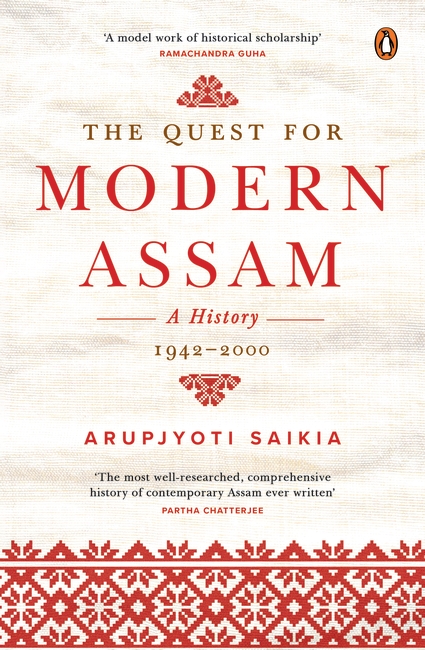
‘A model work of historical scholarship’-Ramachandra Guha
‘The most well-researched, comprehensive history of contemporary Assam ever written’-Partha Chatterjee
The crucial battles of World War II fought in India’s north-east-followed soon after by Independence and Partition-had a critical impact on the making of modern Assam. In the three decades following 1947, the state of Assam underwent massive political turmoil, geographical instability, and social and demographic upheaval, among others. Later, the truncated state suffered widespread unrest as various groups believed their cultural identity and political leverage were under threat. New social energies and political forces were unleashed and came to the fore.
Definitive, comprehensive and unputdownable, The Quest for Modern Assam explores the interconnected layers of political, environmental, economic and cultural processes that shaped the development of Assam since the 1940s. It offers an authoritative account that sets new standards in the writing of regional political history. Not to be missed by any one keen on Assam, India, Asia or world history in the twentieth century.
A New Idea of India
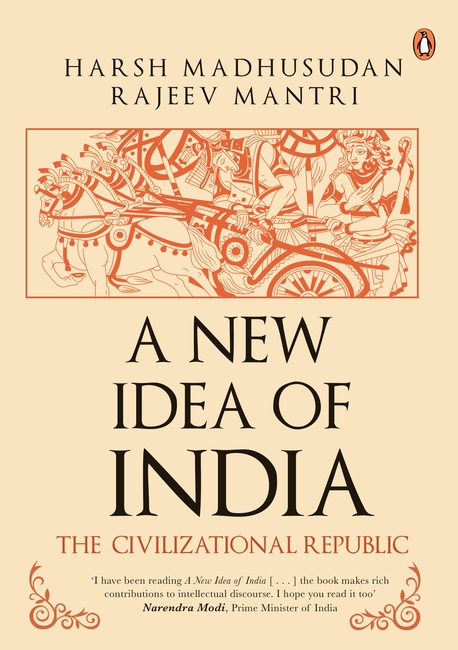
For the better part of seven decades after independence, the Nehruvian idea of India held sway in India’s polity, even if it was not always in consonance with the views of Jawaharlal Nehru himself. Three key features constituted the crux of the Nehruvian way: socialism, which in practice devolved to corruption and stagnation; secularism, which boxed citizens into group membership and diluted individual identity; and non-alignment, which effectively placed India in the Communist camp.
In the early Nineties, India began a gradual withdrawal from this path. But it was only in 2019, with Narendra Modi’s second successive win in the general elections, that this philosophy is finally being replaced by a worldview that acknowledges India as an ancient civilization, even if a young republic, and that sees citizens as equal for developmental and other purposes.
A New Idea of India constructs and expounds on a new framework beyond the rough and tumble of partisan politics. Lucid in its laying out of ideas and policies while taking a novel position, this book is illuminated by years of research and the authors’ first-hand experiences, as citizens, entrepreneurs and investors, of the vagaries and challenges of India. This revised edition builds on some of the arguments of the earlier edition and brings things up-to-date.
In Pursuit of Peace
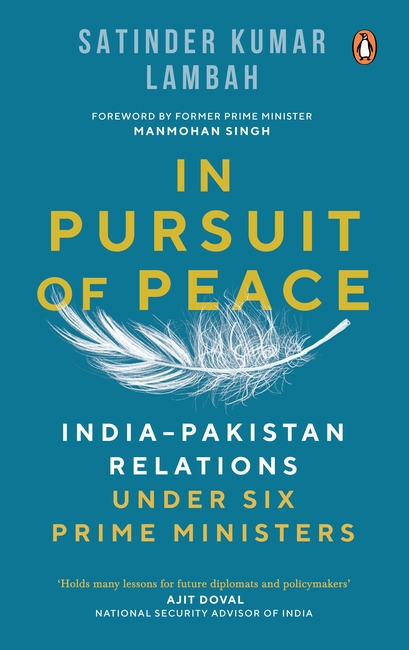
No relationship has been as complex and so difficult to manage as India’s relations with Pakistan. Four wars, cross-border terrorism, and Pakistan’s persistent hostility and relentless campaign on “Kashmir issue” have been a source of strategic challenge for every Indian leader. Yet, each has pursued peace in the interest of India’s progress and security with differing strategies, but with the same result.
As a diplomat who served around the world and in Pakistan, the late Satinder Kumar Lambah’s unique position helps tell an insider’s story of the turbulent history between India and Pakistan. He writes of his personal experiences of India-Pakistan relations having served six Indian Prime Ministers, whom he worked directly with and offered counsel. This includes his role as Prime Minister’s Special Envoy for back-channel talks under PM Manmohan Singh and India’s quick diplomatic moves in the post-Taliban Afghanistan. With insight, he also traces the roots of Pakistan’s evolution since its birth and the challenges its army-driven polity poses for India and reflects on the way forward in dealing with Pakistan to secure peace in the region.
The Nitopadesha

In the distant land of Gandhara, there once was a janapada called Chakrapuri. Its elders were a worried lot. Their children were uninterested in the welfare and upkeep of the janapada. Most of them were consumed by self-interest and avarice, seeking personal gains, even at the cost of their fellow citizens. Realizing that the young must learn the arts and crafts of citizenship, the Sabha of Chakrapuri decided to employ Nitina of Takshashila, whose wisdom was said to be unparalleled, to teach their children. So it came to pass that the unconventional scholar was entrusted with the charge of these boys and girls for the next ninety days.
Thus begins the Nitopadesha. A labyrinth of stories in the style of the Panchatantra and the Jataka tales, this is a book about good citizenship and citizen-craft that will speak to the modern reader. Covering aspects such as what citizenship means, the ethical dilemmas one faces as a citizen and how one can deal with social issues, Nitin Pai’s absorbing translation is an essential read for conscientious citizens of all ages.
Panjab
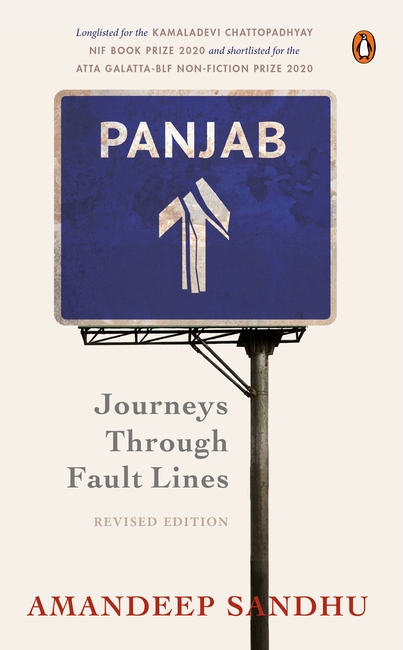
Unlike people born in Panjab who have a direct connection with, and hence a memory of the land, I have no liminal or tangible marker of belonging to Panjab. While my family did hail from Panjab, I was neither born here, nor do I live here. I have no address, bank statement, Aadhaar card, passport or land ownership to prove my connection with Panjab.
In 2015, Amandeep Sandhu began an investigation that was meant to resolve the ‘hole in his heart’, his ’emptiness about matters Panjab’. For three years, he crisscrossed the state and discovered a land that was nothing like the one he had imagined and not like the stories he had heard.
Present-day Panjab prides itself on legends of its military and valorous past even as it struggles with daily horrors. The Green Revolution has wreaked ecological havoc in the state, and a decade and a half of militancy has destabilised its economy and governance. Sikhism-the state’s eclectic and syncretic religion- is in crisis, its gatekeepers brooking no dissent and giving little spiritual guidance. And Panjab has yet to recover from the loss of its other half, now in Pakistan.
This revised edition includes a chapter on the 2020-21 farmers’ struggle which proved beyond doubt that the old spirit of the land with its undercurrent of resistance to power and hegemony still beats away. The hope that Panjab’s unyielding knots can be untied continues to linger.
Kitne Ghazi Aaye, Kitne Ghazi Gaye
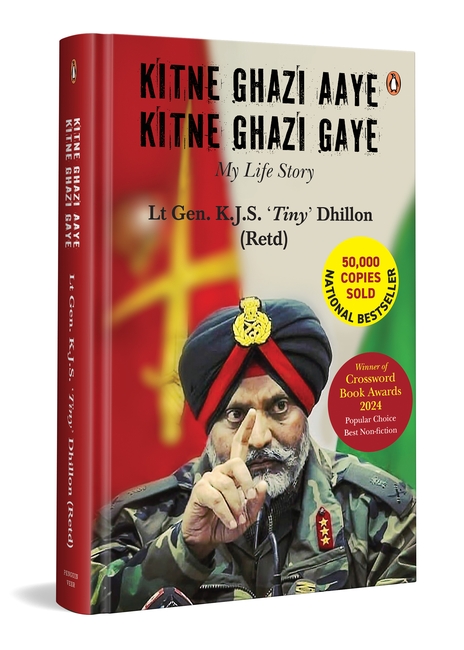
Lieutenant General K.J.S. ‘Tiny’ Dhillon, an Infantry veteran from the Rajputana Rifles with about four decades of military service, has served multiple tenures in Kashmir.
In this book, ‘Tiny’ Dhillon opens a hitherto-closed window, not only to his life but also to Kashmir. He recounts fascinating tales about the toughest challenges he encountered, from age three right up to those from his multiple tenures in Kashmir from 1988 to 2020, where it was his responsibility to maintain a balance between counter-terrorism operations on the one hand and to use military soft power on the other. Dhillon retraces his entire journey, from being a young boy to becoming the Commander of the Chinar Corps, with Kashmir as an inseparable part of this story.
As a first-hand account, the book touches on and demystifies the myths, half-truths, whats, ifs and whys of the exodus of the Kashmiri Pandits; the barbarous attack on an Indian security convoy in Pulwama district, in which forty CRPF personnel were killed; the Balakot air strikes; and the abrogation of Article 370 and its impact on the socio-political, economic and law-and-order situation, among other incidents. It takes us behind the scenes to bring out the nuances of various intriguing developments at a critical juncture in the history of J&K.
Anecdotal, candid and evocative, Kitne Ghazi Aaye, Kitne Ghazi Gaye brings to light the true stories from this Army veteran’s life. It focuses on the personal, professional and, most importantly, family life of a soldier in the Army, and will not only provide an insight into the trials and tribulations he faced but will also inspire a wide spectrum of readers, especially young defence aspirants.
Find Tiny Dhillon online:
Twitter: @Tiny_Dhillon
Instagram: @tinydhillon
Facebook: @TinyDhillon
Grasping Greatness
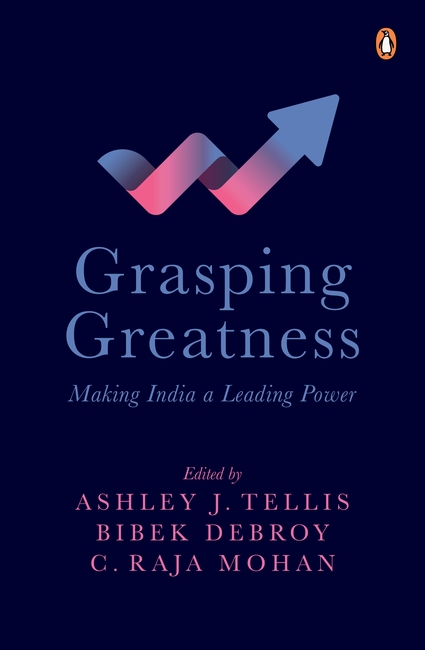
Since its independence in 1947, India’s leaders have sought to grasp the greatness that the country seemed destined for. India’s first prime minister, Jawaharlal Nehru, articulated these aspirations early on but, overwhelmed by development challenges, his successors focused largely on domestic concerns rather than on global leadership. The post-1991 era saw India positioned for the first time in many decades as an economic success, suggesting that it was on the cusp of breaking out as a global player.
The twenty-odd years following the 1991 reforms were heady for India. Based on the expectation that India was now poised to ascend as a major power, Prime Minister Narendra Modi-less than a year after he first took office in May 2014-expressed his desire that India assume a leading role: completing the transformation from being merely an influential entity into one whose weight and preferences are defining for international politics.
Grasping Greatness explores the various tasks pertaining to this push for eminence in world affairs. It elaborates the economic, state-building, and international dimensions of this ambition. Eminent thinkers like Rakesh Mohan, Ila Patnaik, Surjit Bhalla, Arjun Subramanian, and others reflect upon the tasks at hand and the desirable routes to achieve them.
Edited by Ashley J. Tellis, Bibek Debroy and C. Raja Mohan, Grasping Greatness is an important contribution to the intellectual debates as India enters into a new era on the world stage.