



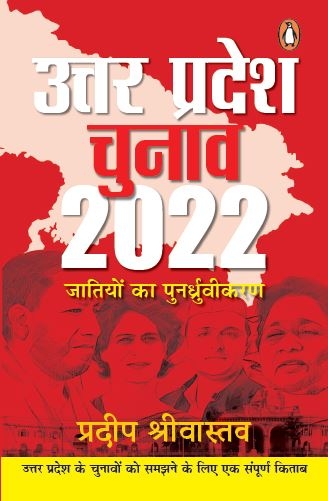
It is said that road to India’s power corridor runs through Uttar Pradesh, the most populous state of the country which sends eighty MPs to the lower house of the Parliament. Till date, most of the Prime Ministers of India belonged to this state and an electoral win in the state assembly paves the way for the formation of a central government.
The question is, do we have a barometer to guess the political pulse of the people? What are the political trends in the state? Which are the political, social, and economic factors that affect those trends?
Would extreme backward castes (EBCs) be successful in getting direct share in the power structure, which has been a dream so far for them?
This book written by veteran journalist Pradeep Srivastava tries to find out answers to these questions with in-depth analysis and in an easy to understand language.
Catagory: Politics
Soli Sorabjee
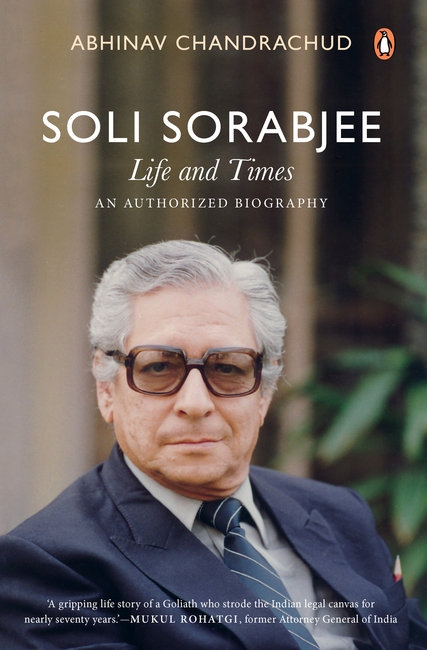
The first authorized biography of Soli Sorabjee
‘A gripping life story of a Goliath who strode the Indian legal canvass for nearly seventy years.’ – Mukul Rohatgi, former Attorney General of India
‘Superbly researched, this book by Abhinav Chandrachud is a must read. ‘ – Madhavi Goradia Divan, Additional Solicitor General in the Supreme Court of India
How does a Parsi lawyer, deeply influenced by the principles of Roman Catholicism, fall in love with a Bahá’í and go on to become the Attorney General of India for a Hindu nationalist BJP government? How does a boy with a broken leg, who studied in a Gujarati-medium school, and lost his father at the age of nineteen, go on to mount a heroic defense of the Janata government’s decision to dissolve Congress state legislatures (in 1977) in the Supreme Court? How does a newspaper columnist who admires Nehru, who criticizes the BJP for being ‘obsessed’ with ‘demolishing mosques’ and advises them to replace ‘Hindutva’ with ‘Bharatva’ or ‘Indianness’, get chosen by Prime Minister Vajpayee to represent the government in the Supreme Court in many cases, including the Ayodhya case? How does a lawyer with a humdrum customs and excise law practice, whose grandfather sold horsedrawn carriages in Bombay, become a U.N. human rights rapporteur, and repeatedly defend the fundamental right to free speech and expression in the Supreme Court of India?
Definitive, comprehensive and absolutely unputdownable, this first biography of Soli Sorabjee opens a window into the life and times of one of India’s foremost constitutional experts.
Planning Democracy
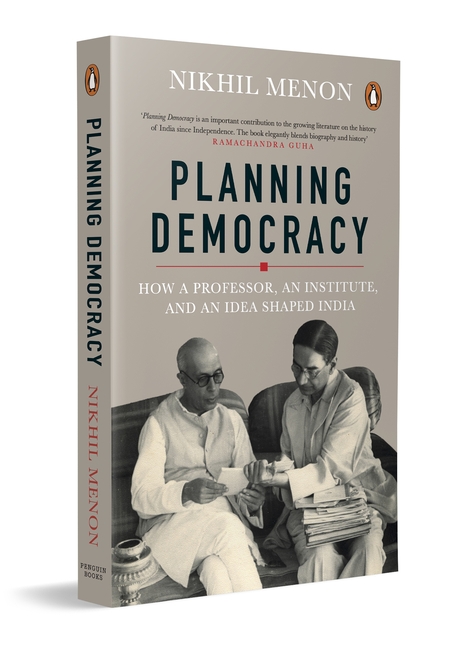
India’s Five-Year Plans were one of the developing world’s most ambitious experiments. After nearly two centuries of colonial rule, planning the economy was meant to be independent India’s route from poverty to prosperity. Planning Democracy explores how India married liberal democracy to a socialist economy. Planning not only built India’s data systems, it even shaped the nature of its democracy. The Five-Year Plans loomed so large that they linked surprisingly far-flung contexts-from computers to Bollywood to Hindutva.
In this compelling history, Nikhil Menon brings the world of planning to life through the intriguing story of a gifted scientist known as the Professor, a trail-blazing research institute in Calcutta, and the alluring idea of ‘democratic planning’. Set amidst global conflicts and international debates, Menon reveals how India walked a tightrope between capitalism and communism. Planning Democracy recasts our understanding of the Indian republic, uncovering how planning came to define the nation and revealing the ways in which it continues to shape our world today
The Rise of the BJP
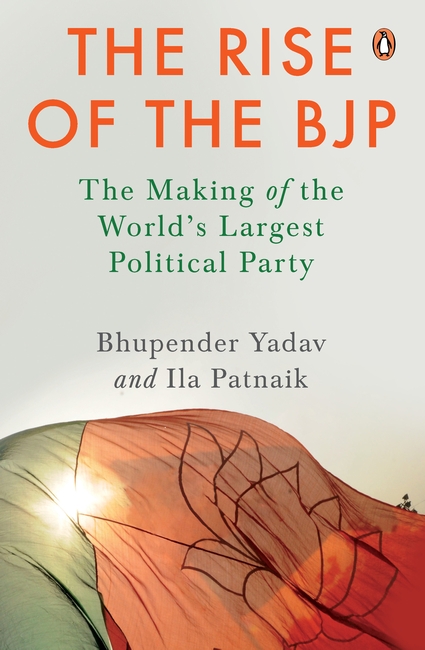
The Bharatiya Janata Party is an idea that was seeded into the minds of nationalist Jana Sangh leaders when they began to envision India after Independence. Much like the very core the freedom struggle was built on, they saw India as a demographically, culturally and historically cohesive and unified nation – as Bharat.
In this book, senior BJP leader and cabinet minister Bhupender Yadav and leading economist Ila Patnaik come together to trace the BJP’s journey from its humble roots, through ups and downs and to eventually getting 303 seats in Lok Sabha in 2019 and becoming the world’s largest political party. While focusing on the larger economics and political story, the book encapsulates many smaller, yet hugely significant stories of individuals and incidents, which brought the BJP to where it stands now.
For the first time ever, The Rise of the BJP, tells us the inside story of how one of the most powerful political parties makes decisions, implements ideas and executes policy. Meticulously researched and immensely readable, the book shows us how the BJP fought competing ideologies, political assaults and catapulted to the centre stage of national politics.
Dada Comrade

‘This fine translation has once again returned Yashpal’s story to that fraught arena where every warrior appears exhausted today’-Ravish Kumar
‘A daring and unusual novel’-Vasudha Dalmia
‘A remarkable contribution to literary translation in English’-Apoorvanand
Harish, a young revolutionary in pre-Independence Lahore, upsets his party by questioning its credo of underground armed resistance. Escaping the party’s wrath, he becomes a labour activist, but is soon framed by the British government. Meanwhile, Shailbala, his comrade and lover, must take a decision about her pregnancy. As she courageously defies social norms and stands up to her influential father, can she find an ally within the revolutionary party-with Dada–Harish’s erstwhile mentor and antagonist–as its autocratic leader?
Yashpal’s first and semi-autobiographical novel, Dada Comrade is considered the pioneering political novel of Hindi literature. It raises questions about freedom and equality, as well as about sexuality and marriage-subjects as urgent today as in those times. In this first-ever English translation, Simona Sawhney brilliantly captures the force and intensity of the original, which had heralded the arrival of a literary genius.
The Tiger’s Pause
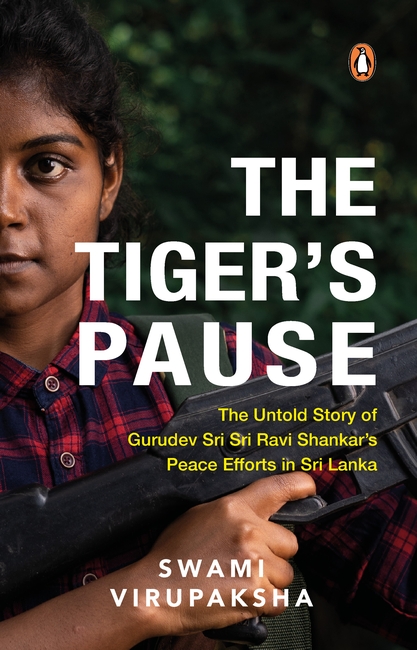
As the fourth phase of the twenty-six-year-long civil war in Sri Lanka was about to begin, Gurudev Sri Sri Ravi Shankar, founder of the Art of Living, visited the island nation with a singular aim: to bring peace to its citizens while trying to mediate between Prabhakaran, leader of the Liberation Tigers of Tamil Eelam (LTTE), and the government. The Tiger’s Pause chronicles Gurudev’s time in a highly strung country and also offers an exclusive look into the final chapters of Sri Lanka’s deadly conflict.
Swami Virupaksha, who spent nine years in the country expounding the Art of Living courses and organizing Gurudev’s visits, expertly charts the enormous hope of the Tamil and Sinhalese people against overwhelming misery. In prose that is both concise and empathetic, Swami Virupaksha gives readers a sweeping view of Gurudev’s endeavours towards a ceasefire agreement, and the ups and downs of a country’s quest for peace. The Tiger’s Pause is the narrative of the Sri Lankan people, and gives us a sense of what it takes to understand and address a shared trauma.
Destiny’s Child
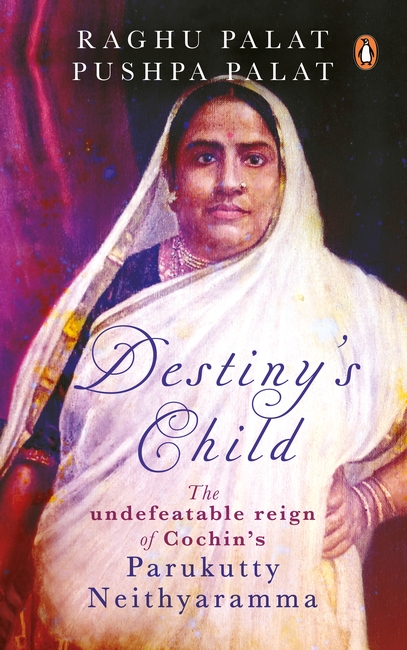
This is an intimate account of the extraordinary life of Parukutty Nethyaramma, who went on to become one of the most powerful rulers of the Kingdom of Cochin.
At the tender age of fourteen, her marriage thrust her into a hostile world. Taking on her detractors, Parukutty stubbornly and fearlessly forged ahead to become a voice none could gainsay. Despite a seventeen-year age gap, she had built a special, unshakable bond with her husband. When he was crowned the sovereign ruler of Cochin, she vowed to support and protect his position throughout her life. Theirs was an enviable partnership of two incredible equals who together went on to break many traditional norms. At a time when women were relegated to the shadows, Parukutty travelled with her husband, participated in important discussions, and even went on to rule as his proxy. She became a force to be reckoned with in her own right.
Unafraid to break norms, she often floated radical reforms that, though lauded by the citizens, riled the conservative and powerful elite. Parukutty deployed her sharp wit, acumen and diplomacy to stand up to a host of adversaries and naysayers, including the British, who choreographed intricate manoeuvres to overthrow the royal family.
Narrated by Parukutty’s own great-grandson and his wife, Raghu and Pushpa Palat, this deeply personal chronicle paints a vivid picture of a woefully understated icon from the twentieth century.
Let Me Hijack Your Mind
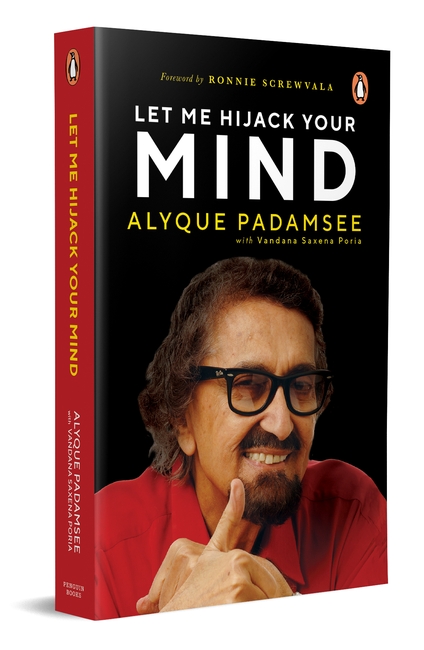
In this one-of-its-kind book by the late Alyque Padamsee, he invites us to re-examine and think afresh about some of our most deeply held beliefs, from love, marriage, terrorism, leadership, money, gender, faith to education. Let Me Hijack Your Mind is Alyque’s parting gift to Indians, exhorting them to throw out the old and embrace new ways of approaching everything, which will lead them towards a more exciting and contented life-and a better society and country. It is a way to open windows in their mind to think about life aside from greed, power and money. This is a book designed to throw everyone off-balance in a good way, because it is crammed with fresh ideas on how to live, how to dream and how to completely reset our mindset and attitudes. As Alyque says in his inimitable style: ‘Get people out of stuffy thinking.’
Some of the provocative questions he asks are:
– Why should marriage be ’till death do us part’?
– Why are terrorists breaking the law of their very own holy books?
– Why are multinational companies obsessed with GNP (Gross National Product) instead of GNH (Gross National Happiness)?
– Why do men fear women? And why do women hate themselves?
A fun, racy and often shocking read, the book busts some of the most well-known taboos, includes life hacks drawing on his experiences in advertising and theatre, as well as new ‘commandments’ for the present generation.
The Communist Manifesto (PREMIUM PAPERBACK, PENGUIN INDIA)
One of the most influential and widely read political documents, The Communist Manifesto deep dives into the nature and politics of society. History is nothing but a series of class struggles between the haves (the bourgeoisie) and the have-nots (the proletariats). Envisioning a revolution by the ‘workers of the world’ that will overthrow Capitalism, it speaks of a society free of private ownership and control, where everyone is free.
Now with seven rarely published prefaces, this edition of The Communist Manifesto encapsulates the theory of Marxism, as penned by German philosophers and political theorists, Karl Marx and Friedrich Engels. Lucid, potent, and above all eye-opening, The Communist Manifesto will change the way you see and understand the world.
The Common Man in India
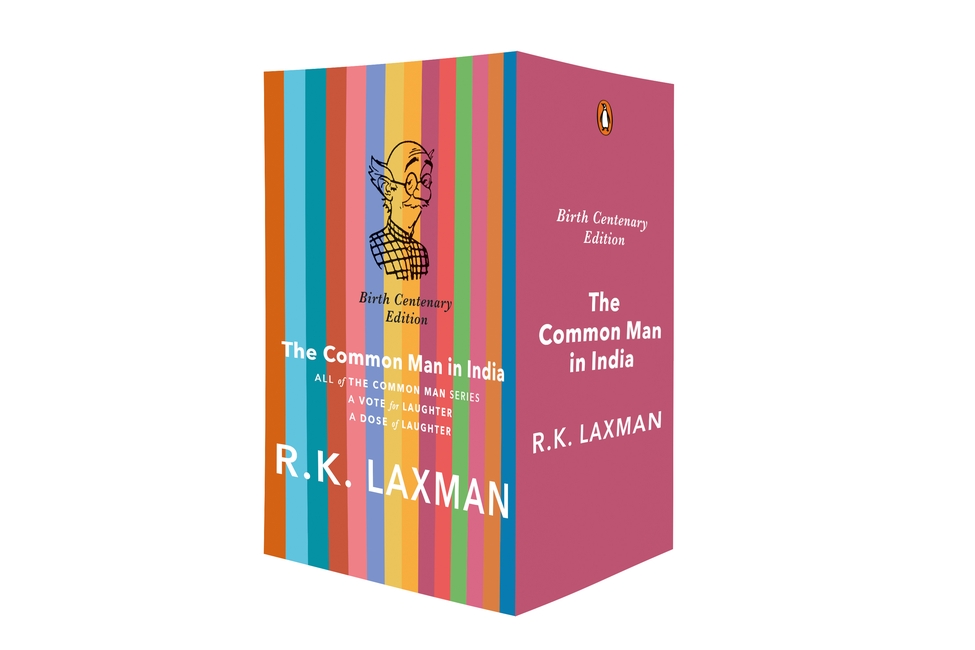
Combined Box Set of R.K. Laxman’s best cartoons: the perfect gift for anyone who loves a good laugh
Includes the entire Common Man Series, A Vote for Laughter and A Dose of Laughter
In his Birth Centenary year, this box set presents all of Laxman’s Common Man cartoons, and some of the best on India’s politics and society.