From the bestselling author of The Accidental Prime Minister, here comes an insightful analysis of Indian politics and elitism that answers many important political questions today.
India’s Power Elite is a study of the nature of power and elitism in postcolonial India. Its point of departure is the political transition under way in twenty-first-century India, with the marginalization of the Congress Party and the staging of a cultural revolution symbolized by the rise of Hindu majoritarianism. Baru deconstructs the morphology of the Indian power elite-comprising remnants of a feudal gentry, kulaks, a metropolitan business class, the civil services and a cultural elite of opinion-makers. He also examines the role of caste, class and culture in the emergence of a ‘New India’. Aimed at the socially engaged reader, this book will interest both students as well as those who wield power.
The main target readership for this book includes socially engaged readers, people interested in politics, activism, students, etc.

Tracing India’s approach to the shifting regional landscape since its independence in 1947 to the Modi era, Shivshankar Menon addresses the many questions, which perplex India as the nation seeks to find its way in the increasingly complex world of Asian geopolitics. From its leading role in the ‘nonaligned’ movement during the Cold War to its current status as a perceived counterweight to China, India often has been an after-thought for global leaders-until they realize how much they needed it.
Examining India’s own policy choices throughout its history, Menon focuses in particular on its responses to the rise of China, as well as other regional powers. He also looks to the future and analyses how India’s policies are likely to evolve in response to current and new challenges. As India gains new stature across the globe, both its domestic preoccupations and international choices become more significant.
Authoritative, comprehensive and deeply engaging, in India and Asian Geopolitics Menon makes a powerful geopolitical case for an India increasingly and positively engaged in Asia and the broader world in pursuit of a pluralistic, open, and inclusive world order.
The book is a must have for the students and scholars of international relations, India and Asian geopolitics, Indian history and political science. Besides, it will attract policymakers, diplomats, politicians and general readers.
(Pages 23, 93 and 95 intentionally left blank)

“Unconstrained, unlike a historian, the fiction writer Khan Mahboob Tarzi invents a moment in the history of 1857 and imbues it with high romance and action.”-Rita Kothari, translator, writer, and professor of English, Ashoka University
“[The 1857] rebellion has been the subject of scholarly attention and debate, but the events have not drawn too much literary attention in terms of novels, plays, etc. It is thus good to read this novel and to have it in translation.”-Rudrangshu Mukherjee, chancellor and professor of history, Ashoka University
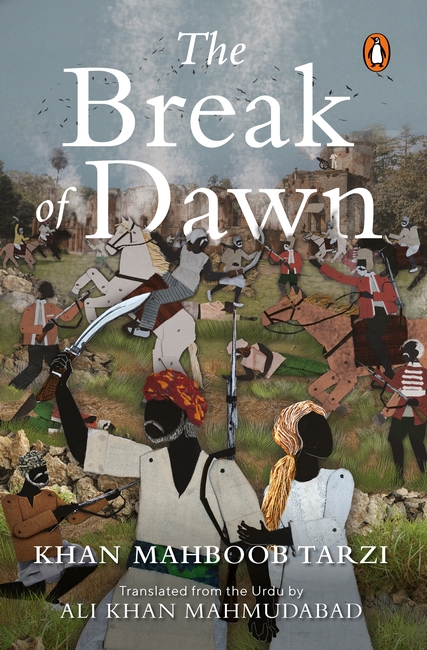
-A thriller and romance set amidst the raging battle to free India of the British in 1857.
-Brings into focus the lesser-known popular literature in Urdu around the 1857 mutiny.
-The translator, Prof. Ali Khan Mahmudabad, was led to the book out of personal interest, as it includes an account of the erstwhile Mahmudabad royal family’s role in the 1857 revolt.
-Introduces readers to Khan Mahboob Tarzi, a prolific author who wrote over a hundred novels on history, politics, science-fiction, romance and erotica.
It is the searing month of June. The rebellion against the British has just begun and Awadh is up in flames. Hindus and Muslims have joined hands to overthrow the foreign rulers and set India free. Some Indian rulers have started to enter into alliances to fight the firangis, while others have thrown in their lot with the foreigners. Amid all this, Riyaz Khan, a young soldier from the army of the Raja of Mahmudabad, saves a group of Britishers from fellow ‘mutineers’ and escorts them to the safety of Lucknow. In this group is Alice, who falls in love with Riyaz and eventually becomes an informer for the rebels.
The Break of Dawn, originally published in Urdu under the title Aghaaz-e-Sahar, is a thrilling page-turner and a reminder of a time when Indians of all classes and creeds came together to fight for the honour and freedom of their homeland.
The world was last designed seventy-five years ago, about the same time that Sam Pitroda was born. This design has outlived its utility. Hyperconnectivity and the COVID-19 pandemic offer a unique opportunity to redesign the world to take humanity to the next level.
Redesigning the world is not about looking at it from the point of view of liberal or conservative; left or right; capitalism or socialism; public or private; democracy, dictatorship or monarchy; open or closed systems; rich or poor; urban or rural; east or west; white, brown, black or yellow. This proposed redesign of the world has the planet and its people at the centre; it is built on the foundations of sustainability, inclusion, equality, equity and justice so that everyone on earth can enjoy peace and prosperity. It is not an idealist or utopian vision, but one with humanity at its core.
This book is about reshaping the world to meet the future challenges of our planet and our people.

Soon to be seen as a major motion picture Badnam Ladoo, this humorous yet inspiring story of a small-town woman’s fight against social stigma will resonate with every woman, and man
Thirty-four-year-old Ladoo, a simple middle-class divorcée from Rishikesh, wants only one thing from life–a baby. She eats gondh halwa, drinks badam milk, and takes folic acid, to slow down her ticking biological clock and become the world’s most fertile woman.
When an accidental meeting with a gynaecologist reveals that her ‘eggs are drying up’ and finding a sperm donor is her last chance of having a child, Ladoo races against time to find the right baby daddy, whose kundali matches her, while addressing her own mixed feelings about whether Mr Right Donor can also be Mr Right.
Along the way, Ladoo must figure out whether motherhood means marriage, whether being a single mother means loneliness, whether ‘my body, my rules’ applies to women, and whether doing something scandalous is outrageous or courageous.

“I echo [the authors’] siren call for urgent disruptive change that will shatter patriarchal norms”–Winnie Byanyima, Executive Director of UNAIDS
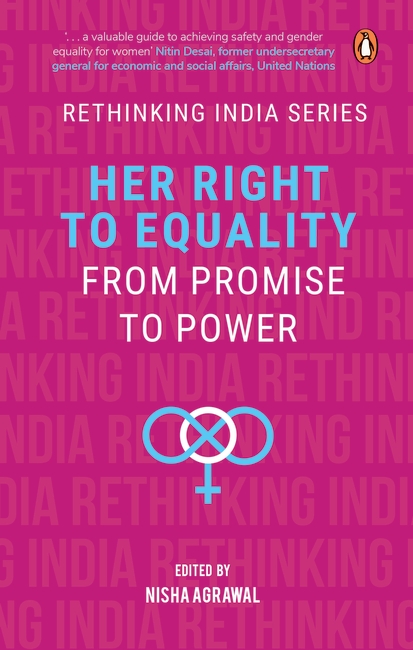
“…a valuable guide to achieving safety for women and gender equality at home and in social, political and economic life.”-Nitin Desai, former Under-Secretary General for Economic and Social Affairs, United Nations
“A must-read for anyone who believes that women in India deserve better…”-Alankrita Shrivastava, film director, Lipstick Under My Burkha
“Harvesting existent knowledge as a way of shaping the future is a valuable idea… [This book] fulfills exactly this need…”-Devaki Jain, feminist economist and author of The Brass Notebook
The sixth volume in the Rethinking India series, in collaboration with the Samruddha Bharat Foundation, looks at the reality of gender equality in the country against the promises of justice and equality made in the Constitution of India. What it finds is that even today, India remains an unequal country and that women control, at best, about 10-15 per cent of economic and political resources. While there has been progress in some areas, in many other areas there has been very little and uneven change.
One of the main reasons for this slow progress is that social norms that assign particular roles and identities to men and women are ‘sticky’ and hard to change. In India, a highly patriarchal society, these norms give very little power to women and, consequently, they have little control or influence over decisions taken within their households, in markets or in political spaces.
Challenging the status quo can cause a backlash, leading to high levels of violence against women in the domestic sphere, the workplace and in public places. If we are to see a more safe, just and equal society by 2047, a hundred years after Independence, it cannot be business as usual. Her Right to Equality argues that what we require is disruptive change through individual and collective leadership and action.
Essays by Flavia Agnes, Rajini R. Menon, Amita Pitra, Sumitra Mishra, Shubhika Sachdeva, Poonam Muttreja, Sanghamitra Singh, Swarna Rajagopalan, Ashwini Deshpande, Archana Garodia Gupta, Sushmita Dev, Kanimozhi Karunanidhi, Tara Krishnaswamy, Bina Agarwal.

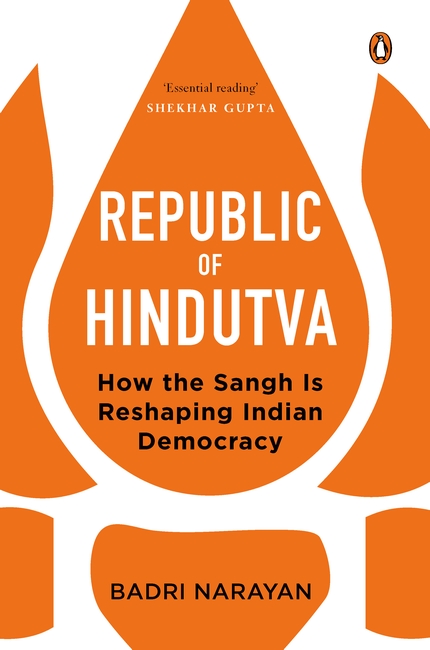
‘Essential reading’ ~ Shekhar Gupta
‘A handy insight into the activities, reach and influence of the RSS’ ~ Indian Express
‘[Yields] insights for students of Indian democracy’ ~ The Hindu
‘Very insightful and is recommended reading for both critics as well as admirers of the RSS’ ~ Financial Express
AN EXPLOSIVE ACCOUNT OF HOW THE RSS HELPS THE BJP WIN ELECTIONS
The RSS is like the tip of an iceberg, exerting its influence much beyond what is visible. Beginning with the choice of Narendra Modi as the forerunner for the 2014 general election up to the campaign for the 2019 election, RSS cadres have been a formidable force behind the staggering rise of the BJP in national politics.
In this eye-opening, necessary book, Badri Narayan offers an intimate glimpse of how the Sangh and its vast network of educational, cultural and social outfits have been digging deep roots in the Indian psyche. By refashioning its modes of mobilization as well as assimilating Dalits, OBCs, tribals and other marginalized communities, the RSS has made the Hindutva metanarrative appealing to a large section of Indians. During elections, the BJP-instead of wiping out caste from electoral politics-reaps rich political dividends from this social appropriation.
Drawing on extensive field research in the heartland of India and interviews with RSS volunteers, Narayan reveals how a new public is being forged at the grassroots, which will determine the course of Indian democracy.

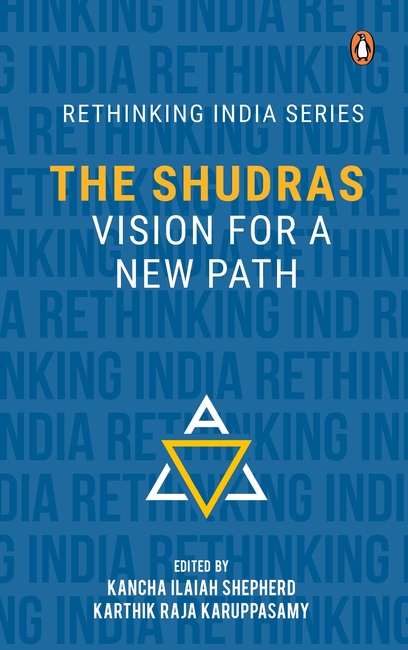
‘The Shudras echoes Dr Ambedkar’s question in Who Were the Shudras? that he asked in 1946. More than 70 years later, Kancha Ilaiah and his team of authors revisit this issue to give Shudras a voice again’ -CHRISTOPHE JAFFRELOT
The Shudras: Vision for a New Path weaves together multiple dimensions of the predicament of India’s productive castes–in the spiritual, social, political, economic, philosophical and historical spheres. It reformulates their current position as well as future pathways. It strives to provoke Shudras-including regional political party leaders-all over India to realize their unique historical role in fighting unequal caste structures. And it gives a call to resist Hindutva, in which they have no liberated, equal space with the Dwija castes. At a juncture when the Shudra castes are regionalized and the Dwijas have become ‘national’, the fifth volume of the Rethinking India series, in collaboration with the Samruddha Bharat Foundation, seeks to bring home the real picture of their marginalized status in all key structures of the nation. It posits that the emancipation and progress of the Shudras are vital to sustain Ambedkar’s constitutional democracy and move towards socio-spiritual equality.
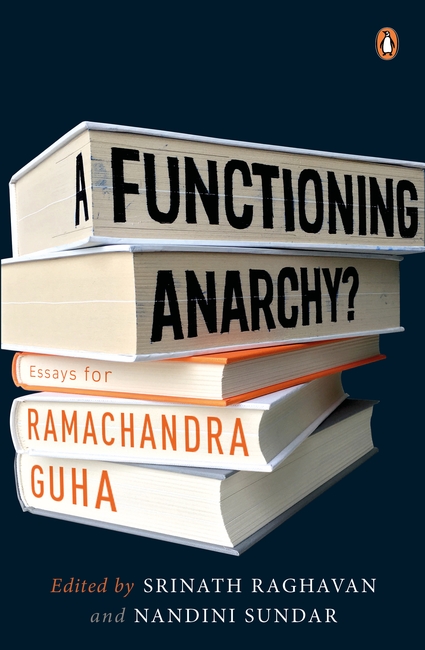
In a long and versatile career spanning thirty-five years, Ramachandra Guha has produced a vast body of work. Each time, he has broken new ground-his pioneering environmental histories of India and his still-relevant work on ecology and equity; his social histories of Indian cricket; his monumental history of the Indian republic; his biographies of Verrier Elwin and Gandhi; his anthologies of ecological, social and political thought in India; and his collections of biographical and political essays.
Sparked by Guha’s wide-ranging and important work, A Functioning Anarchy is a collection of essays by historians, social scientists, ecologists and journalists.

In recent years, India has repeatedly expressed its ambitions of becoming a global power, or ‘jagat guru’. Yet, many believe that India’s economic troubles at home are far more pressing and that foreign policy aspirations can wait. But is a proactive foreign policy really a ‘luxury’ for India, to be postponed until the economy develops; or is it, in fact, a prerequisite for economic growth in a globalized world? Why should the average Indian citizen care about foreign policy? And how can a proactive foreign policy help Indians become more prosperous? Scanning our ever-changing world from east to west, and defining India’s national interests and needs, Mohamed Zeeshan passionately argues that India needs a more coherent strategy for its relations with the outside world. Through travels and debates across continents, Zeeshan lays out a vision for how India can champion the cause of global good.