Was Savarkar really a co-conspirator in the Gandhi murder?
Was there a pogrom against a particular community after Gandhi’s assassination?
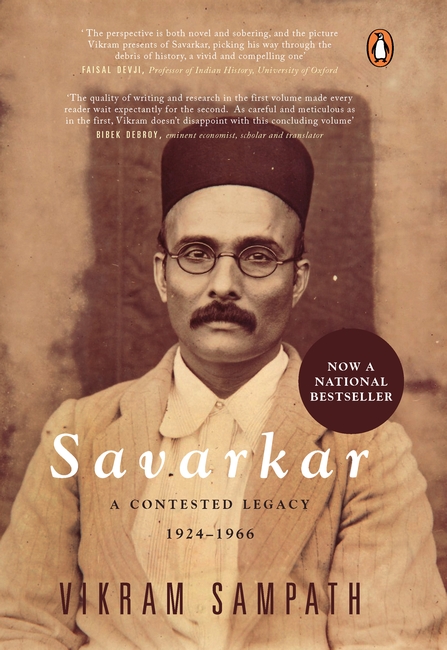
Decades after his death, Vinayak Damodar Savarkar continues to uniquely influence India’s political scenario. An optimistic advocate of Hindu-Muslim unity in his treatise on the 1857 War of Independence, what was it that transformed him into a proponent of ‘Hindutva’? A former president of the All-India Hindu Mahasabha, Savarkar was a severe critic of the Congress’s appeasement politics. After Gandhi’s murder, Savarkar was charged as a co-conspirator in the assassination. While he was acquitted by the court, Savarkar is still alleged to have played a role in Gandhi’s assassination, a topic that is often discussed and debated.
In this concluding volume of the Savarkar series, exploring a vast range of original archival documents from across India and outside it, in English and several Indian languages, historian Vikram Sampath brings to light the life and works of Vinayak Damodar Savarkar, one of the most contentious political thinkers and leaders of the twentieth century.
Savarkar is one of the most debated figures in Indian History and Indian Politics!

As a vocalist in the Karnatik tradition, T.M. Krishna eludes standard analyses. Uncommon in his rendition of music and original in his interpretation of it, Krishna is at once strong and subtle, manifestly traditional and stunningly innovative. He is searingly outspoken about issues affecting the human condition. His work is spread across the whole spectrum of music and culture, politics and the social sphere; he is at once philosophical, aesthetic and sociopolitical, and asks important questions about how art is made, performed and disseminated. Unabashedly given to rethinking classical paradigms, he addresses crucial issues of caste, class and gender with nuance and openness.
For the first time, T.M. Krishna’s key writings have been put together in this extraordinary collection. The Spirit of Enquiry: Dissent as an Art Form draws from his rich body of work, thematically divided into five key sections: art and artistes; the nation state; the theatre of secularism; savage inequalities; and in memoriam. Revised and expanded, and with marvellous new additional materials and powerful new introductions, this is a collection that reflects the critical and cultural engagement of one of our finest thinkers, public intellectuals and practitioners of art.

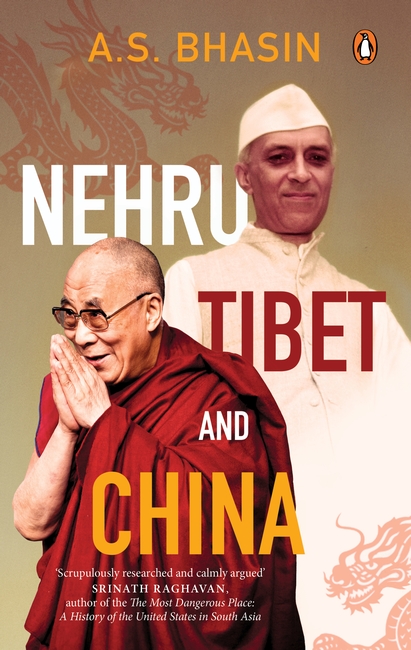
On 1 October 1949, the People’s Republic of China came into being and changed forever the course of Asian history. Power moved from the hands of the nationalist Kuomintang government to the Communist Party of China headed by Mao Tse Tung. All of a sudden, it was not only an assertive China that India had to deal with but also an increasingly complex situation in Tibet which was reeling under pressure from China.
Clearly, newly independent India, with Prime Minister Jawaharlal Nehru at its helm, was navigating very choppy waters. Its relations with China progressively deteriorated, eventually leading to the Indo-China war in 1962. Today, more than six decades after the war, we are still plagued by border disputes with China that seem to routinely grab the headlines. It leads one to question what exactly went on during those initial years of the emergence of a new China. And, more importantly, why have we repeatedly failed to arrive at a solution?
Based on years of meticulous archival research, this book in fascinating detail, analyses the events from 1949 to the Indo-China war in 1962 and its aftermath to explore the answers to these burning questions.

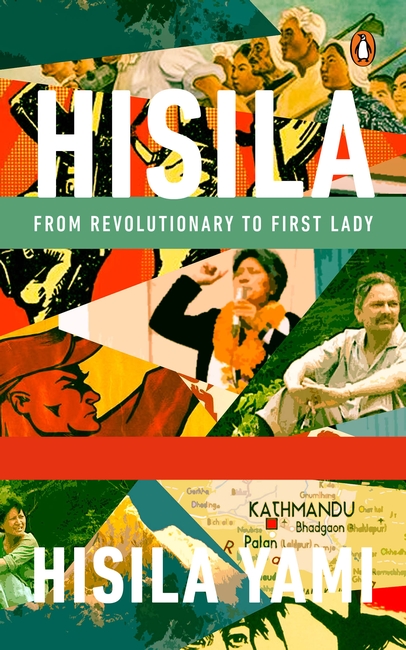
In this fascinating book, Hisila Yami traces her journey from being a young Nepali student of architecture in Delhi in the early eighties to becoming a Maoist revolutionary engaging in guerrilla warfare in Nepal. Yami was one of the two women leaders who were a part of the politburo of the Communist Party of Nepal (Maoist), which led the People’s War in the country that changed the course of its history forever.
On the one hand, this is a lucidly written political memoir, where Yami talks about gaining political awareness, joining protests, being imprisoned, participating in the People’s War, and later her experiences as the first lady and a minister. But, at the same time, this is also a vivid narrative that offers touching glimpses of her personal life. She candidly writes about falling in love and marrying a fellow politician, Baburam Bhattarai, who later went on to become the prime minister of Nepal. From how she balanced her political life with motherhood to what it really meant to be a woman in the communist party that launched a civil war, Yami tells it all in what is truly an unforgettable account of a remarkable life.

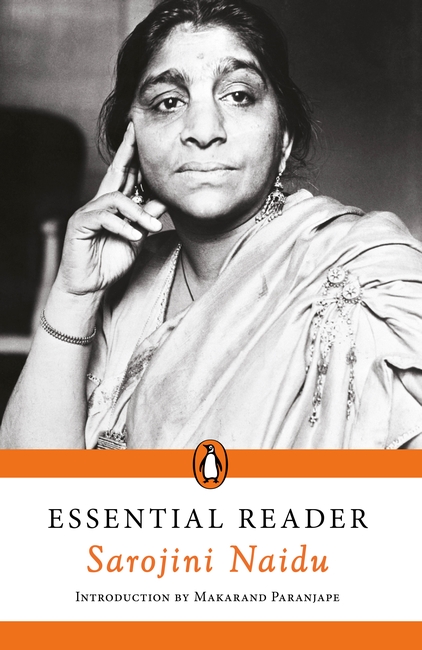
Sarojini Naidu was a prolific writer and speaker, publishing three collections of poetry during her life and delivered many rousing speeches throughout the freedom struggle and after India gained Independence. This book compiles her best-known work, as well as letters she wrote throughout her life to Mahatma Gandhi, Jawaharlal Nehru, Rabindranath Tagore and others, to provide a glimpse into the kind of person she was and the ideas she believed in.
Through these pages, we can witness her innermost thoughts and feelings, and the important role she played in shaping the country’s freedom struggle and its ideas as a young nation, particularly through rousing speeches on the Education of Indian Women and the Battle of Freedom is Over, which were broadcast over the All India Radio on 15 August 1947.

From the bestselling author of The Accidental Prime Minister, here comes an insightful analysis of Indian politics and elitism that answers many important political questions today.
India’s Power Elite is a study of the nature of power and elitism in postcolonial India. Its point of departure is the political transition under way in twenty-first-century India, with the marginalization of the Congress Party and the staging of a cultural revolution symbolized by the rise of Hindu majoritarianism. Baru deconstructs the morphology of the Indian power elite-comprising remnants of a feudal gentry, kulaks, a metropolitan business class, the civil services and a cultural elite of opinion-makers. He also examines the role of caste, class and culture in the emergence of a ‘New India’. Aimed at the socially engaged reader, this book will interest both students as well as those who wield power.
The main target readership for this book includes socially engaged readers, people interested in politics, activism, students, etc.

Tracing India’s approach to the shifting regional landscape since its independence in 1947 to the Modi era, Shivshankar Menon addresses the many questions, which perplex India as the nation seeks to find its way in the increasingly complex world of Asian geopolitics. From its leading role in the ‘nonaligned’ movement during the Cold War to its current status as a perceived counterweight to China, India often has been an after-thought for global leaders-until they realize how much they needed it.
Examining India’s own policy choices throughout its history, Menon focuses in particular on its responses to the rise of China, as well as other regional powers. He also looks to the future and analyses how India’s policies are likely to evolve in response to current and new challenges. As India gains new stature across the globe, both its domestic preoccupations and international choices become more significant.
Authoritative, comprehensive and deeply engaging, in India and Asian Geopolitics Menon makes a powerful geopolitical case for an India increasingly and positively engaged in Asia and the broader world in pursuit of a pluralistic, open, and inclusive world order.
The book is a must have for the students and scholars of international relations, India and Asian geopolitics, Indian history and political science. Besides, it will attract policymakers, diplomats, politicians and general readers.
(Pages 23, 93 and 95 intentionally left blank)

“Unconstrained, unlike a historian, the fiction writer Khan Mahboob Tarzi invents a moment in the history of 1857 and imbues it with high romance and action.”-Rita Kothari, translator, writer, and professor of English, Ashoka University
“[The 1857] rebellion has been the subject of scholarly attention and debate, but the events have not drawn too much literary attention in terms of novels, plays, etc. It is thus good to read this novel and to have it in translation.”-Rudrangshu Mukherjee, chancellor and professor of history, Ashoka University
-A thriller and romance set amidst the raging battle to free India of the British in 1857.
-Brings into focus the lesser-known popular literature in Urdu around the 1857 mutiny.
-The translator, Prof. Ali Khan Mahmudabad, was led to the book out of personal interest, as it includes an account of the erstwhile Mahmudabad royal family’s role in the 1857 revolt.
-Introduces readers to Khan Mahboob Tarzi, a prolific author who wrote over a hundred novels on history, politics, science-fiction, romance and erotica.
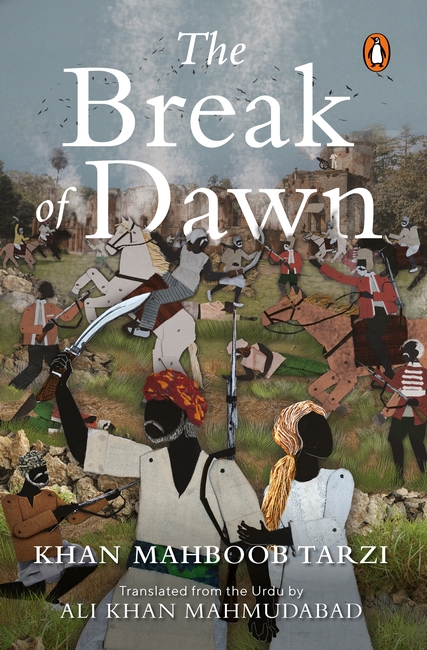
It is the searing month of June. The rebellion against the British has just begun and Awadh is up in flames. Hindus and Muslims have joined hands to overthrow the foreign rulers and set India free. Some Indian rulers have started to enter into alliances to fight the firangis, while others have thrown in their lot with the foreigners. Amid all this, Riyaz Khan, a young soldier from the army of the Raja of Mahmudabad, saves a group of Britishers from fellow ‘mutineers’ and escorts them to the safety of Lucknow. In this group is Alice, who falls in love with Riyaz and eventually becomes an informer for the rebels.
The Break of Dawn, originally published in Urdu under the title Aghaaz-e-Sahar, is a thrilling page-turner and a reminder of a time when Indians of all classes and creeds came together to fight for the honour and freedom of their homeland.
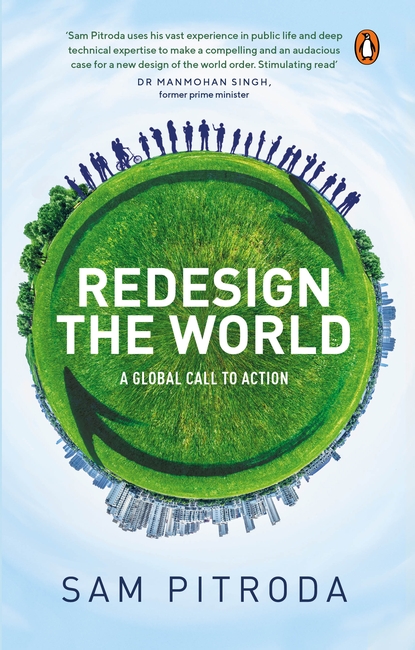
The world was last designed seventy-five years ago, about the same time that Sam Pitroda was born. This design has outlived its utility. Hyperconnectivity and the COVID-19 pandemic offer a unique opportunity to redesign the world to take humanity to the next level.
Redesigning the world is not about looking at it from the point of view of liberal or conservative; left or right; capitalism or socialism; public or private; democracy, dictatorship or monarchy; open or closed systems; rich or poor; urban or rural; east or west; white, brown, black or yellow. This proposed redesign of the world has the planet and its people at the centre; it is built on the foundations of sustainability, inclusion, equality, equity and justice so that everyone on earth can enjoy peace and prosperity. It is not an idealist or utopian vision, but one with humanity at its core.
This book is about reshaping the world to meet the future challenges of our planet and our people.

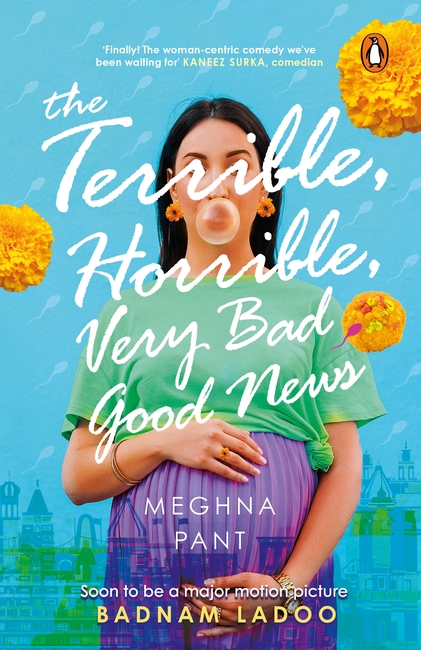
Soon to be seen as a major motion picture Badnam Ladoo, this humorous yet inspiring story of a small-town woman’s fight against social stigma will resonate with every woman, and man
Thirty-four-year-old Ladoo, a simple middle-class divorcée from Rishikesh, wants only one thing from life–a baby. She eats gondh halwa, drinks badam milk, and takes folic acid, to slow down her ticking biological clock and become the world’s most fertile woman.
When an accidental meeting with a gynaecologist reveals that her ‘eggs are drying up’ and finding a sperm donor is her last chance of having a child, Ladoo races against time to find the right baby daddy, whose kundali matches her, while addressing her own mixed feelings about whether Mr Right Donor can also be Mr Right.
Along the way, Ladoo must figure out whether motherhood means marriage, whether being a single mother means loneliness, whether ‘my body, my rules’ applies to women, and whether doing something scandalous is outrageous or courageous.