



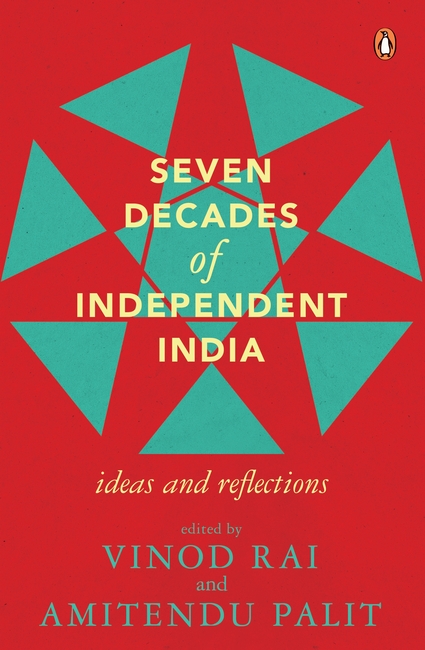
Has democracy in India fulfilled the aspirations of its people? Have institutions delivered? Have public policies succeeded in making substantial differences to living standards? Is the country secure on its external borders? Would the country become an economic powerhouse? And can India be a leading power in the years ahead?
All these and many more questions loom large as India completes seven decades of independence. Major challenges persist on the economic front and in providing adequate and quality healthcare, education, food, sanitation and drinking water. Regulatory preoccupations persist as policymakers continue to search for optimal solutions. The task is made harder by a socio-political environment shaped by various complexities. These include an expanding young workforce, a demanding citizenry, intense social media campaigns and a difficult neighbourhood.
Seven Decades of Independent India, edited by Vinod Rai and Amitendu Palit, reflects on the India of yesterday, today, and tomorrow, by gathering rare and candid insights from some of the most distinguished experts, practitioners and scholars on India. These include D. Subbarao, ex-governor of RBI; Rajiv Kumar, vice-chairman of NITI Aayog; S.Y. Quraishi, former chief election commissioner; Shivshankar Menon, former national security adviser; Ashok Gulati, professor ICRIER and former chairman of Commission for Agricultural Costs and Prices; Sumit Ganguly, professor of political science, Indiana University; A.K. Shiva Kumar, director, International Centre for Human Development; Poonam Muttreja, executive director, Population Foundation of India; Tan Tai Yong, president and professor (humanities) Yale-NUS College, Singapore; Dipankar Gupta, sociologist and former professor, JNU; Pronab Sen, former chief statistician of India and many others.
Catagory: Politics
Pakistan under Siege
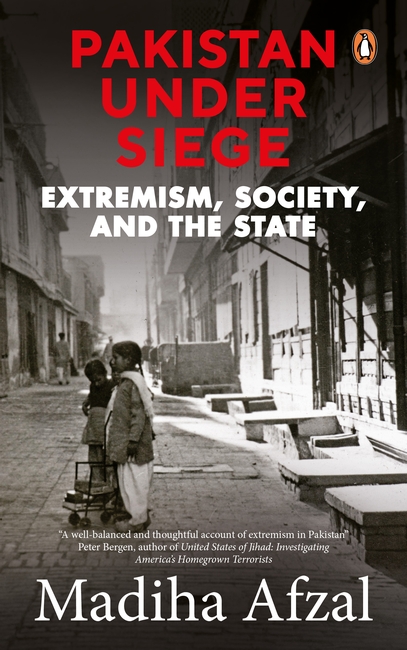
Much of the current work on extremism in Pakistan tends to study extremist trends in the country from a detached position-a top-down security perspective that renders a one-dimensional picture of what is at its heart a complex, richly textured country of 200 million people. In this book, using rigorous analysis of survey data, in-depth interviews in schools and universities in Pakistan, historical narrative reporting, and her own intuitive understanding of the country, Madiha Afzal gives the full picture of Pakistan’s relationship with extremism. The author lays out Pakistanis’ own views-on terrorist groups, jihad, religious minorities and non-Muslims, America, and their place in the world. The views are not radical at first glance, but are riddled with conspiracy theories. Afzal explains how the two pillars that define the Pakistani state-Islam and a paranoia about India-have led to a regressive form of Islamization in Pakistan’s narratives, laws, and curricula. These, in turn, have shaped its citizens’ attitudes.
Afzal traces this outlook to Pakistan’s unique and tortured birth. She examines the rhetoric and the strategic actions of three actors in Pakistani politics-the military, the civilian governments, and the Islamist parties-and their relationships with militant groups. She shows how regressive Pakistani laws instituted in the 1980s worsened citizen attitudes and led to vigilante and mob violence. The author also explains that the educational regime has become a vital element in shaping citizens’ thinking. How many years one attends school, whether the school is public, private, or a madrassa, and what curricula are followed, all affect Pakistanis’ attitudes toward terrorism and the rest of the world.
In the end, Afzal suggests how this beleaguered nation-one with seemingly insurmountable problems in governance and education-can change course.
Breach
A journalist accused of hacking the inbox of a billionaire
A company which fought back when its data was stolen
An entrepreneur who fought an international battle to end piracy
A hacker who decided to take a start-up hostage by stealing its data
Full of riveting stories of hackers, police and corporates, Breach reads like a thriller. The book brings to light several incidents which till now were brushed under the carpet. It has instances of piracy, data theft, phishing, among many others.
Even though he focuses on India, Nirmal John takes great pains to show links between underground international networks working to undermine data security.
Moong over Microchips
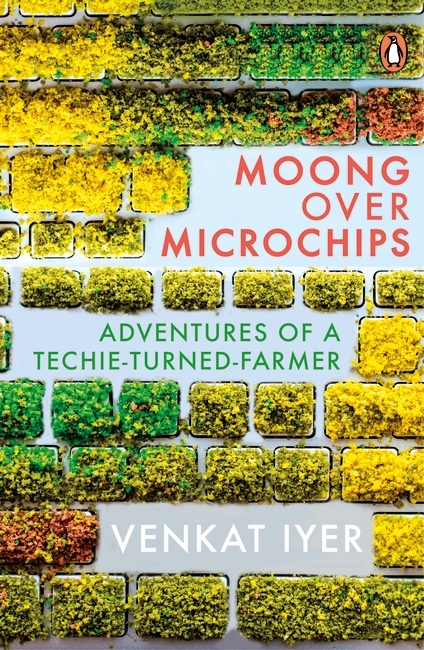
Venkat Iyer was living a fast-paced life in the IT world in Mumbai when he decided to stop and take a long, hard look at where he was headed. Disheartened by his stressful existence in the city, he decided to give it all up and take up organic farming in a small village near Mumbai. But it wasn’t easy. With no experience in agriculture, his journey was fraught with uncertainty. He soon went from negotiating tough clients, strict deadlines and traffic to looking forward to his first bumper crop of moong. As he battled erratic weather conditions and stubborn farm animals, he discovered a world with fresh air and organic food, one where he could lead a more wholesome existence. At times hilarious, and other times profound, this book follows his extraordinary story.
Supreme Whispers
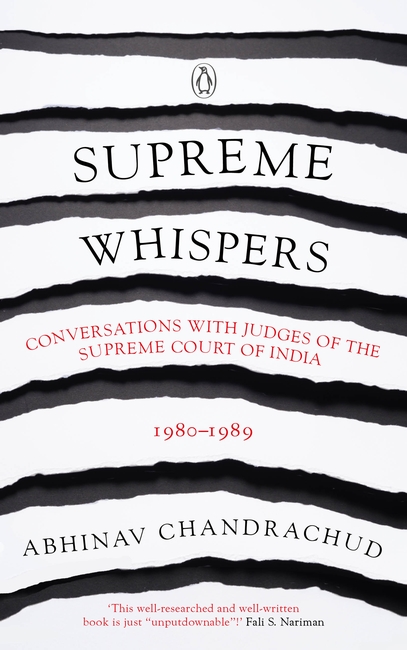
In 1980, a brilliant young American scholar, George H. Gadbois, Jr., met five judges of the Supreme Court of India. The judges gave him astonishing details: about what they actually thought of their colleagues, about the inner workings and politics of the court, their interactions with the government and the judicial appointments process, among many other things. This was only the beginning. Over the course of that decade, Gadbois visited India on two more occasions and conducted over 116 interviews with more than sixty-six judges of the Supreme Court of India (nineteen of whom held the post of chief justice of India),
and others such as senior lawyers, politicians, relatives of deceased judges, and court staff. During each meeting, Gadbois diligently took down handwritten notes, which he later typed up on his typewriter, recording nearly every detail of what the judges had told him, sometimes to a fault.
Relying on these typewritten interviews, Abhinav Chandrachud sheds light on a decade of politics, decision-making and legal culture in the Supreme Court of India. This book yields a fascinating glimpse into the secluded world of the judges of the Supreme Court in the 1980s and earlier.
The Indian Rennaissance
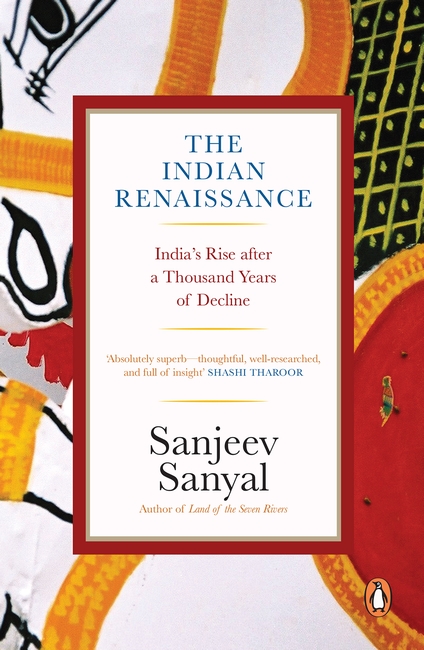
One thousand years ago, India was at the height of its power, influencing the world with its ideas and trade. Now, ten centuries later, India’s recent economic performance is once again attracting world attention as the country re-awakens not just as an economy but as a civilization.
In The Indian Renaissance: India’s Rise after a Thousand Years of Decline, Sanjeev Sanyal looks at the processes that led to ten centuries of decline. He also examines the powerful economic and social forces that are working together to transform India beyond recognition. These range from demographic shifts to rising literacy levels and, the most important revolution, the opening of minds and changed attitude towards innovation and risk-fundamental, if India is to take advantage of the twenty-first century.
Kannur
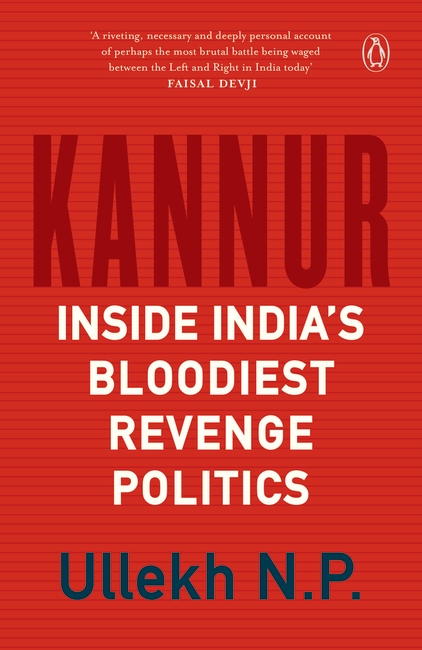
Kannur, a sleepy coastal district in the scenic south Indian state of Kerala, has metamorphosed into a hotbed of political bloodshed in the past few decades. Even as India heaves into the age of technology and economic growth, the town has been making it to the national news for horrific crimes and brutal murders with sickening regularity.
What makes this region so susceptible to vendetta politics and such deadly violence? How is it an anomaly in Kerala, the state with the highest social development parameters in India? Born in Kannur and brought up amidst some of the tallest political leaders of the state, author Ullekh N.P. delves into his personal experiences while drawing a modern-day graph that charts out the reasons, motivations and the local lore behind the turmoil. He analyses the numbers that lay bare the truth behind the hype, studies the area’s political and cultural heritage, and speaks to the main protagonists and victims. With his journalistic skills and years of on-the-field reporting, he paints a gripping narrative of the ongoing bloodbath and the perceptions around it.
Ullekh’s investigations and interviews reveal a bigger game at work involving players who will stop at nothing to win.
Staggering Forward
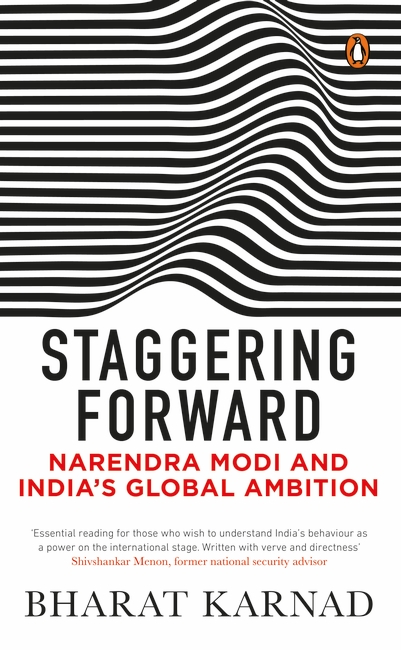
There is a paradigm shift in India’s politics. With his clean reputation, proven track record as chief minister of Gujarat and formidable leadership qualities on display, Narendra Modi seemed the right fit for the prime minister’s job, and just the man to turn the country around after the decade-long UPA rule by the modest and tongue-tied Manmohan Singh.
Prime Minister Modi’s first term, however, raises troubling questions. How has his strongman persona and social background impacted policymaking? Has Modi delivered on the high expectations to advance India’s national interest and security? Has the country’s role in the region, in Asia and the world changed, become more meaningful? What has been the effect of Modi’s India First foreign policy on neighbours, and with respect to raising India’s stock in the world and showing the Indian military has teeth? Especially with regard to the UUS, Russia and China.
Analysing Prime Minister Modi’s foreign and military policies in the context of India’s evolving socio-political and economic milieu, this book offers a critical perspective that helps explain why India has not progressed much towards becoming a consequential power. Argumentative and thought-provoking, Staggering Forward is a must-read to understand India’s foreign and national security policies since 2014.
The Accidental Prime Minister
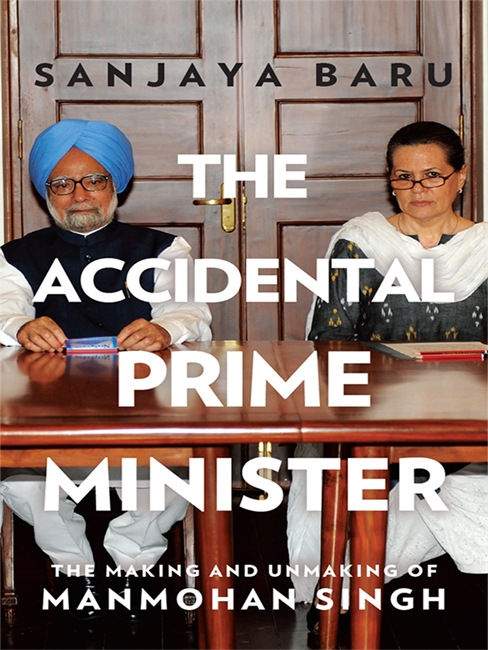
When The Accidental Prime Minister was published in 2014, it created a storm and became the publishing sensation of the year. The Prime Minister’s Office called the book a work of ‘fiction’, the press hailed it as a revelatory account of Prime Minister Manmohan Singh’s first term in the UPA. Written by Singh’s media adviser and trusted aide, the book describes Singh’s often troubled relations with his ministers, his cautious equation with Sonia Gandhi and how he handled the big crises from managing the Left to pushing through the nuclear deal. Insightful, acute and packed with political anecdotes, The Accidental Prime Minister is one of the great insider accounts of Indian political life.
The Non Violent Struggle for Freedom 1905-1919
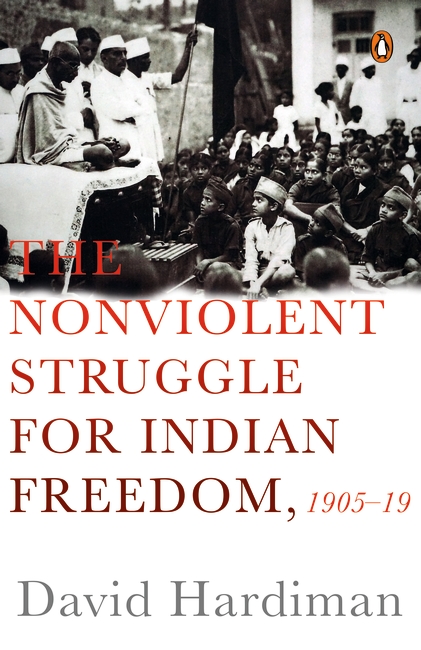
In recent years, there has been a surge of writing on the technique and practice of non-violent forms of resistance. Much of this has focused on movements that occurred after the end of the Second World War, many of which have been extremely successful. Although the fact that such a method of resistance was developed in its modern form by India is acknowledged, there has not until now been an authoritative history available to show exactly how this occurred.
This book provides such a study. Although non-violence is associated above all with the towering figure of M.K. Gandhi, David Hardiman shows that civil forms of resistance were already being practiced by nationalists in British-ruled India under the rubric of ‘passive resistance’. In this, there was no principled commitment to non-violence as such.
It was Gandhi, first in South Africa and then in India, who both evolved a technique that he called ‘satyagraha’ that he characterised in terms of its ‘non-violence’. In this, ‘non-violence’ was forged as both a new word in the English language, and as a new political concept.
The Non-violent Struggle for Freedom brings out in graphic detail exactly what this entailed, and the formidable difficulties that the pioneers of such resistance encountered in the years 1905-19.