



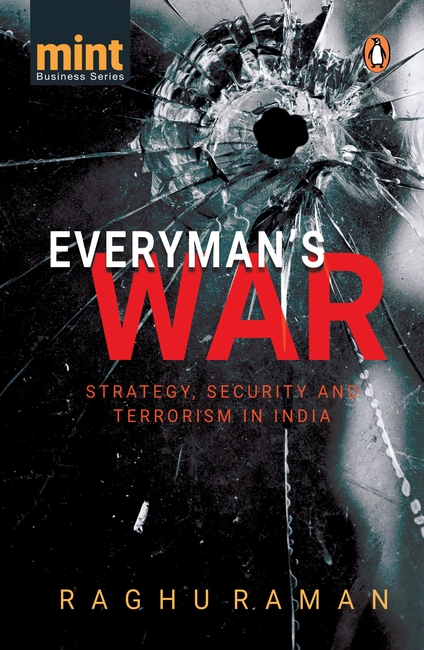
What do Naxal terrorists have in common with Somali pirates? What man-made event triggers more refugees than all wars put together? How do terrorist movements end? And how can you help?
Everyman’s War is a collection of insightful essays that describe our participatory role in securing ourselves and our progeny. Defence, internal security and terrorism are important yet closely guarded issues. Even as outrage over safety of women and rising terror take centrestage, there continues to be limited access to information on the subjects of national defence and security, especially in language that a layman can understand. Raghu Raman, an expert on security and terrorism, presents issues of defence, strategy and national security in an engaging narrative, with historical and contemporary examples. He recalibrates the great ‘India rising’ story with its real and present dangers and the role of a regular citizen in this everyman’s war.
Catagory: Politics
The Blood Telegram
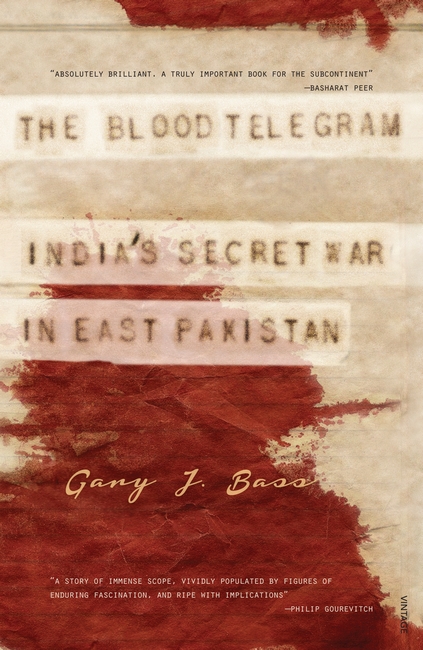
In 1971, the Pakistani army launched a devastating crackdown on what was then East Pakistan (today’s independent Bangladesh), killing thousands of people and sending ten million refugees fleeing into India. The events also sparked the 1971 Indo-Pakistani War.
Drawing on recently declassified documents, unheard White House tapes, and meticulous investigative reporting, Gary Bass gives us an unprecedented chronicle of the break-up of Pakistan, and India’s role in it. This is the pathbreaking account of India’s real motives, the build-up to the war, and the secret decisions taken by Indira Gandhi and her closest advisers.
This book is also the story of how two of the world’s great democracies-India and the United States-dealt with one of the most terrible humanitarian crises of the twentieth century. Gary Bass writes a revealing account of how the Bangladeshis became collateral damage in the great game being played by America and China, with Pakistan as the unlikely power broker. The United States’ embrace of the military dictatorship in Islamabad would affect geopolitics for decades, beginning a pattern of Ameranti-democratic engagement in Pakistan that went back far beyond General Musharraf.
The Blood Telegram is a revelatory and compelling work, essential reading for anyone interested in the recent history of our region.
Bombay Before Mumbai
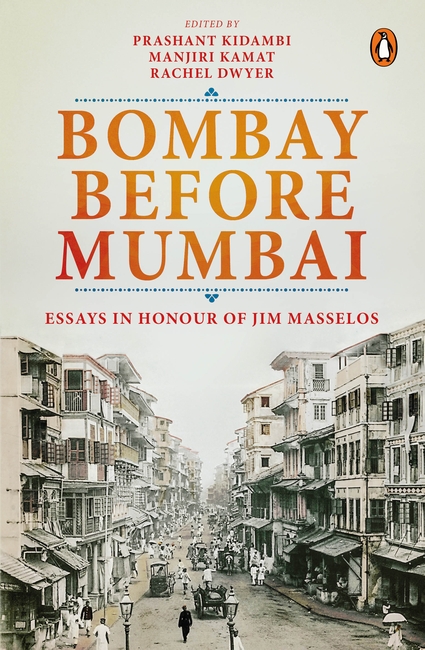
‘City of Gold’, ‘Urbs Prima in Indis’, ‘Maximum City’: no Indian metropolis has captivated the public imagination quite like Mumbai. The past decade has seen an explosion of historical writing on the city that was once Bombay. This book, featuring new essays by its finest historians, presents a rich sample of Bombay’s palimpsestic pasts. It considers the making of urban communities and spaces, the workings of power and the nationalist makeover of the colonial city. In addressing these themes, the contributors to this volume engage critically with the scholarship of a distinguished historian of this frenetic metropolis. For over five decades, Jim Masselos has brought to life with skill and empathy Bombay’s hidden histories. His books and essays have traversed an extraordinarily diverse range of subjects, from the doings of the city’s elites to the struggles of its most humble denizens. His pioneering research has opened up new perspectives and inspired those who have followed in his wake. Bombay Before Mumbai is a fitting tribute to Masselos’ enduring contribution to South Asian urban history.
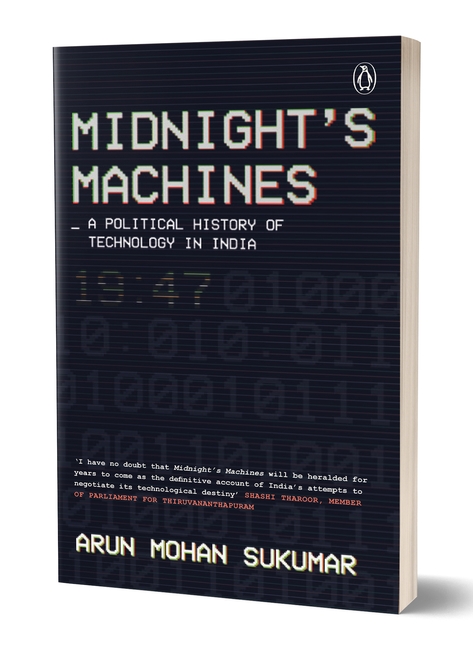
Midnight’s Machines
Named among “The Best Books of 2020” by Bloomberg
Shortlisted for New India Foundation’s Kamaladevi Chattopadhyay Book Prize 2020
Every Prime Minister of Independent India has guided, if not personally overseen, one prized portfolio: technology. If, in the early years, Nehru and his scientist-advisors retained an iron grip on it, subsequent governments created a bureaucracy that managed everything from the country’s crown jewels – its nuclear and space programmes – to solar stoves and mechanized bullock carts.
But a lesser-known political project began on 15 August 1947: the Indian state’s undertaking to influence what the citizens thought about technology and its place in society. Beneath its soaring rhetoric on the virtues or vices of technology, the state buried a grim reality: India’s inability to develop it at home. The political class sent contradictory signals to the general public. On the one hand, they were asked to develop a scientific temper, on the other, to be wary of becoming enslaved to technology; to be thrilled by the spectacle of a space launch while embracing jugaad, frugal innovation, and the art of ‘thinking small’. To mask its failure at building computers, the Indian state decried them in the seventies as expensive, job-guzzling machines. When it urged citizens to welcome them the next decade, the government was, unsurprisingly, met with fierce resistance. From Jawaharlal Nehru to Narendra Modi, India’s political leadership has tried its best to modernize the nation through technology, but on its own terms and with little success.
In this engaging and panoramic history spanning the arc of modern India from the post-War years to present day, Arun Mohan Sukumar gives us the long view with a reasoned, occasionally provocative standpoint, using a lens that’s wide enough for the frame it encompasses. With compelling arguments drawn from archival public records and open-source reportage, he unearths the reasons why India embraced or rejected new technologies, giving us a new way to understand and appreciate the individual moments that brought the country into the twenty-first century.
The ISIS Peril
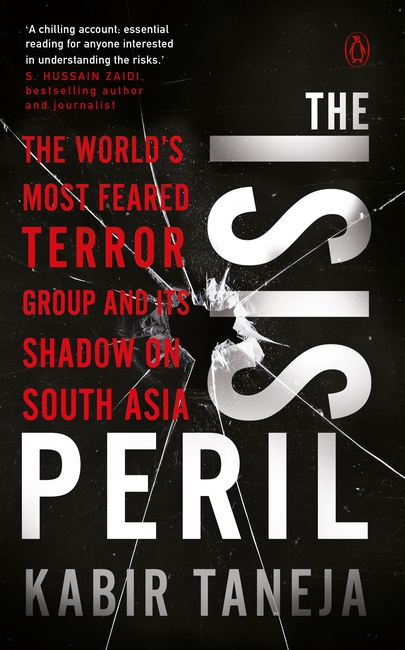
As early as 2014, after the fall of Mosul, maps of ISIS showing a desire to take over South Asia started to appear on social media. But how far has that borne fruit? Or has it always been more of an ill-conceived chimera?
One of the shortcomings of our understanding of ISIS in India-and indeed in South Asia-is that neither the media nor the public discourse seems to know what ISIS itself is. The militant group has eclipsed Al Qaeda to become the most feared terror group in the West, and it continues to expand its influence, despite losing the territory it had captured. And yet, its shadow on South Asia has not been grasped quite as clearly.
In The ISIS Peril, Kabir Taneja explores the psychology of South Asian jihadists through the discussion on various narratives from Kashmir to Kerala, the Islamic State’s online propaganda strategies by way of Twitter, Facebook and Telegram, leading to the radicalization and subsequent recruitment of the youth, to the Holey Bakery attack in Bangladesh in 2016 and the Easter weekend bombings in Sri Lanka in 2019.
Based on detailed and rare primary sources, Taneja uncovers the ideological underpinnings of the jihadist movement in South Asia, and in the process, not only exposes its fault lines but also highlights the challenges in defeating not just the world’s most feared terror group but something more powerful, an ideology that it represents.
Ayodhya
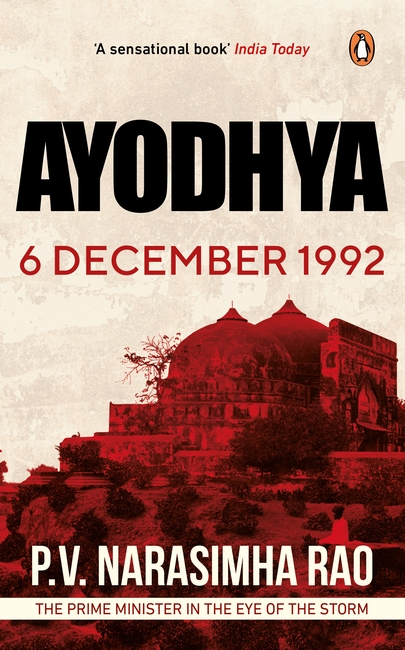
‘A sensational book’ India Today
A shocking exposé of the event that changed Indian politics forever
P.V. Narasimha Rao was the prime minister of India when, on 6 December 1992, thousands of kar sevaks stormed into the site of the Babri Masjid in Ayodhya. The nation watched in horror as the centuries-old mosque was razed to the ground, in the presence of paramilitary forces and senior political leaders, marking a turning point in post-Independence Indian history.
Many hold Rao responsible for not preventing the demolition, while others accuse him of being a co-conspirator. In this tell-all account, Rao reveals what really transpired in the run-up to that fateful day. Drawing on the Supreme Court order, parliamentary proceedings, eyewitness reports and his own insights, he presents a comprehensive view of the machinations that led to the demolition of the Babri Masjid.
Nearly three decades after the event, Ayodhya: 6 December 1992 remains a valuable resource to understanding the political manoeuvres behind the Ram Mandir issue and the dangers of exploiting religious sentiments for narrow electoral gains.
Nepal Nexus, The
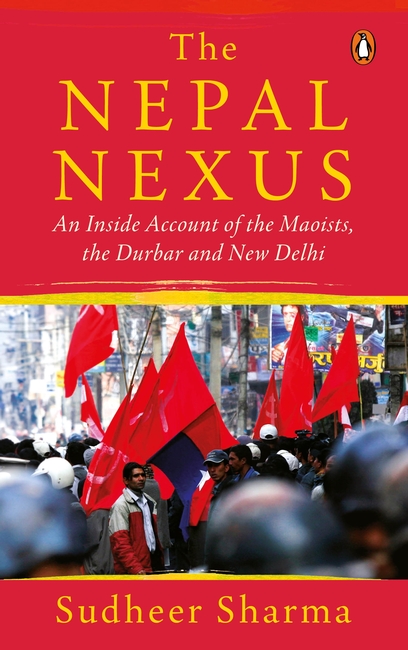
This fast-paced and comprehensive account of Nepal today traces the recent past and the present of Nepali politics and geopolitics from the vantage point of an insider who had a ringside view of the developments of the last two decades. This was a turbulent, eventful era which had a transformative impact on the country. In this short span, Nepal experienced the Maoist revolt, the palace massacre, the state of emergency, the royal coup, the people’s movement, the republic, the Madhes uprising, the Constituent Assembly, federalism and the new Constitution.
Looking back at these developments, Sudheer Sharma argues that poverty, unemployment and oppression drove the Maoist revolt, and despite its ultimate failure, it played a decisive role in the socio-political transformation of Nepal. Furthermore, the relationship between the Maoists, the monarchy (Durbar) and the Indian establishment (Delhi) is absolutely critical to the understanding of the trajectory of the changes. The Nepal Nexus examines the impact of each of these three strands and tracks the complex interplay between them.
Re-forming India
India’s social and political landscape has, in recent times, witnessed many significant transformations. This book offers a wide-ranging review of how India has, over the last few years, fared on the most critical dimensions of our collective life-politics, economy, governance, development, culture and society.
The project of change entailed processes of both reform and re-formation: if reform was about correcting or improving what was considered unsatisfactory, re-formation was a bolder project that aimed to construct anew, anchored in a fundamental re-visioning of India in social, cultural and even moral terms. In many ways, the programme of re-forming India may have outpaced that of reforming India and even exceeded its own expectations.
This volume provides an overview of the prevailing political imaginary of nationalism and of the current trends of public discourse in Indian democracy; it seeks to identify and interpret the transformations in state institutions and the public sphere and evaluate their implications for the future.
Re-Forming India brings together reflections, from leading commentators in their fields, on some of these transformations-from the promise of economic revival and demonetization to the impact on gender relations, higher education and the media. Has the country been transformed in ways that were promised? Or indeed in other ways that had not been anticipated?
With essays from Smita Gupta, Ashok K. Lahiri, C. Rammanohar Reddy, Indira Rajaraman, Radhicka Kapoor, Prem Shankar Jha, Harish Damodaran, A. K. Bhattacharya, Paranjoy Guha Thakurta, Yamini Aiyar, Yogendra Yadav, Diane Coffey, Anirudh Krishna, Navroz K. Dubash, Shibani Ghosh, Madhav Khosla, Ramachandra Guha, Srinath Raghavan, Ashutosh Varshney, Suhas Palshikar, Anand Teltumbde, Pratiksha Baxi, Amitabh Behar, Sanjay Srivastava, Surinder S. Jodhka, Ravindra Karnena, Niraja Gopal Jayal, Gautam Bhatia (lawyer), Ravish Kumar, Taberez Ahmed Neyazi, Neera Chandhoke, Apoorvanand, Gautam Bhatia (architect), Siddhartha Chatterjee and Chandrika Grover Ralleigh.
Vision for a Nation
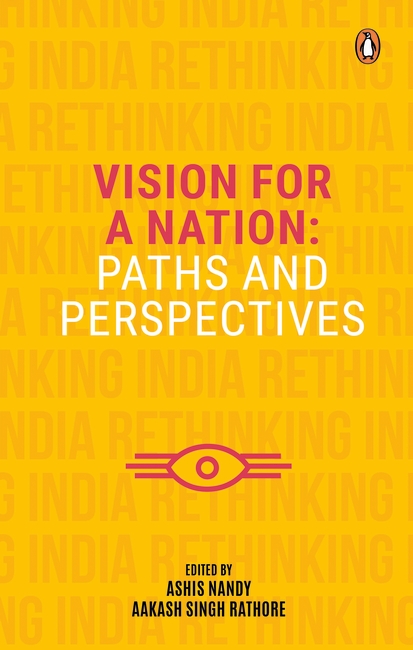
What is the nation? What is the idea of India? Whose India is it, anyway?
This inaugural volume in the series titled Rethinking India aims to kickstart a national dialogue on the key questions of our times. It brings together India’s foremost intellectuals, academics, activists, technocrats, professionals and policymakers to offer an in-depth exploration of these issues, deriving from their long-standing work, experience and unflinching commitment to the collective idea of India, of who we can and ought to be. Vision for a Nation: Paths and Perspectives champions a plural, inclusive, just, equitable and prosperous India, committed to individual dignity as the foundation of the unity and vibrancy of the nation.
In order to further disseminate these ideas-the vision for the nation as aspirationally reflected in the Constitution-this book provides a positive counter-narrative to reclaim the centrality of a progressive, deeply plural and forward-looking and inclusive India. It serves as a fresh reminder of our shared and shareable overlapping values and principles, and collective heritage and resources. The essays in the book are meaningful to anyone with an interest in contemporary Indian politics, South Asian studies, modern Indian history, law, sociology, media and journalism.
So All Is Peace
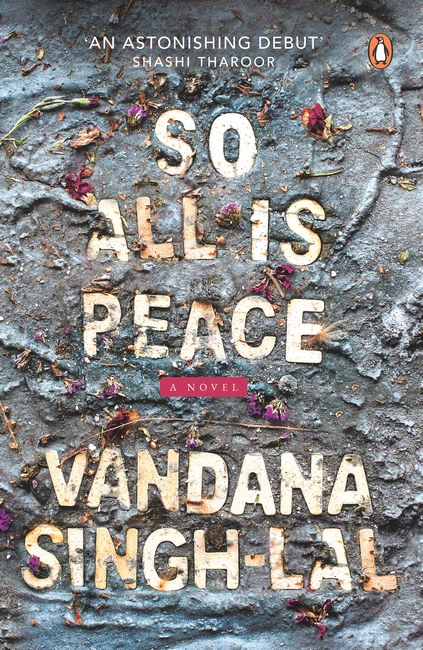
But sit down, breathe deep, and ask a woman. Any woman. They are there.
When twin sisters Layla and Tanya are found starving in their upmarket apartment, there is frenzy in the media. How often does one find two striking, twenty-something women, one half-dead, the other not speaking, living in a state of disrepair and chaos, for no apparent reason? Theories about them are rampant, but disillusioned journalist Raman is loath to follow the story. That is, until Tanya begins to talk to him, and the darker truth behind the sisters’ lives starts to unravel.
A richly atmospheric, deeply claustrophobic story with a stunning denouement, of two women confronting the everyday realities of their city and country, So all is Peace provides an unflinching insight into love, lust, fear, grief, and the decisions we make, through a cast of sharply drawn characters brought together by an unspoken wrong.