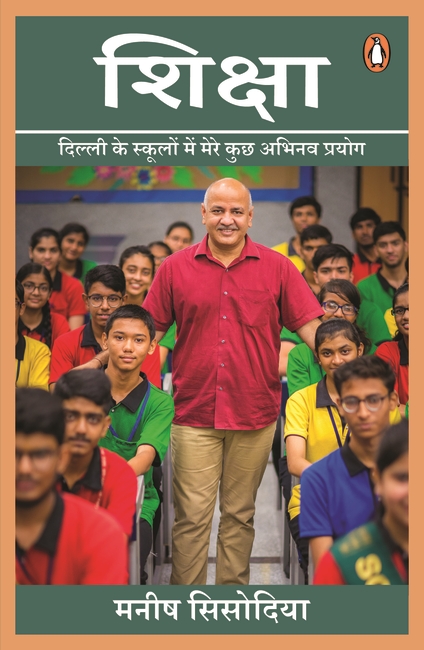
From schools of excellence to brilliant improvement in the board examinations and state-of-the-art facilities, government schools in Delhi rock. The implementation of innovative concepts like ‘happiness curriculum’ and ‘entrepreneurship mindset programme’ in Delhi government schools has brought about revolutionary change in the public school education system in the national capital of India.
Manish Sisodia, Delhi’s deputy chief minister and education minister, is the visionary instrumental in ushering in such a transformation. Recounting his experiences and experiments as an education minister, this book offers blow-by-blow account of this amazing success story. Shiksha, a book of hope and possibilities, will inspire everyone who is poised to make a difference in society through education.

From schools of excellence to brilliant improvement in the board examinations and state-of-the-art facilities, government schools in Delhi rock. The implementation of innovative concepts like ‘happiness curriculum’ and ‘entrepreneurship mindset programme’ in Delhi government schools has brought about revolutionary change in the public school education system in the national capital of India.
Manish Sisodia, Delhi’s deputy chief minister and education minister, is the visionary instrumental in ushering in such a transformation. Recounting his experiences and experiments as an education minister, this book offers blow-by-blow account of this amazing success story. Shiksha, a book of hope and possibilities, will inspire everyone who is poised to make a difference in society through education.

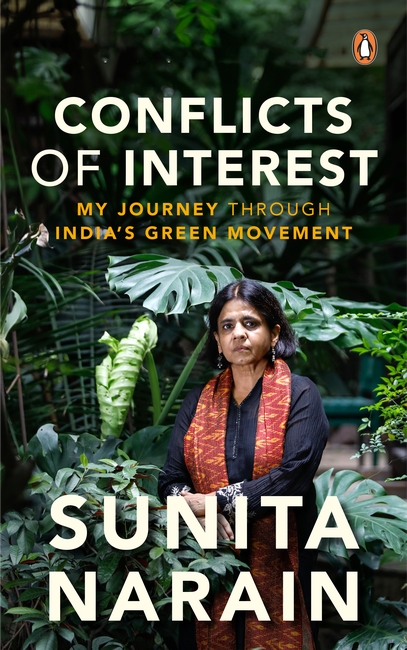
India’s foremost environmentalist, Sunita Narain, gives a personal account of her battles as part of the country’s green movement. While outlining the enormous environmental challenges that India faces today, Narain talks about how corporate lobbies and political interests often scuttle their effective resolution. She recounts some widely reported controversies triggered by research undertaken by her along with her team at the Centre for Science and Environment, such as a report on pesticides in colas, and a study on air pollution in Delhi, and includes a ringside view of global climate change negotiations. Conflicts of Interest also includes an ‘environmental manifesto’, a blueprint for the direction India must take if it is to deal with the exigencies of climate change and environmental degradation.

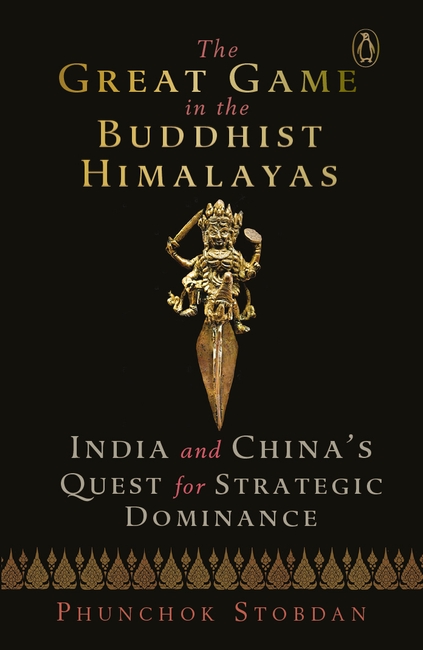
There is a new ‘great game’ being played in the Buddhist Himalayas between India, China and Tibet, which makes for a crucial third player. Together, they are leveraging their influence with the Buddhist communities to create strategic dominance, with varying degrees of success.
China’s ‘Buddhist diplomacy’ has focused on Nepal and Bhutan, and the Indian Himalayan regions of Ladakh, Arunachal Pradesh and Sikkim, which have sizeable Buddhist populations and are vulnerable to this influence. The crisis in Doklam brought into focus what will be one of the most difficult issues to unfold in the Himalayas in future: India’s insufficient ability to deal with China only through the prism of military power.
If Xi Jinping, who is known to be working towards a resolution of the Tibet question, succeeds, and the Dalai Lama does indeed return to Tibet, how will it impact Indian interests in the Buddhist Himalayas? If the Tibet issue remains unresolved, how will India and China deal with and leverage the sectarian strife that is likely to intensify in a post-Dalai Lama world?
The Great Game in the Buddhist Himalayas includes several unknown insights into the India-China, India-Tibet and China-Tibet relationships. It reads like a geopolitical thriller, taking the reader through the intricacies of reincarnation politics, competing spheres of sacred influence, and monastic and sectarian allegiances that will keep the Himalayas on edge for years to come.

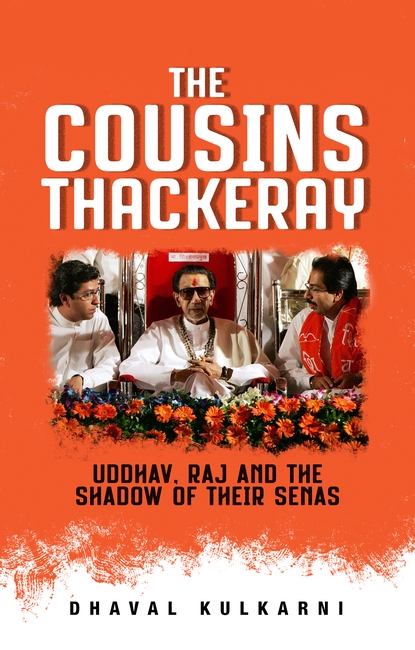
They are first cousins twice over, but have had widely divergent political trajectories. One, an abrasive, fire-breathing demagogue, was seen as his uncle’s political heir whose behavioural traits he cultivated. The other, an introvert, is at his best when plotting strategies on the drawing board rather than the rough-and-tumble of street-corner politics that his party is known for in India’s financial capital.
Starting out as brothers-in-arms, they had a bitter falling out over inheriting the party mantle. The younger cousin branched out on his own, hijacked the populist, ethno-centric plank of his parent party, putting his cousin-turned-political foe on the defensive. A series of miscalculations later, the boot seems to be on the other foot. The elder cousin has managed to keep his flock together and cemented his position as his late father Bal Thackeray’s political heir, while the other, one of the most popular crowd-pullers in Maharashtra, is itching for an electoral comeback.
The Cousins Thackeray evaluates the political careers of Shiv Sena president Uddhav Thackeray and Maharashtra Navnirman Sena (MNS) chief Raj Thackeray. It also examines questions about identity politics, and the social, cultural and economic matrix that catalysed the formation of the Shiv Sena and the MNS from it. Above all, it is a look at what makes the Thackeray cousins so integral to the politics of India, Maharashtra and Mumbai.
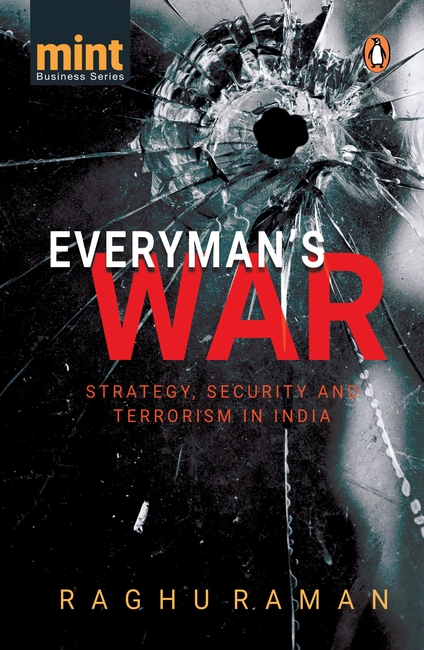
What do Naxal terrorists have in common with Somali pirates? What man-made event triggers more refugees than all wars put together? How do terrorist movements end? And how can you help?
Everyman’s War is a collection of insightful essays that describe our participatory role in securing ourselves and our progeny. Defence, internal security and terrorism are important yet closely guarded issues. Even as outrage over safety of women and rising terror take centrestage, there continues to be limited access to information on the subjects of national defence and security, especially in language that a layman can understand. Raghu Raman, an expert on security and terrorism, presents issues of defence, strategy and national security in an engaging narrative, with historical and contemporary examples. He recalibrates the great ‘India rising’ story with its real and present dangers and the role of a regular citizen in this everyman’s war.
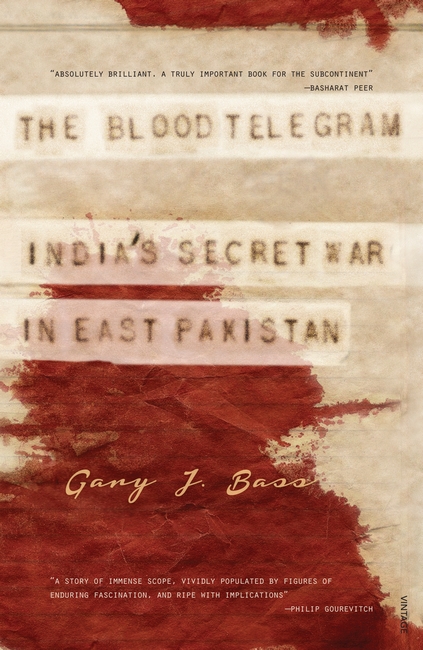
In 1971, the Pakistani army launched a devastating crackdown on what was then East Pakistan (today’s independent Bangladesh), killing thousands of people and sending ten million refugees fleeing into India. The events also sparked the 1971 Indo-Pakistani War.
Drawing on recently declassified documents, unheard White House tapes, and meticulous investigative reporting, Gary Bass gives us an unprecedented chronicle of the break-up of Pakistan, and India’s role in it. This is the pathbreaking account of India’s real motives, the build-up to the war, and the secret decisions taken by Indira Gandhi and her closest advisers.
This book is also the story of how two of the world’s great democracies-India and the United States-dealt with one of the most terrible humanitarian crises of the twentieth century. Gary Bass writes a revealing account of how the Bangladeshis became collateral damage in the great game being played by America and China, with Pakistan as the unlikely power broker. The United States’ embrace of the military dictatorship in Islamabad would affect geopolitics for decades, beginning a pattern of Ameranti-democratic engagement in Pakistan that went back far beyond General Musharraf.
The Blood Telegram is a revelatory and compelling work, essential reading for anyone interested in the recent history of our region.

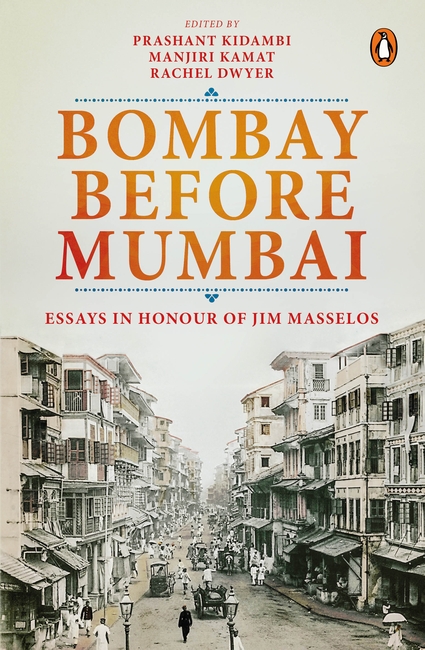
‘City of Gold’, ‘Urbs Prima in Indis’, ‘Maximum City’: no Indian metropolis has captivated the public imagination quite like Mumbai. The past decade has seen an explosion of historical writing on the city that was once Bombay. This book, featuring new essays by its finest historians, presents a rich sample of Bombay’s palimpsestic pasts. It considers the making of urban communities and spaces, the workings of power and the nationalist makeover of the colonial city. In addressing these themes, the contributors to this volume engage critically with the scholarship of a distinguished historian of this frenetic metropolis. For over five decades, Jim Masselos has brought to life with skill and empathy Bombay’s hidden histories. His books and essays have traversed an extraordinarily diverse range of subjects, from the doings of the city’s elites to the struggles of its most humble denizens. His pioneering research has opened up new perspectives and inspired those who have followed in his wake. Bombay Before Mumbai is a fitting tribute to Masselos’ enduring contribution to South Asian urban history.

Named among “The Best Books of 2020” by Bloomberg
Shortlisted for New India Foundation’s Kamaladevi Chattopadhyay Book Prize 2020
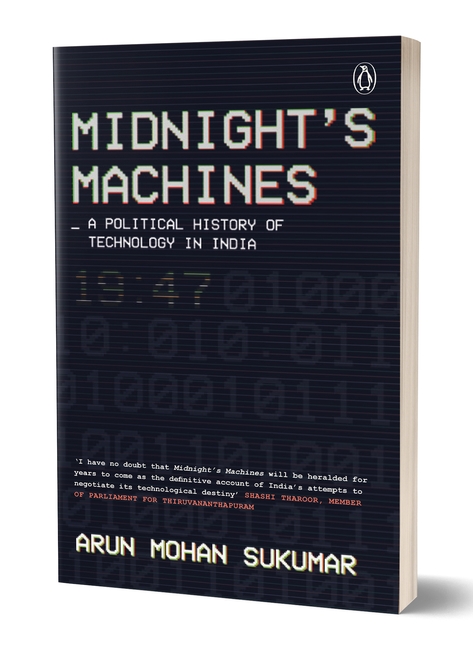
Every Prime Minister of Independent India has guided, if not personally overseen, one prized portfolio: technology. If, in the early years, Nehru and his scientist-advisors retained an iron grip on it, subsequent governments created a bureaucracy that managed everything from the country’s crown jewels – its nuclear and space programmes – to solar stoves and mechanized bullock carts.
But a lesser-known political project began on 15 August 1947: the Indian state’s undertaking to influence what the citizens thought about technology and its place in society. Beneath its soaring rhetoric on the virtues or vices of technology, the state buried a grim reality: India’s inability to develop it at home. The political class sent contradictory signals to the general public. On the one hand, they were asked to develop a scientific temper, on the other, to be wary of becoming enslaved to technology; to be thrilled by the spectacle of a space launch while embracing jugaad, frugal innovation, and the art of ‘thinking small’. To mask its failure at building computers, the Indian state decried them in the seventies as expensive, job-guzzling machines. When it urged citizens to welcome them the next decade, the government was, unsurprisingly, met with fierce resistance. From Jawaharlal Nehru to Narendra Modi, India’s political leadership has tried its best to modernize the nation through technology, but on its own terms and with little success.
In this engaging and panoramic history spanning the arc of modern India from the post-War years to present day, Arun Mohan Sukumar gives us the long view with a reasoned, occasionally provocative standpoint, using a lens that’s wide enough for the frame it encompasses. With compelling arguments drawn from archival public records and open-source reportage, he unearths the reasons why India embraced or rejected new technologies, giving us a new way to understand and appreciate the individual moments that brought the country into the twenty-first century.

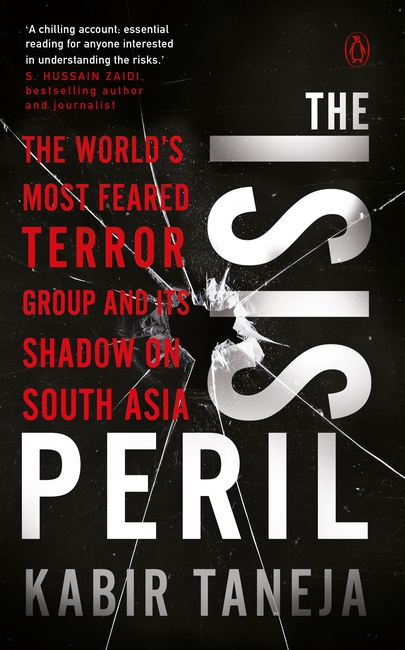
As early as 2014, after the fall of Mosul, maps of ISIS showing a desire to take over South Asia started to appear on social media. But how far has that borne fruit? Or has it always been more of an ill-conceived chimera?
One of the shortcomings of our understanding of ISIS in India-and indeed in South Asia-is that neither the media nor the public discourse seems to know what ISIS itself is. The militant group has eclipsed Al Qaeda to become the most feared terror group in the West, and it continues to expand its influence, despite losing the territory it had captured. And yet, its shadow on South Asia has not been grasped quite as clearly.
In The ISIS Peril, Kabir Taneja explores the psychology of South Asian jihadists through the discussion on various narratives from Kashmir to Kerala, the Islamic State’s online propaganda strategies by way of Twitter, Facebook and Telegram, leading to the radicalization and subsequent recruitment of the youth, to the Holey Bakery attack in Bangladesh in 2016 and the Easter weekend bombings in Sri Lanka in 2019.
Based on detailed and rare primary sources, Taneja uncovers the ideological underpinnings of the jihadist movement in South Asia, and in the process, not only exposes its fault lines but also highlights the challenges in defeating not just the world’s most feared terror group but something more powerful, an ideology that it represents.