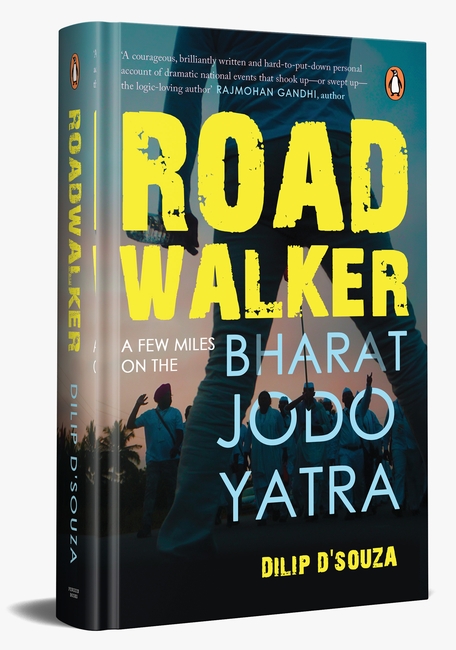
‘The length of India, though. Think of that. The magnitude of it takes my breath away, even months later. When next will I get such an opportunity? As the Yatra got going, through its early days in Tamil Nadu and Kerala, that question began to haunt me. Through those early days, the challenge of finding an answer came to mean something to me. Something deep, profound, elemental. The challenge of the walk, yes. But what it helped me articulate for myself, too. The way it dredged up long-ago experiences, reminded me of what they had meant, wrung new meaning from them now, said things about my country, my family, myself. All in all, it helped me decide — if I wasn’t doing the whole trip, there was a next best thing I could do.’
Dilip D’Souza joined the Bharat Jodo Yatra four times. This is the story of that experience. But even more, this is the story of how he found energy, empathy and enthusiasm in the Yatra. How it spoke to him of renewal. How it filled him, and many others, with hope. ‘This was my chance to make my own slice of personal history,’ he writes. ‘That was enough for me.’
आम लोग सुभाष चंद्र बोस के गांधी से मतभेद और जर्मनी व जापान की मदद से द्वितीय विश्वयुद्ध में भारत को आज़ाद करवाने के प्रयासों के बारे में जानते हैं। लेकिन अब जो सूचनाएँ सामने आ रही हैं, वो बताती हैं कि उनके देश भर के क्रांतिकारियों से कैसे संबंध थे और अध्यात्म और खुफिया मिशनों से उनको कितना लगाव था। साथ ही, उन्होंने ब्रिटिश भारतीय सेना में विद्रोह पैदा करवाने के क्या-क्या प्रयास किए थे।
प्रश्न यह है कि क्या बोस वाकई नाजियों से सहानुभूति रखते थे? उन्होंने अपनी राजनीतिक छवि दांव पर क्यों लगाई? ऐसे ही कई सवालों के जवाब सुभाष बाबू नाम की यह पुस्तक देती है।

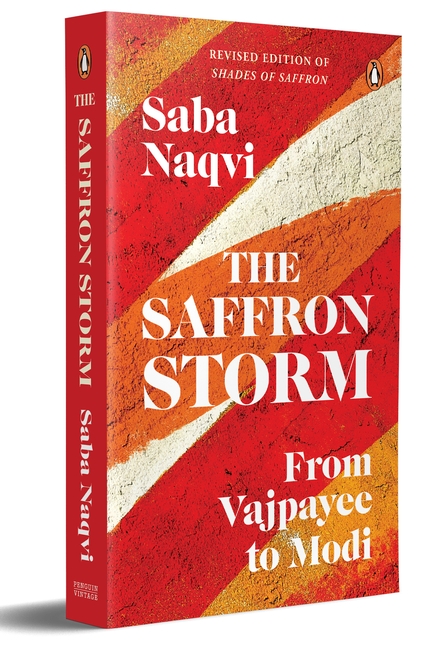
The Bharatiya Janata Party (BJP) enjoys a predominant position in Indian politics today. In its journey from coalition to single-party rule, the BJP has changed as much as India appears to have. Veteran journalist Saba Naqvi tells the story of the party’s journey under two very different prime ministers drawn from the same ideological family. In 1998, the author attended the very modest swearing-in ceremony of Atal Bihari Vajpayee in the courtyard of the Rashtrapati Bhavan. In 2014, she was at a mega event at the same venue
when Narendra Modi was sworn in.
The Saffron Storm is both a first-person account of racy events as they unfolded in the nation’s history and a work that raises larger analytical points about the BJP’s growth. It examines the role of the Rashtriya Swayamsevak Sangh cadre and its equations with elected leaders, the calibration of ideology, the issue of political finance and the social expansion of the party, as also the cults of personality that would emerge around, first, Vajpayee and then, more forcefully, around Modi. The book provides a riveting account of the party’s journey from ‘untouchability’ (when allies were unwilling to join) to its presumed ‘invincibility’ today.
This updated edition also describes the enforcement agencies’ action against the party’s opponents, the increasingly centralized command structure of the BJP and the implications of the delimitation exercise due in 2026. The Saffron Storm is a fascinating and readable dive into the contemporary history of the BJP.

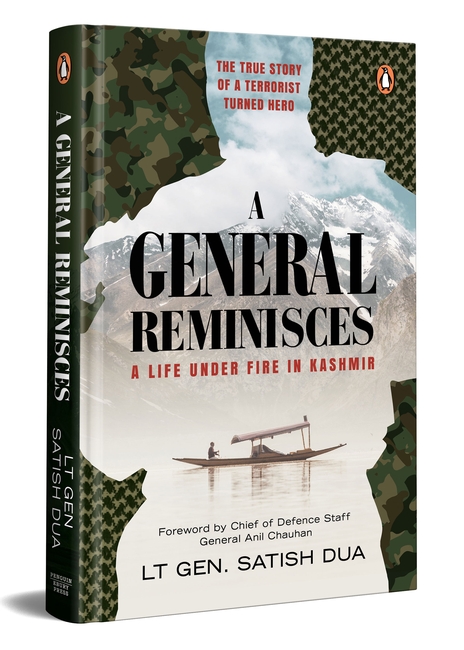
Lt Gen. Satish Dua’s tryst with Kashmir has spanned nearly four decades (from 1980 to 2018), during which, he has observed the changing social, political, security and religious landscape of the region.
In A General Reminisces, he reflects upon this time, his interactions with bureaucrats and experiences about the atmosphere at the Line of Control that divides Kashmir between India and Pakistan. He mulls the change, the way it has taken over the citizens and the army stationed there—at the same time, he pens his thoughts about how militancy sprung up in the Valley in 1990s and how the Indian Army evolved to respond to it. A counter-terrorism force called Rashtriya Rifles was created to counter the rising threat. Then there was a bold response of creation of Ikhwan, a rehabilitation programme that allowed young Kashmiri men to convert from militancy and work with the Indian Army. This eventually led to a bolder experiment of raising the Territorial Army battalion, comprising of surrendered terrorists.
In these events, Lt Gen. Dua weaves in the context to tell a story of a terrorist-turned-soldier, Nazir Wani, who ended up becoming the very beacon of change that Lt Gen. Dua has witnessed and hopes for.
Nazir, the son of a farmer, was born at a time when teenagers of Kashmir heard strident voices, fiery speeches, and more than occasional gunfire. Nazir strayed on the wrong side as a teenager, starting with running errands for terrorist groups to more. Fortunately for him, Ikhwan was started just then. He joined the programme and proved himself as a cool and confident operative in the field. As an Ikhwan and later as a soldier of Territorial Army (TA) Battalion of Jammu and Kashmir Light Infantry (JAKLI), Nazir earned his spurs in several operations. He was awarded the Ashok Chakra for his ultimate sacrifice in a daring operation.
An inspiring tale of Nazir’ s operations and valour, this book also goes to the man behind the hero and shows the humble aspirations of a father.
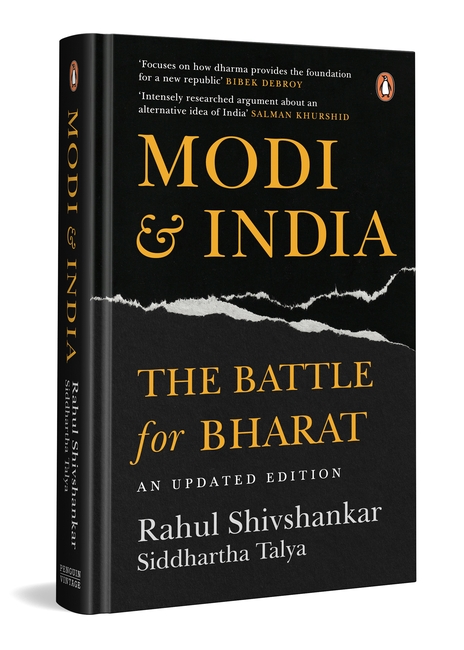
The Narendra Modi-led National Democratic Alliance (NDA) was voted to power in the year 2014. That election was to prove to be a consequential one for the Bharatiya Janata Party (BJP) and for India. The Indian National Developmental Inclusive Alliance (INDIA) bloc had since declared the 2024 election as the last opportunity to stop the rise of Modi and his idea of India. That project didn’t succeed. The NDA won even though the BJP fell short of the majority mark on its own. The setback hasn’t deterred Prime Minister Modi from proceeding with the BJP’s ideological agenda.
In line with that objective, PM Modi has worked to position Bharat as a ‘Vishwa Guru’—an exemplar of moral righteousness, a pluralistic democracy led by dharma and drawing sustenance from the wellspring of an eternal Hindu universalism. But this shift towards India’s Hindu ethos has forced the Opposition and many allied commentators to fear the rise of a second republic—a ‘Hindu Rajya’—moored to an implacable ultra-nationalist and majoritarian dogma. But is that really the case?
Evocative, anecdotal, argumentative and deeply researched, Modi and India: The Battle for Bharat chronicles the emergence of, and the battle for, a new republic in the making.

The unknown history of economic conservatism in India after independence.
Neoliberalism is routinely characterized as an antidemocratic, expert-driven project aimed at insulating markets from politics, devised in the North Atlantic and projected on the rest of the world. Revising this understanding, Toward a Free Economy shows how economic conservatism emerged and was disseminated in a postcolonial society consistent with the logic of democracy.
Twelve years after the British left India, a Swatantra (“Freedom”) Party came to life. It encouraged Indians to break with the Indian National Congress Party, which spearheaded the anticolonial nationalist movement and now dominated Indian democracy. Rejecting Congress’s heavy-industrial developmental state and the accompanying rhetoric of socialism, Swatantra promised “free economy” through its project of opposition politics.
As it circulated across various genres, “free economy” took on meanings that varied by region and language, caste and class, and won diverse advocates. These articulations, informed by but distinct from neoliberalism, came chiefly from communities in southern and western India as they embraced new forms of entrepreneurial activity. At their core, they connoted anticommunism, unfettered private economic activity, decentralized development, and the defense of private property.
Opposition politics encompassed ideas and practice. Swatantra’s leaders imagined a conservative alternative to a progressive dominant party in a two-party system. They communicated ideas and mobilized people around such issues as inflation, taxation, and property. And they made creative use of India’s institutions to bring checks and balances to the political system.
Democracy’s persistence in India is uncommon among postcolonial societies. By excavating a perspective of how Indians made and understood their own democracy and economy, Aditya Balasubramanian broadens our picture of neoliberalism, democracy, and the postcolonial world.

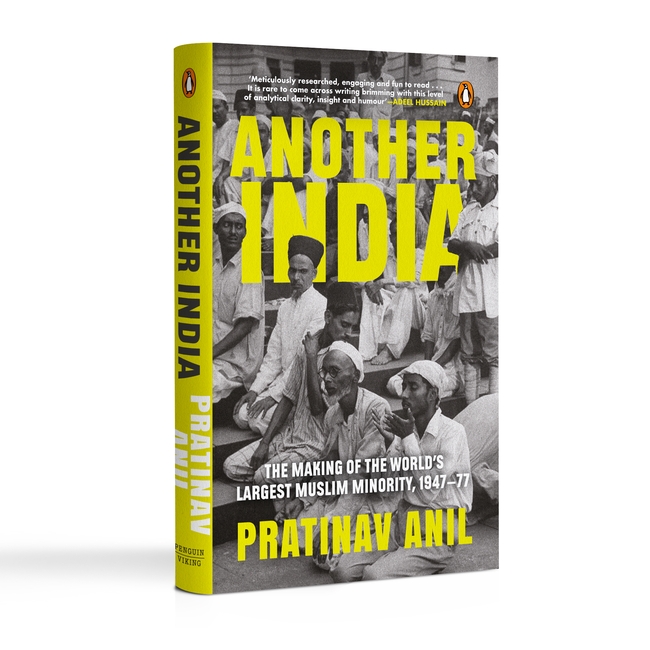
Another India tells the story of the world’s biggest religious minority through vivid biographical portraits that weave together the stories of both elite and subaltern Muslims.
By challenging traditional histories and highlighting the neglect of minority rights since Independence, Pratinav Anil argues that Muslims, since 1947, have had to contend with discrimination, disadvantage, deindustrialization, dispossession and disenfranchisement, as well as an unresponsive leadership. He explores the rise and fall of the Indian Muslim elite and the birth of the nationalist Muslim, and emphasizes the importance of class in understanding the dynamics of Indian politics.
Anil also sheds light on the vested custodial interests and the depoliticization of the privileged classes, all of which resulted in the elite betrayal by the landed gentry of the ordinary members of the community, a betrayal whose consequences are still felt by India’s 200 million Muslims today.
Another India ultimately recovers Muslim agency from the back pages of history and offers a different picture of democratic India, challenging received accounts of the world’s largest democracy.

Political Hinduism was once considered a sort of fringe ideology, shadowy and even misunderstood. Its ideas and narratives seemed, in popular discourse, to lack analytical rigour and were easily dismissed.
But history shows that political Hinduism as an intellectual idea was a pioneering theme in India’s nationhood. In fact, it precedes the Indian republic and has been one of the most resilient political theories of India, which survived many bans, boycotts and decades out of power to become, in the twenty-first century, the predominant political force of India. The adherents of political Hinduism are as determined as its detractors—one complains about facing relentless prejudice; the other throws accusations of promoting continuous religious strife. One believes that India cannot be saved without decimating political Hinduism; the other is sanguine that only political Hinduism can save the future of India.
Soul and Sword traces the journey of political Hinduism from events that are critical to its self-narration, that is, early Indian resistance to invasions, to intellectual definitions by nineteenth-century littérateurs and more contemporary electoral politics. It tries to understand the context and historical sources used to construct and promote political Hinduism’s world view.
From award-winning writer Hindol Sengupta, Soul and Sword is absolutely critical reading to understand India’s present and future.

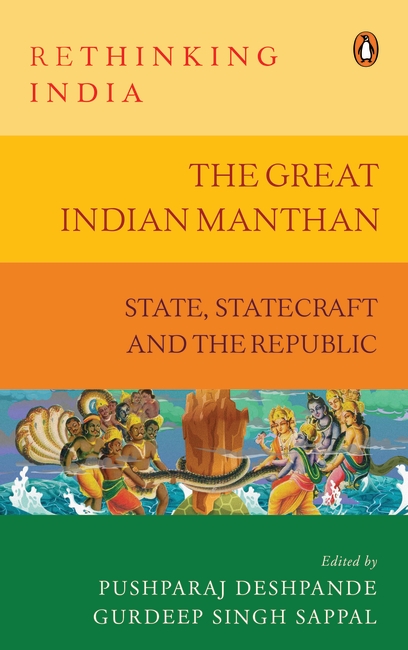
The Great Indian Manthan: State, Statecraft and the Republic features sharply insightful and meaningful essays from India’s foremost politicians and practitioners. Collectively, they dissect the why, what and how of the Indian State.
Each essay in the tenth volume of the Rethinking India series outlines the norms that underpin the governing instruments of the Indian State and critically analyse how they function. In a measured and methodical manner, they then demonstrate how the State has deviated from its constitutional raj dharma (moral duties) and the adverse impacts this has had on every aspect of India’s society, economy and polity. The essays thus juxtapose what should have been, what is and what should be. From their singularly unique vantage point, the authors also propose innovative and disruptive solutions to redress structural fault lines that hold India back.
This is a must-have book for policymakers, academics, activists, businesspersons, diplomats, journalists and anyone interested in understanding the black box of the Indian State.

यह किताब सामाजिक कार्यकर्ताओं, शिक्षाविदों, पत्रकारों, एनजीओ से जुड़े लोगों या आम लोगों के लिए भी एक ज़रूरी किताब है। इसमें ग्रामीण विकास को लेकर ऐसे तथ्य और ऐसी रिपोर्टिंग की गई है जिसे सरकारी अधिकारी मानने के लिए राज़ी नहीं हो सकते।
इस पुस्तक में सुदूर इलाकों की अड़सठ रिपोर्टें, दस लेख और उनतीस तस्वीर हैं जो ग्रामीण भारत की व्यथा को सामने लाती है।
इसमें भूख है, बदहाल खेती है, सूदखोर महाजन हैं और बंधुआ मजदूर हैं। यह किताब हर संवेदनशील व्यक्ति के लिए एक ज़रूरी किताब है।