



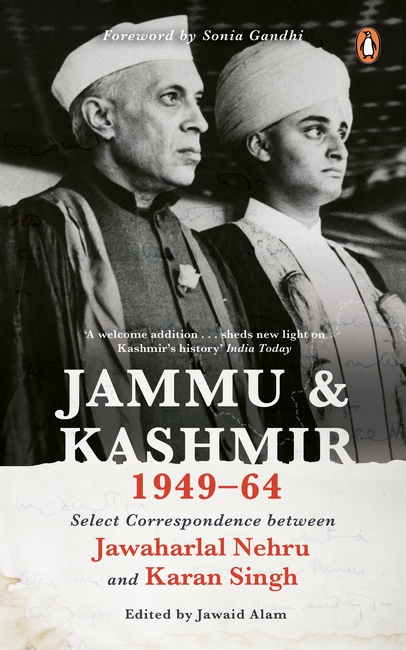
In 1949, Dr Karan Singh had just turned eighteen when he was appointed regent of Jammu and Kashmir, two years after his father, Maharaja Hari Singh, signed the Instrument of Accession merging the then independent state with India. Under the mentorship of Pandit Jawaharlal Nehru, Dr Singh was at the helm of affairs in the state for eighteen years, successively as regent, Sadar-i-Riyasat and governor.
This carefully conceived selection of over 200 letters exchanged between Dr Singh and Pandit Nehru sheds light on significant issues and events, including the teething problems of a fledgling country and a newly grafted state, the emerging conflicts between Pakistan and India, and the Chinese aggression of 1962. In addition to valuable insights into the political situation of the period, these letters also provide rare glimpses into the personal lives and thoughts of Pandit Nehru and Dr Singh. The memorandum submitted by Maharaja Hari Singh to President Rajendra Prasad in August 1952 is published in full, revealing how the identity and future of Kashmir were shaped.
A rare collection, Jammu and Kashmir offers an unmatched ringside view of the momentous events in Kashmir and the rest of India after Independence.
Catagory: Religion
Pakistan
Among the USA’s allies in the war against terrorism, Pakistan cannot be easily characterized as either friend or foe. Nuclear-armed Pakistan is an important centre of radical Islamist ideas and groups. After 9/11, the selective cooperation of President General Pervez Musharraf in sharing intelligence with the United States and apprehending Al-Qaeda members led to the assumption that Pakistan might be ready to give up its long-standing ties with radical Islam. But Pakistan’s status as an Islamic ideological state is closely linked with the Pakistani elite’s world view and the praetorian ambitions of its military.
Pakistan: Between Mosque and Military analyses the origins of the relationships between Islamist groups and Pakistan’s military, and explores the nation’s quest for identity and security. Tracing how the military has sought US support by making itself useful for concerns of the moment-while continuing to strengthen the mosque-military alliance within Pakistan-Haqqani offers an alternative view of political developments since the country’s Independence in 1947.
This new edition of this classic work includes data updates and an Epilogue by the author.
Identity & Survival
Drawing on his experiences in Punjab as director general of police from 3 July 1984-within weeks of Operation Blue Star-to 22 August 1985, Kirpal Dhillon writes about the phase of militancy in the state as not just a law and order problem but a question of Sikh nationalism, of a minority under threat. This is an insider’s view of the factors that bedeviled Punjab for close to two decades. Coming from a man who witnessed the drama first-hand and analyzed its historical causes, this book is a valuable addition to literature on the Sikh community’s darkest years-a phase that is not necessarily over.
Sarama And Her Children
The most recognized dog in Indian myth is the dog in the Mahabharata that accompanied the Pandavasnot actually a dog but Dharma in disguise. There are, however, several more references to dogs in the classical texts. Mentioned for the first time in the Rg Veda, the eponymous Sarama is the dog of the gods and the ancestor of all dogs. In Sarama and Her Children, the evolution of the Indian attitude towards dogs is traced through the vedas, epics, puranas, dharmashastras and niti shastras. The widespread assumption is that dogs have always been looked down upon in Hinduism and a legacy of that attitude persists even now. Tracing the Indian attitude towards dogs in a chronological fashion, beginning with the pre-Vedic Indus Valley civilization, Bibek Debroy discovers that the truth is more complicated. Dogs had a utilitarian role in pre-Vedic and Vedic times. There were herd dogs, watchdogs and hunting dogs, and dogs were used as beasts of burden. But by the time of the Mahabharata, negative associations had begun to creep in. Debroy argues convincingly that the change in the status of the dog in India has to do with the progressive decline of the traditional Vedic gods Indra, Yama and Rudra (who were associated with dogs), and the accompanying elevation of Vishnu, associated with an increase in brahmana influence. Debroy demonstrates that outside the mainstream caste Hindu influence, as reflected in doctrines associated with Shiva and in Buddhist jataka tales, dogs did not become outcasts or outcastes. Drawing references from high and low literature, folk tales and temple art, Sarama and Her Children dispels some myths and ensures that the Indian dog also has its day.
The Vedas
The Mahabharata
The Mahabharata is one of the greatest stories ever told. Though the basic plot is widely known, there is much more to the epic than the dispute between Kouravas and Pandavas that led to the battle in Kurukshetra. It has innumerable sub-plots that accommodate fascinating meanderings and digressions and it has rarely been translated in full, given its formidable length of 80,000 shlokas or couplets. This magnificent 10-volume unabridged translation of the epic is based on the Critical Edition compiled at the Bhandarkar Oriental Research Institute.
The final volume ends the instructions of the Anushasana Parva. The horse sacrifice is held and Dhritarashtra, Gandhari, Kunti, Vidura and Sanjaya leave for the forest. Krishna and Balarama die as the Yadavas fight among themselves. The Pandavas leave on the great journey with the famous companion – Dharma disguised as a dog. Refusing to abandon the dog, Yudhishthira goes to heaven in his physical body and sees all the Kurus and the Pandavas are already there.
Every conceivable human emotion figures in the Mahabharata, the reason why the epic continues to hold sway over our imagination. In this lucid, nuanced and confident translation, Bibek Debroy makes the Mahabharata marvellously accessible to contemporary readers.
The Mahabharata
The Mahabharata is one of the greatest stories ever told. Though the basic plot is widely known, there is much more to the epic than the dispute between Kouravas and Pandavas that led to the battle in Kurukshetra. It has innumerable sub-plots that accommodate fascinating meanderings and digressions, and it has rarely been translated in full, given its formidable length of 80,000 shlokas or couplets. This magnificent 10-volume unabridged translation of the epic is based on the Critical Edition compiled at the Bhandarkar Oriental Research Institute.
*
The final volume ends the instructions of the Anushasana Parva. The horse sacrifice is held, and Dhritarashtra, Gandhari, Kunti, Vidura and Sanjaya leave for the forest. Krishna and Balarama die as the Yadavas fight among themselves. The Pandavas leave on the great journey with the famous companion-Dharma disguised as a dog. Refusing to abandon the dog, Yudhishthira goes to heaven in his physical body and sees all the Kurus and the Pandavas are already there.
*
Every conceivable human emotion figures in the Mahabharata, the reason why the epic continues to hold sway over our imagination. In this lucid, nuanced and confident translation, Bibek Debroy makes the Mahabharata marvellously accessible to contemporary readers.
The Hanging of Afzal Guru
A comprehensive, sensitive view of one of the most controversial hangings of modern India
On 13 December 2001, the Indian Parliament was attacked by a few heavily armed men. Eleven years later, we still do not know who was behind the attack, nor the identity of the attackers. Both the Delhi high court and the Supreme Court of India have noted that the police violated legal safeguards, fabricated evidence and extracted false confessions. Yet, on 9 February 2013, one man, Mohammad Afzal Guru, was hanged to ‘satisfy’ the ‘collective conscience’ of society.
This updated reader brings together essays by lawyers, academics, journalists and writers who have looked closely at the available facts and who have raised serious questions about the investigations and the trial. This new version examines the implications of Mohammad Afzal Guru’s hanging and what it says about the Indian government’s relationship with Kashmir
The Shape of the Beast
The Shape of the Beast is our world laid bare by a mind that has consistently and unhesitatingly engaged with its changing realities and often anticipated the way things have moved in the last decade.
In the fourteen interviews collected here, conducted between January 2001 and March 2008, Arundhati Roy examines the nature of state and corporate power as it has emerged during this period, and the shape that resistance movements are taking. As she speaks about people displaced by dams and industry, the genocide in Gujarat, Maoist rebels, the war in Kashmir and the global War on Terror, she raises fundamental questions about democracy, justice and non-violent protest.
Unabashedly political, this is also a deeply personal collection that talks about the necessity of taking a stand and about the dilemma of guarding the private space necessary for writing in a world that demands urgent, unequivocal intervention.
Listening to Grasshoppers
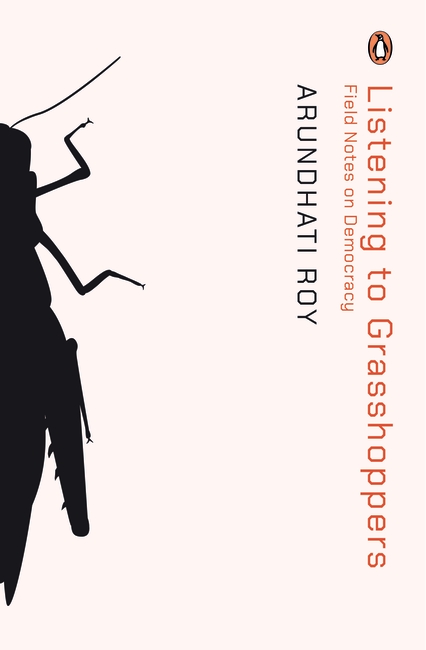
Now with a new introduction by the author discussing the election of India’s new prime minister, Narendra Modi.
In eleven powerful, and closely argued, linked essays, Arundhati Roy takes a hard look at the underbelly of the world’s largest democracy. Beginning with the state-backed killing of Muslims in Gujarat in 2002, she writes about how ‘progress’ and genocide have historically gone hand in hand; about the murky investigations into the 2001 attack on the Indian Parliament; about the dangers of an increasingly powerful and entirely unaccountable judiciary; and about the collusion between large corporations, the government and the mainstream media. The volume ends with an account of the August 2008 uprising in Kashmir and an analysis of the November 2008 attacks on Mumbai. ‘The Briefing’, included as an appendix, is a compelling fictional text that brings together many of the issues central to the collection.