



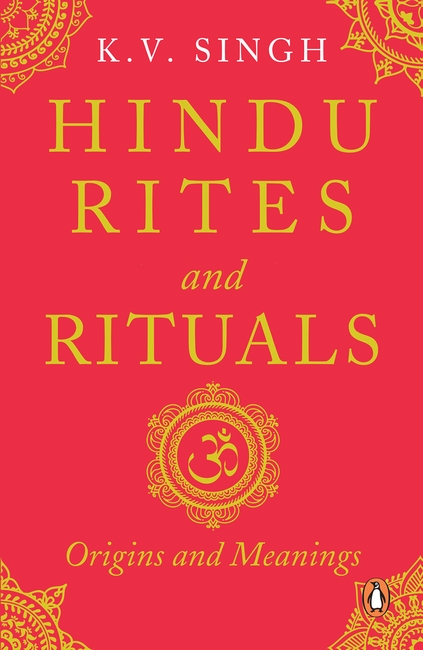
Why is the tulsi considered sacred?
What is the significance of namaste?
Why do Hindus light a lamp before performing a ritual?
Why is it forbidden to sleep facing the south?
Why do Hindus chant ‘shanti’ three times after performing a rite?
Millions of Hindus the world over grow up observing rites, rituals and religious practices that lie at the heart of Hinduism, but which they don’t know the significance of. Often the age-old customs, whose relevance is lost to modern times, are dismissed as meaningless superstitions. The truth, however, is that these practices reveal the philosophical and scientific approach to life that has characterized Hindu thought since ancient times; it is important to revive their original meanings today.
This handy book tells the fascinating stories and explains the science behind the Hindu rites and rituals that we sometimes follow blindly. It is essential reading for anyone interested in India’s cultural tradition.
Catagory: Religion
Hinduism And Nature
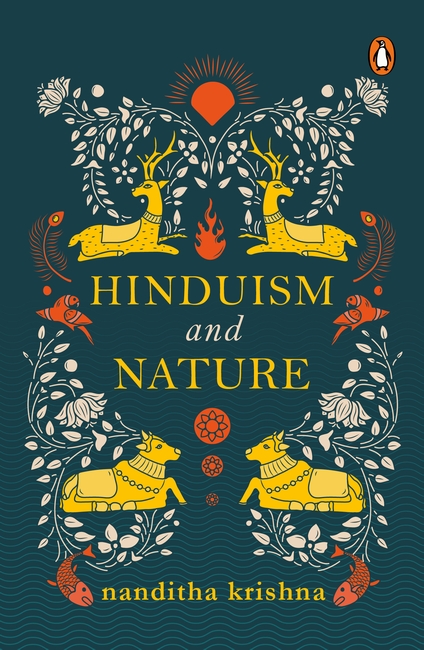
The basis of Hinduism is dharma or righteousness, incorporating duty, cosmic law and justice. Five thousand years ago, the Vedas showed a clear appreciation of the natural world and its ecology, the importance of the environment and the management of natural resources.
Hinduism and Nature delves into the religion’s deep respect for all life forms, the forests and trees, rivers and lakes, animals and mountains, which are all manifestations of divinity. Nature is venerated all over India: every village has a sacred grove, every temple a sacred garden and sacred tree. In this fascinating book, scholar and environmentalist Nanditha Krishna explores both the classical and the tribal traditions that venerated nature, and convincingly argues that we can save the environment only by seeking answers in ancient wisdom.
Pakistan under Siege
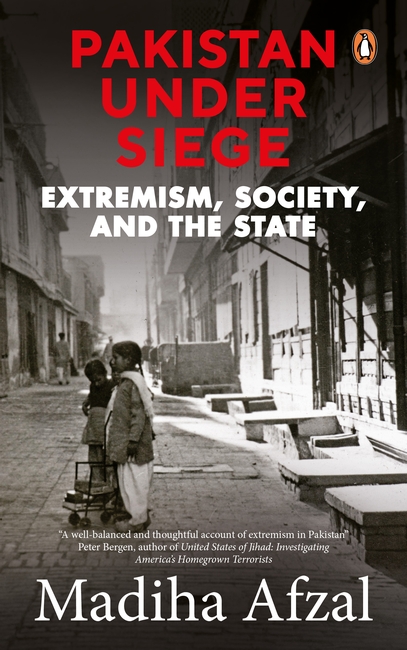
Much of the current work on extremism in Pakistan tends to study extremist trends in the country from a detached position-a top-down security perspective that renders a one-dimensional picture of what is at its heart a complex, richly textured country of 200 million people. In this book, using rigorous analysis of survey data, in-depth interviews in schools and universities in Pakistan, historical narrative reporting, and her own intuitive understanding of the country, Madiha Afzal gives the full picture of Pakistan’s relationship with extremism. The author lays out Pakistanis’ own views-on terrorist groups, jihad, religious minorities and non-Muslims, America, and their place in the world. The views are not radical at first glance, but are riddled with conspiracy theories. Afzal explains how the two pillars that define the Pakistani state-Islam and a paranoia about India-have led to a regressive form of Islamization in Pakistan’s narratives, laws, and curricula. These, in turn, have shaped its citizens’ attitudes.
Afzal traces this outlook to Pakistan’s unique and tortured birth. She examines the rhetoric and the strategic actions of three actors in Pakistani politics-the military, the civilian governments, and the Islamist parties-and their relationships with militant groups. She shows how regressive Pakistani laws instituted in the 1980s worsened citizen attitudes and led to vigilante and mob violence. The author also explains that the educational regime has become a vital element in shaping citizens’ thinking. How many years one attends school, whether the school is public, private, or a madrassa, and what curricula are followed, all affect Pakistanis’ attitudes toward terrorism and the rest of the world.
In the end, Afzal suggests how this beleaguered nation-one with seemingly insurmountable problems in governance and education-can change course.
The Valmiki Ramayana Vol. 3

The Valmiki Ramayana remains a living force in the lives of the Indian people. A timeless epic, it recounts the legend of the noble prince Rama and his battle to vanquish the demon king Ravana.
Even before he is crowned king of Ayodhya, Rama is exiled to the Dandaka forests where he is accompanied by his beauteous wife Sita and loyal brother Lakshmana. Deep in the jungle, Sita is abducted by Ravana and taken to his island kingdom Lanka, setting into motion a dramatic chain of events that culminates in an epoch-defining war. Filled with adventure and spectacle, the Ramayana is also the poignant story of a family caught up in the conflict between personal duty and individual desires.
In Bibek Debroy’s majestic new translation, the complete and unabridged text of the Critical Edition of this beloved epic can now be relished by a new generation of readers.
The Valmiki Ramayana (Box Set)
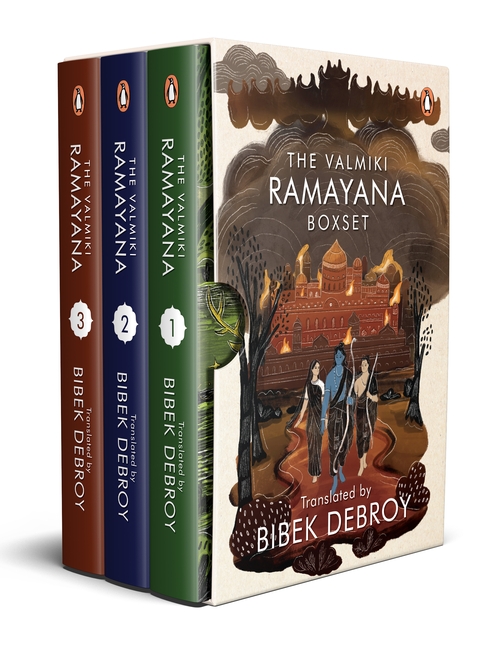
The Valmiki Ramayana remains a living force in the lives of the Indian people. A timeless epic, it recounts the legend of the noble prince Rama and his battle to vanquish the demon king Ravana.
Even before he is crowned king of Ayodhya, Rama is exiled to the Dandaka forests where he is accompanied by his beauteous wife Sita and loyal brother Lakshmana. Deep in the jungle, Sita is abducted by Ravana and taken to his island kingdom Lanka, setting into motion a dramatic chain of events that culminates in an epoch-defining war. Filled with adventure and spectacle, the Ramayana is also the poignant story of a family caught up in the conflict between personal duty and individual desires.
In Bibek Debroy’s majestic new translation, the complete and unabridged text of the Critical Edition of this beloved epic can now be relished by a new generation of readers.
The Valmiki Ramayana Vol. 1
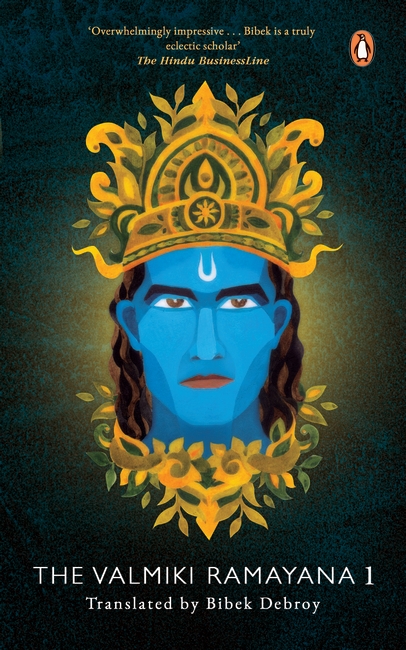
The Valmiki Ramayana remains a living force in the lives of the Indian people. A timeless epic, it recounts the legend of the noble prince Rama and his battle to vanquish the demon king Ravana.
Even before he is crowned king of Ayodhya, Rama is exiled to the Dandaka forests where he is accompanied by his beauteous wife Sita and loyal brother Lakshmana. Deep in the jungle, Sita is abducted by Ravana and taken to his island kingdom Lanka, setting into motion a dramatic chain of events that culminates in an epoch-defining war. Filled with adventure and spectacle, the Ramayana is also the poignant story of a family caught up in the conflict between personal duty and individual desires.
In Bibek Debroy’s majestic new translation, the complete and unabridged text of the Critical Edition of this beloved epic can now be relished by a new generation of readers.
The Valmiki Ramayana Vol. 2
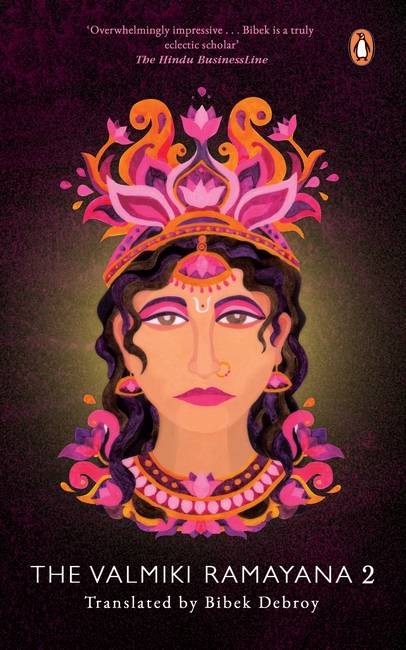
The Valmiki Ramayana remains a living force in the lives of the Indian people. A timeless epic, it recounts the legend of the noble prince Rama and his battle to vanquish the demon king Ravana.
Even before he is crowned king of Ayodhya, Rama is exiled to the Dandaka forests where he is accompanied by his beauteous wife Sita and loyal brother Lakshmana. Deep in the jungle, Sita is abducted by Ravana and taken to his island kingdom Lanka, setting into motion a dramatic chain of events that culminates in an epoch-defining war. Filled with adventure and spectacle, the Ramayana is also the poignant story of a family caught up in the conflict between personal duty and individual desires.
In Bibek Debroy’s majestic new translation, the complete and unabridged text of the Critical Edition of this beloved epic can now be relished by a new generation of readers.
The Mahabharata
This definitive and magnificent 10-volume unabridged translation is one of the rare English translations of full of the epic. Bibek Debroy makes the Mahabharata marvelously accessible to contemporary readers. Dispute over land and kingdom may lie at the heart of this story of war between cousins-the Pandavas and the Kouravas-but the Mahabharata is about conflicts of dharma. These conflicts are immense and various, singular and commonplace. Throughout the epic, characters face them with no clear indications of what is right and what is wrong; there are no absolute answers. Thus every possible human emotion features in the Mahabharata, the reason the epic continues to hold sway over our imagination.
In this superb and widely acclaimed translation of the complete Mahabharata, Bibek Debroy takes on a great journey with incredible ease. This is the fifth volume in the series.
The Mahabharata
This is the sixth book in the definitive and magnificent 10-volume unabridged translation of one of the rare English translations of the full epic. Bibek Debroy makes the Mahabharata marvellously accessible to contemporary readers. Dispute over land and kingdom may lie at the heart of this story of war between cousins-the Pandavas and the Kouravas-but the Mahabharata is about conflicts of dharma. These conflicts are immense and various, singular and commonplace. Throughout the epic, characters face them with no clear indications of what is right and what is wrong; there are no absolute answers. Thus every possible human emotion features in the Mahabharata, the reason the epic continues to hold sway over our imagination. In this superb and widely acclaimed translation of the complete Mahabharata, Bibek Debroy takes on a great journey with incredible ease.
The Mahabharata

The Mahabharata is one of the greatest stories ever told. Though the basic plot is widely known, there is much more to the epic than the dispute between the Kouravas and the Pandavas that led to the battle in Kurukshetra. It has innumerable sub-plots that accommodate fascinating meanderings and digressions, and it has rarely been translated in full, given itsformidable length of 80,000 shlokas or couplets. This magnificent 10-volume unabridged translation of the epic is based on the Critical Edition compiled at the Bhandarkar Oriental Research Institute.
With the ninth volume, the magnificent epic approaches its end. The war is over and Yudhishthira is crowned. Bhishma’s teachings that began in the eighth volume continue past the Shanti Parva into the Anushasana Parva.
Every conceivable human emotion figures in the Mahabharata, the reason why the epic continues to hold sway over our imagination. In this lucid, nuanced and confident translation, Bibek Debroy makes the Mahabharata marvellously accessible to contemporary readers.