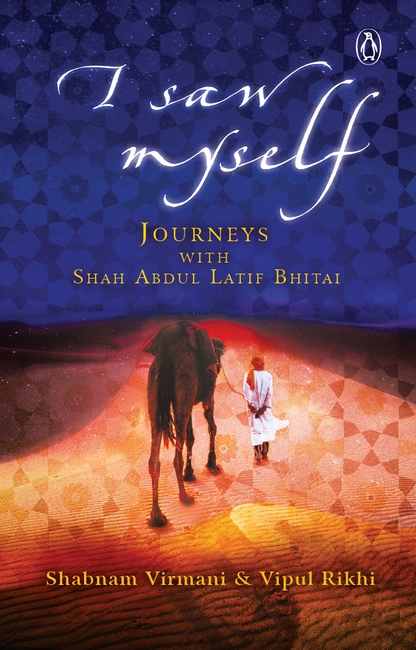
I saw myself
I was the Beloved
I made the world
I myself seek it
Travelling into the stark deserts of Kutch, I Saw Myself explores the contemporary presence of epic love legends of the region, such as Sohini-Mehar and Sasui-Punhu, brought to throbbing verse by the powerful eighteenth-century Sufi poet Shah Abdul Latif Bhitai. As the authors travel to villages to meet folk singers and lovers of Latif’s poetry, immersing in sessions that stretch into the night, they unearth a unique, thriving love-soaked ethos in which the call to oneness rings out like a defiant manifesto for our divisive times.
Retelling epics along with other tales and historical events that created the field of experience from which Shah Latif’s poems sprang, I Saw Myself brings into English a selection of his finest poems. A spell is cast, of story and song, of metaphor and meaning. The insights that emerge are subtle, even startling, radical at times, solace-giving at others, but always deeply meaningful.

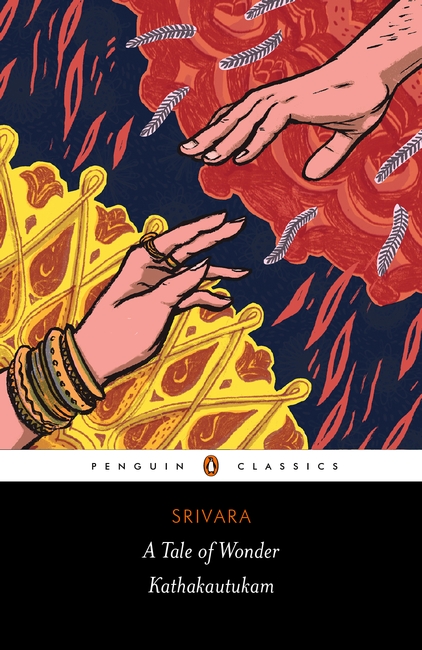
A biblical story travels across regions and time-ultimately reaching medieval India where it is transformed by Shaivite overtones. The result is an exquisite epic love poem of love which also attests to the rich diversity of India’s cultural past.
In an unnamed kingdom in the West, the beautiful princess Zuleikha has nightly visions of a handsome, young man. So captivated is she by this beautiful stranger that her waking hours are afflicted with heartache, much to the anxiety of her father. Zuleikha is resolved to be with Yusuf, and it is in her dreams that she learns of the obstacles that separate her from her beloved. What ensues is a captivating tale of longing and love-a parable of the journey of the soul in its search for the divine.
Magnificent in its simple elegance, A Tale of Wonder is a timeless story that challenges the insidious notion that India has always been dominated by one faith only and insular to other cultural and religious influences.

The essential message of J. Krishnamurti, revered philosopher and spiritual teacher, challenges the limits of ordinary thought. In talks to audiences worldwide, he pointed out the tangled net of ideas, organizational beliefs and psychological mindsets in which humanity is caught, and that truth-the understanding of what is-not effort is the key factor of human liberation.
Commentaries on Living, a three-volume series, records Krishnamurti’s meetings with individual seekers of truth from all walks of life. In these dialogues, he reveals the thought-centred roots of human sorrow and comments on the struggles and issues common to those who strive to break the boundaries of personality and self-limitation. In over fifty essays in each volume, Krishnamurti explores topics as diverse as knowledge, truth, fulfillment, meditation, love, effort, seeking life and death and education.
The series invites readers to take a ‘voyage on an uncharterd sea’ with Krishnamurti in his exploration of the conditioning of the mind and its freedom.

The essential message of J. Krishnamurti, revered philosopher and spiritual teacher, challenges the limits of ordinary thought. In talks to audiences worldwide, he pointed out the tangled net of ideas, organizational beliefs and psychological mindsets in which humanity is caught, and that truth-the understanding of what is-not effort is the key factor of human liberation.
Commentaries on Living, a three-volume series, records Krishnamurti’s meetings with individual seekers of truth from all walks of life. In these dialogues, he reveals the thought-centred roots of human sorrow and comments on the struggles and issues common to those who strive to break the boundaries of personality and self-limitation. In over fifty essays in each volume, Krishnamurti explores topics as diverse as knowledge, truth, fulfillment, meditation, love, effort, seeking life and death and education.
The series invites readers to take a ‘voyage on an unchartered sea’ with Krishnamurti in his exploration of the conditioning of the mind and its freedom.

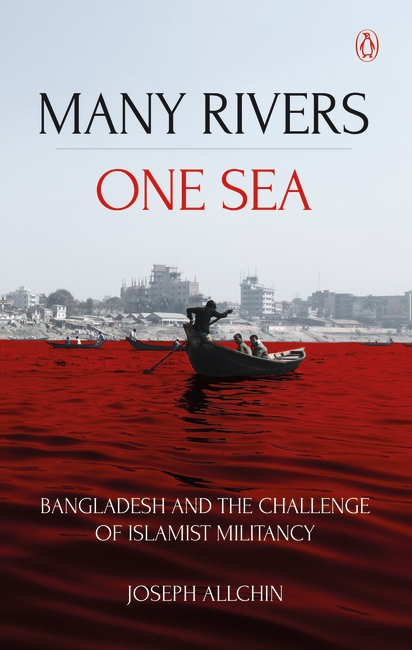
In July 2016, the world’s attention fell upon a café in a leafy Dhaka neighbourhood, as the barbarity of a distant ‘Caliphate’ was visited on this corner of South Asia. Twenty-nine died in the assault on the Holey Bakery, affixing an unbidden nightmare to the image of a supposedly tolerant Muslim nation.
Joseph Allchin dives into this burgeoning Muslim nation’s travails with extremism and politics in this penetrating work. Examining Bangladesh’s recent and not-so-recent past, Allchin explores a recent rise in Islamist politics, as well as violent terrorism. With a compelling blend of history, narrative journalism and political analysis, Allchin demonstrates how Bangladesh’s society and politics are starkly contemporary and relevant to our inter-connected world.
Delving into the local and global differences between political actors, he exposes the continued influence of the country’s independence struggle and global geopolitics on today’s tumultuous body politic. Scrutinizing the careers and dissensions of the country’s political rivals: current prime minister Sheikh Hasina, and her predecessor Khaleda Zia.
This deep-dive investigation examines the multitude of relationships between radical Islam and politics in India’s neighbourhood, laying bare the forces that seek to shape Bangladesh’s present and its destiny.

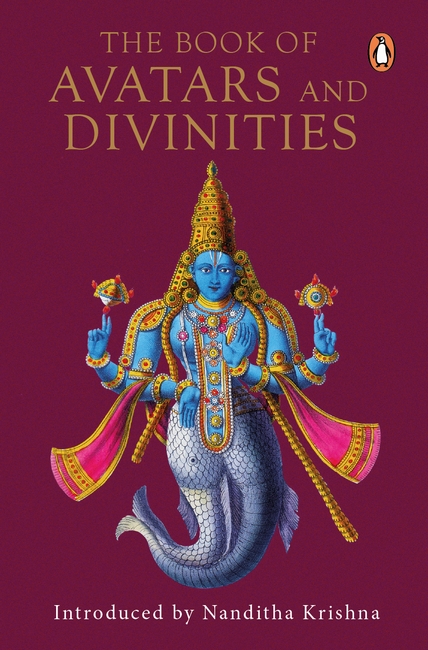
In the Hindu universe, gods and goddesses play freely among human beings to help them, nudge them towards the right action and mete out justice. They may appear to us as avatars in human form or manifest themselves as forces of nature. The many myths of Hinduism become colourful and entertaining when Shiva, Vishnu and Devi take different forms to enact their rivalries, destroy demons and teach devotees with superpowers a lesson in humility.
This first-of-its-kind book brings together the major deities of the Hindu pantheon, describing the different manifestations by which they are recognized, celebrated and worshipped-from Durga to Sita to Kali, and from Narasimha to Parashurama to Krishna. The contributions by Bulbul Sharma, Namita Gokhale, Nanditha Krishna, Parvez Dewan, Royina Grewal and Seema Mohanty offer enchanting stories about our favourite divinities.

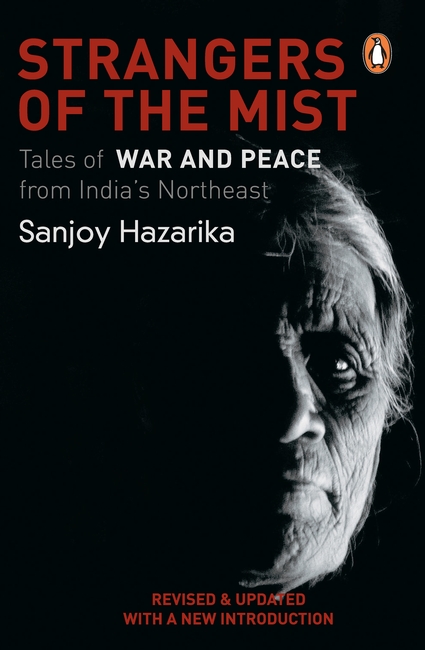
A classic on the festering issues in the North-east
In this insightful book, Hazarika systematically presents the developments in Assam and the neighbouring regions, from post-Independence onwards to the present day. He sheds light on possible causes and factors behind ethnic clashes, separatist outbreaks and political unrest, that this region has come to be known for. He candidly discusses the issue of migrating refugees from nearby countries to the north-eastern states, which has caused tension between the many ethnicities in these states. With a balanced and clear-eyed view, Hazarika urges the reader to take heed of the urgent situation in the region. Strangers of the Mist is considered a classic on the issues facing the North-east.

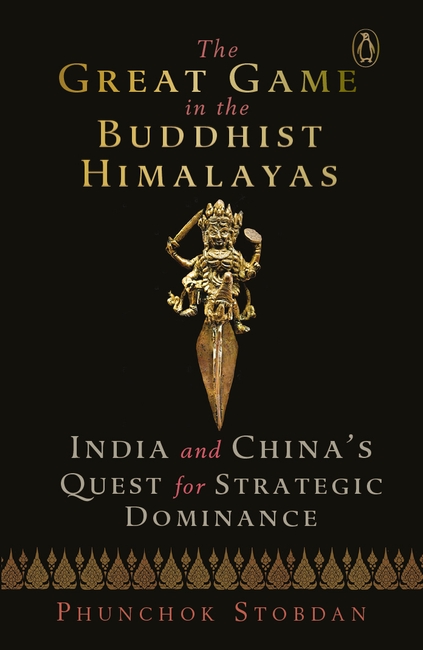
There is a new ‘great game’ being played in the Buddhist Himalayas between India, China and Tibet, which makes for a crucial third player. Together, they are leveraging their influence with the Buddhist communities to create strategic dominance, with varying degrees of success.
China’s ‘Buddhist diplomacy’ has focused on Nepal and Bhutan, and the Indian Himalayan regions of Ladakh, Arunachal Pradesh and Sikkim, which have sizeable Buddhist populations and are vulnerable to this influence. The crisis in Doklam brought into focus what will be one of the most difficult issues to unfold in the Himalayas in future: India’s insufficient ability to deal with China only through the prism of military power.
If Xi Jinping, who is known to be working towards a resolution of the Tibet question, succeeds, and the Dalai Lama does indeed return to Tibet, how will it impact Indian interests in the Buddhist Himalayas? If the Tibet issue remains unresolved, how will India and China deal with and leverage the sectarian strife that is likely to intensify in a post-Dalai Lama world?
The Great Game in the Buddhist Himalayas includes several unknown insights into the India-China, India-Tibet and China-Tibet relationships. It reads like a geopolitical thriller, taking the reader through the intricacies of reincarnation politics, competing spheres of sacred influence, and monastic and sectarian allegiances that will keep the Himalayas on edge for years to come.

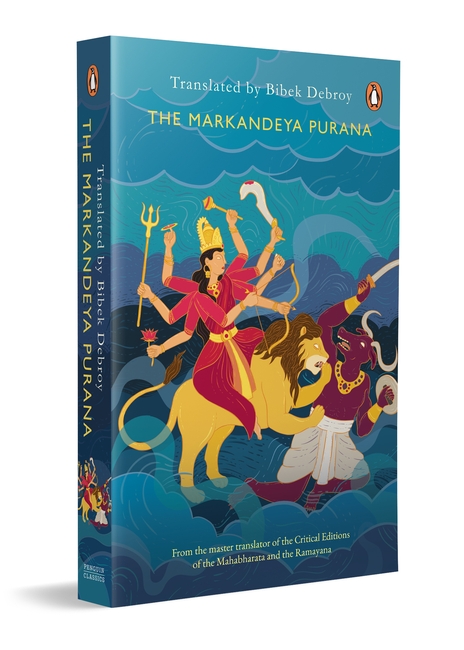
A marvellous amalgam of mythology and metaphysics, the Markandeya Purana unfolds as a series of conversations, in which the sage Markandeya is asked to answer some deeper questions raised by events in the Mahabharata. These illuminating exchanges evolve into a multi-faceted exploration of the core concepts of Hindu philosophy-from an excellent exposition of yoga and its unique attributes to a profound treatise on the worship of the goddess, the Devi Mahatmya, which also includes the popular devotional texts known as ‘Chandi’ or ‘Durga Saptashati’.
Brimming with insight and told with clarity, this luminous text is also a celebration of a complex mythological universe populated with gods and mortals, and contains within its depths many nested tales like that of Queen Madalasa and her famous song.
Bibek Debroy’s masterful translation draws out the subtleties of the Markandeya Purana, enabling a new generation of readers to savour its timeless riches.

The foundational text on dharma and Hindu philosophy, exquisitely rendered by one of our most eminent Sanskrit translators
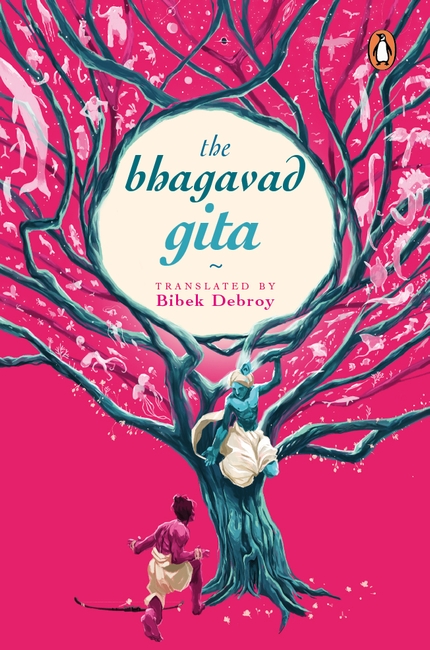
As a spiritual guide, the Bhagavadgita is a mesmerizing account of the debate between right and wrong, and the bond between action and consequence. One of the core Hindu scriptures, it is part of the great Indian epic, the Mahabharata, and unfolds in the form of a dialogue between Krishna and the Pandava prince, Arjuna.
This beautifully produced bilingual edition is a masterful verse-for-verse translation, providing the original Sanskrit verses alongside the English rendition. Bibek Debroy’s deep familiarity with the text yields a treasure trove of insights that will delight the scholar and the lay reader alike, making this essential reading for anyone with an abiding interest in Indian scriptures.