



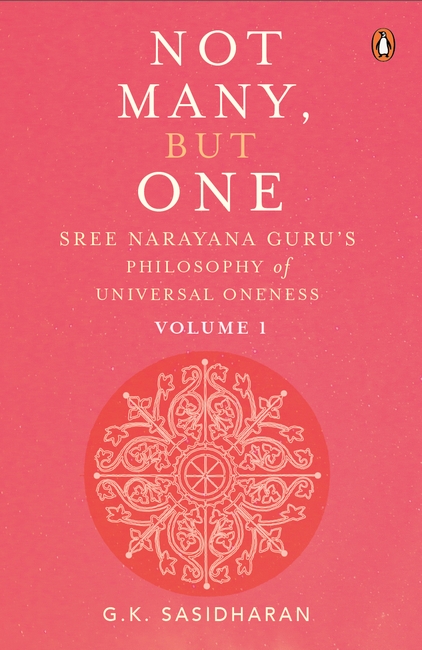
Sree Narayana Guru (1855-1928) was a spiritual leader and social reformer who led powerful movements to promote social equality. Not Many, But One brings together his work in two rich volumes of translation and interpretation, pieced together for a modern readership.
In Volume 1, we see Sree Narayana Guru’s philosophy of Advaita. He foresees the potential and the need for a new approach to science and technology. As a result, he discovered new dimensions of Advaita and revived it in a manner that suited the most sophisticated developments in physics and modern cosmology. This volume is a study of the works and teachings of Sree Narayana Guru on a spiritual and scientific footing. In his work, one can see a deep-rooted correlation of Advaita and quantum cosmology. The translations, explanations and commentary given are simple and conceivable by ordinary readers who may not be well equipped to grasp the complexities of the intuitional spiritual findings of Advaita and hypothetic conclusions of quantum physics-but without compromising on the authenticity of the works.
Vedic philosophers, physicists, cosmologists and enthusiasts of science and spirituality will appreciate this enterprising effort-though with limitations-in bringing closer two hitherto uncompromising schools of thought. The devotees of Sree Narayana Guru will find an opportunity to delve deeper into his work.
Catagory: Sciences, technology & Medicine
Not Many, But One Volume II

Sree Narayana Guru (1855-1928) was a spiritual leader and social reformer who led powerful movements to promote social equality. Not Many, But One brings together his work in two rich volumes of translation and interpretation, pieced together for a modern readership.
In Volume 2, we see how Sree Narayana Guru revived the Advaita philosophy. The book also focuses on the correlation between the teachings of Advaita, the conclusions of modern physics and cosmology, and how Advaita reveals the complex secrets of the universe. It explains the theoretical, observational and experimental findings given by science about the origin, evolution, existence and future of our universe. Volume 2 also explores the Big Bang theory, the inflation theory, the role of dark matter and dark energy, the concept of space and time, the anthropic principle, supersymmetry, spontaneous symmetry breaking, string theory and other latest avenues of modern science. The translations, explanations and commentary given are simple and conceivable by ordinary readers who may not be well equipped with the complexities of intuitional spiritual findings of Advaita and hypothetic conclusions of quantum physics-but without compromising on the authenticity of the works.
Vedic philosophers, physicists, cosmologists and enthusiasts who love science and spirituality will appreciate this enterprising effort – though with limitations – in bringing closer the two hitherto uncompromising schools of thought. The devotees of Sree Narayana Gurudev will find an opportunity to go deeper into his works.
The Coronavirus

On the eve of 31 December 2019, as the world celebrated the start of a new decade, the province of Wuhan alerted the World Health Organization of several ‘flu-like’ cases. Less than a week later, a novel coronavirus, was identified. In February, the disease it caused was named COVID-19. Even now, as the global infection rate crosses 1,00,000 and the death toll surpasses 3000, we are yet to understand the threat posed by this new coronavirus. There is no vaccination to prevent it, and no antiviral to cure the sick. While high numbers are being reported daily, agencies may still be unaware of many cases.
The symptoms of Coronavirus are dangerously similar to that of the common flu: fever, coughing, breathlessness, tiredness, headache and muscle pain. But in India, that has such a high population density, we will have to do more than just stick to Namaste to greet each other. It seems that a crippling pandemic is inevitable. While some of us may find it easier to resign ourselves to fate, what we need most right now is credible and comprehensive information from professionals that can help us understand what the Coronavirus is, and how we can prepare and protect ourselves against it. This is the first book that addresses the history, evolution, facts and myths around the pandemic. The Coronavirus is a timely must-read for everyone keen on understanding its impact and fallout.
Bridgital Nation
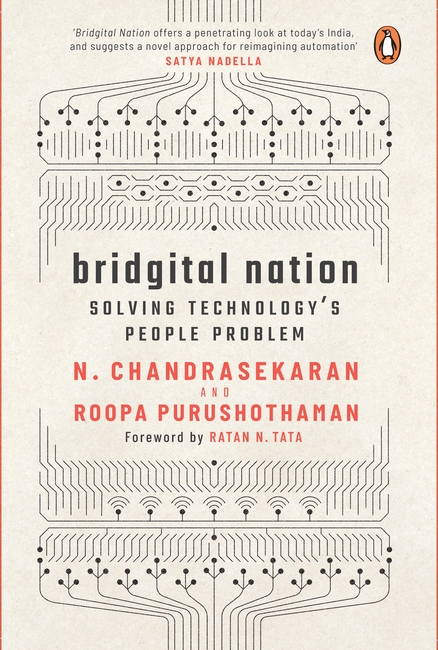
It is 2030. India is among the world’s top three economies. All Indians use advanced technology to either do their job or get their job done. All Indians have access to quality jobs, better healthcare and skill-based education. Technology and human beings coexist in a mutually beneficial ecosystem.
This reality is possible. It is within reach. With Bridgital.
In this ground-breaking book, N. Chandrasekaran, chairman of Tata Sons, presents a powerful vision for the future. To the coming disruption of artificial intelligence, he proposes an ingenious solution, where India is perfectly positioned to pave a unique path from the rest of the world. Instead of accepting technology as an inevitable replacement for human labour, India can use it as an aid; instead of taking them away, AI can generate jobs.
Chandrasekaran and his co-author, Roopa Purushothaman, chief economist of the Tata Group, survey the country for inspirational stories of resilience and determination, and seek the ideal way to bring Indians closer to their dreams through on-ground application of a cutting-edge approach called ‘Bridgital’. This brilliant concept addresses India’s biggest challenges by bridging the huge chasm between rural and urban, illiteracy and education, aspirations and achievement. From healthcare to education to business, the model can be applied in various sectors, and, by a conservative estimate, it can create and impact 30 million jobs by 2025.
One of the country’s foremost industry leaders and pioneers, N. Chandrasekaran brings his expertise of over thirty years with the Tata Group to offer a blueprint for building a prosperous India, where everyone is included in the growth story.
Foreword by Ratan N. Tata
Land Of The Seven Rivers-Pb
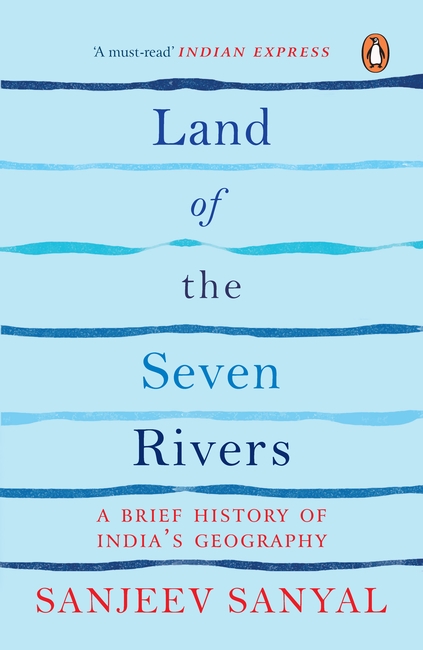
Did ancient India witness the Great Flood? Why did the Buddha give his first sermon at Sarnath? How did the Europeans map India?
Combining scholarship with sparkling wit, Sanjeev Sanyal sets out to explore how India’s history was shaped by its geography-answering questions you may have never thought to ask. Moving from geological and genetic origins to present-day Gurgaon, Land of the Seven Rivers is riveting, wry and full of surprises.
The Meaning of India
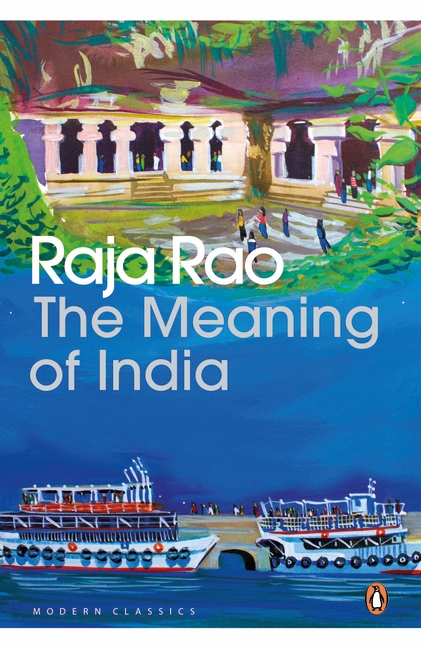
First published in 1996 when he was eighty-eight years old, this selection of nearly six decades of Raja Rao’s non-fiction is an audacious contemplation on the deeper significance of India. A combination of fables, journeys, discussions and meditations, The Meaning of India advances the view that India is not just a geographical entity, or even a civilization-state. India is, above all, a metaphysic, a way of being and regarding the self and the world.
Drawing on a wide range of sources-including the Vedas, the Upanishads, the Ramayana, the Mahabharata, the Gita, the Buddha, Sankara, Bhartrihari, Kalidasa, Dostoevsky, Valéry, Rilke, Mann and Mallarmé-as also meetings with Gandhi, Nehru, Forster and Malraux, Rao teases out the implications of Advaita or non-dualism, which he regards as India’s unique contribution to the world.
Healer
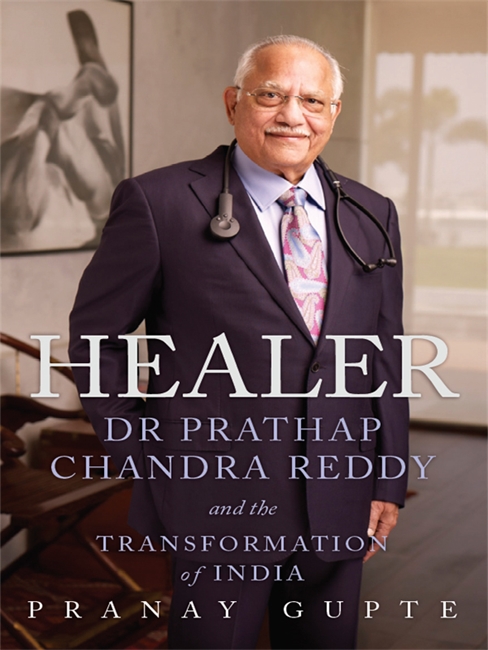
At the age of fifty, when most people start planning for retirement, Dr Prathap Chandra Reddy decided that he was going to revolutionize healthcare in India. In 1983, the renowned cardiologist launched the country’s first professionally run private sector hospital system. Thirty years later, Apollo Hospitals has become one of the world’s largest providers of high-technology healthcare. In the areas of heart, liver and bone marrow transplants, as also in knee and hip replacement surgery and robotic surgery, Apollo is an industry pioneer and a world leader. More than 32 million men and women have been treated at Apollo’s fifty hospitals, where over 70,000 professionals work. How did Dr Reddy, who grew up in the small village of Aragonda in Andhra Pradesh, actualize his dream? How did he overcome the seemingly insurmountable odds and transform the sustainable development space? How did he become one of India’s enduring icons? Full of delightful anecdotes and dramatic twists and turns, The Healer tells Dr Reddy’s inspirational story like it has never been told before.
Where Will Man Take Us?
The first person who will live to be 150 years old has already been born.
The screen that we peer into will soon be within us.
We could soon be taking happiness pills before breakfast.
The perfect partner might need to be charged before bed.
This is a new world we are walking into. And the man who began this journey won’t be the man who ends this journey. Where Will Man Take Us? explores the changes technology is bringing about in us-as a society and as a species. What will the next generation turn into, what will it be like, how will the new Adam and Eve live and love?
In this book, Atul Jalan tackles nanotechnology, artificial intelligence, quantum computing and genetics, seamlessly weaving the future of technology with the changing dynamics of human love, morality and ethics.
The Tech Whisperer
Companies all over the world are being buffeted by new technologies, disruptive business models and start-up innovation. Business leaders know that they need to adopt these new technologies like blockchain, artificial intelligence and Internet of things, and transform their companies using them to keep pace with rapid customer and business environment changes. Therefore, there is an urgent need to understand the basic principles of digital transformation and the technology forces that enable this shift.
The Tech Whisperer, as the name suggests, demystifies and simplifies emerging technologies like AI, blockchain, Internet of things, virtual reality, etc. and narrates how companies can employ these to drive their digital transformation.
Jaspreet Bindra has been a leading practitioner and thought leader in digital transformation and technology. In his first book, he gives an engaging and forward-looking practitioner’s view which can help business leaders, entrepreneurs and anyone looking to understand digital transformation and technology, and leverage them for their future success.