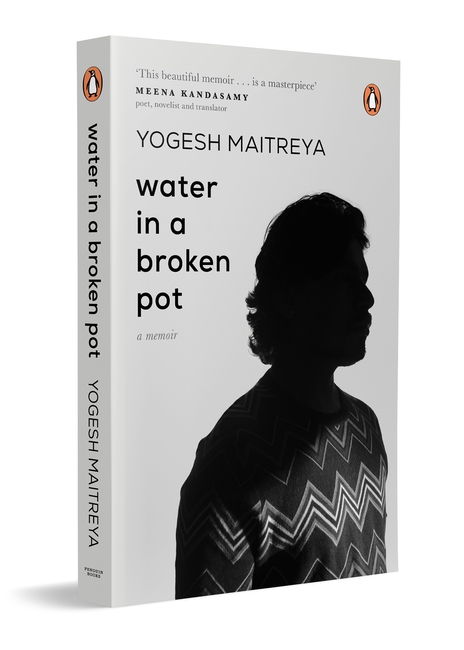
Incredibly moving and hauntingly honest, Water in a Broken Pot is the memoir of Yogesh Maitreya, a leading independent Indian Dalit publisher, writer, and poet. Encompassing experiences of pain, loneliness, depravation, alienation, and the political consciousness of his caste identity, this intimately moving memoir is a story of resilience and raw brutality. Growing up in a working-class family with meagre wages to get by in life, Yogesh writes of his father’s struggle against alcohol and passion for cinema; of intergenerational dreams shattered; working day and night shifts in factories; the struggle of being lost, overlooked and unmentored in India’s schooling, college and University systems which continue to be casteist, exclusionary and hostile; and feelings of lovelessness, loss and heartaches.
Having hopped from gig to gig to make ends meet, he writes of his eventual discovery of the written word, literature and the Ambedkarite legacy, which helped shape his dreams, identity and the eventual career choice of publishing books. In sharing his story, this fresh and radical voice tells his truth in the most frank and unfiltered of ways, as it happened, giving us readers permission to also be vulnerable in telling our tales.

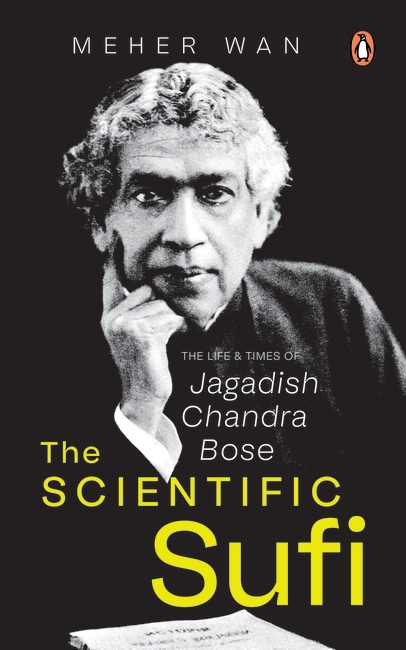
The Scientific Sufi is the most definitive English language biography of Sir Jagdish Chandra Bose, the father of modern science in India. In his time, he came close to, and many believe was robbed of, his due to winning at least two Nobel Prizes, if not one, for his work on wireless communication and the discovery of nervous system in plants. This biography carefully reconstructs his life, times, work, legacy, childhood, early years, influences and paint an intimate portrait of the father of modern science in India.

Is Pluto a planet? Or a dwarf planet? The controversy rages. But this planet, on the fringes of our solar system, has immense astrological significance, unexplored by the Vedic and Western astrologers. Author and scientific astrologer Greenstone Lobo believes Pluto symbolises destruction and regeneration-as the mythological Rudra Shiva.
In a scary and uncertain world-on the edge because of a pandemic, economic crises, ecological disasters and pandemonium in politics, Lobo looks towards Pluto to make sense of the past, present and the future.
He describes the planet’s journey over the last 250 and the next fifty years, as well as the grand scale on which it can operate. Exploring its character and impact, Lobo discusses his techniques for predictions, the cyclical nature of Pluto, how it changed the world order and its relationship with astrological signs.
From his unique insider’s perspective-as someone familiar with the ways of Pluto through his research-Lobo predicts what to expect and how to prepare for it through 91 predictions. What will the next fifty years bring? When will the world see the last of the pandemic? Who will lead India next? Can India win the next Cricket World Cup? What does the future hold for Ranbir Kapoor and Alia Bhatt? What lies in store for star kids Suhana Khan, Hrehaan Roshan, Aarav Akshay Kumar and Aaradhya Bachchan? What about Messi, Angelina Jolie, Rihanna, Beyoncé and others who hold our imagination today?
Through these predictions of good fortune and disasters, scandals and affairs, readers will gain an intimate sense of the rogue planet and its centrality to astrology.
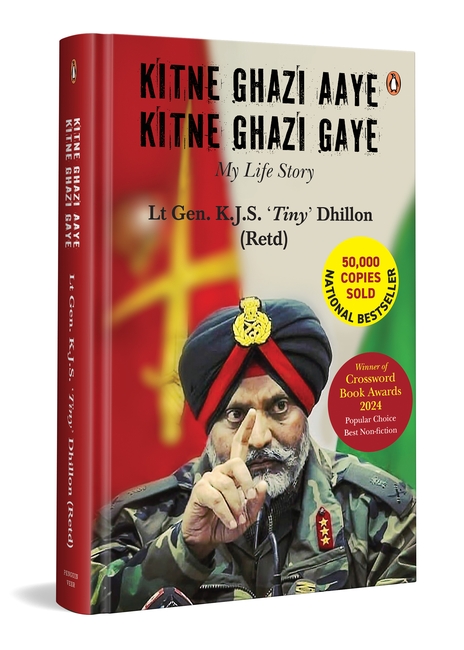
Lieutenant General K.J.S. ‘Tiny’ Dhillon, an Infantry veteran from the Rajputana Rifles with about four decades of military service, has served multiple tenures in Kashmir.
In this book, ‘Tiny’ Dhillon opens a hitherto-closed window, not only to his life but also to Kashmir. He recounts fascinating tales about the toughest challenges he encountered, from age three right up to those from his multiple tenures in Kashmir from 1988 to 2020, where it was his responsibility to maintain a balance between counter-terrorism operations on the one hand and to use military soft power on the other. Dhillon retraces his entire journey, from being a young boy to becoming the Commander of the Chinar Corps, with Kashmir as an inseparable part of this story.
As a first-hand account, the book touches on and demystifies the myths, half-truths, whats, ifs and whys of the exodus of the Kashmiri Pandits; the barbarous attack on an Indian security convoy in Pulwama district, in which forty CRPF personnel were killed; the Balakot air strikes; and the abrogation of Article 370 and its impact on the socio-political, economic and law-and-order situation, among other incidents. It takes us behind the scenes to bring out the nuances of various intriguing developments at a critical juncture in the history of J&K.
Anecdotal, candid and evocative, Kitne Ghazi Aaye, Kitne Ghazi Gaye brings to light the true stories from this Army veteran’s life. It focuses on the personal, professional and, most importantly, family life of a soldier in the Army, and will not only provide an insight into the trials and tribulations he faced but will also inspire a wide spectrum of readers, especially young defence aspirants.
Find Tiny Dhillon online:
Twitter: @Tiny_Dhillon
Instagram: @tinydhillon
Facebook: @TinyDhillon

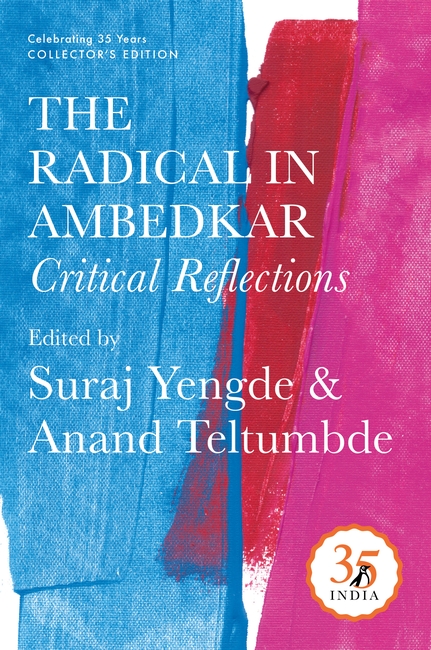
This landmark volume, edited and introduced by Anand Teltumbde and Suraj Yengde, establishes B.R. Ambedkar as the most powerful advocate of equality and fraternity in modern India. While the vibrant Dalit movement recognizes Ambedkar as an agent for social change, the intellectual class has celebrated him as the key architect of the Indian Constitution and the political establishment has sought to limit his concerns to the question of reservations. This remarkable volume seeks to unpack the radical in Ambedkar’s legacy by examining his life work from hitherto unexplored perspectives.
Although revered by millions today primarily as a Dalit icon, Ambedkar was a serious scholar of India’s history, society and foreign policy. He was also among the first dedicated human rights lawyers, as well as a journalist and a statesman. Critically evaluating his thought and work, the essays in this book-by Jean Drèze, Partha Chatterjee, Sukhadeo Thorat, Manu Bhagavan, Anupama Rao and other internationally renowned names-discuss Ambedkar’s theory on minority rights, the consequences of the mass conversion of Dalits to Buddhism, Dalit oppression in the context of racism and anti-Semitism, and the value of his thought for Marxism and feminism, among other global concerns.
An extraordinary collection of immense breadth and scholarship that challenges the popular understanding of Ambedkar, The Radical in Ambedkar is essential reading for all those who wish to imagine a new future.
‘An effortless combination of empathy, moral conviction and deep cultural sensitivity’ ~ Ashis Nandy
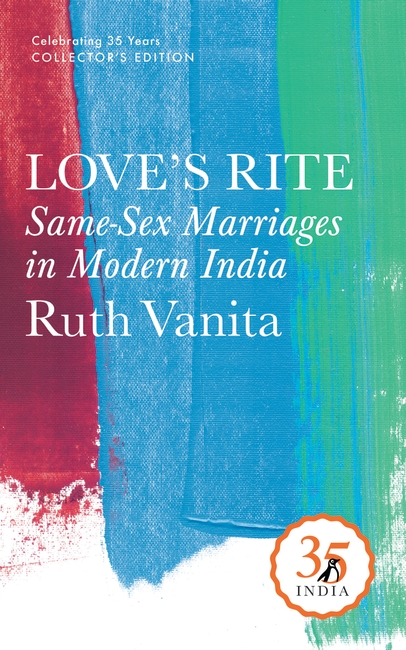
A CHRONICLE OF LOVE’S TRIUMPH OVER ALL OBSTACLES
Long before the debate on marriage equality began, young, non-English speaking, low-income female couples all over India got married by religious rites or committed joint suicide, which they considered being ‘married in death’. These women had no contact with any movement and had never heard words like ‘lesbian’ or ‘gay’. While many families, in collusion with police, violently separated the couples, several families also supported their daughters.
Love’s Rite, first published in 2005, is the first and still the only book-length study of these unions, starting with one reported in 1980. The book argues that the couples asserted-and today still assert-their right to be together, using an age-old language of love understood by Indians. Vanita explores Indian religious, legal and literary traditions that provide spaces for same-sex and other socially disapproved unions.
While many recent high-profile Indian weddings have been reported as the ‘first’ of their kind, Love’s Rite celebrates the unsung pioneers and martyrs of the struggle for marriage equality.
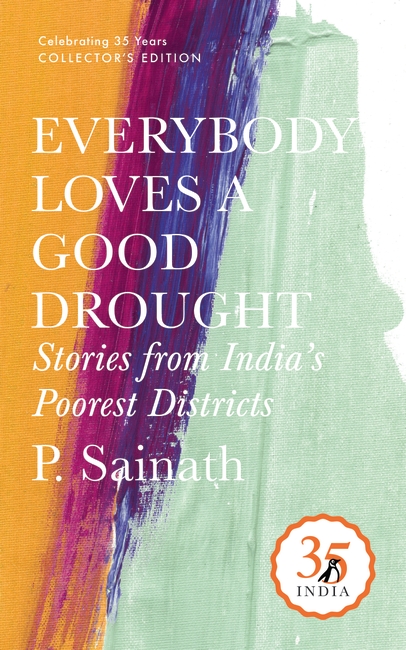
A CLASSIC OF REPORTAGE FROM RURAL INDIA BY AWARD-WINNING AUTHOR, WITH A FOREWORD BY GOPALKRISHNA GANDHI
Acclaimed across the world, prescribed in over 100 universities and colleges, and included in part in The Century’s Greatest Reportage (Ordfront, 2000), alongside the works of Gabriel Garcia Marquez, Studs Terkel and John Reed, Everybody Loves a Good Drought is the established classic on rural poverty in India. Twenty years after publication, it remains unsurpassed in the scope and depth of reportage, providing an intimate view of the daily struggles of the poor and the efforts, often ludicrous, made to uplift them.
An illuminating introduction accompanying this twentieth-anniversary edition reveals, alarmingly, how a large section of India continues to suffer in the name of development so that a small percentage may prosper. Besides exposing chronic misgovernance, it is also a devastating comment on the media’s failure to speak for the voiceless.

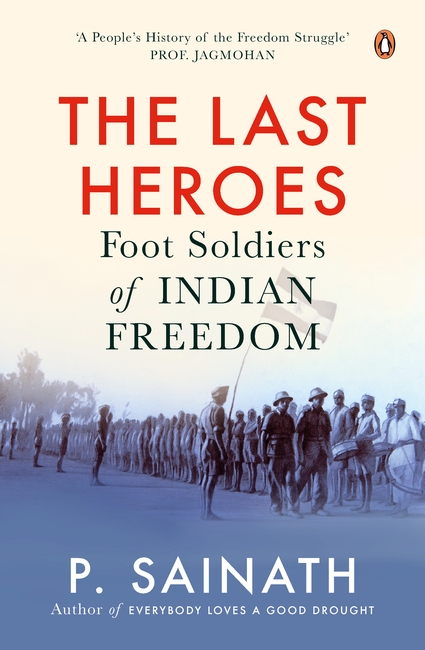
So who really spearheaded India’s Freedom Struggle? Millions of ordinary people-farmers, labourers, homemakers, forest produce gatherers, artisans and others-stood up to the British. People who never went on to be ministers, governors, presidents, or hold other high public office.
They had this in common: their opposition to Empire was uncompromising.
In The Last Heroes, these footsoldiers of Indian freedom tell us their stories. The men, women and children featured in this book are Adivasis, Dalits, OBCs, Brahmins, Muslims, Sikhs and Hindus. They hail from different regions, speak different languages and include atheists and believers, Leftists, Gandhians and Ambedkarites.
The people featured pose the intriguing question: What is freedom? They saw that as going beyond Independence. And almost all of them continued their fight for freedoms long after 1947.
The post-1947 generations need their stories.
To learn what they understood. That freedom and independence are not the same thing. And to learn to make those come together.

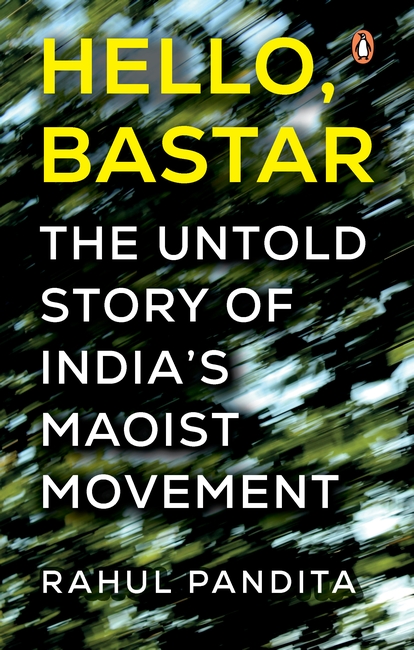
With direct access to the top Maoist leadership, Rahul Pandita provides an authoritative account of how a handful of men and women, who believed in the idea of revolution, entered Bastar in Central India in 1980 and created a powerful movement that New Delhi now terms as India’s biggest internal security threat. It traces the circumstances due to which the Maoist movement entrenched itself in about 10 states of India, carrying out deadly attacks against the Indian establishment in the name of the poor and the marginalised. It offers rare insight into the lives of Maoist guerillas and also of the Adivasi tribals living in the Red zone. Based on extensive on-ground reportage and exhaustive interviews with Maoist leaders including their supreme commander Ganapathi, Kobad Ghandy and others who are jailed or have been killed in police encounters, this book is a combination of firsthand storytelling and intrepid analysis.
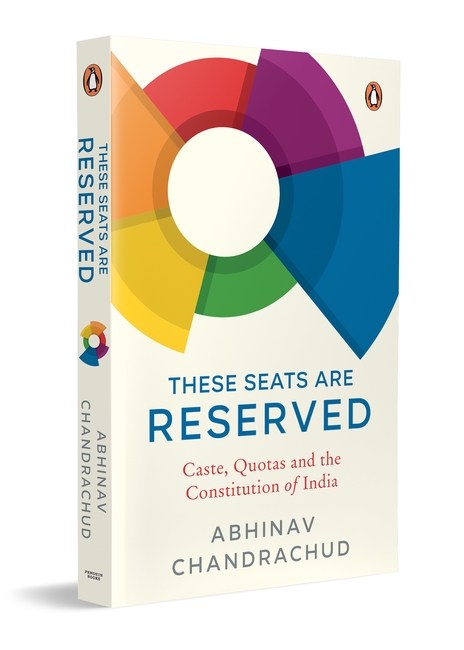
Reservation or affirmative action is a hugely controversial policy in India. While constitutionally mandated and with historians, political scientists and social activists convinced of its need, many resist it and consider it as compromising ‘merit’ and against the principle of equality of opportunity.
In These Seats Are Reserved, Abhinav traces the history and making of the reservation policy.
How were groups eligible for reservations identified and defined? How were the terms ‘depressed classes’ and ‘backward classes’ used in British India and how have they evolved into the constitutional concepts of ‘Scheduled Castes’, ‘Scheduled Tribes’, and ‘Other Backward Classes’ in the present day?
The book delves into the intellectual debates that took place on this matter in the Constituent Assembly, the Supreme Court and Parliament. Several contentious issues are examined dispassionately: are reservations an exception to the principle of equality of opportunity? Do quotas in government service undermine efficiency? Can ‘merit’ really be defined neutrally? What is the thinking behind the rule that no more than 50 per cent of the available seats or positions can be reserved?
Deeply researched and ably narrated, this volume is a compelling addition to every thinking individual’s library.