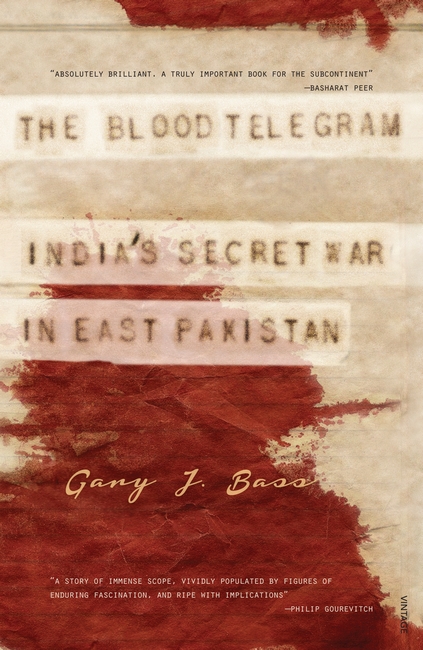
In 1971, the Pakistani army launched a devastating crackdown on what was then East Pakistan (today’s independent Bangladesh), killing thousands of people and sending ten million refugees fleeing into India. The events also sparked the 1971 Indo-Pakistani War.
Drawing on recently declassified documents, unheard White House tapes, and meticulous investigative reporting, Gary Bass gives us an unprecedented chronicle of the break-up of Pakistan, and India’s role in it. This is the pathbreaking account of India’s real motives, the build-up to the war, and the secret decisions taken by Indira Gandhi and her closest advisers.
This book is also the story of how two of the world’s great democracies-India and the United States-dealt with one of the most terrible humanitarian crises of the twentieth century. Gary Bass writes a revealing account of how the Bangladeshis became collateral damage in the great game being played by America and China, with Pakistan as the unlikely power broker. The United States’ embrace of the military dictatorship in Islamabad would affect geopolitics for decades, beginning a pattern of Ameranti-democratic engagement in Pakistan that went back far beyond General Musharraf.
The Blood Telegram is a revelatory and compelling work, essential reading for anyone interested in the recent history of our region.
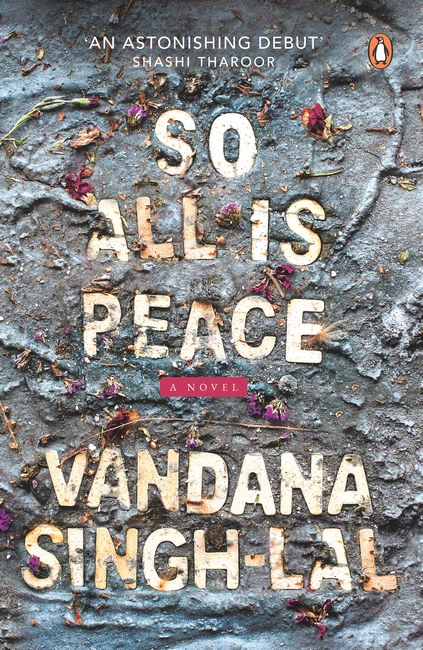
But sit down, breathe deep, and ask a woman. Any woman. They are there.
When twin sisters Layla and Tanya are found starving in their upmarket apartment, there is frenzy in the media. How often does one find two striking, twenty-something women, one half-dead, the other not speaking, living in a state of disrepair and chaos, for no apparent reason? Theories about them are rampant, but disillusioned journalist Raman is loath to follow the story. That is, until Tanya begins to talk to him, and the darker truth behind the sisters’ lives starts to unravel.
A richly atmospheric, deeply claustrophobic story with a stunning denouement, of two women confronting the everyday realities of their city and country, So all is Peace provides an unflinching insight into love, lust, fear, grief, and the decisions we make, through a cast of sharply drawn characters brought together by an unspoken wrong.

In this explosive book, Suraj Yengde, a first-generation Dalit scholar educated across continents, challenges deep-seated beliefs about caste and unpacks its many layers. He describes his gut-wrenching experiences of growing up in a Dalit basti, the multiple humiliations suffered by Dalits on a daily basis, and their incredible resilience enabled by love and humour. As he brings to light the immovable glass ceiling that exists for Dalits even in politics, bureaucracy and judiciary, Yengde provides an unflinchingly honest account of divisions within the Dalit community itself-from their internal caste divisions to the conduct of elite Dalits and their tokenized forms of modern-day untouchability-all operating under the inescapable influences of Brahminical doctrines.
This path-breaking book reveals how caste crushes human creativity and is disturbingly similar to other forms of oppression, such as race, class and gender. At once a reflection on inequality and a call to arms, Caste Matters argues that until Dalits lay claim to power and Brahmins join hands against Brahminism to effect real transformation, caste will continue to matter.

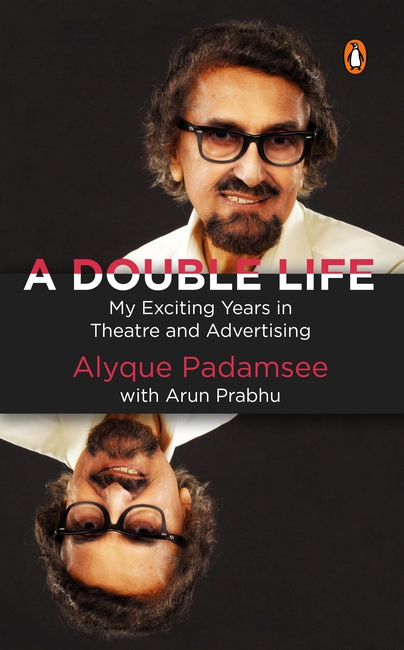
Bubbling with indefatigable energy, Alyque Padamsee was a unique genius who had mastered both theatre and advertising. Famous for playing Mohammad Ali Jinnah in Richard Attenborough’s film Gandhi, he also created several iconic advertisement campaigns on Indian television.
A Double Life takes you on a memorable, sometimes hilarious, trip spanning nearly all the years of Padamsee’s brilliant career. It also offers you a chance to go backstage with the man dubbed ‘God’, as he unfolds thrilling scenes from his high-voltage life. With acute human insights that illuminate the book like flashes of lightning, Padamsee reveals the hidden stories behind the provocative ads for megabrands like Liril and Kama Sutra, and behind blockbuster productions like Evita and Jesus Christ Superstar.

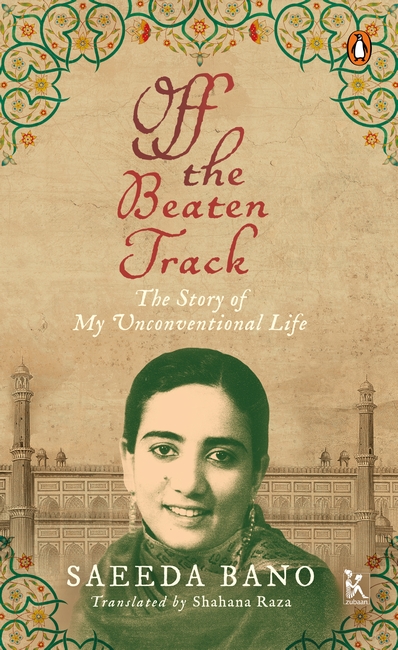
Saeeda Bano was the first woman in India to work as a radio newsreader, known then and still as the doyenne of Urdu broadcasting. Over her unconventional and courageous life, she walked out of a suffocating marriage, witnessed the violence of Partition, lost her son for a night in a refugee camp, ate toast with Nehru and fell in love with a married man who would, in the course of their twenty-five-year relationship, become the Mayor of Delhi. Though she was born into privilege in Bhopal-the only Indian state to be ruled by women for four successive generations-her determination, independence and frankness make this a remarkable memoir and a crucial disruption in India’s understanding of her own past.

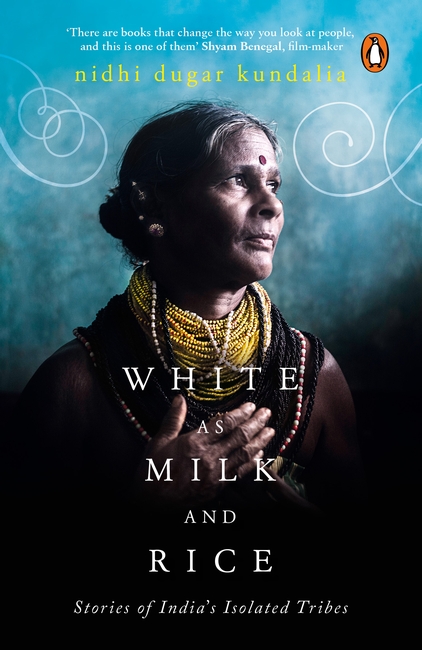
The Maria girls from Bastar practise sex as an institution before marriage, but with rules-one may not sleep with a partner more than three times; the Hallaki women from the Konkan coast sing throughout the day-in forests, fields, the market and at protests; the Kanjars have plundered, looted and killed generation after generation, and will show you how to roast a lizard when hungry. The original inhabitants of India, these Adivasis still live in forests and hills, with religious beliefs, traditions and rituals so far removed from the rest of the country that they represent an anthropological wealth of our heritage.
This book weaves together prose, oral narratives and Adivasi history to tell the stories of six remarkable tribes of India-reckoning with radical changes over the last century-as they were pulled apart and thrown together in ways none of them fathomed.

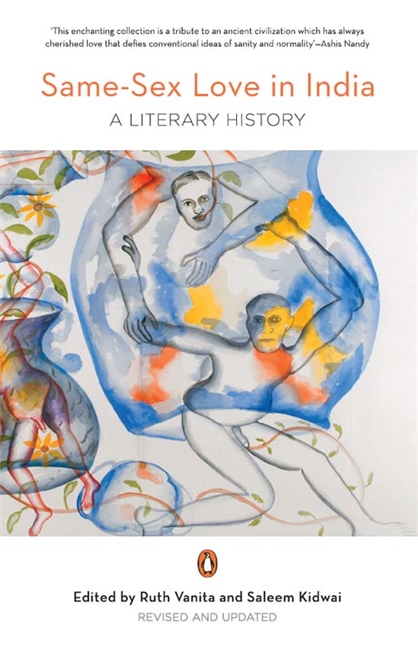
In 2009, the Delhi High Court’s historic judgment overturning Section 377 as violative of the Indian Constitution referred to Same-Sex Love in India. So did the 2018 Supreme Court decision which upheld that judgment. All the petitions against this anti-sodomy law have cited this landmark book to prove that homosexuality is not a Western import.
Same-Sex Love in India is the book that brought to light the long, incontestable history of same-sex love and desire in the Indian subcontinent. Covering over 2000 years, from the Mahabharata to the late twentieth century, the book contains excerpts from stories, poems, letters, biographies and histories in fifteen languages. The editors’ introductions to each period and text trace the changing depictions of and debates around same-sex relations, illuminating their social, political and literary contexts. These essays have been called ‘outstanding works of scholarship’. Including writings that range from romantic to analytical, playful to thoughtful, this classic work will help you see Indian culture and society with new eyes.

Since its inception in 1925, the RSS has perplexed observers with its organizational skills, military discipline and single-minded quest for influence in all walks of Indian life. Often seen as insidious and banned thrice, the pace of its growth and ideological dominance of the political landscape in the second decade of the millennium have been remarkable. It believes that Hindus have exclusive ownership of the Indian nation or Bharat, as it prefers to call it, and that hitherto, forces inimical to the interests of Hindus were deciding the socio-political and economic agenda in India. With political power firmly in favour, it is now going all out to embed its ideology deep in India’s genetic code. The abrogation of Article 370 in Kashmir, the big push to construct a Ram Temple in Ayodhya and moves to amend personal laws are the first symbolic steps in establishing the primacy of Hindus in the affairs of the country.
Relying on original research, interviews with insiders and analysis of current events, The RSS and the Making of the Deep Nation traces the RSS’s roots and nearly century-long operations in the relentless pursuit for ideological dominance in a nation known for its rich diversity of thought, custom and ritual.

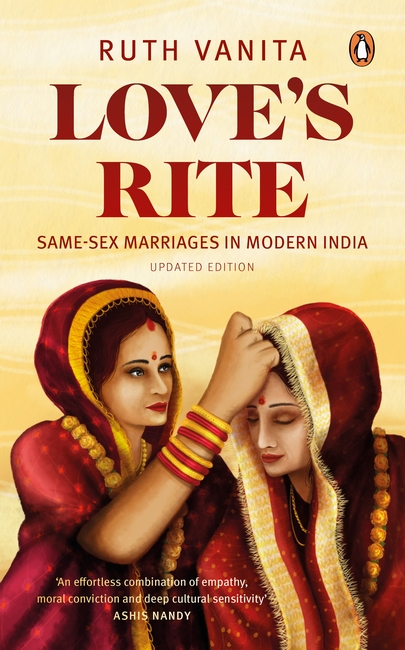
‘An effortless combination of empathy, moral conviction and deep cultural sensitivity’ ~ Ashis Nandy
A CHRONICLE OF LOVE’S TRIUMPH OVER ALL OBSTACLES
Long before the debate on marriage equality began, young, non-English speaking, low-income female couples all over India got married by religious rites or committed joint suicide, which they considered being ‘married in death’. These women had no contact with any movement and had never heard words like ‘lesbian’ or ‘gay’. While many families, in collusion with police, violently separated the couples, several families also supported their daughters.
Love’s Rite, first published in 2005, is the first and still the only book-length study of these unions, starting with one reported in 1980. The book argues that the couples asserted-and today still assert-their right to be together, using an age-old language of love understood by Indians. Vanita explores Indian religious, legal and literary traditions that provide spaces for same-sex and other socially disapproved unions.
While many recent high-profile Indian weddings have been reported as the ‘first’ of their kind, Love’s Rite celebrates the unsung pioneers and martyrs of the struggle for marriage equality.
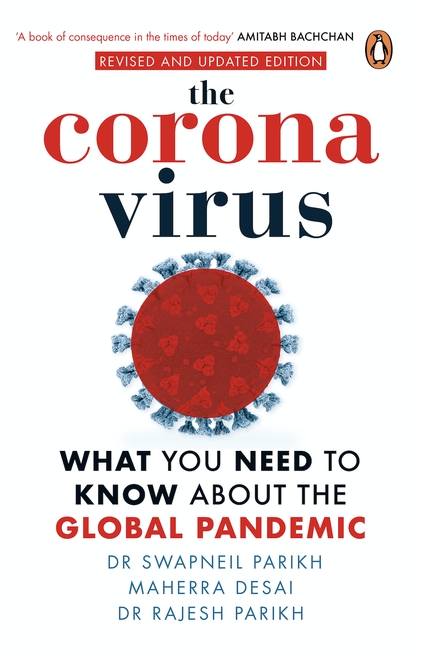
On the eve of 31 December 2019, as the world celebrated the start of a new decade, the province of Wuhan alerted the World Health Organization of several ‘flu-like’ cases. Less than a week later, a novel coronavirus, was identified. In February, the disease it caused was named COVID-19. Even now, as the global infection rate crosses 1,00,000 and the death toll surpasses 3000, we are yet to understand the threat posed by this new coronavirus. There is no vaccination to prevent it, and no antiviral to cure the sick. While high numbers are being reported daily, agencies may still be unaware of many cases.
The symptoms of Coronavirus are dangerously similar to that of the common flu: fever, coughing, breathlessness, tiredness, headache and muscle pain. But in India, that has such a high population density, we will have to do more than just stick to Namaste to greet each other. It seems that a crippling pandemic is inevitable. While some of us may find it easier to resign ourselves to fate, what we need most right now is credible and comprehensive information from professionals that can help us understand what the Coronavirus is, and how we can prepare and protect ourselves against it. This is the first book that addresses the history, evolution, facts and myths around the pandemic. The Coronavirus is a timely must-read for everyone keen on understanding its impact and fallout.