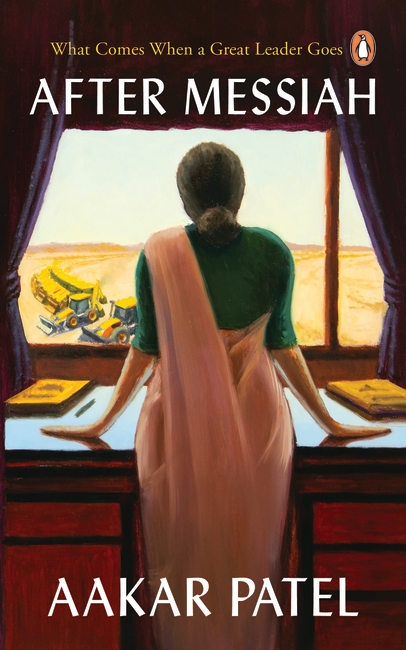
‘Everyone bowed to the Big Man. He was glorified, deified even, with temples raised to him, as the embodiment of the nation.’
Now the Big Man is gone, with nobody named as his successor. Into this void is pushed Mira, who is reluctant at first but increasingly interested in the position she finds herself in. Will she use her authority to further her agenda, or will she hold on to her principles? Watched by her political rivals, Jayeshbhai and Swamiji, and guided by well-wishers Ayesha, Prabhu and Du Bois, she marches on and discovers something about power-and about herself.

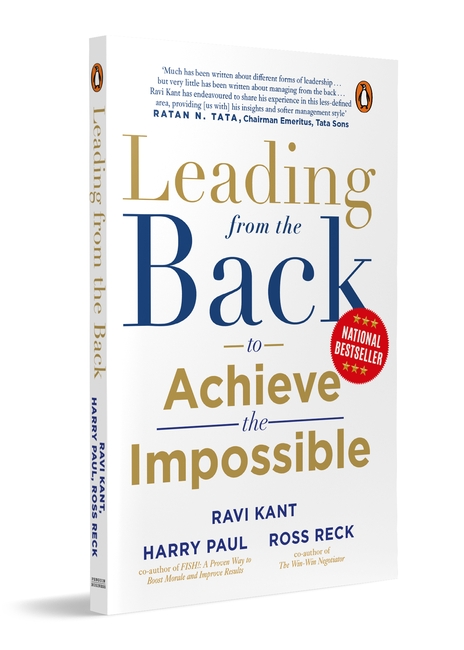
Are you looking for a leadership model that is uncomplicated, easy to use and produces amazing results? If so, then Leading from the Back is for you! In it you will find everything you need to become a superstar leader. You will learn how to earn respect from your team members and help them in achieving the impossible. No more learning about numerous principles and laws of leadership. Just a three-part model that has an amazing track record of proven success.
Through an engaging parable about the travails of an upcoming young manager, Shiv Kundra, whose leadership style hampers both his ability to lead and his ability to deliver, the authors outline the fascinating concept of ‘leading from the back’.
Leading from the Back is a distillation of the collective experience and wisdom of Ravi Kant (former CEO, vice chairman, Tata Motors), Harry Paul (co-author of the bestseller FISH! A Proven Way to Boost Morale and Improve Results) and Ross Reck (co-author of The Win-Win Negotiator).

There is an adventure inside every person, waiting to be had . . . the discovery of a self, long buried within.
This personal belief reverberates through Ashok Alexander’s How the Light Gets In. In his memoir of an improbable start-up in public health, he writes about an organization with the audacious goal of ending needless deaths and sickness at scale, amongst India’s poorest mothers and children. It is a great leap emboldened by an unshakable faith in the ‘idea that cannot be denied’. It is a tale of adventure filled with twists and turns, told with a disarming honesty.
Ashok writes with his signature ability to transport the reader from the ground-level view of a Mumbai shoeshine boy, through hushed hallways of power, and on to the green forests and enchanting hills of tribal Madhya Pradesh-where much of the book is set. This book is a curated tour of the other India, with all its pathos and ineffable beauty. This is also a story of personal transformation-Ashok left a high-profile job in corporate India to be inspired by the everyday heroism and grit of utterly marginalized women, soon after realizing a simple truth: you must ask the way from those you serve. The journey described here will leave you awash with feelings-joy, anguish, anger, compassion and much laughter. It is about the adventures waiting within, that give great hope and never fail to inspire.

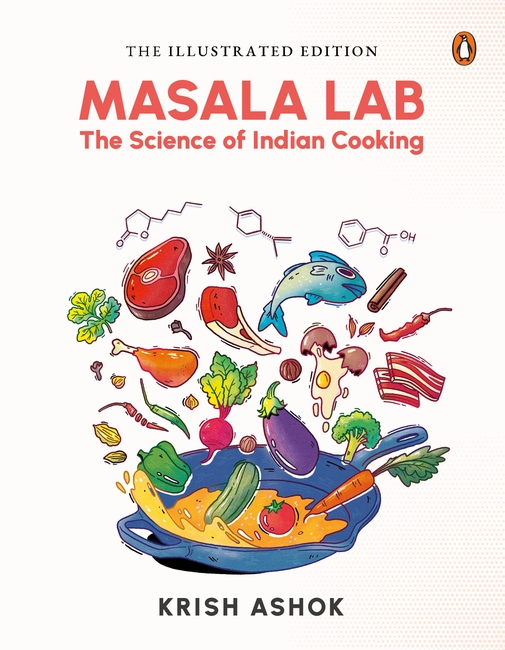
With its meteoric rise to bestseller status, Masala Lab has captivated readers across generations, and now returns as an irresistible collector’s edition, adorned with ingenious additions, illustrations, infographics and charts: it’s the collector’s edition you know your kitchen-laboratory needs.
Ever wondered why your grandmother threw a teabag into the pressure cooker while boiling chickpeas, or why she measured using the knuckle of her index finger? Why does a counter-intuitive pinch of salt make your kheer more intensely flavourful? What is the Maillard reaction, and what does it have to do with fenugreek? What does your high-school chemistry knowledge, or what you remember of it, have to do with perfectly browning your onions? Just like memorizing an equation might have helped you pass an exam but not become a chemist, following a recipe without knowing its rationale can be a sub-optimal way of learning how to cook.
Masala Lab by Krish Ashok is a scientific exploration of Indian cooking aimed at inquisitive chefs who want to turn their kitchens into joyful, creative playgrounds for gastronomic experimentation. In this special edition, Meghna Menon’s vibrant illustrations effortlessly complement Krish Ashok’s lighthearted approach to the demystification of culinary science, making it the perfect vehicle to absorb the exhaustive testing, groundbreaking research and scientific rigour that went into the making of this revolutionary book.

Social consciousness is neither corporate social responsibility (CSR) nor public relations but a mindset that understands and accepts the interconnectedness of an organization’s economic, social, and natural environments. Socially conscious organizations come into existence when led by socially conscious managers. This book enables socially conscious managers to become Impact Champions through three pathways to successfully initiate and run socially responsible business innovations, CSR projects, and social entrepreneurial ventures. The book is organized into five parts. The first part sets the context and provides the readers with tools to reflect on contemporary social and environmental issues and orient themselves towards action. To develop the skills necessary to contribute to the triple bottom line, young managers need to deepen their understanding of social problems, developmental issues, threats to the environment, and long-standing issues of sustainability and environmental management, all of which are woven into various chapters. In the following four parts, the book progresses through three pathways: socially driven business innovation, CSR, and social entrepreneurship. Being an Impact Champion hopes to instill confidence in new managers to talk about socially and environmentally sensitive issues facing the corporate world and thereby expand their capacity to influence.

Educating a Billion is an insider’s take on how edtech companies in India are trying to solve the issues plaguing our education system and trying to deliver quality at scale. It covers the formative days of India’s well-known edtech start-ups-BYJU’S, Unacademy, upGrad and Whitehat Jr, among others, and how these companies created products with a promise that made a difference. The growth of these start-ups is synonymous with the growth of venture capitalist led capital deployment in privately held Indian companies (private markets). The book covers Covid-19-induced changes in our educational system which led to the hypergrowth of the edtech ecosystem, a watershed event for digital start-ups globally.
With a unique ringside perspective, Arjun Mohan weighs in on the future of edtech and how technologies like artificial intelligence (AI) and virtual reality (VR) are going to play an important role in the next phase. Above everything else, this book is the story of India’s new generation of entrepreneurs and founders-their hopes, their unwavering faith in the face of ambiguity and their rejection of fear. The book is about vision, audacity and optimism that’s changing the education system after 200-plus years of slumber.
‘Have I not, having kept a man for years, learnt that it’s/ like raising a snake?/ So many animals on this earth, why keep a man of all things?’ writes one of the world’s most celebrated writers, Taslima Nasrin, in her first-ever comprehensive collection of poetry translated from the original Bangla into English. The poems get to the heart of being the other in exile, justifying one’s place in a terrifying world. They praise the comfort and critique the cruelty of a loved one. In these are loneliness, sorrow, and at times, exaltation. Relying almost entirely upon the free verse form, these poems carry a diction which is at once both gentle and fierce, revealing the experiences of one woman while defining the existence of so many generations of women throughout time, and around the world.

One Way to Live was written at a time when Dr Tehemton Udwadia knew that he had just a few months left to live. It is partly a personal memoir recounting about his youthful romance and the influence of his mother and heartfelt anecdotes about his friends and family, and partly his own medical journey, including the story behind the setting up of Center for Minimal Access SurgeryTraining (ceMAST)-perhaps his greatest achievement.
The last few couple of chapters of this book were written at a time when Dr Udwadia was on ventilator support; the second and final epilogue was dictated by him from a hospital bed at a time when he could barely speak. He passed away on 7 January 2023. It was life well-lived.

For millennia, our cities have prospered and grown in the cradles of civilization-fertile lands blessed with rivers, lakes, seas and oceans. From the origins of life on earth, right down to its downfall, biblical or otherwise, water has been integral to the human story.
In this passionate and extensively researched tribute to the elixir that sustains us all, authors Harini Nagendra and Seema Mundoli take us on a panoramic view of the water bodies of India and the urgent need to address their emergent ecological threats. From the Yamuna in Delhi to the Cauvery in Karnataka and the Pichola Lake in Udaipur to the Brahmaputra in Assam, this book is epic in its sweep and yet deeply moving in its intimate concerns.
Interspersed with anthropological, legal and scientific vignettes of the water are fascinating anecdotes, ditties, myths and monsters blue and green. This book also brings into dialogue a vast range of colourful characters-from medieval poets to colonial masters and modern scientists-to paint for us a tapestry of connected histories and ring a timely knell for saving the very ecological systems that have sustained us for ages.