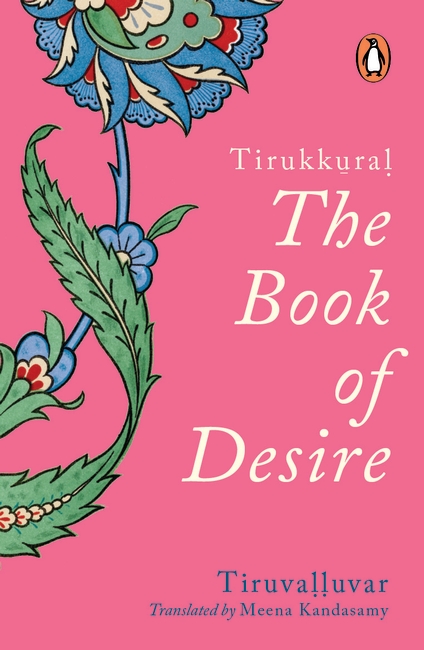
Written by the poet Thiruvalluvar, the Kamattu-p-pal is the third part of the Tirukkural – one of the most important texts in Tamil literature. The most intimate section of this great work – it is also, historically, the part that has been most heavily censored. Although hundreds of male translations of the text have been published, it has also only ever been translated by a woman once before. Tirukkural is award-winning writer Meena Kandasamy’s luminous translation of the Kamattu-p-pal.
Meena Kandasamy delves into this classic, and provides the first feminist interventionist translation into English-remaining true to the desire throbbing through the lifeblood of the text, while retaining the drama that pervades the quintessential Tamil world of exaggerated hurt, lover’s quarrels and evenings lost to longing.
With her trademark wit, lyricism and passionate insight, Meena weaves a magic spell: taking the reader on a journey through 250 kurals, organised under separate headings – ‘The Pleasure of Sex’, ‘Renouncing Shame’, ‘The Delights of Sulking’ – the result is a fresh, vital, and breath-taking translation that conveys powerful messages about female sensuality, agency, and desire. It is a revolution 2000 years in the making.

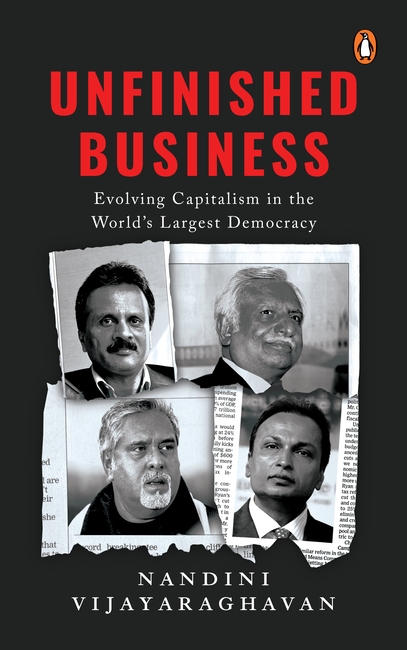
Unfinished Business is a chronicle of contemporary Indian corporate history, narrated through the professional trajectories of four high-profile businessmen: Anil Ambani, Naresh Goyal, V.G. Siddhartha and Vijay Mallya.
By no means unique in their proclivity for debt and penchant for politics, these four men belonged to a rarefied club of entrepreneurs, who could raise a sizeable quantum of financing with ease despite their businesses not generating adequate cash flows and/or possessing sufficient collateral.
So, what competitive advantage(s) did this guild of Indian entrepreneurs have? What caused their enterprises to struggle, while other similar organizations whose CEOs shared these attributes survived and even flourished? How did the Indian business ecosystem, regulatory norms, lenders’ underwriting practices and investor due diligence influence the organizations helmed by this quartet?
Following these four entrepreneurs’ careers and professional decisions, Unfinished Business throws light on the evolution of Indian capitalism during the first two decades of the twenty-first century, set against the backdrop of a dynamic political, regulatory and business climate in India. And, with great insight, clarity and analysis, Nandini Vijayaraghavan explores the takeaways for entrepreneurs, regulators, lenders and investors in this compelling, illuminating read.

Paradise: that elusive place where the anxieties, struggles, and burdens of life fall away. Most of us dream of it, but each of us has very different ideas about where it is to be found. For some it can be enjoyed only after death; for others, it’s in our midst-or just across the ocean-if only we can find eyes to see it.
Traveling from Iran to North Korea, from the Dalai Lama’s Himalayas to the ghostly temples of Japan, Pico Iyer brings together a lifetime of explorations to upend our ideas of utopia and ask how we might find peace in the midst of difficulty and suffering. Does religion lead us back to Eden or only into constant contention? Why do so many seeming paradises turn into warzones? And does paradise exist only in the afterworld – or can it be found in the here and now?
For almost fifty years Iyer has been roaming the world, mixing a global soul’s delight in observing cultures with a pilgrim’s readiness to be transformed. In this culminating work, he brings together the outer world and the inner to offer us a surprising, original, often beautiful exploration of how we might come upon paradise in the midst of our very real lives.

Unlike people born in Panjab who have a direct connection with, and hence a memory of the land, I have no liminal or tangible marker of belonging to Panjab. While my family did hail from Panjab, I was neither born here, nor do I live here. I have no address, bank statement, Aadhaar card, passport or land ownership to prove my connection with Panjab.
In 2015, Amandeep Sandhu began an investigation that was meant to resolve the ‘hole in his heart’, his ’emptiness about matters Panjab’. For three years, he crisscrossed the state and discovered a land that was nothing like the one he had imagined and not like the stories he had heard.
Present-day Panjab prides itself on legends of its military and valorous past even as it struggles with daily horrors. The Green Revolution has wreaked ecological havoc in the state, and a decade and a half of militancy has destabilised its economy and governance. Sikhism-the state’s eclectic and syncretic religion- is in crisis, its gatekeepers brooking no dissent and giving little spiritual guidance. And Panjab has yet to recover from the loss of its other half, now in Pakistan.
This revised edition includes a chapter on the 2020-21 farmers’ struggle which proved beyond doubt that the old spirit of the land with its undercurrent of resistance to power and hegemony still beats away. The hope that Panjab’s unyielding knots can be untied continues to linger.
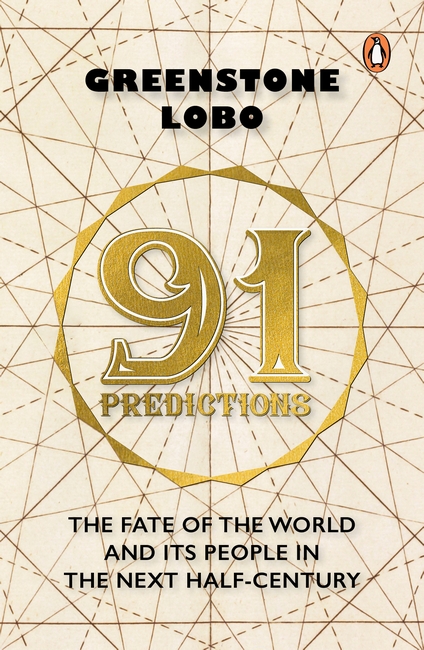
Is Pluto a planet? Or a dwarf planet? The controversy rages. But this planet, on the fringes of our solar system, has immense astrological significance, unexplored by the Vedic and Western astrologers. Author and scientific astrologer Greenstone Lobo believes Pluto symbolises destruction and regeneration-as the mythological Rudra Shiva.
In a scary and uncertain world-on the edge because of a pandemic, economic crises, ecological disasters and pandemonium in politics, Lobo looks towards Pluto to make sense of the past, present and the future.
He describes the planet’s journey over the last 250 and the next fifty years, as well as the grand scale on which it can operate. Exploring its character and impact, Lobo discusses his techniques for predictions, the cyclical nature of Pluto, how it changed the world order and its relationship with astrological signs.
From his unique insider’s perspective-as someone familiar with the ways of Pluto through his research-Lobo predicts what to expect and how to prepare for it through 91 predictions. What will the next fifty years bring? When will the world see the last of the pandemic? Who will lead India next? Can India win the next Cricket World Cup? What does the future hold for Ranbir Kapoor and Alia Bhatt? What lies in store for star kids Suhana Khan, Hrehaan Roshan, Aarav Akshay Kumar and Aaradhya Bachchan? What about Messi, Angelina Jolie, Rihanna, Beyoncé and others who hold our imagination today?
Through these predictions of good fortune and disasters, scandals and affairs, readers will gain an intimate sense of the rogue planet and its centrality to astrology.

Lieutenant General K.J.S. ‘Tiny’ Dhillon, an Infantry veteran from the Rajputana Rifles with about four decades of military service, has served multiple tenures in Kashmir.
In this book, ‘Tiny’ Dhillon opens a hitherto-closed window, not only to his life but also to Kashmir. He recounts fascinating tales about the toughest challenges he encountered, from age three right up to those from his multiple tenures in Kashmir from 1988 to 2020, where it was his responsibility to maintain a balance between counter-terrorism operations on the one hand and to use military soft power on the other. Dhillon retraces his entire journey, from being a young boy to becoming the Commander of the Chinar Corps, with Kashmir as an inseparable part of this story.
As a first-hand account, the book touches on and demystifies the myths, half-truths, whats, ifs and whys of the exodus of the Kashmiri Pandits; the barbarous attack on an Indian security convoy in Pulwama district, in which forty CRPF personnel were killed; the Balakot air strikes; and the abrogation of Article 370 and its impact on the socio-political, economic and law-and-order situation, among other incidents. It takes us behind the scenes to bring out the nuances of various intriguing developments at a critical juncture in the history of J&K.
Anecdotal, candid and evocative, Kitne Ghazi Aaye, Kitne Ghazi Gaye brings to light the true stories from this Army veteran’s life. It focuses on the personal, professional and, most importantly, family life of a soldier in the Army, and will not only provide an insight into the trials and tribulations he faced but will also inspire a wide spectrum of readers, especially young defence aspirants.
Find Tiny Dhillon online:
Twitter: @Tiny_Dhillon
Instagram: @tinydhillon
Facebook: @TinyDhillon

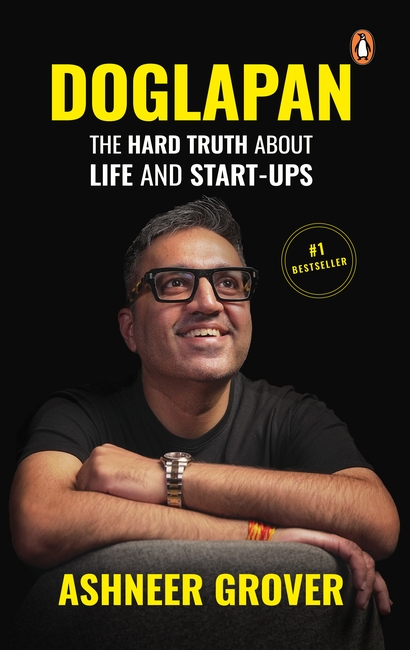
This is the unfettered story of Ashneer Grover-the favourite and misunderstood poster boy of Start-up India.
Raw, gut-wrenching in its honesty and completely from the heart, this is storytelling at its finest.
A young boy with a ‘refugee’ tag growing up in Delhi’s Malviya Nagar outpaces his circumstances by becoming a rank-holder at the pinnacle of academic excellence in India-IIT Delhi. He goes on to do an MBA from the hallowed halls of IIM Ahmedabad, builds a career as an investment banker at Kotak Investment Banking and AmEx, and is pivotal in the making of two unicorns-Grofers, as CFO, and BharatPe, as co-founder.
As a judge on the popular TV show Shark Tank India, Ashneer becomes a household name even as his life turns upside down. Controversy, media spotlight, garrulous social media chatter descend, making it difficult to distinguish fact from fiction.

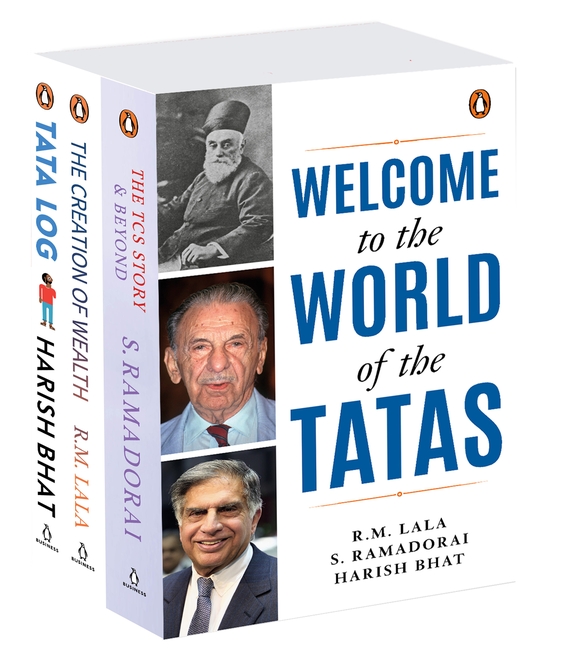
The Creation of Wealth is R. M. Lala’s bestselling account of how the Tatas have been at the forefront in the making of the Indian nation-not just by their phenomenal achievements as industrialists and entrepreneurs but also by their singular contributions in areas like factory reforms, social welfare, medical research, higher education, arts and rural development.
In The TCS Story and Beyond, S. Ramadorai, one of the country’s most respected business leaders, recounts the steps to the extraordinary success of Tata Consultancy Services, one of the world’s largest IT software and services companies, and outlines a vision for the future where the quality initiatives he undertook can be applied to a larger national framework.
Tatalog: Eight Modern Stories from a Timeless Institution provides readers with an insider’s glimpse of the challenges faced by the Tata companies and how they rose above it all and carved a name for themselves.

Few have championed the cuisine of Kerala like Mrs K.M. Mathew (1922-2003), who authored many a column and twenty-three cookbooks, introducing an entire generation to the culinary culture of the state. A true master of the craft, she travelled across the length and breadth of Kerala, visiting homes and restaurants, noting down recipes, before going back home to experiment with dishes repeatedly until they were perfect. Eventually, she ushered in a shift from the oral telling of recipes to written instructions, and before long, due to her innovative and easy step-by-step approach to cooking, her cookbooks were being
gifted to newly married couples. Even today, her books not only serve as a treasure chest of unforgettable recipes but also inspire new readers to rush to the kitchen.
Mrs K.M. Mathew’s Finest Recipes brings a definitive compilation of her all-time top recipes, which have been enjoyed around the world, to a new generation of readers.