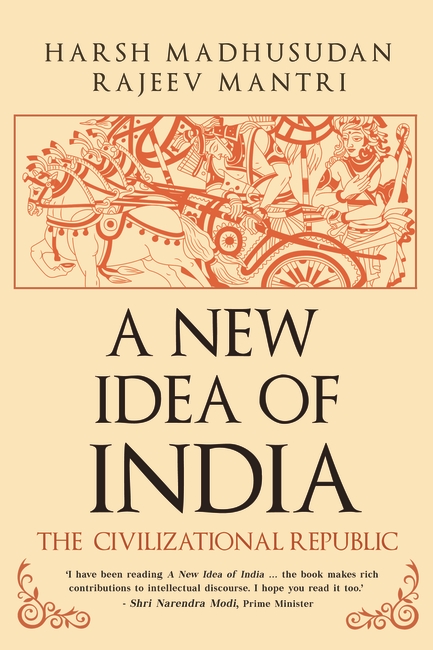
For the better part of seven decades after independence, the Nehruvian idea of India held sway in India’s polity, even if it was not always in consonance with the views of Jawaharlal Nehru himself. Three key features constituted the crux of the Nehruvian way: socialism, which in practice devolved to corruption and stagnation; secularism, which boxed citizens into group membership and diluted individual identity; and non-alignment, which effectively placed India in the Communist camp.
In the early Nineties, India began a gradual withdrawal from this path. But it was only in 2019, with Narendra Modi’s second successive win in the general elections, that this philosophy is finally being replaced by a worldview that acknowledges India as an ancient civilization, even if a young republic, and that sees citizens as equal for developmental and other purposes.
A New Idea of India constructs and expounds on a new framework beyond the rough and tumble of partisan politics. Lucid in its laying out of ideas and policies while taking a novel position, this book is illuminated by years of research and the authors’ first-hand experiences, as citizens, entrepreneurs and investors, of the vagaries and challenges of India. This revised edition builds on some of the arguments of the earlier edition and brings things up-to-date.

The Shiva Purana is the fifth book in an eighteen-part series on the sacred Hindu texts known collectively as the Puranas. Translated with great rigor and precision, Bibek Debroy recounts the tales of creation and the many myths that surround Lord Shiva in twenty-four thousand shlokas and an introduction that simplifies the myth and history of the Puranas.
Brimming with insight and clarity, this translation presents readers with an opportunity to truly understand classical Indian texts. Previous translations by Bibek Debroy include the Bhagavata Purana, the Markandeya Purana, the Brahma Purana, and the Vishnu Purana.
The Shiva Purana is the fifth book in an eighteen-part series on the sacred Hindu texts known collectively as the Puranas. Translated with great rigor and precision, Bibek Debroy recounts the tales of creation and the many myths that surround Lord Shiva in twenty-four thousand shlokas and an introduction that simplifies the myth and history of the Puranas.
Brimming with insight and clarity, this translation presents readers with an opportunity to truly understand classical Indian texts. Previous translations by Bibek Debroy include the Bhagavata Purana, the Markandeya Purana, the Brahma Purana, and the Vishnu Purana.
The Shiva Purana is the fifth book in an eighteen-part series on the sacred Hindu texts known collectively as the Puranas. Translated with great rigor and precision, Bibek Debroy recounts the tales of creation and the many myths that surround Lord Shiva in twenty-four thousand shlokas and an introduction that simplifies the myth and history of the Puranas.
Brimming with insight and clarity, this translation presents readers with an opportunity to truly understand classical Indian texts. Previous translations by Bibek Debroy include the Bhagavata Purana, the Markandeya Purana, the Brahma Purana, and the Vishnu Purana.

The Penguin Book of Modern Tibetan Essays is a groundbreaking anthology of modern Tibetan non-fiction. This unprecedented collection celebrates the art of the modern Tibetan essay and comprises some of the best Tibetan writers working today in Tibetan, English and Chinese.
There are essays on lost friends, stolen inheritances, prison notes and secret journeys from-and to-Tibet, but there are also essays on food, the Dalai Lama’s Gar dancer, love letters, lotteries and the Prince of Tibet. The collection offers a profound commentary not just on the Tibetan nation and Tibetan exile, but also on the romance, comedy and tragedy of modern Tibetan life.
For this anthology, editor and translator Tenzin Dickie has commissioned and collected 28 essays from 22 Tibetan writers, including Woeser, Jamyang Norbu, Tsering Wangmo Dhompa, Pema Bhum and Lhashamgyal.
This book of personal essays by Tibetan writers is a landmark addition to contemporary Tibetan letters as well as a significant contribution to global literature.
Also available in a paperback edition outside the Indian subcontinent. To order online, visit https://www.amazon.com/Penguin-Book-Modern-Tibetan-Essays/dp/0143462326/ref=tmm_pap_swatch_0?_encoding=UTF8&qid=1685626767&sr=8-2

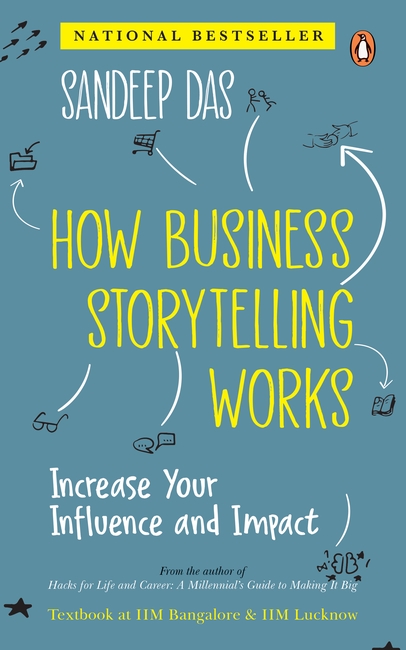
Why are you alive today and reading this book?
How will you, a corporate professional, be relevant in the future?
The #1 answer to both is storytelling.
Business storytelling is the #1 skill you need to succeed in your professional lives amidst all the noise, competition and massive technological disruption. In this book, Sandeep looks at human evolution, behavioural psychology and the world of movies to identify the golden principles of storytelling.
Whether you are a corporate professional, an entrepreneur, a tech guru, a marketer, a strategy consultant, a social media influencer or a student, the book tells you how to succeed in the REAL world. Sandeep brings in nuggets from his numerous storytelling workshops at leading corporates and business schools, and intersperses it with illustrations and hordes of popular culture references, making the book
as engaging as a good story. So, what are you waiting for? Head to the checkout counter.
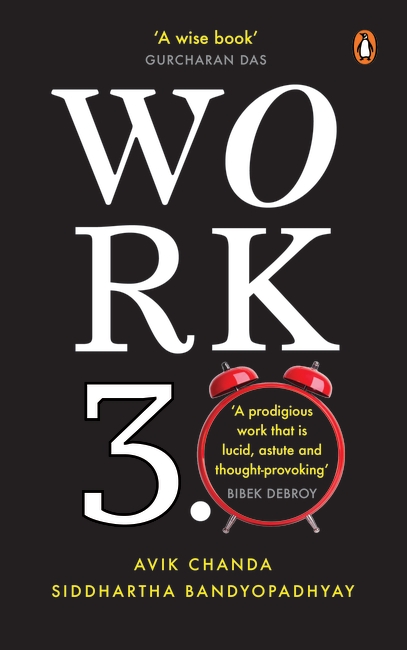
What will the worker, workplace and work itself look like in the future?
Work 3.0 tackles this and some of the other most pressing and complex questions of the present age, head-on. Avik Chanda and Siddhartha Bandyopadhyay employ rigorous research supplemented with industry reports, business case studies, expert interviews, anecdotes, their personal expertise and insights, to present a rich multi-disciplinary brew that spans economics, statistics, public policy, history, sociology, psychology, law, political science, literature and philosophy. Highly ambitious in scope, astonishingly rich in analytical detail and far-reaching in its conclusions, the book will change the way you think about the future and how the past and present still shape it.
Conceived as the ultimate future of work preparation guide, this book is essential reading for our tenuous and unpredictable times.

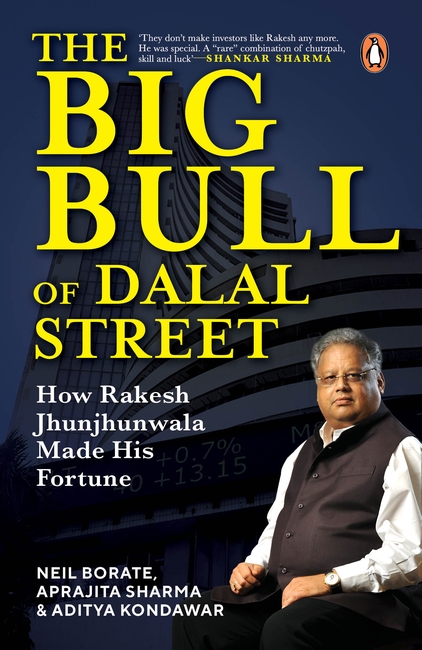
‘Respect the market. Have an open mind. Know what to stake. Know when to take a loss. Be responsible,’ this is what Rakesh Jhunjhunwala, India’s iconic stock market investor, often used to say.
This book looks at the life of India’s big bull, as Rakesh was famously known, both as a person and as a professional. Providing a fascinating account of his journey, it analyses the records of Jhunjhunwala’s investments and interviews he has given over the years. More than just a biography, a large section of the book is devoted to understanding the stocks that made him rich and the mistakes he made. Looking at the journey of the legendary investor, the book offers retail investors some useful insights—-benefits of long-term investing, mistakes one should avoid in the stock market, risk associated with leveraged trades, among others.

Darjeeling, late 1980s. The demand for a separate state of Gorkhaland has taken a violent turn. The Green Party is at war with the Red Party-and with the state’s security forces. Murder, loot, terror and arson beset the Himalayan foothills.
Fruits of the Barren Tree is a story of that time, and of Relling, a small village near Darjeeling. In Relling there’s Basnet, the village shaman, and his wife; there’s Jhuppay, their son-incorrigible thief, truant and amateur drunk; and also Nimma, Jhuppay’s great love, whose only desire in life is that he take the path of virtue. There’s Chyaatar too, former army man, now a militia commander in the Green Party, who rules the village with an iron hand. Ever the miscreant, nothing Jhuppay does can win Nimma’s heart. But when the Red Party hires his loudspeaker for a meeting-the first innocent, honest job of his life-it sets Jhuppay, Nimma and Chyaatar on a murderous course that fate itself cannot derail.
Originally published in Nepali as Phoolange, this sharp, evocative novel is the story of a failed movement and a cautionary tale of how easily the contagion of violence can infect a community. Intensely visual and imbued with a strong sense of place, it is equally a compelling portrait of Darjeeling away from the brochures and the postcards.

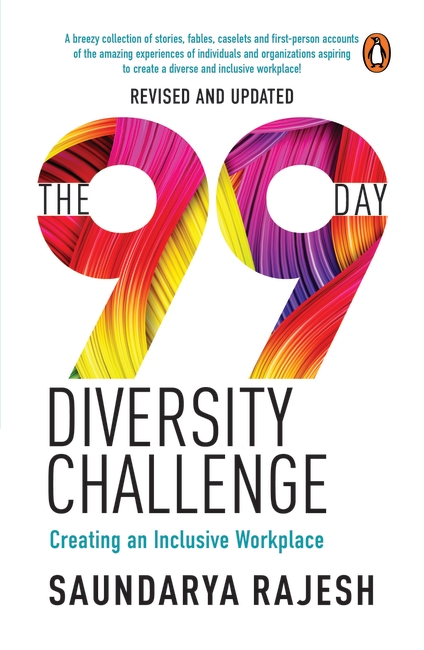
Is it really possible for an individual or an organization to develop an inclusion and diversity mindset within the
proverbial 99 days?
Award-winning social entrepreneur Dr Saundarya Rajesh, one of India’s most prominent diversity strategists who is credited with having ushered in the ‘second-career’ revolution for women professionals, believes it is.
In an engaging, gentle, often light-hearted way, Dr Rajesh demystifies this vast subject of Diversity and Inclusion (D&I) for the business leader, the diversity enthusiast and even the young professional who is interested in this topic. Over a set of 99 stories, anecdotes and thought blogs, this book sequentially uncovers the meaning of D&I and how this can be absorbed by just about everyone.
At the core of the 99 Day Diversity Challenge is the belief that the organizational practice of inclusion actually results in us becoming better human beings. For when we break down differences and create greater connectedness between people, we are building a better world.