



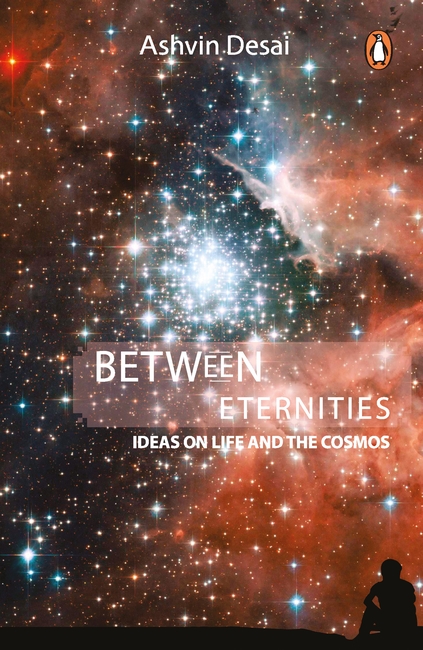
It is through man’s involvement that the universe becomes conscious of itself. The universe created life and, in an astounding feat of circularity, it is life, principally the human being, that then brought the universe into existence and a creator into possibility. Alternatively, is the universe only an illusion, an aberration of nothingness? Science, philosophy, religion and mysticism all offer different propositions. Ashvin Desai interweaves the different streams of reasoning to produce a meticulously researched, closely argued and thought-provoking work, tracing the history of the universe.
Catagory: Non Fiction
non fiction main category
The Essential Marathi Cookbook
The Essential Marathi Cookbook, a modern, easy-to-use introduction to several Marathi sub-cuisines, travels across the regions and religions of Maharashtra to bring out the most authentic and appetizing recipes from the state. Journalist and chef Kaumudi Marathé presents a varied and nuanced selection ranging from the delectable entrées long associated with Maharashtra, to appetizing and unusual side dishes, and a plethora of desserts, as well as, lesser-known but equally tantalizing family and regional specialties which have never before appeared in an English-language cookbook.
The comprehensive introduction describes Marathi cooking basics, ingredients and techniques and also explains the special spices used in Marathi kitchens along with the methods for their best use in seasonings. Packed with personal anecdotes and food memories from the author and other contributors to the book, The Essential Marathi Cookbook is the definitive guide to Marathi food and customs.
Recipes include:
Pithla-Bhat (zesty gram flour sauce with hot rice), Shiryachi Poli (sweet semolina-stuffed bread), Ambyacha Loncha (green mango-mustard pickle), Spicy Kolhapuri mutton, Suranachi Koshimbir (elephant’s foot yam salad), Kelphulachi Bhaji (banana blossom stir-fry), Pach Dalinchi Amti (five lentil stew), Mugache Kadhan (Konkan lentil-coconut pudding), Bol Marie (East PBI – Indian coconut pie), Pathare-Prabhu baked karanjis (coconut crescents), Kharvas (first-milk custard), Khudi (sautéed East PBI – Indian-style chicken), Ukad Shengule (sorghum pasta), Kaumudi’s grandmother’s Lettuce Salad
Flavours Of Delhi (R/E)
Just as each ruler left his architectural mark on Delhi, so each bequeathed to it a culinary legacy. Flavors of Delhi: A Food Lover’s Guide tells the story of Delhi through its food. It explores the city’s culinary history beginning with Indraprastha, taking us through the Sultanate period, Mughal rule and the British raj, and bringing us right up to the present. Professional chef and food writer Charmaine O’Brien’s love for Delhi and its culinary delights is evident. She tells us not only what to eat, but also where to eat it. From paranthas in the galis of Chandni Chowk to kakori kababs at the fancy Dum Pukht, from chaat at a roadside stall to appams at Keraleeyam, from fresh fruit and vegetables at INA Market to fish at Chittaranjan Park, O’Brien takes us on a guided tour through the capital, encouraging us to sample and savour as we see. History comes alive as the recipes in this book allow us to recreate the varied flavors of the city in our kitchens. The result of extensive travel and research, and lavishly illustrated with photographs taken by Kirsten Grant, Flavors of Delhi is a fascinating read that whets the reader’s interest and appetite.
Superstar India
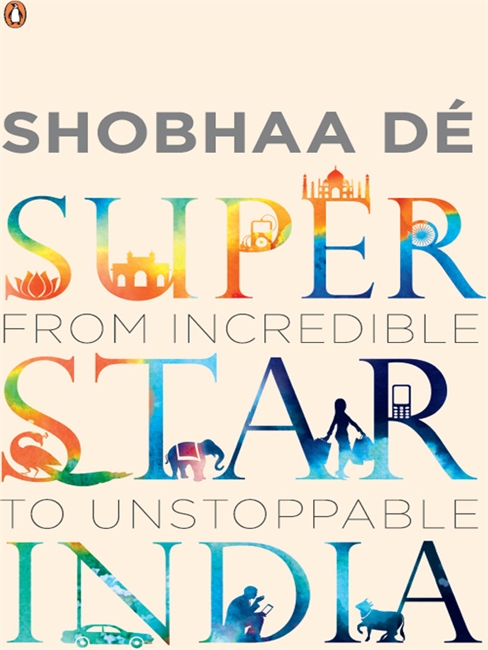
Explore the Shobhaa De minsite here! ‘This is a story about India. My India. It is a very personal story. You see, I’m exactly as old as India is.’ It all began when, viewing the breathless preparations for independent India’s 60th birthday celebrations–and poised then on her own sixth decade—Shobhaa Dé was struck by the thought: ‘Surely my life has taken the same trajectory as the country’s?’ In an intimate confession to her readers, she answers that question, and many more: Does India really deserve to congratulate itself? Has it lived up to the early promises it made to its people? Does the author believe in India herself? Surveying the many images of the country, Dé points out that for every truism about India the opposite is also true: India as the land of the meek; India as inheritor of the earth; India gherao-ed by distinctly unfriendly neighbours; Indians fleeing to jobs in the West and then racing right back to a better life; Indians who ape their erstwhile colonizers and yet cling irrationally to tradition. In a departure from anything else she has written, Shobhaa Dé lasers in on Indian people and their place in the larger human society, pointing out her country’s historical failings and equally historical glories. Admitting to our knee-jerk reactions to much of what is happening at home and in the world, Dé reasons, nevertheless, that the nation has earned superstar status, and with humorous argumentativeness, she convinces the reader that India is not about to lose its glow.
Mrs Funnybones (Spl 30)
In Mrs Funnybones, Twinkle Khanna wittily explores the plight of the modern Indian woman who has a familiar family story. She organizes dinner each evening after having been at work all day, she runs her own life but has to listen to her mummyji and she worries about her weight and the state of the country. This is an extraordinary book with deliciously witty observations.
Modi
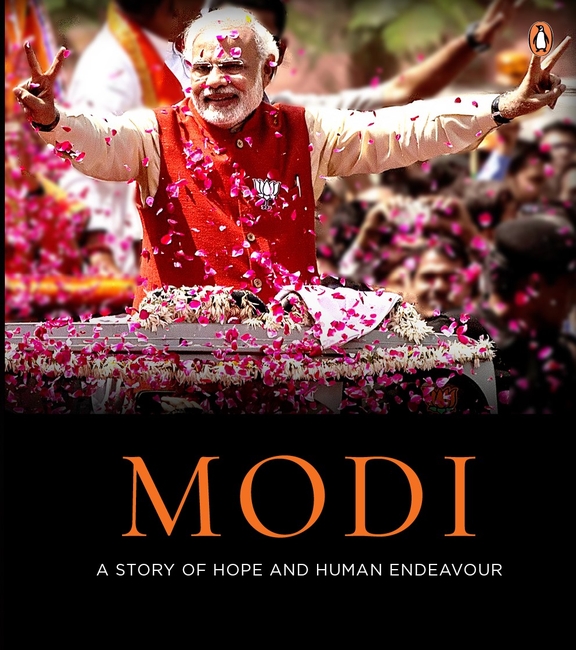
The story of a young boy with limited means becoming the Prime Minister of India is a true testament of democracy. Modi: A Story of Hope and Human Endeavour details the working of the Prime Minister’s mind: what inspires him, what motivates him, the experiences that shaped the man we see before us today, featuring unseen photographs and telling unheard stories.
Set in two volumes, The Life and The Leader, these two books tell the story of Narendra Damodardas Modi, from when he was a young boy in Vadanagar, Gujarat, to 7, Lok Kalyan Marg, the official residence of the Prime Minister of the world’s largest democracy. The first volume, The Life, shares his journey from his childhood to ascending the ladder of the BJP’s leadership, until his resounding mandate in the 2014 general elections. The second volume, The Leader, tells his story from then to now, the milestones India achieved under his visionary leadership.
Reporting India
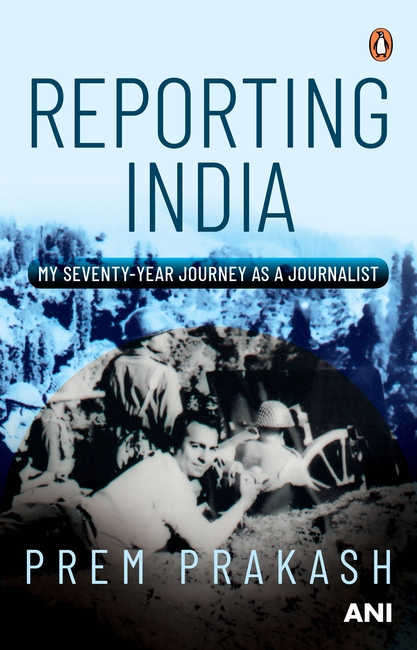
Reporting India is a fascinating account of the life and times of Prem Prakash, a pioneer in the field of Indian journalism. Over the course of his long and illustrious career as a photographer, film cameraman and columnist, Prakash covered major events, both in India and abroad, bearing witness to natural calamities, wars, military coups and insurgencies.
The book celebrates Prakash’s unparalleled body of work, providing a detailed account of his personal and professional life, along with his reminiscences of the most impactful stories that he covered-from the 1962 Indo-China war to the
1965 and 1971 wars against Pakistan; from the Emergency to the assassination of Indira Gandhi; from Lal Bahadur Shastri’s fateful Tashkent journey to the liberation of Bangladesh; from Jawaharlal Nehru’s demise to Narendra Modi’s rise. An intriguing read, Reporting India brings to life some of the defining moments in Indian history.
From Pony to Unicorn
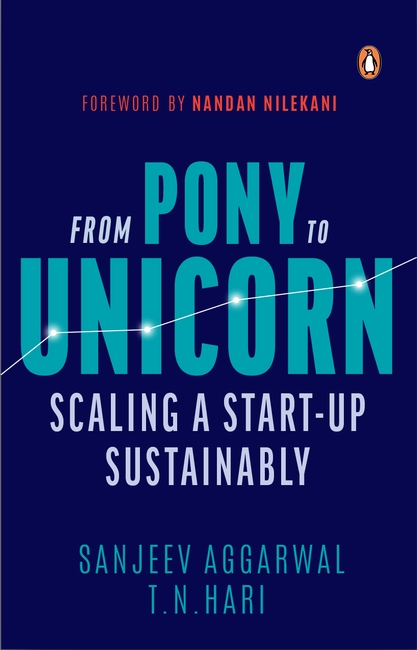
The journey of a business-from a small start-up to a large company ready for an initial public offering (IPO)-is fraught with pitfalls and landmines. To scale a company, one needs to do more than just expand distribution and ramp up revenue. Scale entails a long-term vision that includes putting in place a timeline to achieve anticipated milestones, hiring and managing the right talent, sourcing capital to support expansion and building in simple yet effective processes as well as technology. Scaling requires the founders and the leadership team to understand the different pieces of the puzzle of scale and the components of organization-building.
From Pony to Unicorn lucidly describes the X-to-10X journey that every start-up aspiring to become a unicorn has to go through. The book effortlessly narrates the fundamental principles behind scaling. Peppered with anecdotes, insights and practical wisdom, the book is a treasure trove of lessons derived from the authors’ rich personal experiences in both building and guiding several start-ups that went on to attain the ‘unicorn’ status and became public-listed companies. Guaranteed to make for a very interesting read, the book will be useful to entrepreneurs, leaders and investors involved in scaling start-ups.
How to Improve Concentration

Our world today is filled with distractions that demand our attention every few seconds. The constant messages, notifications and pop-ups have a huge impact on our physical and mental health, making it difficult for us to concentrate on any task. In such a fast-paced world, attention is our most important resource. But we are largely unaware of the key role it plays in shaping our everyday lives.The book aims to help you harness the power of concentration for personal and professional growth, and overcome distractions through simple, research-based and time-tested exercises. It showcases various techniques used by maths and memory experts Aditi and Sudhir Singhal, and digital wellness coach Bala Kishore, in their own lives.
Let’s Build A Company
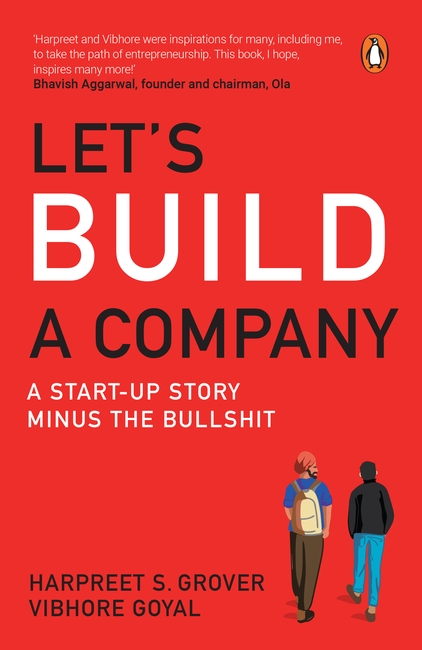
Harpreet Grover and Vibhore Goyal met in college and then spent the next decade of their lives building a company before exiting successfully.
One way to tell their story is this: they had a dream, they followed it and, then, through perseverance, they made it come true.
But that’s not really the truth. Like everything in life-at least everything worth having-it wasn’t that simple. There was blood, sweat and tears, there was loss of capital, loss of friendship and even a loss of faith along the way.
It started with a phone call from Harpreet’s mother introducing him to an uncle who wanted some help. Or maybe it started when Vibhore and Harpreet met as roommates in Room 143 at IIT Bombay. What remains true is that soon both had quit their jobs and launched CoCubes. From no money in their bank accounts for eight years after graduating to becoming dollar millionaires two years later in 2016, this is a tale of grit-of a company built in India by two Indian-middle-class-twenty-somethings-turned-entrepreneurs-written in the hope that you can avoid the mistakes they made and learn from what they did right.
This is that story-the story that you don’t always hear. But if you want to be an entrepreneur, and you prefer straight talk to sugar-coating, it’s one you should read.