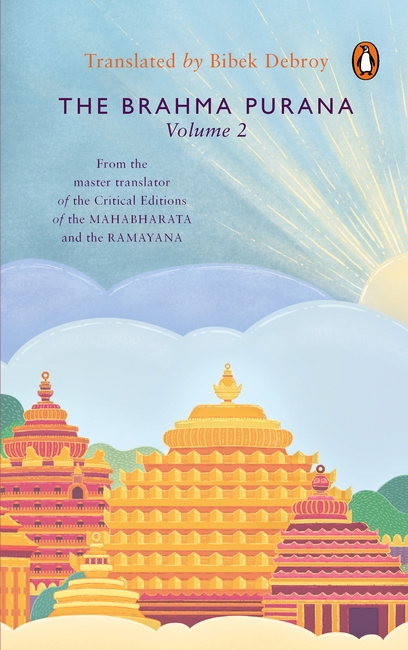
Translated by Bibek Debroy
A GLORIOUS RENDITION OF ONE OF THE OLDEST PURANAS BY A MASTER TRANSLATOR
The Brahma Purana is the first of a series of eighteen texts known collectively as the Puranas. These are counted amongst the foundational texts of Hinduism. The holy trinity of Brahma as the creator, Vishnu as the preserver and Shiva as the destroyer constitutes the central deities of this series and features in its narratives. Sometimes referred to as Adi Purana, Brahma Purana oscillates between being a work of geography with a focus on the holy sites of the River Godavari, and being an encyclopaedic work of cosmology, genealogy and mythology.
Reading almost like a travel guide, it celebrates temples and sites related to Vishnu, Shiva and Devi as it focuses on places like modern-day Odisha and Rajasthan. Brimming with insight and told with clarity, this luminous text is a celebration of a complex mythological universe populated with gods and mortals, providing readers with an opportunity to truly understand Indian philosophy.

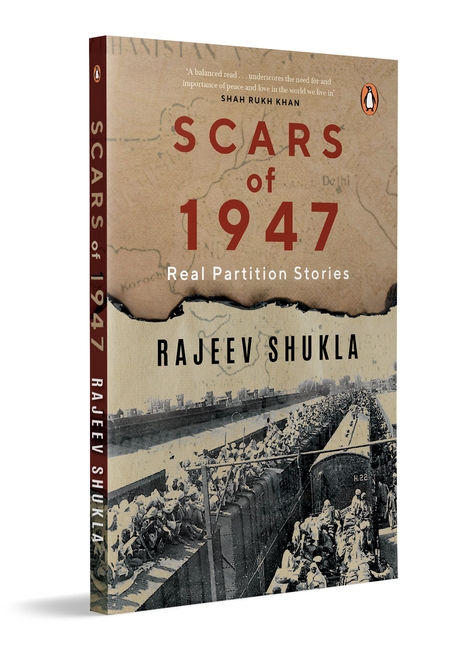
More than seven decades after the Partition of India in 1947, the burden of grief in the hearts and minds of those affected still bears heavy. With a mere stroke of ink on a map, a nation was divided into two, affecting families from one generation to the next, the resultant wounds of which run painfully deep even today.
People on either side of the dreaded Radcliffe line that divided India and Pakistan experienced unimaginable trauma. The horrific events which led to the displacement of millions of people is forever etched in the memories of those who survived this nightmare. Yet, despite the widespread devastation, there were also some uplifting stories of humanity, grit and determination, along with the memories of all that was lost and those who were lost. Through these real stories of Partition, Rajeev Shukla has captured inspiring tales of love, kindness and perseverance of the human spirit.
There are stories from people who went on to become prime ministers, presidents, industrialists, medical researchers and more. In the decades following Partition, these stories of how families rebuilt their lives from scratch are worth remembering.
From the stories of figures like Manmohan Singh and Muhammad Ali Jinnah, to Gauri Khan’s grandmother and Avtar Narain Gujral, Scars of 1947 is a moving and nostalgic collection of a journey back in time, of an unforgettable period that left two nations scarred forever.

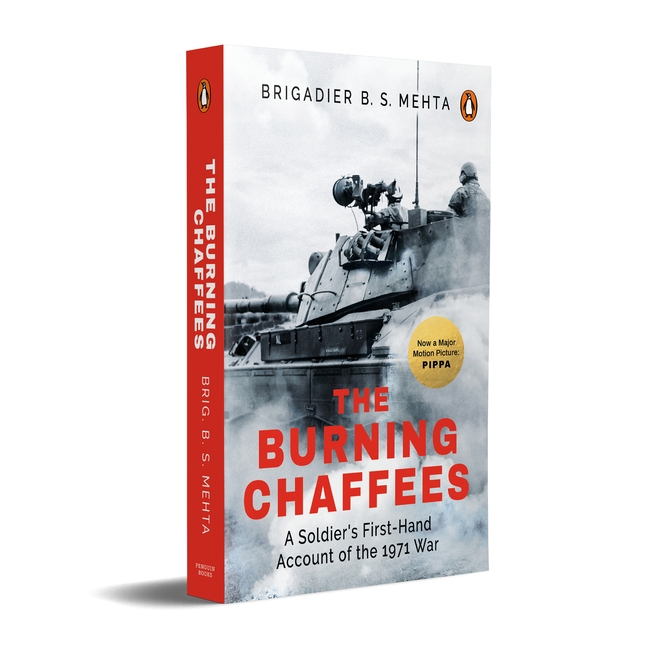
In 1971, India waged a momentous war against Pakistan. But before all-out war, an even more significant tank battle was fought on 21 November 1971 by the C Squadron 45 Cavalry, which demolished the Pakistani General A.A.K. Niazi’s plans of victory and set the stage for the utter routing of the Pakistani Army.
Equipped with the amphibious PT-76 tanks, the Indian Army’s C Squadron 45 Cavalry was unleashed to swim across the River Kabodak, near the Boyra salient (now in Bangladesh), to counter the threat from East Pakistan. On 21 November 1971, the two warring armies clashed in a tank versus tank battle at Garibpur. In one fell swoop, Pakistan’s 3 (Independent) Armoured Squadron, consisting of fourteen American M-24 Chaffee tanks, was completely destroyed and two of its infantry battalions were badly mauled. This was followed by the shooting down of three Sabre F-86 jets for the loss of two PT-76 tanks on the Indian side. And thus, the biggest attack planned by General A.A.K. Niazi to teach the Indians and the Mukti Bahini a lesson had gone up in smoke.
This battle was a victory and a decisive one at that. It was a trumpet call to the rest of the world of India’s intent to stand up for human liberty and dignity in this war of liberation.
On 3 December 1971, Pakistan declared war. The rest is history.
The Burning Chaffees is a thrilling account of the pivotal battle of 21 November by Brigadier B.S. Mehta.
Note: There is an error on Page 267. Brigadier Mehta was awarded Mention-in-Despatches for his gallant services, and not the MVC. The error is regretted and has been corrected in the new edition.

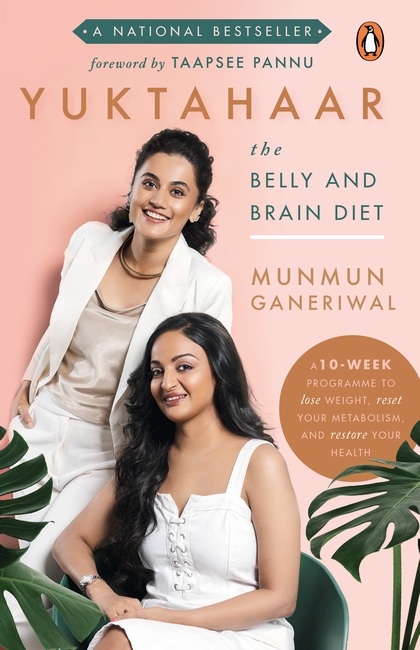
Have you ever wondered why diets just don’t seem to work? In Yuktahaar, celebrity nutritionist Munmun Ganeriwal argues that the reason why none of the diets in the past have seemed to work is because they focused on the wrong cause-you, the reader. While we may continue to have a fling with low carb, vegan, low fat diets and everything in between but a long-lasting solution may never be found if we do not shift our focus from ‘you’ to ‘them’-the human-gut microbiome connection.
Nearly all chronic issues are rooted in an imbalanced microbiome. Disruption in the balance of your belly-based microscopic community not only causes weight gain and increases the risk of chronic diseases but also impacts our mood, behavior, happiness, and a general sense of well-being.
In this book, Munmun gives an actionable 10-week holistic program that encourages a gut balancing lifestyle, consisting of season-wise meal plans, recipes, exercise routines, sleep hygiene tips, and yoga practice. The book also charts actress Taapsee Pannu’s phenomenal physical transformation while working with Munmun. With a focus on combining traditional, regional Indian foods with evidence-backed tips, Yuktahaar will transform your relationship with food and rebalance your gut for a leaner and healthier you.

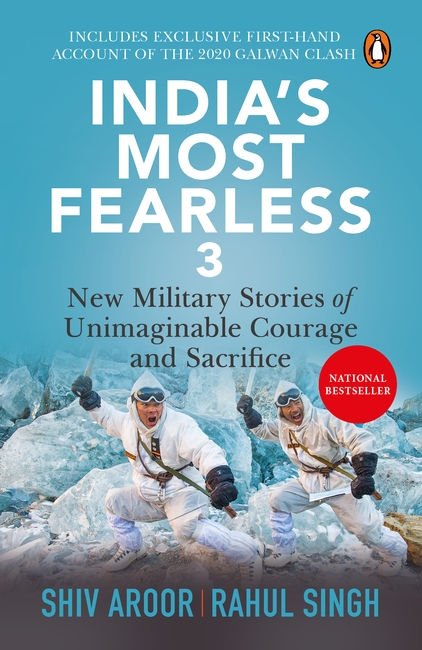
Includes exclusive first-hand account of the 2020 Galwan clash
An army medic who went beyond the call of duty amid a frenzy of treacherous bloodletting in Ladakh’s Galwan while his fellow soldiers fought the Chinese to death; the crew of an Indian Navy destroyer that put everything on the line to rescue hundreds from Cyclone Tauktae in the Arabian Sea; an Indian Air Force pilot who ejected from his doomed fighter less than two seconds before it hit the ground, only to find he was missing a leg.
This book presents their accounts, or of those who were with them in their final moments. India’s Most Fearless 3 features ten true stories of extraordinary courage and fearlessness, providing glimpses of the heroism Indian soldiers have displayed in unthinkably hostile conditions and under grave provocation.
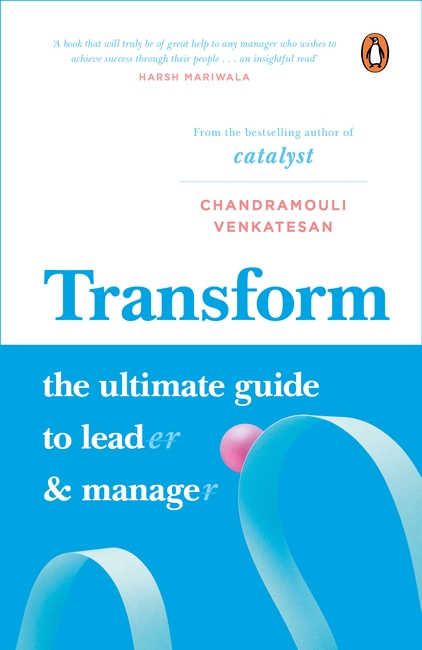
Transform focuses on people management, which the author demonstrates is a very important pillar of success. That is because leadership and managing are the means, while the end impact is what they do to people.
The book is divided into four sections. The first introduces you to the core concepts of leading and managing, and present a series of exercises to open your mind and make you more self-aware as a leader and manager. The second section focuses on helping you become great at managing, with a direct focus on your teams. The third section focuses on becoming great at leading-leading by doing and leading by being. The final section will help you create action plans, and help you develop a practical and implementable plan towards becoming a great leader and manager.
Insightful and practical, Transform is a comprehensive book on leadership and management which covers all important concepts while giving practical implementation techniques for each.

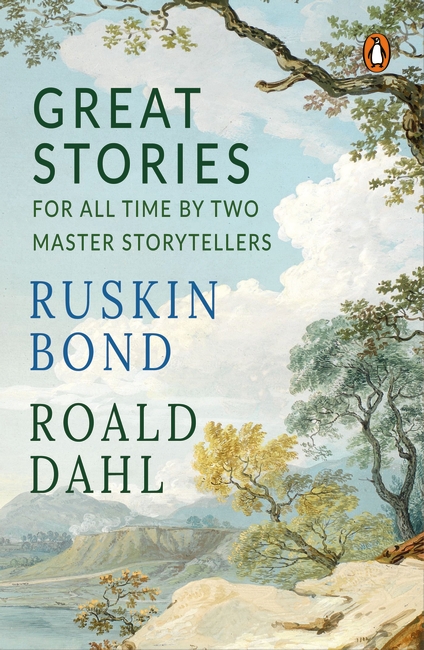
A SPECIAL COLLECTOR’S ITEM WITH THE BEST OF THE TWO MOST-LOVED STORYTELLERS
This box set brings together for the first time two masters of storytelling, to offer readers the best variety of fiction in a single package! From humour to horror, romance to thriller, humour to sadness, and an entire spectrum of human emotions, these two books have it all. A perfect collection to adorn your shelf and to gift to loved ones.
The Best of Roald Dahl
A great selection of Dahl’s most-read stories from his bestsellers: Over to You, Someone Like You, Kiss Kiss and Switch Bitch. Hypnotized from the first sentence, you will remain spellbound as Roald Dahl unravels his fiendish fictions with their satisfying twist-in-the-tale finales, as he leads you through the dangers of gambling for high stakes over wine, the perils of being a vegetarian and the macabre consequences of a night-time seduction . . . This book is, quite simply, Roald Dahl at his sinister best.
The Best of Ruskin Bond
Experience the best of four decades of Ruskin Bond’s writing in one book. This consolidated anthology has selections from all of Ruskin’s major books and includes his classic novel, Delhi Is Not Far. Accompanied by an endearing collection of essays, beautiful excerpts from different stories, serene poems and short stories, this book finds a way to create a unique literary landscape.

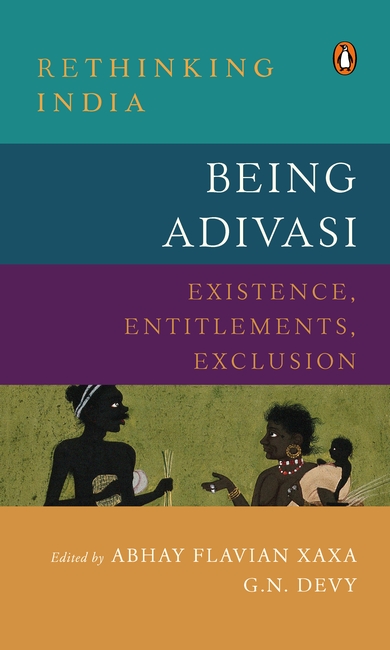
The Adivasis form nearly 8 per cent of the Indian population and live in most states. Despite being one of the oldest constituents of the Indian population, barring a few states in the North-east, they are in a minority in the rest. Persistent problems faced by them-like land alienation, indebtedness, vanishing minor forest products from government forests and displacement from their ancestral lands-have led to their impoverishment. The Panchayats (Extension to the Scheduled Areas) Act (PESA) and the Forest Rights Act (FRA), enacted by the previous governments, were decisive steps towards the empowerment of the Adivasis.
However, at present, the implementation of these provisions has taken a back seat. The seventh volume of the Rethinking India series, in collaboration with the Samruddha Bharat Foundation, presents the views of the Adivasis and the Denotified communities on the process of development and its clash with their rights.
This volume brings together the discussion of several issues from the Adivasi perspective, which is quite different from what is done in anthropology and ethnography.
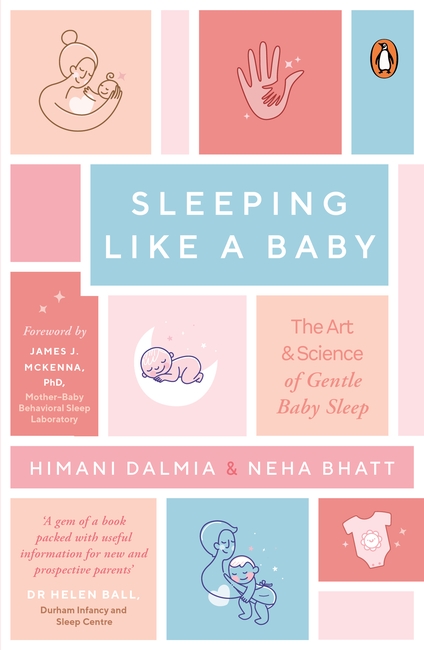
How do I get my baby to sleep? Discover the gentle, scientific, child-led solution to this bewildering (and exhausting) phenomenon of early parenthood for 0-5 year olds.
Sleeping Like a Baby serves as the ultimate bedside companion for parents, packed with all the modern tools you need to build a stronger connection with your children and enable age-appropriate sleep for their optimum growth. The book does the seemingly impossible: blending traditional wisdom and the latest research, it gives us a revolutionary approach to achieve longer naps, better night sleep with fewer wakings, a happier baby and more joy and rest as a family, without resorting to fraught practices like ‘sleep training’.
With anecdotal insights, deep research and practical tips in an Indian context, this book empowers parents to tune into their instincts and understand a child’s cues so that bedtime battles, cranky days and sleepless nights are a thing of the past. Authored by the co-founders running the pioneering Facebook group Gentle Baby Sleep India, Sleeping Like a Baby shares the secret sauce that enables a family-no matter its structure or pressures-to keep the child’s evolutionary and biological sleep needs in focus.
Endorsed by some of the most eminent child sleep experts and written in a style that is deceptively simple and accessible, Sleeping Like a Baby is the final word on responsive and restful sleep for caregiver and baby. All night long.

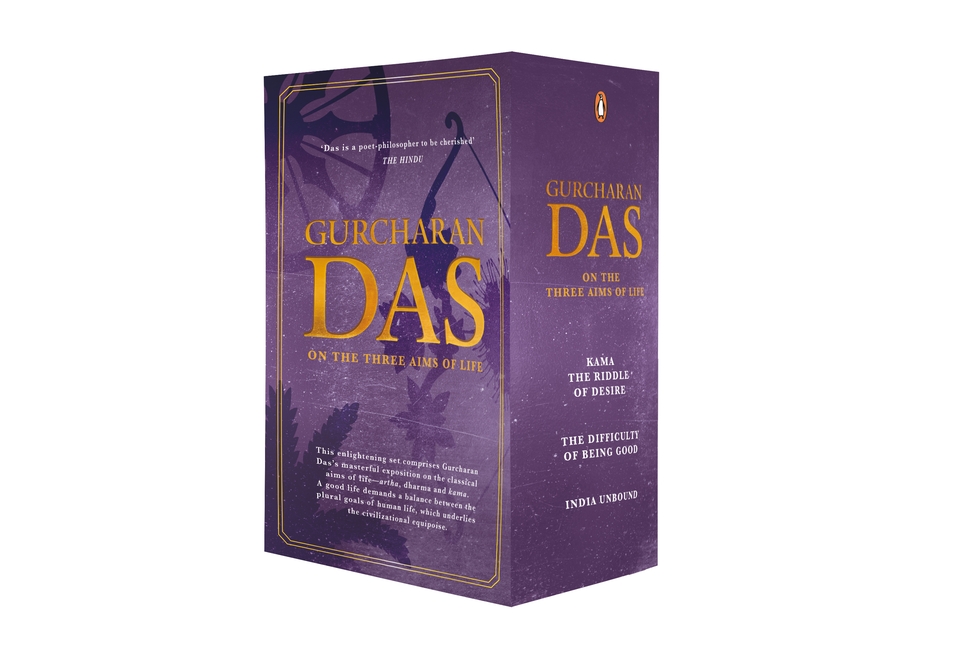
THE COMPLETE TRILOGY OF ARTHA, DHARMA, KAMA
This box set comprises the complete trilogy on life’s goals by bestselling author and thought leader Gurcharan Das: India Unbound, on artha, material well-being; The Difficulty of Being Good, on dharma, moral well-being; and Kama: The Riddle of Desire, on kama, pleasure.
In his magnificent prose, Das argues how dharma is duty to another, kama is duty to oneself, and artha determines the ground on which one stands. As you keep the three aims of life in view, the books in this set will help you find your path through the challenges and answer timeless questions.