



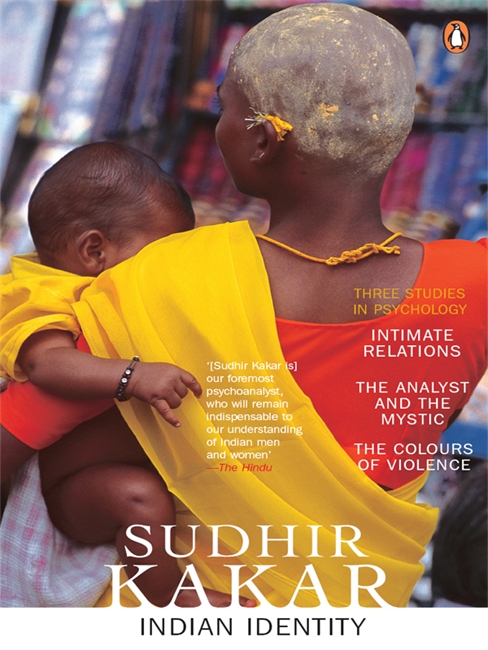
As A Commentator On The Worlds Of Love And Hate , India S Foremost Psychoanalyst Sudhir Kakar Has Isolated The Ambivalence, Peculiarly Indian, To Matters As Various And Connected As Sex, Spirituality And Communal Passions.
In Intimate Relations, The First Of The Well-Known Books In This Edition, He Explores The Nature Of Sexuality In India, Its Politics And Its Language Of Emotions. The Analyst And The Mystic Points Out The Similarities Between Psychoanalysis And Religious Healing, And The Colours Of Violence Is His Erudite Enquiry Into The Mixed Emotions Of Rage And Desire That Inflame Communalism.
Catagory: Non Fiction
non fiction main category
The Great Uprising
‘The punishment for Mutiny,’ said John Nicholson, Commander of the Movable Column, ‘is death’.
As India marks 150 years of the 1857 Uprising, this meticulously researched and vivid work recounts a time both tragic and compelling. Many-staged and many-charactered, this volume searches for the key issues, causes and effects, figures and developments that culminated in the massacres of Cawnpore, Satichaura and Bibighar, the ensuing counter-massacres, and the gory retribution dealt out by the British on their subjects.
Beginning with an account of the state of the British Raj in 1857, Pramod Nayar moves on the ‘A Gathering Storm’, the strife that led to the Uprising, ‘The Summer of Discontent’, recounting the Mutiny, ‘The Retreat of the Native’ which tells us how the British won back lost ground, and ‘The Raj Rises Again’, explaining the repercussions the Mutiny had on the administrative plans of the empire. He also delves into the real causes of the Uprising, more complex than what conventional history upholds. Detailed descriptions of the Mutiny’s main figures, including Henry Lawrence, John Nicholson, Lord Canning, Nana Sahib, the Rani of Jhansi, and the tragic king of Delhi, Bahadur Shah Zafar, are interspersed with quotes, facts and anecdotes that reanimate the past.
An overview and analysis of the Mutiny is flavoured with references to the literature of the time and includes an appendix on how the events of 1857 influenced European literary imagination.
Kanpur and Jhansi, violence and counter-violence, heroism and savagery – this every-person’s guide to 1857 captures the most tumultuous years of British India and re-enacts the drama of the first stirrings of nationalism.
Last Mughal
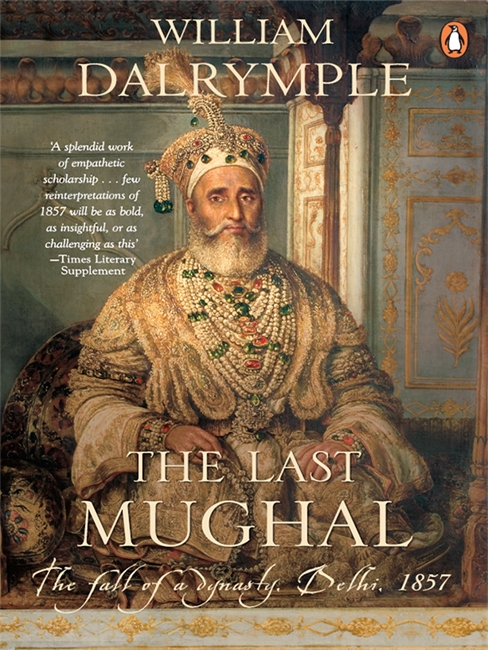
Winner of the Duff Cooper Prize for History 2007 Bahadur Shah Zafar II, the last Mughal Emperor, was a mystic, a talented poet, and a skilled calligrapher, who, though deprived of real political power by the East India Company, succeeded in creating a court of great brilliance, and presided over one of the great cultural renaissances of Indian history. In 1857 it was Zafar’s blessing to a rebellion among the Company’s own Indian troops that transformed an army mutiny into the largest uprising the British Empire ever had to face. The Last Mughal is a portrait of the dazzling Delhi Zafar personified, and the story of the last days of the great Mughal capital and its final destruction in the catastrophe of 1857. Shaped from groundbreaking material, William Dalrymple’s powerful retelling of this fateful course of events is an extraordinary revisionist work with clear contemporary echoes. It is the first account to present the Indian perspective on the siege, and has at its heart the stories of the forgotten individuals tragically caught up in one of the bloodiest upheavals in history.
Dateline Islamabad
It was an assignment that was at once challenging and intimidating. I was going to be setting foot on –enemy” territory.’ Amit Baruah was one of only two Indian journalists allowed to be based in Islamabad during three tumultuous years of Pakistan’s history. The author recounts with some amusement his family’s experience of life in Islamabad society between April 1997 and June 2000″all of it conducted under the suspicious gaze of Pakistani intelligence agents who shadow Baruah, his wife and daughters everywhere, including into friends’ living rooms. He records his frustration at being disallowed from reporting freely on the ground many events that defined Indo-Pak relations, even as death or kidnapping forever stalks him. Three incidents haunt Baruah the most: not being cleared to attend the funeral, in 1998, of John Joseph, the bishop of Faisalabad who committed suicide in protest against Pakistan’s -blasphemy’ laws; being forbidden to view the wreckage of an Indian Air Force plane shot down during the Kargil conflict of 1999; and being prevented from entering Afghanistan from Pakistan to report on the Kandahar hijacking later that year. And yet, says Baruah, despite all the personal and professional difficulties he faced in Pakistan, his stint in Islamabad”and his exchanges with so many friends he cannot name”proved to be the most exciting and enriching in his career. While admitting the difficult nature of his job as a foreign correspondent in a hostile nation, Baruah recalls the joys of meeting generous, like-minded people in a country whose regimented stance on India”and its press”is less than friendly.
The Penguin U.G. Krishnamurti Reader
My teaching, if that is the word you want to use, has no copyright. You are free to reproduce, distribute, interpret, misinterpret, distort, garble, do what you like, even claim authorship, without my consent or the permission of anybody.’ Thus spoke U.G. Krishnamurti in his uniquely iconoclastic and subversive way, distancing himself from gurus, spiritual ‘advisers’, mystics, sages, ‘enlightened’ philosophers et al. UG’s only advice was that people should throw away their crutches and free themselves from the ‘stranglehold’ of cultural conditioning. Uppaluri Gopala Krishnamurti was born on 9 July 1918 in Masulipatnam, a coastal town in Andhra Pradesh. He died on 22 March 2007 at the age of eighty-nine in Vallecrosia, Italy, at the villa of a friend. The effect that he had, and will continue to have, on legions of his admirers is difficult to put into words. With his flowing silvery hair, deep-set eyes and elongated Buddha-like ears, he was an explosive yet cleansing presence and has been variously described as ‘a wild flower of the earth’, ‘a bird in constant flight’, an ‘anti-guru’ and a ‘cosmic Naxalite’. UG gave no lectures or discourses and had no organization or fixed address, but he travelled all over the world to meet people who flocked to listen to his ‘anti-teaching’. His language was always uncompromisingly simple and unadorned, his conversational style informal, intimate, blasphemous and invigorating. This reader, edited by long-time friend and admirer Mukunda Rao, is a compilation of UG’s freewheeling and radical utterances and ideas. UG unceasingly questioned and demolished the very foundations of human thought but, as Rao says, in the cathartic laughter or the silence after UG had spoken, there was a profound sense of freedom from illusory goals and ‘the tyranny of knowledge, beauty, goodness, truth and God’
The Book Of Demons
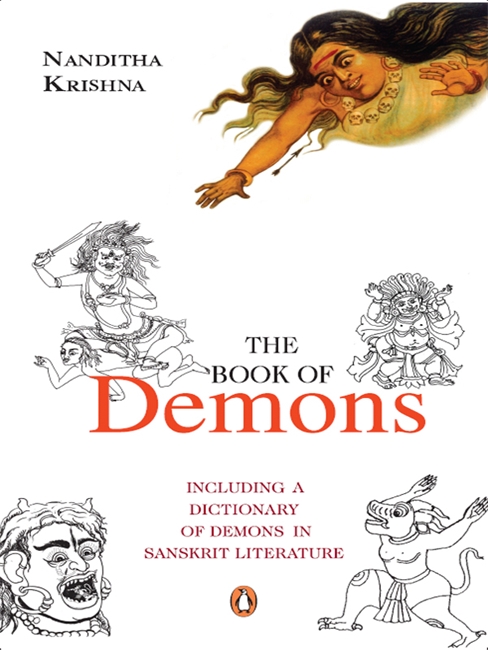
From The Rig Veda To Myriads Of Folk Narratives, The Belief In Demons Prevails All Over India, Vividly Illustrating That A Demon Is Something People Fear Because It Is Beyond Their Comprehension And Control. Time And Again, The Menacing And Uncontrollable Forces Of Night, Darkness And Death, Along With Powerful Defeated Enemies And Incomprehensible Natural Phenomena, Are Demonized.
The Book Of Demons Presents A Perceptive Overview Of The Various Types Of Demonic Beings And Concepts That Exist In Hindu Literature, Supplemented With A Dictionary Of Individual Demons For Ready Reference. Besides The Well-Known Rakshasas And Asuras, The Author Also Reveals A Densely Populated World Of Lesser-Known, But Equally Fascinating, Demonic Creatures. Andhaka (Blind Darkness), Conceived When Parvati Playfully Covered Shiva S Eyes And The World Was Plunged Into Darkness; Gajamukha, The Elephant-Faced Demon Who Was Transformed Into A Mouse By Ganesha And Then Converted Into His Vehicle; Jambha, The Demon-Leader Who Snatched The Pot Of Immortal Nectar From The Ocean During The Great Churning; Maya, The Demonic Equivalent Of Vishvakarma, Architect Of The Gods, Who Built The Three Cities Of Tripura; And Putana, The Demon Who Tried To Kill Krishna By Suckling Him With Poisoned Breasts.
Male Or Female, Human, Animal, Plant, Or Simply A Concept Demons Play A Pivotal Role In Our Mythical Traditions. Blending Insightful Erudition And Lively Description, Nanditha Krishna Brings To Life The Traits And Actions Of A Host Of Complex, Colourful, Monstrous And Intriguing Demons That Inhabit Indian Religion And Mythology.
Eating India
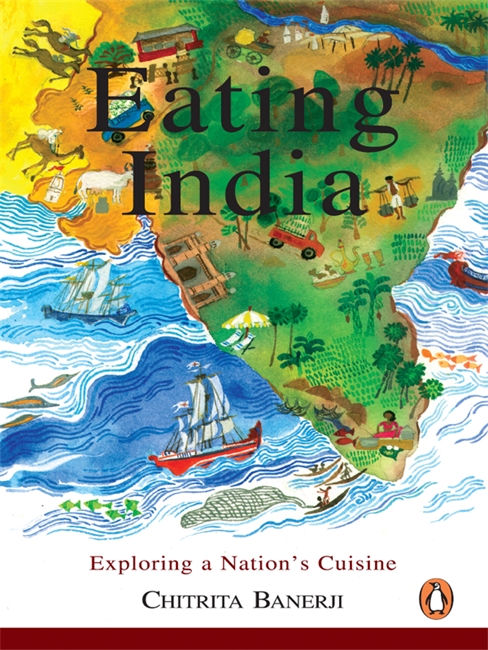
In Eating India, award-winning food writer Chitrita Banerji takes us on an extraordinary journey through a national cuisine formed by generations of arrivals, assimilations and conquests. Traveling across the length and breadth of the country-from Bengal to Goa and Karnataka, via the Grand Trunk Road, then northwards to Amritsar, Lucknow and Varanasi, on to Bombay and Kerala-Banerji discovers a civilization with an insatiable curiosity, one that consumes the old and the new with eager voracity. Weaving together myths and folklore associated with food, the people and their culture, the author narrates captivating accounts of life in the subcontinent: the legend behind the week-long harvest festival of Onam; the strictly observed rules of kosher in the Jewish households of Cochin; the best Benarasi thandai that has a dollop of bhang in it; and the food and culture of the indigenous people who hover on the edges of mainstream consciousness, among others. Eating India is also peppered with fascinating tidbits from India’s history: the use of ‘shali’ rice to make pilafs during the Mughal period; the advent of chillies with the arrival of the Portuguese; British, apart from Goan, influence on Parsi society that prompted the Parsis to open the first girls’ school in India in 1849; and the medieval movable feast that unfolded on the travellers’ platter as they moved from east to west on Sher Shah Suri’s Sarak-i-Azam. At different points in her journey, Banerji shows us how restructuring old customs and making innovations is what India is all about: food in India has always been and still is fusion-one that is forever evolving. Certain to enchant anyone enamoured of Indian food and culture, Eating India is a heady blend of travelogue and food writing.
The Shattered Thigh & Other Plays
Ethnography Of Goa, Daman And Diu
The intellectual and cultural efflorescence in Goa reached its apogee in the late nineteenth and early twentieth centuries. Antonio Bernardo de Bragana Pereira was a product of this time, and Ethnography of Goa, Daman and Diu is an expression of the author passionate interest in scholarship and research into various dimensions of Goan life. His intellectual curiosity and critical spirit led him to delve deep to understand the lan vital of the society of his ancestors and to catalogue the many dimensions of Goan life. In the book he describes the rituals, customs and manners of various castes and religions, their habitat, their artisanship, their environment and all aspects of Goa and Goan society. Ethnography of Goa, Daman and Diu was published as a two-volume edition in 1940 in Portuguese. In making the second volume available to a larger readership, the publishers perform a dual role of bringing this scholarly work to a new generation of readers and in a language that will be accessible. Its publication is a tribute to A.B. de Bragan.a Pereiras passionate attachment to Goa and his pride in being a Goan.
The Untold Charminar
A dazzling collection that captures the essence of Hyderabad, offering glimpses of the various strands that go into its making, fact and legend, old-world quaintness and the highest hi-tech, eccentricity and intrigue, the calm of genteelness and the fury of rebellion.
Hyderabad is a city once ruled by the worlds richest man who invested most lavishly in his state, most shabbily in his wardrobe; it holds stories of a courtesan who fought wars, counselled prime ministers, sang her own verse and enthralled luminaries who mattered; of a chief minister who transformed it into a hi-tech hub; and of a sports star who brought the young glamour of India to every tennis court in the world.
Home as much to the Golconda as to Jacob, the 187-carat diamond used as a paperweight by the Nizam, and to rock landscapes two and a half million years old, Hyderabad is a city that forever mixes cultures, cuisines, religions and languages. Here, Persian turned alloy with Telugu, Marathi and Arabic to yield a special version of Urdu, Dakhini. And here, as Andhra mingled with Telangana, a smiling mildness has survived, disarming at every turn, just as grace under pressure, regardless of gender, is unfailing.
In The Untold Charminar readers will discover a city they will want to explore, as Sarojini Naidu, Sir Mark Tully and William Dalrymple rub shoulders with Ian Austin, Meenakshi Mukherjee and Anees Jung, regaling you with their feast of hard facts and hearsay; as each foreign visitor shares his story through Narendra Luther; as the film-makers Shyam Benegal and Nagesh Kukunoor paint their vivid memories of home; as poets, not just the maverick Makhdoom and Gaddar, raise their voices in song; as statesmen, academics and aficionados hold forth on the completely different Hyderabad each experienced.
And when Tejaswini Niranjana profiles the vigilante Vijayasanthi and Dharmender Prasad picks out place names and explains their sometimes almost mystic origins, as Bachi Karkaria, Omkar Goswami and Harsha Bhogle share their typically offbeat views of a favourite city, readers will be persuaded to believe they have encountered not a city but the inner workings of a very complex character.