In The Archer we meet Tetsuya, a man once famous for his prodigious gift with a bow and arrow but who has since retired from public life, and the boy who comes searching for him. The boy has many questions, and in answering them Tetsuya illustrates the way of the bow and the tenets of a meaningful life. Paulo Coelho’s story suggests that living without a connection between action and soul cannot fulfil, that a life constricted by a fear of rejection or failure is not a life worth living. Instead, one must take risks, build courage and embrace the unexpected journey fate has to offer.
With the wisdom, generosity, simplicity and grace that have made him an international bestseller, Paulo Coelho provides the framework for a rewarding life: hard work, passion, purpose, thoughtfulness, the willingness to fail and the urge to make a difference.

When will India win the fight against the COVID-19 pandemic?
How long do we have to use masks?
When can we expect a safe and effective vaccine? Do we need to wear masks even after we get a vaccine?
What if there is no definitive treatment against COVID-19?
How can we protect our family form this disease?
How should we respond to this ‘new normal’ as an individual and as a community?
What is the way forward?
Offering insights on how India continues to fight the pandemic, Till We Win is a must-read for everyone. It is a book for the people, for political leaders, policymakers and physicians, with the promise and potential to transform public health in India.
In What the Customer Wants You to Know, Ram Charan explains how the crisis of a broken selling system can be tackled. According to the author, today selling has become a war of prices. Conducting a business transaction is no longer fun since most customers feel cheated by their respective vendors. Charan says that the easiest way to avoid the hassle is to understand the customer’s point of view. Instead of feeling cheated, the consumer should look to the seller for assistance in today’s cost-effective times. The author brings in a new aspect of selling, which he calls value creation selling.

No any cases run so long and important in the history of modern India, which has a serious impact on the politics, society and its overall thinking of the country. The supreme court of India gave its verdict on the Ram Janmbhoomi-Babri Masjid dispute going on for centuries, on 9th November 2019, after a continuous hearing for forty days.
This book is an eye witness account of the same forty days of hearing in the Supreme Court. The book presents the background of the judges, the lawyers and the parties concerned, the ups and downs in the litigation and our secular justice system without any bias.

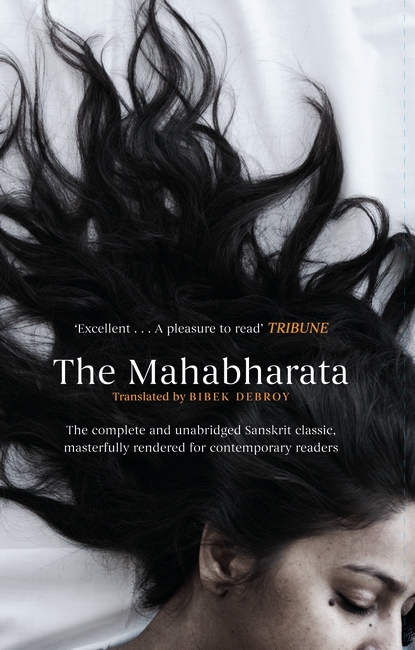
The greatest Indian story ever told of a war between two factions of a family, The Mahabharata has continued to sway the imagination of its readers over the past centuries.
While the dispute over land and kingdom between the warring cousins-the Pandavas and the Kauravas-forms the chief narrative, the primary concern of The Mahabharata is about the conflict of dharma. These conflicts are immense and various, singular and commonplace. Throughout the epic, characters face them with no clear indications of what is right and what is wrong; there are no absolute answers. Thus every possible human emotion features in The Mahabharata, the reason the epic continues to hold sway over our imagination.
The complete and unabridged Sanskrit classic, now masterfully and accessibly rendered for contemporary readers by Bibek Debroy.

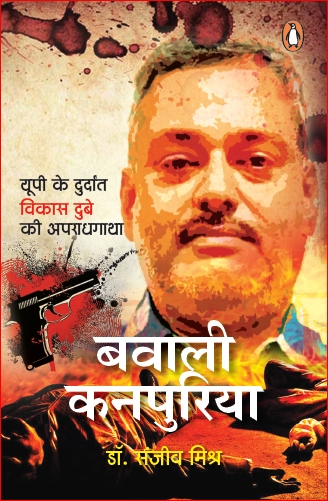
Gangster Vikas Dubey was killed in a police encounter on 10 July 2020. The story of his life was revealed by his death and the face of a fearless criminal, a gangster and a murderer who did not spare even the police officers.
A long list of crimes against him including murder of his own teacher, Siddheshwar Pandey in broad daylight, sneaking into the police station of Uttar Pradesh to kill the minister Santosh Shukla, and by killing Jhunna Baba announcing a land mafia that had access to far and far-reaching extent.
After all, how did this criminal arise? Under what circumstances he became a criminal and what were the forces that did not just save him for so many years but made him a leader.
Bawali Kanpuriya is such a raw details of Vikas Dubey’s life who also examines how the meritorious child of an ordinary family fell into such a trough of crimes that he could not get out of it again.

One of the world’s oldest forms of faith, Hinduism has an unbroken trajectory of beliefs and rituals that have continued for many millennia through the footsteps of pilgrims and the pedagogies of theologists; through myth, science and politics. But what does all that mean to the modern Hindu today? Why do Hindus call themselves so? Is it merely because their parents were Hindus? In what way does the faith speak to those who profess to follow it? What does Hinduism mean to the everyday-practising or sometimes-accessing ordinary Hindu? Away from the raucous debate around religion, this is the journey of a common Hindu, an attempt to understand why, for so many Hindus, their faith is one of the most powerful arguments for plurality, for unity in diversity, and even more than the omnipresent power of God, the sublime courage and conviction of man.
Being Hindu is an exploration of Hinduism in a way you have never seen before, almost through your own eyes. This is the first book on Hinduism to have won the Wilbur Award given by the Religion Communicators Council of America for excellence in writing about religion.
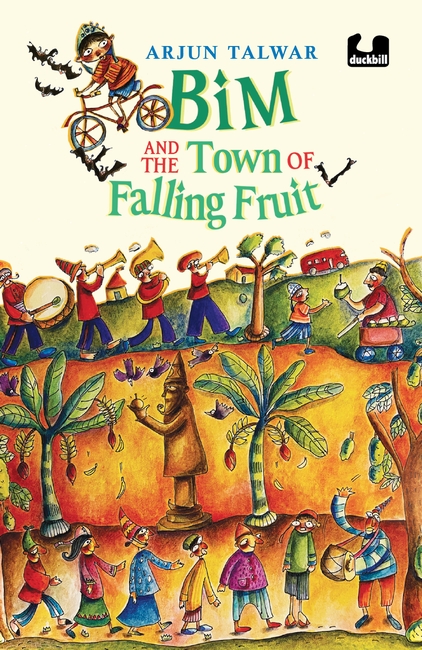
In Poondy, fruits are always falling on people’s heads-from the jackfruit, coconut and toddy trees-causing many injuries. So all the Poondizens wear fruit-helmets invented by the legendary Falwala. Bim loves Poondy, with its falling fruits, its Wise Man and its barber-detective.
Then one day, Miss Chitty, Bim’s mother, who drives a coffee-coloured taxi, decides to move away from Poondy. Bim’s last two weeks in his home town are full of strange and exciting adventures-from a bat attack to a bike theft-that can only happen here!
Arjun Talwar’s debut novel is a mad and hilarious romp through a town filled with eccentric people. It is brought to vivid life by Shilpa Ranade’s beautiful illustrations.

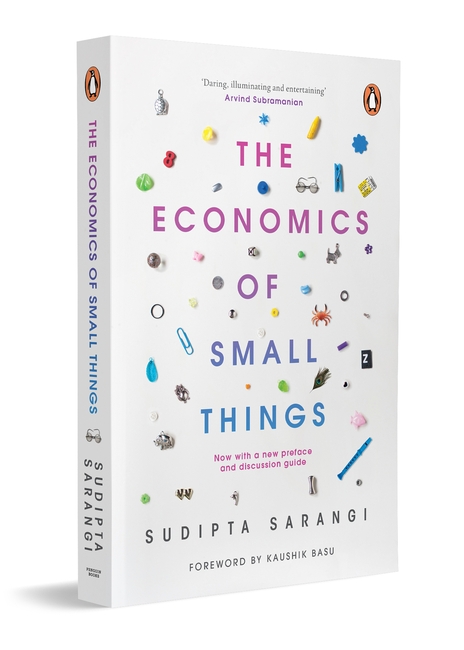
What do peacocks, fountain pens and IIT degrees have in common? Do you think creating good cricket teams or for that matter, any team, is like designing a good stock portfolio? In The Economics of Small Things, Sudipta Sarangi reveals the hidden logic governing our daily lives, proving that economics isn’t just about stock markets—it is about the choices we make every single day.
From the bargaining power of domestic help to the signalling games played on first dates, Sarangi uses delightful anecdotes and pop-culture references—from Lage Raho Munna Bhai to the game of Chicken—to explain how complex concepts, such as asymmetric information, focal points and efficiency wages, are a part of our lived experiences. He demonstrates how ‘small things’, such as the price of a mango or a viral forward, illustrate the fundamental principles of human behaviour and social coordination.
Written with warmth, wit and clarity, this book is a journey through the ‘economics of the ordinary’. It transforms the mundane into the fascinating, offering a fresh lens to understand the world. You’ll never look at a grocery shelf or a traffic jam the same way again.
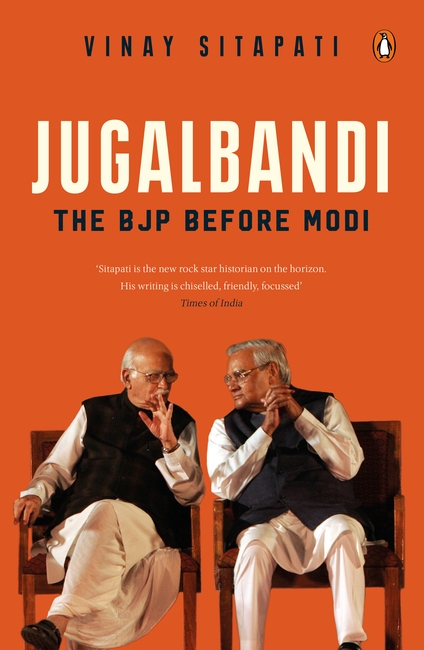
Narendra Modi has been a hundred years in the making. Vinay Sitapati’s Jugalbandi provides this backstory to his current dominance in Indian politics. It begins with the creation of Hindu nationalism as a response to British-induced elections in the 1920s, moves on to the formation of the Bharatiya Janata Party (BJP) in 1980, and ends with its first national government, from 1998 to 2004. And it follows this journey through the entangled lives of its founding jugalbandi: Atal Bihari Vajpayee and Lal Krishna Advani.
Over their six-decade-long relationship, Vajpayee and Advani worked as a team despite differences in personality and beliefs. What kept them together was fraternal love and professional synergy, of course, but also, above all, an ideology that stressed on unity. Their partnership explains what the BJP before Modi was, and why it won.
In supporting roles are a cast of characters-from the warden’s wife who made room for Vajpayee in her family to the billionaire grandson of Pakistan’s founder who happened to be a major early funder of the BJP. Based on private papers, party documents, newspapers and over two hundred interviews, this is a must-read for those interested in the ideology that now rules India & Indian politics & government