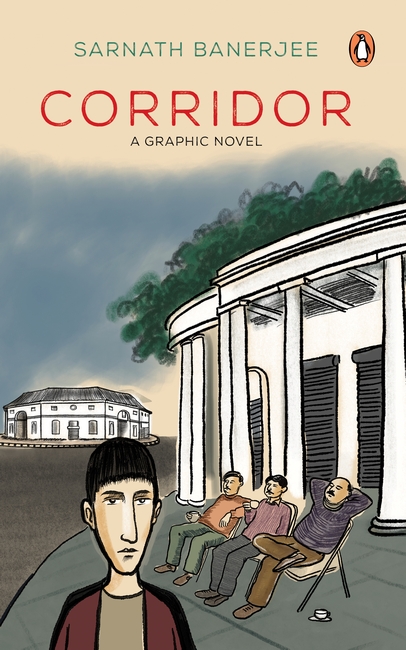
The story of Corridor revolves around an enlightened dispenser of tea, Jehangir Rangoonwalla, who has a shop in the heart of Lutyens’ Delhi, Connaught Place. He also sells second-hand books and dispenses wisdom to his customers. All of the main characters of the novel have this shop as their common local haunt and Mr Rangoonwalla interacts with these residents of Delhi when they visit his shop and at times gives them his words of wisdom. They come to him for tea, books, conversation and advice.
The story is about a plethora of characters, each from a different strata of society and different background. These customers are Brighu, passionate for obscure collectibles and a real love life, Shintu, the newly married on a quest of the ultimate aphrodisiac, and Digital Dutta, a person mostly torn between an H-1B visa and Karl Marx. Dutta is portrayed as a man who lives in his head.
Each of these characters has a story of his own and the author ties them together in a brilliant manner for his book. While narrating their stories, Banerjee subtly touches the greyer shades of their lives and presents them vividly to the reader. The entire novel has been captured in the corridors of contemporary Connaught Place in Delhi and Calcutta. Various pictures and objects have been shown in the background frame and the author ensures to refer them, thereby touching upon the different cultural references.
Sarnath Banerjee presents a different flavour to the art of storytelling by mixing various other art forms such as sketches, illustrations, and photographs. These heighten the impact on the reader in a beautiful way. The author uses an imaginative alchemy of words and images, of a script and artwork, to present the alienation and fragmented reality of the Indian urban life. Thus, the novel presents a delightful tale with interesting twists and turns.

Being a diabetic does not mean you have to eat boring or insipid food, and here are some interesting and unusual recipes to prove it. Not only are these recipes simple to follow, they also use ingredients readily available in a regular kitchen. The end result is healthy food that is so delicious that non-diabetic members of the family will also enjoy it, thus doing away with the need to prepare `special’ food for a diabetic person. And to help monitor calorie intake, a crucial aspect of diabetic care, every recipe is supplemented with a list of the protein, fat and carbohydrate content as well as the total calories per serving. The introduction, by a dietician specialized in diabetics, clears many myths and fears concerning the disease. It explains lucidly how and why diabetes occurs, what its side effects are and what causes them, and how to control diabetes. So, if you are a diabetic or know one in search of a healthy yet adventurous diet plan, this is the perfect book for you.
The Indian Economy: Problems and Prospects, first published in 1992, looks at the country’s economy and the resolved fiscal crisis from a historical perspective. Edited and updated with a new Introduction by Bimal Jalan, the book retains the thirteen essays written by eminent economic thinkers in 1991 and 1992 in their original form as they provide a comprehensive overview of India’s economic development since Independence and answer questions on key economic issues that are as relevant today as they were at that time. Bipan Chandra conducts a historical survey of fiscal developments during the colonial period, the late V.M. Dandekar evaluates India’s economic performance from 1950 to 1990, and Rakesh Mohan traces the history of industrial controls from the pre-independence era. Also included are essays by C.H. Hanumantha Rao, C. Rangarajan and Narendra Jadhav, Raja Chelliah, Sudipto Mundle and M. Govinda Rao, Jyoti and Kirit Parikh, Pravin Visaria, T.S. Papola, Pranab Bardhan and Kaushik Basu. In his revised Introduction, Bimal Jalan assesses the country’s economic progress since 1991, examines crucial events and their relative significance. Exploring diverse aspects of the Indian economy as well as the political, institutional and legal implications of economic reforms, these insightful and revelatory essays will be of enormous interest to experts and the general reader alike.

`On the day of Qayamat you will be called by your names and the names of your fathers. Therefore keep good names.’—The Prophet The Complete Book of Muslim and Parsi Names is a practical guide for choosing the perfect name for your child. The result of several years of research; it is an erudite and thorough compilation of approximately 30;000 names taken from ten languages. With the actual and the construed meanings and the history or mythology associated with the name given against each entry; this is a precise and invaluable sourcebook for scholars and lay readers alike.
The Partition of the Indian subcontinent in 1947 left a legacy of hostility and bitterness that has bedevilled relations between India and Pakistan for over fifty-five years. The two countries, both nuclear powers now, have fought three wars since Independence and have twice come to the brink of war in recent years. Each of their attempts to make peace has failed, and each failure has added a new layer of anger and mistrust to existing animosities.
So what will it take for India and Pakistan to put the long shadows of Partition behind them, once and for all?
Reviewing the turbulent history of their past relationship, Radha Kumar analyses the chief obstacles the two countries face and looks afresh, in particular, at the Kashmir conflict, in the light of the new opportunities and challenges that the twenty-first century presents. Kumar’s comparisons with partition-related peace processes in Bosnia, Ireland, Cyprus and Israel-Palestine offer a radically different perspective on the prospects for peace between India and Pakistan, and illuminate the key elements that go into a successful peace process.
Lucid, incisive and optimistic, Radha Kumar’s essay, written at a time when a new peace process between India and Pakistan has begun to unfold, challenges received wisdom as it argues persuasively that the South Asian neighbours are today better placed to make peace than ever before.
In December 1961, Indian Troops Marched Into Goa Putting An End To Over 450 Years Of Portuguese Rule, The Longest Spell Of Colonialism On The Subcontinent, And Goa Became Part Of The Indian Union. In Popular Imagination, However, Goa Has Remained A Place Not Quite India, And Stereotypes About Goa And Goans Abound. Maria Aurora Couto S Unique Blend Of Biography, Memoir And Social History Brings Us The Goa Behind The Beaches And Booze Culture That Is Projected For The Tourist And Which Has Unfortunately Come To Define Goa For The Vast Majority Outside The State.
Starting With An Account Of The Immediate Aftermath Of Liberation, Couto Goes Back And Forth In Time To Examine The Fundamental Transformations In Goan Society From 1510, When Afonso De Albuquerque Conquered Goa, Up To The Present. Drawing Upon The Experiences Of Her Own Family And Those Of Others, Both Hindu And Catholic, She Writes Of The Influences That Have Touched All Goans The Luso-Indian Culture; Conversion And The Inquisition; Political And Cultural Changes In Europe Such As The French Revolution And The Ideals Of Republicanism; Folk Traditions, Music And The Konkani Language; And, Ultimately, Freedom And Integration With India. In The Process She Reveals How Goa, Which Combines The Best Of Traditional And Cosmopolitan Lifestyles, Has Evolved Into India S Twenty-First-Century Model Of Economic Development And Communal Harmony. Written With Sensitivity, Insight And Scholarship, Goa: A Daughter S Story Is At Once Expansive And Intimate: A Moving Narrative About Home, The Village And The World, In Which The Author Crosses The Boundaries Between History And Memory, Truth And Imagination, To Evoke Personal And Community Experience. It Is As Much An Appraisal Of Goa S Past As It Is An Examination Of Its Present And A Vision For Its Future.

Seven Summers, first drafted when Mulk Raj anand was a student at London University but not published till 1951, recreates teh events and feelings of the first seven years of the writer’s life, or what he called his ‘half unconcious and half conscious childhood’. first of the seven volumes of autobiographical fiction that Anand conceptualized but never completed, this book is full of memorable scenes and people observed through the eyes of a child. the most impressive of them all being the Coronation Durbar in Delhi to which our young hero is smuggled wrapped in a blanket so that the Sahibs might not object to the presence of ‘so discordant an element into so gorgeous a ceremony’. this edition of Seven Summers is a special reissue of the classic autobiography to commemorate Anand’s birth centenary.
A reasoned, objective examination of the role of madrasas The emergence of radical Islamist movements in various parts of the world, the rise and fall of the Taliban in Afghanistan, the 9/11 attacks, widespread vilification spearheaded by Hindutva groups”all these and more have made madrasas a much talked about institution. Focussing on the madrasas of India, Bastions of the Believers seeks to critically interrogate sensationalist and stereotypical images of the madrasas by highlighting their diversity and the complex social roles that they play in the lives of many Muslims. Madrasas, as a rule, represent a conservative form of theology and jurisprudence that is, in many ways, ill-suited to a modern, pluralistic society. Much of what is taught in madrasas is outdated and unscientific (the Deoband madrasa, for instance, still insists that the sun revolves around the earth, and it has special seating arrangements for invisible jinns). Yet, obscurantism need not necessarily lead to militancy and hostility against others. For instance, in the decades leading to India’s independence, the Deobandis, representing an extreme form of religious conservatism, insisted on Hindu—Muslim amity and a joint struggle for a free and united India. It is this integrated view of madrasas and a more liberal and open understanding of Islam, and indeed of all faiths, which Yoginder Sikand seeks to promote”for he believes this is one of the principal duties confronting committed believers if we have to learn to live together despite our differences. Bastions of the Believers covers a wide range of thought-provoking issues”from the origins and develoent of the institution to critiques of madrasa curricula and the alleged links between madrasas and Islamist militancy”making this a must-read for all those interested in creating and preserving a just social order.
Looking at the 19th and 20th centuries, and drawing on scholarly sources, this book traces the history of Gujurat from the time of the Indus Valley civilization, where Gujarati society came to be a synthesis of diverse cultures, to the state’s encounters with the Turks, Marathas and the Portuguese.

Kalidasa is the greatest poet and playwright in classical Sanskrit literature and one of the greatest in world literature. Kalidasa is said to have lived and composed his work at the close of the first millennium BC though his dates have not been conclusively established. In all, seven of his works have survived: three plays, three long poems and an incomplete epic. Of these, this volume offers, in a brilliant new translation, his two most famous works, the play Sakuntala, a beautiful blend of romance and fairy tale with elements of comedy; and Meghadutam (The Cloud Messenger), the many-layered poem of longing and separation. Also included is Rtusamharam (The Gathering of the Seasons), a much-neglected poem that celebrates the fulfillment of love and deserves to be known better. Taken together, these works provide a window to the remarkable world and work of a poet of whom it was said: Once, when poets were counted, Kalidasa occupied the little finger; the ring finger remains unnamed true to its name; for his second has not been found