



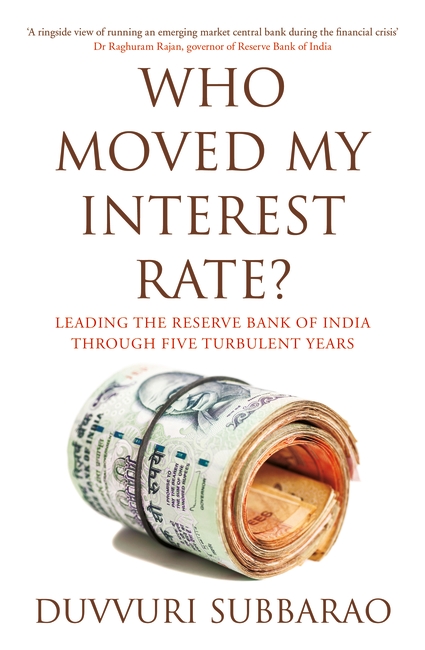
Duvvuri Subbarao’s term as the governor of the Reserve Bank of India from 2008 to 2013 was by all accounts an unusually turbulent period for the world and for India. The global financial crisis erupted within a week of his assuming office. Then, just as the impact of the crisis on India ebbed, the action shifted to combating a decade-high, stubborn inflation during 2009¬¬¬¬-11, which segued into a battle against a sharp depreciation of the rupee starting mid-2012. Who Moved My Interest Rate is an insider’s account of the dilemmas and quandaries Subbarao confronted while leading the Reserve Bank through these extraordinary economic and political challenges.
Subbarao’s five years at the Reserve Bank also marked an intellectually vigorous period for central banking around the world. Not only did the global financial crisis test the policy force of central banks, but it also raised several questions about the breadth of their mandates and the limitations of their autonomy and accountability. While much of the existing debate is set in the advanced economy context, Who Moved My Interest Rate places these issues squarely in an Indian and emerging market perspective.
This is also a compelling chronicle of Subbarao’s attempts to demystify the Reserve Bank and explain to the public its impact on their everyday lives. Honest, authoritative and deeply insightful, this book enhances our understanding of what is, arguably, one of India’s most trusted institutions.
Catagory: Non Fiction
non fiction main category
Applied Minds
Growing up in a remote village in Bengal, Rekha Kalindi was always made to believe that being born a girl was a burden. A feisty, intelligent child, she was aware of the horrific consequences of forced marriages on the young girls in her village. Having observed how her friends were married off and sent to live with their mothers-in-law, where they were often treated like slaves, she was determined not to suffer the same miserable fate.
At the age of eleven, Rekha caused a sensation when she refused to be a child bride. Furious, her mother locked her up and even starved her, but the young girl’s spirit could not be broken. It took an incredible amount of bold determination for Rekha to persuade her family not to marry her off against her will. Ever since, she has actively campaigned for the rights of young girls, and has emerged as a crusader for justice. She also went on to become a recipient of India’s National Bravery Award in 2010.
The Strength to Say No is a powerful portrait of one girl’s monumental struggle against oppression as well as a heartrending and inspiring story about the triumph of the human spirit.
Bhujia Barons
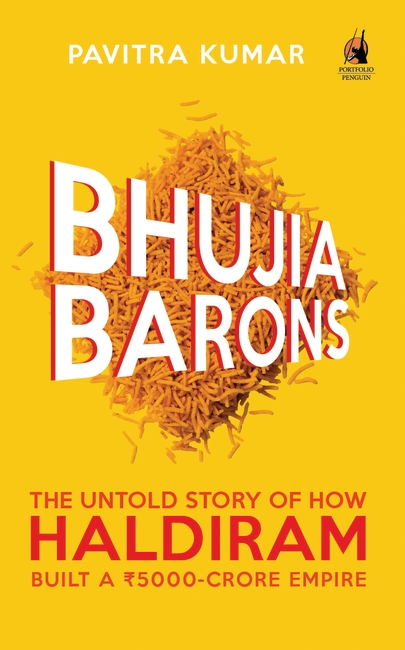
In the early twentieth century, young Ganga Bhishan Agarwal, aka Haldiram, gained a reputation for making the best bhujia in town. Fast-forward a century and the Haldiram’s empire has a revenue much greater than that of McDonald’s and Domino’s combined.
In Bhujia Barons, Pavitra Kumar manages to tell the riveting story of the Agarwal family in its entirety-a feat never managed before. It begins in dusty, benign Bikaner and traces the rise and rise of this homegrown brand which is one of the most-recognized Indian brands in the world.
The Haldiram’s story is not an average business story, it’s chock-full of family drama with court cases, jealousy-fueled regional expansion, a decades-old trademark battle, and a closely guarded family secret of the famous bhujia. Fast-paced and riveting, this book provides a delicious look into family business dynamics and the Indian way of doing business.
Red Lipstick

The world keeps taunting him as girlish but the fact is that, biologically, he is a boy. And, he is always attracted to guys. Is Laxmi both a man and a woman? Or, perhaps, neither a man nor a woman? The first inklings and stirrings of lust that Laxmi remembers came from noticing big, strong arms, the hint of a guy’s moustache over his lips, billboards that advertised men’s underwear. Laxmi found this puzzling initially. Was there a woman inside him who couldn’t really express herself because of some last-minute mix-up that god did at the time of his birth? Struggling with such existential questions, Laxmi Narayan Tripathi, eminent transgender activist, awakens to her true self: She is Laxmi, a hijra.
In this fascinating narrative Laxmi unravels her heart to tell the stories of the men-creators, preservers, lovers, benefactors, and abusers-in her life. Racy, unapologetic, dark and exceptionally honest, these stories open a window to a brave new world.
Sleepwalking to Surrender

Khaled Ahmed is Pakistan’s most respected columnist, and his formidable expertise on the ideologies of extremism is internationally acknowledged. In Sleepwalking to Surrender he explores why, despite the horrifying toll that terrorism has taken on Pakistan, the civil and military establishments continue to uphold a variety of conspiracy theories in place of the facts on the ground. In a situation where the writ of the state is fraying in the face of Taliban–al-Qaeda terror, it continues to view the USA and India as its designated enemies, rather than the extremists holding the state to ransom.
In this powerful and insightful analysis of the state of Pakistan today, Ahmed examines a wide spectrum of events, ideologies and personalities and appraises the portents for the future.
The Assassinaton of Rajiv Gandhi
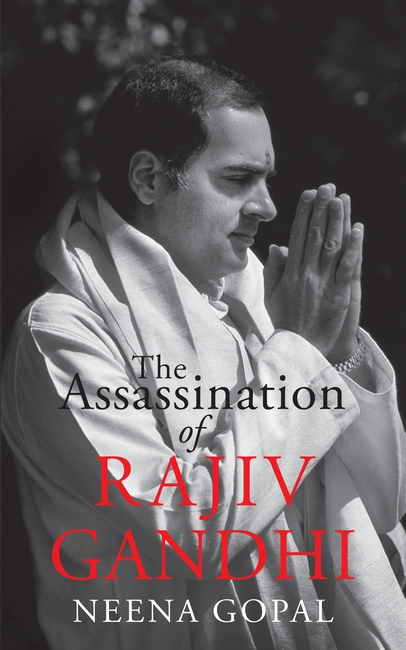
On 21 May 1991, journalist Neena Gopal had finished just one part of an interview with Rajiv Gandhi-the last of his life-when his car reached the election rally at Sriperumbudur. Moments later, Rajiv Gandhi was dead, blown up by suicide bomber Dhanu, irrevocably changing the course of Indian politics, as Neena Gopal, just yards behind him, watched in horror.
In this gripping, definitive book, Gopal reconstructs the chain of events in India and at the LTTE’s headquarters in Sri Lanka where the assassination plot was hatched, and follows the trail of investigation that led to the assassins being brought to justice.
Drawing on extensive interviews, research and her own vast experience as a journalist, she deftly establishes the background-the shortsightedness of India’s Sri Lanka policy; the friction between the intelligence agencies and between the agencies and the external affairs ministry; the many warnings that went unheeded; and the implacable hatred that LTTE supremo Prabhakaran felt for Rajiv Gandhi. Bringing all these complex threads together, Gopal takes us step by step to Sriperumbudur as Rajiv Gandhi walked inexorably to his death on that tragic May evening twenty-five years ago.
Economics without Tears
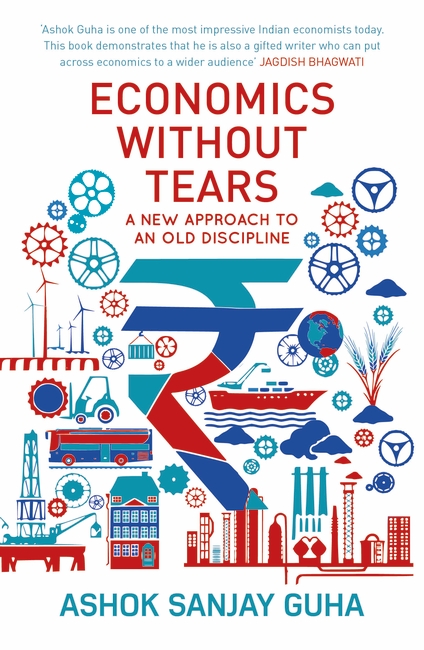
If you are a layman wondering what economics is all about or a freshman student of the subject, this is a book you cannot afford to miss. Starting from the first principles and stripped of mathematics and almost all jargon, it introduces you to all the basic concepts of economic theory as well as to some of its more surprising depths.
Economics pervades every aspect of our lives and our world. This book shows how anyone can acquire an understanding of its key principles while finding the exercise not only an exciting intellectual adventure but also great fun.
The Hidden Life of Trees
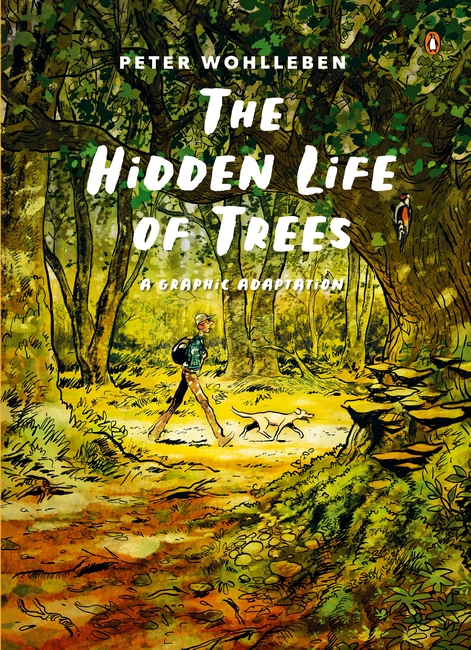
In this beautifully illustrated narrative peppered with scientific facts, Peter Wohlleben tells the story of his journey from city boy to the world’s most famous forester, sharing his insights into trees and the challenges they face. Take a guided tour through the extraordinary life of the forest, where you’ll meet trees that communicate through their root systems, protect each other from danger, and even live together like human families. A portal to an astonishing yet fragile world, and a call to protect it for future generations.
Politics of the Womb
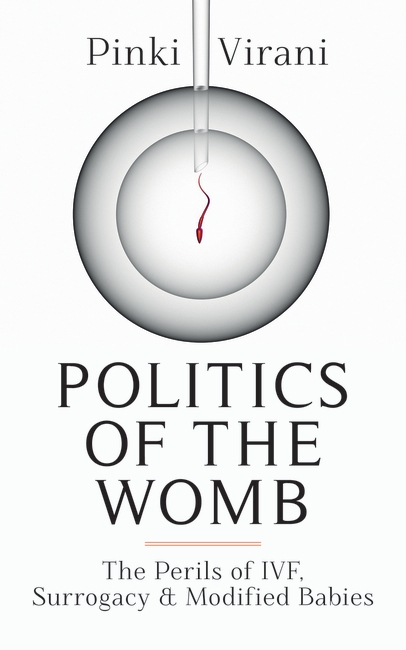
Among life’s choices is to have children or remain childfree. Yet those who want a child and find themselves unable, live through the trauma of ‘infertility’-cruelly attributed as ‘their fault’-to undergo the tribulations of assisted reproductive technology.
But how safe is aggressive Ivf, invasive Icsi, exploitative ovarian hyper-stimulation and commercial surrogacy? Politics of the Womb proves that there can be broken babies and breaking mothers; it rips away the romanticism around uterus transplants, warns of genetic theft and ‘designer babies’, and points to the human element being sacrificed, as artificial reproduction uses, reuses and recycles the woman.
Pinki Virani combines investigation with analysis to question those who lead the worldwide onslaught on the woman’s womb in the name of babies, and squarely confronts what has become the business of baby-making by a chain of suppliers that manufactures on demand.
Written in a manner accessible to all, here finally is a path-breaking book which speaks up, in no uncertain terms, for the right to informed choice on responsible reproduction.
The World of Hrishikesh Mukherjee
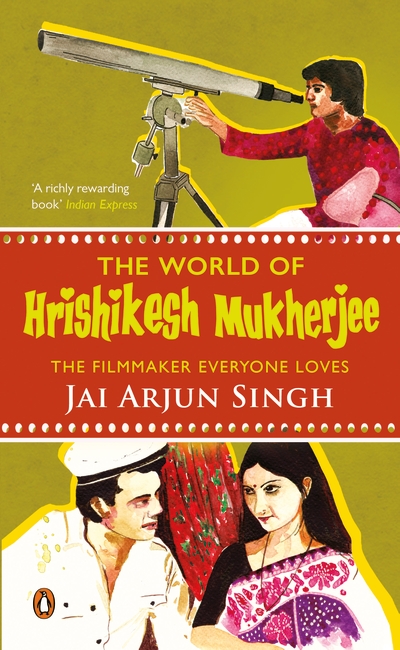
One of India’s best-loved film directors, Hrishikesh Mukherjee is perhaps best known today for his perennially popular creations like Anand, Chupke Chupke and Gol Maal. But Hrishi-da’s best work was provocative, wide-ranging and always aware of the complexities of people and their relationships, even when the setting was a simple, middle-class household. Often combining breezy narratives with serious ideas, his films created a distinct world with recurring themes such as the relationship between fantasy and life, an individual’s journey towards becoming more responsible in a flawed world, performance (naatak-baazi) as a revelation of character, and gender relations in a conservative society.
Jai Arjun Singh looks closely at Hrishikesh Mukherjee’s oeuvre, from well-known films like Satyakam, Guddi, Abhimaan and Khubsoorat to lesser known (but equally notable) works such as Mem-Didi, Biwi aur Makaan and Anuradha. Combining a fan’s passion with a critic’s rigour, The World of Hrishikesh Mukherjee is a book for anyone who takes their filmed entertainment seriously.
AUTHOR BIO
Jai Arjun Singh has previously authored a book about the cult comedy film Jaane Bhi Do Yaaro and edited The Popcorn Essayists, an anthology of personal essays on cinema. His columns, reviews and essays have appeared in Business Standard, The Hindu, Yahoo! India, Tehelka, Caravan, Sunday Guardian, Forbes, Open and Indian Quarterly, among many other publications. Most of his published writings can be found on his widely read culture blog Jabberwock (jaiarjun.blogspot.in).