



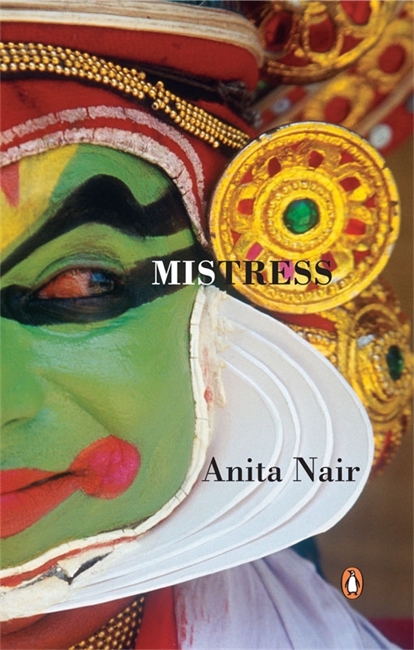
Christopher, a young travel writer, arrives at a riverside resort in Kerala to meet Koman, a famous kathakali dancer. Immediately he is sucked into a world of masks and repressed emotions. Koman is instantly drawn to the enigmatic young man with his incessant questions about the past-but so is his niece Radha. Excluded from this triangle is Shyam, Radha’s husband, who can only watch helplessly as she embraces Chris with a passion that he has never been able to draw from her. As the drama unfolds, the nuances and contradictions of the relationships being made-and unmade-come alive in this searing novel of art and adultery.
Catagory: Non Fiction
non fiction main category
Kumarasambhavam
The greatest long poem in classical Sanskrit, by the greatest poet of the language
She with her beautiful face at once was in the power
of Siva and of drunkenness, taking her shyness away,
both eagerly drawing her toward the bed
and both now turned into kindled desire.
The greatest long poem in classical Sanskrit, Kumarasambhavam celebrates the love story of Siva and Parvati, whose passionate union results in the birth of their son, the young god Kumara. Beginning with a luminous description of the birth of Parvati, the poem proceeds in perfectly pitched sensuous detail through her courtship with Siva until the night of their wedding. This poem plays out their tale on the immense scale of supreme divinity, wherein the gods are viewed both as lovers and as cosmic principles.
Composed in eight cantos by the greatest Sanskrit poet of all time, the verses of Kumarasambhavam continue to enchant readers centuries after they were first written. Hank Heifetz’s sparkling translation brings to life the heady eroticism and sumptuous imagery of the original.
Malavikagnimitram
Her left hand rests on her hip, the bangle motionless at her wrist
while the other arm falls freely like a fig branch.
Lowering her eyes to the tiled floor, where her big toe caresses a flower,
her curved body is more beautiful than her dance.
Believed to be Kalidasa’s first work, Malavikagnimitram is the love story of King Agnimitra and the court dancer Malavika. The tale unfolds through humorous palace interludes, vivid descriptions of fine arts and the cunning machinations of court players. Even in this early work, Kalidasa’s characteristic penchant for romance, art and natural beauty is evident at every delightful turn of the plot. He transforms a simple tale of forbidden love into an engrossing courtly drama filled with beauty, humour and wit.
The Seeker
Can a man walk on water?
Can he see the future?
Can he read people’s minds?After a deep personal loss, Maximus Pzoras, Harvard economist and Wall Street banker, sets out on a quest to find the cause of human pain and suffering. His journey takes him from New York to a hidden ashram in south India, and then to a freezing cave high in the Himalayas. And as he goes from being a cubicle dweller to a cave-dwelling yogi, he starts to develop extraordinary powers. But will Max, an investment banker turned Himalayan sage, find the answers to the questions that led him to India?
The Seeker is the story of a man’s tremendous inner transformation, a Siddhartha for our generation.
Mahabharata
This definitive and magnificent 10-volume unabridged translation is one of the rare English translations of full of the epic. Bibek Debroy makes the Mahabharata marvelously accessible to contemporary readers. Dispute over land and kingdom may lie at the heart of this story of war between cousins-the Pandavas and the Kouravas-but the Mahabharata is about conflicts of dharma. These conflicts are immense and various, singular and commonplace. Throughout the epic, characters face them with no clear indications of what is right and what is wrong; there are no absolute answers. Thus every possible human emotion features in the Mahabharata, the reason the epic continues to hold sway over our imagination.
In this superb and widely acclaimed translation of the complete Mahabharata, Bibek Debroy takes on a great journey with incredible ease. This is the second volume in the series.
The Order of the Crest
Bishop Cotton Boys’ School, Bangalore, which completes 150 years in 2015, was founded in the memory of Bishop George Edward Lynch Cotton (a master at Rugby). The school has transitioned from a Victorian school conceived in Tom Brown’s School Days to one that has sought to keep the public school relevant in modern India. The book encompasses profiles of the people and the times, right from the 1860s, covering spheres as varied as the armed forces, public service, police, education, academia, law, medicine, the arts and the offbeat.
Peppered with extracts from old letters, oral history and archives, the narrative features an eclectic range of prominent personalities, such as Lieutenant William ‘Leefe’ Robinson (the first Victoria Cross in an air operation), General K.S. Thimayya, Admiral V.S. Shekhawat, Dr Raja Ramanna, Lord Colin Cowdrey, Leslie Claudius, Lucky Ali, Sam Balsara, Feroz Khan, Nandan Nilekani, and several others. With chapters dedicated to those martyred in the World Wars as well as linking the journey of the school with the city of Bangalore, The Order of the Crest traces the alumni of Bishop Cotton over this period, profiling those old boys who have accomplished eminence or otherwise
remained unsung, but not without touching others’ lives.
The Tryst Betrayed:
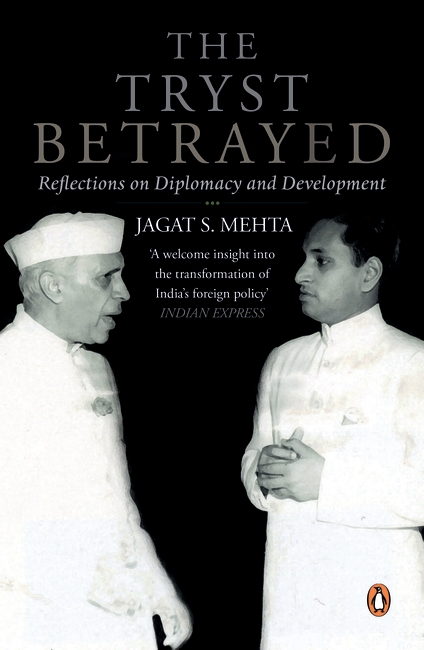
In The Tryst Betrayed, former Indian foreign secretary Jagat Singh Mehta looks back on an eventful career which began on the day after India’s independence.
In his lucid and informative style Mehta sheds light on Nehru’s prophetic assertion of ideological agnosticism (named ‘Non-Alignment’ in 1946) and its distortion by the accidental overlap of decolonization with the Cold War.
Mehta argues that Nehru was naïve on China, wishful on the Soviet Union and prejudiced against America. The civil servants were hypnotized by what he refers to as the ‘Panditji knows best’ syndrome. He illustrates that Nehru’s bark was no doubt frightening but his bite not vicious.
Aarushi
It is the murder that haunts India with the simplest of questions: Who did it? A fourteen-year-old girl is killed in her comfortable suburban home along with the family servant under puzzling circumstances. Within weeks, her dentist parents are the prime suspects; within months, they are as good as exonerated; a year and half later, they are on trial. But did they do it? From the controversial police investigation to the media frenzy surrounding the Talwars and the protracted legal battle, every layer of the Aarushi case has mystery and metaphor. Now comes the ultimate retelling of the story. Avirook Sen has followed the court case, examined all the police documents and interviewed key players among investigators, lawyers, family and Aarushi s friends. In Aarushi he draws a superb portrait of the young woman, the aftermath of her death, and tries to answer the biggest question of all. Acute, gripping and brilliantly written Aarushi is a book that will take you into the heart of the murder that has gripped the nation.
The Lazy Girl’s Guide To Being Fit
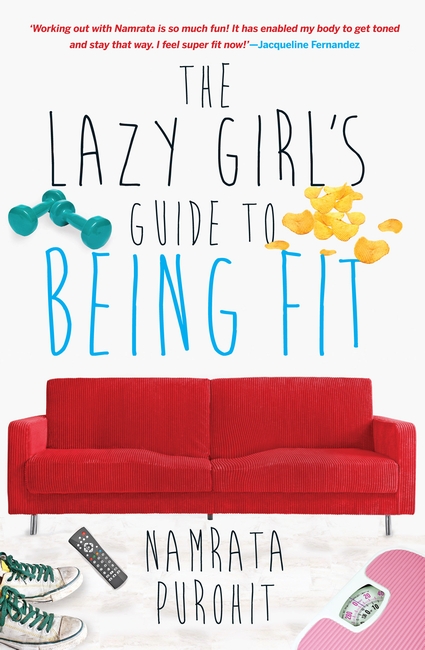
Get smart, get moving!
Most of us want to be fit and healthy, but get stuck in a rut—we just don’t have the will power to get up and move. What is the incentive for you to get off that couch and work out when you have all three seasons of Game of Thrones waiting for you? Almost everyone wants to be fit, but they just can’t muster up the effort to do so. If you are like them, then this book is for you.
The Lazy Girl’s Guide to Being Fit is about the first few steps you need to take to go from a sedentary lifestyle to an active one, because that’s the biggest challenge for a couch potato—movement! It’s all about finding the balance in your life. This book will show you how exercise can take the guise of several daily activities—be it shopping or going on a picnic—and how eating right can solve half your problems. The easy and effective exercise routines contained here will get you fit in no time. The body can be beautiful if you know how to put it to use and have fun doing so. And this is exactly what this book will show you.
CII India Design Yearbook 2014
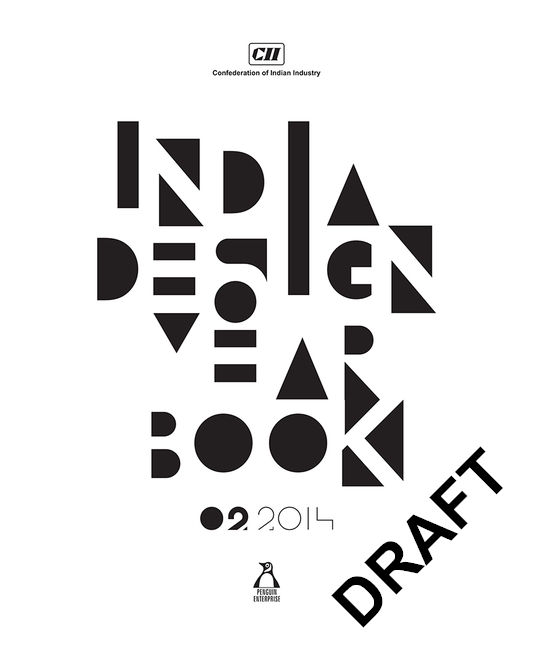
Showcasing the best in design in India for the year 2014-15
The CII India Design Yearbook 2014 is a medium to communicate the best of design emanating from India in diverse design disciplines. These yearbooks become an international reference for excellent design. Companies, journalists, architects, planners, designers and people all over the world who are interested in design use the yearbooks for their day-to-day work and keep them over the years as collectors’ items and an archive of excellent design.
This is the second instalment of the yearbook, which aims to capture over 200 recent projects in which the companies / design firms have employed agile design thinking, methodology and processes to achieve success for clients, partners and end users.