



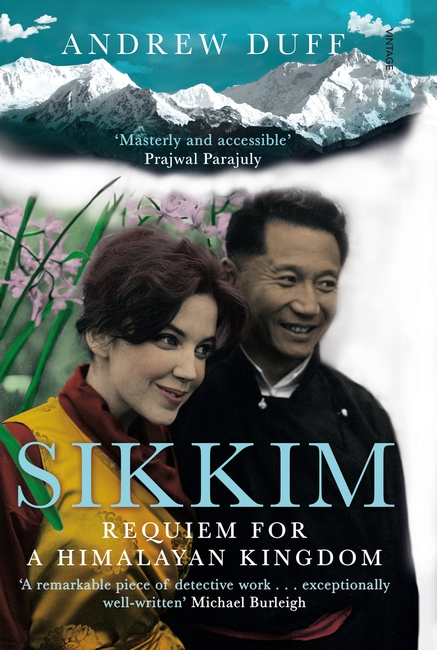
This is the incredible true story of Sikkim, a fairy-tale kingdom in the Himalayas that survived the end of the British Empire in India only to be annexed by India in 1975. Sikkim: Requiem for a Himalayan Kingdom tells the remarkable story of Thondup, the handsome last King of Sikkim, and his young and beautiful American queen, Hope Cooke, thrust unwittingly into the spotlight as they sought support for Sikkim’s independence after their wedding in 1963. But as tensions between India and China spilled over into war in the Himalayas, Sikkim became a pawn in the Cold War ideological battle that played out in Asia during the 1960s and 1970s.
Rumours circulated that Hope was a CIA spy. Meanwhile, a shadowy Scottish adventuress, the Kazini of Chakung, married to Sikkim’s leading political figure, coordinated opposition to the Palace. As the geopolitical tectonic plates of the Himalayas ground together, Sikkim never stood a chance. Thondup died a broken man in 1982; Hope returned to New York; Sikkim began a new phase as India’s twenty-second state.Based on exclusive interviews and new archival research, this is a thrilling, romantic and informative glimpse of life in a lost paradise.
Catagory: Non Fiction
non fiction main category
Sikkim
How to Read Amartya Sen

Nobel Laureate Amartya Sen is one of the world’s best-known voices for the poor and the downtrodden, and an inspiration for the proponents of justice across the globe. He has contributed almost without peer to the study of economics, philosophy and politics, transforming social choice theory, development economics, ethics, political philosophy and Indian political economy, to list but a few.
This book offers a much-needed introduction to Amartya Sen’s extraordinary variety of ideas. Lawrence Hamilton provides an excellent, accessible guide to the full range of Sen’s writings, contextualizing his ideas and summarizing the associated debates. In elegant prose, Hamilton reconstructs Sen’s critiques of the major philosophies of his time, assesses his now famous concern for capabilities as an alternative for thinking about poverty, inequality, gender discrimination, development, democracy and justice, and unearths some overlooked gems. Throughout, these major theoretical and philosophical achievements are subjected to rigorous scrutiny.
How to Read Amartya Sen is a major work on one of the most influential economists and philosophers of the last few centuries. It will be illuminating for readers keen to understand the breadth of Sen’s vision, and an invaluable resource for scholars, policy makers and global activists.
Life Tree
In this moving collection of poems, A.P.J. Abdul Kalam takes us into his world, full of simplicity and beauty, understanding and compassion. Kalam’s love for the country shines through as he inspires us and urges us to break the barriers of caste, religion and language. He wonders at God’s creation in his paeans to nature, while imparting a deeply personal touch to his observations of human relationships. The Life Tree is an intimate introduction to Kalam the man, his life and his inspirational thoughts.
A History Of Sri Lanka
An Open Window
In the early years of the twentieth century, Sigmund Freud and Carl Gustav Jung proposed that, more often than not, dreams represent those thoughts and memories which are unbearably painful and have been relegated to the realm of the unconscious. Unlocking the meanings in these dreams can help people free their mind and feelings from irrational desires, fears and insecurities.
This brief but profound book assails the conventional understanding of dreams and their interpretation, drawing attention to a much-neglected aspect of dreams as a source of guidance for the spiritual aspirant. It uses the insights of psychology, but transcends it, to confront the inescapable questions most people should be driven by: What is the purpose of life, and does it all end with death? Laying bare dreams of childhood anxiety, traumas and sexuality – ‘cleaning the windows’ to uncover the deeply buried material that blocks our efforts on the inner path – it then invites contention from ‘materialists’ in its discussion of subjects beyond psychology, such as precognitive dreams, reincarnation, out-of-the-body experiences, death dreams, and numinous or ‘big dreams’- ‘an open window’ through which deeper, non-physical levels of reality can shine.
Drawing on examples from real life, Sri Madhava Ashish teaches the ‘language of dreams, ensuring a better understanding and awareness of the unconscious self, guiding the reader on the path to mental and spiritual freedom.
Sarama And Her Children
The most recognized dog in Indian myth is the dog in the Mahabharata that accompanied the Pandavasnot actually a dog but Dharma in disguise. There are, however, several more references to dogs in the classical texts. Mentioned for the first time in the Rg Veda, the eponymous Sarama is the dog of the gods and the ancestor of all dogs. In Sarama and Her Children, the evolution of the Indian attitude towards dogs is traced through the vedas, epics, puranas, dharmashastras and niti shastras. The widespread assumption is that dogs have always been looked down upon in Hinduism and a legacy of that attitude persists even now. Tracing the Indian attitude towards dogs in a chronological fashion, beginning with the pre-Vedic Indus Valley civilization, Bibek Debroy discovers that the truth is more complicated. Dogs had a utilitarian role in pre-Vedic and Vedic times. There were herd dogs, watchdogs and hunting dogs, and dogs were used as beasts of burden. But by the time of the Mahabharata, negative associations had begun to creep in. Debroy argues convincingly that the change in the status of the dog in India has to do with the progressive decline of the traditional Vedic gods Indra, Yama and Rudra (who were associated with dogs), and the accompanying elevation of Vishnu, associated with an increase in brahmana influence. Debroy demonstrates that outside the mainstream caste Hindu influence, as reflected in doctrines associated with Shiva and in Buddhist jataka tales, dogs did not become outcasts or outcastes. Drawing references from high and low literature, folk tales and temple art, Sarama and Her Children dispels some myths and ensures that the Indian dog also has its day.
Women Of The Tagore Household
The story of an accomplished group of Women who, more than any others, moulded Bengal’s distinct ethos.
The Tagore family has long been the focus of public curiosity. Like its men, the women of this illustrious family have had a great and enduring influence on the life and people of Bengal.
Women of the Tagore Household portrays several generations of connoisseurs, aesthetes and lovers of literature who were nurtured under the umbrella of cultural richness and spiritual freedom that the extended family provided. We meet Rabindranath’s wife Mrinalini and his sister-in-law Kadambari, who had considerable influence on the young poet; the progressive Jnandanandini who sailed alone to England in the nineteenth century, presenting to ordinary women a vision of courage and daring; and Sushama, who broke out of the confines of music, literature and culinary arts to tread the path of women’s empowerment. This book reveals hitherto unknown aspects of
women’s emancipation in Bengal in which the women of the Jorasanko Tagore family were at the forefront-Chandramukhi and Kadambini were the first two female graduates of India, Protiva opened up music and dramatics to women by preparing musical notations for Brahmo sangeet and Hindustani classical music, and Pragya’s prefaces to her cookbooks are still considered storehouses of not only recipes but also homemaking skills.
This engaging narrative, spanning over three hundred years, highlights the Tagores’ influence on the Bengal Renaissance and brings out the special role the Tagore women played in Bengali history and culture.
The Inheritors
Now a strike, led by ageing Marxist trade union leader Hirenmoy Chakroborty, is destabilizing its Calcutta headquarters-and Aruna the bitter, power-hungry sister of Hari Lohia, the head of the dynasty, is using the opportunity to launch a covert takeover of the business with the help of her two ambitious sons. But Hari Lohia, who single-handedly built up Lohia & Co from a tiny jute trader in the crowded alleys of Barabazar to a sprawling global conglomerate, is not willing to let go of his empire so easily. He comes from a family of survivors, ancestors who moved across the country from Rajasthan with nothing and built their fortunes from scratch. And he discovers unlikely allies in this last great battle he has to fight-Anjali, his tough, cynical sister, a fiery opponent of Aruna’s; and Shivani, his beautiful, rebellious daughter who has always been too busy having love affairs to pay attention to her father’s business. Who will lose? Who will win? And most importantly-will the house of Lohia fall like a pack of cards? Moving from the crumbling offices of Calcutta to hedge funds in Hong Kong, from the Mumbai stock market to nineteenth century Rajasthan, and boasting an enormous cast of characters, The Inheritors is quite simply sensational.
Cold Feet

Amisha has found her perfect man and is going to marry him, but suddenly feels the need to push the boundaries of their relationship. Akshara is in love with her best friend, but while he will give her benefits, he won’t give her his love. Ladli has had her heart broken, so she runs away only to find it waiting for her at the other side. Shayna knows what she wants in a man, but the man she wants is nothing like that and finally, the girl who wants Shayna, actually just needs a friend. Cold Feet is the story of the strangely entwined lives of five women who live in Mumbai and deal differently with the same thing, love.