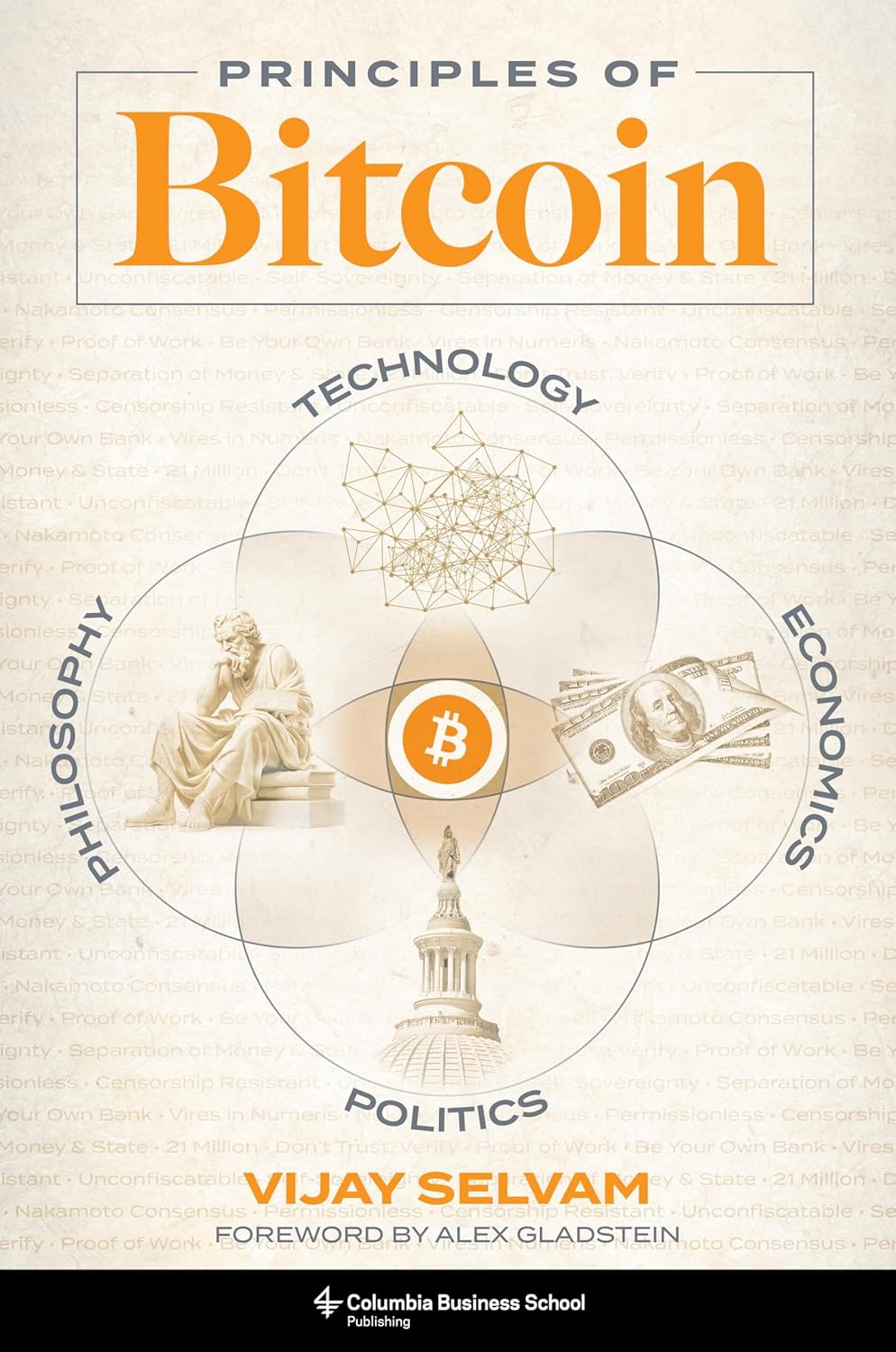
Principles of Bitcoin presents a holistic, first-principles-based framework for understanding one of the most misunderstood inventions of our time. By stripping away the hype, jargon, and superficial analysis that often surrounds the crypto industry, this book uncovers the true ingenuity behind Satoshi Nakamoto’s creation―and its profound implications for the future of money, governance, and individual freedom.
Vijay Selvam analyzes the technology, economics, politics, and philosophy of Bitcoin, making the case that only through this holistic understanding can we gain an appreciation of its true meaning and significance. Readers are invited to consider Bitcoin as a tool for individual empowerment, a catalyst for economic autonomy, and a challenge to traditional monetary systems. Selvam demonstrates why Bitcoin stands alone in the digital asset space as a path-dependent once-in-history invention that cannot be replicated.

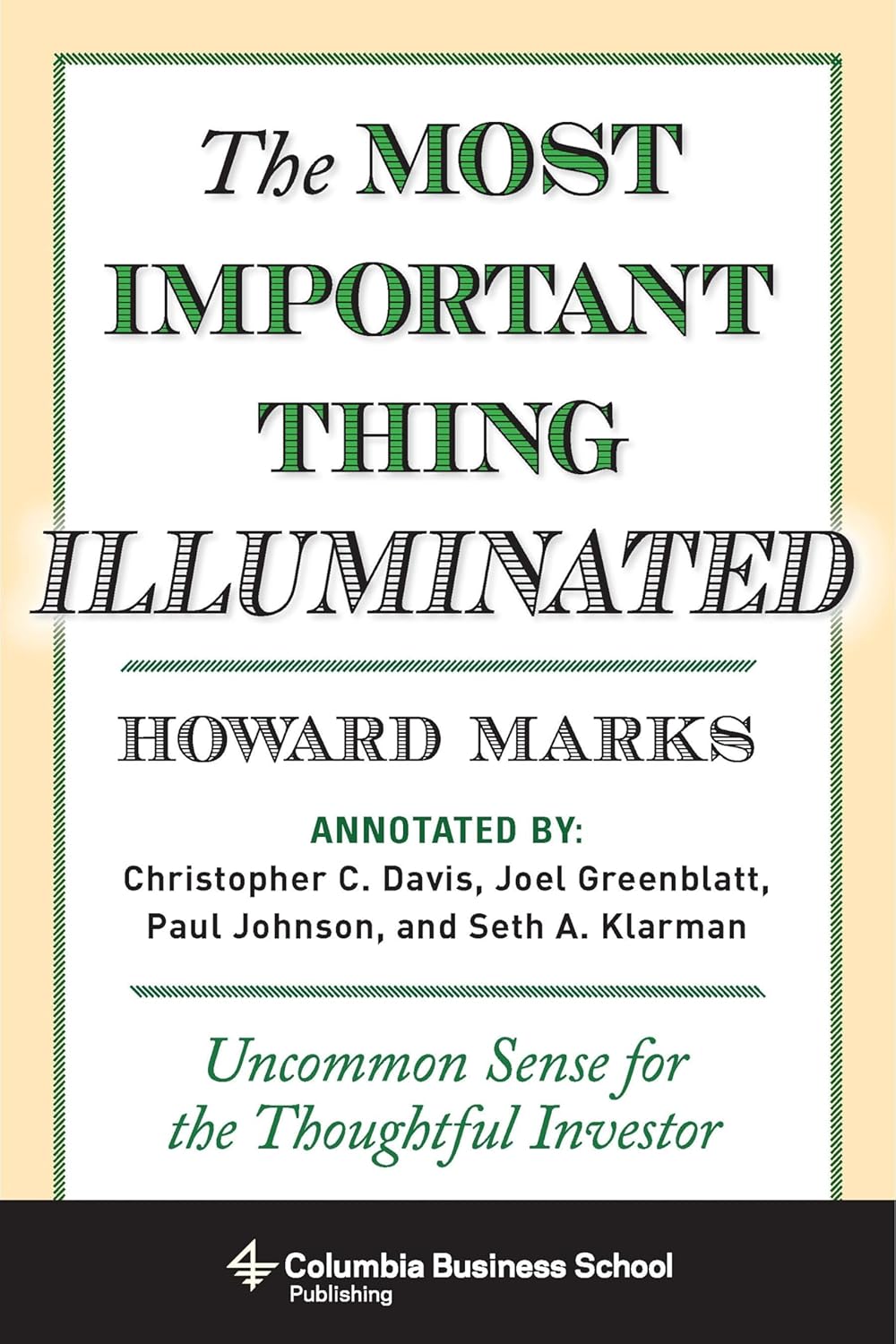
Howard Marks’s The Most Important Thing distilled the investing insight of his celebrated client memos into a single volume and, for the first time, made his time-tested philosophy available to general readers. In this edition, Marks’s wisdom is joined by the comments, insights, and counterpoints of four renowned investors and investment educators: Christopher C. Davis (Davis Funds), Joel Greenblatt (Gotham Capital), Paul Johnson (Nicusa Capital), and Seth A. Klarman (Baupost Group).
These experts lend insight into such concepts as “second-level thinking,” the price/value relationship, patient opportunism, and defensive investing. Marks also adds his own annotations, expanding on his book’s original themes and issues. A new chapter addresses the importance of reasonable expectations, and a foreword by Bruce C. Greenwald, called “a guru to Wall Street’s gurus” by the New York Times, speaks on value investing, productivity, and the economics of information.

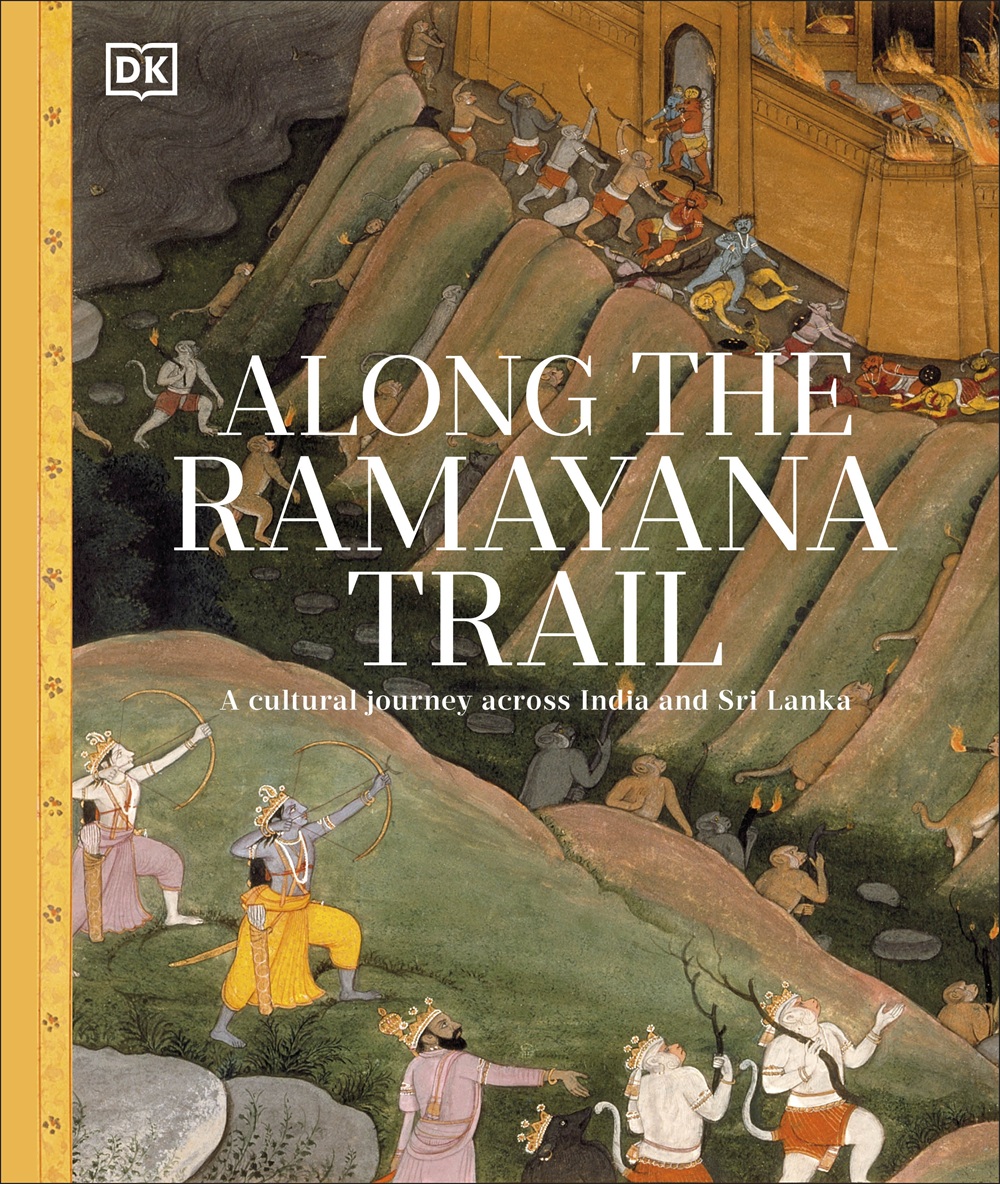
Take an unforgettable journey across the heart of India and Sri Lanka, tracing the path of the epic Ramayana across sacred geographies.
Travel from the sprawling temple city of Ayodhya in northern India where Rama was born and the dense forests of Dandakaranya where he was exiled, to the misty Horton Plains in Kandy, believed to be the site of Ravana’s airport and the reefs of Hambantota, once the Lankan king’s citadel.
Walk in Rama’s footsteps as he searches for Sita, experience Sita’s yearning as she awaits rescue, follow Hanuman on his reconnaissance across the ocean, and relive the grandeur of Lanka, ruled by Ravana, a mighty king. And explore the cultural practices that have emerged from the Ramayana – from RamLila performances in Varanasi and the Tanjore paintings to the shadow puppets of Kerala.
In Along The Ramayana Trail, the reader will experience the epic’s living heritage – at once a cultural odyssey and an essential guide to exploring two nations bound by one timeless story.

Swimming In Our Oceans traverses the uncertainties and contradictions that shape who we are. The memoir explores performance, invisibility, and mental health, following Pragya’s move to a village in Uttarakhand. Alternating between the author’s past and present, Swimming in Our Oceans questions what it means to belong – to a place, to a person, to oneself.

Nishikant leads a quiet life, going for long walks around Pune with his older sister, fantasizing about the handsome next-door neighbor and lingering in bookstores while dreaming of being a writer. But when a love affair claims his sister’s life and takes the handsome neighbour far away from him, his middle-class parents pack him off to Mumbai to shield him from the scandal. Through his relationships with Shiv in Mumbai, and later with Sreenivas, in London, Nishikant is able to break apart the shackles his past have placed on him. When Nishikant moves back to Mumbai, he has become a writer and a professor and the only escape from his solitary existence are the long letters he receives from Srinivas , until one day, Sreenivas disappears mysteriously.
Silk Route translated from the Marathi Reshim Marg, invites readers to go on a journey along with Nishikant on his many travels through cities and people in a way that has rarely been seen in Indian literature. As the series’ first part, the novel lays the groundwork for this expansive narrative journey that questions love, identity and the false veneer of societal expectations.
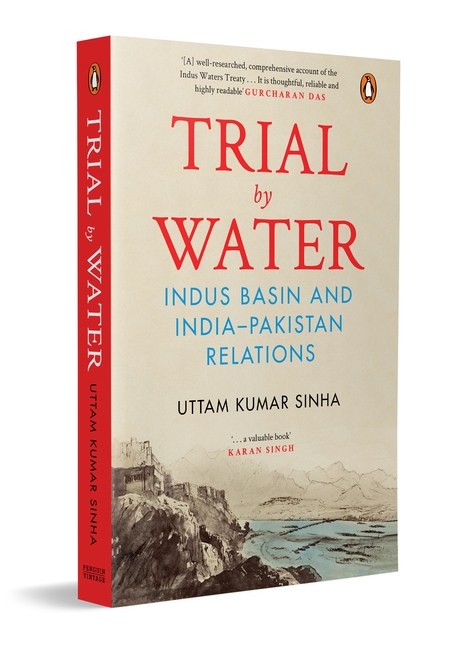
In 1947, the Indian subcontinent was partitioned, and Pakistan was born. A shared heritage, a composite culture and centuries-old bonds between people, all seemed to vanish overnight. Nowhere was this rupture more profound than in the Indus Basin—once a unified lifeline of the region, now fragmented by sovereign borders, its rivers flowing through two nations immediately at odds with each other.
The Indus Waters Treaty was signed in 1960, proving that even bitter adversaries could cooperate over shared resources. Yet, it never brought lasting peace. The treaty was suspended by India in April 2025 as a punitive measure in the wake of the Pahalgam terror attack, and its future remains shrouded in uncertainty. Can it still endure and adapt? Perhaps the time has come for a new arrangement—one that is not just inevitable but essential.
This book traces the turbulent history of the Indus Basin and examines how the Indus Waters Treaty has been shaped by the region’s ever-evolving political dynamics. It explores the role of key leaders on both sides, as well as external pressures, in shaping and reshaping one of the world’s most critical transboundary water agreements.
The Indus Basin has been a witness to conflict, compromise and survival. And if you seek to understand the true nature of India–Pakistan relations, start with the rivers that bind them. Trial by Water leads us in that direction.
Hundred Greatest Love Songs is a genre-bending memoir of a young artist and poet willing to risk his life for his craft. Told in a hundred short chapters and arranged like a playlist, the story is one of transformation—spiritual, sexual and intellectual—as the protagonist, a waiter, carves his path from a greasy diner in small-town Iowa to a prestigious arts college in upstate New York. Along the way, he makes many new friends: misfits and outcasts who become his chosen family, and renowned American poets and artists who show him that it is possible to lead a remarkable life, no matter the circumstances.
At its core, the book is an ode to friendship. It is as much about an artist trying to find his place in the world as it is about the people who help him do so. Ultimately, Hundred Greatest Love Songs serves as a testament to the healing power of poetry and proves that literature, art and music can save lives.
A business strategy consists of certain guiding principles that helps an organization make quick and accurate decisions. Since an organization is nothing without its people, strategy is essentially human centric. It is about how people in an organization should make decisions and allocate resources to attain critical objectives. A robust strategy offers a clear roadmap with guiding principles defining the actions individuals in an organization should take (and not take). It also provides insights into the things one should prioritize (and not prioritize) to accomplish desired goals.
This book highlights strategy techniques that can help you navigate both your personal and professional conundrums. It tries to showcase how strategy consultants think through frameworks, examples and tools, to help young professionals improve their chances at professional success. Conceived as a definitive guide to achieving both personal and professional success, Why Your Strategy Sucks will unleash your true potential to win at work and in life.
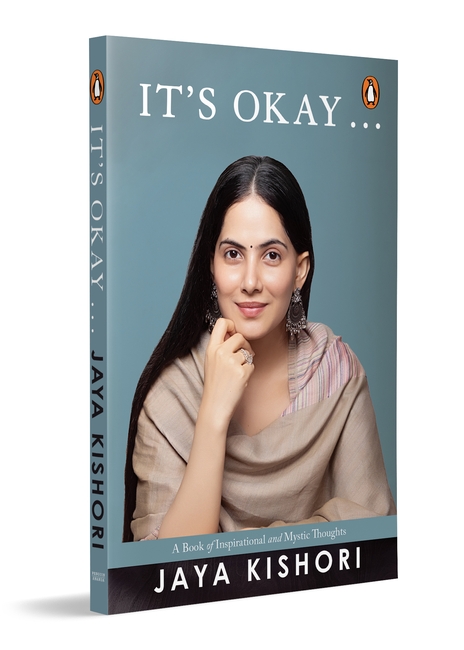
Jaya Kishori is a well-known spiritual orator and a famed motivational speaker. Having seen people immersed in every kind of difficulty, trouble, sicknesses, stress, trauma, she has put together advice and thoughts that can help readers make their lives better and more meaningful. Through this book, she would like to tell the reader that ‘It’s okay to have problems and issues in life. Everyone has them.’ She also wishes to offer solutions to these problems, so people can obtain some solace and are able to handle situations better
Like Arjuna, every human being must navigate the battlefield of life, so the Gita speaks to us all, providing invaluable coping skills to handle adversities that inevitably arise along the way.
In this book, Priya Arora clubs together verses that have a common theme or concept, such as the power of focus and how actions have consequences, and goes on to explain the instructions that the Gita offers on how to handle these situations. She contextualizes the verse and explains what the takeaway is meant to be.
The Gita’s spiritual teachings are forever pertinent because they are not born of the social constraints or moral conventions of a particular time in history. Instead, Krishna shows the path to overcoming suffering by adopting the right attitude to adversity.
This wonderful interpretation and explanation of the Gita shows the abiding relevance of Krishna’s instruction in our lives today.