Publish with Us

Follow Penguin

Follow Penguinsters

Follow Penguin Swadesh

Ayurveda: medicine without side-effects

This book is not a defence of Ayurveda. A sound, scientific framework of healthcare that has saved countless lives over 5000 years does not need defenders. It needs champions, and to be given wings. In a world that needs Ayurveda more than ever, Dr G.G. Gangadharan, who has been researching both the theory and the practice for the past thirty-five years, shows in his book the logic behind the science.

Let us take a look into some essential tips from this book, so that you can find the secret to greater happiness through balance and long-lasting health.

~

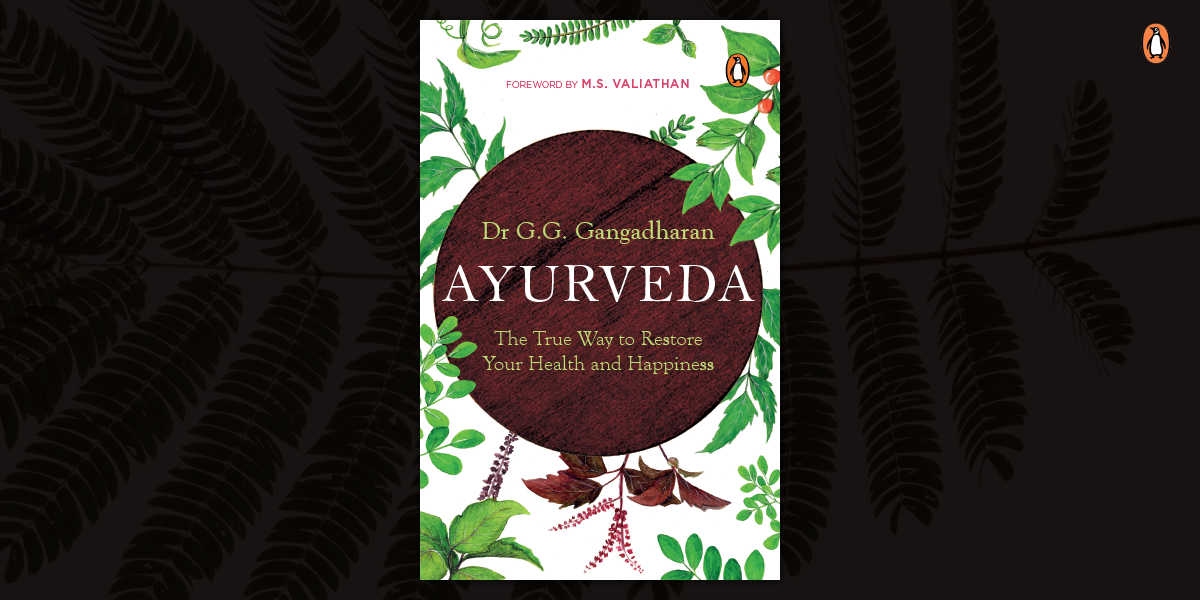
Ayurveda Front cover
Ayurveda||Dr G.G. Gangadharan

The plant that the West calls Rauwolfia serpentina is known in Ayurveda as ‘sarpagandha’. Ayurveda has been using it for centuries for the treatment of high blood pressure without any side-effects. Modern scientists have researched this plant and identified a master molecule named reserpine. They extracted it

from the plant, synthesized it in a laboratory and used it to make medicines that would reduce blood pressure. The medicine achieved this objective, but also caused side-effects that included depression and suicidal tendencies.* After many fatal incidents, the medicine had to be retracted from the market.

There’s a larger story behind this phenomenon—what I call the ‘Sarpagandha Syndrome’. To understand this story, we need to know how nature works and how Ayurveda has moulded itself to fit into nature’s contours.

Nature, Wholeness and the Dynamic Equilibrium

We know that nature abhors a vacuum. Let’s also acknowledge that nature abhors the lack of wholeness. At every point in time since the formation of our planet, every life form and substance found in nature has remained in a state of dynamic equilibrium— within itself and also with respect to its environment. If there is a momentary imbalance in that—for instance, if an unstable isotope is created—nature quickly restores the substance to its whole and natural state.

Meanwhile, nature uses chemistry to change biology over vast periods of time, so that every life form continuously evolves to a higher level of resilience.

Since nature sets such exacting standards for itself, is there any wonder that Ayurveda trusts it implicitly? By extension, Ayurveda trusts every plant and human body to be whole and complete. In the human body, this dynamic equilibrium is maintained by, among other phenomena, homeostasis; Claude Bernard, the father of experimental physiology, called this self-regulating ability the milieu interior. Since the human body and other natural life forms are designed this way, any imbalance in the human body—that manifests as a disease—can be addressed by using the restorative power of nature.

When we take a step back and look at the entire universe, we realize that nature is awe-inspiring. We realize that every life form is a microcosm of the entire universe. Since humans tend to be self-obsessed, let us rewrite that sentence as follows: The human body is a microcosm of the entire universe. The matter of the universe is in the human body and what is in the human body is in the universe. After all, astronomy tells us that the atoms that make up our body were produced inside a star. We share chemistry with the universe and, therefore, everything we find in it is potentially therapeutic for us.

So for the vaidya—the practitioner of Ayurveda—our planet is a boundless pharmacy. This makes the vaidya a bridge connecting the whole nature with the whole human being.

We will now look at how Ayurveda embraces the wholeness of the plant while also treating the human being in its entirety. In simpler terms, Ayurveda does not reduce a plant to its constituent bio-molecules. Nor does it reduce the human being to a set of ailing organs. Life is undoubtedly enabled by molecules and organs, but life is experienced in its entirety. Therefore, the processes that nurture and preserve life must be wholesome.

The first sign that Ayurveda is wholesome is the fact that its medicines do not cause side-effects if used appropriately.

No Side-Effects

Yes, Ayurvedic medicines cause no side-effects. The brazenness of this claim is made apparent by the fact that many allopathic medicines have a list of side-effects that’s longer than the list of chemicals used to make them. Despite painstaking research that can last years—including clinical trials on various life forms and multiple iterations of development—allopathic medicines have been unable to shrug off the bane of unwanted externalities. Take antibiotics, for example—every generation of antibiotics is made stronger so as to vanquish newer generations of more resilient superbugs. This also means that every new generation of antibiotics takes a stronger toll on the human body, with the side effects becoming starker. In such a dynamic domain, Ayurveda continues to use medicines free of side-effects, conceptualized and created many centuries ago. How has Ayurveda achieved this?

Well, Ayurveda studies plants in their entirety. Roots, stems, bark, flowers, fruits and leaves are understood—as constituent yet interconnected parts of the plant—and the therapeutic value of each part is understood. That done, Ayurveda identifies the best way to extract the plant’s essence for human use.

Any part of any plant has hundreds of types of bio-molecules, such as alkaloids and saponins. In many cases, only one bio-molecule among these is capable of acting as the master molecule that combats the ailment. While allopathy will isolate, extract and synthesize this bio-molecule, Ayurveda will extract the

entire part because it believes that the other bio-molecules in the plant negate the side-effects caused by just one of them.

This throws new light on the Sarpagandha Syndrome mentioned earlier. The plant sarpagandha behaves like a team, whereas reserpine behaves like the star player of that team, who is completely lost without his teammates.

The long and short of it is that Ayurveda trusts nature’s design to be more holistic than its counterpart, the human design, and by embracing nature’s holism, it manages to do away with potential side-effects.

Having said that, let’s make another statement that, which at first glance, may appear contradictory: We don’t take all parts of the plant or even everything within a single part of the plant.

All we are saying is that molecular-level selection of matter leads to problems. So, in Ayurveda, the vaidya removes those parts of the plant that are neither necessary for treatment, nor easily ingested by the human body. Through well-considered extraction methodologies, the physician makes the therapeutic qualities of the plant accessible to humans.
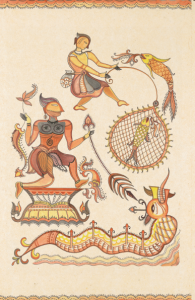
 

Why does man get wrinkles and a stoop?

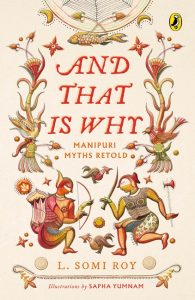
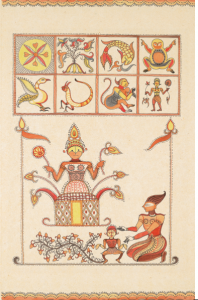
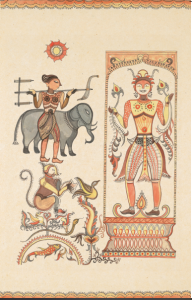
L. Somi Roy is here with a collection of endearing and vibrant retellings of Manipuri myths told for the first time ever to the outside world! Do we know why man gets wrinkles and a stoop?

Here’s why! Scroll down for a short extract from one of the 12 fascinating tales from Manipur passed on by balladeers and grandmothers over hundreds and hundreds of years!

‘O Paobirai, my ancestor! Your grandchild humbly offers you a basket of rice and a human every day. Please accept my offering.’


*

Finally, it was Man’s turn. Now, Man was very lazy and tardy and so he came very late to the gathering. He did not know what lifespans each of the animals, birds, fishes and insects had requested. As he came into the presence of his creator, Soraren looked at the latecomer with annoyance. Man said nervously, ‘Lord of the Sky, my Creator, I humbly request that my kind and I may live for fifty years. Please grant us a lifespan of fifty years.’

Front cover of And That Is Why
And That is Why || L. Somi Roy (Author), Sapha Yumnam (Illustrator)

Very well,’ said Soraren in an irritable voice.  ‘Your wish is granted. You, Man, shall have a lifespan of fifty years. And it is just as well since you are late and the last to come and I have only fifty years left to give out.’

And  Man  gratefully  took  the  last  remaining  fifty  years  and  hurriedly went along his way. And that is why, Dear Punctual One, you must never be lazy and always be on time.

After all the living beings had received their lifespans, they set out on their journey back to their holes and burrows and nests and houses on Earth.  On the way, Man met Monkey and Elephant.  Man asked them, ‘Monkey and Elephant, how many years did each of you ask for and how many were you granted?’

They replied, ‘We both asked for a lifespan of a hundred years each and it was granted. How many years did you ask for?’

Soraren, who was also known as the Eternal Creator, lived in great happiness with the other mighty beings and together they knew no pain or sorrow or even illness or death

Hearing  their  reply,  Man  did  not  answer  but  started  to  cry  instead.  He  wept  loudly  and  large  drops  of  tears  rolled  down  his  cheeks and snot ran from his nose. It was all really quite awkward, Dear Embarrassed One.

Seeing  the  very  wet  and  messy  and  unhappy  state  Man  was  in,  Monkey  and  Elephant  did  not  know  whether  to  be  sorry  or  embarrassed for him. Finally, they asked, ‘Man, why are you crying?’

Man  burbled  through  his  tears,  ‘I  thought  the  Creator  was  angry with me since I was late. I was afraid. So, I did not ask for many years. I asked only for fifty years. And I got the last fifty years the Eternal Creator had left. And now I will have to die before you both.’ Saying this, Man sobbed all the more. He bawled even more loudly than before, if that was possible.

Monkey  and  Elephant  rolled  their  eyes  and  looked  at  each  other  and  said,  ‘Do  not  cry  any  more,  Man.  We will each give you twenty-five years from our lifespans.  This  way,  you  will  have  one  hundred  years  altogether  to  live.’  For,  as  everybody  knows,  Dear  Arithmetical  One,  fifty  and  twenty-five  and  twenty-five  make one hundred.

Man happily agreed.  He  wiped  away  his  tears  and  Elephant  helped  him  blow  his  nose  with  his  long  trunk.  ‘Oh, thank you, Monkey and Elephant!’ said Man through his tears. ‘Let us go to the Eternal Creator. Let us tell him what we have spoken about and request him to give his approval to our arrangement.’

So according to the elders, Soraren decided that he would give all the living beings a lifespan each

Monkey and Elephant agreed. Together with Man, they went back to  Soraren  and  told  him  everything.  Upon hearing their words, Soraren thought in silence. ‘Very well,’ he spoke at last. ‘If this is what you have all agreed upon, I will allow it. And I have no more years to hand out.  Man will now live for one hundred years. For, as everybody knows, fifty and twenty-five and twenty-five make one hundred.  But  this  lazy  and  tardy  creature  called  Man  must  never  forget  the  generosity  and  kindness  of  Monkey  and  Elephant.  He  must  be  reminded  in  the  future,  for  all  his  tomorrows, and for all generations to come till the end of time, that  the  lifespan  I  had  granted  him  was  fifty  years  but  that  he  received  twenty-five  years  from  Monkey  and  twenty-five  years  from Elephant.’

Soraren  then  looked  at  Man  and  declared,  ‘Man,  here’s  the  thing. You shall keep your looks and stand upright as I have made you for the fifty years that I first granted you. But once you cross the age of fifty and start to live the twenty-five years you have received from  Monkey,  your  skin  will  wrinkle  and  fold  like  Monkey’s  so  that  you  may  never  forget  you  are  living  his  years.  And  once  you  cross the age of seventy-five and start to live the twenty-five years you have received from Elephant, your back will bend and you will stoop like Elephant so that you may never forget you are living his years. Let this be so.’

And  that  is  why,  Dear  Curious  One,  once  Man  has  lived  his  fifty years, he gets wrinkles like the Monkey, and once he has lived seventy-five years, he gets a stoop like the Elephant.

*


Dhoni and Raina’s special bond

In his book Believe, Suresh Raina takes us through the challenges he faced as a young cricketer. He was bullied in school and at cricket camps, but he always punched above his weight, overcoming every adversity life threw at him and never giving up. This is the story of the lessons he learnt and the friendships he built.

Peppered with invaluable insights – about the game and about life – that Raina acquired from senior colleagues like M.S. Dhoni, Rahul Dravid, Anil Kumble, Sachin Tendulkar and Sourav Ganguly, among others, this book will make you believe in the power of hard work, love, luck, hope and camaraderie. It is a journey through the highs and lows in the cricketing career of a man who saw his world fall apart and yet became one of the most influential white-ball cricketers India has ever seen.

Enjoy this little excerpt that explores his relationship with the legend M.S. Dhoni.

~

Believe
Believe||Suresh Raina, Bharat Sundaresan

Mahi Bhai always makes fun of me for being clumsy. I’ve seen him talk about how if I am around in his room, I would end up dropping something or walking into something. ‘Tu rahega toh kuch na kuch hoga,’ he likes to say. Maybe there’s some truth there. I am just a very energetic person, and I am always up and about as you might have seen me on the field.

There’s another thing that he is amused by. He’ll talk about how I would saunter into his room, order a lot of food over room service and not even wait for it to arrive. I’ll tell you why I am always keen on ordering my own food. What happens with a lot of them is that they would order nothing but chicken and roti. I, on the other hand, am a vegetarian. Moreover, I never have maida, because back home, I was used to having rotis made of ragi atta. My eating habits are pretty desi, so I need a good number of vegetable dishes and can’t do without a dal.

So, Mahi would ask me to order my own food. But often, after ordering, I would remember that I had a gym session and end up not eating that food. But I made it a point to not waste it and would go back later for it, even if by then the food had gone cold.

Talking of room service always reminds me of the times Robin Uthappa and I would order food on Mahi Bhai’s tab. And of that time in Pakistan when Rahul Bhai was captain and said, ‘Boys, order whatever you want. It’s on me.’ We made him pay for that reckless statement.

It involved, me, Irfan, Robin and Mahi Bhai. It was Dhoni’s idea. He just called up room service and asked for a double of everything we had ordered. Two milkshakes, an extra biryani, two extra rotis, two more dals, two more sabzis. Rahul Bhai couldn’t stop laughing at us. He eventually admitted that he’d learnt his lesson and that he would never give us a free hand again with room service. We did end up finishing everything we’d ordered, though.

That’s the kind of fun Mahi Bhai and I would have at other people’s expense all the time. We are like partners in crime when it comes to pulling someone else’s leg. I’ve been at the receiving end too at times, when he decides to turn on me. We’ve had an interesting relationship over the years.

I have also gone through so much because of our friendship. Like the whole bias angle. People would say, ‘Oh, Raina gets picked because he is Dhoni’s friend.’ But people forget the contributions I have made for teams captained by him—India as well as CSK. That’s how you build trust in a player as captain.

For us, it was like how when you have a neighbour over at your place all the time. You can take liberties with that person, saying yeh toh ghar ki baat hai. I played so much of my career down the order, and he would say let some of the others play at the top. At times I would say, ‘Humein bhi upar khelna hai.’ But he would respond, ‘Nahi, tu at will chhakke marta hai . . .’ and say that the others, be it Rohit or Virat or Ajju (Ajinkya Rahane), were better off at the top of the order. I was more reliable in those situations. He knew my mindset. He knew what brought the best out of me. And I trusted him. It would hurt when people kept linking our friendship to my being part of the team. I don’t think the numbers lie. I’ve always earned my spot in the team, just like I earned Mahi Bhai’s trust and respect. I was there for him. He always made me feel special. Nobody can take away from that. And it doesn’t matter what people say . . .

We grew closer and closer, and even got to know a lot about each other’s personal lives and families. I went to his house and met his family. After meeting them, I realized why he is so sorted. Sakshi and he came to meet my parents soon after their wedding. A UP–Bihar cultural connection there as well.

There’s always a lot of talk about Mahi Bhai being Captain Cool. But I can tell you that is not his greatest strength as captain. He will never compromise on the game. That’s what I like about him the most. That’s what I think makes him such a legendary captain and a fantastic leader.


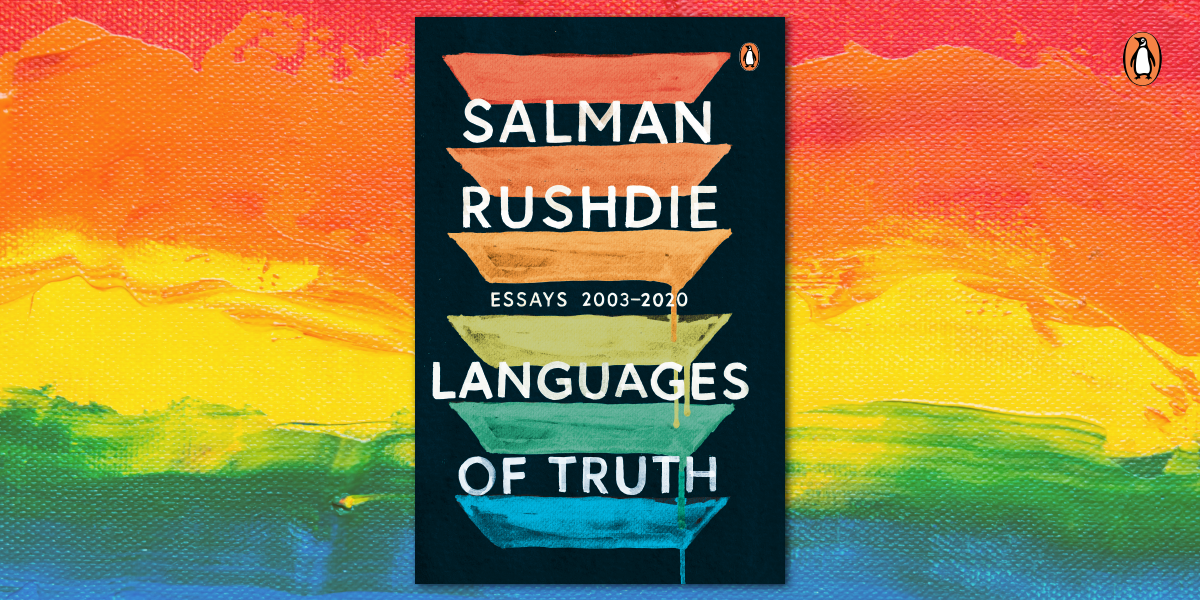
Childhood, the country to which we once belonged

A storyteller of the highest order, illuminating truths about our society and culture through his gorgeous, often searing prose. In his latest collection of nonfiction, Salman Rushdie brings together insightful and inspiring essays, criticism, and speeches, written between 2003 and 2020, that focus on his relationship with the written word and solidify his place as one of the most original thinkers of our time.

Languages of Truth chronicles Rushdie’s intellectual engagement with a period of momentous cultural shifts. Immersing the reader in a wide variety of subjects, he delves into the nature of storytelling as a human need. He explores what the work of authors from Shakespeare and Cervantes to Samuel Beckett, Eudora Welty, and Toni Morrison mean to him.

Here us a taste of Rushdie’s signature wit and dazzling voice in Languages of Truth:

~

Languages of Truth FC
Languages of Truth||Salman Rushdie

Before there were books, there were stories. At first the stories weren’t written down. Sometimes they were even sung. Children were born, and before they could speak, their parents sang them songs, a song about an egg that fell off a wall, perhaps, or about a boy and a girl who went up a hill and fell down it. As the children grew older, they asked for stories almost as often as they asked for food. Now there was a goose that laid golden eggs, or a boy who sold the family cow for a handful of magic beans, or a naughty rabbit trespassing on a dangerous farmer’s land. The children fell in love with these stories and wanted to hear them over and over again. Then they grew older and found those stories in books. And other stories that they had never heard before, about a girl who fell down a rabbit hole, or a silly old bear and an easily scared piglet and a gloomy donkey, or a phantom tollbooth, or a place where wild things were. They heard and read stories and they fell in love with them, Mickey in the night kitchen with magic bakers who all looked like Oliver Hardy, and Peter Pan, who thought death would be an awfully big adventure, and Bilbo Baggins under a mountain winning a riddle contest against a strange creature who had lost his precious, and the act of falling in love with stories awakened something in the children that would nourish them all their lives: their imagination.

The children fell in love with stories easily and lived in stories too; they made up play stories every day, they stormed castles and conquered nations and sailed the ocean blue, and at night their dreams were full of dragons. They were all storytellers now, makers of stories as well as receivers of stories. But they went on growing up and slowly the stories fell away from them, the stories were packed away in boxes in the attic, and it became harder for the former children to tell and receive stories, harder for them, sadly, to fall in love. For some of them, stories began to seem irrelevant, unnecessary: kids’ stuff. These were sad people, and we must pity them and try not to think of them as stupid boring philistine losers.

I believe that the books and stories we fall in love with make us who we are, or, not to claim too much, that the act of falling in love with a book or story changes us in some way, and the beloved tale becomes a part of our picture of the world, a part of the way in which we understand things and make judgements and choices in our daily lives. As adults, falling in love less easily, we may end up with only a handful of books that we can truly say we love. Maybe this is why we make so many bad judgements.

Nor is this love unconditional or eternal. A book may cease to speak to us as we grow older, and our feeling for it will fade. Or we may suddenly, as our lives shape and hopefully increase our understanding, be able to appreciate a book we dismissed earlier; we may suddenly be able to hear its music, to be enraptured by its song. When, as a college student, I first read Günter Grass’s great novel The Tin Drum, I was unable to finish it. It languished on a shelf for fully ten years before I gave it a second chance, whereupon it became one of my favourite novels of all time: one of the books I would say that I love. It is an interesting question to ask oneself: Which are the books that you truly love? Try it. The answer will tell you a lot about who you presently are.

I grew up in Bombay, India, a city that is no longer, today, at all like the city it once was and has even changed its name to the much less euphonious Mumbai, in a time so unlike the present that it feels impossibly remote, even fantastic: a real- life version of the mythic golden age. Childhood, as A. E. Housman reminds us in ‘The Land of Lost Content’, often also called ‘Blue Remembered Hills’, is the country to which we all once belonged and will all eventually lose: Into my heart an air that kills

From yon far country blows:

What are those blue remembered hills,

What spires, what farms are those?

That is the land of lost content,

I see it shining plain,

The happy highways where I went

And cannot come again.

Careful what you wish for

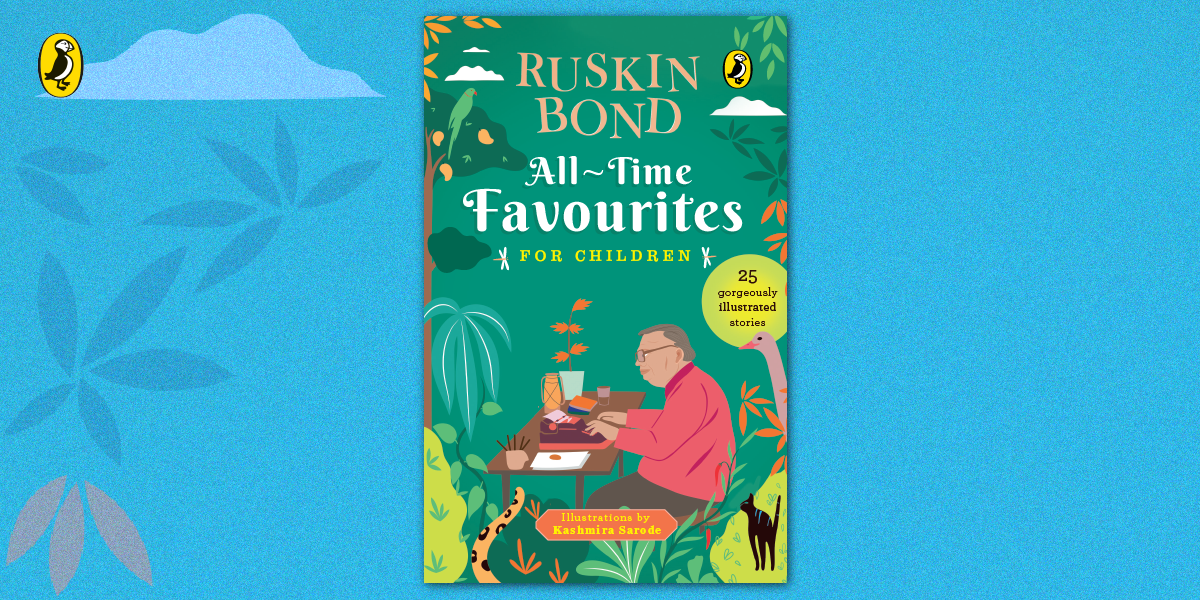
All Time Favourites for Children celebrates Ruskin Bond’s writing with stories that are perennially loved and can now be enjoyed in a single collectible volume. Curated and selected by India’s most loved writer, this collection brings some of the evocative episodes from Ruskin’s life. It brings together many known charming, endearing characters such as the iconic Rusty, the eccentric Uncle Ken and the ubiquitous grandmother, and a smattering of new ones that are sure to be firm favourites with young readers, especially middle schoolers. Heart-warming, funny and spirited, this is a must-have on every bookshelf!

All-Time Favourites FC
All-Time Favourites||Ruskin Bond

Here’s a taste of what’s in store in this exciting collection of stories. An extract from the story of a parrot who could, but ‘wouldn’t’ talk. ‘What goes around comes around’ is a complete mood in this one.

~

‘Kiss, kiss!’ Aunt Ruby would coo, putting her face close to the barge of the cage. But the parrot would back away, its beady little eyes getting even smaller with anger at the prospect of being kissed by Aunt Ruby. On one occasion, it lunged forward without warning and knocked my aunt’s spectacles off her nose.

After that, Aunt Ruby gave up her endearments and became quite hostile towards the poor bird, making faces at it and calling out, ‘Can’t talk, can’t sing, can’t dance!’ and other nasty comments.

It fell upon me, then ten years old, to feed the parrot, and it seemed quite happy to receive green chillies and ripe tomatoes from my hands, these delicacies being supplemented by slices of mango, for it was then the mango season. It also gave me an opportunity to consume a couple of mangoes while feeding the parrot.

One afternoon, while everyone was indoors enjoying a siesta, I gave the parrot his lunch and then deliberately left the cage door open. Seconds later, the bird was winging its way to the freedom of the mango orchard.

At the same time, Grandfather came to the veranda and remarked, ‘I see your aunt’s parrot has escaped!’

‘The door was quite loose,’ I said with a shrug.

‘Well, I don’t suppose we’ll see it again.’

Aunt Ruby was upset at first and threatened to buy another bird. We put her off by promising to buy her a bowl of goldfish.

‘But goldfish don’t talk!’ she protested.

‘Well, neither did your bird,’ said Grandfather. ‘So we’ll get you a gramophone. You can listen to Clara Cluck all day. They say she sings like a nightingale.’

I thought we’d never see the parrot again, but it probably missed its green chillies, because a few days later I found the bird sitting on the veranda railing, looking expectantly at me with its head cocked to one side. Unselfishly, I gave the parrot

half of my mango.

While the bird was enjoying the mango, Aunt Ruby emerged from her room and, with a cry of surprise, called out, ‘Look, my parrot’s come back! He must have missed me!’

With a loud squawk, the parrot flew out of her reach and, perching on the nearest rose bush, glared at Aunt Ruby and shrieked at her in my aunt’s familiar tones: ‘You’re no beauty! Can’t talk, can’t sing, can’t dance!’

Aunt Ruby went ruby-red and dashed indoors.

But that wasn’t the end of the affair. The parrot became a frequent visitor to the garden and veranda and whenever it saw Aunt Ruby it would call out, ‘You’re no beauty, you’re no beauty! Can’t sing, can’t dance!’

The parrot had learnt to talk, after all.

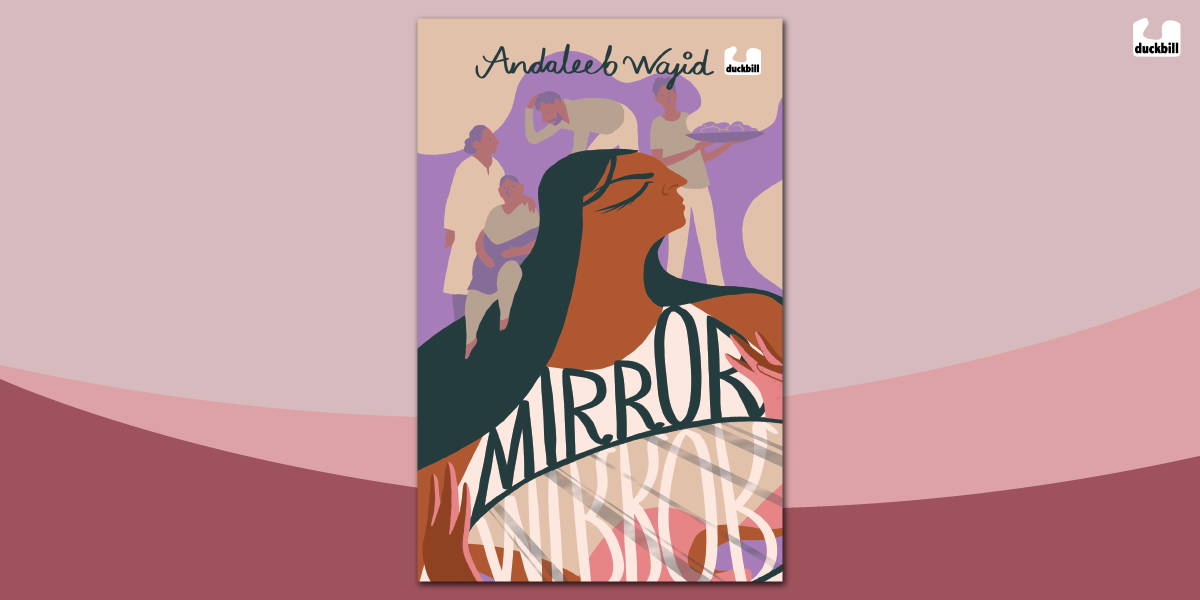
Growing up body shamed

Five years earlier, a friend’s nasty comment made Ananya start hating her body. She decided to change into a new person; one who effortlessly fits into all kinds of clothes, who shuns food unless it’s salad, and who can never be called ‘Miss Piggy’ – and to cut everything from her ‘old’ life, including her best friend, Raghu, for being witness to her humiliation.

Ananya was on her way to becoming who she wished to be, but she’s continued to see herself as a work in progress.

One day, her parents announced that they were expecting a baby, which worried her. To make matters worse, Raghu reappeared in her life …

Andaleeb Wajid’s latest novel for young adults is a touching and funny story about a young girl’s journey to acceptance and self-love. Here’s a glimpse into her struggle as she finds her way.

~

Mirror mirror front cover
Mirror, Mirror||Andaleeb Wajid

I felt a little guilty about the way I had been treating Ma so I went looking for her. When I didn’t find her at home, I called her phone.

‘I’m back home. Where are you?’ I asked.

‘I left you messages. You didn’t see?’ Her voice was a little muffled. Where was she?

‘No. Why? Where are you?’

‘At the gynaecologist,’ she said. What? Already?

‘But you just found out yesterday!’

‘At my age, sweetie, you can’t be too careful,’ she said. ‘Okay, I have to go now.’ She hung up and I continued staring at my phone.

At her age?

Mom was just forty-three. But . . . having a baby at her age . . . I suddenly felt a spasm of fear. What if something went wrong and she died? All because of this stupid baby.

My throat closed with panic. I needed to talk to someone but didn’t want to call up Nisha. Obviously, I didn’t want to talk to Anirudh about it either. I called up Papa instead.

‘What is it?’ he asked, his voice coming muffled too.

‘Are you also at the gynaecologist’s?’ I asked, surprised.

‘Yes, of course,’ he said gruffly. ‘What is it, Ananya?’

‘I . . .’ I didn’t know how to tell him what I’d been thinking.

‘Nothing. I’ll see you at home,’ I said.

‘Okay,’ he said and he hung up too.

I sat on my bed, feeling out of sorts. I needed to do something. I needed to take my mind off this panic.

I rolled out my yoga mat and did a few stretches, and then sat down, trying to calm my mind. It wasn’t working. My mind was fixated on something else. Something with chocolate in it.

No, we’re not going there, I told my mind firmly.

Please?

One square of dark chocolate wouldn’t hurt anyone. I knew Ma kept a stash in the fridge but I had never ventured near it, as though afraid it would bite me.


Saliva pooled under my tongue and I felt an unbearable urge to just taste one little piece.

No. I knew exactly how to change that. I got up from the yoga mat and, bracing myself, walked over to the mirror.

That one piece of chocolate is going to show on your tummy, I told myself, making myself study my reflection. On your thighs. Do you want that?

I pinched my stomach and winced at the pain. Despite all the crunches, this was never going to go away, was it?

Fat bitch. Ugly cow. You’ll always be like this.

The thought of chocolate was no longer appealing. I sat in the hall, waiting for my parents to return home and when I heard the sound of the car, I got up to meet them at the door. I looked for an indication on Ma’s face that everything was all right. But she looked fatigued and anxious.

‘What is it? Are you going to die?’ the words tripped out of my mouth before I realized how silly I sounded.

Ma sidestepped me and walked towards the living room slowly. Papa followed her, looking grim, holding on to a file.

I held his thick wrist and he stopped. ‘What is it? You guys are scaring me,’ I whispered to him.

He looked confused. ‘Why are you scared? Everything is fine,’ he said. I didn’t believe him because his face looked drawn and worried.

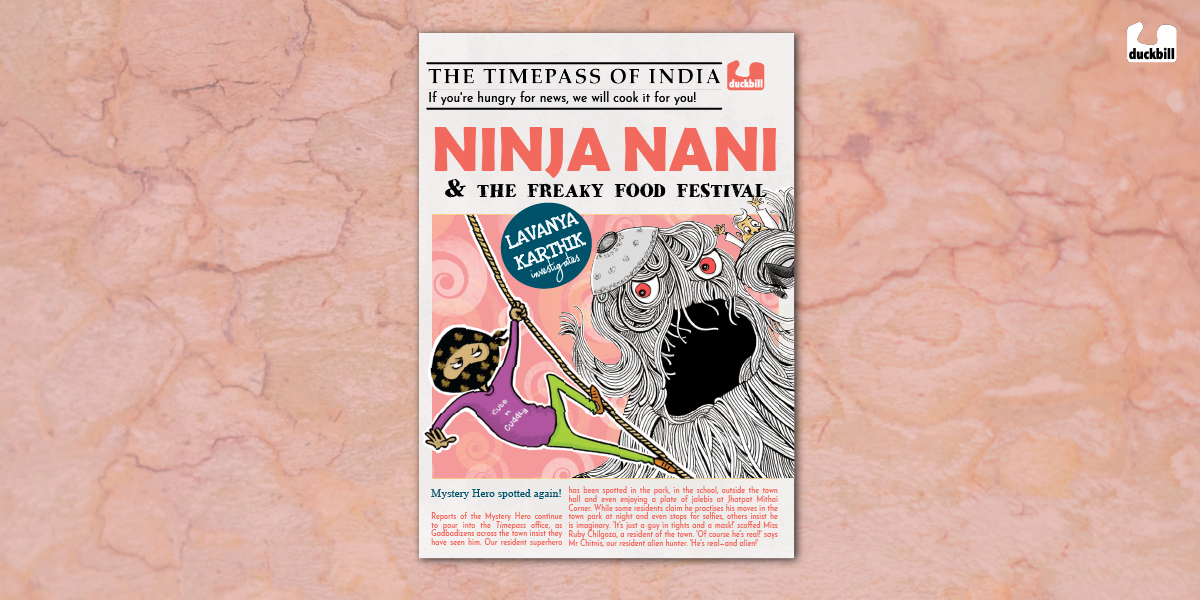
Ninja Nani – The mystery hero

It is common for Nani to somersault around the room and backflip without a flinch. Her ninja senses jingle when there is danger in Gadbadnagar and the air then wibbles and wobbles around her. Nani steps out every night, catches robbers, helps people trapped in lifts and burning buildings, and saves stray pups and little birdies. Is it hard to believe?

Here’s an excerpt from the book where Nani gives a glimpse of her superpowers to young Deepu.

*

Ninja Nani and the Freaky Food Festival || Lavanya Karthik

‘So what happened? Where did you go? How?’ If Deepu’s questions had had feet, they would have tripped over themselves trying to get out of his head.

The door slammed as Papa rushed out of the house to get to his doctor.

Upstairs, another door slammed. Then they heard the SKREECH-THUD! of Mummy pulling her chair out and plonking herself in it. The muffled sounds of her talking on the phone followed.

Nani turned to Deepu. ‘I could tell you, or . . .’ She smiled and raised her hands. The air around her fingers fizzled! Little electric sparks danced.

Deepu gasped. ‘Is this . . .?’ he whispered.

Nani pressed her fingers gently to either side of Deepu’s forehead. Deepu’s brain sparked and frizzled! More jutsu!

‘The Ninja ThoughtMeld!’ Deepu shut his eyes tight, as images jumped and crashed and fizzed about inside his head. Morimori used it on his show all the time!

Who knows?’ said Nani’s voice, inside his head. ‘It’s this trick I picked up last week.’

‘Am I hearing your thoughts?’

You are! Pretty neat, huh? But wait, it gets better!’

She was right.

Deepu couldn’t just hear her thoughts, he could see them as well.


*

To know how Nani, Deepu’s own Superhero, fights the monsters and saves everyone from gadbad, read Ninja Nani and the Freaky Food Festival.

An unfinished portrait

A gift book for children and teens, Another Dozen Stories is a must-read collection of 12 fascinating short stories by award-winning author Satyajit Ray.  It is our homage to this brilliant writer who has blessed us with an era of enchanting stories. Translated for the very first time into English by noted translator Indrani Majumdar, this edition is a gift for his many fans and children who are nine years old or more, on the centenary of his birth.

Another Dozen Stories brings to you the magical, bizarre, spooky and sometimes astonishing worlds created by Satyajit Ray, featuring an extraordinary bunch of characters! This collection includes twelve hair-raising stories that will leave you asking for more!

We decided to add to the gift by giving away a part of a story. If the cliff-hanger at the end piques your curiosity, you know what to do.

~

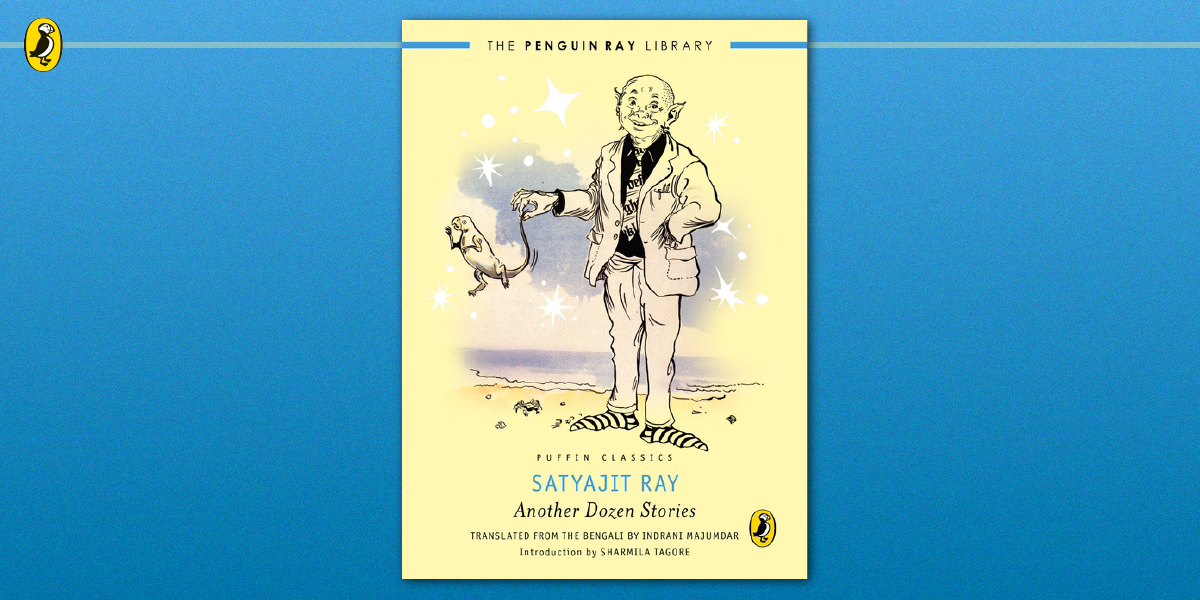
Another Dozen Stories front cover
Another Dozen Stories||Satyajit Ray

Ranjan Purakayastha is a noted painter in Calcutta. Why just Calcutta? His popularity has spread way beyond Bengal, across the whole of India. He has had exhibitions in Bombay, Madras, Delhi, Bangalore and Hyderabad. Ranjanbabu’s income, which is quite substantial, comes from selling his paintings. Last month in Bombay, one of his oil paintings was sold for thirty-five thousand rupees.

The painting style Ranjanbabu has adopted is modern. Very little of the real world can be associated with his work. His human figures look like puppets created by some incapable artisan; the trees resemble the twigs of a broomstick; the clouds in the sky look like floating chunks of meat; and his birds and animals have nothing to do with nature or a zoo. But as today’s art connoisseurs appreciate this kind of approach, Ranjanbabu’s earnings have not been affected. Yet I must also add, Ranjanbabu remains unrivalled in creating portraitures of people. Here he doesn’t adopt his modern style, the pictures look like real people and the likenesses are rather good too. Due to the nature of his work, Ranjanbabu needs to travel often, and that offers him a good income too. For a life-size oil painting, he charges fifteen thousand rupees, which he plans to increase to twenty-five thousand next year. Even in the age of photographs, a few wealthy people still prefer to have their portraits made, and Ranjanbabu gets to prove his expertise again and again.

One Sunday morning, a gentleman arrives at Ranjanbabu’s fancily decorated flat on Richi Road. At a glance, one can tell he is wealthy. Tall and hefty, attired in a raw silk suit, and sporting five rings on five fingers. His appearance is marked by a strapping personality. The gentleman says his name is Bilash Mallik, and he is keen to have his portrait done. When Ranjanbabu hears his name, he knows the gentleman is one of Calcutta’s most affluent businessmen. His will be a life-size portrait, and he is ready to pay any amount stipulated.

‘How much will you charge?’ Mr Mallik asks.

With a straight face, Ranjanbabu says, ‘Fifty thousand rupees.’

The client promptly agrees.

Ranjanbabu already has an incomplete work at hand, a large painting. He needs at least seven days to finish it. Accordingly, he calculates his timeframe and offers Mr Mallik a date. He will have to do a one-hour sitting every day at 9 a.m.

‘How many days will you take to finish it?’ Mr Mallik queries.

‘About a fortnight.’

‘Very well,’ says Mr Mallik. ‘It’s settled. Hmm . . . do you require an advance?’

‘No, sir.’

Before embarking on any major project, Ranjanbabu always seeks his guru’s blessings. He became Saralananda Swami’s—also known as Babaji or Swamiji—disciple ten years ago. On many occasions he takes Babaji’s advice, and the latter too is very fond of this disciple. Babaji has been bestowed with many powers, and fortune-telling is one of them.

After listening to everything his disciple tells him, Babaji meditates for three minutes and then says, ‘There is danger.’

‘What danger, Swamiji?’

‘A lot of mishaps. You didn’t do the right thing by taking up this task.’

‘Then should I refuse the gentleman?’

‘Wait.’

Babaji closes his eyes once again and begins to sway.

This continues for another five minutes, after which Babaji finally opens his eyes. Ranjanbabu is looking at his guru reverentially.

‘I can foresee you ultimately crossing all the hurdles and finding success. Don’t worry; get on with your work,’ Babaji says.

Greatly relieved, Ranjan Purakayastha touches Babaji’s feet and takes his leave.

The work on Bilash Mallik’s portrait commences on Saturday, 21 January. Mr Mallik is a jovial fellow. Right at the outset he checks if he can talk during sittings. Usually Ranjanbabu doesn’t permit this, but since this is an exceptional client, he has to say yes.

‘But you shouldn’t move your neck. If you speak, speak in one direction, that is, look at my right shoulder and then speak.’

When the first stroke of charcoal appears on the canvas, the time is 9.15 a.m.

Day by day, Mr Mallik’s face begins to emerge. There’s no doubt that Ranjanbabu is a very skilful artist, but at this juncture the only person who can see his work is the artist himself. The person whose portrait is being created will get to see it only after it’s completed. Even though this condition wasn’t discussed beforehand, Mr Mallik doesn’t have any objections.

It’s the twelfth day, and the portrait is nearing completion. After half an hour of sitting, Mr Mallik says he’s feeling dizzy.

Ranjanbabu stops and says, ‘Please go home. In any case, the portrait is almost complete. If you feel better, please come back tomorrow morning.’

But Mr Mallik doesn’t feel any better the next day. In fact, his fever goes up to 103 degrees. On the third day, things turn even more serious and he is shifted to a hospital.

Ranjan Purakayastha removes the portrait from the easel, puts it aside and fixes a brand-new canvas on it. Then he starts to work on a landscape with a modern touch.

After spending one-and-a half months in hospital, when Mr Bilash Mallik finally returns home, he no longer carries any resemblance to his former self. He has lost weight—down to seventy-two kilos from ninety. His cheeks are now hollow and his eyes sunken. He sends word to Ranjan Purakayastha that the portrait can wait. When his appearance becomes a little better, he can once again come for a sitting.

A month later, Mr Bilash Mallik begins to look better. Yet there’s no resemblance between his former and present selves. Doctors have advised him to control his diet. With the result, his weight can never go beyond eighty kilos.

Mallik says, ‘Let’s do a new portrait in my present state.’

Ranjan Purakayastha places a fresh canvas on his easel. Mr Mallik has altered his clothes to fit his reduced frame. But it’s a fact that he no longer looks unwell.

After four days of sketching, Ranjanbabu goes shopping to New Market in his Fiat one evening. On the way back, as soon as he crosses the turn at Park Street, a mini bus coming at high speed rams into the car from the right.

Of course, the Fiat is damaged, but along with it, Ranjanbabu’s right hand is severely battered. In the

hospital, the X-ray reveals multiple fractures on his elbow, wrist and the right thumb.

Once the cast on his hand is taken off after two months, Ranjanbabu discovers that he will never regain the same level of artistic expertise as he had before the accident. The most critical issue is his thumb. One can create modern art by holding a brush between the index and middle fingers,

but not a natural portrait.

This causes a huge trauma in Ranjanbabu’s life. He stops all work and goes on a pilgrimage. After spending three months travelling in Kashi, Haridwar, Rishikesh and Lakshman Jhula, he returns home and starts painting again using two fingers. The work produced looks slack and the appearance of his work completely changes. Ranjanbabu can now no longer demand thirty to forty thousand rupees for a painting. He needs to re-establish his market.

Meanwhile, Mr Bilash Mallik enquires about him, extends his sympathies and deeply regrets that he can now no longer have a Ranjan Purakayastha portrait in his house.

After trying for three months, using the paintbrush with only two fingers, Ranjanbabu manages to evolve a style that eventually earns him an endorsement in the art market. One Sunday morning, the retainer comes to his studio to announce the arrival of a gentleman.

‘You know him,’ the retainer remarks.

A diving holiday, disturbing discovery, and kidnapping

Far out in the Arabian Sea, where the waters plunge many thousands of metres to the ocean floor, lies a chain of bewitching coral atolls – the Lakshadweep Islands. Vikram and Aditya dive into lagoons with crystal-clear water and reefs that are deep and shrouded in mystery. But when they stumble upon a devious kidnapping plot, their idyllic holiday turns into a desperate struggle for survival.

Here is an excerpt from Deepak Dalal’s new book, Lakshadweep Adventure where Faisal – the boy who’s care Vikram and Aditya are left in – makes a disturbing discovery.

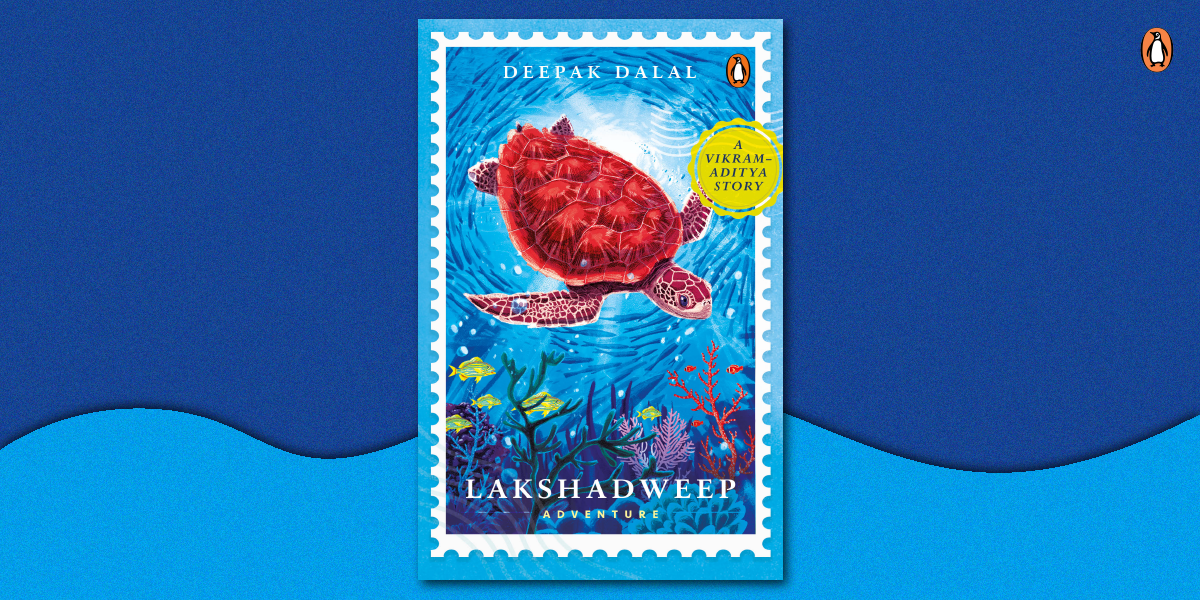
Front Cover A Vikram–Aditya Story: Lakshadweep Adventure
A Vikram–Aditya Story: Lakshadweep Adventure

Faisal was in a bad mood. His uncle’s impending arrival hovered like a dark cloud above him. And his friends’ decision to abandon him for the day only made things worse.

Faisal had noticed the wind the moment he had strolled out on to the beach, and his mood had soured even further when he saw his friends enjoying themselves. He wished he had accepted Aditya’s offer as he watched them speed their boards across the lagoon. But it was too late now. His uncle would be arriving shortly.

Faisal sat under a palm tree. He passed time drawing figures in the sand. Above him, palm fronds shook and fluttered as the wind whistled through them. The sun shone brightly. The sand intensified its glare, forcing Faisal to shut his eyes. It was pleasant under the tree and the wind was crisp and enjoyable. The rustling of the palms overhead soothed him and he soon fell asleep.

The tide slowly crept up the beach and finally washed over Faisal’s feet, waking him with a start. He looked at his watch, muttering softly to himself. It was past midday.

Basheer uncle would have arrived by now. He dusted sand from his clothes and rose hurriedly to his feet.

Faisal heard raised voices from the living room window when he entered the yard. He crept forward till he was below the window and peeped in.

His uncle was standing in the centre of the room, facing a group of men.

Basheer Koya was a copy of Faisal’s father, except that he was fatter and there was hardly any hair on his head. But unlike his brother, whose manner was calm and collected, Basheer Koya’s face was contorted with rage. His cheeks were dark and red and he was shouting like a man possessed.

‘Fools!’ thundered Basheer Koya in Malayalam. ‘Monkeys have more brains than you lot. Idiots. I thought you had ears. But obviously you don’t. You weren’t to set foot in Kalpeni. How many times did I tell you not to come here? Yet, not only do you come to the island, but even more brainlessly, you visit my home.’

A bearded man with big, wide shoulders spoke. ‘Sir,’ he began. ‘Sir—’

Basheer Koya ranted on, cutting off the man. ‘I travelled all the way to Kochi to make certain that no suspicion fell on me and I returned only after the operation was over. And you? I come home and see you fools sitting in my house. I take all these precautions and now everyone on this island can link me to you and from there to the operation.’

‘But, sir—’

‘You were under orders to head to Tinakara Island. What are you doing here?’

‘Sir. I was trying to explain just that, sir. We were headed for Tinakara. But we had engine trouble, sir. A terrible rattling noise came from the engine and we were forced to head for the nearest island. You can speak to the mechanic, sir. He looked at our boat and said we were lucky to make it here to Kalpeni.’

The explanation diminished Basheer Koya’s rage, yet he continued to glare at the bearded man. ‘Kumar. Where is Kumar?’ he barked.

‘Kumar is safely on board, sir. There’s no need to worry about him. He is in the lower cabin and one of our men is with him all the time. He can’t make a sound or do anything. He won’t be able to alert the mechanics.’

Faisal froze. This was not for his ears. It was wrong of him to eavesdrop. He wondered if he should leave, but who was Kumar and what was his uncle up to?

‘No one is to know that we have a prisoner on board,’ growled Basheer Koya. ‘Even Allah will not be able to help you if he is discovered. I make no allowances for mistakes.’ Basheer Koya stared at his men, shifting his gaze from one to the other. ‘Do you understand?’

There was silence in the room.

Faisal understood full well what his uncle meant. He shuddered.

***

Journey through these breath-taking islands with a tale of scuba diving and sabotage, set in one of India’s most splendid destinations.

A slip and a fall in search of the grey ghost of the Himalayas

In Deepak Dalal’s new book, The Snow Leopard Adventure, Vikram and Aditya are back in magnificent Ladakh. Having finally freed their young friend Tsering from the hands of dangerous men, they’ve set themselves up for an even greater challenge: to track down the grey ghost of the Himalayas, the snow leopard.

But things don’t always go according to the plan during their trek. Here is an excerpt from the book that highlights one of the more challenging events of the trek.

Front Cover The Snow Leopard Adventure
The Snow Leopard Adventure||Deepak Dalal

I didn’t see exactly what happened because I was looking down at the gravel-strewn track as I ran. I heard a scream, and when I looked up, I saw a pair of hands grabbing desperately at the edge of the outcrop. I wasn’t far behind Caroline and scarcely a few seconds must have elapsed between her falling and my flinging myself to the ground and locking my fingers around her wrists. I had barely grasped them when her scrabbling fingers slipped, and her entire weight was transferred on to me. I was dragged forward and my chest hit the rock at the edge of the cliff with a thud.

We were both stuck, Caroline dangling from my hands and I pressed against the cliff edge, pinned down by her weight. Caroline is three inches taller than my 5 feet 7 inches and also heavier than me (sixty-five kilos to my sixty, she told me later). I could feel myself being pulled towards the edge. Disaster appeared to be a certainty, but Tsering intervened, saving us by clinging to my thighs and adding his weight to mine.

Now, on reflection, I don’t think any of us would have died if we had gone over. The cliff we clung to was not a large one. The fall was only a few metres. But the area at the base of the cliff was not flat, it sloped downwards at an alarming angle. Our injuries could have been serious. We would have broken several bones, but we would have survived.

My breath came in rapid gulps and sweat must have flowed from my every pore. Yet, even though I was terrified, a part of my mind admired the vista that spread before me. I could see the river valley below and the mountain slopes opposite. I spotted flecks of colour in the distance—our camp mates. I wondered if they could see us.

I am ashamed to admit that I lost control of myself up there. My hands shook and my chest hurt terribly. My heart kicked and pummelled my chest, and my senses swam about me. I kept assuring myself that there was no reason to panic and that nobody would go over.

I had no idea then that I was speaking my thoughts aloud (Caroline and Tsering informed me later). I told myself that we only had to wait it out. Somebody would come . . . Tina and Kathy would return and untangle us.

Luckily, a heaven-sent determination infused Caroline as she dangled in the sparse Ladakh air. While I was rambling, she spotted fissures and cracks on the rock face she was suspended against. She willed her legs to grope beneath her and she found secure anchors in the stony crevices. Her fingers and palms gripped rock at the cliff edge. With me still holding on to her wrists, she pulled herself up a few inches.

I heard her breathing. She was gasping and panting far louder than I was. Soon her face was level with mine and our eyes met. Hers glittered with cold determination. There was a vacant expression in mine, she told me later. She was probably right, because she had to shout several times before I paid attention to what she was saying. She wanted me to release her wrists, which I did mechanically. Now sure of herself, Caroline dragged herself up and without further incident she flopped beside me. We lay inert on the rock, Tsering looking down on us.

After a long time we continued our walk to the crest. The rest of the morning was a blur. None of us were in any state to look for bharal or search for leopards. Kathy, Tina and Yuan turned up, exhausted, after an hour. They had found more sign of the leopard they were following but had not been able to locate it. We turned back for camp shortly thereafter. Caroline had extracted a promise from

Tsering and me not to speak about the morning’s drama to anybody. She smiled gratefully when it became clear that we were not going to say a word, and she turned distinctly friendly when we maintained our silence at camp too.

Aditya was aghast when he learnt that I had not pursued the leopard with the others. ‘How could you let such an opportunity go?’ he wanted to know. ‘You were so close to the leopard!’

Does Aditya eventually see the Snow Leopard? Grab your copy for Snow Leopard Adventure to find out!

error: Content is protected !!