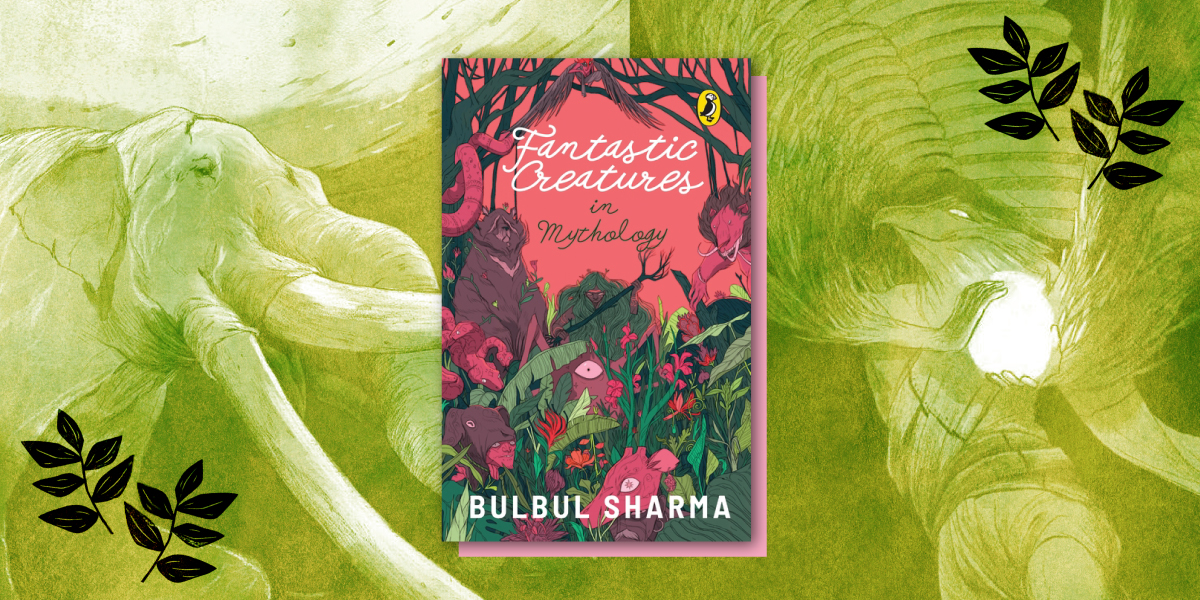
Fantastic Creatures is a spellbinding anthology of Indian mythology retellings. With a focus on the chimeric beings that populate our folklore, author Bulbul Sharma has found an evocative way to reintroduce the beloved stories from our childhood. Here she writes about why children often learn storytelling and writing from mythologies, and why these ancient tales will never grow old.
*
Fantastic Creatures in Mythology || Bulbul Sharma
Indian mythology, with its treasure trove of tales, is one of the richest and most colourful mythologies in the world. The wonderful and unique aspect of our myths is that we are still totally familiar with these age-old stories. They are ever-present in our art and dance traditions, in classical music and theatre. Most Indian children in city schools or in remote village schools know these tales really well. When they are younger, they beg their grandparents to tell them these stories, and later when they are older, they love reading them. Whatever age they are, they love listening to or reading these familiar stories over and over again.
It is important for them to revisit these tales often to absorb all the subtle messages and gems of ancient wisdom that each story contains.As they read these stories, children admire the courage of the various great heroes and feel good when they defeat the demons. The tale is familiar, yet it makes them think about the battle between good and evil. These ancient tales teach children the value of good conduct but in an exciting, action-packed manner. There is always a curious twist to the tale. How did Tataka become such a terrible demoness? Who saved the inhabitants of the forest from her evil ways? Why did Khabanda have only one eye and a huge stomach? Why did Marich change himself into a magical, golden deer? How did Hanuman recall his superpowers?
Each story in mythology has stories hidden within itself, and only by reading them over and over again, are children able to discover the various layers. It is important for children to see for themselves how good always prevails over evil. However difficult the lives of the heroes might be, however many battles they might have to fight; the young reader always knows that his hero will always win in the end. The demons we meet are not always bad. Some were good creatures once upon a time but were turned into demons because they did some mischief. This is a subtle way of teaching our children that wickedness is always punished. Despite being tales about good conduct, the stories from mythology never preach morality in a stern and boring way. There is always drama and colour, and there are many fantastic creatures dancing through the story to hold a child’s interest.
In ancient days, when a storyteller sat under a banyan tree and recounted tales of valour and courage from our ancient epics, people absorbed every word with enthusiasm. Though they knew these tales of earth-shattering battles, amazing valour and courage, from beginning to end, they still found them interesting since each storyteller added a different nuance to the familiar, much-loved tale. Each time I retell a story from mythology I try to add a slightly different layer of colour, but I am careful to stay very much true to the ancient story as the children know each and every word. Stories from our mythology are timeless, and children have always known this, and this is why they love reading these wonderful stories, over and over again.
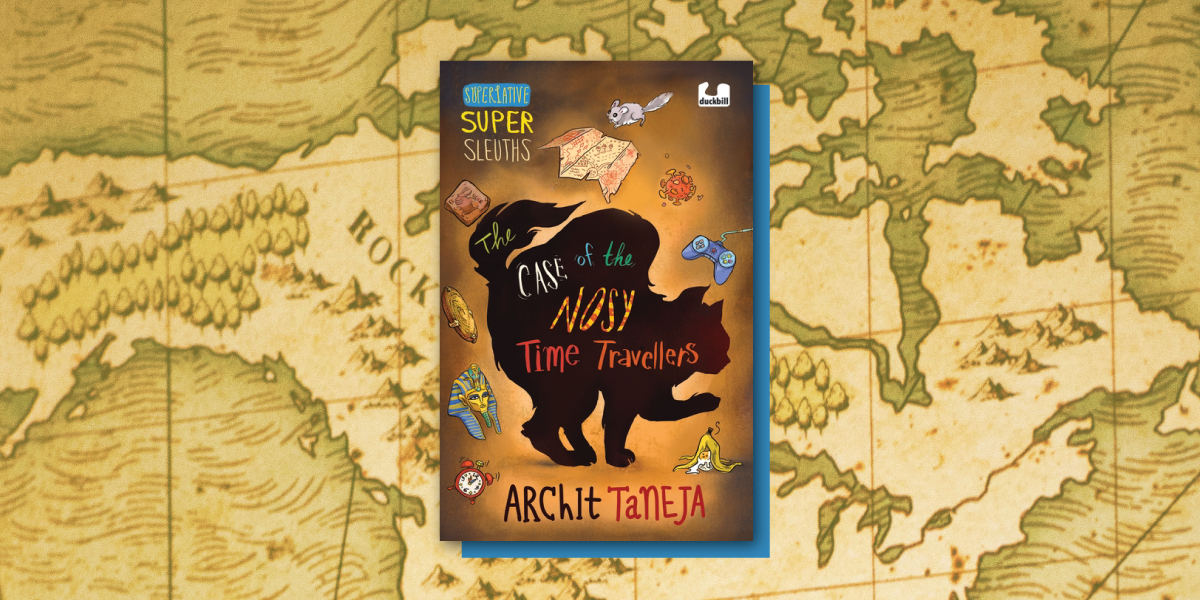
Rachita and Aarti have a nemesis who is out to destroy them. Garbage vandals are defacing walls of residential societies. Aarti’s birthday presents include miniature coasters. Rachita starts having egg-themed nightmares. Are these happenings related to the mysterious time-travelling detective gang that is challenging the Superlative Supersleuths? We’re all eager to find out!
Here’s an intriguing excerpt from the third book in the Superlative Super Sleuths series titled The Case of the Nosy Time Travellers.
*
The Case of the Nosy || Archit Taneja
Our sleuthing services had been in high demand since we got semi-famous last winter. I’d thought that having Vipul and Ashwin as official Supersleuths would help us manage the load, but the number of cases just kept growing. Aarti had come up with the idea of creating a website during the summer vacations. It’s been a great success: anyone can anonymously request us to solve a mystery. We encourage others to solve them too. It reduces our workload, and we feel good about keeping the spirit of sleuthing alive. Jyoti and Shilpa from our class formed a team and claimed that they’ll solve one before us one of these days. They’ve been failing miserably so far.
We had got a request two days earlier. Someone was vandalizing walls in Aarti’s apartment complex, the Shobhana Hillside View. One of the boundary walls had been smeared with garbage from the dustbins. This had been happening for just under a week. The adults didn’t seem to care much since the wall wasn’t visible during their evening walks or early morning yoga classes, but it stank up the area where the kids played football. Aarti hadn’t noticed it either—she had been busy pet-proofing her home for the last five days.
We had scouted the boundary wall before the party began. It was already dark by then, but my phone’s flashlight was enough to make some initial observations. The garbage patterns on the wall looked random. If the vandals were human, I’d expect them to leave some sort of message behind. Vandals leave messages because it made them look cool. They’d have made some art out of the garbage or arranged it to form curse words or something like that.
Interestingly, smearing trash on the walls seemed a nice way to segregate it. The wet waste remained stuck on the walls, while the dry waste slowly fell down. Could it be that the vandals understood the importance of recycling and wanted the people in the society to segregate their waste better? I noticed a glum-looking eggshell and a banana peel on the ground. I picked them up and smeared them on the wall again so that they could be back with their wet-waste brothers and sisters.
I tried to convince the security guards to show me the CCTV footage. They didn’t take me seriously, even when I tried to bribe them. I put them on the suspect list. My hunch was that the criminal was an animal, one that was really fond of playing with garbage. I’ve heard of pet owners complain about that. We couldn’t spot any strays in the society, so it was likely to be someone’s pet.
‘How many pets are left?’ I whispered into the mic. ‘Around a dozen, I guess. Over,’ Ashwin responded. ‘Make it quick, people will start to leave soon,’ I said. I’ve explained to Ashwin several times that he doesn’t need to use ‘Over’ when he finishes a message. We’re not in the 1950s any more, when only one person could speak on the radio channel at a time. But he insists on doing it because that’s how he’s seen it being done in movies.
I’d asked Aarti to invite everyone in the society who had pets, even if she didn’t know them well. She didn’t have a problem with that. For her, it just meant more gifts and more pets to cuddle with. Uncle and Aunty weren’t pleased, but they couldn’t say no. Our school counsellor must have recommended to our parents that they be extra nice to us after what we had been through.
**
To find out more about the spying adventures of Rachita and Aarti, read The Case of the Nosy Time Travellers.
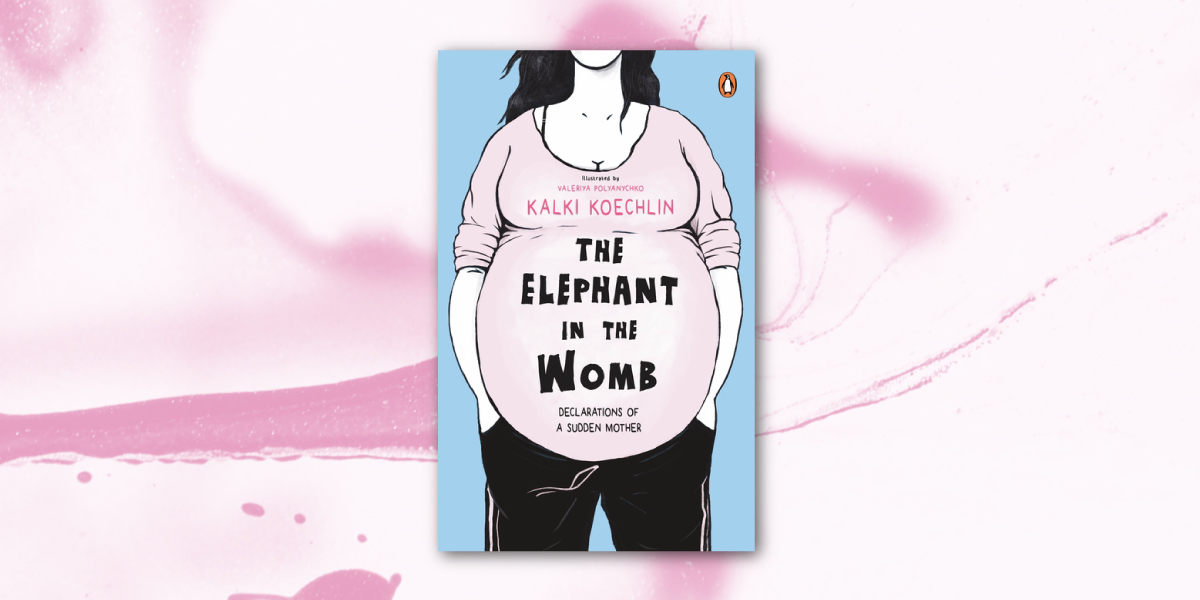
Parenthood is a challenging process, no matter who you are. Ask actress Kalki Koechlin! In her graphic narrative The Elephant in the Womb, Kalki records the physical, mental, and emotional reckonings that she and her partner had to face, before and after childbirth. While archiving these raw feelings, she manages to bust a lot of myths surrounding pregnancy. Below are some of the many myths that the author dismantles while experiencing childbirth for the first time.
The Elephant in the Womb||Kalki Koechlin
Myth 1: Miscarriages should not be talked about
Kalki starts her memoir right off the bat with a crucial point: miscarriage is not a matter of shame. It can feel tragic, can trigger grief and depression, but the guilt and shame are aggravated by treating miscarriage itself like a myth. 1 in 4 pregnancies experience a miscarriage, and most women experience this in the first trimester itself. Because most people hush it up and bring up other superstitions like the evil eye, the psychological effects of miscarriage are often felt by the mother, all by herself.
Myth 2: Pregnant women should restrict their movements
It doesn’t take long for people to change their behaviour around pregnant women, and The Elephant in the Womb describes this in fun, illustrative anecdotes. Once Kalki got pregnant, people around her began treating her like a porcelain doll, ready to break. When in fact, she wanted nothing more than to still hang out with friends and socialize! This myth is harmful especially because pregnant women need exercise in preparation for childbirth.
Myth 3: ‘Standard Procedure’ should be followed
The medical routines and processes which most expecting mothers are told are ‘standard procedure’, are sometimes myth. With the help of other mothers’ anecdotes, Kalki quickly realizes that she gets to decide how her body should be treated during her pregnancy. From discovering that anomaly scans are not mandatory to choosing both a doula as well as a gynaecologist for advice, Kalki establishes boundaries early on in her pregnancy. Most pregnant women let go of the authority of this process, often falling victim to unnecessary invasive procedures, not knowing that they are most likely to know what is best for their body.
Myth 4: Maternal instinct
Haven’t we all grown up hearing ‘mommy knows best’? Every mother has experienced being a mother for the first time, which means that making mistakes, looking out for support, having more people involved with the care of the baby is not an option but crucial for the mother’s physical and mental wellness. With postpartum depression being a real issue, it is unfair that women are expected to magically know and take care of all the affairs of the home after such a life-changing event.
The Elephant in the Womb is a unique graphic memoir that creatively expresses the hopes and anxieties of a modern mother in an ever-changing world.
India is one of the youngest countries in the world, thanks to its population of over 400 million millennials. Being in such great numbers shows how this demographic makes their country a huge well of untapped potential. What is it that makes millennials the true influencers, and what is their greatest obstacle?
In this interview, author (and millennial) Vivaan Marwaha answers some key questions about how he worked on this book and the method of writing and researching about such a massive data set.
~
What Millennials Want||Vivan Marwaha
Born between 1981 and 1996, roughly numbering more than 440 million, Indian millennials are without any doubt the largest millennial cohort on the planet.
But how much do we know about this generation? India’s youth is India’s future, but in order to build a prosperous future, we need to comprehensively understand the economic aspirations, social views, and political attitudes of the young Indians who will take the country forward.
Like every other generation in India, millennials are incredibly diverse: with not just significant economic division, but also important linguistic, regional, caste, gender and religious differences, which make the generation difficult to understand as a cohesive group.
Yet millennials have the potential to be India’s most significant generation. If you’re not convinced about why they could become the country’s most important—and potentially most disruptive—generation, consider some of these numbers.
India’s median age, according to a 2021 estimate by the CIA World Factbook, is twenty-eight years. This means that half of its population is under the age of twenty-eight. By contrast, the median age in the world’s top three economies— namely, the United States, China, and Japan—is thirty-eight, thirty-seven and forty-seven years respectively. Among the top ten economies in the world, India has the youngest population followed distantly by Brazil, which has a median age of thirty-two years. By 2021, two-thirds of India’s population will be within the working age of twenty to thirty-five years.
These young Indians will be the world’s largest labour force and market for goods and services. This is what is referred to as India’s ‘demographic dividend’. This term was popularized by academics, journalists, and businesspersons keen on investing in India in the early 2000s, who saw the country’s youth as an asset in the longer-run, particularly when compared to China, a country whose one-child policy was viewed as a demographic crisis in the making. It was believed that with the right education and investment in human capital, a growing middle class and an increase in foreign investment in the economy, India would not only enjoy high single-digit and even double-digit GDP growth, but its millennials and working-age population would power the country to transform itself like many east Asian success stories.
India’s millennials can only become a global power if they have cash in their wallets and stable jobs.
But there’s scant attention paid to millennials as a unique generation. Instead of viewing them as independent islands of young Indians based on their caste, class, or religion, in my book, I shine light on what brings them together—their common aspirations, anxieties, and experiences. When new policies and cultural issues are debated in India, lawmakers, news reporters and commentators all too often neglect to consider the impact these developments have on the millions of young Indians currently getting their education or joining the economy. The quality of their education; their opinions on hot-button cultural issues; their political beliefs; and whether they find employment will be crucial to India’s future in the economic and political order of the 21st Century. As the country seeks to become a global leader, members of its most populous generation will soon become its most powerful, and it is hard to overstate the importance of understanding the attitudes, behaviours, and views of India’s millennials. What Millennials Want is a book which combines data and anecdotes to narrate an intimate biography of this dynamic and important generation.
India’s mathematicians have made significant contributions over the last 5000 years. From the ever-popular Aryabhata, widely recognized for revolutionizing the number system and Shakuntala Devi, universally admired for her fast mental calculations to pioneers forgotten by time, like Baudhayana, who explained the Pythagoras’ theorem nearly 3000 years ago, India has produced many trailblazers in the field of mathematics.
Here are the stories of three such inspirational figures whose passion for knowledge and love for maths not only earned them worldwide acclaim but also brought prestige to the country.
Madhava – He is considered the greatest mathematician-astronomer to emerge from medieval India whose works laid the foundation for the Kerala School of Mathematics, which flourished between the late 14th century and the 18th century.
Madhava was a genius. He went a step ahead and linked the idea of an infinite series with geometry and trigonometry. He even obtained a way to calculate the value of pi correct to 13 decimal places, and this was two centuries before Gottfried Wilhelm Leibniz, a polymath from Germany.
It is perceived that Newton and Leibniz independently found the methods of calculus by building on and borrowing from the works of mathematicians like Fermat, Taylor, Gregory, Pascal and Bernoulli. But what is not known is that the elements of calculus were already known in Kerala, India, for over 250 years. The West has now recognized this and accordingly renamed some results regarding the trigonometric series, previously known as the Newton, Gregory and Leibniz series, as the Madhava-Newton, Madhava- Gregory and the Madhava-Leibniz series, respectively.
Srinivasa Ramanujan – During his short life, Ramanujan independently compiled over 3900 identities and equations, which have all been proved by later mathematicians. This contributed to breakthrough research in mathematics and remarkable discoveries in crystallography and string theory.
It was in January 1913 that Ramanujan wrote the famous letter to an English mathematician Prof. G.H. Hardy of Cambridge University with numerous theorems he had researched and worked upon himself. Hardy was initially skeptical of Ramanujan’s work assuming that he was a fraud but soon had to change his mind as he went through the theorems given in the letter. He finally concluded that Ramanujan was ‘a mathematician of the highest quality, a man of altogether exceptional originality and power’. Hardy then immediately made arrangements to invite Ramanujan to Cambridge University from India.
Ramanujan was elected as a member of the London Mathematical Society in 1917 and the next year, in 1918, Ramanujan was elected as a Fellow of the Royal Society—the youngest ever at thirty-one years of age.
Shakuntala Devi – was India’s iconic ambassador in the field of mathematics and travelled the world enthralling audiences with her number-crunching prowess.
She was found displaying exceptional memorization skills by her father while he was showing her card tricks. She was only three at the time. At six, the young wonder, Shakuntala Devi started travelling with her father, doing roadshows, where she displayed her unique calculation abilities of large multiplications, cube roots of huge numbers and even questions related to dates! In 1980, at the Imperial College of London, she rose to meteoric success and global fame by multiplying two 13-digit numbers in 28 seconds flat.
In her book In the Wonderland of Numbers, she wrote ‘As for numbers, they hate nobody, and nobody can afford to hate them!’ She continues to give us hope that mathematics can also be fun and exciting and that it is essential to approach it with a spirit of curiosity!
*
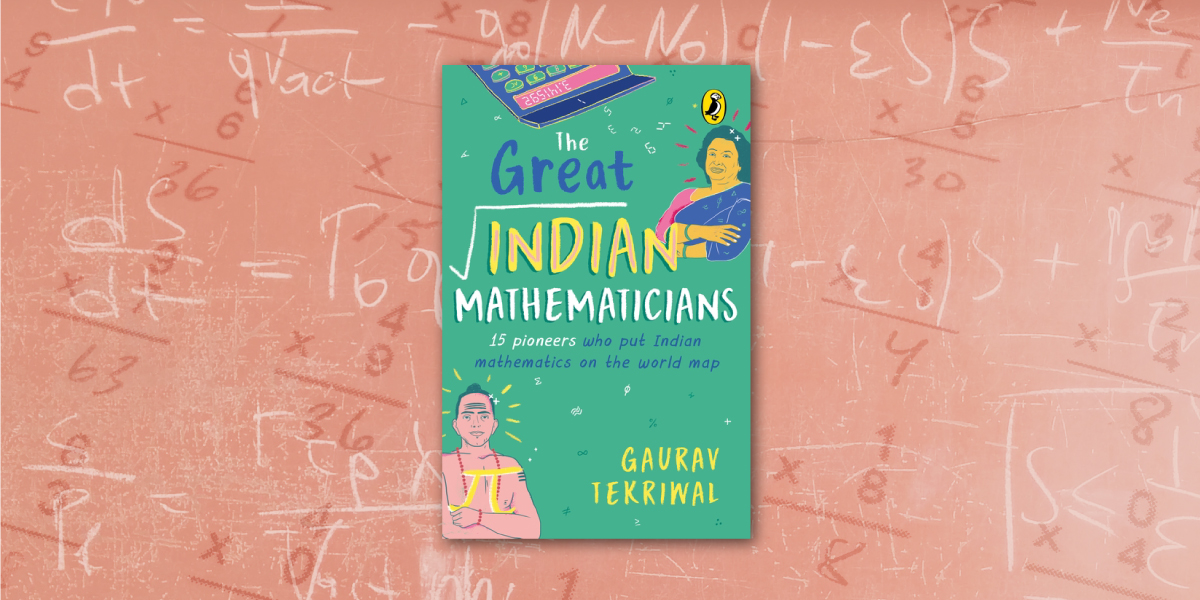
The Great Indian Mathematicians by Gaurav Tekriwal
To know more about India’s finest mathematicians, read The Greatest Indian Mathematicians. It is an ideal introduction for the next generation of tenacious and curious maths wizards.
Finding the right job at the start of your career can be a hard row to hoe. Several factors such as the company’s reputation, job description, your designation, remuneration, skill set, attitude are to be considered before you embark on a career in a company.
Here are some general questions for you to think about and look answers for while planning your career. These questions may help you streamline your choices and develop your career.
What roles interest you?
Have you shortlisted the companies you’d want to work with?
Have you made a priority list of the shortlisted companies?
Have you found the right people to network with?
What are the most appropriate platforms for the job you are looking for?
What qualities do you have that will help you excel in the role you’d be applying for?
What value will your organization add in your career?
What value can you add to the organization you join?
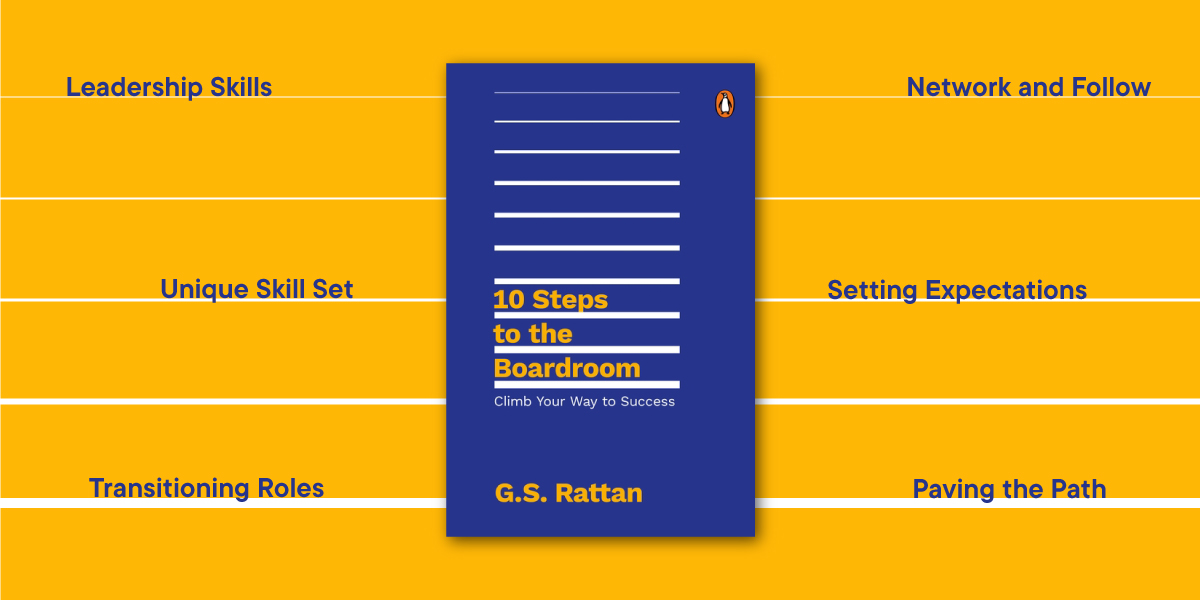
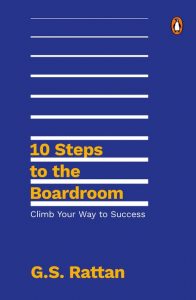
10 Steps to the Boardroom || G.S. Rattan
If you’re on the first step of your professional journey and have found answers to the above questions, then jot down the information on the template given below. It may prove to be your guiding light in achieving your dream of reaching the boardroom.
Your Plan
The Company You Want to Work in:
Key Stakeholders:
What I Admire About the Company:
Vision of the Company:
Mission of the Company:
Why I Belong Here:
Job Description and Responsibilities
JD:
Responsibilities that I can take on:
Responsibilities that will require learning on the job:
Area of Jurisdiction
Performing areas:
What I can take a shot at:
Defining Results
Tangible:
Intangible:
Network and Follow
Possible Mentor 1:
Network to Follow on
Possible Mentor 2:
Where to Start:
Department I Would like to Start With
Option 1:
Option 2:
Option 3:
Attitude Matters
My key strengths:
What I need to work on:
What is valued by this organization?
Remember the words of the author of 10 Steps to the Boardroom: ‘The most important factor will always be the intensity of the fire in your belly. Everything else is either a catalyst or a deterrent.’
India’s mathematicians have made significant contributions over the last 5000 years. From the ever-popular Aryabhata, widely recognised for revolutionising the number system and Shakuntala Devi, universally admired for her fast mental calculations to pioneers forgotten by time, like Baudhayana, who explained the Pythagoras’ theorem nearly 3000 years ago, India has produced many trailblazers in the field of mathematics.
The Great Indian Mathematicians||Gaurav Tekriwal
Here are the stories of three such inspirational figures whose passion for knowledge and love for maths not only earned them world-wide acclaim but also brought prestige to the country.
1. Madhava – He is considered the greatest mathematician-astronomer to emerge from medieval India whose works laid the foundation for the Kerala School of Mathematics, which flourished between the late 14th century and the 18th century.
Madhava was a genius. He went a step ahead and linked the idea of an infinite series with geometry and trigonometry. He even obtained a way to calculate the value of pi correct to 13 decimal places, and this was two centuries before Gottfried Wilhelm Leibniz, a polymath from Germany.
It is perceived that Newton and Leibniz independently found the methods of calculus by building on and borrowing from the works of mathematicians like Fermat, Taylor, Gregory, Pascal and Bernoulli. But what is not known is that the elements of calculus were already known in Kerala, India, for over 250 years. The West has now recognized this and accordingly renamed some results regarding the trigonometric series, previously known as the Newton, Gregory and Leibniz series, as the Madhava-Newton, Madhava- Gregory and the Madhava-Leibniz series, respectively.
2. Srinivasa Ramanujan – During his short life, Ramanujan independently compiled over 3900 identities and equations, which have all been proved by later mathematicians. This contributed to breakthrough research in mathematics and remarkable discoveries in crystallography and string theory.
It was in January 1913 that Ramanujan wrote the famous letter to a English mathematician Prof. G.H. Hardy of Cambridge University with numerous theorems he had researched and worked upon himself. Hardy was initially skeptical of Ramanujan’s work assuming that he was a fraud, but soon had to change his mind as he went through the theorems given in the letter. He finally concluded that Ramanujan was ‘a mathematician of the highest quality, a man of altogether exceptional originality and power’. Hardy then immediately made arrangements to invite Ramanujan to Cambridge University from India.
Ramanujan was elected as a member of the London Mathematical Society in 1917 and the next year, in 1918, Ramanujan was elected as a Fellow of the Royal Society—the youngest ever at thirty-one years of age.
3. Shakuntala Devi – was India’s iconic ambassador in the field of mathematics and travelled the world enthralling audiences with her number- crunching prowess.
She was found displaying exceptional memorization skills by her father while he was showing her card tricks. She was only three at the time. At six, the young wonder, Shakuntala Devi started travelling with her father, doing roadshows, where she displayed her unique calculation abilities of large multiplications, cube roots of huge numbers and even questions related to dates! In 1980, at the Imperial College of London, she rose to meteoric success and global fame by multiplying two 13-digit numbers in 28 seconds flat.
In her bookIn the Wonderland of Numbers, she wrote ‘As for numbers, they hate nobody, and nobody can afford to hate them!’ She continues to give us hope that mathematics can also be fun and exciting and that it is essential to approach it with a spirit of curiosity!
*
To know more about India’s finest mathematicians, read The Greatest Indian Mathematicians. It is an ideal introduction for the next generation of tenacious and curious maths wizards.
October is the month of adventure. Introduce your young ones to Rachita and Aarti, who have a nemesis out to get them, and the Naturalist Ruddy Mongoose, who combines natural history with detective fiction. Ruskin Bond’s famous character, Ranji, is back in a heart-warming story and so is Rumi, who encounters a ghost–Rain! Muhammad bin Tughlaq, the Sultan of Dihli, is outraged; but why? Maithili and the Minotaur are on their very first adventure in an outlandish world where nothing is as it seems…
We’ve also included something for the youngest readers – those learning to read!
My First Words
My First Words
This collection of 15 mini board books is more than just a set of adorable books for a child’s first library–they are also engaging learning tools! The format includes activities like stacking, sorting, counting, matching and identifying colours that encourage interactive learning of basic concepts and facilitate developmental skills in kids.
The box set comprises mini books with sturdy board pages and rounded corners that are perfect for tiny hands. With adorable illustrations and a modern design, this box set includes a variety of relevant topics like first words, animals, numbers, shapes, colours and more.
The Tunnel
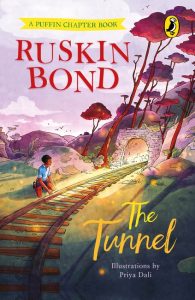
The Tunnel || Ruskin Bond
Fascinated by the midday train, Ranji would find himself waiting near the tunnel to catch a glimpse of the engine come roaring out of it. But the tunnel has more surprises for him. From a jungle full of lush green trees comes a timeless tale of unexpected friendship, curiosity, duty and wildlife.
Peppered with delightful illustrations, Ruskin Bond brings to his readers another heart-warming story packaged as a charming chapter book-a perfect introduction for beginners to the world of India’s favourite writer!
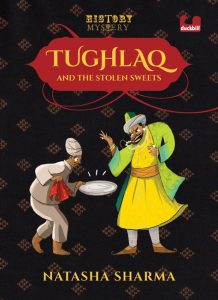
Tughlaq and the Stolen Sweets
Tughlaq and the Stolen Sweets || Natasha Sharma
For Ages: 8+ years
Muhammad bin Tughlaq, the Sultan of Dihli, is outraged. Someone has stolen his favourite dessert, the sugared melons from Khurasim. What’s worse, people are questioning his plans of torture and punishment. Who can help the Sultan solve this mystery?
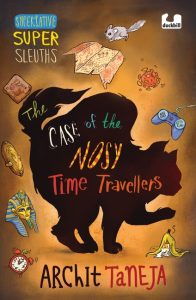
The Case of the Nosy
The Case of the Nosy || Archit Taneja
For Ages: 11+ years
Rachita and Aarti have a nemesis who is out to destroy them …
Garbage vandals are defacing walls of residential societies. Aarti’s birthday presents include miniature coasters. Rachita starts having egg-themed nightmares …
Are these happenings related to the mysterious time-travelling detective gang that is challenging the Superlative Supersleuths? And will they be able to foil their rivals or will they end up getting owned?
Case notes:
1. Why do the eggs have banana heads?
2. The Harappans cared about home furnishings.
3. The Nemesis might be a time traveller!
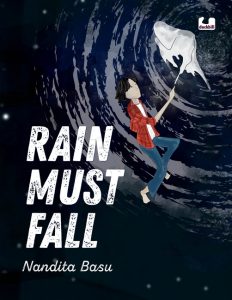
Rain Must Fall
Rain Must Fall || Nandita Basu
For Ages: 12+ years
Rumi is not too enthusiastic about accompanying Baba to the sleepy village of Shankerpur, where he is planning to convert their ancestral home into a bed and breakfast. But Rumi is happy to be away from school and friends who have problems understanding Rumi’s identity.
In the middle of one night, Rumi encounters a ghost–Rain, who does not remember his own story or why he is compelled to be a ghost. And it is in trying to help Rain find his peace, that sets Rumi on a journey of love, friendship and acceptance.
This is a tale of love and loss, of rejection and affirmation, and above all, the healing and illuminating power of friendship.
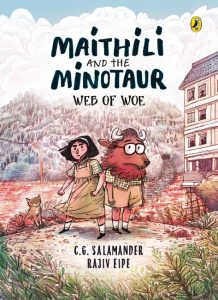
Maithili and the Minotaur
Maithili and the Minotaur || C.G. Salamander
For Ages: 10+ years
An outcast to the world of humans, Maithili lives in the outskirts of a magical wilderness. But as she makes new friends in the realm of monsters, she must learn to be careful because some monsters are just like humans: mean, nasty and out for blood.
Perfect for fans of Hilda and Arthur and the Golden Rope, join Maithili and the Minotaur on their very first adventure in an outlandish world where nothing is as it seems.
Naturalist Ruddy
Naturalist Ruddy || Rohan Chakravarty
Are you ‘Ruddy’ for adventure?
In the forests of central India, where teak meets sal and plateaus meet hills, natural history meets detective fiction in an inquisitive Ruddy Mongoose’s investigations. Join Naturalist Ruddy as he unearths some of nature’s most fascinating mysteries in this one-of-a-kind comic book set across India’s various natural habitats.
Amitav Ghosh is a name that needs no introduction, but being proponents of his literary art form, we find ourselves compelled to acquaint you with his life and accomplishments. For those who already know this, think of it as a refresher course.
Born in Calcutta during the summer of 1956, Ghosh spent his formative years hopping from place to place thanks to his father’s military background. He had the opportunity to experience living in Bangladesh, Sri Lanka and India. He studied at the Universities of Delhi and Oxford and has been awarded multiple honorary doctorates. In addition to these impressive qualifications, he has been the receiver of numerous awards, including the Jananpith Award, the highest and oldest literary award in the country.
He possesses the ability to spin words in ways that create the most captivating tapestries, often using ornamental English, elevating his literary works to what appears to be high art and literature. Though he does not confine himself to one genre, a theme that often appears in his work is that of untold histories, ones that no one else sought to pursue. This is what he does in his newest piece of writing, The Nutmeg’s Curse, where he reveals the profoundly remarkable ways in which human history is shaped by non-human forces.
Yes, we are all extremely excited about this book, but since we have to wait a few days before we can get our hands on it, here are a few (easy to obtain) Amitav Ghosh classics everyone ought to read!
~
Gun Island by Amitav Ghosh
Gun Island
Bundook. Gun. A common word, but one which turns Deen Datta’s world upside down.
A dealer of rare books, Deen is used to a quiet life spent indoors, but as his once-solid beliefs begin to shift and he is forced to set out on an extraordinary journey. A journey that takes him from India to Los Angeles and Venice via a tangled route through the memories and experiences of those he meets along the way. There is Piya, a fellow Bengali-American who sets his journey in motion; Tipu, an entrepreneurial young man who opens Deen’s eyes to the realities of growing up in today’s world; Rafi, with his desperate attempt to help someone in need and Cinta, an old friend who provides the missing link in the story they are all a part of. It is a journey that will upend everything he thought he knew about himself, about the Bengali legends of his childhood and about the world around him.
Gun Island is a beautifully realised novel that effortlessly spans space and time. It is the story of a world on the brink of increasing displacement and unstoppable transition. However, it is also a story of hope of a man whose faith in the world and the future is restored by two remarkable women.
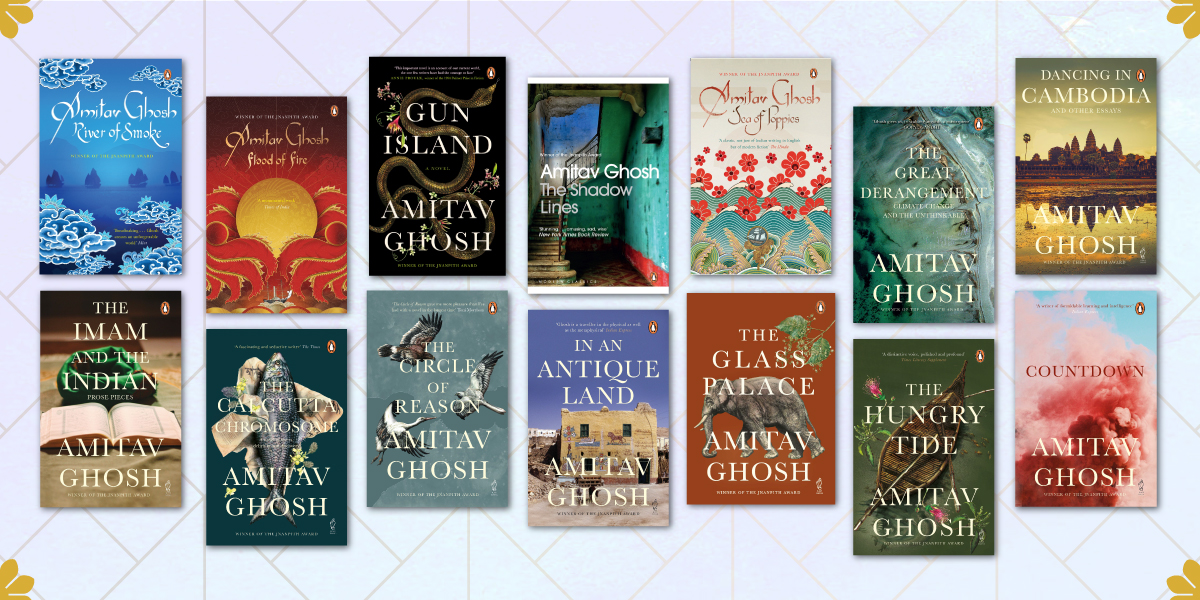
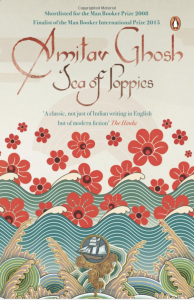
Sea Of Poppies by Amitav Ghosh
Sea Of Poppies
A motley array of sailors and stowaways, coolies and convicts is sailing down the Hooghly aboard the Ibis on its way to Mauritius. As they journey across the Indian Ocean old family ties are washed away, and they begin to view themselves as jahaj-bhais or ship brothers who will build new lives for themselves in the remote islands where they are being taken.
A stunningly vibrant and intensely humane work, Sea of Poppies, the first book in the Ibis trilogy, confirms Amitav Ghosh’s reputation as a master storyteller.
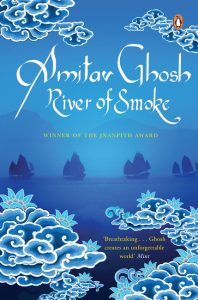
River of Smoke by Amitav Ghosh
River of Smoke
September 1838. A storm blows up on the Indian Ocean and three ships – the Ibis, the Anahita and the Redruth – and those aboard are caught in the whirlwind. River of Smoke follows the fortunes of these men and women to the crowded harbours of China where they struggle to cope with their losses – and for a few, unimaginable freedoms – in the alleys and teeming waterways of nineteenth-century Canton.
Written on the grand scale of a historical epic, River of Smoke, book two in the Ibis trilogy, will be heralded as a masterpiece of twenty-first-century literature.
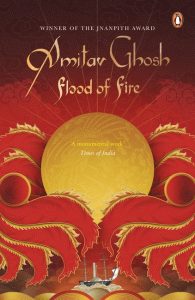
Flood of Fire by Amitav Ghosh
Flood of Fire
It is 1839. The British, whose opium exports to China have been blockaded by Beijing, are planning an invasion to force China’s hand. In Calcutta, Zachary Reid, an impoverished young sailor, dreams of his lost love and of a way to make his fortunes. Heading towards Calcutta is Havildar Kesri to lead a regiment of Indian volunteers in the upcoming war. In Mumbai, Shireen Modi prepares to sail alone to China to reclaim her opium trader husband’s wealth and reputation.
In Canton, Neel becomes an aide and translator to a senior Chinese official as Beijing begins to prepare for war with Britain and the more he sees, the more worried he becomes for the Chinese have neither the ships nor the artillery to match the British in modern warfare. The future seems clear but do the Chinese know it?
The Shadow Lines by Amitav Ghosh
The Shadow Lines
As a young boy, Amitav Ghosh’s narrator travels across time through the tales of those around him, traversing the unreliable planes of memory, unmindful of physical, political and chronological borders. But as he grows older, he is haunted by a seemingly random act of violence. Bits and pieces of stories, both half-remembered and imagined, come together in his mind until he arrives at an intricate, interconnected picture of the world where borders and boundaries mean nothing. They are mere shadow lines that we draw dividing people and nations.
Out of a complex web of memories, relationships and images, Amitav Ghosh builds an intensely vivid, funny and moving story. Exposing the idea of the nation state as an illusion, an arbitrary dissection of people, Ghosh depicts the absurd manner in which your home can suddenly become your enemy.
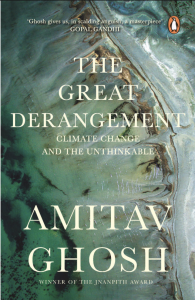
The Great Derangement by Amitav Ghosh
The Great Derangement
Are we deranged?
Amitav Ghosh, argues that future generations may well think so. How else can we explain our imaginative failure in the face of global warming? In this ground-breaking return to non-fiction, Ghosh examines our inability-at the level of literature, history and politics-to grasp the scale and violence of climate change. The climate crisis asks us to imagine other forms of human existence-a task to which fiction, Ghosh argues, is the best suited of all forms. The Great Derangement serves as a brilliant writer’s summons to confront the most urgent task of our time.
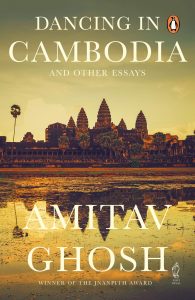
Dancing in Cambodia by Amitav Ghosh
Dancing in Cambodia and Other Essays
Through extraordinary first-hand accounts Amitav Ghosh presents a compelling chronicle of the turmoil of our times.
Dancing in Cambodia recreates the first-ever visit to Europe by a troupe of Cambodian dancers with King Sisowath, in 1906. Ghosh links this historic visit, celebrated by Rodin in a series of sketches, to the more recent history of the Khmer Rouge revolution.
‘The Town by the Sea’ records his experiences in the Andaman and Nicobar Islands just days after the tsunami; and in ‘September 11’ he takes us back to that fateful day when he retrieved his young daughter from school in New York, sick with the knowledge that she will be marked by the same kind of tumult that has defined his own life.
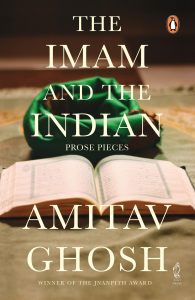
The Imam and the Indian by Amitav Ghosh
The Imam and the Indian
The Imam and the Indian is an extensive compilation of Amitav Ghosh’s non-fiction writings. Sporadically published between his novels, in magazines, journals, academic books and periodicals, these essays and articles trace the evolution of the ideas that shape his fiction. He explores the connections between past and present, events and memories, people, cultures and countries that have a shared history.
Ghosh combines his historical and anthropological bent of mind with his skills of a novelist, to present a collection like no other.
The Calcutta Chromosome by Amitav Ghosh
The Calcutta Chromosome
In this extraordinary novel, Amitav Ghosh navigates through time and genres to present a unique tale. Beginning at an unspecified time in the future and ranging back to the late nineteenth century, the reader follows the adventures of the enigmatic L. Murugan. An authority on the Nobel Prize-winning scientist Sir Ronald Ross, who solved the malaria puzzle in Calcutta in 1898, Murugan is in search of the elusive ‘Calcutta Chromosome’. With its astonishing range of characters, advanced computer science, religious cults and wonderful portraits of Victorian and contemporary India, The Calcutta Chromosome expands the scope of the novel as we know it, as Amitav Ghosh takes on the avatar of a science thriller writer.
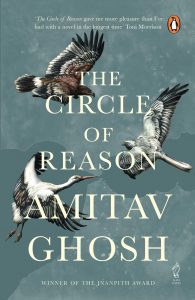
The Circle Of Reason by Amitav Ghosh
The Circle Of Reason
Following the form of the raga in Indian classical music, Amitav Ghosh slowly builds the tempo of The Circle of Reason. The first part spans several decades, the second unfolds over a few weeks, and the third, like a scherzo, races through a day. Ghosh’s debut novel centres on Alu, an orphan enlisted by his foster father as a soldier in his crusade against the forces of myth and unreason. Suspected of terrorism, they are about to be arrested when a tragic accident forces Alu to flee his village. Pursued by a misguided police officer, Alu finds his way through Calcutta to Goa and on to a trawler that runs illegal immigrants to Africa. Tracing Alu’s journey across two continents, The Circle of Reason is an exceptional novel by one of India’s most celebrated writers in English.
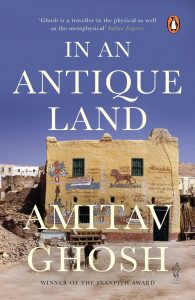
In An Antique Land by Amitav Ghosh
In An Antique Land
Packed with anecdotes and exuberant details, In an Antique Land provides magical and intimate insights into Egypt from the Crusades to Operation Desert Storm. It exposes the indistinguishable and intertwining ties that bind together India and Egypt; Hindus, Muslims and Jews.
By combining fiction, history, travel writing and anthropology, to create a single seamless work of imagination, Ghosh characteristically makes us rethink the political boundaries that divide the world and the generic boundaries that divide narratives.
The Glass Palace by Amitav Ghosh
The Glass Palace
Set in Burma during the British invasion of 1885, this masterly novel tells the story of Rajkumar, a poor boy lifted on the tides of political and social chaos, who goes on to create an empire in the Burmese teak forest. When soldiers force the royal family out of the Glass Palace and into exile, Rajkumar befriends Dolly, a young woman in the court of the Burmese queen, whose love will shape his life. He cannot forget her, and years later, as a rich man, he goes in search of her. Through this brilliant and impassioned story of love and war, Amitav Ghosh presents a ruthless appraisal of the horrors of colonialism and capitalist exploitation.
The Hungry Tide by Amitav Ghosh
The Hungry Tide
Between the sea and the plains of Bengal, on the easternmost coast of India, lies an immense archipelago of islands. Some are vast and some no larger than sandbars; some have lasted through recorded history while others have just washed into being. These are the Sundarbans. Here there are no borders to divide fresh water from salt, river from sea, even land from water. The settlers of the Sundarbans believe that anyone without a pure heart who ventures into the watery labyrinth will never return. Survival is an everyday battle for these people who have managed to strike a delicate balance with nature.
But the arrival of Piyali Roy, of Indian parentage but stubbornly American, and of Kanai Dutt, a sophisticated Delhi businessman, threatens to upset this balance. Kanai has returned to the islands on the request of his aunt, a local figure, for the first time since the death of his uncle, a political radical who died mysteriously in the aftermath of a local uprising. When Piya, who is on the track of the rare river dolphins, hires Fokir, an illiterate but proud local man to guide her through the backwaters, Kanai becomes her translator. From this moment, the tide begins to turn.
Amitav Ghosh has discovered another new territory, summoning a singular, fascinating place, another world, from its history and myth, and bringing it to life. Yet The Hungry Tide also explores another and far more unknowable jungle: the human spirit. It is a novel that asks at every turn: what man can take the true measure of another?
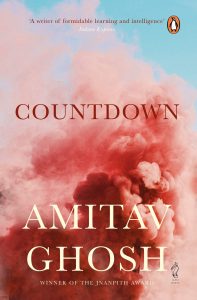
Countdown by Amitav Ghosh
Countdown
On 11 May 1998 the Indian government tested five nuclear devices some forty kilometers from Pokaran. Seventeen days later Pakistan tested nuclear devices of its own. About three months after the tests, Amitav Ghosh went to the Pokaran area, after which he visited Kashmir as part of the defense minister’s entourage. He also went to the Siachen glacier in the Karakoram Mountains where Indian and Pakistani soldiers have been exchanging fire since 1983. Ghosh then travelled through Pakistan and Nepal. Countdown is partly a result of these journeys and conversations with many hundreds of people of the subcontinent. In its description the book is haunting and evocative; and its analyses of the compulsions behind South Asia’s nuclearization, and the implications of this, are profound, deeply disturbing and, ultimately, chilling.
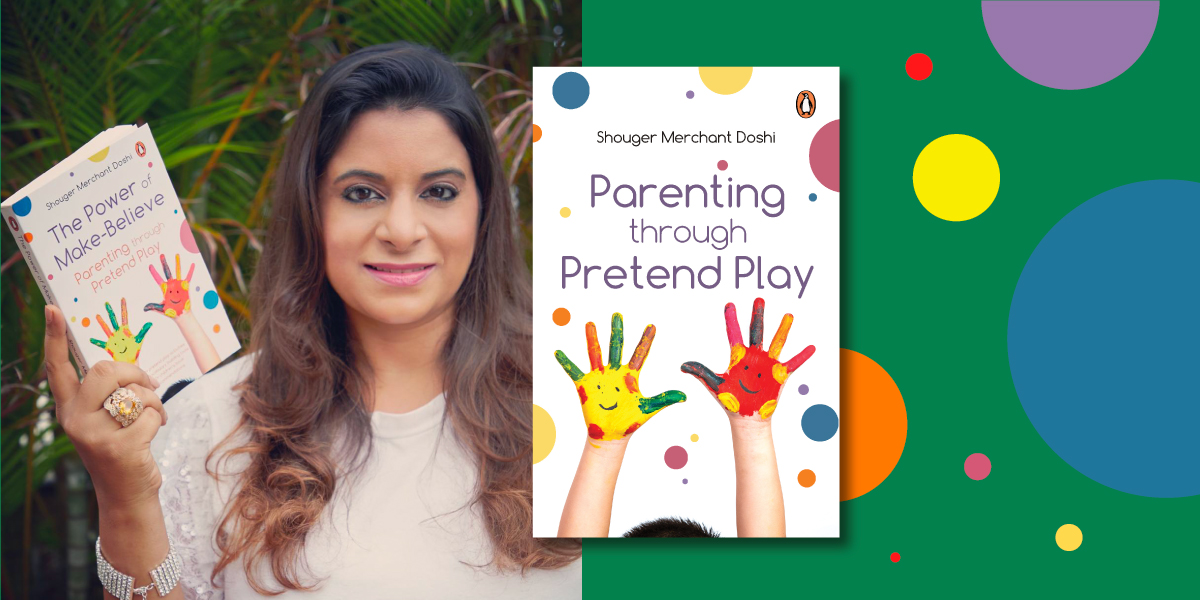
In a delightful conversation with the author of The Power of Make-Believe: Parenting trough Pretend Play, we asked questions about parenting, her inspiration to write the book, and how her book can be of help to modern parents.
Here’s what the author had to say!
The Power of Make-Believe || Shouger Merchant Doshi
What inspired you to write this topic?
I was inspired to write on this topic for several reasons. I definitely believe that the power of communication is one that has taken me far in life and the ability to speak well and write well is something that can benefit you in any given situation or in any career one may opt for. If there is one gift you can give your child – let it be that of a good vocabulary. And to engender that, I came up with fun ways to increase my communication with my son. Pretend play was one of the foremost ways to do that. I also felt like there wasn’t enough material out there on how play is so beneficial for children and how adults should engage in pretend play specifically with children. Moreover, I wanted to detail activities that I was doing with my son that were edutainment – educational but yet entertaining and the casual nature of it made it fun and light.
What research went into writing this book?
I researched lauded professionals and experts in the field and looked up important studies such as the Meredith Rowe study which details how the quantity and quality of words impact your child’s development and the Root-Bernstien study that shows a positive relation with creative performance when as a child you dwell in make-believe worlds. There is also substantial research to show a nexus between pretend play and higher academic / career achievement and accomplishment which I looked into and mentioned in the book to show mothers that play is as good, if not better than pedagogic learning.
You wrote, ‘Caring for a child is not an easy job.’ What gaps have you observed in the modern parenting style?
Being a parent is not easy – parenting involves many processes – you have a million tabs open in your brain and a million to-do lists. Caring for a child involves being a teacher, being a doctor, being a class monitor, playdate organizer, a driver, chef, student, playmate, nanny… and much much more. Needless to say, it takes up a lot of your brain space and time and sometimes we lose sense of ourselves. Many Indian mothers tend to believe that being there for their children at all hours of the day and maybe folding on their personal goals and ambitions is the best way to be present. I am of the opinion that one must receive a sense of self validation or achievement professionally or personally outside of being a mother or else one feels a shift in identity.
You mentioned in your book that ‘children need to develop a variety of skill sets to optimize the process of their growth.’ What, according to you, are the three most important life skills parents can inculcate during their children’s early development?
I think children learn their own set of skills and find out what they are good at over time. It is our job as parents to identify their strengths and help them hone those skills, should they be inclined. However, what is in our control is to ensure
a) independence and self-reliance,
b) enhanced communication skills (vocabulary and dialogue) and problem solving skills and
c) empathy, kindness and generosity (treating other children and adults well).
These are skills we can inculcate in our children through play, books and good conversation.
How do you think your book will help parents in the Covid-19 crises?
The Power of Make-Believe is about getting back to the basics. Through lockdowns and our children being unvaccinated, we are more at home now than we ever were. These activities are meant to be enjoyed and planned with excitement and the best part of all is the process not the outcome. I definitely think parents will enjoy the activities in the book and hopefully will take time out to do them. The curated books list at the end of the book is based on topics that you may want to have with your child such as racial diversity, cultural diversity, LGBTQ rights, acceptance of a sibling, nanny separation, and other such important topics. I feel a book can really help spark a good conversation between parents and child and the books mentioned are tried and tested by a bibliophile herself.