Publish with Us

Follow Penguin

Follow Penguinsters

Follow Penguin Swadesh

Yet another unjust ritual


On the third day after the death of Bangaravva, a solemn procession that made its way towards the graveyard encountered a strange obstacle. A blast of wind rose up in revolt, the embers flared and the sacred ritual fire fell to the ground. The ceremony was ruined because custom demanded that the ritual fire never touch the ground.

What followed was chaos and confusion. The people sought a sacrifice to bear the blame for things going awry, and a solution to set it all right. The division between castes and communities came to the fore as the panchayat struggled to pronounce justice.

A poetic work calling for change in our casteist society, Karya unfurls a kaleidoscope of perspectives. Studded with symbols drawn from nature and myth, this small but significant novel explores the politics and power embedded within a Dalit community.

Here’s a peek into the main action of the book.

~

Front cover of Karya
Karya||Aravind Malagatti

The men on the way to the karya stopped suddenly at the boundary stone as they reached the limits of the village. The women in the third group were still some distance away.

A buffalo was swimming in a tank within the bounds of the village. Akkavva, from among the women going to the karya, stopped in her tracks to gawk at it, even as she handed over her pitcher of water to another. Her face, screwed tight with weeping, filled out suddenly like a pumpkin, beaming. It was three months since she had lost that buffalo while grazing it and she had been fretting. Now, she recognized it by the ornamental tipcovers on its horns. For a moment, she thought of the dead Bangaravva and turned back to get her buffalo. Who

knows if it would come home on its own or not? Some of the women who had seen her, turned up their noses at her and walked on.

The men had the, ‘ask them to hurry up’ expression, aimed at no one in particular but as if surely meant for the one particular group that was lingering. Just that no one said it aloud. The women stepped up their pace. The woman who had taken the pot from Akkavva walked briskly, ahead of them all. The men stood facing the village, with their back to the boundary stone. Once water was poured over the stone, they continued on their way facing the graveyard. All of men had the same solemn expressions. The women followed them, matching their strides.

That was when they removed the fresh white cloth covering the kavala mora. Their faces perked up to see the crows that had followed them, thanks to the aroma.

The wind picked up as soon as they crossed the village. Even before this, smoke from the smouldering kullaggi in Mallappa’s right hand had touched the dung cakes in his left; turning some of them too to ash. Once they crossed the boundary stone, the front wind caused the smoking kullaggi to catch fire. To keep his fingers from burning, Mallappa kept moving them to safer spots on the berani and screaming for fresh ones, ‘Ei, this is hot! Give me some more.’

Their feet swallowed the distance. All at once, the men opened their mouths; they murmured:

‘Ei, don’t let the kullaggi fall.’

‘It shouldn’t touch the ground.’

‘It’s bad luck if it does.’

‘Don’t let it fall. Come what may. Control the blaze; don’t let it burn so bright.’

Some even tried to put it down. But the flame would not be subdued. A boy picked up a fistful of mud to throw at it.

‘Ei, into whose mouth are you trying to throw mud?’ shouted Shivappa, Bangaravva’s husband. The fingers of the fist that held the mud loosened slowly, on their own. Mud dribbled through as flour from a flourmill, all along the way. They were getting closer to the graveyard. Mallayya tried his

best to press the dung cakes against one another to control the fire. But the headwind was too strong.

‘Chikkappa, kullu!’ he shouted for dry dung cakes to his uncle, Chandappa.

His uncle had fallen behind. All eyes turned towards him even as their strides quickened. Chandappa, feeling their eyes, darted towards Mallappa.

‘Why, didn’t you bring enough?’ he asked.

‘I did . . . but they’re over . . . You said you’d bring some, didn’t you?’

‘I? When did I say that?’

Mallappa went cold. He broke out in a sweat. His mouth went dry.

‘What do we do now?’

‘We’ll do whatever. But don’t drop it.’

‘Chikkappa?’

‘Chikkappa, he says, Chikkappa,’ Chandappa muttered to himself. And then to the men around, ‘Ei, go and gather some kullu drying in the fields.’

Even before he could finish, a few youngsters jumped the fence and entered the field with a standing crop. But none of them returned. Everyone scolded Mallappa. Everyone cautioned him from letting the ritual fire touch the ground. More than anyone else, Chandappa kept at it. Mallappa’s hands trembled as the heat touched them.

‘Chikkappa—at least fetch a flat stone to place under the burning cakes,’ Mallappa screamed but his uncle showed no concern. He was waiting for those who had gone to get some dry dung cakes from the field. When Shivappa brought a flat stone to help Mallappa, he shouted at him,

‘Why, do you want to snuff out your progeny by blocking the fire with stone?’

‘Not just his offspring,’ added another elder, ‘Looks as if he wants to burn down his whole house.’ Then Shivappa remembered his only son, Suryakantha, the fruit of many vows to many gods. He was already nearly chest-high. Not willing to lose him, Shivappa did not let the stone fall gently

to the ground; he dropped it with a thud. It fell on his big toe and . . . blood flowed.

Mallappa, caught amid the words of caution from everyone, tried his best to put out the fire with his hands but in vain. Already the hair on his hands was singed. The flame was trying to burn them. He gasped, helpless. Tears ran down his cheeks. And, finally, when the burning dung cake scorched his iron-like hands, he screamed and let go of the kullaggi! He looked at his hands, sobbing. They were covered with blisters. He looked around at the others.

Their looks were like knives. Those who had gone to fetch dry dung returned with some. They looked from Mallappa to the burning kullu on the ground. The ash was blown away by the wind and sparks of fire flew from them, happy to have won!

Everyone stood silent for a while. The wind had lost its gusto. All those who had come to attend the karya felt the whole world had come to a standstill. They had even forgotten they were alive.

All this happened in just a few moments.

~

Karya is a depiction of the unfairness of certain customs and how they discriminate harshly, even in dangerous, but easily remedied situations against one section of individuals, the Dalit community.

The Hindutva movement trying to convert Ambedkar into a relatable symbol

Ambedkar was seen as a strong critic of the Hindu caste system by the radical Ambedkarite movement in India. He had once said that he was born as a Hindu but will not die a

Hindu. He was of the view that there is no escape from one’s birth-based caste location within Hinduism. Thus, he chose to convert to Buddhism in 1956, just a few months before his death. Inspired by him, a large section of Dalits also converted to Buddhism. One can observe the trend of adopting Buddhism among a section of newly educated higher and middle-class north-Indian Dalits. But during our fieldwork in the villages of UP and Bihar, we also observed that their conversion in terms of religious memories from Hinduism to Buddhism is not yet fully complete. Some of them still live with the memories of their Hindu beliefs and lifestyle, while their identity is Buddhist. They are still not able to stop themselves from celebrating some Hindu festivals and worshipping some Hindu deities along with revering Buddha and Ambedkar. During the wedding ceremonies of some of the neo-Buddhist families in the Hindi speaking regions, the worship of Ganesha and Buddha takes place together, and the icons can be seen next to each other on several wedding invitation cards. The case of Maharashtra may be different, but in many Hindi-speaking regions this phenomenon is common.

Republic of Hindutva
Republic of Hindutva| | Badri Narayan

The Hindutva movement, as led by the Sangh, is trying to convert Ambedkar into a relatable symbol for everyone by downplaying his critique of the caste system. They want to detach his persona that critiqued the caste system from the version of him that they have invented. Their strategies are twofold. The first is if all Hindus across castes start respecting Ambedkar, his critique of the Hindu religion can be sidelined from the memories of Dalits and other oppressed communities. Secondly, they are constantly trying to rebuild Ambedkar’s image based on a selective forgetting of his critique. His image is used as a brand icon for the samrasta campaign, as a part of the drive to assimilate Dalits into the Hindu fold. In order to attach the elements of divinity, rituals and worship to the image of Ambedkar, it is expedient for Hindutva forces to associate themselves with the symbolic power that lies within it. There are calendars and portraits of Ambedkar in many RSS offices. In their public programmes too the portrait of Ambedkar occupies centre stage. The BJP government also took various steps to prove that they pay more respect to Ambedkar’s memories, symbols and memorials than done by the Congress government during its rule. For instance, it turned five places in Delhi, Mumbai, Nagpur, Mhow and London connected with Ambedkar into pilgrimage spots. The government of Maharashtra purchased Ambedkar’s house in 2015 in order to create a memorial museum to him. Modi inaugurated the memorial on 14 November 2015. He had earlier laid the foundation stone for the Dr Ambedkar International Centre in Delhi on 20 April 2015.


In addition, the Sangh is constantly responding to changes in the Indian socioeconomic landscape ushered in by economic liberalization and to the new technologically constructed public sphere. As it forges its relationship with modernity, democracy, the market and new technology, and evolves under their influence, it is using all the fruits of modernity in its functioning. With smartphones, social media sites and online media, the RSS is working creatively and channelling traditional resources of Indian society for its new mobilizational politics.

‘Please, don’t. I am scared’ – The painful world of IVF clinics

Detailing the difficulty of undergoing infertility treatments, What’s a Lemon Squeezer Doing In My Vagina is a nuanced, heart-breaking and heart-warming work on the indignities of medical procedures, the precariousness of motherhood, and what this means to women. In this excerpt, Rohini Rajagopal talks about one of her Intrauterine insemination sessions.

~

I heard of ‘artificial insemination’ for the first time in a Malayalam movie when I was eight or nine years old. It was Malayalam cinema’s cult classic Dasharatham (1989), which was so ahead of its time that even now I am not sure if its time has come. A leading mainstream actor, Mohanlal, plays a rich, spoilt man-child who decides to act on a whim and have a child through surrogacy. He finds a desperate woman who needs money for her ailing footballer husband’s medical treatment and agrees to rent her womb. They draw up a contract, turn up for the procedure, and fifteen days later she is pregnant! No failed attempts, cancelled cycles or any other complications. With this movie lodged in my brain for reference, I thought fertility treatments were an easy-peasy lemon-squeezy affair. To be fair to the movie, it is not about infertility. It’s about a healthy, fertile couple who use artificial insemination for conception. It may well have happened that quickly and effortlessly in real life too. But the movie glosses over the unseemliness and hardships of the treatment. For those who have seen the movie, I hate to burst your bubble. Welcome to the world of ART.

Front cover What's A Lemon Squeezer Doing In My Vagina
What’s A Lemon Squeezer Doing In My Vagina||Rohini S. Rajagopal

I began our first IUI in July 2011 with the earnestness of a debutant, expecting early and prompt success… The procedure itself was relatively simple with only a few key steps. The first step was pills to stimulate my ovaries to release multiple eggs. The second was follicular study. Follicles are tiny fluid-filled balloons in the ovaries that function as the home of the egg. They may expand from the size of a sesame seed (2 millimetres) to the size of a large kidney bean (18 mm to 25 mm) during the course of the menstrual cycle, eventually bursting to push the egg out. The follicles are measured at regular intervals during a cycle to ascertain if they have matured and are ready to release the egg. This is done through a transvaginal ultrasound (TVS).

I was not a big fan of TVS. It involved insertion of a long, slim plastic probe into my vagina and twisting it around to get a close look at the uterus. Magnified images of the uterus appeared on a computer screen. I was appalled the first time when the doctor covered the transducer with a condom and dipped it in lubricating gel, indicating that it had to enter an orifice in my body. I thought that scans, by definition, were non-invasive. It caused some discomfort, but it was not very painful. Eventually, I learnt to relax my muscles and spread my legs far apart to make things easier. I wished I didn’t have to get a TVS, but if I had to then I could tolerate it.

The cycle got off on the wrong foot from the very beginning. The first ultrasound showed only one big-enough follicular blob (at 13 mm). The other four or five follicles were too small, indicating they might not reach maturity. This meant I might have only one egg despite taking drugs to stimulate the release of many.

…It was a busy day at the hospital for Dr Leela, who was swamped with several emergency C-sections. I sat alone in the deserted waiting hall of the IVF clinic, biding my time. Other patients had left after their ultrasounds in the morning. No one else was lined up for a procedure.

…Finally, at around one, Dr Leela came and apologized for the delay. I was taken to the operating room, asked to remove my leggings and empty my bladder. I lay down on the bed and pulled a sheet over my naked legs. A tray of surgical instrument kits was placed on a stand next to the bed. I kept my fingers crossed, hoping there would be no speculum.

Dr Leela began briskly tearing the kits open one by one and getting ready for action. When she pulled out the speculum, I lost my nerve. The thin mask of composure I was wearing until then crumbled. I sprang up and held back her hand desperately.

‘Please, don’t. I am scared.’

As soon as I said it, I regretted it. What was I thinking? It was a meaningless request. And Dr Leela had no patience for such trembling and dithering. She was not known to offer empty, placatory words, ‘It’s okay. Just relax. It will not hurt you.’ My protest was an annoying interruption and she reacted sternly.

‘Take your hand off. I don’t need it here.’
The room became tense.

…The ninety seconds it must have taken to fix the speculum and inject the semen were excruciating, and not just because of the physical hostility of the act. Not just because it felt raw or sore or I was bleeding. But because it was a breach of my already fragile self. It tore through the membranes of my defences, leaving me exposed and helpless.

In a few minutes, it was over and the doctor left. The stainless-steel tools were taken out by the nurses. The housekeeping staff cleaned the floor. The room became empty again. The pounding in my heart ceased. I rested in the metallic stillness of the operating room for thirty minutes, drove home, ate my lunch and went to sleep.

That IUI was an eye-and-mind-opener of the path ahead. An IVF clinic is a cold place to walk into. It doesn’t matter which IVF clinic you go to. There might be a difference in degree, but the air is still chilly and biting. You must shed your inhibitions, modesty and fears quickly because the most crucial part of fertility treatment involves lying on your back, knees bent, legs wide open, while probes, catheters and lemon squeezers are thrust inside your vagina by professionals whose day job this is. What you need is the stance of a warrior, not the long-suffering bearing of a patient.

~

Years later, I am just a few weeks away from going into labour. Ranjith’s mother and I are alone at home. We are having a woman-to-woman conversation about the trials and tribulations of bringing a human into this world. We discuss pregnancy scans and the improvements in technology since her time. She speaks about her own repulsion and discomfort during an internal examination, which was necessary in her days when ultrasounds were not as prevalent.

She asks casually, only half-asking, but mostly reconfirming, ‘You’ve never had an internal examination, alle?’

I gasp and mumble something to the effect of, ‘Yes, I have.’ But the truth is, there was no short answer to that question.

~

What’s a Lemon Squeezer Doing In My Vagina opens up a discussion that we are hardly willing to have, sensitising us to the physical and emotional toll that medical procedures and social scrutiny take on women.


10 tips to invest better the Coffee Can Investing way

Most people usually invest in the same four to five assets: real estate, gold, mutual funds, fixed deposits and stock markets. All they end up making is a measly 8 to 12 per cent per annum. Those who are exceptionally unfortunate get stuck in the middle of a crash and end up losing a lot of money. But what if there was another way?
In the book, Coffee Can Investing, Saurabh Mukherjea along with Pranab Uniyal and Rakshit Ranjan show us how to make low-risk investments that generate great returns.
Here are 10 tips from the book to help you invest better.
————–

The three critical rules of working as a consultant

Management consulting is seen as a glamorous profession. But behind the mystique are the consultants who put in extraordinary effort, cultivate great problem-solving skills and display fine personal attributes to capture the attention and respect of their clients.

The Mind of a Consultant opens up that world to the readers through the story of Samantha Thomas, a character modelled on many excellent consultants, who gives us a glimpse of what goes on inside the mind of a consultant.

Here is an excerpt from when Samanta is an intern and learns the three critical rules of working as a consultant.


‘Is the presentation ready?’ Hamid was unapologetic in his question.

It was 2 a.m. Samanta had been working for more than eighteen hours straight on the presentation for the client leadership team that was to be presented the next day. She was expected to be part of the presenting team alongside Hamid, the project manager and partner who owned the account. Hamid was six years her senior and from the same institute she was attending. He was highly respected by his colleagues and the project team members looked to him for guidance.

She thought back over the past few weeks, remembering the first day she had arrived at Pinnacle for her internship. It was like a dream come true. Her first official day as an intern at Pinnacle. She, along with thirty-five fellow interns from some of the best management institutes in the world, had been participating in the internship orientation. Two of the senior partners and a few engagement managers who could make it were part of the two-day programme.

While partners spoke about the culture and the attributes of great consultants, the engagement managers were more operational. They spoke about the tools and the support that were available to interns. They shared Pinnacle’s knowledge base, along with templates for ppts and Excel sheets, which were life-savers for the interns when they started out.

At the end of the second day, the interns were provided with laptops and their project assignments. Samanta was assigned to a large organization-transformation project in the retail industry. The organization was exploring strategies to enhance growth and increase efficiency amid changing industry dynamics. Her project manager for the assignment was Hamid. At the time, Hamid was participating in more than half a dozen similar assignments worldwide. He was always up to date on the latest happenings in the industry and often considered an expert in the field.

The first time Samanta and Raghav, a fellow intern, met Hamid to work on the project, he came across as passionate and knowledgeable. It was obvious that he was an accomplished consultant.

‘I want you guys to challenge me,’ he told them. ‘it’s important that you get a head start and not waste time doing things that don’t matter to this project.’

He gave them presentations and materials to read, a brief on the client requirements and the names of some resources in the firm that he thought could be helpful.

‘Get ready to fly out tomorrow to meet the client,’ he said. ‘We’re having meetings with some of the key management team members before doing a few store visits to understand their set-up. You need to be up to speed on everything that we know about the client by then.’

One thing Samanta learnt from Day One was that consulting constantly needed one to learn and travel. That was the best part about being at Pinnacle. It treated its team members as star talent, and believed that its people could figure out a way to deliver on even the toughest assignments.

Samanta and Raghav spent their time leading up to their trip reading more on the retail industry in general and the company in particular. Pinnacle had some wonderful case studies and industry knowledge available that they found helpful. There were different terminology and business metrics that Samanta and Raghav had never encountered before, but Hamid encouraged them to learn all of it, and learn it well.

‘You don’t want to be seen as novices. You should be able to ask and understand questions in areas that are relevant even to the CEO.’

The following day, Samanta, Raghav and Hamid started on their trip to see the client. Samanta had been told that she was lucky to be doing her first project with Hamid, so she took advantage of the uninterrupted cab drive to ask him questions. there was one in particular she couldn’t help asking.

‘How did you earn so much respect from your peers?’

Hamid raised his eyebrow at her, a smile on his face. Samanta shifted uncomfortably in her seat. She was probably the first intern to ever ask him that.

Hamid gave a short laugh at her discomfort before answering. ‘How do you think, Sammy? And you too, Raghav.’ Samanta thought for a moment. There were several possible reasons, or, more likely, a combination of several of them.

Raghav chimed in first. ‘Maybe hard work? or domain knowledge?’

Samanta nodded. She had been thinking along the same lines. She added her own thoughts. ‘I would think project-management expertise would have something to do with it. Is that part of the reason?’

Hamid nodded and smiled. ‘All of those are correct, but there are three main rules I live by in this firm.’ he held up his fingers as he counted them off.

‘Rule 1: strive for knowledge.

‘Rule 2: build your best coalition.

‘Rule 3: Always be ahead of the client.

‘Each of these is critical when working as a consultant.’

The Mind of a Consultant hands you all the tools necessary to build a successful professional career in an easy-to-understand manner.

How infidelity unravels

Sometimes when you’re desperate to leave the past behind, the past is eager to catch up!

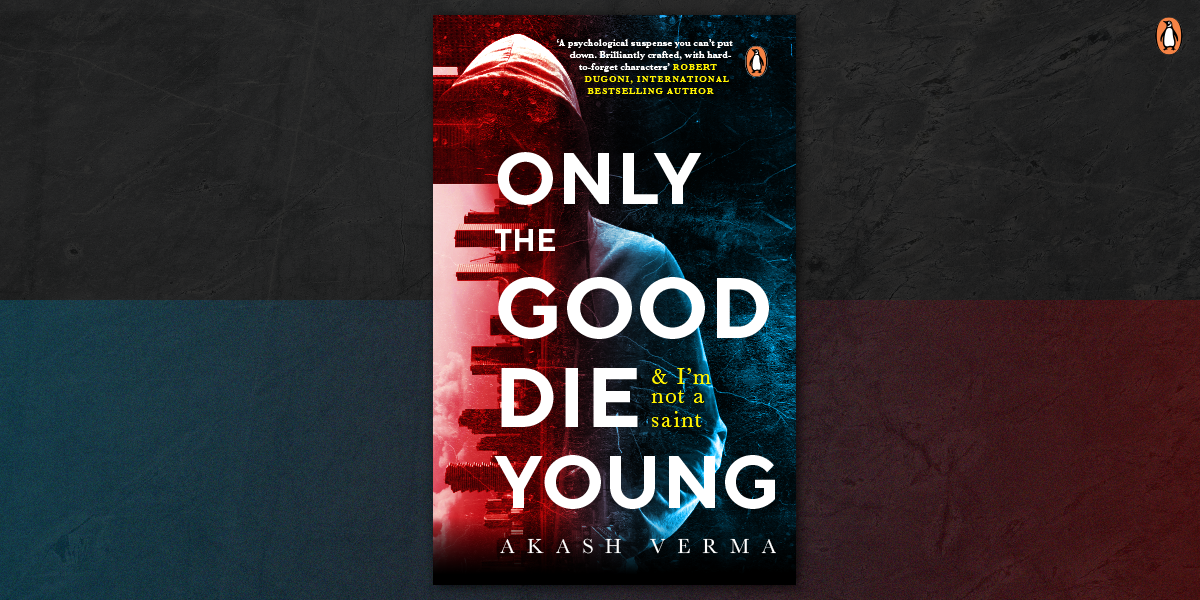
Anuradha leaves Gurgaon when Dhruv chooses his family over her. She thinks that chapter of her life has ended, and starts afresh in Mumbai. But strangely, it seems her past is trying to catch up. Dhruv suddenly comes back into her life. Even as they try to figure out their relationship, horrible things start happening to people they know. Together, Anuradha and Dhruv need to find out who it is that cannot bear to see them together. Who is carrying out these shocking crimes? Are they really soulmates cursed to stay apart, or is there some karmic debt they have to repay?


Read on for a look at the psychological aftermath  of an extra-marital affair


Only The Good Die Young | Akash Verma

Mumbai has unnerved me every single time I’ve set foot here in the last few months. It wasn’t like this before. It used to be like any other city. Just that I frequented it more as my advertising agency, C&M, is headquartered here. But now, since you have been here for about a year, coming to this city has never been the same. Work still brings me here—a couple of times a month at least—for a sales review or a client meeting. But every time I am here, I feel like running to you first, clasping you to my chest and not letting you go. Yes, that’s what I still feel, Anuradha, after pushing you so far away from my life. The first few months after you left were tough—to come to work each day with you not being in office; to live without you in Gurgaon; not hearing your voice; and not feeling your touch. Despite having Shalini and the kids back in my life, there was this one large gash in my heart. However hard I tried, it refused to heal. It stayed there, untended and bleeding. My head feels heavy with the weight of a sack inside it.. ‘“Don’t do it!” didn’t we warn you?’ the pebbles inside the sack which rests in my head scream in unison. ‘You can’t love two people at the same time.’ ‘I didn’t do it knowingly. It wasn’t in my control,’ I protest. ‘Oh, come on! Liar, liar, pants on fire!’ squeals one. ‘You had a rock-solid marriage, a lovely family. Didn’t you know what you were getting into?’ ‘I know. All my fault. I thought I could handle it. I loved them both, you know. I just couldn’t stop.’ One of the pebbles has a throaty voice. It’s smaller than the rest. ‘Look where this “love” has led you to. No one’s happy. Neither Shalini, nor you and I guess not even Anuradha.’ ‘Well, who knows?’ I say. ‘Maybe she has found someone. Why “maybe”? I am sure she has someone in her life by now. She is young, beautiful, successful . . . she can easily be happy. Don’t you think so?’ The pebble glances at me, scrutinizing me. ‘Yes . . . maybe. Will you be happy if she has found someone?’ I clear my throat, ‘Why not? Yes.’ ‘Sure?’ I nod. ‘Yes. I will be happy as long as she is.’ ‘Do you want to meet her?’ the pebbles chorus. ‘No. It’s over, isn’t it? Why would I want that?’ ‘Ah, come on,’ one of them says. ‘It’s what you want the most. To meet her. Isn’t it?’ I fumble for an appropriate answer. Unsuccessful. I go quiet, then. The plane has landed. I get out of the airport and spot the driver holding a placard with my name on it. I purse my lips and force a smile; a familiar weakness sweeps over me. He signals to me to wait and hurries off to get the car when I nod. I glance at the passengers leaving the airport, people gathered around the arrival gate, greeting incoming passengers: relatives and friends. I wish you too were here, waiting for me, Anuradha . . .Such feelings seem even more unreal after the way our relationship ended. But then how is one supposed to conceal one’s true feelings from oneself? How can I hide that I love you? Even after you lied to me. Even after I promised my wife, Shalini, that our affair happened in the heat of the moment and was well over. How can my feelings for you ever cease to exist? Maybe I really am the asshole that the people I love think me to be. Shalini and you. Maybe I don’t deserve love from either of you. My relationship with my wife will never go back to what it was. I have done enough to scar it and I don’t know if those scars will ever fully disappear. ‘We have struck a compromise for our children, Dhruv,’ was what Shalini told me at the dinner table one day when the kids were asleep. ‘It can never be the same again,’ she had said. Shalini is a headstrong, self-made woman who sticks to her word in her personal life as much as she does when treating her patients.


COVID-19 : The past and the future

Anirban Mahapatra’s COVID-19 is a meticulous dive into the pandemic that changed the 21st century world. In this excerpt, he delves into what the future could look like, and what kind of a situation we’re likely to have on our hands in the near future:

~

Envisioning what the future holds in store is like imagining what dry land is like while in a storm in the middle of the ocean. Even in the best of times, predicting the future is a risky enterprise. A devastating pandemic of this scale and severity imposes additional challenges because we have no reference point in the modern era for something like this. Off-the-cuff comments may be forgotten but writing tends to stick around and haunt the writer. If you’re too certain with your pronouncements, you’re almost certain to be wrong. If you’re too vague, no one will read what you have to say.

We are only coming to terms with the direct fallout of the pandemic, but what will be the ramifications for long-term health and planning? What will be the implications for travel, for immigration and for commerce? Will countries continue to look inward once the pandemic is over?

Certain aspects of human life and society have changed due to the immediate effects of the pandemic. It is possible, therefore, to make short-term predictions. What will happen five, ten, or fifteen years down the road because of the ongoing, cataclysmic event and our responses to it are more difficult to say.

Will there be more public interest in interest in infectious diseases and medicine? Will it become a field that attracts more of the brightest minds as engineering, information technology, finance and business management have in preceding decades? Will physicians take up more active roles in framing public policy? Will economists stress-test catastrophic economic events of this nature?

Human societies are designed to maximize connections. Over the course of a day, most of us have dozens of close interactions with other people. The design of cities, buildings, jobs, transportation and commerce keeps the human need for connection in mind more than the rare threat of a disease that spreads by human-to- human interaction.

Front cover COVID-19 Separating Fact from Fiction
COVID-19||Anirban Mahapatra

What can we say looking at the past? Based on a study of the H1N1 influenza pandemic of 1918, the historian Nancy Bristow writes, ‘If history is any guide, not much will change in the wake of the COVID-19 pandemic.’4 Yet, it is impossible to use history as guide, because the world has changed immensely in a century. In 1918, viruses had not been characterized. Colonial powers ruled the world and were in the middle of World War I. Commercial airline travel was non-existent. There was no Internet to allow the lay public to read research articles immediately and view daily statistics on illness and death.

… We can assume that the pandemic will irrevocably change some business practices. There will be more people working from home permanently and less business travel to meet clients and for conferences. Technological solutions that were embraced perhaps with a bit of trepidation during the pandemic will become wider habits.

Distancing is challenging in factories, warehouses, prisons, airplanes, dormitories and ships where space is maximized. Due to a premium being put on space in cities and the density of population, buildings have grown vertically. Property values have risen globally since the Great Recession. Gentrification had led to a return to economically disadvantaged areas. It is possible that there will be a reshaping of how urban spaces are used, with more people now moving outward instead of flocking to New York, Mumbai or London. But the experience of Hong Kong, Taiwan and Tokyo in the first year of the pandemic has demonstrated that even within densely populated cities, measures can be taken to keep infections low. There may be a reshaping of urban societies, but it is still too early to tell. People tend to go where there are economic opportunities.

More broadly, will humans finally address the pressing problems of the day which the pandemic brought into stark relief?

Problems of inequality, poor access to healthcare and economic opportunities, and lack of equal rights are prevalent globally.

The pandemic allows humans to face difficult challenges that we have been ignoring, instead of denying or downplaying them. It gives us a chance to reframe priorities and reimagine society.

As humans we tend to focus on immediate problems. Our ancestors were good at hiding from tigers and other dangerous animals, finding caves to sleep in when it was raining, and building a fire when it was cold. Longer-term planning for problems does not come easily. This is applicable to both people individually and to us as a species.

… We keep asking ourselves, ‘When will the pandemic end?’ But we can’t mark the end as the date when it is over only for those of us who are privileged. We know that the biological pandemic will end one day. What we must also ensure is that there is an end to the social one.

~

COVID-19 is an excellent and insightful read. Anyone can read this book, and everyone should read this book.


The Absence of Adolescence

Writer – politician Muthuvel Karunanidhi is amongst the most important political leaders India has ever seen. In Karunanidhi: A Life, author A.S. Panneerselvan tells the story of the man who became a metaphor for modern Tamil Nadu, where language, empowerment, self-respect, art, literary forms and films coalesced to lend a unique vibrancy to politics.

Here is an excerpt from the chapter titled, The Absence of Adolescence.

Karunanidhi
Karunanidhi A Life || A.S. Panneerselvan


Like many underprivileged children, karunanidhi’s life moved straight to adulthood from childhood, bypassing the phase of indulgent adolescence. The politicization that began with the anti-Hindi agitation and exposure to the literature of the Self- Respect Movement propelled karunanidhi into becoming an activist right from his days in the second form. The police excesses and the custodial deaths of two anti-Hindi agitators, Thalamuthu and natarajan, had a profound impact on the young karunanidhi.


The late 1930s witnessed varied crises for all the political players: the imperial government was getting ready for the Second World War; the great Depression and its fallout was taking its toll; Mahatma gandhi’s supremacy was challenged within the Congress by the election of Subhas Chandra Bose as the party president for the second time; and the Left was emerging as a distinct political force with its leaders gaining a hold over decision-making in both the Congress as well as other popular fronts. There was also a shift in Dravidian politics with the leadership moving from the wealthy section among the non-Brahmins to Periyar and Annadurai.


The twists and turns of the Left’s mobilization need elaboration in order to understand how, despite its revolutionary aura, karunanidhi remained with the Dravidian Movement’s social reform agenda. in his essay, in the January–March 1984 issue of The Marxist, E.M.S. namboodiripad points out that when the Congress Socialist Party was formed in 1934, the Communist Party of india initially branded it as Social Fascist. With the Comintern’s change of policy towards the politics of the Popular Front, the indian communists’ relationship to the inC witnessed a reversal. The communists joined the Congress Socialist Party (CSP), which worked as the left wing of the Congress. Once they had joined, the Communist Party of india (CPi) accepted the CSP demand for the Constituent Assembly, which it had denounced two years before.1


in July 1937, the first kerala unit of the CPi was founded at a clandestine meeting in Calicut. The five persons present at the meeting were E.M.S. namboodiripad, krishna Pillai, n.C. Sekhar, k. Damodaran and S.V. ghate. The first four were members of the CSP in kerala; ghate was a CPi Central Committee member, who had come from Madras. Contacts between the CSP in kerala and the CPi had begun in 1935, when P. Sundarayya (Central Committee member of CPi, based in Madras at the time) met with EMS and krishna Pillai. Sundarayya and ghate visited kerala several times and met with the CSP leaders there. The contacts were facilitated through the national meetings of the Congress, CSP and All india kisan Sabha.


in 1936–1937, the cooperation between socialists and communists reached its peak. At the second congress of the CSP, held in Meerut in January 1936, a thesis was adopted which declared that there was a need to build ‘a united indian Socialist Party based on Marxism-Leninism’. in kerala the communists won control over the CSP, and for a brief period controlled the Congress there.2


While the Congress in kerala had a distinct leftward tilt, in Tamil nadu it was virtually under the conservative leadership of stalwarts such as C. Rajagopalachari and S. Satyamurti.


Thiruvarur became a microcosm of the play of these multiple forces. Smitten by Periyar’s radicalism and Annadurai’s eloquence, karunanidhi began devouring the entire oeuvre of Dravidian literature. Periyar had already published the Tamil version of The Communist Manifesto in 1937; a number of serious political publications were being published from various parts of the state. Periyar’s Kudiarasu (The Republic) was the key vehicle for dissemination as well as articulating new ideas and planning political mobilization towards an egalitarian society.3


While Muthuvelar and Anjugam were rejoicing at their son’s tireless learning, little did they realize what he was reading about. Textbooks were last on karunanidhi’s reading list. The extensive literature in politics was revelatory for young karunanidhi. For the first time, he realized that he too had two priceless possessions—his oratory and his pen. His first public speech was a clear pointer. it was a school competition. And karunanidhi decided to make a mark. He looked at some of the redeeming features of the so-called villains within Hindu mythology. karunanidhi spoke at length about the friendship between karna and Duryodhana—a friendship that cut across both caste and class.


The speech was well-received, and the teachers developed a new respect for their wayward student. But, what they did not know was the effort that went behind this oratory. karunanidhi worked on the text of the speech for nearly a week; rehearsed the speech frequently before the mirror; changed the words, similes and metaphors to get the rhythm that would alter the art of public speaking in Tamil forever.


He also created his own publication—Maanavanesan (Friend of students). A handwritten fortnightly of eight pages in demy size that dealt with a range of issues—from questioning orthodoxy to exploring the poetics of early Tamil. He and his friends would make about fifty copies of the magazine and circulate it for a modest fee that managed to just cover the cost of the paper. Years later, when i met him at Murasoli along with Kungumam editor Paavai Chandran for a short interview for the Illustrated Weekly of India, karunanidhi said the handwritten journal was a great learning experience. ‘We could not afford to make any spelling mistakes or grammatical errors. A single mistake meant rewriting fifty copies. The sheer labour of correcting made me write a very clean first draft, without any corrections or overwriting,’ he recalled. He also took pains to mail a copy of the magazine to the leaders of the Self-Respect Movement.


But not all of karunanidhi’s icons were happy with the handwritten magazine. Bharathidasan, the well-known poet and a life-long supporter of the Dravidian Movement and karunanidhi, called it a waste of time and effort. He told karunanidhi: ‘The madness of expecting changes from handwritten publications can only be compared to the madness in thinking that development will happen due to spinning charkhas.’


Muthuvel Karunanidhi was ardent as a social reformer and unrelenting as an opposition leader. To read more about him, his life and his work, get your copy of Karunanidhi: A Life.

Battling Infertility and what they don’t tell you

What’s a Lemon Squeezer Doing in My Vagina? is a witty, moving and intensely personal retelling of Rohini’s five-year-long battle with infertility, capturing the indignities of medical procedures, the sting of prying questions from friends and strangers, the disproportionate burden of treatment on the woman, the everyday anxieties about wayward hormones, follicles and embryos and the overarching anxiety about the outcome of the treatment.


Here is an excerpt from the chapter where she first encounters a lemon squeezer.


I heard of ‘artificial insemination’ for the first time in a Malayalam movie when I was eight or nine years old. It was Malayalam cinema’s cult classic Dasharatham (1989), which was so ahead of its time that even now I am not sure if its time has come. A leading mainstream actor, Mohanlal, plays a rich, spoilt man-child who decides to act on a whim and have a child through surrogacy. He finds a desperate woman who needs money for her ailing footballer husband’s medical treatment and agrees to rent her womb. They draw up a contract, turn up for the procedure, and fifteen days later she is pregnant! No failed attempts, cancelled cycles or any other complications. With this movie lodged in my brain for reference, I thought fertility treatments were an easy-peasy lemon-squeezy affair. To be fair to the movie, it is not about infertility. It’s about a healthy, fertile couple who use artificial insemination for conception. It may well have happened that quickly and effortlessly in real life too. But the movie glosses over the unseemliness and hardships of the treatment. For those who have seen the movie, I hate to burst your bubble. Welcome to the world of ART.

I began our first IUI in July 2011 with the earnestness of a debutant, expecting early and prompt success. I had not dealt with sickness or physical incapacity in any significant manner until then, being blessed with a constitution that rarely fell prey to illness. I sailed through ten years of school without any noteworthy episodes of fever. My haemoglobin level typically hovered near the fourteen mark. When Ranjith caught the swine flu, despite my being in close contact with him my natural immunity provided the necessary shield against the deadly virus. My good health was my secret pride and I had taken it for granted all my life, expecting the body to tag along in whichever direction I pulled it. Therefore when we started treatment I anticipated the same level of responsiveness and performance from it. But for the first time, my body, specifically the reproductive apparatus, proved to be a terrible let-down, insolently ignoring my instructions.

The procedure itself was relatively simple with only a few key steps. The first step was pills to stimulate my ovaries to release multiple eggs. The second was follicular study. Follicles are tiny fluid-filled balloons in the ovaries that function as the home of the egg. They may expand from the size of a sesame seed (2 millimetres) to the size of a large kidney bean (18 mm to 25 mm) during the course of the menstrual cycle, eventually bursting to push the egg out. The follicles are measured at regular intervals during a cycle to ascertain if they have matured and are ready to release the egg. This is done through a transvaginal ultrasound (TVS).

I was not a big fan of TVS. It involved insertion of a long, slim plastic probe into my vagina and twisting it around to get a close look at the uterus. Magnified images of the uterus appeared on a computer screen. I was appalled the first time when the doctor covered the transducer with a condom and dipped it in lubricating gel, indicating that it had to enter an orifice in my body. I thought that scans, by definition, were non-invasive. It caused some discomfort, but it was not very painful. Eventually, I learnt to relax my muscles and spread my legs far apart to make things easier. I wished I didn’t have to get a TVS, but if I had to then I could tolerate it.

The cycle got off on the wrong foot from the very beginning. The first ultrasound showed only one big-enough follicular blob (at 13 mm). The other four or five follicles were too small, indicating they might not reach maturity. This meant I might have only one egg despite taking drugs to stimulate the release of many.

In the next ultrasound, my ovarian plight did not show improvement. The lead follicle was still only at 15 mm (way below the 18 mm mark of maturity) and the others had not grown at all, looking like they were giving up on ovulation altogether.

There were no outward symptoms to show if the follicles were fattening or dying (this is true for most reproductive processes). So at every ultrasound I went in expecting miracle growth, only to be told that my seeds were lagging poorly behind. I felt helpless at the response from my body because there was nothing I could do to expand the follicles. If it were an outwardly manifest condition I could have applied my inner reserves of resolve and determination to improve the outcomes, in the same way that I would do daily exercise and physiotherapy to regain strength in an injured leg. But my action, or inaction, had no bearing on the ungovernable follicles.

We waited a couple of more days and did a third ultrasound. This time the news was worse. The lead follicle had ruptured; it hadn’t waited for the others to catch up or even to reach its own full maturity. There was nothing left to do but to hurriedly put the sperm inside the uterus since an egg (presumably underdeveloped) had arrived and was waiting. The sperm transfer was scheduled for the same day.

what’s a lemon squeezer doing in my vagina | Rohini S. Rajagopal

I rang up my manager and said I would be taking the day off to address a personal emergency. An hour later, Ranjith drove in from his office to give a semen sample. He came in, gave the semen sample and left. He did not stay any longer because he had meetings that could not be rescheduled at such short notice.

I had come to the clinic at eight in the morning assuming I would just pop in for the ultrasound and pop out. An easy day with only the bother of TVS. But when I heard that I would have to stay back for the IUI, I inwardly experienced a mini-heart attack. Early on, while describing the procedure, Dr Leela had mentioned that the sperm would be injected inside the uterus using a catheter. Having heard the words ‘inject’ and ‘catheter’ in conjunction with my vagina, I thought it best to look up the process in detail on the Internet. One of the first search results showed that during an IUI the doctor uses a ‘speculum’ to pass the catheter into the uterus. It was a surgical instrument inserted inside the vagina or anus to dilate the area and give the doctor a better view. I did a quick search on Google Images to know what it looked like. The photos that flashed on my screen sent ripples of shock through

my system. It looked like the stainless-steel lemon squeezer found in a kitchen. It was made of metal and about the same size as the kitchen tool. It had two blades to widen and hold open the vagina and a third handle with a screw to lock the instrument into place.

What’s a Lemon Squeezer Doing in my Vagina offers a no-holds-barred view of Rohini S. Rajagopal’s circuitous and highly bumpy road to motherhood.

Jude Sequeira’s drunken escapades in Bombay’s Orlem

Philomena Sequeira knows what she wants by the time she turns fourteen. Her father wants something else. Her neighbours deal with adultery, abandonment and abuse, by hoping for a place in heaven.

Life is unyielding for the tenants of the rundown Obrigado Mansion in Orlem, a Roman Catholic parish in suburban Bombay. They grapple with love, loss and sin, surrounded by abused wives and repressed widows, alcoholic husbands and dubious evangelists, angry teenagers and ambivalent priests, all struggling to make sense of circumstances they have no control over.

Gods and Ends takes up multiple threads of individual stories to create a larger picture of darkness beneath a seemingly placid surface. It is about intersecting lives struggling to accept change as homes turn into prisons. This is a book about invisible people in a city of millions, and the claustrophobia they rarely manage to escape from.

**

The well appeared to have been there forever, sunk into the earth at a time when there couldn’t have been too many people around to use it. And yet, as any careful observer might have noticed, it had once been cared for, its sides carefully scoured, solid stone steps marking circles as they disappeared into its gloomy depths. Until the outer wall collapsed, sliding slowly into the murky green water, there may have been a few informal meetings held nearby. Some of the early residents of Orlem may well have stopped to chat around it on sunny mornings, to discuss dissolute husbands or the latest scandal from the goan villages they came from, while stooping down to draw water.

On the night of 24 December, only one voice was heard. It was between 1 and 2 a.m., and the water lay undisturbed, its opaque surface broken only by lethargic leaves slipping, sliding, gliding down from laburnum trees looming darkly above and around the well. The only other sound came from an unsteady stream of urine pattering down, over the ruined edge, through a space where the wall once stood.

front cover of Gods and Ends
Gods and Ends || Lindsay Pereira


‘Come from England, come from Scotland, come from Ireland,’ the voice slurred tunelessly. ‘Looking out for a pleasant holiday? Come to Bombay, meri hai.’

Jude Sequeira pissed his cares away. He was dimly aware about urinating into a source of drinking water for some of his neighbours, but was too drunk to care. The half bottle of cheap whisky he had consumed lay volatile in his stomach, warming him, while making his head swim ever so gently. The song he was singing continued to pour out of him, its lyrics a jumble. After singing it twice, he looked up and stopped in awe. Above him, in a hole cut out through the trees that formed a canopy, a few stars twinkled brightly. He couldn’t remember the last time he had seen stars.

Smiling to himself, he shook his penis half-heartedly, the last few drops wetting his toes. As he tried to zip up, something caught his eye. A mouse? A cat? Swaying slightly, he turned. There was a sudden moment of clarity when he recognized the figure standing before him. His lips moved as he struggled to articulate something that seemed to be just out of reach. Teetering for a few seconds, suddenly on the brink of sobriety, he slipped. The splash echoed briefly before receding into the night. The waters closed over, stifling a scream before it reached his throat. As he went down, Jude found the name he was looking for.

On the ground above, all that remained were his slippers: a pair of grimy Bata chappals, their blue straps long faded. In time, a milky sun rose, its appearance heralded by noisy sparrows.

**

error: Content is protected !!