Publish with Us

Follow Penguin

Follow Penguinsters

Follow Penguin Swadesh

Why are so many Indian women out of the labour force?

Promises of gender equality and justice have been made, repeatedly. They have failed repeatedly. The roots of misogyny form the foundations of our civil society, and the essays in Her Right to Equality raise crucial questions about the status of gender equality in our country. It scrutinizes institutions that are meant to safeguard the rights of women and minorities, and sheds light on the colossal amount of work that needs to be done. This is an excerpt from the volume:


A great deal of focus in this discussion is on the decline. However, an equally (if not more) important issue is the persistently low level of women’s LFPR in India, lower than our other South Asian neighbours, Bangladesh and Sri Lanka. In joint work with Naila Kabeer, we explore factors that shape the low level. Our results are based on a large primary household survey in seven districts in West Bengal. We collect data on all the indicators included in the official surveys, and on additional variables that are usually not included in surveys. Since we wanted to focus on which specific internal constraints inhibit women from working, we asked specific questions on whether they were primarily responsible for childcare, for elderly care, for standard domestic chores (cooking, washing clothes, etc.), and if they covered their heads/faces always, sometimes, or never. The latter is taken as a proxy for cultural conservatism; indeed, internationally, the fact of women covering their faces in public spaces is often criticized as an oppressive practice. Of course, the context in the West is different in that covering heads/faces is associated with being Muslim. In India, the practice is followed by both Hindus and Muslims, and in recognition of that, we label it more broadly as ‘veiling’, and not as wearing a burqa or hijab. We implemented simple changes to the official survey questionnaires in order to get better estimates of women’s work that lie in the grey zone. Accordingly, our estimates are higher than official estimates, but even with improved measurement, a little over half (52 per cent) get counted as ‘working’. Which means that participation in work is low, even after work in the grey zone is included.


The Critical Role of Domestic Chores

front cover Her Right to Equality
Her Right to Equality||Nisha Agrawal

We then investigated the main constraints to women’s ability to work. Our main findings were that women being primarily responsible for routine domestic tasks such as cooking, cleaning and household maintenance, over and above the standard explanations in the literature (age, location, education, marriage and so on) as well as elderly care responsibilities, lowers their probability of working. If domestic chores emerge as an important determinant of women’s labour force participation, after controlling for the standard explanatory factors, the question that arises is this: to what extent do the low LFPRs found in India in particular, but in South Asia and MENA (Middle East and North Africa) countries more broadly, reflect international differences in women’s involvement in housework? There is some indicative evidence that indeed, in these regions, women spend more time on unpaid care work, broadly defined (including care of persons, housework or other voluntary care work), relative to a range of other developing and developed countries in the world. According to OECD (Organisation for Economic Cooperation and Development) data, in 2014, the female-to-male ratio of time devoted to unpaid care work was 10.25 and 9.83 in Pakistan and India respectively—the two countries with the lowest female LFPRs within South Asia—compared to 1.85 in the UK and 1.61 in the US. Factors traditionally viewed as cultural norms that constrain women’s participation in paid work, such as the practice of veiling or adherence to Islam, are insignificant in our analysis after the conventional variables have been accounted for. Given that the primary responsibility of domestic chores falls on the woman, we suggest that the conventional definition of cultural norms needs to be revised and shifted to focus on the real culprit, viz., the cultural norm that places the burden of domestic chores almost exclusively on women.


Is There an Unmet Demand for Work?

Do women really want to participate in paid work, or have they either internalized the male breadwinner model which relegates them to take care of the home and the family? What about the ‘income effect’, according to which women work only if necessary for economic reasons, and withdraw from work as soon as they don’t need to? What about the marriage penalty, that is, women dropping out of the labour force once they are married? Thus, women’s work might be a sign of economic compulsions of trying make two ends meet rather than an expression of their desire for economic independence. We explore the evidence for this in our survey. Married women are less likely to be working than unmarried women, but marriage in India is near universal (making marriage the most common career choice for women), and asking women to choose either marriage or paid work is not a fair or realistic choice. We asked women who were currently not working if they would accept paid work if it was made available at or near their homes; 73.5 per cent said ‘yes’. When questioned further, 18.7 per cent expressed a preference for regular full-time work, 7.8 per cent for regular part-time work; 67.8 per cent for occasional full-time work and 5.78 per cent for occasional parttime work. It would appear that there was indeed a major unmet demand for paid work, whether regular or occasional, full-time or part-time, as long as the work in question was compatible with their domestic responsibilities. Based on this, we suggest that being out of the labour force is less a matter of choice for large numbers of women, and more a reflection of the demands of unpaid domestic responsibilities.

~

Her Right to Equality is an urgent and meticulous study of how far we have come in terms of gender justice, and how far we need to go.


The dirty trail of money

While much has been read and said about Vijay Mallya and his constant hide-and-seek with government authorities, details remain either inaccessible or too obfuscated. Escaped is a deep dive into the deeds and misdemeanours of the magnate, and what lies beneath the scaffolding of a billionaire-gone-wrong. Here is an excerpt:


The more famous pad of the Mallyas is the palatial country house in Tewin village, Hertfordshire, 20 miles north of London. The quintessential English village dates back to the Anglo-Saxon times, boasts of a picturesque countryside rich in flora and fauna and has a population of barely 2000.

Mallya’s property Ladywalk was previously owned and occupied by Anthony Hamilton, father of F1 champion Lewis Hamilton, and hence has always been the cynosure of all eyes in the sleepy village.

Though not much is visible from the main entrance, a public footpath runs around the property, providing an unrestricted view of the enormous spread that includes the main house Ladywalk and a lodge called Bramble Lodge with plenty of land for Mallya’s five dogs — Bichon lapdogs Elsa and Daisy, golden retrievers Luna and Bella and a St Bernard called Spirit — to play chase.

Security at Ladywalk is a priority and several CCTV cameras are in operation 24×7 at various entry and exit points along the periphery of the extensive property. Guards, dressed in black and armed with iPads and binoculars, are ever vigilant, and more so for snoopy scribes.

The large modern house sits on 30 acres of land and boasts of swimming pools, tennis courts and several outhouses. The two-year renovation of the property saw a continuous flow of architects, landscape artists, builders and gardeners. But what the locals most look forward to is the plethora of supercars that take to the narrow roads leading to Queen Hoo Lane. A sure sign that the party king is at home!

Front cover Escaped
Escaped||Danish Khan, Ruhi Khan

The story begins on 11 June 2014. This property was already on the market through estate agents Savills and Knight Frank with at least one prospective buyer lined up. Mallya paid Hamilton a visit, instantly fell in love with the property and immediately made an offer. An offer that Anthony Hamilton could not refuse. So desperate was Mallya to make this his new home that a written agreement between the two was signed that day, thus sealing the fate of this property.

Interestingly, this agreement specified the ‘Buyer’ as: ‘Dr Vijay Mallya and/or, Miss Leena Vijay Mallya, Miss Tanya Vijay Mallya, Mr Siddhartha Vijay Mallya OR to his/their order’. Mallya’s Cornwall Terrace address in London was listed as the residential address. The deal was signed for a whopping £13 million and strangely no deposit was taken by Hamilton on that day.

On 11 June 2014, Anthony Hamilton signed as the ‘seller’, witnessed by Force India’s Deputy Head Robert Fernley, and Mallya signed the agreement under his own name as a ‘buyer’, witnessed by his chartered accountant Dr Lakshmi Kanthan.

The only signature on the preliminary agreement under the ‘buyer’ was that of Mallya.

None of his children had accompanied him to view the property and there is no evidence to suggest that they were aware that they were put as buyers then or had authorized Mallya to purchase the property on their behalf.

This property has all the hallmarks of being owned and occupied by Mallya. A fleet of supercars making their way down the drive, hordes of people descending to party all night long and a constant delivery of goods and services.

Yet when we dig deeper into the ownership, Vijay Mallya is a phantom lurking everywhere yet really nowhere.

Ladywalk is propped up on a complex structure of ownership that defines the existence of many such marquee properties in the UK.

Mallya has never disputed claims that he bought his new family home with the intention of securing it for his son and two daughters.

Though he has often nonchalantly challenged reporters to prove that the Ladywalk property was bought by him through ill-gotten money.

If one can lawfully hide the real ownership and flow of funds, why wouldn’t billionaires exercise the option and bask in the security this provides them?

~

Danish Khan and Ruhi Khan’s book is going to keep you at the very edge of your seats.

Poetry for a broken world

In times of darkness, there has and will always be poetry. Ranjit Hoskote’s Hunchprose is an intimate crafting of vulnerability, beauty, and the feeling of estrangement that accompanies long durations of social anxiety. Here is an excerpt from the eponymous poem, and a few others:


Hunchprose

He calls me Hunchprose but what’s a word

between murderous rivals?
Across from me he strops his fine blade

smooth talker barefaced liar pissfart

teller of tall tales who wraps you up
in his flying carpet serves you snake oil
carries off the princess every time.
And I what can I offer you except
fraying knots coiled riddles scrolled bones
keys to doors that were carted away by raiders

betrayed by splayed light and early snow.
Lost doors I could have opened with my breath.
Call me Hunchpraise. I bend over my inkdrift words.

And when I spring back up I sting.


Sidi Mubarak Bombay
(1820–1885)

I should go home now, but I forget where that is.


A child, I was sold for a length of cotton and hammered into a link in a

chain of caravans. Taken across the sea in a dhow. The Arab slavers had

been generous with the whip. The Gujarati merchant who bought me

had a sense of humour. He called me Mubarak, Blessed.


Many years I worked for him in Bombay. City of opium warehouses.

City of cotton godowns. City of spice stores. City of jahazis, munshis,

khalasis, sarafs, bhishtis, sepoys that was the only family I knew. So I

called myself Bombay.


My seth died, leaving instructions that I was to be freed. I went back

to Zanzibar and built a house. In Bombay I was a Sidi, a man from

the Zanj, a man the colour of night. In Zanzibar I spoke Gujarati,

Hindustani, two words of English. Stuttered in Kiswahili. But this

new–old country spoke to me in rhymes of soil, sand, river, jungle. It

brought me gold. Coral. Also pearls.


Speke Sahib, Bwana Speke, wanted me to be his guide. Then Burton

Front cover Hunchprose
Hunchprose||Ranjit Hoskote

Sahib came. Bwana Burton. Then Bwana Stanley. Bwana Speke was

looking for the source of the Nile. So were they all. I was their compass

and their sextant. With them, I looked for the source of the Nile.


Once, we nearly died. As if the journey was cursed. Burton Sahib

vomiting all the time. Bwana Speke going blind, his eyes gummy and

swollen with too much dreaming. At last, Ujiji. The lake rippled from

one end of the world to the other. Wide as a sea cradled in a giant’s

palm. God forgive us, we tried to cross it. Bwana Speke lost his hearing.

A beetle had crawled into his ear. What afrit possessed him I don’t

know, but he tried to get it out with a knife. No boats large enough to

cross that lake. Later, I crossed Africa from coast to coast. Walked more

than any other man alive. Logged six thousand miles, most of it on foot,

match that if you can. Sometimes donkeys.


Long after I left Bombay and went back to Zanzibar, its smells followed

me. Freshly chopped garlic, fenugreek, heeng, pepper, cinnamon,

bombil drying in a sharp wind. ‘Bombil,’ I would say to myself, sitting

on my stoop, looking across the sea, rolling the syllables in my mouth.

‘Bombil, surmai, bangda, rawas.’ The masala-thick pungency of one fish

after another after another would settle on my tongue. My neighbours

must have thought I was chanting spells.


Voice

I’d snatched at every straw
and thought you’d got it right at last:

                swallowing swords
when you could so easily have been

                    sewing buttons

I should have told myself:

                  Be careful what you wish for

before you stropped yourself

into a voice

            that could call down rain
rap out commandments

            needle the air with prophecies

            or draw it into a bowstring

            snatch breath away


Why did you call down
this darkness on yourself?

Where
in this garden of unsealed tombs

                                         did we lose our serenades?


Jallianwala Bagh and the 102 years of its history

V.N. Datta’s book remains relevant and immediate to this day. While his research documents the events of the Jallianwala Bagh massacre, its history, context and aftermath, it also reveals the failure of larger institutions of power and control. Here is an excerpt from the introduction to the 2021 edition:


In April 2019, 100 years after the massacre, the nation remembered Jallianwala Bagh as a major historical event in the long tale of Indian nationalism and independence. Jallianwala Bagh has become an integral part of the grand saga of the nation’s history. Yet, not all local memories match the prevailing narrative; and here Datta’s book reminds us not to be swayed by the nationalist frenzy.

As preparations were underway for the centenary commemoration, I walked into Jallianwala Bagh intending to unearth its hidden histories. I met a Sikh policeman at the gate who led me to the narrow ‘Historical Lane’ to the Bagh. He told me that Dyer had brought guns and troops through this constricted passage to shoot at the innocent crowd that had assembled in the Bagh on 13 April, the day of the Baisakhi mela, which is celebrated with much fanfare in Punjab. ‘There were no exit points,’ he says. ‘People in panic ran to the walls to escape. They jumped into the khoo [well].’

While in the Bagh, I was taken over by mixed feelings. It looked like an insignificant garden with some old trees abutting the residential buildings at the back. However, there was something eerie about the place. The very ordinariness of the site was almost shocking in view of the violence that occurred there. Of course, there are commemorative structures that are not ordinary. To the right is the amar jyoti, the eternal flame. The pedestal is inscribed with the words Vande Mataram, praise to the motherland. There is also an old samadhi with a dome. At the centre of the Bagh stands an impressive oblong-shaped cenotaph. And to its right is the deadly khoo. Further down is the passage to the Martyrs’ Gallery and a museum. The bullet-ridden wall represents the horror that occurred here. The gaping marks are a tragic testimony to Dyer’s savagery in the Bagh. They are all too visible. The plaque says,

The wall has its own historic significance as it has thirty-six bullet marks which can be easily seen at present and these were fired into the crowd by the order of General Dyer. Moreover, no warning was given to disperse before Dyer opened fire which [sic] was gathered here against the Rowlatt Act. One Thousand Six Hundred and Fifty Rounds were fired.

…The Bagh shapes a national memory and constructs a national past through a patchwork of myth and history, fact and fiction. As Madan Lal Vij, the city’s historian, told me, ‘After the kand [scandalous episode], Jallianwala Bagh became a historic garden and a national memorial.’ The city’s local tragedy is fashioned as a national crisis through the idea of shahadat, martyrdom. A white flame-like sculpture stands with faces of martyrs and all their names engraved below. The compound surrounding Jallianwala Bagh is today part of a larger heritage area that includes the Golden Temple and the old Town Hall. The Congress narrative, as shown on the plaque, forges a direct connection between the massacre and the Rowlatt Act.

Front cover Jallianwala Bagh
Jallianwala Bagh||V.N. Datta

The construction of a definitive history in Jallianwala Bagh obfuscates the complex truths of the massacre, which contain unresolved contradictions and ambiguities. One such ambiguity is the nationalist attempt to establish an unmediated relationship between the crowd in the Bagh and the anti-Rowlatt Act protests. However, the irony is that to present the crowd as agitators alone would authenticate the claims of Dyer and official histories and do an injustice to the plural memories and differentiated experiences of the victims. I asked the locals to share their memories. ‘It was a random crowd, some were playing cards, others had come to celebrate the Baisakhi mela,’ says the octogenarian Om Prakash Seth from Katra Ahluwalia. ‘It was not a political meeting,’ adds Trilok Chand, one of the oldest booksellers at Hall Bazaar. Udham Singh’s history in the Bagh presents yet another dilemma. It is doubtful whether he was ever present in the Bagh at the time of the massacre. Doubtless, Jallianwala Bagh is primarily dominated by the story of Gandhi’s satyagraha and Udham Singh’s martyrdom.

The tailored history of the Bagh tends to ignore the diverse echoes and voices. We know little about the people who were in the Bagh and what they were up to. Popular memories too are shifting. Dyer’s shooting is no longer central to their recollections. People feel excluded from the mainstream history of Jallianwala Bagh. The locals see themselves as victims of a state that has let them down consistently since 1919.

…My journey to Amritsar tracing the memories of Jallianwala Bagh was greatly enriched by Datta’s insights and revelations. Even after the 100th year of commemoration, his work becomes all the more immediate. As a historian writing in the 1960s, his crafting of an intricate narrative and analysis of 1919, uncomfortably entangled with local and national histories, is no mean feat. Recognized as a classic across the global community of scholars, V.N. Datta’s Jallianwala Bagh deserves a wider readership for generations to come.

Some books never cease to remain relevant. Jallianwala Bagh is one such.


Sanskrit love poetry at its peak

Amaru Shatakam is a collection of a hundred love lyrics. It is regarded as the greatest of such works in ancient Sanskrit.

Little is known of the poet Amaru, except that he could put the emotions of a whole poem into a single stanza. More than a thousand years old, each of these verses gives vivid glimpses of human love in quite a modern manner.

The love these lyrics picture, has physical, emotional as well as social aspects. Delightful or  painful, it is felt by women as well as men.

To give readers a feel of these sensitively drawn portraits of love, in separation and loss, in desire and fulfillment, here are a few samples of these Amaru lyrics.


A first look


Your gaze is languid, soft with love,

you shut your eyes repeatedly,

and open them for just a moment

to stare or shyly dart a glance

full of some inner feeling.

Say, young lady, who is he,

that lucky man you are looking at ?               (4)


A first query


‘You simple girl, do you intend

to be so naive all the time?

Compose yourself and mind your honour,

don’t be artless with your lover’.

Thus advised by friends, the maid

with a timorous look replies:

‘Hush! Softly! My lord may hear you,

he is here within my heart.                             (70)


Lover to beloved


‘Beautiful, give up your pride.

Look at me, I’m at your feet.

You’ve never been so cross before’.

By her loved one thus addressed,

she cast a glance from half-closed eyes,

she’d many tears, said not a word.                 (39)


A memory of love

When to the bed my lover came,

my skirt not opened by itself,

I held the string, but the dress slipped off

with just a bit left on my hips.

That is all I know, dear friend,

for when he took me in his arms,

who was he and I myself,

or what we both then did together,

I can’t at all remember.                                  (101)


Another memory#

Somehow, in a play of pique,

I told him to get out, and he

hard-hearted, just left the bed

and walked away abruptly.

His ardent feelings seem at an end,

but my shameless heart still yearns

for that callous spoiler of our love,

O good friend, what shall I do?                      (15)


Once again


They were on the same bed,

but lay back to back,

distressed,and they did not speak,

though conciliation with each other

was in the heart of both,

they preserved their dignity.

Than,gradually, the couple turned

heir eyes on one another:

their quarrel gone, and with a laugh,

they embraced each other.                              (23)


N.B. Numbers at each verse end refer to the book as a whole.

Clash of the opposites

Avni believes true love is a myth. Unlike her gregarious Punjabi parents, she prefers to live in her own little world and wants nothing more than to be left alone with her books for company. When she comes across her new neighbour Sidharth, she is irked by his behaviour. A fun and outgoing Gujju boy, Sidharth is everything Avni detests. As fate would have it, he is instantly drawn to her on their first meeting. But Avni wants nothing to do with the boy who seems to be ruining her chances of securing the top position in college. A series of miscommunications makes Avni believe the worst of Sidharth, further ruining his hopes of ever having a chance at love.

Can’t Quarantine Our Love is an epic love story of two neighbours with a twist of fate that puts everything they know to a heartbreaking test. Here’s an excerpt from the book!

**

Sometimes life throws things at you that are way beyond your control. Sidharth chose to stay silent and not react to Avni’s slap. He knew he was equally at fault. But he had to face the heat from the head of the department who had asked him to bring his parents to college the next day or else he would get suspended.

When he reached home, he barely interacted with anyone and went straight to his room and locked himself in. He wanted to spend some time just by himself and his thoughts. He felt anxious thinking Avni would never talk to him again and that it was perhaps over before it could even begin. Adding to his anxiety was the fact that he had to tell his mother about what had happened. He didn’t know how to bring it up and called Bani for advice.

‘My mom will kick me out of the house if she finds out what happened,’ Sidharth said.

Bani tried to calm him down with an idea. ‘Dude, do not tell your mom anything. I know someone who can come to college as your fake dad. He had acted as my fake dad in the twelfth standard when my parents were hauled up for my low attendance. No one will come to know, trust me. We can pay him with bottles of his favourite alcohol.’

‘That’s asking for more trouble. If I get caught, I’ll get screwed,’ Sidharth replied. He wasn’t too enthused about the idea. ‘I shouldn’t have got drunk. It’s all your fault. You pushed me to keep drinking. And I lost control.’

‘Yes, and I also pushed you to dance with Avni without her permission, right?’ Bani replied.

‘Anyway, I think I have no choice.’

Sidharth hung up and stepped outside his bedroom. His grandfather was watching a reporter screaming on the top of his lungs on a prime time news show, unaware that Sidharth had some breaking news of his own.

‘Mom, I need to talk to you.’

‘I am busy right now, can’t you see?’ his mom said as she kneaded the dough for dinner.

But Sidharth pleaded with her and she finally stepped out of the kitchen, washing her hands in the basin on her way out. Nana knew something was up, and switched off the TV. As she stepped closer, his mother finally saw the bruises on his face. She panicked and rushed towards him.

front cover of Can't Quarantine Our Love
Can’t Quarantine Our Love || Sudeep Nagarkar


‘What happened? Is everything okay?’ she asked worriedly.

Nana walked towards him to inspect the bruises more closely. ‘Did something happen in college?’

Sidharth didn’t know what to tell them. He looked down, unable to make eye contact. He knew what would follow but somehow he gathered courage and spoke up.

‘Mom, the thing is that today in college . . . we had a freshers’ party and . . .’

‘Come straight to the point. Did you pick up a fight with someone?’

How should I tell her? If I tell her about Avni, she’ll take an avatar of Kali Ma. I better stick to the fight. ‘Actually, I got into a fight with some seniors, and the professors saw it. They’ve called you to college tomorrow to meet the HOD.’

I want to tell her the entire episode. Why am I focusing on just the fight that happened after the party? If she comes to know about Avni tomorrow, she’ll be even angrier. No . . . I can’t tell her. I’ll think of a more plausible explanation tonight.

His mom was devastated. He was half expecting her to slap him blue in the face, but she just stood in her place looking zapped. Sidharth could see tears in her eyes. He looked at Nana, who was his usual cool self.

‘Mom, I am sorry.’ He thought of telling her the whole story but just couldn’t find the courage to do so.

His mother finally spoke up. ‘Didn’t I tell you that you have responsibilities? Do you know the amount of effort we are making so that you can get the best education? And how are you repaying us for it? It’s hardly been a few days since college started, and look at you! These years will decide the course of your life.’

Damn, why are all parents as dramatic as a Sooraj Bharjatiya movie?

**


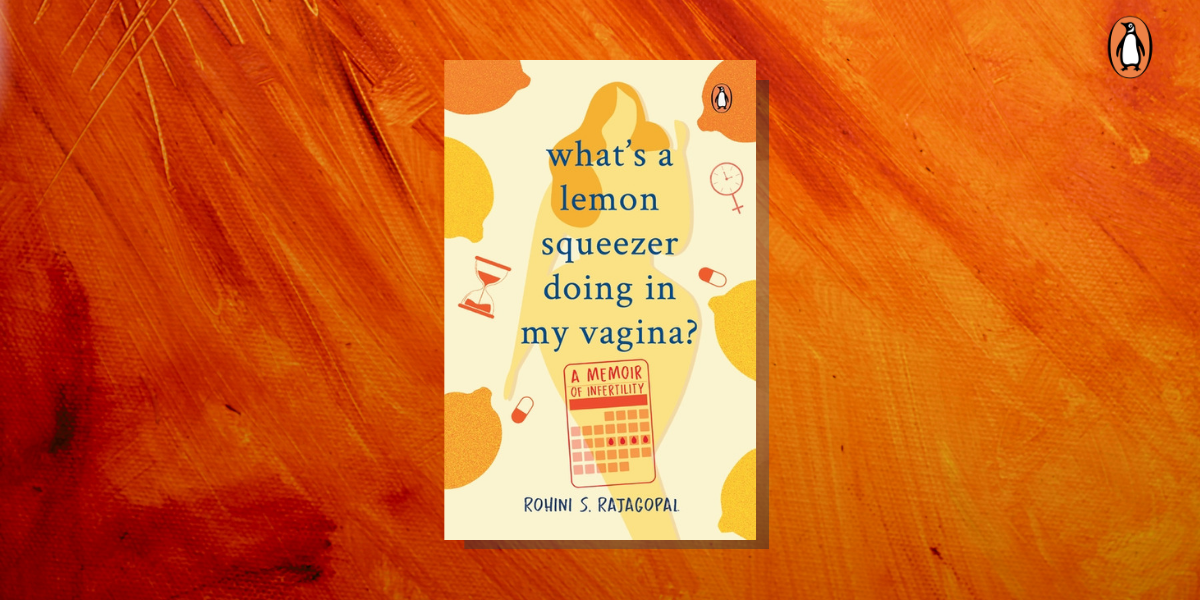
A witty, moving and intensely personal retelling of a woman’s battle with infertility

When Rohini married Ranjith and moved to the ‘big city’, they had already planned the next five years of their life: job, home, and then child. After three years of marriage and amidst increasing pressure from family, they decided to seek medical help to conceive. But they weren’t prepared for what came next-not only in terms of the invasive, gruelling and deeply uncomfortable nature of infertility treatment but also the financial and emotional strain it would put on their marriage, and the gnawing shame and feeling of inadequacy that she would experience as a woman unable to bear a child.


What’s a Lemon Squeezer Doing in My Vagina? is a witty, moving and intensely personal retelling of Rohini’s five-year-long battle with infertility, capturing the indignities of medical procedures, the sting of prying questions from friends and strangers, the disproportionate burden of treatment on the woman, the everyday anxieties about wayward hormones, follicles and embryos and the overarching anxiety about the outcome of the treatment. It offers a no-holds-barred view of her circuitous and highly bumpy road to motherhood.It was 8 a.m. on a Saturday and the reception area was already packed with couples at various stages of treatment. As first-time visitors, we paid the registration fee and went into a consultation room. A bespectacled, presumably junior consultant motioned us to sit down and began inquiring into our condition, reading out queries from a four-page data sheet in her hand and filling it in as the Q&A progressed.


There were questions on our medical history, the nature of my menstrual cycle, our lifestyle, hereditary diseases and, of course, the most critical query: how long we had been trying to conceive. That probably did not tick all the boxes, so what followed was a point-by-point probing of our sex life.


‘How often do you have intercourse?’
‘Once or twice a week.’
‘When was the last time you had intercourse?’
‘Last Sunday.’
‘Have you experienced any sexual dysfunction?’
‘No.’
‘Do you have any history of sexually transmitted diseases?’
‘No.’


Our tone was flat and deadpan, betraying none of the unease we felt, as if it were routine to discuss the schedule and specifications of our sex life. Of course, only I spoke.


Ranjith leaned back in his chair, arms folded across his chest, and uttered a syllable or two when a question was specifically directed at him. He had come there only for me.


Once the patient history form was filled up the doctor said she would have to examine me and pointed to a bed in the same room. I knew what was coming and didn’t look forward to it, but agreed obediently. Removing my shoes, I stepped on a two-rung stool and climbed onto the steel examination table while she drew a curtain around it.


‘Please remove your pyjamas,’ she ordered.


I loosened the knot of my salwar, pulled it down along with my underwear and lay down on my back. She wore her gloves, dipped her index and middle fingers in jelly and inserted them inside my vagina, feeling the contours of my insides in rough, rapid moves. I held my breath, interlocked my fingers tightly and focused unblinkingly on the ceiling.


What’s Lemon Squeezer Doing In My Vagina | Rohini S. Rajagopal

After a few seconds she noted, ‘There is nothing anatomically wrong with your body.’
‘Hmm,’ I exhaled. The only thing I cared for was the departure of the groping fingers and restoration
of dignity to my half-naked self.


Back at the table, she handed us a printout that laid down the next steps. ‘Please come back once you finish all the tests on this sheet,’ she said. We nodded dutifully and stepped out of the room, our to-do list in hand. We chose the diagnostics lab first. There were twenty odd tests to strike off the list—from HIV to blood sugar to the various hormones that govern reproduction. The phlebotomist1 indicated a student chair and asked me to place my extended arm on the foldable writing pad. He drained several millilitres of my blood into colour-coded vials. I did not fear needles and breathed easily through the prick of skin and tightness of strap. It was certainly easier than offering access to the inner recesses of my vagina.


Once I was done, Ranjith sat on the same chair and went through the same motions. Next was sperm collection. A male technician handed Ranjith a small plastic container with a white label on it. He asked him to make use of a room at the opposite end of the corridor with the sign ‘Sample Collection’ outside. Ranjith hid the cup in his closed fist and walked into the room. As the door closed I caught a fleeting glimpse of its interiors—peeling walls and a broken chair. I sat on the bench, facing the closed door, trying to block all thoughts. After fifteen minutes he emerged.


The final stop was ultrasound. I was led into a room overpowered by medical equipment and asked to lie down on a long, narrow bed. My salwar and underwear rested on hooks in the bathroom. A chirpy radiologist photographed the insides of my uterus with the transducer, noting down measurements of my ovaries on paper. Once or twice she yelped in delight at the images that appeared on the screen.


‘Excellent. A triple lining!’ she said. I maintained my breathless silence, again fixated only on when the ultrasound probe would be withdrawn from my vagina.


As soon as Ranjith and I stepped into the clinic, it was as if an invisible wall had emerged to separate us—husband and wife—snapping the lines and wires of marital communication. We walked around the clinic like zombies, taking instructions, undoing zippers, lowering underwear, offering arms for needles . . . It was like a spontaneous, self-imposed blockade. We resisted processing the happenings around us. We resisted conversation. We resisted each other’s eyes even, each feeling sickeningly guilty that the other had been dragged into such a distasteful setting.


We had come in expecting the privacy and safety of a cosy consultation room, but the fertility clinic turned out to be an open parade in which our self-respect and dignity were systematically poked, squeezed and drained out. It was only about one and a half hours later, when the stripping and skinning were complete, that we were ushered into the cabin of the doctor we had come to meet in the first place.

Success stories of people with diabetes

Making Excellence a Habit is a behind-the-scenes account of a person honoured internationally for delivering path-breaking care to hundreds of thousands of people with diabetes. While hard work, passion and focus emerge as winning lessons, delicate and tender learnings from Dr Mohan’s life, such as empathy or spirituality, are not forgotten.

Here is an excerpt from the book that talks about success stories of people with diabetes.


Front cover of Making Excellence A Habit
Making Excellence A Habit || Dr V. Mohan

Many people with diabetes believe that because of their illness, they cannot achieve their ambitions. Of the two most common forms of diabetes, type 2 and type 1, the former can be treated with tablets, diet and exercise, although some individuals may need insulin at some point in their life. Type 1 diabetes, on the other hand, is a more severe form of the disorder where insulin injections are needed from the beginning, and often several times a day, in order to maintain good health. I have seen that when people develop type 1 diabetes (or even type 2 diabetes, for that matter), they often tend to give up. Their family also thinks that they are doomed to a life of mediocrity, devoid of any ambitions or success.


Doctors, too, unknowingly, reinforce this mindset. We were taught as students that if somebody is fifty years old and has had diabetes for twenty years, their arteries and blood vessels would be seventy years old. We therefore recognize what’s referred to as the ‘chronological age’, which is the actual age of the patient, and the ‘biological age’, which is the age of the arteries. In the case of people with diabetes, almost every study has shown that diabetes decreases the lifespan of an individual. Statistics show that in both men and women between seven to eight years of life are lost due to diabetes. Currently, the average lifespan of an Indian is sixty- seven years for males and sixty-nine years for females. Hence, for Indians with diabetes, one would expect that the average lifespan would be around sixty years for both males and females. By this calculation, one would assume that it would be almost impossible to find an elderly person with diabetes in India. Only 0.001 per cent of India’s population today are nonagenarians, that is aged ninety years or above. Hence, finding a ninety-year-old person with diabetes in India would be an absolutely rarity.


While these statistics are well established, they’re not necessarily true, and moreover, there are a lot of exceptions to the rule. Over the last few years, we have been noticing at our centre that our patients with diabetes, presumably due to better control, are living longer and longer. In 2013, I published a paper to show that patients with type 2 diabetes could live for forty or fifty years despite their diabetes. This paper was published in the prestigious American journal Diabetes Care and became a landmark paper. My colleagues and I were pleased that we as Indians were the first to report on the long-term survival of patients with type 2 diabetes.


After we had submitted the paper, Dr William Cefalu, then the editor of Diabetes Care, visited me in Chennai. Dr Cefalu told me that he was delighted to receive our paper and wanted to learn more about the survival among people with type 2 diabetes. Dr Cefalu then suggested that we have, as a control group, patients who were ‘non-survivors’, that is, had not survived for forty years. I mentioned to him that this would take time, as we would have to painstakingly match the ‘survivors’ and ‘non-survivors’ from our large electronic records. He gave us additional time to do it, and once we were done, we submitted the paper again to the journal. The paper was an instant hit—and was the first in the world to demonstrate the long-term survival of patients with type 2 diabetes of more than forty years duration.


In fact, when I received the Harold Rifkin Award for Distinguished International Service in the Cause of Diabetes from the American Diabetes Association, Dr Cefalu was present at the ceremony. I walked up to him and asked him whether he remembered me. Dr Cefalu smiled and said, ‘Why do you think you are receiving this award?’ By then, Dr Cefalu was the chief scientific officer of the association and, despite his high position, he hadn’t forgotten my paper in his journal. ‘That paper of yours was definitely one of the highlights of your career,’ he said. I agreed. I was humbled to receive the award, and even more so because I was the first diabetologist from India to have been chosen for the award.


However, in that study we did not take the age of the patients into consideration—only the duration of diabetes. Only recently have we started looking at our electronic medical records again to see how many patients lived very long lives. This time, our study showed that 325 of our patients with type 2 diabetes had survived beyond ninety years of age. This meant that if one applied the formula taught by our teachers, the biological age of these patients was unbelievably long. By now, I have several patients who have crossed ninety-five years of age and are approaching their hundredth birthday. I have also seen my first patient with diabetes cross the coveted hundred-year birth-anniversary mark. This man was the former vice chancellor of two universities and has had diabetes for almost sixty years. This means his biological age would be 160 years!


To understand the fundamentals of what makes a person achieve meaningful success, get your copy of Dr Mohan’s Making Excellence A Habit

If you think a higher IQ guarantees mental dexterity, think again!

Intelligence is usually seen as the ability to think and learn, but in a rapidly changing world it might matter more that we can rethink and unlearn.

Organizational psychologist Adam Grant is an expert on opening other people’s minds and our own. Think Again invites us to let go of views that are no longer serving us well and prize mental flexibility, humility, and curiosity over foolish consistency. If knowledge is power, knowing what we don’t know is wisdom.

**

Mental horsepower doesn’t guarantee mental dexterity. No matter how much brainpower you have, if you lack the motivation to change your mind, you’ll miss many occasions to think again. Research reveals that the higher you score on an IQ test, the more likely you are to fall for stereotypes, because you’re faster at recognizing patterns. And recent experiments suggest that the smarter you are, the more you might struggle to update your beliefs.

One study investigated whether being a math whiz makes you better at analyzing data. The answer is yes—if you’re told the data are about something bland, like a treatment for skin rashes. But what if the exact same data are labeled as focusing on an ideological issue that activates strong emotions—like gun laws in the United States?

Being a quant jock makes you more accurate in interpreting the results—as long as they support your beliefs. Yet if the empirical pattern clashes with your ideology, math prowess is no longer an asset; it actually becomes a liability. The better you are at crunching numbers, the more spectacularly you fail at analyzing patterns that contradict your views. If they were liberals, math geniuses did worse than their peers at evaluating evidence that gun bans failed. If they were conservatives, they did worse at assessing evidence that gun bans worked.

front cover of Think Again
Think Again || Adam Grant


In psychology there are at least two biases that drive this pattern. One is confirmation bias: seeing what we expect to see. The other is desirability bias: seeing what we want to see. These biases don’t just prevent us from applying our intelligence. They can actually contort our intelligence into a weapon against the truth. We find reasons to preach our faith more deeply, prosecute our case more passionately, and ride the tidal wave of our political party. The tragedy is that we’re usually unaware of the resulting flaws in our thinking.

My favorite bias is the “I’m not biased” bias, in which people believe they’re more objective than others. It turns out that smart people are more likely to fall into this trap. The brighter you are, the harder it can be to see your own limitations. Being good at thinking can make you worse at rethinking.

When we’re in scientist mode, we refuse to let our ideas become ideologies. We don’t start with answers or solutions; we lead with questions and puzzles. We don’t preach from intuition; we teach from evidence. We don’t just have healthy skepticism about other people’s arguments; we dare to disagree with our own arguments.

**

Discover how rethinking can lead to excellence at work and wisdom in life with Think Again.

The story of unapologetic women and their quest for agency

Women Who Misbehave, much like the women within its pages, contains multitudes and contradictions-it is imaginative and real, unsettling and heartening, funny and poignant, dark and brimming with light.


At a party to celebrate her friend’s wedding anniversary, a young woman spills a dangerous secret. A group of girls mourns the loss of their strange, mysterious neighbour. A dutiful daughter seeks to impress her father even as she escapes his reach. A wife weighs the odds of staying in her marriage when both her reality and the alternative are equally frightening. An aunt comes to terms with an impulsive mistake committed decades ago.


In this wildly original and hauntingly subversive collection of short stories, Sayantani Dasgupta brings to life unforgettable women and their quest for agency. They are violent and nurturing, sacred and profane. They are friends, lovers, wives, sisters and mothers. Unapologetic and real, they embrace the entire range of the human experience, from the sweetest of loves and sacrifices to the most horrific of crimes.


Here is an excerpt from the book, Women Who Misbehave:


It is a Friday evening, but you can’t head home and settle in front of the TV with beers from your fridge and mutton biryani from the dhaba across the street. It’s already been a long day and doesn’t seem to be anywhere close to ending. You now have to go to your friend’s home for a dinner party. Well, she isn’t really a friend. She is a former colleague, so you can blow it off. But you’re not an asshole, and she has invited you to celebrate the three- month anniversary of her wedding. You care neither for the occasion nor the husband. Still, you board an auto and head her way because you are a good person.


The two-storeyed bungalow-style home has a wrought- iron gate and a small garden. It is conveniently located a hop, skip and a jump from the bustling Hauz Khas market. You can’t help being envious. They probably just stand on their balcony and holler for all sorts of vendors to come rushing with platters of pakoras, samosas and hot jalebis straight from the fryer. You, on the other hand, live in the hinterland by yourself because that’s what you can afford on your salary. Which is really why you tip the dhaba boys so generously every time they deliver your order. You cannot risk angering the one source of palatable food in your neighbourhood.


You reread the directions your friend texted you this morning. You are to go straight upstairs and neither loiter around the ground floor nor accidentally ring the bell. The husband’s widowed mother lives on the ground floor, and you’ve been warned that she has little tolerance for anyone under the age of seventy.


You walk past the tidy square garden until you hit the mosaic staircase. With each step you take, the strain of jazz music grows stronger. The stairs lead you to a heavy black door, and you let your finger hover over the bell. You’re no expert, you don’t know the names and types of woods in this world, but you can tell this is expensive. And you’re happy for your former colleague, you truly are. After all, how many people your age, and with practically the same goddamned salary, get to disappear behind a door like this every evening?


You take a deep breath and press the bell even though your throat feels like it is closing in, like flowers whose petals clam up at night. We are done preening for you, sucker! You hear the momentary lull in conversation, but you have already recognized the voices. You quit these people a few months ago in pursuit of a flashier salary, but now you have to spend an entire evening with them. You press the doorbell again. Urgently. As if you are here to take care of serious business.


Tanu opens the door, her face awash with happiness. Marriage hasn’t changed her, at least not on the outside. She is dressed simply in her usual blue jeans and a pale T-shirt, her outfit of choice for practically every occasion. She gives you a hug and you breathe in a cloud of familiar smells— lemon verbena soap, sandalwood perfume. Mahesh slides up beside her, his shaved head hovering like an egg over her bony shoulder, his arm possessively gripping her tiny waist. He smiles too and says, ‘Welcome, welcome. Please come in.’


Women Who Misbehave | Sayantani Dasgupta

You say ‘thank you’ although you can’t help but think that the deep lines under his eyes and the tight way his skin stretches over his face make him look less like Tanu’s husband and more like a creepy uncle. Somehow, the fifteen-year gap between them is more pronounced this evening than it was on the day of their wedding, when you saw him for the first time. But you were too drunk then, and so all you remember is how after a few drinks Mahesh began telling everyone what he would like to do to every man who had ever hurt Tanu. You had giggled along with the others, but, secretly, you had wondered what it might feel like to be the object of such passion. You catch Mahesh’s eyes sweeping over your black shirt. His gaze doesn’t linger on your breasts—maybe if you weren’t so flat-chested things would be different—but out of habit, you surreptitiously glance down to check that the buttons haven’t come undone.


‘Black really suits you,’ Mahesh says. You laugh because you haven’t mastered the art of accepting compliments. You follow Mahesh and Tanu into the drawing room where a cluster of familiar faces acknowledge you with varying degrees of nods and smiles. It’s a smartly put-together room—stainless steel and white leather, with tasteful accents of bamboo. Two love seats face an enormous couch and the side tables have neat stacks of expensive-looking coffee-table books, lit up just so by stark, Scandinavian-looking lamps. On one of the love seats, Pia and Projapoti are smashed next to each other, gazing into a glossy book of black-and-white photographs of umbrellas. Their romance is as new as it is tumultuous, so you tell yourself to forgive them if they ignore you. But they don’t. Pia looks up to give you a cheery wink and Projapoti, who took you under her wing when you first joined the company, sets downs her drink, stands up and wraps you in a hug.


Rani is sprawled on the couch. Swathed in a voluminous pink and red sari, she looks like a porcelain doll. Her eyes are closed; her lips are pressed together. She is the picture of calm, a far cry from the perpetually anxious person she is at work. Auro, the only other man in the room besides Mahesh, is on the other end of the couch. He was hired to replace you, and you trained him during the last week that you were there. But from the cocky, two-fingered salute he gives you, you would think it was the other way round. He slides towards Rani to make space for you on the couch. You sit beside him, and as if to deliberately ignore your irritation, Auro stretches languorously and crosses his long legs at the ankles.

error: Content is protected !!