Publish with Us

Follow Penguin

Follow Penguinsters

Follow Penguin Swadesh

Learn the nuances of managing human capital, the unicorn way

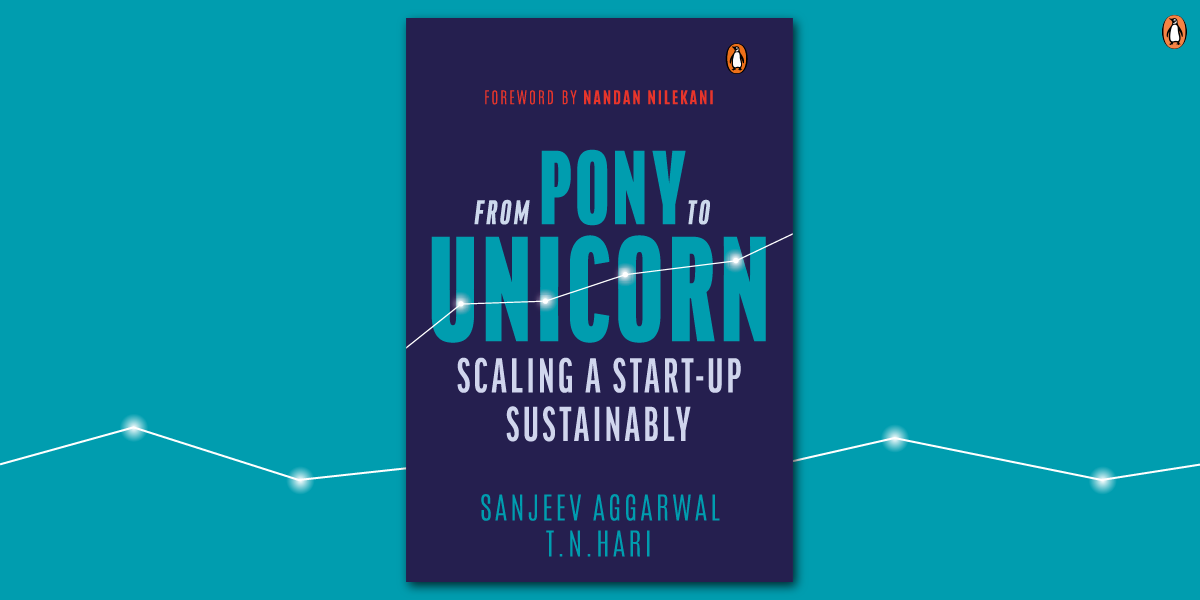
The journey of a business-from a small start-up to a large company ready for an initial public offering-is fraught with pitfalls and landmines. To scale a company, one needs to do more than just expand distribution and ramp up revenue. From Pony to Unicorn lucidly describes the X-to-10X journey that every start-up aspiring to become a unicorn has to go through. The book effortlessly narrates the fundamental principles behind scaling.

Peppered with anecdotes, insights and practical wisdom, the book is a treasure trove of lessons derived from the authors’ rich personal experiences in both building and guiding several start-ups that went on to attain the ‘unicorn’ status and became public-listed companies. Here’s an excerpt from the book on some key takeways about human capital.

**

Of all the enablers of scale, we believe the people side is by far the most critical and nuanced. Poor understanding of the human capital is the single biggest reason for most promising start-ups, we know, getting derailed and coming apart.

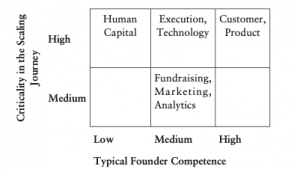
The table below captures our assessment of the typical founder competence in a domain vis-à-vis the criticality of the domain in the scaling journey. A deep understanding of ‘customer’ and ‘product’ perspectives are extremely critical for scale, but most founders understand these domains quite well. In fact, a start-up is almost always defined by the ‘product’ and ‘target customer’. Hence, most founders are well placed to navigate the challenges that crop up in these areas from time to time. In contrast, most founders do not have sufficient understanding of human capital issues. The simple reason for this is that most learning in this domain tends to be experiential. Therefore, given the criticality of human capital and the relative ineptitude of most founders in this domain, it often ends up as the ‘Achilles heel’.

front cover of From Pony to Unicorn
From Pony to Unicorn || Sanjeev Aggarwal, T.N. Hari


We have identified some of the most common human capital questions and challenges that start-ups face during the course of their journey of scale, and the choices in front of them.


Here are the key takeaways about human capital

  • Lateral hiring is inevitable. What normally breaks is the assimilation of lateral hires and their seamless collaboration with the home-grown rock stars. it is important to get this piece right. Conflict between these two groups has been the nemesis of many a good start-up.
  • Too few or too many lateral hires are bad. Getting the optimal mix and number is important.
  • It is key to hire the right candidates for leadership roles. timing is important, but more important is to spot the red flags in the hiring process.
  • Most start-ups begin by being very homogeneous in terms of thought process. founders and early-stage employees almost always have something strong in common that brings them together. This homogeneity is helpful in acting with speed in the early stages of growth, but need not necessarily be an asset at a later stage. It actually pays to build diversity into the teams as the start-up begins to scale.
  • At rapidly scaling start-ups, some people start capping out in terms of capabilities and are not able to keep pace with the growing demands. So, when symptoms of things beginning to break begin to show up, it is critical to step back a bit and figure out whether the team needs to be strengthened or whether the leader needs to be replaced.
  • Another important decision is whether generalists would work better or specialists would work better at different points of time for different functions.
  • Learning and development is the cornerstone of creating leadership capacity, but start-ups are always brimming with intense activity and people cannot easily be pulled out of jobs to undergo leadership development. Separating learning from work rarely works, and hence it is important to integrate learning into work.
  • Creating a culture of high performance, dealing with non-performers, coaching and designing the right feedback mechanisms are absolutely crucial for scaling.

There are standard frameworks that could be leveraged to strengthen these programmes.

**

The life and dilemmas of Ruby R.

Ruby finds herself in politics, a field where even the best of people like Saif Haq have the moral compass of a plastic bag. But this is a game where Ruby will not be defeated. Get a glimpse into Moni Mohsin’s delightful new read through this excerpt:


Ruby had intended to push her way through the crowd to congratulate Saif on his rousing speech. Though neither as sophisticated nor as socially connected as Kiran, Ruby was not lacking in confidence. She knew from experience that diffidence in a woman was seldom rewarded. But once near the lectern, she was overwhelmed by unaccustomed shyness. Hugging her folder to her chest, Ruby lingered at the edge of the cluster around Saif. A couple of girls, she saw with a stab of envy, had managed to push through the thicket of boys and were now at his side, their radiant faces turned up to him like sunflowers.

He beamed at them from his great height. His caramel- coloured eyes crinkled at the corners and long vertical grooves creased his cheeks. Their voices raised in excitement, the boys were all speaking at once. One was suggesting they repair to the college canteen; another was asking how Saif intended to win the next election; a particularly loud one was demanding a selfie with him; Jazz was insisting that they go to a restaurant, while the handler with whom Saif had arrived—a beefy, middle-aged man sporting an ill-fitting blazer and a comb-over—stood by impassively.

Saif raised his hands as if in surrender and said in a loud but amused voice, ‘All right, everyone. All right.’ They fell silent at once. ‘I had a prior appointment, but you know what?’ He grinned at his fans. ‘I’ll cancel it. How’s that?’ His announcement was greeted with whoops of joy. Looking over the bobbing heads surrounding him, Saif glanced briefly at his companion who nodded and turned away. Pulling out a cell phone from his jacket pocket, he went towards the exit. Saif turned back to his admirers and laughed.

‘Okay,’ he said, clapping his hands, ‘let’s go to your restaurant then. But it better be a desi place. I’m sick of bland white food.’

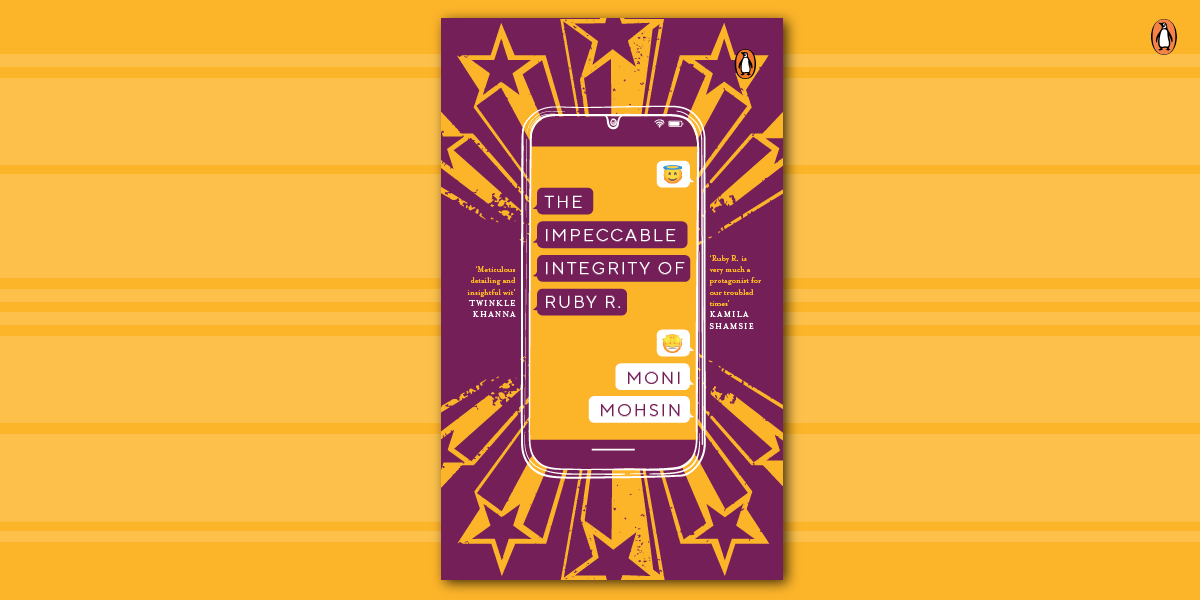
Front Cover Ruby R
The Impeccable Integrity of Ruby R||Moni Mohsin

An ecstatic Jazz, his face lit up by a gigantic grin, whipped out his cell phone and spoke rapid Punjabi into it. Then he announced: ‘It’s arranged. Choy Saab says there’s only one small table  of diners and they’re finishing. Restaurant is empty otherwise. He’ll hold it for us.’ Several students peeled away, citing essays and other commitments, and slouched reluctantly towards the exit. Kiran, brushing past Ruby without a word, followed them out. Ruby had to leave for her babysitting job. She would have to hurry if she wanted to be on time. But she was finding it hard to wrench herself away. It was as if Saif exerted some gravitational pull that forced her to stay in his orbit.

‘Ruby?’ Jazz called out. Their posse, now reduced to a core of about fifteen fans and Saif, was heading towards the exit. ‘You coming?’

‘Er, I’d love to, but I have to go somewhere,’ she said, edging away.

‘Can “somewhere” wait?’ asked Saif. He broke away from the crowd and approached her. ‘You’re a student here, right?’

‘Yes, master’s in business and media,’ she said primly, tightening her grip on her files. ‘But I did my undergrad in political science. From Punjab University, Pakistan,’ she added stupidly, colouring in embarrassment.

‘Wow! I would love to hear your views on our plans.’

Ruby patted her hair to ensure that her protuberant ears hadn’t burst through.

‘It’s just that I have this, er . . . commitment and I . . .’

‘Well, if it’s with someone significant then I mustn’t keep you.’ He smiled his crinkly smile at her.

‘Oh? Oh, no.’ Her hand flew to her mouth. ‘It’s not that. Not at all, no, no.’

‘So, then?’ He cocked a teasing eyebrow.

The group was getting restless behind them. Jazz cleared his throat noisily. Saif, his gaze squarely on Ruby, gave no indication that he had heard. Ruby fiddled with her folder. If she didn’t make it to her job tonight, she would be letting down Annie and Jack. She couldn’t really afford to forgo the payment and fall behind in her bills . . .

‘Okay, I’ll come,’ she said impulsively. ‘But I have to quickly send a text first.’

Ruby was not the impulsive sort. She was, in fact, quite the opposite—calm, cautious, deliberate. But much like the committed dieter who gives into temptation and has a slice of cake, and then follows it with a milkshake because the damage is already done, having broken her iron schedule once at Kiran’s behest, Ruby succumbed again. Knowing for certain that tomorrow would find her back at the library table in her usual place beside the window in the third aisle from the door, Ruby allowed herself this one indulgence. It was a once in a lifetime opportunity. In what world would Saif Haq ever invite Ruby Rauf to dinner again?

~

The Impeccable Integrity of Ruby R is exciting, and we can’t help but wonder how Ruby will fare in Saif’s ruthless world.

Can economics explain daily events in the lives of ordinary Indians?

Why are all the good mangoes exported from India? Why should we pay our house help more? Why do we hesitate to reach out for that last piece of cake in a gathering? Are more choices really better? Why do many of us offer a prayer but are reluctant to wear a seatbelt while driving? Are Indians hardwired to get grumpy at a peer’s success? What’s common between a box of cereal and your résumé?

Can economics answer all these questions and more? According to Dr Sudipta Sarangi, the answer is yes. In The Economics of Small Things, Sarangi using a range of everyday objects and common experiences like bringing about lasting societal change through Facebook to historically momentous episodes like the shutting down of telegram services in India offers crisp, easy-to-understand lessons in economics. Giving us more insight into his new book, Sudipta Sarangi tell us how economics can answer all our curious questions. Read on!

**

The Economics of Small Things approaches economics, and in particular economic theory by identifying it in the little things around us, in the quotidian as well as the quirky aspects of everyday life. This book promises to be different – it sets itself apart right from the Introduction which begins with a timeline of events like a in Fredric Forsythe thriller. Instead these are daily events in the life of ordinary Indians – like having the morning cup of tea, and the office commute to what happens at lunch. Believe me there is economics in all of that!


Unlike other popular books on economics, The Economics of Small Things has a distinctly Indian flavor. Take Chapter 1 for instance – it explores the unholy trinity of asymmetric information: adverse selection, moral hazard and costly auditing but in the context of the Grameen Bank and joint liability lending. Then the book explains why the village Md Yunus, the village Sahukar and Munimji (aka Jeevan) all succeeded while the formal banking sector did not. The book delves into many other such Indian themes like chappal chori at temples, T20 and ODI, and what is the best strategy for shoe shopping. It has 25 chapters but covers the entire gamut from A to Z!


Generally, depending on your level of exposure, economics is either considered expansive and somewhat stodgy, or filled with indecipherable Greek letters and numbers. The Economics of Small Things provides a surprising departure from this – it is written in an easy style with a dash of humor that almost seems counterintuitive to economic theory. It will appeal not only to high school students and their teachers but also to corporate executives; actually anyone who is curious. The refreshing, lighthearted style makes it an easy read. The chapters are big on ideas, short in size – to be enjoyed just like a delicious petit four.

front cover of The Economics of Small Things
The Economics of Small Things || Sudipta Sarangi


The concluding Coda provides a set of six takeaways. For example, it says that cognitive costs matter – which is why people use heuristics. It is also one reason why we stereotype people. Another take away is that heterogeneity matters – a idea that is not strange to Indians given our wide diversity. But the point really is that since people like different prefer levels of comfort in their airplane or train seats, like different flavours of masala oats, or like a professor and her student have a different values for time, it gives firms an opportunity to sell different products at different prices, thereby making higher profits. Summing it all up The Economics of Small Things says “…economics matters, and it matters not only in the abstract, but it matters in the little things in our personal lives and for a great many of our social interactions.”


**

The science of sugar that will transform your cooking

Masala Lab by Krish Ashok is a science nerd’s exploration of Indian cooking with the ultimate aim of making the reader a better cook and turning the kitchen into a joyful, creative playground for culinary experimentation. Just like memorizing an equation might have helped you pass an exam but not become a chemist, following a recipe without knowing its rationale can be a sub-optimal way of learning how to cook.

Here’s an excerpt from the book that divulges the science of sugar, a common ingredient in our kitchen but one that can magically transform any dish. Read on to take your cooking game to the next level with us!

**


Science of Sugar

Sugar is among the most misunderstood things in the Indian culinary landscape. This is surprising because we produce, sell and add more sugar to our food than any other people on the planet. This is also despite the fact that the very idea of extracting sucrose from the sugarcane plant was originally Indian. The word ‘sugar’ and its equivalents in every language, from Persian to Arabic to European languages, follow the path that sugar itself took from its origins in what is today Bengal. It is derived from sharkara in Sanskrit. Fun fact: Even the word ‘jaggery’ comes from the Portuguese jagara that comes from the Malayalam sakkara, which again goes back to the Sanskrit sharkara.

Originally used to make bitter medicine palatable, sugar is, chemically speaking, a family of molecules that are water-soluble carbohydrates. Incidentally, not all sugars taste sweet. Sucrose is the one that is most familiar because it makes up the crystalline sugar we use every single day. Sucrose by itself is made up of two other sugars—glucose and fructose—that got together, shook hands, agreed to lose a water molecule and bonded together.

Glucose and fructose taste sweet individually too. The former is important because it is the single most important source of energy for all living things on the planet. All carbohydrates are ultimately broken down to glucose, the simplest possible sugar. This is why when your body is not functioning normally, and your digestive system is not able to take complex foods and turn them into glucose, hospitals stick a needle into your arm and pump glucose straight into your blood, bypassing the state-of-the-art organic factory that is your digestive tract. The other sugar, fructose, is largely found in fruits, which is why they taste sweet. Milk has lactose, which does not taste sweet and is a tricky sugar because most adult humans lose the ability to digest it (meaning, convert it into glucose). This is why adults mostly cannot consume large amounts of milk beyond the tiny amount in their coffees and teas, and the occasional kheer or payasam.

All starches, which are basically large complex molecules made up of simpler sugar molecules, are ultimately turned into glucose by the body. This is why when you chew on potatoes for long enough, the enzymes in your saliva will turn the starches into glucose, making it taste sweet.

So, that’s about as much useful sugar chemistry theory one needs to know before jumping into the kitchen. The most common sweeteners in the Indian kitchen, in order, are:

1. Plain, crystalline white (or brown) sugar: White sugar is near 100 per cent sucrose. Brown sugar is white sugar with some molasses added back (the syrupy stuff that is left behind when refining sugarcane into refined sugar). This is the sweetest-tasting sugar.

2. Jaggery (gur): Jaggery is the unrefined mix of molasses (which is mostly glucose and fructose) and sucrose. It tends to be about 50 per cent sucrose, while the rest is mostly glucose, fructose and moisture. It has a slightly less sweet taste than sucrose but more depth of flavour.

3. Honey: This is mostly fructose and glucose, and has a very complex depth of flavour compared to plain sugar, or even jaggery. But the complex flavours are heat-sensitive, so avoid adding honey earlier in the cooking process.

front cover of Krish Ashok
Masala Lab || Krish Ashok


Sugar needs to be at least 0.75 per cent by weight in your dish for it to register as sweet. But like salt, sugar can magically improve your dish even without being perceptibly sweet. In general, a pinch of sugar will improve any dish.

Here are some simple rules for sweetness as a taste:

1. Sweet mutes saltiness up to a point, and also mutes sourness and bitterness. You can use it to balance these flavours.

2. Sweetness adds depth to other flavours, such as spices. When you bite into a cardamom, you will smell it, but it will taste bitter. When you bite into cardamom with a pinch of sugar, the aroma and taste of cardamom will seem stronger.


**

Exhaustively tested and researched, and with a curious and engaging approach to food, Krish Ashok puts together the one book the Indian kitchen definitely needs, proving along the way that your grandmother was right all along.

Ruttie Jinnah’s influence and redaction from history

Mohammad Ali Jinnah’s wife, Ruttie Jinnah was a fierce nationalise in her own right, and a proactive political companion to her husband. According to Jinnah’s contemporary political leader Sarojini Naidu, Ruttie was the only one with whom he could truly be himself. Despite her undisputed influence on him, she remains an understudied figure in history.


Here is an excerpt from the introduction of Saad S. Khan’s biography, Ruttie Jinnah, titled The Enigma of Mrs Jinnah.


Eqbal Ahmad, a great South Asian intellectual, once described Jinnah as an ‘enigma’ of modern history. Jinnah’s aristocratic Victorian manners, English lifestyle and secular outlook rendered him a most unlikely leader of Indian Muslims to have led the people to separate statehood.8 However, any keen observer of South Asian history and the politics of Pakistan may find Mrs Jinnah a greater ‘enigma’ than her husband. Sharing the same manners, the same lifestyle and the same outlook that Ahmad uses to describe Jinnah, she was the unlikeliest of candidates to have had a revolutionary, anti-British spirit, the intrepidity to face her family and community upon conversion to Islam, and her rising to become the first lady of the Indian Muslim community in such a conservative era when most Muslim women were wearing face veils.


As the historians study and explore Jinnah’s personality in the thousands of books and titles on him, we come to know him so well that he hardly remains an enigma any longer. Mrs Jinnah, however, has remained one—first, owing to her behind-the-curtains role in the rise of Jinnah and factors that led to the genesis of Pakistan. This should have made her one of the most studied historical figures by and within Pakistan, at least. To the contrary, however—and this brings us to the second reason she is an enigma—she suffered (to borrow the term from the scholar Akbar S. Ahmed) a complete ‘blackout’ from history.


Here, we look at both these conundrums: her influence on Pakistan and her redaction from history.

Influence on Jinnah and Thereby on the Creation of Pakistan


The first mystery about Mrs Jinnah is around her role in moulding her husband from a staunch all-India nationalist to a believer in the two-nation theory. It is well known that their courtship blossomed from 1916, when she proposed to him in Darjeeling. It was the same year that Jinnah got catapulted to national centre stage by becoming the architect and the author of the Lucknow Pact (also known as the Jinnah–Tilak Pact). It prompted Sarojini Naidu to label him as the ambassador of Hindu-Muslim unity. Despite strong opposition from her father, Ruttie came to Lucknow to see Jinnah bask in glory on the Indian political skyline.


The couple got married in 1918. After that there was hardly any major political or legislative engagement of Jinnah for which Ruttie was not by his side, till she left for Europe during her terminal illness in 1928. She died the following year. It was precisely that year, in 1929, that Jinnah propounded his Fourteen Points, effectively laying claim to a separate nation for the Muslims. These demands were to coalesce into one—for separate statehood—within a decade. Though Mrs Jinnah cannot be considered the sole reason for this metamorphosis, the exact coincidence of years, which is hard to miss, cannot be purely incidental. Living together and discussing politics for hours every day, it is hard to believe that Ruttie’s influence on Jinnah’s sea change in outlook was nil.


The argument that Mrs Jinnah was one of the factors that led to Jinnah’s becoming a bi-nationalist instead of the nationalist that he was, is subscribed by more or less all serious studies of Jinnah’s early political life. Akbar S. Ahmed,10 M.C. Chagla,11 Kanji Dwarkadas,12 Sheela Reddy13 and Ian Bryant Wells14 among others count Mrs Jinnah’s life—or death—as one of the factors that contributed to the change in Jinnah’s political philosophy, which led to the creation of Pakistan.


They disagree, however, on the extent of this influence, on what exactly caused it (for instance, Mrs Jinnah’s life or her death) and how. The present volume will uncover this backstage role of Mrs Jinnah, which will also help us grasp various hitherto underappreciated angles of Jinnah’s personality and decisions.


Her Blackout from History


Mohammad Ali Jinnah, better known in Pakistan as Quaid-e-Azam, was the founding father of Pakistan and is highly venerated in the country. Countless roads, towns, streets, institutions and projects are named after him. Those who profess their love for him show him a discourtesy by forgetting his first and last love, Rattanbai Maryam Jinnah. It is indeed a pity that the lady went missing from history and Pakistan’s collective memory. Both her role as comrade-in-arms of Jinnah, and her contribution to the freedom struggle in her own right are equally underexplored areas in the historiography of Pakistan.

Akbar S. Ahmed notes that Ruttie (and Dina) have ‘both been blacked out from history [in Pakistan]’. He argues, ‘Nonetheless, it is through a study of his family that we see the man [Jinnah] and understand him more than at any other point in his life because that is when he exposes his inner feelings to us.’15 Who caused this blackout and why? Who were the figures or what were the factors that led to the obliteration of Mrs Jinnah from collective memory?


Apparently, her direct descendants in post-Partition India and her in-laws in post-Independence Pakistan, for reasons that might not mirror each other, may have developed an interest in keeping Mrs Jinnah’s persona concealed from history. These include her parental family’s revulsion to her conversion, personal dislikes and jealousies by some on her in-laws’ side and simple lust for the Jinnahs’ inheritance in property from yet others living on both sides of the Radcliffe Line. The litigation for Jinnah’s property still continues a century down the road.


Saad S. Khan’s vivid biography, Ruttie Jinnah, provides an incisive look into Ruttie’s life and legacy, bringing forth a novel and fresh understanding of Jinnah and the freedom movement.

One life, two chance encounters

When Dhelabai, the most popular tawaif of Muzaffarpur, slights Babu Haliwant Sahay, a powerful zamindar from Chappra, he resolves to build a cage that would trap her forever. Thus, the elusive phoolsunghi is trapped within the four walls of the Red Mansion.


Forgetting the past, Dhelabai begins a new life of luxury, comfort, and respect. One day, she hears the soulful voice of Mahendra Misir and loses her heart to him. Mahendra too, feels for her deeply, but the lovers must bear the brunt of circumstances and their own actions which repeatedly pull them apart.


In this excerpt, we are introduced to Dhelabai from Pandey Kapil’s Phoolsunghi, translated from the Bhojpuri text by Gautam Choubey.


Dhela!
Dhela or ‘stone’ was what she had come to be called.

Once, her nautch triggered a violent street fight amongst her fanatic admirers, and in the ensuing mayhem, stones were hurled. That same day, she ceased to be known by her real name and became famous as Dhela.

She was a queen among beauties and an unchallenged sovereign in the realm of music and dance. When the fingers of the accompanist moved briskly over the taut head of the tabla, her skirt swirled like a whirlpool in an ocean. And when mellifluous songs flowed from her lips, it seemed as if her throat was a flute upon which the wind was playing resonant tunes. One could liken her to Menaka, or perhaps to Urvashi, the celestial nymphs. This tawaif from Muzaffarpur, once the foremost city in the ancient republic of Vaishali, was as majestic as Amrapali—the fabled royal courtesan of that province.

Once upon a time, a famous tawaif called Janakibai lived in Prayagraj. It is said that a devoted admirer of Janakibai was so completely besotted with her songs that he lavished all his wealth on her. However, he had never seen her face, not even a fleeting glimpse, for she always wore a veil. One day, as she absentmindedly lifted her veil and he caught sight of her dark and pockmarked face, he was shocked beyond belief. Could a sound so sweet emerge from a source so repulsive? As his world came crashing down, he exploded with rage and in a fit of uncontrolled fury, stabbed her over and over again. Janakibai miraculously survived the fifty-six stabs and got a colourful new moniker—Chappan Churi or fifty-six knives.

Like Chappan Churi, Dhela, too, once had a real name. She was Gulzaribai. True to her name, she was a gulzar, a blooming garden of flowers. She was blessed with moonlike radiance and the beauty of a heavenly nymph. But, the deeds of a few fanatics, who clashed over her and engaged in a vicious stone-fight, got her forever renamed to Dhela, alias Dhelabai.

Dhelabai’s fame spread-out in all directions just like the rays of the rising sun. When it reached Babu Haliwant Sahay, a powerful zamindar from Chhapra, he rushed to Muzaffarpur to marvel at her splendour. However, when he returned home after meeting her, he was lovelorn and crestfallen. Haliwant Sahay’s middle-aged body was home to the soul of a young rasik—a devourer of pleasure. Dhelabai’s luscious body and her seductive fragrance had filled his heart with unbearable longings and weakened his scruples. Yet, for him, she remained painfully unattainable.

The words that Dhelabai uttered to repulse his advances were steadfast and sacred, like a church bell. But he felt as if they were a dagger plunged into his heart; they had inflicted a wound whose pain pulsated through his veins. She had said, ‘Babu Sahib! You must have heard of a phoolsunghi—the flowerpecker—yes? It can never be held captive in a cage. It sucks nectar from a flower and then flies on to the next. I come from the community of tawaifs. Members of my community are like a phoolsunghi. Having After sucking money from one pocket, we quickly set out looking for another. Go back home. Spare a thought for your advanced age and spend the remainder of your days saying prayers and chanting the holy name of Lord Ram.’

However, as he descended the steps of her nautch- house, Sahay did not forget to warn her, ‘Dhela, my pocket is a limitless fountain of riches. I have no doubt that any phoolsunghi will gladly agree to a life as a captive in my golden cage. Her beak isn’t big enough to suck all the nectar from my pocket. And, as to my age, let it be heard that Haliwant Sahay earns his money believing he’ll never die. And he lives his life as if he were forever young, like the Ashwinis, the ever-youthful twins of the sun god. It’s all right for now. When the time comes, you’ll know the hollowness of your own sermon. I am returning home to build a palace for you; a golden-cage for a phoolsunghi. Trapped inside that cage, the flowerpecker will remain perfectly satisfied with a single flower and chirp merrily around it.’

Upon hearing these words, Dhela burst into laughter—a laughter so resonant that it sounded like the harmonized tinkling of a thousand golden bells, all arranged in a long single row. Sweltering under the blaze of that withering laughter, a gloomy Haliwant Sahay retreated to Chhapra.


Phoolsunghi || Pandey Kapil

The first ever translation of a Bhojpuri novel into English, Phoolsunghi transports readers to a forgotten world filled with mujras and mehfils, court cases and counterfeit currency, and the crashing waves of the River Saryu.


Prem Prakash watched history unfold, time and again

Having worked as a journalist for several years, Prem Prakash was witness to the turning tides of history. Read an excerpt from the account of his outstanding career and the historic moments he was a part of:


The twelfth of June 1975 was like any other summer day in Delhi— hot and humid with frequent power failures adding to the discomfort. Then there was a bolt from the blue. Suddenly, teleprinters in the newsrooms of media offices began clattering out a news alert from Allahabad. The verdict had been delivered on a lawsuit filed by the opposition’s defeated candidate, Raj Narain, against Mrs Gandhi’s election to Parliament in 1971. It was announced by Justice Jagmohan Lal Sinha. Prime Minister Indira Gandhi’s victory from Raebareli had been set aside by the Allahabad High Court following an election petition alleging malpractices and corruption.

Congress was stunned. Journalists rushed to the prime minister’s house. I was there too, along with Surinder, my colleague. Large crowds had gathered to support Mrs Gandhi, while senior Congress leaders went in and out of the house. Mrs Gandhi did not come out. The court barred Mrs Gandhi from holding elected office for six years, but it stayed the execution of the verdict to give her time to appeal against the judgment, if she chose. The media was as stunned as the government. Several were of the opinion that she should resign. By now, however, it was clear that she would put up a fight and go into appeal at the Supreme Court.

front cover Reporting India
Reporting India||Prem Prakash

After Indira Gandhi’s comprehensive victory in the 1971 Lok Sabha election, her rival, Raj Narain, had challenged the election result in the Allahabad High Court. The case had dragged on. Raj Narain insisted there were corrupt practices, but in fact there were none, except that one of Mrs Gandhi’s confidants, Yashpal Kapoor, whom I had known from Panditji’s time, was just as powerful as he used to be. This indicated that the bureaucracy believed that she hadn’t given up as yet. Raj Narain—the ‘joker in the pack’, as he was known—was elated at the verdict and demanded her resignation.

Yashpal Kapoor’s resignation came a few hours after the election was called, and he had already begun participating in the election campaign while employed by the foreign office of the government, something that the law does not permit. This was at best a technical or bureaucratic irregularity.

The case had already been argued and judgment was due towards the end of May. But the judge delayed it for some unknown reason. It was alleged that some Congressmen approached him to try and influence him in Indira Gandhi’s favour, making things worse for her. The judge was clearly peeved at this approach by the people whom he considered Mrs Gandhi’s agents.

Justice Jagmohan Lal Sinha had been avoiding public appearances for quite some time. He stayed home and called his stenographer to dictate his judgment. To guard against leakage, the judge insisted that his stenographer stay in his house. The day the dictation was completed, he asked the stenographer to disappear. That was 11 June 1975.

These are all known facts. The judgment was to be announced the next day, 12 June. Everybody across the nation was waiting. The judge arrived in court at 10 a.m., and within five minutes he allowed the petition.

The news spread like wildfire all over India and beyond. A news flash said that the court had allowed Raj Narain’s petition and found Mrs Gandhi guilty of corrupt practices. The judge then read out the judgment pronouncing Mrs Gandhi guilty on the basis of a simple technical error. It was like pronouncing a death sentence on someone for jaywalking.

Mrs Gandhi brushed aside all hints at possible corrupt practices by officials around her. At some point, when confronted with a question at a press conference as to why she was not taking steps against corruption, she had replied that corruption was a universal phenomenon. That sent a message down the line to the corrupt bureaucracy that it was okay to indulge in such practices so long as you did not get caught with your hands in the till.

After the Allahabad judgment, Mrs Gandhi was expected to resign. But she stood firm and said she would not do so, not till she went to appeal to the Supreme Court. The opposition took to the streets to protest at her challenging the judgment. This, to my mind, was totally unfair. You cannot prevent a person from exercising all their legal options. Demonstrations by the opposition, primarily led by the Jana Sangh, were not that big. These also did not resonate with the people, as by and large everyone felt that Mrs Gandhi had every right to go in for appeal.

…The Supreme Court, in its judgment on 24 June 1975, upheld the Allahabad High Court judgment, adding that Mrs Gandhi could continue as prime minister for six months and attend Parliament but not vote there. Subsequently, on 7 November 1975 (during the Emergency), the Supreme Court overturned Mrs Gandhi’s conviction in the Allahabad judgment.

Obviously, during those six months, following the Supreme Court’s conditional stay order, the prime minister’s office would be occupied by a person who was not really authorized to be there because of the Allahabad High Court order. At least this was the sensible way of looking at it—if the prime minister was disqualified she ought to resign, as the opposition insisted while holding their demonstrations.

The unrest was beginning to affect the country’s stability. The government had come to a virtual standstill, and many bureaucrats felt they were carrying out the orders of an illegal government.

Reporting India is an invaluable work, showing an intimate understanding of events we have only read about, from someone who was a part of those times.

Moving with the curve

‘Pessimism can become a self-fulfilling prophesy.’

-Martin Reeves and Jack Fuller


Coronavirus: Leadership and Recovery is a forward-looking work. It navigates the pandemic with innovative insights that can help businesses move ahead of crisis management at a time when imagination has become extremely crucial to problem solving. For a glimpse into the book, here is an excerpt:

~

As the coronavirus continues its march around the world, governments have turned to proven public health measures, such as social distancing, to physically disrupt the contagion. Yet doing so has severed the flow of goods and people, has stalled economies, and is in the process of delivering a global recession. Economic contagion has spread as fast as the disease itself.

This didn’t look plausible even in early March. As the virus began to spread, politicians, policy makers, and markets, informed by the pattern of historical outbreaks, looked on while the early (and thus more effective and less costly) window for social distancing closed. Now, much farther along the disease trajectory, the economic costs are much higher, and predicting the path ahead has become nearly impossible, as multiple dimensions of the crisis are unprecedented and unknowable.

Front cover - coronavirus leadership and recovery
Coronavirus: Leadership and Recovery|| Harvard Business Review

The window for social distancing—the only known approach to effectively addressing the disease—is short. In Hubei province it was missed, but the rest of China made sure not to miss it. In Italy the window was missed, and then the rest of Europe missed it too. In the United States, which was constrained by insufficient testing, the early window was also missed. As the disease proliferates, social-distancing measures will have to be enacted more broadly and for longer to achieve the same effect, choking economic activity in the process.

Another wave of infections remains a real possibility, meaning even countries that acted relatively quickly are still at risk every time they nudge their economies back to work. Indeed, we have seen resurgence of the virus in Singapore and Hong Kong. In that sense, only history will tell if their early and aggressive responses paid off.

Another wave of infections remains a real possibility, meaning even countries that acted relatively quickly are still at risk every time they nudge their economies back to work. Indeed, we have seen resurgence of the virus in Singapore and Hong Kong. In that sense, only history will tell if their early and aggressive responses paid off.

… However, we think examining various scenarios still adds value in this environment of limited visibility. The idea of “crisis management” requires no explanation right now. Something unexpected and significant happens, and our first instincts are to defend against—and later to understand and manage—the disturbance to the status quo. The crisis is an unpredictable enemy to be tamed for the purpose of restoring normality.

But we may not be able to return to our familiar precrisis reality. Pandemics, wars, and other social crises often create new attitudes, needs, and behaviors, which need to be managed. We believe that imagination—the capacity to create, evolve, and exploit mental models of things

or situations that don’t yet exist—is the crucial factor in seizing and creating new opportunities, and finding new paths to growth.

Imagination is also one of the hardest things to keep alive under pressure.

… In other words, renewal and adaptive strategies give way to classical planning-based strategies and then to visionary and shaping strategies, which require imagination.

…In a crisis, we likely won’t have immediate answers, and we therefore need to employ good questions. The most natural questions in a crisis tend to be passive, for example, “What will happen to us?” However, the possibility of shaping events to our advantage only arises if we ask active questions, such as “How can we create new options?” Creativity involves reaching beyond precedents and known alternatives to ask questions that prompt the exploration of fresh ideas and approaches.

~

Positing the power of creative imagination at the forefront, this book explicates the economic impact of the pandemic and tackles the fallout from its chokehold over businesses and economies.

The road to scale: challenges and prescriptions for success

From Pony to Unicorn lucidly describes the X-to-10X journey that every start-up aspiring to become a unicorn has to go through. The book effortlessly narrates the fundamental principles behind scaling. Guaranteed to make for a very interesting read, the book will be useful to entrepreneurs, leaders and investors involved in scaling start-ups. Here is an excerpt from the book From Pony To Unicorn:


In his epochal book, Small Is Beautiful, Ernst Friedrich Schumacher says, ‘even today, we are generally told that gigantic organizations are inescapably necessary; but when we look closely we can notice that as soon as great size has been created there is often a strenuous attempt to attain smallness within bigness.’ Big companies have tried to act small to preserve innovation. Extreme proportions, whether for a life form or an organization, is not natural. It is only in science fiction that one comes across animals the size of Godzilla. The network of blood vessels and nerves and the bone structures needed to support a life form of this size don’t exist in the real world. Even large organizations need intricate structures, speedy communication channels, an extremely strong foundation and flawless management. From time to time, a few organizations defy all odds and make it really big until a small start-up somewhere ends up disrupting them. However, the quest for scale is never-ending. One of the most enduring human pursuits throughout history has been to create things on a grand scale. Whether it was building mammoth pyramids in Egypt or connecting the mediterranean with the red sea through the Suez, or laying undersea cables across the Atlantic, the attraction for grandeur and scale has been incessant. Despite the obsessive and timeless allure of scale, the failure rate has been high. Failure to scale can be because of many reasons, some of which are quite universal and pervasive. They show up in almost every scaling scenario. An understanding of these reasons can be very helpful. It does not guarantee success but can raise the odds in favour of success appreciably. There are also unique challenges in every scaling scenario. You need to deal with these like you would deal with any ‘first time’ problem. Tolstoy’s quote from Anna Karenina is beautiful and sublime, but there are underlying nuances and variations in its meaning. It is the sheer variety and number of nuances that make universal prescriptions for success and scaling, as much as for happiness, almost impossible and often meaningless. This applies as much to start-ups as to families. The closest universal prescription for success was from Arthur Rubinstein, who once said, ‘there is no formula for success, except perhaps an unconditional acceptance of life and what it brings.’ Insights and prescriptions make sense only to individuals who recognize deeply that lessons and wisdom are meaningless in the absence of context, and there is no wisdom or prescription that can’t be challenged. However, given a clear context, an insight drawn from similar contexts can be very powerful, create those ‘Aha!’ moments and help you rapidly overcome the hurdle that is holding you back. Steve Blank, a highly respected author on entrepreneurship in Silicon Valley, in an interview with Kevin Ready published by Forbes magazine, defines a start-up as a ‘temporary organization designed to search for a repeatable and scalable business model’. Eric Ries, a successful American entrepreneur and prolific author, in his seminal book The Lean Start-up, defines a start-up as an organization that is dedicated to creating something new under conditions of extreme uncertainty. He further adds, ‘this is just as true for one person in a garage as it is for a group of seasoned professionals in a Fortune 500 boardroom. What they have in common is a mission to penetrate that fog of uncertainty to discover a successful path to a sustainable business.’


From Pony To Unicorn
By Sanjeev Aggarwal || T. N. Hari

This is a reasonably accurate description of what every start-up sets out to do. However, it is a bit too broad and would include many organizations, such as research laboratories and Fortune 100 companies that wouldn’t be considered start-ups. Therefore, let’s narrow this down by adding three other unambiguous filters before an organization dedicated to creating something new under conditions of extreme uncertainty can be called a start-up: a) the founder/s should still be active; b) it should be funded by venture capital (vc); and c) it should still be a private company. if these filters are applied, companies like Amazon, Google, Flipkart, Uber and Lyft would fail to qualify as start-ups, while Bigbasket, Doordash, Rubrick, Dunzo, Paytm and Swiggy would all qualify. While founder/s being active and the start-up not yet being a public company are understandable filters, the additional filter of the organization being VC-funded is relevant because that helps exclude mom-and-pop businesses that don’t have the same appetite for scaling as VC-funded start-ups.


Geoffrey West in his seminal book Scale, published by Penguin Press in May 2017, points out that scaling laws, whether for organizations, organisms or cities, are consequences of the optimization of network structures that sustain these various systems, resulting from the continuous feedback mechanisms inherent in natural selection and survival of the fittest. There is compelling evidence, even though there are the rare exceptions, that scaling of organizations follows certain power laws. He also points out that after growing rapidly in their youth, almost all companies end up floating on top of the ripples of the stock market with their metaphorical noses just above the surface. This is a precarious situation because they can drown in the next wave, and they are even more vulnerable if they can’t deal with the uncertainties of the markets and their own finances. While it is important to be optimistic and believe that by doing the right things your start-up could deftly navigate through the labyrinth of challenges, it is equally important to have the wisdom to understand that scale, especially extreme scale, is truly an exception and nature has stacked all the odds against it!

Raja Rao’s Gandhi – A life in words

In many ways, Raja Rao changed the way Mahatma Gandhi is read and written about. Get a glimpse into the processes of his writing through Makarand R. Paranjape’s introduction to Mahatma Gandhi: The Great Indian Way: 


In the symposium on Raja Rao on 24 March 1997, I had spoken on his forthcoming book The Great Indian Way: A Life of Mahatma Gandhi. This was a marvellous retelling of Bapu’s life in the form of a modern purana. Rao had called it ‘an experiment in honesty’, adding that the ‘Pauranic style, therefore, is the only style an Indian can use’.

The publisher was Kapil Malhotra of Vision Books, who in 1996 had published The Meaning of India. Malhotra had inherited one-half of what used to be Dina Nath Malhotra’s Hind Pocket Books, India’s first paperback imprint. Malhotra, believing in Rao’s genius, had also published The Chessmaster and His Moves in 1988. That book had won Rao the coveted Neustadt Prize. The manuscript was part of a veritable treasure trove of unpublished material that some of us, who were close to Rao, had been fortunate to be able to see. But there were many more such unpublished works, which I had seen at the Harry Ransom Humanities Research Center, where Rao’s papers now rested.

front cover The Great Indian Way
Mahatma Gandhi: The Great Indian Way||Raja Rao

After the Chessmaster, Malhotra published On the Ganga Ghat (1989) too. It was a unique collection of short stories with the common theme and location of Varanasi. It was clear that we were in the midst of a quiet Raja Rao efflorescence. It would culminate in his being posthumously awarded India’s second-highest civilian honour, the Padma Vibhushan, in 2007, ten years after the prestigious Sahitya Akademi Fellowship mentioned earlier.

What was so special about Rao’s book, yet another of the hundreds written on Gandhi? Why had Mulk Raj Anand called it ‘Among the most authentic accounts of the Mahatma’s life and work’? It was this question that I had tried to answer in my presentation on Rao in the symposium in 1997.

The clue came from Rao himself. ‘Facts of course are there,’ he says in the preface, ‘but facts are shrill.’ Facts, in other words, do not tell the whole truth: ‘They have a way of saying more than they mean, and disbelievingly so. The silences and the symbols are omitted, and meaning taken out of breath and performance.’

What else do we have other than facts? It is, as Rao says, the ‘rasa, flavour, to makes facts melt into life’. The Indian experience is complex and multi-layered, requiring a special style to express it, even in modern times: ‘the Indian experience is such a palimpsest, layer behind layer of tradition and myth and custom go to make such an existence: gesture is ritual, and each act a statement in terms of philosophy, superstition, historical or linguistic provincialism, caste originality, or merely a personal one, and yet it’s all a whole, it’s India.’

Rao, next, makes a very bold statement: ‘Thus to face honesty against an Indian event, an Indian life, one’s expression has to be epic in style or to lie.’ Facts alone cannot tell the Indian story, nor can myths, rituals, or fables by themselves. The two must be combined in a unique manner. That was Rao’s reinvented pauranic style. Not in the manner of the old puranas, with— from the point of modern history—their unverifiable material. Nor the contemporary histories which were slaves to facts. But a unique combination of both.

This is what I called ‘seeing with three eyes’. The first eye sees only facts. The second espies the fable behind and around the fact. It is only the third eye, the eye of wisdom, that can combine both to see into the depths of things, their secret significance and meaning.

This special way of seeing is what Rao calls ‘fact against custom, history against time . . . geography against space.’ In his book on the Mahatma, this is precisely what Rao accomplishes, making ‘life larger than it seems, and its small impurities and accidents and parts, must perforce be transmuted into equations where the mighty becomes normal, and the normal in its turn becoming myth. Prose and poetry thus flow into one another, the personal and the impersonal, making the drama altogether noble and simple.’

An important feature of traditional Indian society, which persists to this very day, is its enormously rich and varied method of chronicling and celebrating life. In rural society, for instance, even humble craftspersons like weavers, potters, blacksmiths and wood workers have a specially designated bhiksha vritti jati, a group of mendicant performers, to record and disseminate their deeds. Thus, all our communities have their own jati puranas or community histories. Likewise, each village, each region, each state has its own legends, songs and stories. All these go into making up our rich narrative traditions.

Raja Rao, as he himself has often reiterated, belongs very much to this pauranic tradition. He has performed his duty as a writer as faithfully and sincerely as our ancient poets, who have told the stories of gods and demons, heroes and villains, apsaras and princesses, sages and mendicants with such zealous relish. A key and recurring figure in Raja Rao’s works is one of the greatest men of our times, Mahatma Gandhi. This book is Rao’s retelling of and tribute to Gandhi’s extraordinary life.

~

Through Mahatma Gandhi: The Great Indian Way, Raja Rao changed the rules of biography writing. The book paints a holistic and in-depth picture of a man who was larger than life.

error: Content is protected !!