Publish with Us

Follow Penguin

Follow Penguinsters

Follow Penguin Swadesh

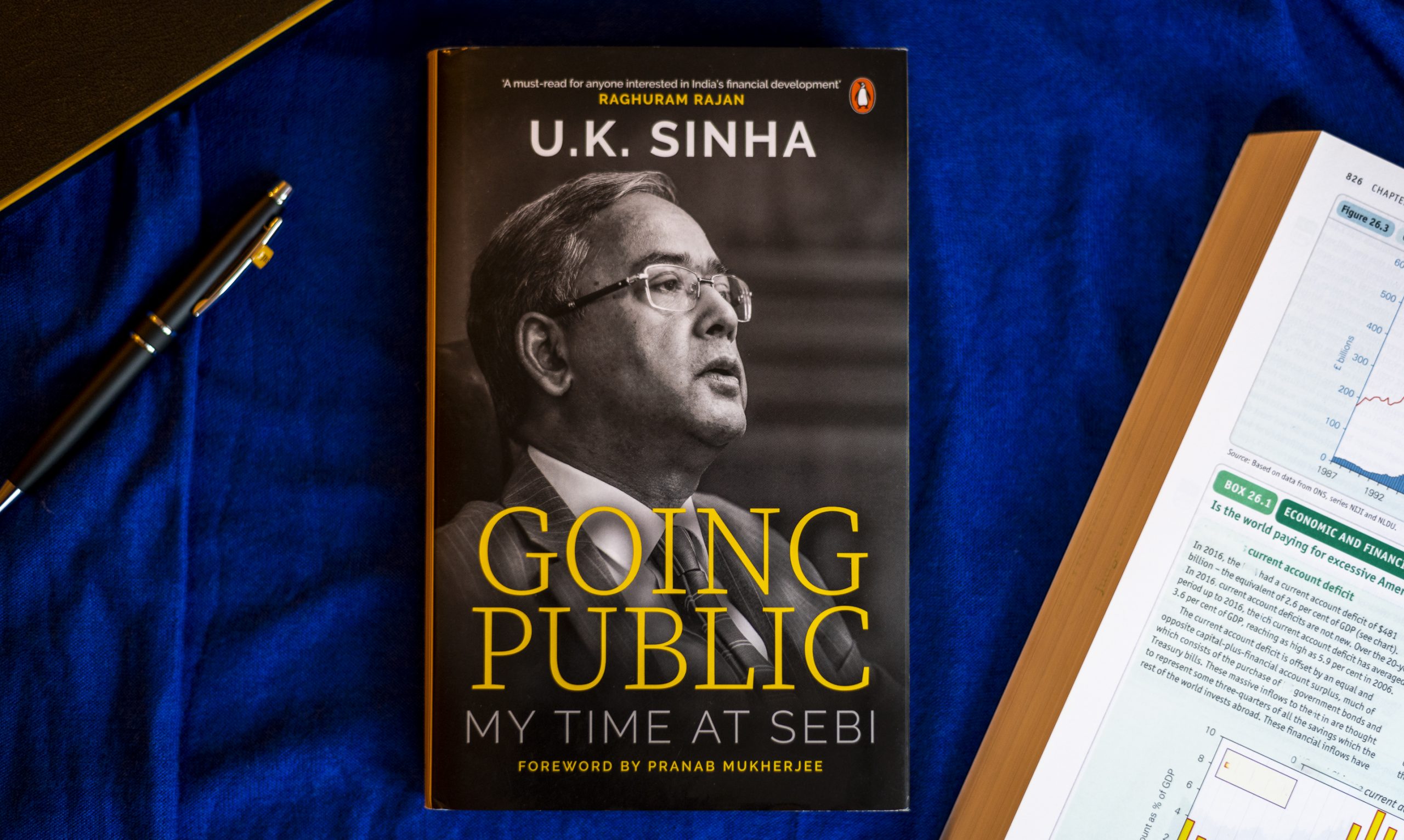
Deemed Public Issue or Doomed Investment? An Extract From ‘Going Public’

Upendra Kumar Sinha has contributed significantly to shaping India’s capital markets. He has been the guiding force behind reforms to protect the rights of investors and make stock exchanges more secure. Under his leadership, SEBI successfully fought a long legal battle with Sahara, and led the crackdown on other institutions which conducted unauthorized deposit collections.

Reiterating the importance of joint efforts of the government and regulatory bodies, Sinha in Going Public writes, ‘When there is a crisis or the financial stability is at stake, the government and the regulators have to mutually reinforce each other.’

Read on for a glimpse of how companies lure investors-

In spite of clear legal provisions, many companies have deliberately resorted to raising funds from hundreds of thousands of members of the public by taking recourse to the private placement route even though it was restricted for issue made to less than fifty subscribers. The maximum number of subscribers in a private placement has now been enhanced to 200 under the Companies Act, 2013. The main intention of companies that violate this rule has been to mislead investors and avoid stricter public scrutiny. Subscribers are denied full information about the true financial condition of the company and its actual business. They are not aware how much money is being raised, how many subscribers there are, the duration of the issue, or the corporate purpose for it. In addition, there is often a strong push from agents and salesmen. Investors are often duped into making these investments without any idea about the risk factors, or the remedy or guarantee available to them in case of refund or redemption.

In most cases, the preferred instrument is debt instead of equity. Generally, debentures or bonds (both terms are used interchangeably) are issued as these contain provisions of an assured rate of interest. People find these assurances very attractive. The rates of interest offered are very high so that these debentures can be easily sold. Several complications can be built into these instruments. A debenture can be convertible into equity, either partially or fully. The conversion into equity shares can take place at the option of the investor, compulsorily after a period or be linked to an event in future, such as the share prices of the company crossing a certain band. But, instead of highlighting these complications, agents push the instrument on the strength of the high rate of interest being offered.

Although many companies have taken recourse to it, the Sahara case is the biggest example in the country of a deemed public issuance. The surprising fact, however, is that neither SEBI nor any other government agency such as the RBI or MCA raised any red flag about such a large amount of money being raised from the public in utter violation of the law. Had Sahara Prime City Ltd (a group company) not decided to list on the stock exchange and thereby be forced to make disclosures to SEBI regarding its group entities such as Sahara India Real Estate Corporation Ltd (SIRECL) and Sahara Housing Investment Corporation Ltd (SHICL), the matter would never have come to light. It is also significant that the process of issuing these optionally fully convertible debentures (OFCDs) started around the same time as the RBI placed severe restrictions on the working of Sahara India Financial Corporation Ltd (SIFCL), a non-banking finance company of the group. SIFCL had been asked by the RBI not to raise any fresh deposits from the public and to close all existing deposits and reduce its public liability to nil in a given time frame. It is no coincidence that around the same time, these new instruments were issued by two companies of the Sahara group.

According to their own admission, the net amount raised by the two companies was more than Rs 24,000 crore from more than three crore investors.


Upendra Kumar Sinha is known to have been the longest-serving chief of SEBI. He also served as the chairman and managing director of UTI Mutual Fund and was head of the Capital Markets division in the Ministry of Finance. In his candid and historically important memoir Going Public, Sinha reminisces on his journey through India’s changing financial landscape.

To know more, read Going Public!

A Diwan with Foresight- An Excerpt from ‘The Magnificent Diwan’

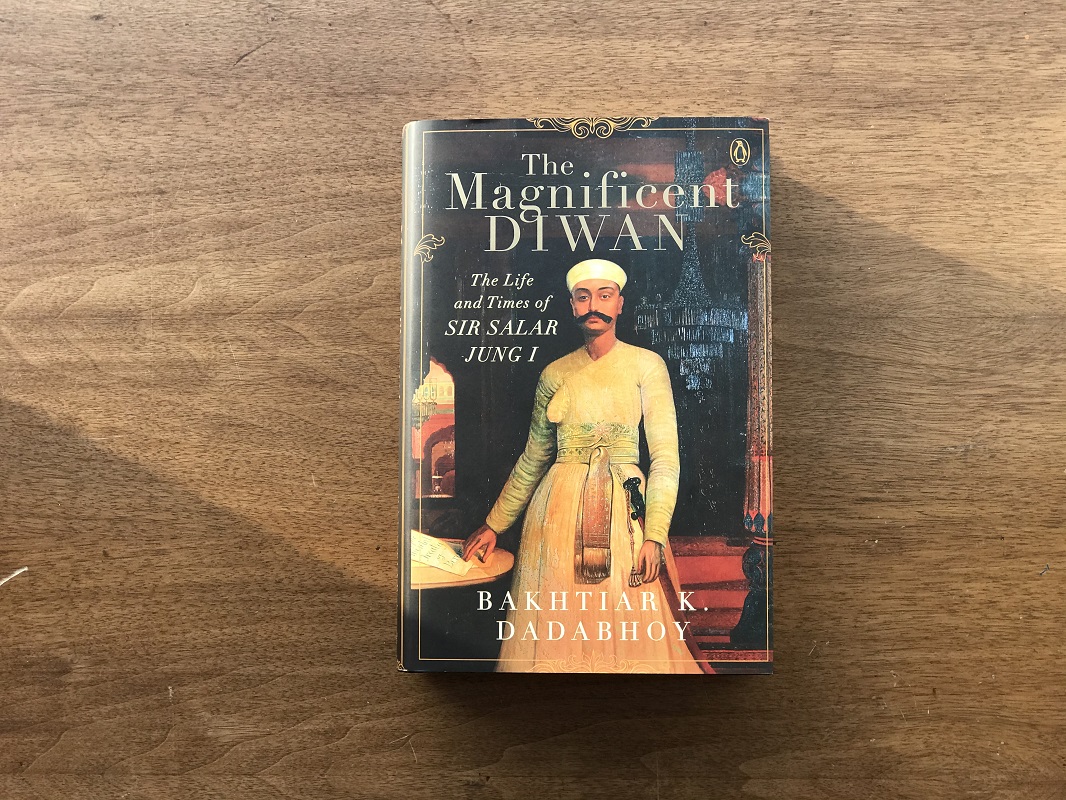
The Magnificent Diwan by Bakhtiar K. Dadabhoy waxes eloquent about Hyderabad’s truly magnificent Diwan, Sir Salar Jung I. A Diwan with a foresight who was one of the firsts to establish an organized system of government in Hyderabad, Jung restored its prosperity and developed its resources to such an extent that the nizam’s dominions were as orderly as any other part of India. 

Reintroduced to a generation that doesn’t have an inkling about him, Dadabhoy in the introduction of the book writes –

To understand Salar Jung, we must understand that his most dominant sentiment was devotion to the nizam. He did not hesitate to oppose the nobles of the court, and to reform every department of the disorganized administration, because he realized that the strength of the ruler lay in the firmness of the administration. His loyal attitude during the Mutiny was but a part of this well-considered policy. Throughout his career, the mainspring of his policy was the interest of his master, the nizam. His loyalty to the British, notwithstanding his childhood influences, sprang from a deliberate conviction that the maintenance of British authority was the best pledge of safety to the dynasty he served so faithfully. At the risk of his own popularity, and often at the risk of his own life, he refused to align with fanatics. For the nizam’s sake, he bore the humiliation he received from the British which resulted from his persistence on the restoration of Berar. He bore with meekness the frequent indignities to which he was exposed in the palace, and waged a constant and unequal battle against fanatics and other malcontents. Till Afzal-ud-Daula’s death, Salar Jung had never left Hyderabad, a fact which makes his administrative reforms still more remarkable, since they were accomplished in spite of the opposition of a capricious nizam, and hostile nobility. His strong individuality, firmness and caution gave him an ascendancy in Hyderabad which no previous diwan had attained.

The difficulties he faced, unusually trying and complicated in themselves, were compounded by the fact that he was never able to rely on the support of the court because he was identified with a policy of reform which threatened vested interests. Imbued with a liberal education and outlook thanks to the English influence in his formative years, Salar Jung honestly believed in the superiority of British administration. He adopted the fundamentals of British principles of administration in his reforms which covered almost every sphere of activity: land revenue, police, judiciary, administration and education. Sir Richard Temple, who was resident in 1867, believed that Salar Jung, as a man of business and in matters of finance, had no rival among Indian ministers. European influences had greatly moulded his thinking, and Temple recognized that he was a great imitator. Whatever improvement the British government introduced, he would sooner or later adopt, to good effect.

It is no surprise that British influence preponderated, since apart from his own predilections, he was encouraged and advised by successive residents who wanted to foster good government, not only in Britain’s own interest, but for a principle as well. Carrying ‘civilization’ to India was both an imperial necessity and a mission of pride in the nineteenth century.


To read more about Sir Salar Jung I’s reign, check out his biography, The Magnificent Diwan. We’d love to know what you think!

Lambton’s Cartographical Adventure- An Excerpt from ‘Mapping The Great Game’

While ‘the game for power’ between Imperial Russia and Great Britain was being played out in the 19th century, a self-educated cartographer named William Lambton began mapping the Great Arc, attempting to measure the actual shape of the Indian subcontinent. It was completed four decades later by a fellow officer working for the Survey of India, George Everest, who would have a special mountain named in his honor.

Featuring forgotten, enthralling episodes of derring-do and the most sincere efforts to map India’s boundaries, Mapping the Great Game is the thrilling story of espionage and cartography.

Read an excerpt from the book below:

—–

Now, nothing stood in Lambton’s way: he could embark on his cartographical adventure, and attempt to solve a key question of geodesy he had pondered for many years. It originated from a knotty problem known as ‘spherical excess’, which arises because the earth is essentially a sphere. In effect this means the angles of a triangle, rather than adding up to 180 degrees as they would on a flat surface, actually exceed this figure, albeit ever so slightly. If the triangles being marked out are relatively small, then this impact is minor and can be ignored, as Mackenzie was doing in his Topographical Survey. Conversely, as the land area being surveyed becomes larger than 10 square miles, the mathematics of trigonometry must be adjusted for this effect. Thus, a survey across the whole peninsula would obviously need to take spherical excess into account. But this was only the first part of the conundrum, and actually the simpler of two problems concerning the earth’s shape.

The second and more complex problem arises from the well-understood fact that the earth isn’t a true sphere, but is flatter at the poles as it spins on this axis. Isaac Newton had postulated this in the late seventeenth century, as a natural consequence to his theory of gravitation. It had been proven in the 1730s, by two separate expeditions sent out from France—at great expense—to measure one degree of latitude at two different points on the earth’s surface. This exercise, which took a number of years to complete and involved much hardship, determined a degree to equal 68.7 miles close to the equator, whereas near the Arctic Circle it measured 69.6 miles. This difference proved beyond doubt that the effect was significant, and must be corrected for if a large-scale survey was to be credible.

The geodetic problem for Lambton boiled down to a similar question: what was the length of one degree of latitude around the tropics where Madras lay? If he knew this, he would have the information needed to determine the extent of spherical excess in this part of the world. Such a discovery would not only improve the accuracy of his own survey, but also, as he put it, ‘determine by actual measurement the magnitude and figure of the earth’. It wouldn’t be just an academic exercise either, as ascertaining this dimension would have immense practical value: for example, it would improve the compilation of navigation tables and sea charts. Moreover, by measuring the actual shape of the earth on the subcontinent, the true positions and heights of all its places, including its towering mountains, could be fixed.

Once he had acquired his precious instruments and measured out the base-line, this question was finally answered in 1802, although it would require a year of painstaking work. First, he triangulated a short arc* just over 100 miles long, equivalent to almost 1½ degrees of latitude. Working down the south coast from Madras, this exercise gave him the arc’s precise ground distance, measured in miles. Next, he determined the latitude of both its extremities through astronomical observations and, by subtracting one from the other, determined the arc’s span in degrees. Since these two values were determined independently of each other, by dividing the length of the arc in miles by its span in degrees, he was able to deduce the precise length of one degree of latitude. In this way, he was able to finally determine the spherical excess figure that had eluded him for so long.


Grab your copy of  Mapping The Great Game  and discover forgotten and enthralling episodes of the most sincere efforts to map India’s boundaries!

The Game of Business: Excerpt from Simon Sinek’s ‘The Infinite Game’

In today’s world lead by young entrepreneurs, what does competition in businesses actually mean?

An optimist, motivator and author, Simon Sinek lays out a clear framework to help us navigate the world of business – which he presents as an ‘infinite game’, with no clear finish lines, losers or winners.

Read on for an excerpt that introduces this idea.

The Infinite Game of Business

The game of business fits the very definition of an infinite game. We may not know all of the other players and new ones can join the game at any time. All the players determine their own strategies and tactics and there is no set of fixed rules to which everyone has agreed, other than the law (and even that can vary from country to country). Unlike a finite game, there is no predetermined beginning, middle or end to business. Although many of us agree to certain time frames for evaluating our own performance relative to that of other players – the financial year, for example – those time frames represent markers within the course of the game; none marks the end of the game itself. The game of business has no finish line.

Despite the fact that companies are playing in a game that cannot be won, too many business leaders keep playing as if they can. They continue to make claims that they are the “best” or that they are “number one.” Such claims have become so commonplace that we rarely, if ever, stop to actually think about how ridiculous some of them are. Whenever I see a company claim that it is number one or the best, I always like to look at the fine print to see how they cherry-picked the metrics. For years, British Airways, for example, claimed in their advertising that they were “the world’s favourite airline.” Richard Branson’s airline, Virgin Atlantic, filed a dispute with Britain’s Advertising Standards Authority that such a claim could not be true based on recent passenger surveys. The ASA allowed the claim to stand, however, on the basis that British Airways carried more international passengers than any other airline. “Favourite,” as they used the word, meant that their operation was expansive, not necessarily preferred.

To one company, being number one may be based on the number of customers they serve. To another, it could be about revenues, stock performance, the number of employees or the number of offices they have around the globe. The companies making the claims even get to decide the time frames in which they are making their calculations. Sometimes it’s a quarter. Or eight months. Sometimes a year. Or five years. Or a dozen. But did everyone else in their industry agree to those same time frames for comparison? In finite games, there’s a single, agreed-upon metric that separates the winner from the loser, things like goals scored, speed or strength. In infinite games, there are multiple metrics, which is why we can never declare a winner.


Are you playing an inifinite game or finite game? Read The Infinite Game to find out!

Fear of Transience: Excerpt from Shaheen Bhatt’s ‘I’ve Never Been (Un)Happier’

‘I don’t write about my experiences with depression to defend the legitimacy of my pain. My pain is real; it does not come to me because of my lifestyle, and it is not taken away by my lifestyle,’ says Shaheen Bhatt in her multidimensional philosophical tell-all book, I’ve Never Been (Un)Happier.

A poignant illustration of her day-to-day struggles with depression, Shaheen Bhatt’s memoir is crucial in starting a conversation that has been hushed for too long.

Read on to find an excerpt to begin a dialogue around mental health in India.

**

Perpetual bliss does not exist and anyone who peddles the belief that it does, or tries to convince you that there is a secret path through the woods that leads to an oasis of unending peace and happiness is either deluded, or a liar.

For too long we’ve been convinced that the emotional fairy tale—the perfect state of emotional well-being— exists, and that it’s tantalizingly close but just out of reach. We’ve been convinced that it exists and we’ve been convinced that there’s something fundamentally wrong with us for not being able to attain it.

It’s high time that we realize that there’s nothing wrong with us.

There’s something wrong with the fairy tale. Perpetual bliss does not exist, and saying that does not make me a nihilist.

I sit on the same see-saw that we all do and it continuously goes up and down, shifting between darkness and light—it’s the same for us all. Some of us simply stay down a little longer in a dark that’s just a little darker.

Transience is something we’re all so afraid of, and we live in perpetual fear of a new, different reality.

But thank God for transience because even though it means that happiness doesn’t last it also means that pain eventually passes.

It means that neither heaven nor hell are permanent.

There is nothing glorious or freeing or romantic or lovely about depression. Depression is a monster, a villain and thief, but even the worst of experiences teach you something. Depression has taken a lot from me and it has also given me a lot, but only because I eventually demanded it. I demanded my lessons and I took them head on.

‘You must not allow your pain to be wasted, Shaheen,’ my father said to me. I chant that quietly to myself—‘My pain must not be wasted,’ I say—and I try to learn, I try to do. I grieve and cry and hurt but I also take my medication and go to therapy. I watch my soul being bent and twisted into painful, unnatural shapes and marvel at how I’ve never seen it from those angles before. There are still days and weeks and months when I am also consumed by depression, when I forget all my lessons, when I forget everything but the pain. And that’s also when I turn to the very idea I’m afraid of: transience.

I remind myself if happiness is fleeting, then so is sadness.

I remind myself depression is the weather, and I’m a weather-worn tree.

I remind myself even the worst storms pass.

I remind myself I’ve survived them all.


**

A topic of massive interest to anyone with mental health disorders, I’ve Never Been (Un)Happier stretches out a hand to gently provide solace and solidarity. Go get your copy today!

Dear reader: A letter from Jojo Moyes

Bestselling author Jojo Moyes’ new book The Giver of Stars is a mesmerising tale of female friendship, romance, and the wonder of books and reading, inspired by a remarkable true story.

Here’s a special letter from the author in which she gives insight into the inspiration behind her novel:


Dear Reader,


Fifteen months ago I read an article in the Smithsonian magazine about the Horseback Librarians of Kentucky — a group of young women employed by the US Government’s WPA scheme to go into the mountains after the Great Depression and take books and magazines to families who might not otherwise read a word.


Enduring harsh conditions and braving all kinds of dangers — snakes, dangerous mountains, moonshiners and criminals — they would saddle up and ride hundreds of miles a week to read to the sick, teach children, encourage the spread of facts in a time where religion and snake oil salesmen were able to battle for people’s minds. They often faced fierce resistance, both for their sex and from families who were suspicious of any reading materials other than The Bible, but worked together in a system that lasted seven years across several states, bringing everything from recipes to comic books biological texts to these remote families. Many of them became beloved to the people they served.


The photographic images of these young women were extraordinary, and their relevance to today hit me hard. I travelled to this remote area of East Kentucky on two separate research trips, rode the trails that the librarians would have ridden and stayed a week in a remote log cabin so that I could experience nature as they would have done (I got told off for moving a snake with a stick). I fell in love with the landscape and the storytelling people who inhabit it.


The Giver of Stars is the result — a story of five such women from very different backgrounds, brought together in a tiny community in the mountains of Kentucky. The story is fictional, but I have rested it on a skeleton of facts. I can honestly say I have never loved writing a book more, or been more inspired by my subject matter. I really hope everyone else enjoys it as much as I have.


Jojo Moyes


Intrigued? The Giver of Stars is available now.

Even True Love Has a Dangerous Side- The Prologue from Novoneel Chakraborty’s New Book

‘I’ll gift you a love story that every girl desires, but few get to live.’

He’d told me once. And boy, did he stick to his words! Vanav Thakur is the perfect boyfriend that any girl can have. Sometimes, I wonder if I really deserve him.

I’m Aarisha Shergill and my life is about to get ripped apart because I should have known some things should be left alone.

Bestselling author Novoneel Chakraborty is back with Roses Are Blood Red. Read the prologue from the book below:

TOSH, HIMACHAL PRADESH Sometime Ago

It was an important day for her. Very important. He was coming down to meet her after . . . in fact, she had been counting: three months, fifteen days, eleven hours and—as she left her house—exactly nine minutes. She had told her parents that she would stay with her bestie from college— Pragya—that night. Pragya, obviously, had no idea about her subterfuge.

He had selected the venue for their clandestine meet. It was only two blocks from her house to the small tea shop that would have closed for the day by then.

Despite the several layers she had on, Aarisha’s teeth chattered as she cycled towards the tea shop. The shiver was partially due to the unseasonal cold wave that had gripped the Himalayan town; she trembled more in anticipation of the impending rendezvous. Should I launch into his arms as soon as we meet? Or should I stand back and simply admire him for a bit? With an avalanche of thoughts crashing through her mind, she finally reached the location for their tryst. She stopped nineteen-to-the-dozen. Only the rarest find their harmony in silence. They were rare, she knew.

She cupped his jaw in her long-fingered hands and caressed his three-day-old stubble with her thumbs. He stretched out an arm to flick the switch on the car stereo. Ariana Grande’s husky voice softly permeated the interior of the car with one of her favourite tracks: ‘God is a Woman’. Aarisha leaned in, but before their lips could touch, he gripped her waist and stopped her descent.

‘Not so quick, Ranisa,’ he whispered.

She loved it when he called her by that name. ‘Ranisa’ meant queen—his queen.

If there was one thing she absolutely loved and couldn’t quite define, it was his enormous respect for her. It was so deep-seated that she often wondered whether she deserved to be placed on such a high pedestal.

‘You always say this,’ she whispered petulantly. ‘Don’t you want to kiss me?’

He stared at her beauty, her dark hair cascading like a cloud around her shoulders. Her eyes didn’t reflect pain, they carried a complaint.

‘D’you honestly believe that I don’t want to kiss you?’ he asked.

‘Then why don’t you?’ she sulked. ‘Also,’ she dismounted from him and scrambled back into her seat, ‘I hate it when you leave me and go away.’ He sensed the flood of tears about to burst through the dam at any moment.

‘Why?’ he asked softly.‘I feel insecure about you, about us,’ Aarisha choked.

An ironical smile touched his face. ‘You know this thing we call love, it’s like a dense forest. As you enter, you hear the growl of several wild beasts. At times, you may even encounter them. Insecurity is the most ferocious beast in this jungle. Whether to fall victim to it or vanquish it to continue one’s quest to unearth the greatest treasure ever, which is also hidden in this very forest, is the lover’s call. I’ve taken mine. What’s your call, Ranisa?’

She stared at him, amazed at the total conviction in his eyes. How could someone’s eyes always reflect such confidence? It was the kind of assurance one developed after scrutinizing life so closely that its tricks became only too predictable. She leaned over and kissed his closed eyelids.

‘I’ll fight. I promise I’ll fight all the beasts that come our way,’ she whispered.

There was a faint smile on his face as he said, ‘Don’t worry about the distance between us.’ He raised her downcast face and kissed her forehead, ‘The body is only what is. The soul is what is, what was and what will be. The scope of all the urges stemming from the body is a mere molecule compared to the intense longing that arises from the soul. And for the soul, distance is an alien concept. Distance only restricts the body.’

‘But the body is also important in its own way, isn’t it?’

‘As much as a house of bricks and mortar, because it houses the vulnerable and the fragile within. But we all know that the shelter is temporary and, as all temporary things, too transient to worry about.’

‘What’s permanent then?’ Aarisha asked.

He placed his right hand flat against her left hand, palm to palm, their fingertips splayed until they found the gaps through which the fingers slipped, and the hands clasped each other.

‘This,’ he said, tightening the clasp, ‘this is permanent.’

I wish I could tell you the number of wars I’ve fought to make this permanent, he thought.

‘D’you know, there are times in your absence when I get the feeling that I hardly know you at all. Is that good?’ she asked, resting her head on his shoulder.

‘You’ll know. You’ll know very soon. It’s just a matter of one more year.’

‘One more year?’ she asked, frowning.

‘Yes. In one more year I’ll gift you a love story that every girl desires, but few, if any, get to live,’ he whispered.

‘What do you mean?’ she drew back to look at his face. There was no response. She raised her head—and suddenly she felt a tug on her hair.

‘Ouch!’ she yelled. Before she realized what was happening, she felt a punch on her face that broke her nose and lacerated her lips. The second punch that buried itself in her gut almost made her throw up. Aarisha fell unconscious, her face a bloodied mess. Three more punches followed: one to her jaw, another landed in her ribs and the third, in the stomach again. He shoved her away from him with force. The side of her head slammed against the window. He yanked down her jeans, slipped them off her legs and tossed them out of the window. He tugged her panties down to her knees and from his pocket he extracted a vial of semen. He smeared

some of the semen on her panties, on her dress and emptied the rest on her bare abdomen. He made sure nobody would ever track down whose semen it was. For a doctor, it wasn’t even a task. He dressed her back in a hasty manner.

As soon as he was done, he used his cell phone to call the local police station. Emotionlessly, he relayed the information, ‘A girl has been raped and abandoned on the road.’ He gave them the approximate location before hanging up. He glanced at Aarisha’s unconscious battered face and muttered, ‘The first thing you should know about me is: I…Don’t…Let…Go…’

He turned on the ignition, opened the passenger side door and pushed the girl’s insensate body out. He put the car into gear, gunned the engine and sped away into the night. After half an hour of driving, he stopped. He alighted from the car and stood at the edge of the abyss, gazing into the darkness. He dialled the police again. They informed him that the girl had been rescued and countered with their own questions about his identity. In reply, he flung the phone into the abyss as far as it would go. He looked up at the night sky— at the constellations of stars—they had mocked him enough. They thought she would never be his. And now, he would win her from everything—and everyone.

He extended both his middle fingers skywards and bellowed a bloodcurdling war-cry against destiny.

Vanav Thakur was no ordinary man. He was soul-deep in love with a girl. And he was a man with a plan.


Curious to know what happens next?  Mysteriously thrilling in its essence, Novoneel Chakraborty’s Roses Are Blood Red is a haunting story of a passionate and eternal love.


An Exclusive Excerpt from Harinder Sikka’s Newest Book!

Bestselling author of Calling Sehmat, Harinder Sikka is back! His new book Vichhoda, narrates the experiences of another powerful woman, Bibi Amrit Kaur.

Bibi’s life is torn apart in the 1947 riots. She’s now living in a different country with a different identity, a fate she eventually accepts gracefully. She gets married and has two children. Life, however, has something else in store for her. It breaks her and her children apart. And this time the pain is unbearable.

Read an excerpt from the book below:


In the meantime, Bibi reached home to find a large group of women assembled in front of her home. They were surprised to see her without her burqa. As the tonga stopped, she stepped down, and, without saying a word to the women, rushed into her home and bolted the door from inside. But like jungle fire, stories about her act of bravery reached every ear in no time. It generated praise and fear in equal measure. Even though Sakhiullah was respected by the villagers, most women feared police retaliation. They were all aware of the brutality with which cops often operated, especially in rural areas where they were treated like demigods. When Sakhiullah arrived that evening, he was shocked to learn about the turn of events. He rushed to the army camp situated near his house and narrated the story to the deputy camp commander, a young army captain named Ishtiaq, who was also his first cousin. ‘I need urgent help, Ishtiaq. We have no time to waste. It won’t be long before the police come banging at our doors. And that could mean serious trouble; not only for Bibi, but for the entire family!’


The young captain nodded and called his most senior and experienced jawan at the camp, Subedar Major Mushtaq Khan, for advice. A deep furrow appeared between his brows as Sakhiullah related the story. He mused for a moment and then said, ‘Sir, the camp commandant will have to intervene immediately as this is a case of attack on a serving police officer. But he’s in Islamabad for the entire week. I know the SHO well. He’s politically connected, highly corrupt and most brutal. If he survives, he will take revenge in every possible manner. But even if he doesn’t, his colleagues won’t spare your family. I suggest that you move out with your family immediately. Also, Bibi will have to be sent to India right away if we are to save her.’


Captain Ishtiaq looked at Sakhiullah and said, ‘Bhaijaan, if what Mushtaq Sahib is saying is right, then we don’t have much time. Please decide. I don’t even have the authority to do what we are planning, but I shall not spare any effort.’ A helpless and confused Sakhiullah nodded in affirmation and the subedar swung into action.


An hour later, two military jeeps arrived at Sakhiullah’s residence. Four army jawans in battle rig and armed with rifles stepped out, followed by a subedar and a young lieutenant. The lieutenant took Bibi into custody while Sakhiullah watched from a distance as a mute spectator. The military officer whispered in her ear that her life and that of her entire family was in danger. He explained to her that the arrest was being made only to evade a counter-attack as the police would not interfere with the military forces.


The first jeep left, taking Bibi to an unknown destination. Shortly, Sakhiullah too departed under escort. He was accompanied by his two minor sons and his cousin, Captain Ishtiaq. After travelling for about twenty kilometres, the first vehicle turned left from the narrow highway towards the Indian border while the second one turned right towards the main city. Bibi instinctively realized the plan. She cried and begged for an opportunity to meet her husband and children one last time. But her wails fell on deaf ears. Despite being aware of Sakhiullah’s clout, the young army lieutenant displayed no mercy. He could not have; he was under strict instructions. The jeep reached the border half an hour later. The officer stepped down and went across the border, exchanged pleasantries with his counterpart from India and swiftly handed Bibi over to the Indian armed forces.


What happens to Bibi next? Order your copy of Vichhoda to find out!

A Guide To the Use of Colours and Their Symbolism- An Excerpt from ‘The Hidden Rainbow’

Kelly Dorji takes you on a spiritual journey through Buddhist symbolism to help find your inner peace. In our busy lives, The Hidden Rainbow is the perfect oasis.

Read an excerpt from the book below:


A GUIDE TO THE USE OF COLOURS AND THEIR SYMBOLISM IN BUDDHISM:

The main colours used in Buddhist art are blue, black, white,

red, green and yellow. With black as the exception, the other

five colours are representative of a specific Buddha in the

depiction of the five Wisdom Buddhas of the Vajrayana or

Tantric Tradition of Buddhism.


The colour B L U E is used to represent the Healing Buddha,

signifying calm, purity and healing.


W H I T E signifies purity and is the colour of knowledge

and longevity. The primordial Buddha ‘Vairocana’ is depicted

in white.


The Buddha Amitabha is shown in R E D, which symbolizes

life and holiness.


The Amoghasiddhi Buddha in G R E E N signifies

accomplishment and the elimination of envy.


Y E L L OW is the colour chosen to depict Ratnasambhava,

who is a symbol of balance and humility.


Through meditation, these colours may contribute to the

restorative process of the human condition by transforming human

delusions to original qualities as follows:

– Meditating on the colour blue can pacify aggression.

– White can transform ignorance into wisdom.

– Red turns attachment into selflessness and realization.

– Concentrating on green can eliminate jealousy.

– Meditation on the colour yellow can enrich the sense of self and

eliminate pride.


Keep calm and find your inner peace with The Hidden Rainbow.

The Belief of Oneness in Sikhism, Savayye: An Excerpt from ‘Hymns of the Sikh Gurus’

The vision of Guru Nanak, the fifteenth-century founder of the Sikh faith, celebrated the oneness of the Divine that both dwells within and transcends the endless diversity of life. Guru Nanak’s immaculate vision inspired the rich and inclusive philosophy of Sikhism, which is reflected in this exquisite and highly acclaimed translation of poems,Hymns of the Sikh Gurus, from the religion’s most sacred texts: the Guru Granth Sahib, the principal sacred text of the Sikh religion, which consists of poems and hymns by Guru Nanak, his successors and Hindu and Islamic saints; and the Dasam Granth, a collection of devotional verses composed by the tenth Sikh Guru.

Read an excerpt from this book this Gurpurab:


MORNING AND INITIATION
Savayye

SAVAYYE means quatrains. The ten Savayye that have been included in the Sikhs’ morning prayers are from Guru Gobind Singh’s Dasam Granth (see p. 1). They underscore devotion as the essence of religion. They reject all forms of external worship and cast Guru Nanak’s message of internal love in beautiful undulating rhythm. These Savayye are also recited during the administration of amrita, the initiation ceremony of the Khalsa (the Sikh order).

There is One Being. Victory to the wonderful Guru.

The composition of the Tenth Guru.

My wonderful Guru, I recite the Savayye by Your grace.

I have seen hosts of purists and ascetics,
I have visited the homes of yogis and celibates.
Heroes and demons, practitioners of purity
and drinkers of ambrosia, hosts of saints
from countless religions, I have seen them all.
I have seen religions from all countries,
but I have yet to see followers of the Creator.
Without love for the Almighty,
without grace from the Almighty,
all practices are without a grain of worth.


Drunken elephants draped in gold,
first among giants in blazing colours,
Herds of horses, sprinting like gazelles,
swifter than the wind,
The people bow their heads to strong-armed rulers,
But what if they be such mighty owners;
at the last, they depart barefoot from the world.


Conquerors of the world march triumphant
to the beat of kettledrums.
Their herds of handsome elephants trumpet,
their royal steeds lustily neigh.

These rulers of past, future and present
can never be counted.
Without worshipping the supreme Sovereign,
all end in the house of death.

Pilgrimage, ablutions and charities, self-restraint
and countless rituals,
Study of Vedas, Puranas, Kateb and Qur’an,
of all scriptures from all times and places,
Ascetics subsisting on air, practising celibacy;
countless such have I seen and considered.
Without remembering the One, without love for the One,
all rulers and actions go to naught.


Inured and invincible warriors in shining armour,
determined to crush the enemy,
Proudly think, mountains may grow wings and fly away,
but never us.
They can shatter their enemy, they can wring their foe,
they can crush legions of drunken elephants,
But without the grace of the One,
they too must depart this world.


Countless heroes and doughty warriors
who stand fast against the blows of iron,
Who conquer lands and enemies,
who crush the pride of drunken elephants,
Who raze sturdy castles, who gain the world by words,
They are all beggars at the divine Portal,
the almighty Ruler is the only Giver.


Gods, demons, serpents, and ghosts contemplate
Your Name in all time—past, present, and future.

All creatures of land and sea,
You instantly create and destroy.
Their virtuous deeds are heartily celebrated,
their piles of misdeeds utterly eradicated.
The devout go happily in this world,
their enemies sink in shame.

Rulers of mortals and mighty elephants,
leaders of the three worlds,
Performers of endless rituals and charities,
winners of brides in countless swayamvara rites,
Like Brahma, Shiva, Vishnu and Sachi’s husband,
they all end at last in death.
They who touch the feet of the Transcendent One,
they alone are freed from the cycle of birth and death.


How futile to sit in contemplation,
like a stork with both eyes closed.
While trying to bathe in the seven seas,
we lose this world and the next.
How futile to sink in misdeeds,
we only waste away our life.
I tell the truth, do listen to me,
they alone who love, find the Beloved.


Some worship stones, some bear them on their heads;
some wear phalluses around their necks.
Some claim to see the One in the south;
some bow their heads to the west.
Some worship idols, some images of animals;
some run to worship the dead and their graves.
The entire world is lost in false ritual;
none knows the mystery of the Almighty One.


Poetry from these highly revered texts is heard daily and at rites of passage and celebration in Sikh homes and gurudwaras, carrying forward the Sikh belief in the oneness and equality of all humanity.Read Hymns of the Sikh Gurus to know more about these.

error: Content is protected !!