Publish with Us

Follow Penguin

Follow Penguinsters

Follow Penguin Swadesh

Who is a Minority?

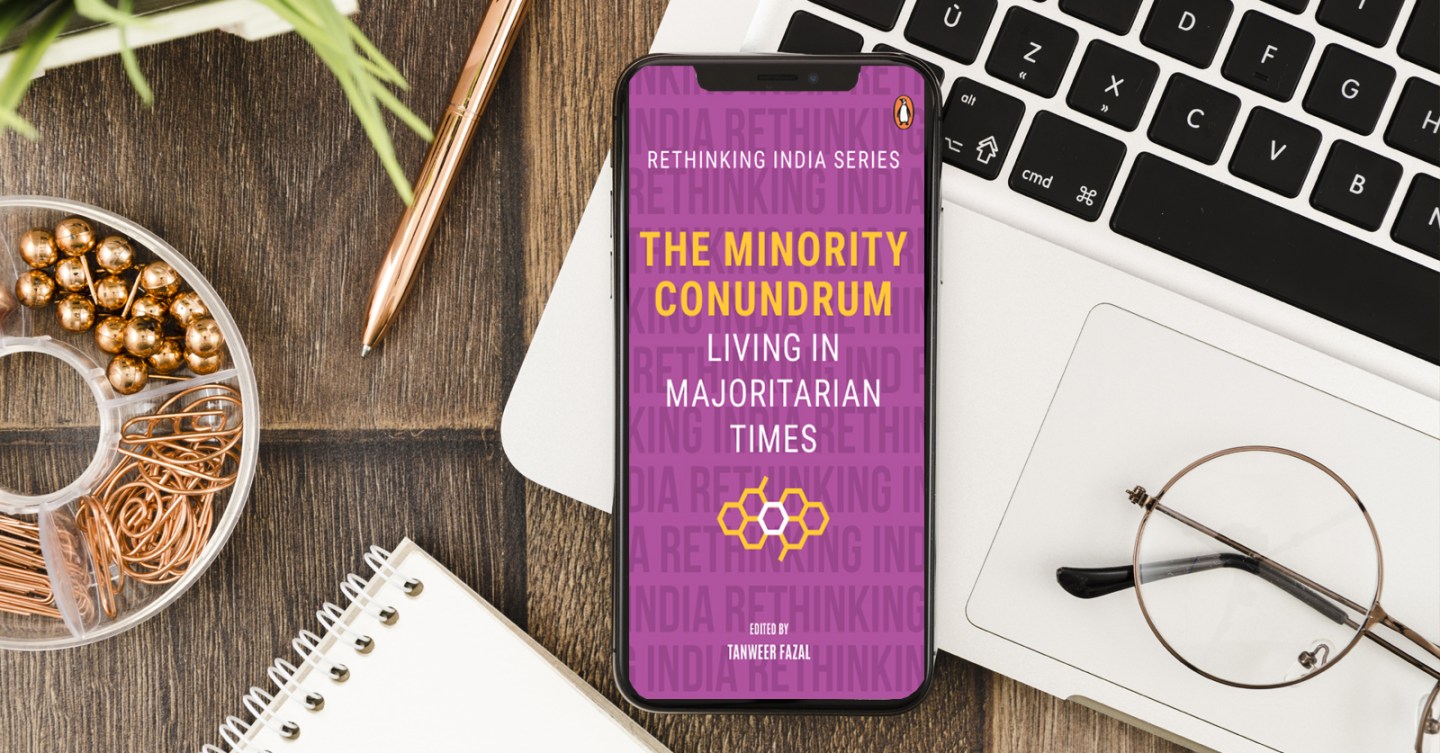
The Minority Conundrum, the second volume in the Rethinking India series explicates what it means to be a minority in majoritarian times. The contributors identify vulnerabilities that encumber the quest for the realization of substantive citizenship by minority groups. The essays deal with educational attainments, employment prospects in a liberalized economy, possibilities of equal opportunity, violence of the state and vigilante groups, emerging questions of citizenship and employment, linking language with the material life of its speakers, and the receding political voice of minorities amidst a majoritarian upswing.


Here’s an excerpt from the book:

In a country marked by multiplicity of faiths, speeches, castes, ethnicities and geographies, the question ‘who is a minority?’ is riddled with complexities. What adds to the intricacy is that each of these collectivities is segmented into status groups, sects, forms of worship, and regional variations to the extent that the difference offsets the commonality. Identities are multiple, and each of these intersects with the other to complicate the situation further. A Santhal convert to Christianity bears no resemblance to the Syrian Christians in Kerala, be it in language, custom or the status that she enjoys in the wider society. A Tamil Muslim has far more points of interaction with a Tamil Hindu than with his co-religionists in Kashmir and in Urdu-speaking areas. This is a complexity that afflicts the formation of majority identity as much. Minorities are contextually produced, and violence is key to it: Biharis in Maharashtra, Tamil speakers in Karnataka during the language riots, Bengalis in Assam at the peak of the Assam movement, Sikhs in 1984. On similar grounds, the rise of Hindutva nationalism in India corresponds with the exclusion and demonization of and the use of targeted violence against the Muslims, and occasionally the Christians.

India represents one of the most complex multinational and polyethnic societies to be governed by modern democratic structures. The presence of at least 1600 speech communities has been recorded by the Indian census, of which at least thirty-three are more than one million strong. More than 3000 castes and nearly 350 tribal groupings form the Indian cultural mosaic. Further, the adherents of almost all the world’s major religions—Judaism, Christianity, Islam, Hinduism, Jainism, Buddhism, Sikhism, Zoroastrianism and various forms of animism—are to be found here. About 80 per cent of the population practises Hinduism, which in itself is a highly plural system of beliefs and practices. The disaggregation of the population along regions and religions provides an intriguing scenario. There are merely 2.3 per cent Christians in the country, but they form the majority in three states, namely Meghalaya, Mizoram and Nagaland, and are a significant proportion of the population in Kerala, Arunachal Pradesh and Manipur. One of the most prosperous states of India, Punjab, has a Sikh majority. The Indian Muslim population, though only 14.1 per cent according to the latest census, constitutes the third highest in the world in its sheer magnitude. Given the situation, quite often, the neat compartmentalization of majority and minority appears mythical. Stretching the argument to an absurd extent, a single- judge bench of an Indian court declared in 2007 that Hindus were a true minority if caste and sectarian divisions were to be taken into account. The judge’s order read that Muslims were in fact the ‘only majority religious community in comparison with other religious communities’, and all others were ‘in minority comparison to the Muslims of India’. Mercifully, realizing the preposterousness of the order, and its far-reaching consequences, a division bench of the high court swiftly overturned it.

India represents one of the most complex multinational and polyethnic societies to be governed by modern democratic structures. The presence of at least 1600 speech communities has been recorded by the Indian census, of which at least thirty-three are more than one million strong. More than 3000 castes and nearly 350 tribal groupings form the Indian cultural mosaic. Further, the adherents of almost all the world’s major religions—Judaism, Christianity, Islam, Hinduism, Jainism, Buddhism, Sikhism, Zoroastrianism and various forms of animism—are to be found here. About 80 per cent of the population practises Hinduism, which in itself is a highly plural system of beliefs and practices. The disaggregation of the population along regions and religions provides an intriguing scenario. There are merely 2.3 per cent Christians in the country, but they form the majority in three states, namely Meghalaya, Mizoram and Nagaland, and are a significant proportion of the population in Kerala, Arunachal Pradesh and Manipur. One of the most prosperous states of India, Punjab, has a Sikh majority. The Indian Muslim population, though only 14.1 per cent according to the latest census, constitutes the third highest in the world in its sheer magnitude. Given the situation, quite often, the neat compartmentalization of majority and minority appears mythical.


From a strictly juristic reading, the Constitution of India recognizes religious and linguistic minorities for the purpose of conferring special rights to establish educational institutions of their choice. Articles 29 and 30 carry the empowering provisions in this regard. The reticence of the Constitution-makers in defining who constitutes a minority has led to endless litigation. Were they to be decided numerically? Given India’s federalism, were the minorities to be determined at the level of the state or at the national plane?


In its cognitive framework, the volume The Minority Conundrum privileges the material lives of the minority groups over the spiritual or the cultural. In the real world, the two spheres rarely exist in compartments. Nonetheless, the task is to identify vulnerabilities that encumber the quest for the realization of substantive citizenship by minority groups. The essays therefore singularly emphasize educational attainment, employment prospects in a liberalized economy, possibilities of equal opportunity, violence of the state and vigilante groups, emerging questions of citizenship and employment, linking language with the material lives of its speakers, and document the receding political voice of minorities in times of a majoritarian upswing.


The Minority Conundrum is available now.

Power of Poetry: Memorable Verses from Tamil Magnum Opus “Tiruvaymoli”

During this difficult time, we tend to turn to powers higher than us. The ancient poet-saint Nammalvar’s magnum opus “Tiruvaymoli”, or “Endless Song”, is a grand 1100-verse Tamil poem in praise of Tirumal—among the many names for Lord Vishnu. On the auspicious occasion of Ram Navami, here are some verses on the devotee’s love and longing for the supreme lord, in Archana Venkatesan’s dazzling translation, that will light you up from within.

*

I.1.5 Each knows what they know,

each finds a different path

Each has their god

each reaches his feet

Each of these gods lacks nothing,

everyone is fated

to find their way to the great lord

who’s always there.

II.5.1 In that place he loved me

fused with my breath.

the lord who wears lovely garlands,

a crown conch disc thread jewels:

His large eyes like a pool of lotuses

his lips red lotuses, his feet too lotuses,

his red-gold body glows.

IV.3.8 You’ve entered my breath,

radiant light of wisdom

filling the seven beautiful worlds.

My breath is yours

Your breath is mine

I can’t describe how this is

I can’t describe the way you are.


Archana Venkatesan’s Endless Song is a dazzling translation of one of the most revered ancient Bhakti poems.

Ingeniously weaving a garland of words-where each beginning is also an ending-the poet traces his cyclical quest for union with the supreme lord, Visnu. In this magnificent translation, Archana Venkatesan transports the flavour and cadences of Tamil into English, capturing the different voices and range of emotions through which the poet expresses his enduring desire for release.

We are turning to poetry and its power to heal; are you?

The Business of Match-fixing

Why is Royal Challengers Bangalore one of the worst-performing teams in the Indian Premier League (IPL), despite having batsman like A.B. de Villiers and Chris Gayle, and being captained by Virat Kohli?

In Cricket 2.0: Inside the T20 Revolution, Tim Wigmore and Freddie Wilde take us on a whirlwind tour of the cricket format that has taken the world by storm. From its inception, when T20 was accepted by a narrow vote of the Marylebone Cricket Club, to its current global popularity, from its original superstar Chris Gayle to newcomers like Rashid Khan and Sandeep Lamichhane, T20 has become a phenomenon that has resurrected the game of cricket.

Here’s an excerpt from the e-book below:

During the mid 1990s, regarded as the modern golden age for cricket fixers, virtually all betting in cricket was concentrated on matches involving the nine nations who were permitted to play Test cricket. The simple reason was that very few other matches were televised internationally – and, without broadcasting coverage, there was a lack of funds in the betting markets. Without enough liquidity in the betting markets, corruptors couldn’t make enough cash for it to be worth their while getting players to fix.

T20 changed this equation. It meant that the number of games with enough money bet on them to be worth fixing went from in the region of 150 a year, the total number of top-tier international fixtures each year in the late 1990s, to five times as many. In 2018, there were 719 T20 fixtures played worldwide. And the potential pool of players of interest to corruptors – barely into three figures in the late 1990s – was now 2,119, the number of cricketers who played any official T20 games in 2018. So there were about 15 times more players worth corrupting than 20 years earlier.

Simple mathematics explained the burgeoning threat to cricket. ‘The amount of cricket being played now is phenomenal,’ the anti- corruption insider explained. ‘It’s the amount of opportunities that people have got.’ While the surge in interest in domestic cricket begat by T20 was celebrated, criminal gangs recognised the trend as a new business opportunity.

The years ahead would show that domestic T20 matches did not merely share the same vulnerabilities that international games had long possessed. Instead, domestic T20 was even more susceptible to corruption. The historic lack of interest in domestic games meant that authorities were initially blasé to the threat of fixing – so matches were not policed as rigorously as the international game, which itself remained vulnerable. Player education about corruption was also less thorough at domestic level, with a solitary brief PowerPoint presentation at the start of seasons generally considered sufficient; players who arrived late often did not even have that.

As the matches included players who were paid far less than in international games, getting players in on a fix was less expensive. Low-paid and insecure players, unsure of whether they would even get another contract, appearing with or against international players earning millions a year could also foment jealousy. It was not uncommon for players earning only a couple of thousand for a league season to play alongside players earning hundreds as much for the same work.

And so for players who fix, taking money to underperform could be entirely rational, as the sports economist Stefan Szymanski wrote. ‘On the “selling” side, the players must balance the reward from fixing against the potential cost of being caught. This cost is the probability of being caught multiplied by the penalty for fixing.’

The first great fixing scandal to be exposed that was caused by the new T20 ecosystem allegedly began in a hotel room. In 2008, the former New Zealand international cricketer Lou Vincent was playing in the Indian Cricket League, a T20 league in the country that was launched before the IPL, but was never approved by the Indian board. Vincent would later claim that he received a phone call from someone claiming to be a cricket equipment manufacturer, inviting him to a hotel room. He went to the room, but found no equipment. The man offered a prostitute as ‘a gift’ – along with a huge wad of American dollars.

This, Vincent would say, was the start of his involvement in match-fixing. In return for promises of US$50,000 per game, Vincent deliberately started underperforming. In the ICL, it was not uncommon for teams to move from odds of evens – suggesting a 50% chance of winning – to near 3/1 on (or 1/3) – suggesting a 75% chance – on betting exchanges for no apparent reason, suggesting a high degree of fixing.

‘I probably had a chip on my shoulder over my career. I left New Zealand pretty heartbroken and a bit angry at the system,’ Vincent later told New Zealand’s TV3. ‘And as the match-fixing world opened up to me . . . I thought, “Yeah, I’m going to make some big money now, so stuff the world.”’

Until his career ended in 2013, Vincent was a fixer. The next year, he admitted to 18 charges of fixing and was banned for life. A teammate he claimed had encouraged him to fix – Chris Cairns, the captain of the Indian Cricket League franchise Vincent was playing for in 2008 – was acquitted after a bruising trial in London in 2015. Indeed, the lack of criminal convictions for fixing, partly explained by the difficulty of explaining the mechanics of fixing to a jury who do not understand the game, may heighten incentives to fix if players deduce that there is scant chance of being caught.

Vincent’s claim that he initially thought that he was simply meeting a cricket equipment manufacturer was typical of how many corruption cases begin. Corruptors often approach players by befriending them in a manner that Ronnie Flanagan, the long- time chairman of the ICC’s Anti-Corruption Unit, has likened to grooming. Players are approached by those claiming to be businessmen in bars or even over WhatsApp, and cultivated for several weeks.

This can be done in a subtle way: for instance, by pretending to offer a clothing contract. Mohammad Ashraful, the former Bangladesh captain who was subsequently found guilty of fixing in the Bangladesh Premier League in 2013, originally got gifts to celebrate his successes. Fixers can befriend players – then feigning personal financial debts, they will ask a player to underperform in a one-off way as a favour. If the player agrees, corruptors can threaten to reveal their corruption if they do not oblige in future. Sometimes, criminal gangs use honeytraps; a player can then be blackmailed – with the gang threatening, say, to release images to his family – to be persuaded to fix. ‘They tend to hunt the bars for you,’ Chris Gayle wrote in Six Machine. ‘You’ve got to be careful out there.’

For corruptors, the beauty of the fix is that getting one player, once, is enough to get them forever. A player who has fixed once can then be blackmailed: should they refuse to be involved in fixes again, then the gang say they will leak details of the fix, or threaten the player more directly. ‘Some of it starts very young . . . If I get you as a 19-year-old I’ve hooked you up,’ said the anti-corruption insider. ‘If I’ve recruited you I’m going to use you whenever I can.’

One-time fixers could effectively be trapped in perpetuity. Ruthless gangs moved to target players ever-younger, including in U-19 tournaments. A fix in one of these tournaments, which might have seemed relatively innocuous – a player could be enlisted to bowl a single no-ball, not for the fixers to make money off but simply as a way of blackmailing the player subsequently – could put the player on to the path of fixing for life.

Fixers using youth competitions as a way of recruiting players highlighted the importance of player education. But standards of education varied hugely around the world, meaning that gangs could pick off teams who offered the greatest likelihood of succumbing when their players were young. Such historic differences in player education are one reason for amnesties, such as for those in Sri Lankan cricket in 2019 – which allowed personnel to report their involvement in corruption without being reprimanded – could help protect the sport from future corruption.

Corruptors did not need to fix a match to enrich themselves; instead, they often merely needed to corrupt one player to make a profit. By knowing that one player was going to underperform in a certain way – either that a bowler would concede a large number of runs, or that a batsman would get out early or score much slower than required (preferably both) – corruptors could bet against this particular team before the period of deliberate underperformance. Then they could bet on the team after their period of deliberate underperformance, meaning that they traded themselves into a position when they could make money on the match market regardless of the actual final result. So players could be paid to fix, but their team would still be able to win without affecting corruptors’ profits.


T20 signaled a shift in cricket in more than one way. To know more check out the e-book of Cricket 2.0!

Moral Dilemmas and Networking: How Facebook Began

How much power and influence does Facebook have over our lives? How has it changed how we interact with one another? And what is next for the company – and us?

As the biggest social media network in the world, there’s no denying the power and omnipresence of Facebook in our daily life. And in light of recent controversies surrounding election-influencing “fake news” accounts, the handling of its users’ personal data, and growing discontent with the actions of its founder and CEO, never has the company been more central to the national conversation.

Award-winning tech reporter, Steven Levy presents a never-before-seen inside look into the making and building of the company. Find below an excerpt that gives you one of the many investor stories for Facebook in its early stages:

*

Moral Dilemma

In March 2005, Thefacebook finally moved into an office. Parker secured a second- floor space on Emerson Street in downtown Palo Alto, over a Chinese restaurant.

By then Zuckerberg had moved out of the Los Altos house. As the company was getting bigger it was less seemly that the CEO was bunking with the underlings. After crashing in different locations for a few months, Zuckerberg would move to a small apartment in downtown Palo Alto, a few blocks from the office. He had no TV, just a mattress on the floor and a few sticks of furniture. He was the CEO and biggest shareholder of a company with more than a million users and he still stacked his clothes on the floor.

In the first few weeks in the office, Thefacebook faced a financial crisis. Though it hadn’t yet spent all of Thiel’s angel money, the server bills and other costs were accumulating. The company still needed a new pot of cash, ideally coming from an investor who could act as an adviser to a CEO who had never even worked for a big company before, let alone run one. There would be no problem getting the money. But the choice of lead funder was fraught.

Zuckerberg had a strong preference for who he wanted to fill that role: Washington Post chairman and CEO Don Graham. Not a venture capitalist. Chris Ma, the father of one of Zuckerberg’s Kirkland House classmates, headed business development for the Post, and his daughter Olivia’s description of Thefacebook’s conquest of the college market intrigued him. In January 2005, Parker and Zuckerberg went to Washington, DC, to explore a business relationship. Ma invited Graham to the meeting, and the Post CEO listened in fascination as Zuckerberg described how Thefacebook worked. He wondered, though, whether privacy was an issue. Are people convinced that their posts will be seen only by those whom they want to see them? he asked.

People were indeed comfortable with sharing, Zuckerberg told him. A third of his users, he said, share their cell- phone numbers on their profile page. “That’s evidence that they trust us.”

Graham was startled at how emotionless and hesitant this kid was. At times, before he’d answer a question— even something that he must have been asked thousands of times, like what percentage of Harvard kids were on Thefacebook— he would fall silent, staring into the ether for thirty seconds or so. Does he not understand the question? Graham wondered. Did I offend him?

Nonetheless, before the meeting was over, Graham became convinced that Thefacebook was the best business idea he’d heard in years, and told Zuckerberg and Parker that if they wanted an investor who was not a VC, the Post would be interested.


Facebook: The Inside Story is crammed with insider interviews, never-before-reported reveals, anecdotes, and exclusive details about the company’s culture and leadership. In the process, the book explores how Facebook has changed our world and what the consequences will be for us all.

The Bringer of Rain

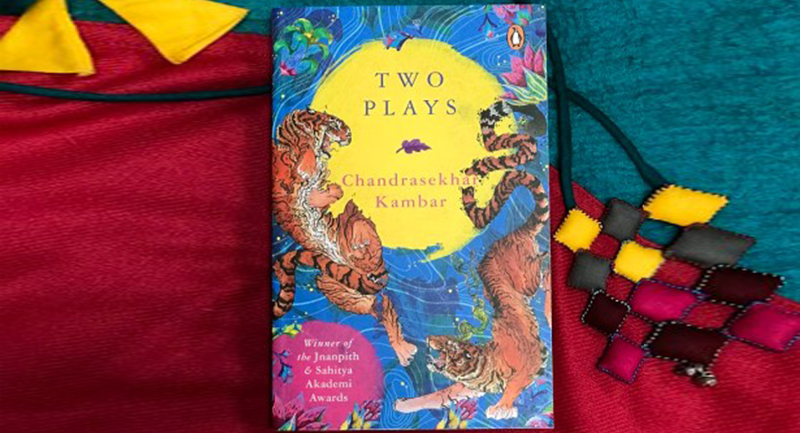
Translated by Krishna Manavalli, Two Plays brings together two of the most celebrated stories from award-winning playwright Chandrasekhar Kambar.

The first play, The Bringer of Rain: Rishyashringya, tells the story of a village afflicted with a deadly famine eagerly awaits the arrival of the chieftain’s son, whose homecoming promises the return of rain.

The second play, Mahmoud Gawan, is set in the fifteenth-century Bahamani Sultanate, it follows Gawan’s rise to fame during a time of intense civil strife when empires routinely rose and fell.

Find a glimpse of the story in Kambar’s first play in the excerpt below!

*

From the play, ‘The Bringer of Rain: Rishyashringa’
Act I

SUTRADHARA: Brothers seated and brothers standing there!

We’re just raw youth, who came here

And right away got on to the stage.

The one who wrote our play is no seasoned

poet,


The ones who act are ignorant lads

If they slip up or go wrong,

Please don’t clap and laugh

And don’t try that gleeful double-whistle!

No, don’t even ask what kind of play this is!

If you don’t get it, don’t drag your chairs and

Yawn

We make no claims to poetic finesse,

But with love, we give you our little message.

Just think that this play was born here

amidst us.

Bear with us for a bit, forgive the flaws.

And you, our elders here, we salute you again!


(He breaks a coconut in a ritual manner and throws the bits on both sides of the stage. By now, it is getting dark. Village entrance. On the right of the stage, you see a raised platform. Backstage, you see a crowd. The people in the crowd are not interested in the Prelude taking place on the fore-stage. With a vacant look in their eyes, they move slowly and gather around the platform once the Prelude is over. In the Prelude, the acting, dialogue and the manner should all follow the style of the traditional folk play

Srikrishnaparijatha)

SUTRADHARA: How can I tell you of this? And how can I not?

Whatever I say, our words will sound

Like the clatter of broken pots and pans,

You miss the inner voice here, I know.

We say something, it means another thing—

True, there’s no rhyme or reason! But we can’t

walk away from this

We try to grasp ‘it’ in our words, grasp it and

see!

We struggle hard, yet when we open our lips

We are saying something, and you are hearing

another thing.

Of course, you make sense of nothing!

Where did we start, and where did we end?

All right, enough of this rant, let’s get to

business

We’ll go on the stage to act, but the play isn’t

new

If you ask me, so what? Life’s a play too, right?

Our faces are the theatres where this drama

unfolds,

God, what a lot of the daily drama!

Starts in the morning and goes on till you go

to bed

What pretensions, what masks!

Oh, True God, I pray to you,

Make the inside and outside seamless and

one!

But who knows, where, how, and in which

cave He is hiding!

Meanwhile, we talk, drink, eat and walk—

We don’t know who we are, do we?

Sometimes, when we bathe in the well—

We seem to recognize ourselves in the water.

And stretch our hands to touch it,

When we try to touch, it slips from our grasp,

When we try to grasp, it slithers from our

hold,

In the end, you just want to pinch your nose

and weep.

But weeping when you see a corpse is such an

old custom!

Anyway, what do we do now?

In the big mortar house, a huge tiger has

got in

There isn’t a drop of rain, there’s no crop in

the field.

The seeds we planted are burnt, the parched

earth is cracked,
With cracks like so many gaping mouths!
People’s faces look burnt, the green fields
have all gone dry.


Two Plays is a must-read for anyone wishing to dip a toe into the rich water of Kannada storytelling and folklore!

Can you Compare Delhi and Peshawar?

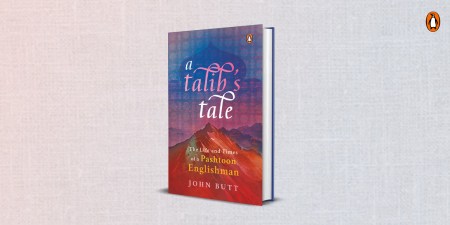
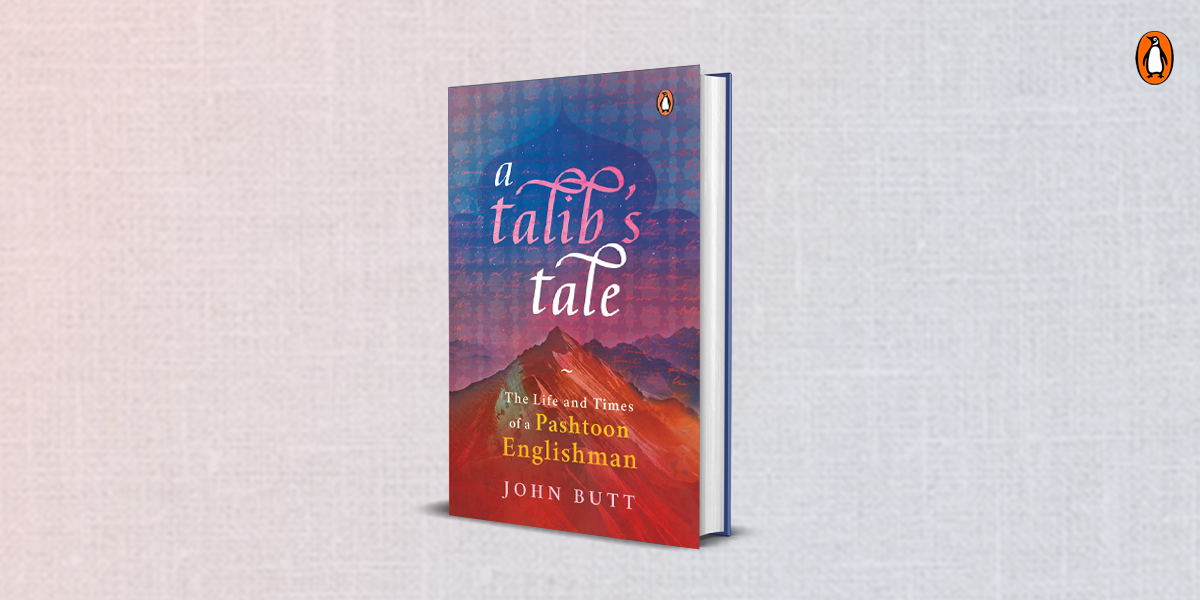
John Butt came to Swat in 1970 as a young man in search of an education he couldn’t get from his birthplace in England. He travels around the region, first only with friends from his home country, but as he befriends the locals and starts to learn about their culture and life, he soon finds his heart turning irrevocably Pashtoon.

Read an excerpt from his book, A Talib’s Tale below:


A Talib’s Trade


The best provision is that which one has worked for, with the labour of one’s own hands.

—Hadith


1973


I owe a lot to Maulana Khan Afzal, but two things in particular. For one, he instilled in me a love of India. Secondly, he showed me practically that one should always work for one’s living.

When I said to Samar Gul in Bara that I was going to the Afridi heartland of Tirah Maidan, he immediately mentioned Khan Afzal. Laiq’s family had some land in Tirah, and he and I had decided to move there for the summer. : ‘That is great,’ Samar Gul said, ‘you will be able to study with Maulana Khan Afzal.’ Like the Sarkai maulvi sahib, Maulana Khan Afzal was an eminent scholar, but at the time he did not have any students residing with him. He was able to devote all his time to tutoring me. I believe it was largely because Tirah was so inaccessible that there were no other students studying with the maulana. Later on, in the late nineties when I visited Maulana Khan Afzal again, he had a good ten to twelve students studying with him. He had become a focal point for talibs, as the Sarkai maulvi sahib had been in the 1970s.

Every day, with my books under my arm, I would make the forty-five-minute walk from Saddar Khel, where Laiq lived, to Landi Kas. Tirah Maidan is a huge, expansive plateau, the like of which there are many in Afghanistan—the Gardez and Logar plateaus are two that spring to mind. The difference with Tirah Maidan is that it is surrounded by richly forested hills, while the hills that surround other Afghan plateaus are mostly bare. Two tributaries of the Bara river meet at the centre of Tirah Maidan, the Malik-Din Khel Bagh. It is the natural capital of Tirah Maidan. The land dips towards that point, as do the streams and the people. From the eastern side, the tribes of Zakha Khel and the Lower Qambar Khels, known as Shalobaris, from the western side the huge swathe of Malik-Din Khel territory, and beyond that the Upper Qambar Khels. From Saddar Khel, I would walk down towards the Malik-Din Khel Bagh, then fork right towards Landi Kas, tucked in a hillside between Bagh and Dunga in Sholobar territory.

I had been studying a Sufi type of collection of Hadith, entitled Riyadh’as-Saliheenthe Path of the Righteous. I say it was Sufi oriented since it was mostly organized according to the virtues that Sufis strive to attain—repentance, patience, sincerity, trust in Allah, steadfastness. It is very spiritually oriented. I am glad I began my study of Hadith with this book. It has remained my favourite collection of Hadith—extremely cleansing and refreshing. However, Khan Afzal switched me to the more mainstream and standard Mishkat’al-MasabihMishkat is arranged more conventionally, according to the various strands of jurisprudence: prayer, fasting and the other forms of worship or ibadat—one’s interaction with Allah—followed by muamilat—one’s dealings with other human beings. In the entire Islamic canon, there is this distinction between the rights of Allah—huqooq’Allah—and the rights of one’s fellow beings, indeed of all Allah’s creatures—huqooq’al-ibad. While in Hadith study Khan Afzal went for the more orthodox Mishkat, in jurisprudence, his choice of book for my study was distinctly unorthodox. His preference was Taaleem’al-Islam, written in Urdu by his own teacher, Mufti Kefayatullah of Delhi. ‘Along with learning Islamic jurisprudence—fiqh—you will learn Urdu,’ he recommended. For Taaleem’al-Islam I went outside with his elder son Abdul Hakeem, then a teenager. I guess Abdul Hakeem felt more comfortable teaching me with his father not immediately on hand. We sat on the verge of the field, had a laugh and chatted a lot, while at the same time also reading Taaleem’al-Islam.

In encouraging me to learn Urdu, it was as though the maulana had a premonition or was goading me in the direction of study in India. It had not been that long, maybe twenty or twenty-five years, since he had returned from studying in the Aminiya madrasa in Delhi. India had rubbed off on him to a considerable degree, in a way making him an unusual Afridi. He even continued to wear a lungi—a skirt-like garment favoured by Muslims of India—at home. Pashtoons generally consider this garment effeminate. Even the maulana would not be seen in that garment outside the home. I have replicated Maulana Khan Afzal in this regard. Even when I am in Afghanistan, I wear a lungi in my place of residence; when I am in north India, I wear my lungi a little further afield, as far as the local shops; when I am in south India, I wear a lungi pretty much all the time. At the time when I was studying with the maulana, I used to ask him a lot about India. In a memorable phrase, he once told me that ‘even the dogs of India have manly virtues’—’da Hindustan spi ham saritob laree.’ ‘What’s Delhi like, compared to Peshawar?’ I once asked. ‘What is Hangu like compared to Peshawar?’ he asked rhetorically, referring to a town in the Frontier province, where buses set out towards Tirah. I answered that it was just a tiny town by comparison to Peshawar. ‘Well, so is Peshawar tiny compared to Delhi.’

Yet at the same time the maulana was the most staunchly Afridi of all the Panjpiris. He absolutely loved his native Tirah. I am getting ahead of myself here, but when he was expelled from Tirah along with other Panjpiris and resided for a while in Peshawar, he pined for his motherland so much that he used to console himself by reciting poems written by muhajirs—those who had emigrated from Mecca to Medina at the time of the Holy Prophet—expressing their homesickness for Mecca. He was also invariably cordial with his fellow Afridis, irrespective of whether they subscribed to his Panjpiri views or not. I never saw him take issue or argue with anyone about matters of dogma. He would enact his duties as the pre-eminent Islamic scholar in Tirah Maidan, in the course of which he would explain how important it was to believe in the oneness of Allah and to follow the Sunna of the Holy Prophet. These two things—Tauhid and Sunna—are the twin pillars on which Panjpiri dogma is founded. But he would never become aggressive towards those who did not subscribe to Panjpiri beliefs.


A Talib’s Tale The Life and Times of a Pashtoon Englishman is available now (also as an e-book)!

Kurumba- A Tribe That Possesses Magic

The Maria girls from Bastar practise sex as an institution before marriage, but with rules-one may not sleep with a partner more than three times; the Hallaki women from the Konkan coast sing throughout the day-in forests, fields, the market and at protests; the Kanjars have plundered, looted and killed generation after generation, and will show you how to roast a lizard when hungry.

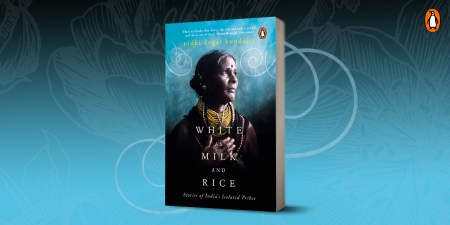
White as Milk and Rice weaves together prose, oral narratives and Adivasi history to tell the stories of six remarkable tribes of India-reckoning with radical changes over the last century-as they were pulled apart and thrown together in ways none of them fathomed.

Here’s an excerpt from the book below:

Lying on the mattress, Mani follows the movement of his father’s breathing. Moments ago, he had watched his father’s sweaty hips thrust up and down while his stepmother, Bindu, lay still beneath him, muffling her pain. His father stayed silent, though maybe his lips kept moving – he was always moving his lips as though he were talking to someone invisible. A mongrel laid beside Mani’s feet, its ears pricked for the sound. Each time his stepmother moaned, the dog yelped.

Like most other children in Hulikkal, a small village in the Nilgiris, Mani lives in one-room mud hut, where pots and pans are pushed aside every night to make room for mats, where they can hear their parents make love, or whatever else it is, through the mosquito net that hangs between them. He shifts on the floor; his upper back hurts from being slammed against walls by his angry father when he had come back jobless from the Badaga village.

“I can’t pay for the giant morsels you eat any more,” he had shouted as he thrashed Mani. Mani wonders what it must be like growing up in the big Badaga houses he saw today, where children sleep in different rooms, thick brick and cement walls separating them from their parents.

He had not seen anything quite like the homes that appeared in the Badaga village: concrete square structures with windows painted smooth in purple, green and blue, with large vegetable patches or a stretch of tea estate sloping down in front. Each home had a little chimney with smoke swirling from it like the incense sticks his father used for the pujas.

The trees and bushes were all trimmed; from the top of the hills, he could see fields of tea, with men and women moving through them, carrying their baskets on their backs, their feet stained red from the soil. When it rains in the Nilgiris, this red earth trickles like blood under its green skin.

Earlier in the day, Mani and his uncle had walked uphill after getting off the bus; the long walk had made his legs hurt, but that did not bother him. He was willing to cross many more such hills. In the absence of trees, that part of the Nilgiris was full of gusty wind that stung his eyes till tears stained his cheeks.

When his uncle spoke, the winds carried his voice louder than he meant it to be, “I told them you already know sowing”; he’d brought him here for a daily wage job at a tea garden. Mani nodded, although he’d hardly worked in fields: They had only a small plot where they grew vegetables and some millet.

On other days, they ate what they collected – roots of yam, herbs and honey – from the forest where they lived or rice given to them by the government. This village, meanwhile, only housed the Badagas, an educated, prosperous tribe that had migrated to the Nilgiris in the early twelfth century. The estate owner his uncle was taking him to had political aspirations and everything he did was to be transactional, driven by the desire to secure votes. Among his pet constituencies were the hamlets of the Kurumbas, also some of the poorest people in Nilgiris, and the area beyond.

“Call him appa,” his uncle insisted, in the Alu Kurumba language, a mix of Tamil and Kannada.

“Remember, you’re a Kurumba. Do not stare at their family members.” Mani nodded, though his uncle had already told him this many times, just as he had told him to pat his hair down and not to say inane things: They are all educated, so don’t talk any jungle hocus-pocus.

Mani wished people did not speak to him as if he were a jungle idiot; that said, he couldn’t help but gape at the women who were walking their children to school. How smooth their skin was, their hair shining with oil, decorated with jasmine and plaited neatly with ribbons; their eyes, unlike the yellowed eyes of Kurumbas, were as white as their teeth.

Minutes later, Mani waited outside the Badaga man’s house, while a few boys chatted on their way back from school, clapping each other’s backs, laughing as they walked past him. Only a few from his hamlet went to school, but he could read what was written on their bag – “Government”. He recognised the word from its shape – it was on every pamphlet and poster handed to them.

One of the boys said something that made the others shout with laughter. Mani bunched the hole in his shirt with his fist while admiring their uniforms. They then slowed their steps to look back at their friends coming behind them, signalling them to join. That was what he wanted to do when he got older – saunter with friends through these neat little hills, talk and laugh.

When Mani looked at them again, one of the them seemed to be pointing at him, at his hair matted like a mop on his head, teeming with vermin. After some whispering, one of the boys, pretending timidity, wrung his hands beseechingly before Mani, “Spare me, oh Kurumba! Spare me from your sorcery,” and ran up the lane with the others, received by them with a hoot of laughter and much back-slapping. Mani had squeezed his eyes shut against the fierce brightness in which the boy’s oiled head laughed and moved among the waves of sudden bright sunlight.

When he recovered his vision, Mani ran behind them, but only mustered enough courage to spit in their compound. Before the Badaga estate owner could see them, his uncle tugged at his wrist and hurried him back to the bus stop. The sun was sinking behind the mountains without any play of colours or movement, save for their flustered stomp downhill.

It was only in these last few years that his forest tribe, the Kurumbas, had started working in the fields of Badagas during the day. Until a few years ago, whenever the forest tribals came in view of a Badaga, word flashed through their village, and women and children ran for the safety of home, hiding inside till the Kurumbas had gone.

If Mani knew a spell or two, he would have twisted those boys’ knickers till they fell screaming from groin pain, and practise the sorcery that they claimed his people knew.

The Kurumbas, they said, had medicines that could put all the inhabitants of a Badaga village to sleep before slinking back into the woods. Their ace sorcerer, an odikara, could make openings in the fence, and the Badaga’s livestock, under his spell, would follow him through it without so much as a cluck or a bleat. They could, apparently, turn into bears and kill people, just as they knew how to counter the other spells, to remove or prevent misfortune.

Many decades ago, when the Badaga grandfathers were little boys still hanging from their mothers’ waists, one of their elders returned from a Kurumba settlement situated outside the jungles, where he went to scout a plot for tea planting. He came back breathless, just about stuttering that their end was near and that a monster was around. Now, a Badaga knew that if a Kurumba sorcerer was casting spells, he could be appeased with rice, oil, salt and clothes. But what was this big brown animal he was screaming about, its eyes glowing red?

As the story goes, the goats, hens and cows were restless; they knew for certain that the elderly man had seen an irate Kurumba-turned-monster. All night, they howled in their sheds and tapped the ground, and the villagers slept fitfully, imagining figures and shapes in the hilly darkness.

The Badaga elders today still fear the sorcerer Kurumbas, often banding against them; their school-going children, though, have less faith in the Kurumbas’s magical abilities. “Isn’t your father, what is his name…Moopan? The limping old man who pretends to be a doctor?” a boy had teased Mani at the bus stop.

The Kurumba magic was wearing off, and a pervasive sense of futility remained. There it was, a distant murmur telling Mani that this fat Badaga life was not his birthright; there was always the possibility of running into people who spoke in hushed whispers around him; always a chance that however clean a shirt he wore, a passer-by may assume from his yellow eyes and uncouth hair that he was not a farm owner but the son of Moopan, the limping old sorcerer. His uncle had fallen asleep on the bus ride back home; Mani’s eyes burnt as he looked out at the rolling tea estates of the Badagas.


White as Milk and Rice has stories of India’s isolated tribes.

Life After a War

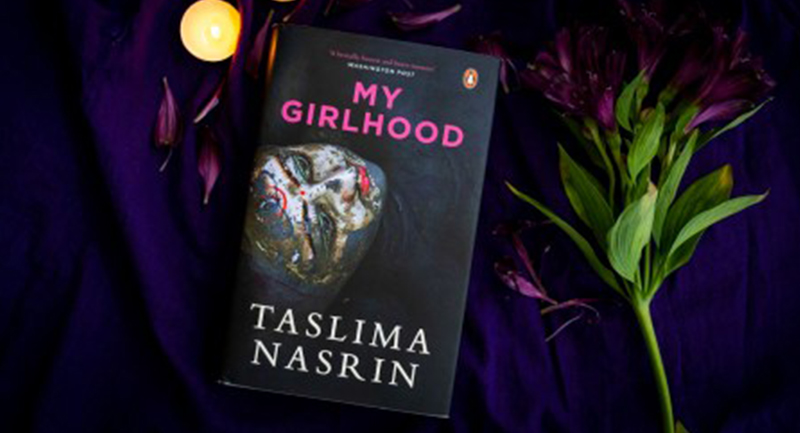
Translated by Maharghya Chakraborty, this latest translation of Taslima Nasrin’s celebrated memoir recollects Nasrin’s early years against the backdrop of the Bangladesh Liberation War of 1971.

My Girlhood revisits Nasrin’s memories of war, trauma, survival, and the beginning of a journey that redefined her world.

Find an excerpt below that gives us a glimpse into life after the War.

*

After the War

The murmurs continued for a few years. Unrest among the people continued to rise as well. Sheikh Mujib formed a political party called Baksal and prohibited all other parties.

‘What sort of government is this that lets its people die in a famine because they have no food?’ Father said one day. Bearded men wearing fez caps materialized out of nowhere and began to clamour that such an Independence was of no value. The country needed to be put back under Pakistani rule. Boromama sighed and said he did not know which direction the country was headed.

‘The government is doing things that did not happen even when Pakistan was ruling us. They are celebrating Shab-e-Baraat in Banga Bhaban with so much pomp. It never used to happen back when this was East Pakistan. Mujib attended an Islamic conference recently. Russia helped us so much during the war and here Mujib is bent on making Bangladesh a part of the Islamic world. The government is even saying things against India. Would we have become free if India had not sent its forces?’

I understood very little of politics. The only thing I knew was that I liked listening to Sheikh Mujib’s 7 March speech whenever it was played on the radio. I would get goosebumps from excitement. ‘This struggle is a struggle for Independence, this struggle is a struggle for freedom,’ this was not just a slogan but a verse that could make the blood boil. In our music classes we would sing ‘Joy Bangla, long live Bangla!’ It was not merely a song, it was something greater, something that sent a jolt through the heart. Every few days pandals would be built in the neighbourhood for music and dance programmes. Every time they would play something on the mike I would be off to see it. Boys and girls would play the harmonium and practise singing and dancing. They all looked so beautiful and their songs always managed to shake me to the core. Like it used to happen while listening to Khudiram’s songs. Kana mama used to tell us Khudiram’s stories, how a young boy had bombed a British Governor-General and embraced death, all for the sake of freedom. I wanted to be like Khudiram, as courageous and as devil may- care.

Then suddenly one day, quite abruptly, something happened that plunged the city into uneasiness again. People gathered on the roads to talk as if the world was about to come crashing down on them any moment. Some had radios stuck to their ear, faces dry, eyes threatening to pop out. What was the matter again? The days of sticking close to the radio for news had come to an end back in ’71, so what had happened again! Whenever things in the country were tense in any way everyone tended to switch on BBC radio for news. No one had too much faith on our own broadcasters. Father too did as expected. I was asked to turn the knob of the radio to try and catch BBC, a big responsibility I felt very proud of having been given. Father never ordered me to do anything except studying, I was never usually asked to participate in anything else. Earlier it was either Dada or Chotda who were asked to turn the knob while I had to stand apart and watch. But that day Dada was away on a work trip to Sherpur for a couple of days. Chotda was not even living with us any more. Hence, the responsibility fell on me. I had almost found the BBC channel when Father asked me to stop. Words could be heard over the ether, broken fragments of half-truncated news.

Sheikh Mujib was dead.


From her birth on a holy day to the dawn of womanhood at fourteen to her earliest memories that alternate between scenes of violence, memories of her pious mother, the rise of religious fundamentalism, the trauma of molestation and the beginning of a journey that redefined her world, My Girlhood is a tour de force.


A Talib’s Tale – An Excerpt


John Butt came to Swat in 1970 as a young man in search of an education he couldn’t get from his birthplace in England. He travels around the region, first only with friends from his home country, but as he befriends the locals and starts to learn about their culture and life, he soon finds his heart turning irrevocably Pashtoon.

Containing anecdotes from his life both before and since he shifted to Afghanistan, and with a keen and optimistic attitude towards becoming the best version of himself, John Butt tells a wonderful and heartfelt tale of a man who finds a home in the most unexpected place.


Read an excerpt from the book below:


I owe a lot to Maulana Khan Afzal, but two things in particular. For one, he instilled in me a love of India. Secondly, he showed me practically that one should always work for one’s living.
When I said to Samar Gul in Bara that I was going to the Afridi heartland of Tirah Maidan, he immediately mentioned Khan Afzal. Laiq’s family had some land in Tirah, and he and I had decided to move there for the summer. : ‘That is great,’ Samar Gul said, ‘you will be able to study with Maulana Khan Afzal.’ Like the Sarkai maulvi sahib, Maulana Khan Afzal was an eminent scholar, but at the time he did not have any students residing with him. He was able to devote all his time to tutoring me. I believe it was largely because Tirah was so inaccessible that there were no other students studying with the maulana. Later on, in the late nineties when I visited Maulana Khan Afzal again, he had a good ten to twelve students studying with him. He had become a focal point for talibs, as the Sarkai maulvi sahib had been in the 1970s.
Every day, with my books under my arm, I would make the forty-five-minute walk from Saddar Khel, where Laiq lived, to Landi Kas. Tirah Maidan is a huge, expansive plateau, the like of which there are many in Afghanistan—the Gardez and Logar plateaus are two that spring to mind. The difference with Tirah Maidan is that it is surrounded by richly forested hills, while the hills that surround other Afghan plateaus are mostly bare. Two tributaries of the Bara river meet at the centre of Tirah Maidan, the Malik-Din Khel Bagh. It is the natural capital of Tirah Maidan. The land dips towards that point, as do the streams and the people. From the eastern side, the tribes of Zakha Khel and the Lower Qambar Khels, known as Shalobaris, from the western side the huge swathe of Malik-Din Khel territory, and beyond that the Upper Qambar Khels. From Saddar Khel, I would walk down towards the Malik-Din Khel Bagh, then fork right towards Landi Kas, tucked in a hillside between Bagh and Dunga in Sholobar territory.
I had been studying a Sufi type of collection of Hadith, entitled Riyadh’as-Saliheenthe Path of the Righteous. I say it was Sufi oriented since it was mostly organized according to the virtues that Sufis strive to attain—repentance, patience, sincerity, trust in Allah, steadfastness. It is very spiritually oriented. I am glad I began my study of Hadith with this book. It has remained my favourite collection of Hadith—extremely cleansing and refreshing. However, Khan Afzal switched me to the more mainstream and standard Mishkat’al-Masabih. Mishkat is arranged more conventionally, according to the various strands of jurisprudence: prayer, fasting and the other forms of worship or ibadat—one’s interaction with Allah—followed by muamilat—one’s dealings with other human beings. In the entire Islamic canon, there is this distinction between the rights of Allah—huqooq’Allah—and the rights of one’s fellow beings, indeed of all Allah’s creatures—huqooq’al-ibad. While in Hadith study Khan Afzal went for the more orthodox Mishkat, in jurisprudence, his choice of book for my study was distinctly unorthodox. His preference was Taaleem’al-Islam, written in Urdu by his own teacher, Mufti Kefayatullah of Delhi. ‘Along with learning Islamic jurisprudence—fiqh—you will learn Urdu,’ he recommended. For Taaleem’al-Islam I went outside with his elder son Abdul Hakeem, then a teenager. I guess Abdul Hakeem felt more comfortable teaching me with his father not immediately on hand. We sat on the verge of the field, had a laugh and chatted a lot, while at the same time also reading Taaleem’al-Islam.
In encouraging me to learn Urdu, it was as though the maulana had a premonition or was goading me in the direction of study in India. It had not been that long, maybe twenty or twenty-five years, since he had returned from studying in the Aminiya madrasa in Delhi. India had rubbed off on him to a considerable degree, in a way making him an unusual Afridi. He even continued to wear a lungi—a skirt-like garment favoured by Muslims of India—at home. Pashtoons generally consider this garment effeminate. Even the maulana would not be seen in that garment outside the home. I have replicated Maulana Khan Afzal in this regard. Even when I am in Afghanistan, I wear a lungi in my place of residence; when I am in north India, I wear my lungi a little further afield, as far as the local shops; when I am in south India, I wear a lungi pretty much all the time. At the time when I was studying with the maulana, I used to ask him a lot about India. In a memorable phrase, he once told me that ‘even the dogs of India have manly virtues’—’da Hindustan spi ham saritob laree.’ ‘What’s Delhi like, compared to Peshawar?’ I once asked. ‘What is Hangu like compared to Peshawar?’ he asked rhetorically, referring to a town in the Frontier province, where buses set out towards Tirah. I answered that it was just a tiny town by comparison to Peshawar. ‘Well, so is Peshawar tiny compared to Delhi.’
Yet at the same time the maulana was the most staunchly Afridi of all the Panjpiris. He absolutely loved his native Tirah. I am getting ahead of myself here, but when he was expelled from Tirah along with other Panjpiris and resided for a while in Peshawar, he pined for his motherland so much that he used to console himself by reciting poems written by muhajirs—those who had emigrated from Mecca to Medina at the time of the Holy Prophet—expressing their homesickness for Mecca. He was also invariably cordial with his fellow Afridis, irrespective of whether they subscribed to his Panjpiri views or not. I never saw him take issue or argue with anyone about matters of dogma. He would enact his duties as the pre-eminent Islamic scholar in Tirah Maidan, in the course of which he would explain how important it was to believe in the oneness of Allah and to follow the Sunna of the Holy Prophet. These two things—Tauhid and Sunna—are the twin pillars on which Panjpiri dogma is founded. But he would never become aggressive towards those who did not subscribe to Panjpiri beliefs.


A Talib’s Tale –The Life and Times of a Pashtoon Englishman is available now (also as an e-book)!


Should You Dance When You’re Pregnant? – An Excerpt from ‘Amma Mia’

Is my baby not well?

When can I introduce my baby to solid foods?

Becoming a new mother can be an exciting yet overwhelming time. No matter how prepared you are, there will always be many confusing moments, opinions and a whole lot of drama! And just like any other new mom, Esha Deol Takhtani was faced with many such questions soon after the birth of her two daughters-Radhya and Miraya.

Packed with advice, tips, stories and easy and delicious recipes for toddlers, Amma Mia reflects the personal journey of one woman’s transformation into a mother. Informative and easy to follow, this book will help new mothers navigate the ups and downs of raising a healthy toddler and make their child fall in love with food.

Read an excerpt from the book below:


When she[Hema Malini] was five months pregnant, my mother was shooting for two films—Satte Pe Satta and Razia Sultan. In the song, ‘Dukki Pe Dukki Ho’, you can clearly see her bump. That’s me in there! And for Razia Sultan, she had to ride a horse while pregnant. She tells me that I’m restless and energetic because she was physically active during her nine months. She also danced onstage during her pregnancy. You must remember that she was doing this during the 1980s, when it was radical for a woman to be so active while pregnant.


My mother is a superwoman like that, who has always broken the rules and stereotypes of what women should be like. She has always inspired me to push the limits. In fact, I will never forget what she told me when I was pregnant. She said, ‘You’re not sick that you need to rest all the time. You’re simply pregnant. After delivery, your body is at its most elastic and flexible. You can mould it into any shape you want.’


And so I followed her advice unconditionally. I performed the dance ballet, Ramayana, on stage; I worked on a short film called Cakewalk; I wrote this book during my second pregnancy; and I had many other projects in the pipeline.


Channelling your inner creativity is a great way to enrich your nine months because the energy and positivity will most certainly be transferred to your child. That being said, no two pregnancies are alike. If you have complications or have been advised rest by your gynaecologist, do so. Be cautious. Don’t be silly or impulsive. From the day you know you’re pregnant, you must be careful. There will be many people with all sorts of advice during this time but pay heed to only one person: your gynaecologist.


For more tips and tricks, check out Amma Mia by Esha Deol Takhtani.

error: Content is protected !!