Read an extract from the epic new novel by the internationally acclaimed and bestselling author of 1Q84, Norwegian Wood and Kafka on the Shore.
Today when I awoke from a nap the faceless man was there before me. He was seated on the chair across from the sofa I’d been sleeping on, staring straight at me with a pair of imaginary eyes in a face that wasn’t.
The man was tall, and he was dressed the same as when I had seen him last. His face-that-wasn’t-a-face was half hidden by a wide-brimmed black hat, and he had on a long, equally dark coat.
“I came here so you could draw my portrait,” the faceless man said, after he’d made sure I was fully awake. His voice was low, toneless, flat. “You promised you would. You remember?”
“Yes, I remember. But I couldn’t draw it then because I didn’t have any paper,” I said. My voice, too, was toneless and flat. “So to make up for it I gave you a little penguin charm.”
“Yes, I brought it with me,” he said, and held out his right hand. In his hand—which was extremely long—he held a small plastic penguin, the kind you often see attached to a cell phone strap as a good-luck charm. He dropped it on top of the glass coffee table, where it landed
with a small clunk.
“I’m returning this. You probably need it. This little penguin will be the charm that should protect those you love. In exchange, I want you to draw my portrait.”
I was perplexed. “I get it, but I’ve never drawn a portrait of a person without a face.”
My throat was parched.
“From what I hear, you’re an outstanding portrait artist. And there’s a first time for everything,” the faceless man said. And then he laughed.
At least, I think he did. That laugh-like voice was like the empty sound of wind blowing up from deep inside a cavern.
He took off the hat that hid half of his face. Where the face should have been, there was nothing, just the slow whirl of a fog.
I stood up and retrieved a sketchbook and a soft pencil from my studio. I sat back down on the sofa, ready to draw a portrait of the man with no face. But I had no idea where to begin, or how to get started. There was only a void, and how are you supposed to give form to something
that does not exist? And the milky fog that surrounded the void was continually changing shape.
“You’d better hurry,” the faceless man said. “I can’t stay here for long.”
My heart was beating dully inside my chest. I didn’t have much time. I had to hurry. But my fingers holding the pencil just hung there in midair, immobilized. It was as though everything from my wrist down into my hand were numb. There were several people I had to protect, and all I was able to do was draw pictures. Even so, there was no way I could draw him. I stared at the whirling fog. “I’m sorry, but your time’s up,” the man without a face said a little while later. From his faceless mouth, he let out a deep breath, like pale fog hovering over a river.
“Please wait. If you give me just a little more time—”
The man put his black hat back on, once again hiding half of his face.
“One day I’ll visit you again. Maybe by then you’ll be able to draw me. Until then, I’ll keep this penguin charm.”
Then he vanished. Like a mist suddenly blown away by a freshening breeze, he vanished into thin air. All that remained was the unoccupied chair and the glass table. The penguin charm was gone from the tabletop.
It all seemed like a short dream. But I knew very well that it wasn’t. If this was a dream, then the world I’m living in itself must all be a dream.
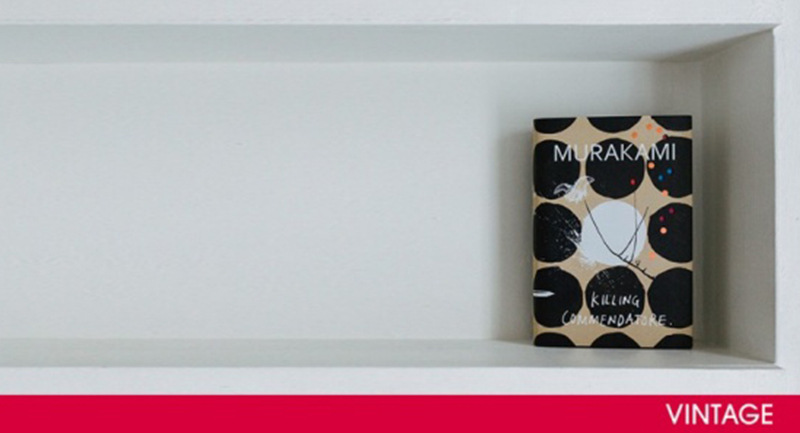
Maybe someday I’ll be able to draw a portrait of nothingness. Just like another artist was able to complete a painting titled Killing Commendatore. But to do so I would need time to get to that point. I would have to have time on my side.
IF THE SURFACE IS FOGGED UP
From May until early the following year, I lived on top of a mountain near the entrance to a narrow valley. Deep in the valley it rained constantly in the summer, but outside the valley it was usually sunny. This was due to the southwest wind that blew off the ocean. Moist clouds carried by the wind entered the valley, bringing rain as they made their way up the slopes. The house was built right on the boundary line, so often it would be sunny out in front while heavy rain fell in back. At first I found this disconcerting, but as I got used to it, it came to seem natural.
Low patches of clouds hung over the surrounding mountains. When the wind blew, these cloud fragments, like some wandering spirits from the past, drifted uncertainly along the surface of the mountains, as if in search of lost memories. The pure white rain, like fine snow, silently swirled around on the wind. Since the wind rarely let up, I could even get by in the summer without air conditioning.
The house itself was old and small, but the garden in back was spacious. Left to its own devices it was a riot of tall green weeds, and a family of cats made its home there. When a gardener came over to trim the grass, the cat family moved elsewhere. I imagine they felt too exposed. The family consisted of a striped mother cat and her three kittens. The mother was thin, with a stern look about her, as if life had dealt her a bad hand.
The house was on top of the mountain, and when I went out on the terrace and faced southwest, I could catch a glimpse of the ocean through the woods. From there the ocean was the size of water in a washbowl, a minuscule sliver of the huge Pacific. A real estate agent I know told me that even if you can see a tiny portion of the ocean like I could here, it made all the difference in the price of the land. Not that I cared about an ocean view. From far off, that slice of ocean was nothing more than a dull lump of lead. Why people insisted on having an ocean view was beyond me. I much preferred gazing at the surrounding mountains. The mountains on the opposite side of the valley were in constant flux, transforming with the seasons and the weather, and I never grew tired of these changes.
Back then my wife and I had dissolved our marriage, the divorce papers all signed and sealed, but afterward things happened and we ended up making a go of marriage one more time. I can’t explain it. The cause and effect of how this all came about eluded even those of us directly involved, but if I were to sum it up in a word, it would come down to some overly trite phrase like “we reconciled.” Though the nine-month gap before the second time we married (between the dissolution of our first marriage and the beginning of our second marriage, in other words) stood there, a mouth agape like some deep canal carved out of an isthmus.
Nine months—I had no idea if this was a long period or a short period for a separation. Looking back on it later, it sometimes seemed as though it lasted forever, but then again it passed by in an instant. My impression changed depending on the day. When people photograph an object, they often put a pack of cigarettes next to it to give the viewer a sense of the object’s actual size, but the pack of cigarettes next to the images in my memory expanded and contracted, depending on my mood at the time. Like the objects and events in constant flux, or perhaps in opposition to them, what should have been a fixed yardstick inside the framework of my memory seemed instead to be in perpetual motion.
Not to imply that all my memories were haphazard, expanding and contracting at will. My life was basically placid, well adjusted, and, for the most part, rational. But those nine months were different, a period of inexplicable chaos and confusion. In all senses of the word that period was the exception, a time unlike any other in my life, as though I were a swimmer in the middle of a calm sea caught up in a mysterious whirlpool that came out of nowhere.
That may be the reason why, when I think back on that time (as you guessed, these events took place some years ago), the importance, perspective, and connections between events sometimes fluctuate, and if I take my eyes off them even for a second, the sequence I apply to them is quickly supplanted by something different. Still, here I want to do my utmost, as far as I can, to set down a systematic, logical account. Maybe it will be a wasted effort, but even so I want to cling tightly to the hypothetical yardstick I’ve managed to fashion. Like a helpless swimmer who snatches at a scrap of wood that floats his way.
When I moved into that house, the first thing I did was buy a cheap used car. I’d basically driven my previous car into the ground and had to scrap it, so I needed to get a new one. In a suburban town, especially living alone on top of a mountain, a car was a must in order to go shopping. I went to a used Toyota dealership outside Odawara and found a great deal on a Corolla station wagon. The salesman called it powder blue, though it reminded me more of a sick person’s pale complexion. It had only twenty-two thousand miles on it, but the car had been in an accident at one point so they’d drastically reduced the sticker price. I took it for a test drive, and the brakes and tires seemed good. Since I didn’t plan to drive it on the highway much, I figured it would do fine.
Masahiko Amada was the one who rented the house to me. We’d been in the same class back in art school. He was two years older, and was one of the few people I got along well with, so even after we finished college we’d occasionally get together. After we graduated he gave up on being an artist and worked for an ad agency as a graphic designer. When he heard that my wife and I had split up, and that I’d left home and had nowhere to stay, he told me the house his father owned was vacant and asked if I’d like to stay there as a kind of caretaker. His father was Tomohiko Amada, a famous painter of Japanese-style paintings. His father’s house (which had a painting studio) was in the mountains outside Odawara, and after the death of his wife he’d lived there comfortably by himself for about ten years. Recently, though, he’d been diagnosed with dementia, and had been put in a high-end nursing home in Izu Kogen. As a result, the house had been empty for several months.
“It’s up all by itself on top of a mountain, definitely not the most convenient location, but it’s a quiet place. That I guarantee for sure,” Masahiko said. “The perfect environment for painting. No distractions whatsoever.”
The rent was nominal.
“If the house is vacant, it’ll fall apart, and I’m worried about breakins and fires. Just having someone there all the time will be a load off my mind. I know you wouldn’t feel comfortable not paying any rent, so I’ll make it cheap, on one condition: that I might have to ask you to leave on short notice.”
Fine by me. Everything I owned would fit in the trunk of a small car, and if he ever asked me to clear out, I could be gone the following day.
I moved into the house in early May, right after the Golden Week holidays. The house was a one-story, Western-style home, more like a cozy cottage, but certainly big enough for one person living alone. It was on top of a midsized mountain, surrounded by woods, and even Masahiko wasn’t sure how far the lot extended. There were large pine trees in the back garden, with thick branches that spread out in all directions. Here and there you’d find stepping stones, and there was a splendid banana plant next to a Japanese stone lantern.
Masahiko was right about it being a quiet place. But looking back on it now, I can’t say that there were “no distractions whatsoever.”
During the eight months after I broke up with my wife and lived in this valley, I slept with two other women, both of whom were married. One was younger than me, the other older. Both were students in the art class I taught.
When I sensed that the timing was right, I invited them to sleep with me (something I would normally never do, since I’m fairly timid and not at all used to that sort of thing). And they didn’t turn me down. I’m not sure why, but I had few qualms about asking them to sleep with me, and it seemed to make perfect sense at the time. I felt hardly a twinge of guilt at inviting my students to have sex with me. It seemed as ordinary as asking somebody you passed on the street for the time.
The first woman I slept with was in her late twenties. She was tall with large, dark eyes, a trim waist, and small breasts. A wide forehead, beautiful straight hair, her ears on the large side for her build. Maybe not exactly a beauty, but with such distinctive features that if you were an artist you’d want to draw her. (Actually I am an artist, so I did sketch her a number of times.) She had no children. Her husband taught history at a private high school, and he beat her. Unable to lash out at school, he took his frustrations out at home. He was careful to avoid her face, but when she was naked I saw all the bruises and scars. She hated me to see them and when she took off her clothes, she insisted on turning off the lights.
She had almost no interest in sex. Her vagina was never wet and penetration was painful for her. I made sure there was plenty of foreplay, and we used lubricant gel, but nothing made it better. The pain was terrible, and it wouldn’t stop. Sometimes she even screamed in agony.
Even so, she wanted to have sex with me. Or at least she wasn’t averse to it. Why, I wonder? Maybe she wanted to feel pain. Or was seeking the absence of pleasure. Or perhaps she was after some sort of selfpunishment. People seek all kinds of things in their lives. There was one thing, though, that she wasn’t looking for. And that was intimacy.
She didn’t want to come to my house, or have me come to hers, so to have sex we always drove in my car to a love hotel near the shore. We’d meet up in the large parking lot of a chain restaurant, get to the hotel a little after one p.m., and leave before three. She always wore a large pair of sunglasses, even when it was cloudy or raining. One time, though, she didn’t show up, and she missed art class too. That was the end of our short, uneventful affair. We slept together four, maybe five times.
The other married woman I had an affair with had a happy home life. At least it didn’t seem like her family life was lacking anything. She was forty-one then (as I recall), five years older than me. She was petite, with an attractive face, and she was always well dressed. She practiced yoga every other day at a gym and had a flat, toned stomach. She drove a red Mini Cooper, a new car she’d just purchased, and on sunny days I could spot it from a distance, glinting in the sun. She had two daughters, both of whom attended a pricey private school in upscale Shonan, which the woman was a graduate of too. Her husband ran some sort of company, but I never asked her what kind of firm it was. (Naturally I didn’t want to know.)
I have no idea why she didn’t flatly turn down my brazen sexual overtures. Maybe at the time I had some special magnetism about me that pulled in her spirit as if (so to speak) it were a scrap of iron. Or maybe it had nothing to do with spirit or magnetism, and she’d simply been needing physical satisfaction outside marriage and I just happened to be the closest man around.
Whatever it was, I seemed able to provide it, openly, naturally, and she commenced sleeping with me without hesitation. The physical aspect of our relationship (not that there was any other aspect) went smoothly. We performed the act in an honest, pure way, the purity almost reaching the level of the abstract. It took me by surprise when I suddenly realized this, in the midst of our affair.
But at some point she must have come to her senses, since one gloomy early-winter morning, she called me and said, “I think we shouldn’t meet anymore. There’s no future in it.” Or something to that effect. She sounded like she was reading from a script.
And she was absolutely right. Not only was there no future in our relationship, there was no real basis for it, no there there.
Back when I was in art school I mainly painted abstracts. Abstract art is a hard thing to define, since it covers such a wide range of works. I’m not sure how to explain the form and subject matter, but I guess my definition would be “paintings that are nonfigurative images, done in an unrestrained, free manner.” I won a few awards at small exhibitions, and was even featured in some art magazines. Some of my instructors and friends praised my work and encouraged me. Not that anyone pinned his hopes on my future, but I do think I had a fair amount of talent as an artist. Most of my oil paintings were done on very large canvases and required a lot of paint, so they were expensive to create. Needless to say, the possibility of laudable people appearing, ready to purchase an unknown artist’s massive painting to hang on the wall at their home, was pretty close to zero.
Since it was impossible to make a living painting what I wanted, once I graduated, I started taking commissions for portraits to make ends meet. Paintings of so-called pillars of society—presidents of companies, influential members of various institutes, Diet members, prominent figures in various locales (there were some differences in the width of these “pillars”), all painted in a figurative way. They were looking for a realistic, dignified, staid style, totally utilitarian types of paintings to be hung on the wall in a reception area or a company president’s office. In other words, my job compelled me to paint paintings that ran totally counter to my artistic aims. I could add that I did it reluctantly, and that still wouldn’t amount to any artistic arrogance on my part.
There was a small company in Yotsuya that specialized in portrait commissions, and through an introduction by one of my art school teachers, I signed an exclusive contract with them. I wasn’t paid a fixed salary, but if I turned out enough portraits, I made plenty for a young, single man to live on. It was a modest lifestyle—I was able to rent a small apartment alongside the Seibu Kokubunji railway line, usually managed to afford three meals a day, would buy a bottle of inexpensive wine from time to time, and went out on the occasional date to see a movie. Several years went by, and I decided that I’d focus on portrait painting for a fixed period, and then, once I’d made enough to live on for a while, I’d return to the kind of paintings I really wanted to do. Portraits were just meant to pay the rent. I never planned to paint them forever.