Publish with Us

Follow Penguin

Follow Penguinsters

Follow Penguin Swadesh

The Economic Puzzle of Demonetization – an excerpt

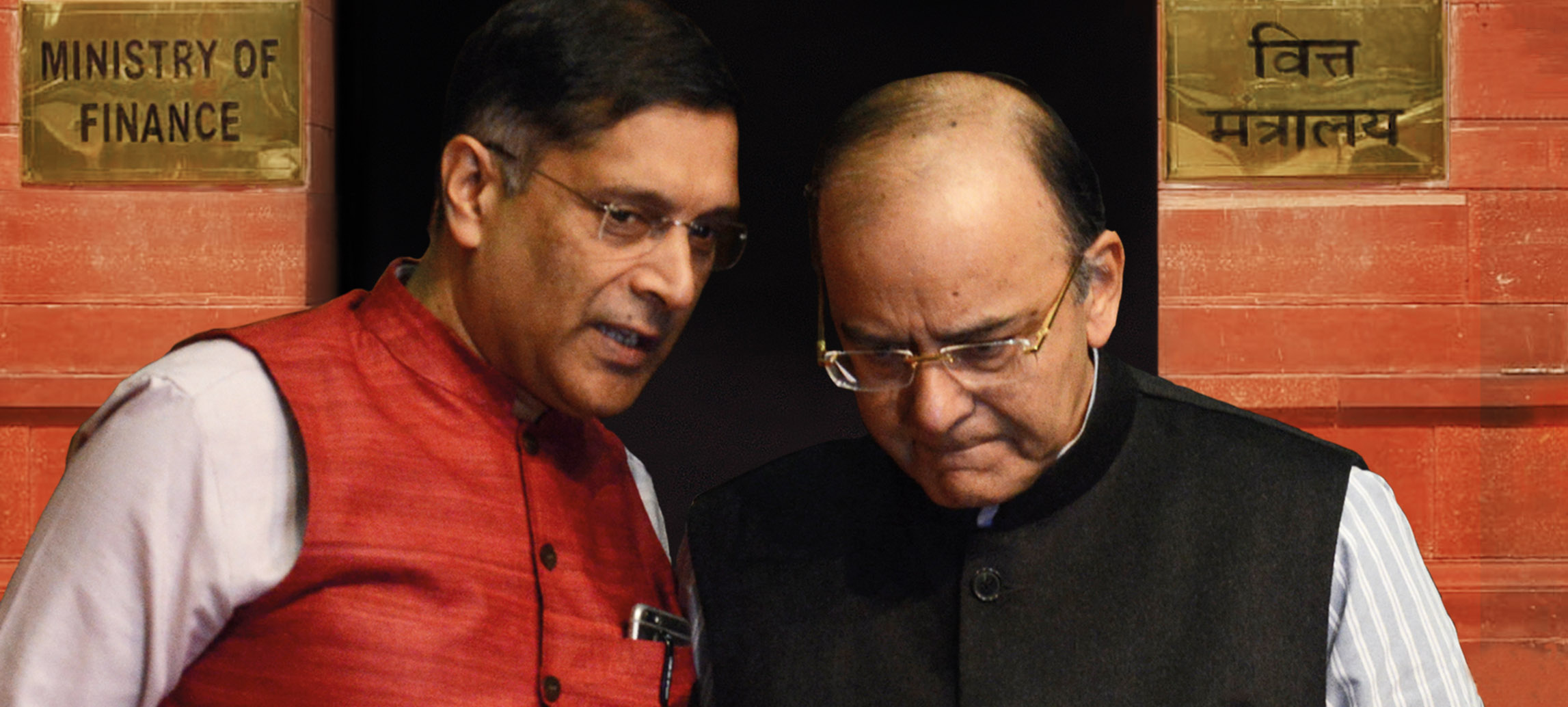
In his book Of Counsel: The Challenges of the ModiJaitley Economy, Arvind Subramanian provides an inside account of his rollercoaster journey as the chief economic advisor to the Government of India from 201418. Subramanian’s trusteeship saw the country through one of the most hotly contested and turbulent periods of economic governance and policymaking in recent decades, including the controversial recall of 85 per cent of circulated currency during demonetization.
In a chapter titled The Two Puzzles of Demonetization, he lays out his hypothesis on the political and economic puzzles of demonetization as a post facto analysis based on publicly known facts.
Puzzle 1: Why was demonetization so popular politically if it imposed economic costs? Specifically, why did demonetization turn out to be an electoral vote winner in the short-term (in the Uttar Pradesh elections of early 2017) if it imposed so much hardship on so many people?
Puzzle 2: Why didn’t the draconian 86 per cent reduction in the cash supply have bigger effects on overall economic growth? To put this more provocatively, the question was not whether demonetization imposed costs—it clearly did—but why it did not impose much greater costs?
Here is an excerpt of the second puzzle.


Why didn’t the draconian 86 per cent reduction in the cash supply have bigger effects on overall economic growth? To put this more provocatively, the question was not whether demonetization imposed costs—it clearly did—but why did it not impose much greater costs?
Demonetization was a massive, draconian, monetary shock: in one fell swoop 86 per cent of the currency in circulation was withdrawn. Figure 1 shows that real GDP growth was clearly affected by demonetization. Growth had been slowing even before, but after demonetization the slide accelerated. In the six quarters before demonetization growth averaged 8 per cent and in the seven quarters after, it averaged about 6.8 per cent (with a four-quarter window, the relevant numbers are 8.1 per cent before and 6.2 per cent after).

I don’t think anyone disputes that demonetization slowed growth. Rather, the debate has been about the size of the effect, whether it was 2 percentage points, or much less. After all, many other factors affected growth in this period, especially higher real interest rates, GST implementation and rising oil prices.
I do not have a strongly backed empirical view apart from the fact that the welfare costs especially on the informal sector were substantial.
As a monetary economist, though, what is striking is how small the effect was compared to the magnitude of the shock. There are many ways of seeing this. Figure 2 compares what happened to cash with what happened to nominal GDP. It is a stunning picture. Prior to demonetization, cash and GDP move closely together. Then, currency collapses and recovers (the dotted line), but through all of this, the economy seems to have been chugging along almost unmindful of the currency in circulation. You have to squint to see any downward movement of the solid black line (for nominal GDP) after demonetization: in fact, there isn’t, and all the downward blips reflect seasonality, which leads to a lower level of activity in the first (April–June) quarter every year.

What could possibly explain this apparent resilience? A number of hypotheses need to be considered. First and foremost, it could simply be an artefact of the way that GDP numbers are created. In India, there are no timely measures of informal sector activity, so it is proxied by formal sector indicators. Normally, this is not a problem, since the two move in tandem. But when a shock like demonetization occurs that primarily affects the informal sector, relying on formal indicators to measure overall activity will overstate GDP.
This hypothesis goes only a small way towards explaining the puzzle, since any squeeze in informal sector incomes would depress demand in the formal sector, and this effect should have been sizable.
As a result, we need to search for other explanations. One possibility is that people found ways around the note ban, for example by continuing to use the Rs 500 note even after its use had been formally banned, so the currency shock wasn’t actually as big as conventionally measured. Another possibility is that production was sustained by extending informal credit: people simply agreed to pay their bills as soon as currency became available. Finally, to a certain extent, people may have shifted from using cash to paying by electronic means, such as debit cards and electronic wallets.
Or, there may be other, completely different explanations that have eluded my understanding of demonetization, one of the unlikeliest economic experiments in modern Indian history.


Recognized as one of the Top 100 Global Thinkers according to Foreign Policy magazine, Arvind Subramanian’s Of CounselThe Challenges of the Modi-Jaitley Economy is a deep-dive into the man, the moments, the measures and the means


Meet the Characters from Anand Neelakantan's 'Vanara'

Baali and Sugreeva of the Vana Nara tribe were orphan brothers who were born in abject poverty and grew up as slaves like most of their fellow tribesmen. Sandwiched between the never-ending war between the Deva tribes in the north and the Asura tribes in the south, the Vana Naras seemed to have lost all hope. But Baali was determined not to die a slave. Aided by his beloved brother, Sugreeva, Baali built a country for his people. For a brief period in history, it seemed as if mankind had found its ideal hero in Baali.
But then fate intervened through the beautiful Tara, the daughter of a tribal physician. Loved by Baali and lusted after by Sugreeva, Tara became the cause of a fraternal war that would change history for ever.
The love triangle between Baali, Tara and Sugreeva is arguably the world’s first. Written by Anand Neelakantan Vanara is a classic tale of love, lust and betrayal. Let’s meet the characters.


Baali – the chief of Vana Naras, an indomitable warrior, a noble savage, and straight as an arrow. He loves his brother Sugreeva deeply and would give him anything he asks for – except Tara, who is the love of his life.

~

Sugreeva – The greatest warrior in Vana Nara tribe after Baali. He loves his brother and would do anything for him. He has always been the second man and for him, the end justifies his means. If he wasn’t lusting after Tara, his devotion to his brother was incomparable.

~

Tara – Daughter of an impoverished but principled and kindhearted tribal doctor. She was considered to be the wisest of all and the most desirable women as per Baali. She was deeply in love with Baali, her husband. If Baali had not been there, perhaps Sugreeva had a chance of marrying her.


Shakespearean in its tragic depth and epic in its sweep, Vanara gives voice to the greatest warrior in the Ramayana-Baali.

Home Remedies to Strengthen Your Lungs – Handy Tips from 'The Asthma Cure'

Given the levels of pollution in many metropolitan cities and states in India, most of us are able to identify the impact on our lungs. But did you know that many a times the medicines and bronchodilators prescribed to asthmatics to temporarily relieve the symptoms actually weaken the lungs over a period of time?
Using authentic remedies and principles from Ayurveda and macrobiotics, The Asthma Cure is a step-by-step practical guide with natural remedies, easy-to-follow wholesome recipes and daily food plans to help a person heal bronchial asthma, wheezing and other lung-related conditions naturally.
Listed below are a few quick home remedies and tips to strengthen your lungs:


Asthma is a curable disease. This is the primary reason Tarika Ahuja chose to write The Asthma Cure  and she hopes to work as an asthma revolutionary through workshops and awareness campaigns in order to break the myth that it is incurable.

6 Instances Highlighting the Pervasiveness of Caste in Everyday India

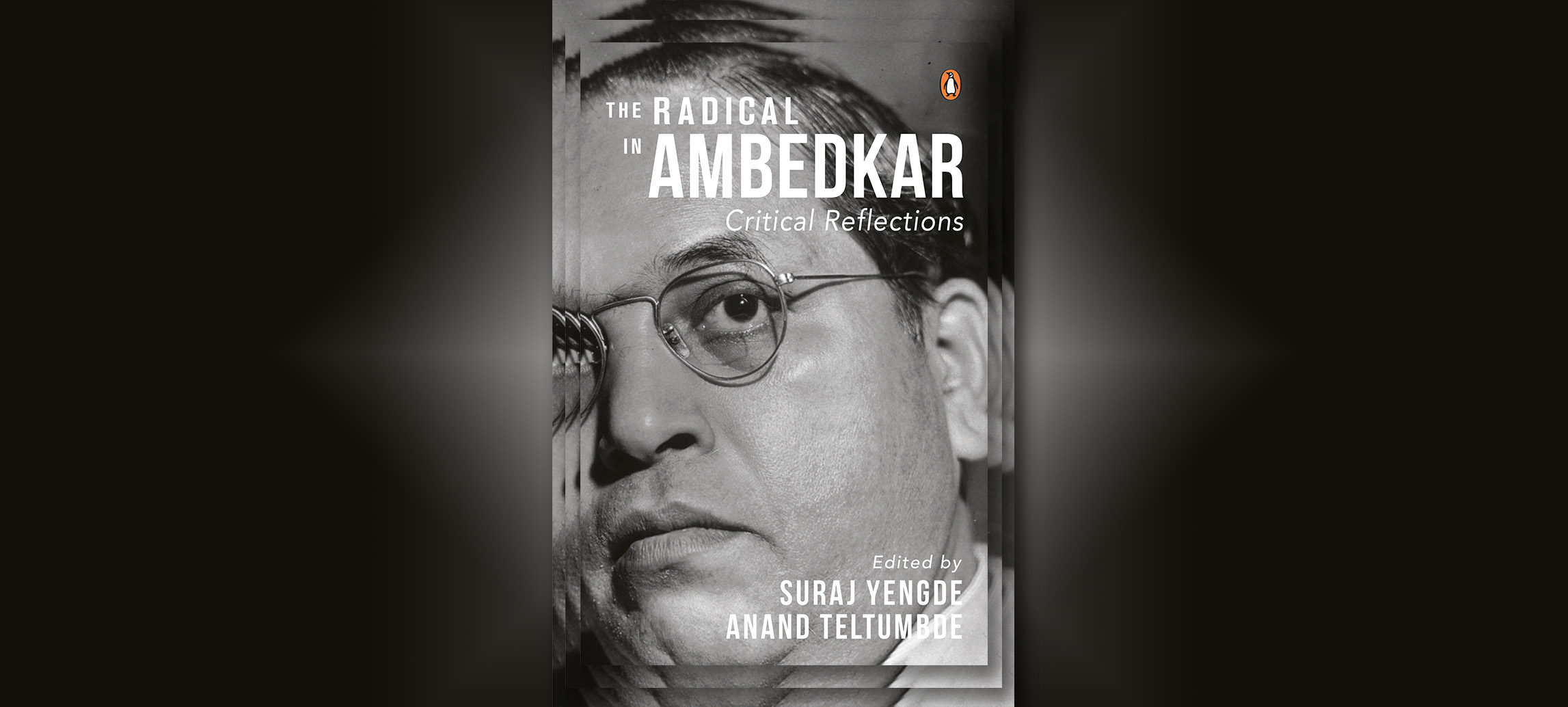
The Radical in Ambedkar: Critical Reflections , edited and introduced by Anand Teltumbde and Suraj Yengde, establishes B.R. Ambedkar as the most powerful advocate of equality and fraternity in modern India. Critically evaluating his thought and work, the essays in this book—by Jean Drèze, Partha Chatterjee, Sukhadeo Thorat, Manu Bhagavan, Anupama Rao and other internationally renowned names—discuss Ambedkar’s theory on minority rights, the consequences of the mass conversion of Dalits to Buddhism, Dalit oppression in the context of racism and anti-Semitism, and the value of his thought for Marxism and feminism, among other global concerns.


Read on to learn why Ambedkar deemed it essential to demystify the traditional terminology of caste oppression

Economic problems intertwine with social discrimination

“The problems of untouchability and caste discrimination and atrocity, however need to be top priorities in government policy and programmes, and in high-caste civil society. Presently, they are low in the pecking order. The removal of untouchability has not become a state-level issue of prime concern, importance and urgency. But it is as important as the problem of poverty. If poverty is the daily experience of hunger, discrimination is the daily experience of humiliation and contempt. It is a day-to-day experience which is absorbed by Untouchables under suppression and dominance.”

The history of caste took roots from skin colour

“The term ‘caste’ is not of Indian origin. Formulated by the Portuguese in the 16th Century, the word has roots in the Portuguese word casta, which literally refers to breed. Varna, which finds mention in the Rig Veda, the oldest of the Vedas, referring to class, also means colour in Sanskrit and is essentially a colour system construct.”

Marginalisation is entrenched deep within our society

“Both African-Americans and Dalits have been segregated and terrorized, denied education, economic opportunity, healthcare and political participation over centuries, and both continue to be exploited economically and psychologically for the benefit of those the elites in their respective societies have ranked above and against them.”

Misogyny and lack of agency in women is a byproduct of casteism

“The structural reproduction of caste occurs in a systematic alliance of unfair gender norms and sexual violence. In other words, the caste system is grounded in gender discrimination and sexual violence. The system operates through a complete control over the being-body of the woman, reducing her to a sub-human category. One can outline the caste-gender-sexuality system as a birth-related graded hierarchical structure of purity pollution and division of labour manifested in distinct ritual status and style of life.”

The practice of segregation does not even spare cremation grounds

“The most widespread and blatant practice of untouchability in the public secular sphere relates to water and cremation or burial grounds—the bare necessities of life and death. Despite being common amenities that are managed and maintained by local governments, access to them continues to be governed by the notion of caste-based pollution and untouchability.”

Educational institutions influence casteist attitudes amongst children

“The practice of untouchability continues to pervade the public sphere, including a host of state institutions and the social interactions that occur within them. In one out of four primary schools in rural India, Dalit children are forced by their teachers or by convention to sit apart from non-Dalits. As many as 40 percent of schools practise untouchability while serving midday meals, with Dalit children being made to sit in a separate row while eating.”


An extraordinary collection of immense breadth and scholarship that challenges the popular understanding of Ambedkar, The Radical in Ambedkar is essential reading for all those who wish to imagine a new future.

The Non Violent Struggle for Freedom – an Excerpt

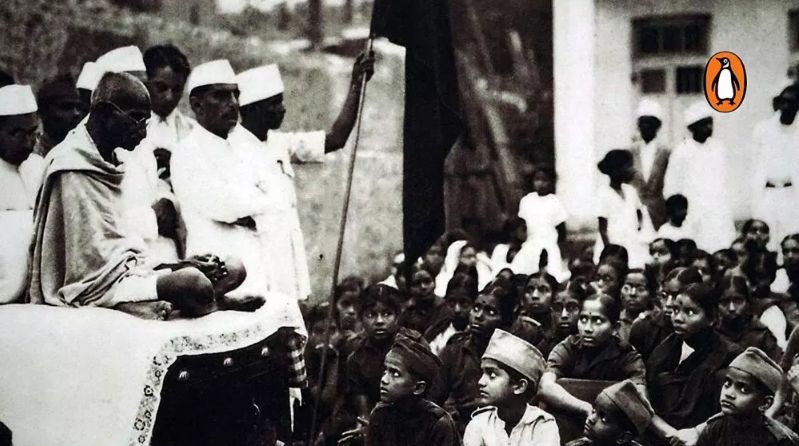
It was Gandhi, first in South Africa and then in India, who both evolved a technique that he called ‘satyagraha’ that he characterised in terms of its ‘non-violence’. In this, ‘non-violence’ was forged as both a new word in the English language, and as a new political concept.
The Non-violent Struggle for Freedom by David Hardiman brings out in graphic detail exactly what this entailed, and the formidable difficulties that the pioneers of such resistance encountered in the years 1905-19.
Here is an excerpt from the book:


The idea of nonviolence as a form of political strategy was theorised by Gandhi in India during the second decade of the twentieth century.   The Oxford English Dictionary states that the first recorded usage of the word – in its hyphenated form – was in the nineteenth century as a medical term describing either a certain type of surgical procedure (Britain) or the failure of the body to resist the violence that is inflicted on it by disease (USA).  Only in 1914 did it appear in a political context when a Wisconsin newspaper contrasted ‘rumpus and riot’ with ‘the tenets of moderation, orderly thinking and non-violence’.   The next usage recorded in the dictionary was by Gandhi, who stated in 1920: ‘I believe that non-violence is infinitely superior to violence, forgiveness is more manly than punishment.’  Despite the preceding appearances of the word in Britain and the USA, the dictionary gives its etymology as a translation of the Sanskrit word ahimsa, which is a combination of a- (non-) and himsa (violence).   This indeed was how Gandhi was to project the idea – namely that nonviolence was a major philosophical principle that was rooted in ancient India.  If, however, we look at the nineteenth-century Sanskrit- English dictionary by Monier-Williams, we find that the term – spelt here as ahinsa – is translated as ‘not injuring anything, harmlessness (one of the cardinal virtues of most Hindu sects, but particularly of the Buddhists and Jains; also personified as the wife of Dharma)…security, safeness’.  Ahinsa-nirata is defined as ‘harmlessness or gentleness’, ahinsana as ‘not hurting’, and ahinsra as ‘innocuous, harmless behaviour’.  The term thus suggested passivity, rather than a principled resistance to wrong-doing that avoids the use of violence – as Gandhi understood it.

***********************************

In the past, ahimsa was hardly deemed to have any applicability to popular protest, or be some sort of political technique.   This only became possible in the epistemic space that we associate with modernity, with its emphasis on the need of states to enjoy popular legitimacy and with acts of mass civil protests becoming one major way in which popular feeling may be expressed.   In emphasising the need for peaceful means, dissent could be expressed without the need for that violence that could threaten both civil tolerance and even civil society itself.  Although such a principle was conceived initially conceived in terms of the secular method of ‘passive resistance’, with peaceable methods being deployed tactically rather than as a matter of principle, it was Gandhi who first tried to make ahimsa-cum-nonviolence into an imperative principle for all forms of civil protest. In doing so, he claimed a compelling power to a moral stance that was, as he understood it, invested with divine power – that of ‘truth force’.   In this, God/Truth was accorded agency.   Secular notions of ‘passive resistance’, ‘civil resistance’, ‘people power’ and the like never made such a daring claim.
 Gandhi only began to talk about ahimsa as an informing principle of his method of resistance after his return to India from South Africa in 1915. Gandhi only began to talk about ahimsa as an informing principle of his method of resistance after his return to India from South Africa in 1915.  Although Gandhi had already forged his method of satyagraha, he had never previously described it as a form of either ‘ahimsa’ or ‘nonviolence’.  There has been some confusion on this matter, as the Collected Works of Mahatma Gandhi gives the impression that he deployed the concept when he launched his first campaign of passive resistance in 1906.  In this source, Gandhi had allegedly asserted: ‘This is for us the time for deeds, not words. We have to act boldly; and in doing so, we have to be humble and non-violent.’   If we examine the original version in Gujarati, we find that he is quoted as saying ‘…narmash vaparvani che’ which literally means ‘make use of softness’.   In fact, the root of ‘narmash’ is the noun ‘naram’, which means soft and smooth, gentle, tender, humble, soft, weak, effeminate.    In other words, it suggests passivity, a connotation that Gandhi was soon to distance himself from.


Although non-violence is associated above all with the towering figure of M.K. Gandhi, David Hardiman shows – in his book, The Non Violent Struggle for Freedom – that civil forms of resistance were already being practiced by nationalists in British-ruled India under the rubric of ‘passive resistance’.

How to Save a Life – an Excerpt from Sohaila Abdulali's Book on Rape

Sohaila Abdulali was the first Indian survivor to speak out about rape. In her book, What We Talk About When We Talk About Rape, writing from the viewpoint of a survivor, writer, counsellor and activist, and drawing on three decades of grappling with the issue personally and professionally and her work with hundreds of survivors, Sohaila Abdulali looks at what we-women, men, politicians, teachers, writers, sex workers, feminists, sages, mansplainers, victims and families-think about rape and what we say.
She also explores what we don’t say.
Here is an excerpt from the chapter in the book titled How to save a life


When Audrey phoned from Rome and told her friends what had happened to her, they flew straight to her from different parts of the world without a moment’s hesitation.
When an unnamed woman (#LionMama) in South Africa heard that her daughter had been raped, she killed the rapist.
When a High Court judge in Punjab and Haryana read a victim statement about the men who raped her, he decided she was promiscuous and rescinded their sentences.
When a twelve-year-old in Pakistan told her mother she had been raped, her mother went to the village elders, who ordered the rape of one of the rapists’ sisters.
When my father found me, he wrapped me in his arms, carried me up four sets of stairs to the roof, and said, “What do you want? We’ll do whatever you want.”
Four years later, when I was counseling survivors, training professionals, and speaking at schools, I found myself using my father—a middle-aged Muslim man who had never
studied psychology, sociology or gender dynamics—as the textbook model for how to behave with a survivor.
It’s a simple formula. Give unstinting control, acceptance and support. That’s it.
A couple of days after the rape, I got ready to go take a bus to a different part of town. My father came in, saw my bright pink and blue silk shirt, and said, “Don’t wear that on the bus!”
“Arre, why not?”
“I don’t know … people might see you!”
We stared at each other, both horrified at what he had said. I understood that he wasn’t ashamed of me. He wanted to protect me, to make me invisible so that nobody could see me, and hurt me.
“Let them see me!” I said.
“Yes, let them.”
Then there was the uncle who first didn’t want to call the police, then didn’t want to tell my mother, then didn’t want anyone to talk about it, ever. Once again, my father, usually the decisive one, turned to me for a cue.
“It’s not a secret,” I fumed. “Why should I hide it, why?”
He took that and ran with it, much to many people’s discomfiture. All he wanted was for me to feel better and get whatever I needed. A few days later, we were paying a social call to some people we didn’t know very well, who had no idea what had so recently happened. In the middle of tea and biscuits and a totally unrelated conversation, my father suddenly broke in with, “My daughter was raped!” Talk about a conversation-killer … I still laugh when I think about that moment.
Despite the simple formula, it’s not always easy to decide what to do. We are always looking for reasons to play down sexual assault. And one of the easiest reasons is plain old discomfort. One woman told me about an uncle groping her, and how she still socialized with him until he died many years later. Shunning him would have meant hurting her aunt, whom she loved. Always making sure there was a table between her uncle and her was easier than creating a huge schism in the family. She and her parents agreed on this. But it’s a slippery slope—suppose she had not been able to bear family gatherings? For her, it was not a huge deal to see the creepy old man. For someone else, it might have been.


Get your copy of What We Talk About When We Talk About Rape now!

Ten Quotes from 'All of My Heart' That Will Make You Swoon

All of My Heart by Sara Naveed is a love story about two friends who traverse the depth of their friendship. Rehaan has always been in love with Zynah since they were kids. After many years of separation, he moves to London and wishes to meet Zynah there. All his hopes are crushed when he finds out that Zynah is betrothed to someone else.
Can Rehaan tell Zynah his heart’s desire even after such a turn of events? Find out in this charming read!
Here we give you a few quotes from the book that are sure to flood you with their intensity:


“I fell in love with Zynah Malik at the very first sight and forgot all my troubles.”

~

“My heart pulsated wildly, and my breath seemed to stop. What had her smile done to me?”

~

“I did not believe in love at first sight. However, she made me rethink my own beliefs. I had never thought that one encounter could make me fall head over heels for someone.”

~

“She would acknowledge me with a nod of her head and one of her rare, winning smiles. My heart would sink and my stomach turn somersaults. Not knowing how to react, I would hastily smile back and turn my attention towards my books.”

~

“Apart from her beauty and intellect, there was something else about her that made me want her. I was smitten by her personality, and every day waited to catch a glimpse of her in school.”

~

“Her lips, made prominent with a luscious shade of pink lipstick, stretched into a smile. I couldn’t take my eyes off her.”

~

“No matter what she did, I loved her. None of her shortcomings could make me un-love her.”

~

“I was seeing her after a week and it felt soothing. I had missed her.”

~

“I looked at her while she ate her ice cream. I wished she knew how much I cared for her and loved her…”

~

“I embraced her back, forgetting everything around us. I took in her fragrance and buried my face in her hair.”


What will Rehaan do? Risk ruining their friendship and tell her he loves her or let her marry the man she has chosen? Read All of My Heart to find out!

A River Sutra : an Excerpt

An elderly bureaucrat escapes the world to run a guest house on the banks of India’s holiest river, the Narmada, only to find he has made the wrong choice. Too many lives converge here. Among those who disturb his tranquility are a privileged young executive bewitched by a mysterious lover; a novice Jain monk who has abandoned opulence for poverty; a heartbroken woman with a golden voice; an ascetic and the child he has saved from prostitution. Through their stories A River Sutra explores the fragile longings of the human heart and the sacred power of the river.
Here is an interesting excerpt from the book:


A River Sutra is a folder or portfolio crammed with stories and anecdotes—folklore, legends, myths, narrated stories proliferate throughout this slim novel. The frame is, on first acquaintance, simple. An unnamed middle-aged senior (and powerful) bureaucrat, tired of work, retires to run a government rest house on the banks of the Narmada. He thinks of this stage of his life as the vanaprastha, the ancient Indian tradition of retiring to a forest to live like a hermit and contemplate spiritual matters following the end of the phase of fulfilling worldly obligations.
In his walks around the beautiful setting—lovingly and evocatively depicted by Mehta—and in his life as the manager of a guest house, he comes in contact with a number of people who tell him stories. Mehta is ingenious about how these encounters come about so as to keep the connection with the frame as seamless and credible as possible.
There is a diamond trader who has become a Jain monk, renouncing extraordinary wealth for a life of extreme poverty and hardship. There is a music teacher who is given charge of a poor blind boy with an
ethereal voice and a preternatural musical talent. A courtesan comes our narrator’s way while searching for her daughter, who has been abducted by the most infamous bandit in the Vindhyas.
Another chapter, which I can only call a story of erotic possession and subsequent exorcism, centres on a high-flying city executive who has a mysterious relationship with a tribal woman. There is the story of an ascetic, a Naga sanyasi, who saves a child from prostitution and brings her up in caves and jungles, teaching her how to become a traditional Narmada minstrel who sings of the great river.
This final story will be of particular relevance to the spiritual education of our narrator and will also contain a twist that will have a bearing on the novel’s structure, particularly on the relationship between the frame and the inset tales. With the exception of this final story, most of the inset narratives have tragic, and often shocking, ends.


Through their stories A River Sutra explores the fragile longings of the human heart and the sacred power of the river.

Something Strange and Sinister – an excerpt from ‘The Spell of the Flying Foxes’

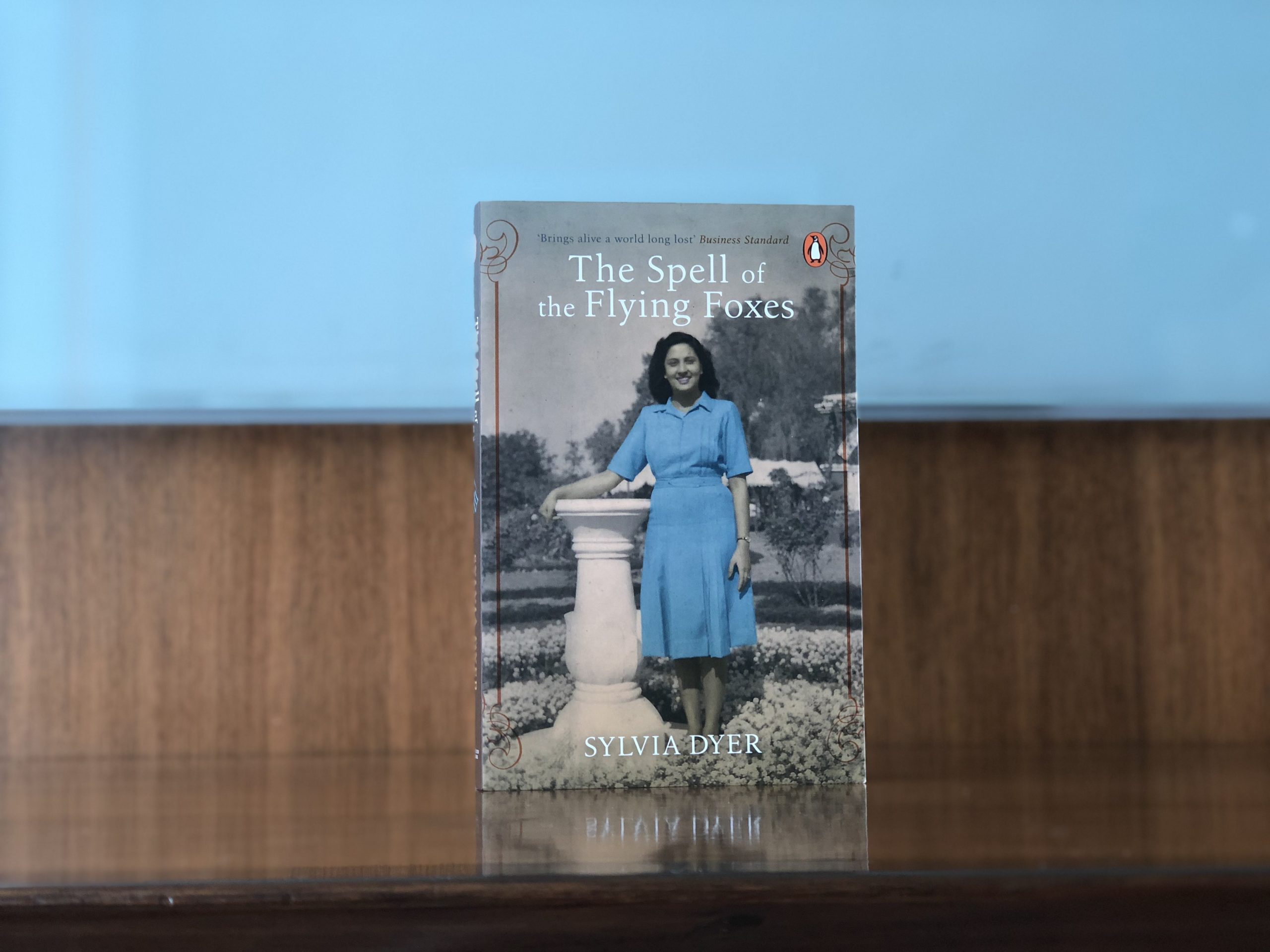
It is a commonly held belief in India that flying foxes augur prosperity. They were certainly abundant in the Champaran region of north Bihar. Here in 1845, an Englishman, Alfred Augustus Tripe, fascinated by the prospect of farming indigo, known as Blue Gold, was drawn to its isolated wilderness.
In The Spell of the Flying Foxes author Sylvia Dyer, recaptures what now seems a fairy-tale world of picturesque beauty, peopled by unique and unforgettable characters.

————————————————————
Here is an excerpt from the chapter Something Strange and Sinister.
The floods that year were devastating. But now it was all over. With the coming of September the water receded. The transplanted paddy seedlings stood vivid green and upright, and the sugar cane was six feet high, with still another three months to go. All should have been well with our world.

But it was not.
The pi-dogs of Musahari Tola were seized by a sudden jitteriness, insisting on being let into the huts to sleep with the Musahars at night. They were kicked out with rough reprimands: ‘Worthless pariahs, are you watchdogs or lapdogs?’
Early next morning, one of the watchdogs had quit and was never seen again. Slowly more watchdogs began to disappear, and always one at a time. It was a mystery in a land where mysteries were quickly cleared up.
 Other villages too were in for mysterious disappearances, villages where only the upper-caste Hindus lived. Most of them owned at least one acre of this fertile land and were comfortably off. Their wives lived in purdah, seldom stepping out to work or socialize, but spending their lives as honoured housewives in their own thatched prisons, for each home had a little private courtyard with high thatched walls. Inside they ground the grain, milked the buffalo, cooked the meals and lived out their lives in cloistered contentment. In the dark hours just before dawn, proud sons of the village mounted on their buffaloes made a slow but certain beeline for our mango groves, or the adjacent fi elds, to graze furtively on the current crops, returning at sunrise, the riders full of song and the buffaloes full of milk for their owners.
But one morning, a buffalo failed to return.
 ‘I tell you, brother, it has been sent to the pound!’
‘The pound? But then, where is the boy? Has the earth swallowed him up?’
 That evening we went to visit Harry. He had built a narrow bamboo bridge across the Mahari so he could visit us or take a short cut through Puchkurwa to the railway station. It served its purpose well enough till a bad fl ood, like the one we had just experienced, swept it clean away.
So we sat on our bank, and he on his, with sixty feet of water in between. It was a little more than knee-deep in most places, scarcely a setback for our usual social exchanges. His servants waded across with chairs for us, and we sat shouting at each other, above the ripple of restless, running water.
Ghogra appeared on Harry’s side, in a snow-white uniform, dhoti hitched up, and a tray of fried snacks carried high above his head as he waded into the water. He had almost reached our bank when, all of a sudden, he lost his footing. His turban flew like a snowball. The eyes in the bulldog face popped, and the mouth opened. And he was gone.
 A moment later he reappeared coated with grey silt, and still clutching the tray. But the fried snacks had gone to the fishes, along with the dishes. Even from our bank, we could see the irritation on Harry’s face. They were from his best set. ‘He is the king of idiots, this Ghogra, and such a show-off!’
Nobody laughed out loud.
The setting sun sent out a blaze of fiery orange from the western horizon as Ghogra was making his slimy way back to Harry’s bank, grumbling about the upkeep of bridges, when—
‘Shh!’ Dad raised a hand for silence. ‘Crikey! Did you hear that?’
 ‘Hear what?’
‘A call . . . I could swear I heard a strange call in the distance, bloody strange.’
Some of the servants had heard it too. ‘Baap re baap! It’s a bhooth—an evil spirit!’

Nostalgic, funny and sad, The Spell of the Flying Foxes is a true story of a plantation in North Bihar on India’s border with Nepal


The Great Gatsby: A Rich Man in India – an excerpt from the 'The Beautiful and the Damned'

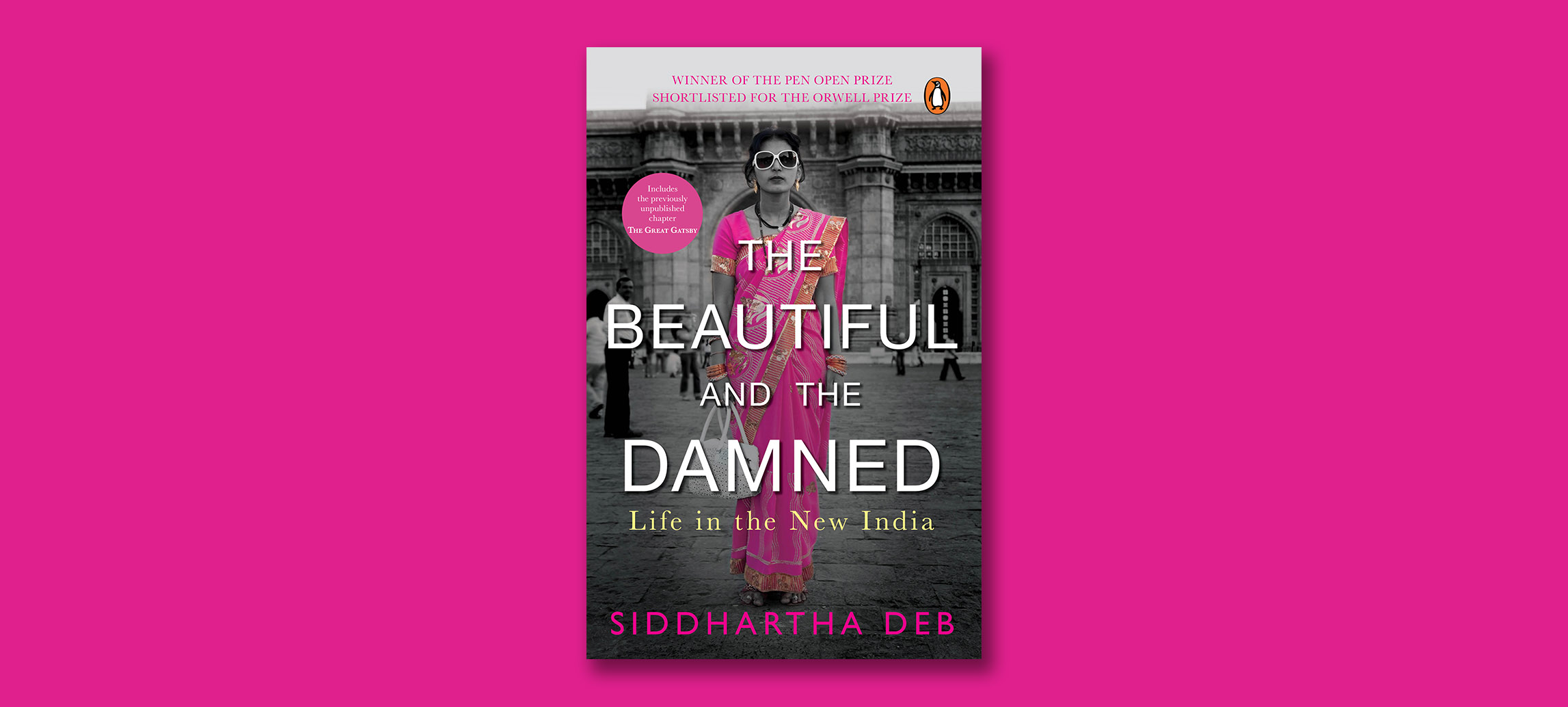
The Beautiful and the Damned examines India’s many contradictions through various individual and extraordinary perspectives. Like no other writer, Siddhartha Deb humanizes the post-globalization experience in the book–its advantages, failures, and absurdities. India is a country where you take a nap and someone has stolen your job, where you buy a BMW but still have to idle for cows crossing your path.
Available for the first time with the controversial and previously unpublished first chapter, The Beautiful and the Damned is as important and incisive today as it was when it was first published. Here is an excerpt from that first chapter of the book, titled The Great Gatsby: A Rich Man in India.


A phenomenally wealthy Indian who excites hostility and suspicion is an unusual creature, a fish that has managed to muddy the waters it swims in. The glow of admiration lighting up the rich and the successful disperses before it reaches him, hinting that things have gone wrong somewhere. It suggests that beneath the sleek coating of luxury, deep under the sheen of power, there is a failure barely sensed by the man who owns that failure along with his expensive accoutrements. This was Arindam Chaudhuri’s situation when I first met him in 2007. He had achieved great wealth and prominence, partly by projecting an image of himself as wealthy and prominent. Yet somewhere along the way he had also created the opposite effect, which – in spite of his best efforts – had given him a reputation as a fraud, scamster and Johnny-come-lately. We’ll come to the question of frauds and scams later, but it is indisputable that Arindam had arrived very quickly. It had taken him just about a decade to build his business empire, but because his rise was so swift and his empire so blurry, it was possible to be quite ignorant of his existence unless one were particularly sensitive to the tremors created by new wealth in India. Indeed, throughout the years of Arindam’s meteoric rise, I had been happily oblivious of him, although once I had heard of him, I began to see him everywhere: in the magazines his media division published, flashing their bright colours and inane headlines at me from little news-stands made out of bricks and plastic sheets; in buildings fronted by dark glass where I imagined earnest young men imbibing the ideas of leadership disseminated by Arindam; and on the tiny screen in front of me on a flight from Delhi to Chicago when the film I had chosen for viewing turned out to have been produced by him. A Bombay gangster film, shot on a low budget, with a cast of unknown, modestly paid actors and actresses: was it an accident that the film was called Mithya? Theword means ‘lies’.
Still, I suppose we choose our own entanglements, and when I look back at the time in Delhi that led up to my acquaintance with Arindam, I realize that my meeting with him was inevitable. It was my task that summer to find a rich man as a subject, about the making and spending of money in India. In Delhi, there existed in plain sight
some evidence of what such making and spending of money amounted to. I could see it in the new road sweeping from the airport through south Delhi, turning and twisting around office complexes, billboards and a granite-and-glass shopping mall on the foothills of the Delhi Ridge that, when completed, would be the largest mall
in Asia. Around this landscape and its promise of Delhi as another Dubai or Singapore, I could see the many not-rich people and aspiring-to-be rich people, masses of them, on foot and on two-wheelers, packed into decrepit buses or squeezed into darting yellow-and-black auto-rickshaws, people quite inconsequential in relation to the world rising around and above them. The beggar children who performed somersaults at traffic lights, the boys displaying
menacing moustaches inked on to their faces, made it easy to tell who the rich were amid this swirling mass. The child acrobats focused their efforts at the Toyota Innova minivans and Mahindra Scorpio SUVs waiting at the crossing, their stunted bodies straining to reach up to the high windows. I felt that such scenes contained all that could be said about the rich in India, and the people I took out to expensive lunches offered me little more than glosses on the above.


A personal, narrative work of journalism and cultural analysis in the same vein as Adrian Nicole LeBlanc’s Random Family and V. S. Naipaul’s India series, The Beautiful and the Damned is an important and incisive new work.

error: Content is protected !!