Publish with Us

Follow Penguin

Follow Penguinsters

Follow Penguin Swadesh

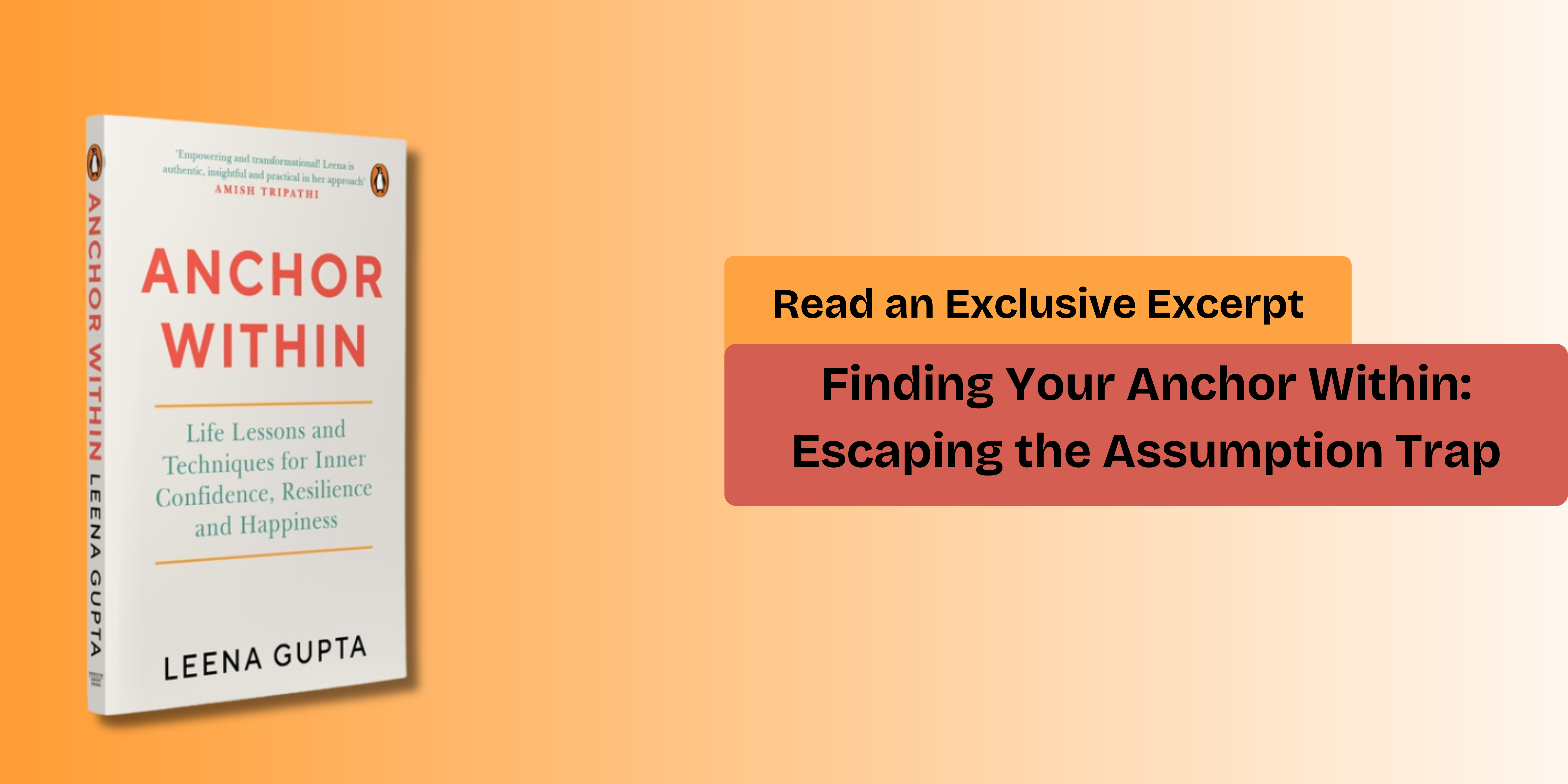
Finding Your Anchor Within: Escaping the Assumption Trap

Too often, our minds trap us in past experiences, shaping how we perceive the present. This excerpt from Anchor Withinexplores how finding inner stability can help break free from the assumption trap and see reality as it truly is.

Front Cover Anchor Within
Anchor Within || Leena Gupta


When we cannot tame our restless mind, it can spin us out of reality and into the assumption trap, where we may perceive our situations through the lenses of past experiences of hurt and prior conditioning and biases. When we go through an uncomfortable situation, our mind replays episodes where we had similar experiences

and feelings. When our mind senses danger or something unfamiliar, it aims to protect us by clinging to what seems known, safe and recognizable. Stuck and wrapped up in our stories from the past, we lose our ability to see things clearly and as they are. The danger is that this may distort reality by making us superimpose our past impressions on to the present moment. We may react impulsively based on past patterns instead of responding mindfully, jeopardizing our relationships

and sabotaging possible opportunities.

For example, it is fascinating to see how different personality types from my extended family and friends make assumptions based on their mental wiring and conditioning. In the family reunion I describe below, each person I mention gets stuck in the assumption trap based on their personality type and has their own perception of reality. We can see how their crafty mind, tries to seduce them to stay stuck and safe rather than face their reality. I have mentioned seven personality types in the family, but there are so many more that we encounter in our lives including, blamer, martyr, saviour, people-pleaser, narcissist, gas lighter and defender.

If there were ever a perfect family reunion, then this was it. Uncle Sammy was in his element as he bowed, removed an imaginary top hat and said, ‘We’ve been waiting so long for this reunion. Let’s get this party started!’ We were at my Aunt Ayesha’s home in Cresskill, a posh locality in New Jersey where each custom-built house features a manicured garden. In no time, we were all jiving to the retro Bollywood music of the 1970s and 1980s, while catching up on our lives in her regal living room. I noticed how she had decorated the whole house with fragrant, exotic floral arrangements and scented candles to soothe our senses. ‘OMG, Aunty Ayesha! What a lovely ambiance you have created! I can feel the love you’ve put into all the details to make this an event to remember,’ I said.

Her courteous, uniformed staff served us beautifully crafted, savoury hors d’oeuvres. My aunt had planned a delicious menu for us with all of our favourite dishes. We could not have imagined a more comfortable and happy setting to be in. Soon, everyone eased up and dropped the formalities with which they had arrived. After several rounds of appetizers, lots of banter and swaying to Bollywood tunes, we sauntered to the long, perfectly decorated twenty-seater dining table. The fun and jokes started, and at one point, my usually meticulous father spilled the yellow masala curry all over his side of the table, unable to contain himself with laughter.

Everyone seemed to be high on life, and everything seemed perfectly orchestrated that evening. However, around 2 a.m., the laughter started to wane as infectious yawns began creeping into the room. My nineteen-year-old cousin Aryan started snoring on the sofa, unknowingly signalling to us that the party was over. Happily picking up their paraphernalia, each guest got up to begin the process of saying goodbye.

It took a while. It was a curious process, with conversations shifting to the next goalpost: the main door. Oddly, the chatter continued, and everyone merely inched in the direction of the main door. Eventually, most of us made our way out, but as soon as Dad stepped out, we heard an abrupt and very loud bang of the door. It was the kind of sound that sends shivers up your spine and freezes your whole being. We were stunned.  Nobody moved. Everyone seemed to be playing the game statue! Startled and motionless, everyone stared at each other. I could see from their expressions that they all had a story starting to spin in their heads. It was not pretty.

***


Get your copy of Anchor Within by Leena Gupta on Amazon or anywhere books are sold.

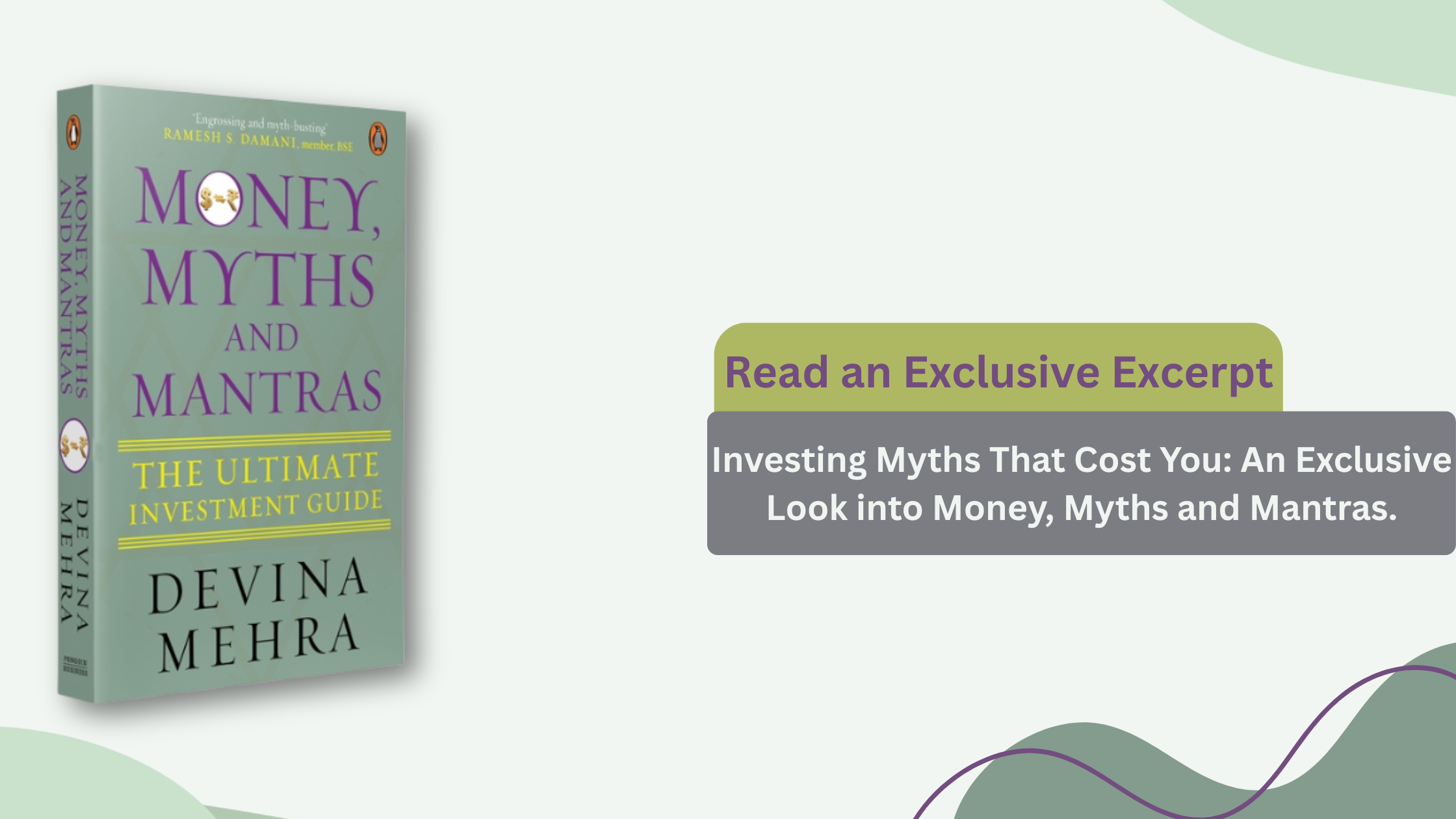
Investing Myths That Could Cost You Big—What You Need to Know

Getting the basics right: The four thumb rules for your financial health.

Let us start at the very beginning . . . a very good place to start – as the song goes. Let us start with a broad, top-down look at your investments.

What do you think of when you think of the term ‘investments’?

Most people think of investments in the stock market, mutual funds, etc. But what about the Public Provident Fund (PPF) you bought for tax-saving? The bank fixed deposits? The plot of land you bought or inherited? The apartment you are waiting to get possession of? Each of these is an investment. All of them have to be considered to get an overall picture of your finances before you decide on what you want your financial future to look like.

Plus, as is known, during the course of your investing journey, you have no option but to live through bull markets and bear markets, at times ferocious ones. How do you ensure that your financial investments get a clean bill of health and not end up in the ICU?

What are the basic tenets to keep in mind while investing?

To my mind, they are four in number, and these make up the framework with which you need to view your investments. Of course, there are overlaps between the four.

Each of these concepts will be dealt with in more detail later in the book. The following descriptions of these only provide

you a starting framework.


Lesson 1: Asset allocation sahi hai

Asset allocation is not just the best thing, it’s the only thing.

If you are just going to be a single-asset (say, equity only) player, then you are not going to last very long in this game.

Sometime back, I got a question on social media asking me, ‘I am a young person in a good job – so should I have 100 per

cent investment in equities?’ And my answer was no, because there are all kinds of demands that may come on your finances: you may lose your job, you may have a family emergency, you may want to buy a house, you may want to study further after a few years, and so on.

Basically, you may have unexpected financial demands in the future, which you may not be factoring in just now.

Equity returns have low predictability, not just on a one- or two-year basis, but sometimes even over a longer time frame. For example, during the entire decade from 2010 to 2020, Indian equity markets compounded at just about 8.5 per cent when fixed deposit rates were also around 8 per cent. So you saw a lot of volatility, with practically no additional return for taking equity risk at all, for a whole decade.

Asset allocation basically means your investment pie chart is strategically diversified across various available asset classes.

Why does asset allocation work? Because different assets give disparate returns at various points in time.

To give a recent example: In 2019, government treasury instruments in India were up 9.5 per cent. Gold prices rose 24.6 per cent. In contrast, the Nifty500 delivered a mere 7.7 per cent return.

But did you ever hear any fund manager or your financial adviser tell you that you were better off investing, or at least diversifying, into government paper and gold, instead of focusing on equities, if you wanted the best returns? I suspect not.

The reason for this is simple: nobody in the business of fund management or financial advice makes much or any money by recommending investments in government securities or gold. The maximum fees are for recommending equity.

All behaviour, good or bad, is always driven by incentives, and sellers of equities incentivize their salespeople far more than sellers of any other asset class, even if they do not deliver returns.

That is part of the reason for this ‘100 per cent in equity if you are young’ recommendations you often see.

Don’t ever forget this!


Lesson 2: Take a portfolio approach to investing

Most investors believe that taking individual stock advice, or ‘tips’ from friends, brokers, talking heads on TV, – that is, almost anyone – and then implementing them on their own is the way to making big money.

Wrong. This is a one-way ticket to financial ruin. The correct way to do it is to take a portfolio approach to determine your asset and equity selection.

One part of this is, of course, asset allocation, which is discussed in more detail later in the book.

But even within your equity portfolio, be mindful of the weightage of each of your stocks and each sector. For every stock you buy, be absolutely clear how about the allocation for that stock and how much it changes the weightage of its industry in your portfolio, and how it alters the risk profile of your equity pie.

***


Get your copy of Money, Myths and Mantras by Devina Mehra on Amazon or anywhere books are sold.

Is It Necessary to Leave Your Job to Ace the CAT Exam?

Should I Quit My Job to Prepare for the CAT?

This is one of the questions that I am asked most often, if not the most asked question! The question is also most likely to come from aspirants whose first or past attempts did not go well and who are thus looking to mount a serious retake attempt. You might also have these questions in your mind:

  • Is it wise to quit my job to prepare for the CAT?
  • Will quitting my job have a negative impact on my profile?
  • How can I prepare if I am working twelve hours a day, six days a week?

These are the questions that many aspirants ask themselves since there is a huge premium on acquiring a degree from a prestigious college and an MBA is for most the last big shot that they can take to get a big brand name on their resume. Some might have faced this situation before as well when they had set their eyes for the first time on getting two Is—the IITs.

There are other reasons as well, ranging from a mind-numbingly monotonous IT job to a horrible boss, to the existential dread: What will become of me and my life if I am stuck in my current situation forever?

For most of my colleagues, the answer to this question is a simple NO. Quitting your job is akin to committing professional hara-kiri. But I think, under certain circumstances, quitting your job might be the best option in front of you with the proviso that:

  • You quit at the right time, and
  • You do more than just prep for the CAT

How will quitting affect your profile in terms of getting into an IIM?

First, let us look at the quantitative effect of quitting your job on your chances of getting a shortlist.

There are colleges, such as IIM-B and others, that give a weightage to work experience in the shortlisting process. In such cases, you will lose out on valuable points and will hence have to score higher on the test to get the shortlist than if you had stuck on in your job. So yes, there is a clear quantitative effect.

If you have two or more years of work experience, as of July of the year you will take the CAT, and the rest of your profile—Class X, Class XII, grad marks—is good, you can, on average, score 0.5–0.75 percentile points lower than someone with no or low work experience. So, those with two years of work experience can get an IIM-B call at a 98.5 percentile whereas freshers have to score in excess of 99.4. But remember that this is only in the case of institutes that give a weightage to work experience.

Just like they have for academics, even for work experience points are awarded based on slabs— less than twelve months, twelve to twenty-four months, etc. IIM-B gives maximum points for work experience of thirty-six months and above. So, if you have more than thirty-six months you are not going to get any more marks than you will if you have exactly thirty-six months.

In effect, if you have thirty-six months’ work experience, quitting your job will not have any mathematical impact on your profile rating.

Will quitting affect your prospects during summer and final placements?

IIMs and other top schools slot candidates into two categories for placements—regular and lateral.

Lateral placements are for people with a certain amount of work experience for roles that are above entry-level management roles. What is that certain amount of work experience?

It differs from college to college. Some base it on the absolute number of months such as twenty- two—IIM-B, while others decide the exact number based on the average work experience in the batch—IIM-A. Either way, it usually falls into the twenty to twenty-four-month range. Also, it is important to note that for some domains and for some firms, work experience is a must-have and hence, recruiters look purely at lateral candidates. What are the domains where relevant work experience is a prerequisite?

Operations roles, for example, most definitely go to people who have experience in shop-floor, product design, logistics, supply chain management, etc. So, engineers working in operations will do well to finish working for two years before entertaining thoughts of quitting. The rationale is simple: an individual with an idea of any aspect of operations cannot be given a managerial role since the stakes are very high.

IT consulting roles, for example, again typically go to those with two-plus years of experience in software. Again, the rationale is the same—an individual who has not worked on large-scale IT projects cannot take up consulting roles in IT. There might be exceptions to this rule but by and large, the rule holds.

***


Get your copy of Bell the Cat by Tony Xavier on Amazon or anywhere books are sold.

Unraveling the Mystery: A Thrilling Excerpt from The Girl on Fire!

As danger looms and secrets unravel, IPS officer Simone Singh is thrust into a chilling investigation. Here’s a gripping excerpt from The Girl on Fire!

Front Cover The Girl on Fire
The Girl on Fire || Devashish Sardana

Eighteen years ago

Malana Village, Himachal Pradesh

Mama’s hands tremble as she unscrews the cap of the transparent bottle. Her lips quiver. She doesn’t look at me.

Her eyes, distant and hollow, are fixated on something unseen as the amber liquid cascades from the bottle, drenching my head, cold and sharp against my scalp. It smells like fear and memories—kerosene.

I’m tied to an old wooden chair in our backyard, dupatta knots biting into my wrists. I don’t ask why. The shackles seem fitting somehow, as the liquid traces a path down my face, lingering on my eyelashes before soaking the hand-sewn white frock I’m wearing. It’s embroidered with beautiful little pink petunias. Mama sewed it at home, each stitch a promise. Now, stained with kerosene, the promises bleed out.

‘Mama, you ruined the frock,’ I say, my voice shaky, tasting the fumes in my throat.

She hushes me with a stern glance. Her face is a mask, unreadable. Her eyes are glassy. It’s like she’s there, but she is not. She sees me, but she doesn’t. Mama sits down across from me, matchbox in hand, and for a moment, we are just reflections of each other—stilled, silent, waiting.

It’s my birthday today. I turned ten. Double digits!

There was supposed to be a cake and a Barbie doll—my first—dressed in traditional Himachali clothes that Papa said he’d pick up from Kullu. But it’s past ten, and he’s not back yet. He never is, not until the screams start.

Last night’s screams were louder than usual. Mama’s, not a stray dog’s like I hoped. Usually, I cower under the blanket when I hear the screams, but last night I had run out to the backyard to find her curled up in the mud, her knees pressed to her chest, yelping, while Papa thrashed her with a bamboo stick, again and again.

‘No!’ I screamed, without thinking. It just came out.

A mistake, I realized later. Papa saw me. He swivelled around, his eyes red, veins bulging, enraged. ‘Why aren’t you asleep, Aadya?’ he shouted and staggered towards me, drunk, the bamboo stick raised like a sword, ready to strike.

I froze. I should have run away. But I couldn’t. The stick cut through the air and came down on my arm, fire igniting along my skin, searing through muscle and bone. I can still feel it.

‘Not Aadya!’ yelled Mama, and she rushed to my rescue.

Papa shoved Mama away and called her haramzadi—

Mama told me later never to repeat that word. Papa threw away the bamboo stick, stumbled towards the makeshift shed in our backyard, picked up the iron rod used to stoke campfires and charged towards Mama . . . um, let’s stop. I don’t want to think about last night any more.

So now, it’s about the Barbie doll and waiting for Papa.

Waiting to start the birthday that Mama promised would be special. She said we’re going somewhere beautiful—a place full of laughter and toys. No more nights filled with screams. I almost believe her.

Then, she pours more kerosene, a line connecting my feet to hers. Her swollen, bruised eye twitches. Is she crying? She pours the kerosene over herself, soaking her shawl, her dress, her skin.

‘Aadya,’ her voice cracks, ‘I’m taking you to a happy place, beta. A place full of Barbie dolls and pink frocks and laughing clowns.’

I smile. I love clowns. ‘Papa isn’t coming with us to the happy place?’

Mama presses her lips together. ‘Do you . . . do you want Papa to come?’

I think for a while. I want Papa to come. All three of us.

Happy together. But it won’t remain a happy place if Papa comes with us, no? Then the happy place would become

this place—our house—with broken arms and shrieks, swollen eyes and cries. No, I don’t want Papa to come. I

meet Mama’s eyes and shake my head.

‘Good, good,’ she nods. ‘Remember, just a bit of pain, then . . . happiness.’

Pain? I’m confused. The bus to happiness shouldn’t hurt.

Mama picks up the matchbox. She takes a deep breath, her chest heaving.

She strikes a match.

The sound is tiny but monstrous in the still night. The flame flickers, a small harbinger of devastation. She’s done this before—told me never to play with matches near the kerosene stove. But here, now, the rules are rewritten in fire.

‘No, Mama, please.’ My voice is a whimper, lost in the crackle of the match.

She looks at me, really looks at me, and for a second, I see her. Not the broken fragments of a woman shaped by fists and fury, but my Mama.

‘I’m doing it for you, Aadya. I love you.’

‘Mama, stop. Please stop.’ I squirm and twist and squeal. Tears roll down my cheeks.

She drops the match.

The fire hisses, a hungry beast that claims her instantly.

***


Get your copy of The Girl on Fire by Devashish Sardana on Amazon or anywhere books are sold.

The Battle Ends, But the Questions Remain!

After a long and brutal war, the Pandavas stand victorious. But when Vyas Ji enters their canopy, his words force them to confront a question they never expected—was this truly a victory?

Read this gripping excerpt where triumph meets its toughest reckoning.

Front Cover The Lineage
The Lineage || Laksh Maheshwari, Ashish Kavi


The sentries led Vyas ji into the Pandavas’ canopy where the five brothers and their wife, Draupadi of Panchal, rose to welcome him. When Vyas ji stood before them, they joined their hands and bowed their heads together.  

‘Pranam, Maharishi,’ they said in unison.  


The brothers were all injured as multiple parts of their bodies were wrapped in bandages. Yudhishthir’s arm had turned blue after all the spears he had propelled. Bheem’s chest and face were bruised due to all the blows he had sustained from Suyodhan’s mace during their duel. Arjun’s hands were riddled with blisters from all the arrows he had launched in the war. Even Nakul and Sahdev looked weary from the effort of war. 


But the joy of victory Vyas ji saw on their faces was far greater than all their pains put together. It was was also visible on Panchali’s face and evident in the blood that drenched her long, flowing hair. This sight of joy and thrill greatly upset Vyas ji. He clenhed his fist to prevent his hand from rising to give the children any blessings.  


When the maharishi did not bless them, the brothers lowered their hands and exchanged gazes of discomfort. Such a thing had never happened to them. Never had they been denied anything. And when they were denied their right, they fought for it. But how could one fight for someone’s blessings? 


Panchali took the first step towards Vyas ji. ‘You have come on an auspicious day, Vyas ji,’ she said with a smile as she stroked her hair. ‘The war of Bharat has ended today. The Mahabharata has ended today.’  


‘Yes,’ Vyas ji answered, deeply remorseful. ‘Much has come to an end today.’  


Yudhishthir felt the sorrow in Vyas ji’s words and walked over to him. Panchali joined him, smiling warmly at the sage. ‘We have won, Vyas ji,’ Yudhishthir said emphatically, hailing their victory as a matter of great joy. ‘We have finally won what is rightfully ours.’ 


‘I have seen your victory, son,’ Vyas ji replied. He glanced back towards the canopy’s entrance, visualizing the carnage that lay outside on the battlefield of Kurukshetra. ‘I congratulate you all,’ he said with a heavy heart.   


‘A simple congratulation isn’t enough, Maharishi,’ Arjun insisted. ‘We want your blessings too. Your blessings will help us rule over the entire kingdom of Hastinapur.’  


‘Why are you asking for my blessings now, Arjun?’ Vyas ji asked, ‘When you did not ask for my blessings for this war?’  


‘Aren’t you happy with our victory, Maharishi?’ Yudhishthir asked anxiously, his hands folded before the sage.  


Vyas ji took a long and painful breath. His eyes grew teary and started to sting. ‘What exactly have you won, Yudhishthir?’ he asked, teary-eyed, as he watched the eldest Pandava.  


A deep frown creased Yudhishthir’s forehead. ‘We have won a great victory, Maharishi,’ he said. ‘Right has defeated wrong. Good has defeated evil. Dharma has defeated Adharma.’ 


‘And who decided what was right and what was wrong?’ Maharishi asked. ‘Who decided what was Dharma and what was Adharma?’ He walked past Yudhishthir and Panchali and stopped in front of the other four brothers.  


He looked at Bheem first. Even with his hands folded before him, the giant of a man towered over the innocent Vyas ji like a mountain. ‘Was it you, Bheem?’ Vyas ji asked, ‘A man who can control neither his emotions nor his gluttony?’ When a flash of shame showed on Bheem’s face, Vyas ji turned to Arjun. ‘Was it you, Arjun, with your pride and vanity of being the greatest archer in the world?’  


Vyas ji then turned to Nakul and Sahdev, his sorrow becoming evident on his face. ‘Maybe it was you Nakul, and your arrogance over your beauty. Or maybe your brother, Sahdev, who considers himself the most learned of us all.’  


With the four brothers standing silent and ashamed, Vyas ji walked back to Panchali and Yudhishthir. He glared at Draupadi and her long, bloodied hair. ‘Tell me, Panchali, do you feel proud of your husbands’ definition of Dharma and Adharma, just as you are proud of their valour, their wisdom and their beauty?’ 


Once Panchali’s eyes dropped to the ground with shame, Vyas ji’s gaze turned towards Yudhishthir. ‘Or was it you, King Yudhishthir, who is so full of hatred for his own kin that you now rejoice in their death?’ 


When even Yudhishthir could not respond to Vyas ji, he addressed all  brothers inside the canopy at once. ‘Tell me, O sons of Pandu,’ he implored, ‘who among you decided this Dharma and Adharma?’ 


Seeing the disappointment on Vyas ji’s face, the Pandavas dared not utter a word. Instead, they stood with sealed lips and folded hands. Their silence only deepened Vyas ji’s disappointment. ‘What a shame!’ He shook his head disdainfully. ‘When men take pride in killing their brothers instead of mourning over their losses. Today, you may have won, sons of Pandu, but I swear to you, Dharma has only lost today.’ With that, he darted towards the canopy’s exit, leaving behind the brothers and their wife in their ashamed silence.  


When Vyas ji stepped outside the canopy, the sentries saw him and bowed before him with folded hands. Vyas ji raised his hand and said, ‘Ayushmaan bhava.’ The two sentries thanked Vyas ji for his blessings and watched him walk away.   


***


Get your copy of The Lineage by Laksh Maheshwari and Ashish Kavi on Amazon or anywhere books are sold.

Sudha Murty Returns After 9 Years with The Circle of Life – A Heartwarming Excerpt

In The Circle of Life, Sudha Murty masterfully weaves a tale of family, tradition, and aspirations. Here’s an excerpt that captures the warmth of relationships and the weight of legacy.

Front Cover The Circle of Life
The Circle of Life || Sudha Murty

Know More!

Lakshmi Nivas was a prominent bungalow in the Banjara Hills of Hyderabad. It is a place where the rich and powerful people from Tollywood live. During the Nizam’s time, Rama Rao was an engineer and had helped to construct different prominent buildings in Hyderabad.

It was not very crowded those days, and the Nizam had liked his work and rewarded him with a big plot. Later, after Independence, his son Venkateshwara Rao started a company called S.V. Constructions and became a well-known engineer in Hyderabad. They were great devotees of Lord Venkateshwara of Tirupathi. Venkateshwara Rao handled several government projects. He had three children. The eldest, Umesh, helped him with the constructions, though he did not have any formal qualification in civil engineers ering. Then there was Uttara, and the youngest was Shamala. It was not very warm in the second week of July, but Uttara was still feeling hot. She was sitting on the steps of her house. Though the coolers were on, she was uncomfortable. Opposite her, her grandfather Rama Rao was sitting in an armchair with a newspaper, but his focus was on Uttara who was knitting a sweater.

Uttara’s siblings were playing tennis on the court adjacent to the house. ‘Uttara, why are you knitting a sweater? Is it for you to take to Bangalore?’ asked her grandfather. Uttara smiled. ‘It is not for me. It is for you.’ ‘Ha, what a joke! Having a sweater in Hyderabad is as good as selling refrigerators to Eskimos,’ laughed Rama Rao. The sun was setting, and its rays fell on Uttara’s ear studs. The diamond earrings were a gift from Uttara’s late grandmother. Rama Rao remembered his wife because Uttara resembled her very much. She had long hair, a slightly dark complexion and, more or less, was an introvert; but she was extremely intelligent.

Uttara had completed her engineering degree from Osmania University and had done very well. She was a rare combination of wealth and knowledge. Rama Rao had studied in IISc’s civil engineering department more than sixty years ago, and more than three decades ago, his son Venkateshwara Rao had graduated from the same department. And now Uttara was about to join the Institute.

However, she had applied to study computer science, unlike her father and grandfather. Uttara’s siblings were not as academically inclined. Rama Rao and his son felt that Uttara had to take their company forward, but she was unsure. She always felt running a company required a different skill set which she did not have. Uttara suddenly remembered something, got up and went inside. She returned within five minutes and continued. ‘What happened?’ asked her grandpa. Uttara smiled and said, ‘Grandpa, I went in to check my email.’ ‘Regarding what?’ Rama Rao was anxious. ‘Regarding my admission to IISc.’ ‘What happened?

I hope our tradition remains intact.’ ‘Relax Grandpa, I have got admission.’ ‘Oh! That is great news!’ grandpa clapped and cheered. Uttara did not show much enthusiasm and continued knitting. Hearing the clap, Umesh and Shamala stopped their game and came running. ‘What is the big news, Grandpa? You are clapping!’ said Umesh. ‘Yes, we should celebrate. Uttara got admitted to IISc.’ ‘Oh,’ they said and did not bother much.

‘That means Uttara is going to Bangalore?’ asked Shamala. Umesh reminded, ‘You remember that we have dinner at Raj Bhavan, right?’ ‘Yes, but I am not coming,’ said Uttara. ‘I expected that.’ ‘I want to spend time with Grandpa.’ Her brother and sister went inside to get ready. ‘Where are your parents?’ asked Rama Rao, eager to share the joy that he was unable to contain. Her mother had gone to a fashion show, and her father was busy with some government delegates. Rama Rao was disappointed. He knew his daughter- in-law Kamakshi was into jewellery and fashion.

She still thought that she was very young and would often forget that she had a twenty-three-year-old daughter. Kamakshi performed puja and other festivals—not out of devotion, but simply to show off and compete with other elite families in Banjara Hills. The grandeur of each festival increased year after year, though devoid of faith. Rama Rao was sad for a minute but cheered up when he looked at Uttara. She was unlike her mother.

Instead, she was simple, loving, knowledgeable and very sincere. He looked at her and said, ‘Uttara, I am not sure if I will be around but when you have children, please see that they also join IISc. Our family tradition should go on.’ ‘Grandpa, where will you go? I will return to Hyderabad after my studies and will be here with you. You will see us every day,’ Uttara replied to lighten up Rama Rao’s mood. As she completed the sweater, Uttara got up. No one knew her destiny; she may never return to Hyderabad after some years.

A Tender Look at Recovery: What You Will Be Alright Reveals About Healing After Loss

You Will Be Alright is intended to serve as an anchor for those dealing with grief and those supporting someone who is dealing with grief.

Read the excerpt to know more.

Front Cover You Will Be Alright
You Will Be Alright || Sonali Gupta


The first few days of loss can be extremely disorienting and exhausting, where we have little or no energy to do much. As the rituals and ceremonies come to an end and relatives leave, we are left to ourselves and may begin to wonder, ‘What happens to my life now?’ Clients in therapy ask, ‘Does the grief ever go away? It seems like I will never be able to do away with it. Will it always pain this much?’


There is no recovery or getting over grief. We learn to live with the grief and also hold space for love. We miss our loved one, who is no more with us, and we know that the world will never feel the same. At the same time, as we continue to do the work of dealing with our emotions, processing, accepting and integrating, our grief shifts. It stays, but it feels different.


As Anne Lamott says, ‘You will lose someone you can’t live without, and your heart will be badly broken, and the bad news is that you never completely get over the loss of your beloved. But this is also the good news. They live forever in your broken heart that doesn’t seal back up. And you come through. It’s like having a broken leg that never heals perfectly—that still hurts when the weather gets cold, but you learn to dance with the limp.’


As I pondered on the subject of this chapter, a statement that came to me instinctively was, ‘Do we ever ask what happens to our love?’ Just as love stays, grief stays. Grief is an extension of the love which we have felt for our loved one. Just because they have passed away, we don’t stop thinking about them. We carry both grief and love in our hearts. I have found it useful to think that a huge part of processing our grief is acknowledging that the presence of our loved one felt like sunshine and hope. We were lucky to have them, and they made our world a better place. Now, when they are no more, we can make a choice to carry forward what they stood for, by imbibing qualities that we always associated with them. We can choose to celebrate them whenever life offers an opportunity. Personally speaking, my father was a huge foodie and loved exploring new cuisines. Over the years, on his birthday and death anniversary, I often order his favourite food—and while I am not a big foodie, I think I have become someone who savours the cuisine. All good food reminds me of him. Although I must mention that it has taken years to imbibe and see it this way, I’m glad it has happened.


As we continue processing our grief, it becomes integrated, and we begin to accept the loss. We start to recognize that our world has changed, and now one slowly needs to adapt to this new reality.


Early in therapy, clients often ask me these questions, and I have always felt that one can give hope and yet be honest with
people. Truth and compassion can co-exist—my experience over and over has been that clients accept it well. As a young therapist, I thought it would be hard for them to hear this. But almost two decades later, I realize that grief is hard enough, and knowing what to expect realistically becomes an anchor, helping people rather than pushing them into a state of despair. I remember working with a seventy-year-old client, Naresh, who had reached out to me three years after the loss of his wife due to a chronic illness. He seemed quite agitated and distressed. He said to me, ‘I have been to therapists and doctors, and everyone tells me that it’s been three years and so, I must move on. I don’t understand how I can move on and see life as the same. When the person I loved for fifty years is no more, everybody still wants recovery and wants me to be done with grief. It has taken me a lot to come here, and I don’t think I can recover.’


I told him, ‘You are right, there is no recovery from grief. No matter how much work you do with me, all I can help you is with grief integration and acceptance. Our grief is not an illness or condition that we can wish away. Your wife was your world and so, it will always hurt. Yet, we can work together to address what you are feeling. Perhaps we can move forward with her memories and the love that you hold for her.’


***


Get your copy of You Will Be Alright on Amazon or wherever books are sold.

What’s ‘Breadcrumbing’ Anyway? Modern Dating Terms Explained for Romantics​

In a world plagued by love gurus and hopeless romantics, Unloved presents a guide to loving oneself through the process of heartbreak. The chaos after the calm, this self-help book offers an antidote to heartache with a uniquely Indian point of view.

Front Cover Unloved
Unloved Harshita Gupta


Once upon a time, relationships followed a script as straightforward as a ‘90s sitcom plotline. Two people met, sparks flew, they fell madly in love and the credits rolled. Cue applause. Fast forward to the present, and the dating world is more of a ‘Choose your own adventure’ novel, written in invisible ink on a rollercoaster.


Welcome to this chapter where we toss aside the rose-coloured glasses and take a daring plunge into the swirling whirlpool of modern romance. Relationships these days are less of ‘happily ever after’ and more of ‘let’s see how this goes . . . and maybe consult a survival guide’.


In the era of swipes, likes and emojis that convey emotions even Shakespeare couldn’t have imagined, decoding relationships feels like trying to solve a Sudoku puzzle designed by a naughty wizard. It has more twists and turns than a soap opera script on caffeine.


In the labyrinth of contemporary courtship, be prepared for plot twists, unexpected cliffhangers and characters who ghost faster than a phantom in a haunted mansion. Buckle up, because in the dating maze, the only thing guaranteed is that nothing is guaranteed.


Let’s dive into the chaos, decode the signals and emerge on the other side with our sanity and sense of humour intact. It’s time to rewrite the rules and find comedy in the chaos of twenty-first-century love.


Scenario 1


A: ‘I don’t know what’s wrong with me. I just can’t. . . fall in love.’


B: (pauses, considering) ‘Hey, maybe you’re aromantic.’


A furrows their brow. ‘Aromantic? Is that like not being into flowers or something?’


B chuckles softly. ‘Not quite. It’s more about not feeling romantic attraction to others. You know, like how some people just aren’t into superhero movies or jazz music? It’s just a different way of experiencing relationships.’


A nods slowly, beginning to understand. ‘So, it’s not about being broken or missing out on something?’


B shakes their head. ‘Exactly! Being aromantic is just one of many ways people experience love and relationships. It’s not better or worse, just different.’


A smiles, feeling a weight lift off their shoulders. ‘Well, that’s a relief. I guess I’ve just been looking for something that’s not in my nature.’


B grins. ‘Exactly! You’re just being true to yourself. And who needs grand romantic gestures anyway? I bet you’ll find your own unique way to connect with people.’


A laughs, feeling a newfound sense of freedom. ‘You know what? You’re right. Maybe I’ll embrace my inner secret agent and navigate the world of relationships on my own terms.’


B raises an eyebrow playfully. ‘And who knows? Maybe instead of a decoder ring, you’ll get a cool gadget that lets you see the world in a whole new way.’


A grins, feeling excited about the possibilities ahead. ‘Now that’s a mission I can get behind.’


Definition of aromantic: Aromanticism is a romantic orientation characterized by a lack of romantic interest or a limited desire for romantic relationships. People who identify as aromantic may still experience other forms of attraction, such as platonic or aesthetic attraction, but they do not typically experience the same level of romantic attraction as those who identify as romantic.


Harshita speaks: Kyunki inko aata hi nahi hai, inko pata hi nahi, inse hota hi nahi hai. Hopeless romantic ki zindagi barbaad ho gayi. (Because they don’t know, they don’t understand, and they can’t do anything. The life of a hopeless romantic has been ruined.)


Scenario 2


A: ‘She only ever seems to text me after I’ve given up on hearing from her.’


B: ‘Ah, the classic “I’ll-subtly-reappear-when-you’ve-moved-on” tactic.’ That’s textbook benching, my friend.’


A sighed, feeling like they were caught in a dating drama series with too many plot twists. ‘Benching? Seriously? I didn’t even know we were playing a sport. What’s next? Penalty kicks for missed date opportunities?’


B chuckled, leaning back as if sharing the wisdom of the dating oracle. ‘Dating is the Olympics of emotions, my dear friend. Bench-warming is just one of the many events.’


A raised an eyebrow. ‘So, what’s my strategy here? Do I start doing push-ups and jumping jacks to stay in the game?’


B smirked. ‘Nah, that’s too old school. The next time she texts, hit her with a hurdle. Something like, “Oh, sorry, I was too busy mastering the art of patience.”’


A: Mastering patience?’


B winked. ‘Exactly. Show her you’re not just a player. And if she tries to bench you again, well, let her know you’re too busy.’


***


Get your copy of Unloved by Harshita Gupta on Amazon or anywhere books are sold.


What Really Happened During Tipu Sultan’s Reign?

Meticulously researched, authoritative and unputdownable, Tipu Sultan: The Saga of Mysore’s Interregnum (1760–1799) opens a window to the life and times of one of the most debated figures from India’s history.

Front Cover Tipu Sultan
Tipu Sultan || Vikram Sampath


There was hardly any respite for a battle-weary Haidar. Despite his commanding position in the final stages of the First Anglo–Mysore War and his ability to dictate the terms of peace to the British at the very gates of their power in Madras, he hardly got a chance to even savour this hard-won victory. The Marathas were knocking at the door yet again. Under Mahimaji Sindhia, the Maratha foujdar of Chikkaballapura, a force of 400 horses and an alliance of neighbouring palegars, the Marathas had invaded the southern country and attempted to capture Gurramkonda. Haidar dispatched a strong force of 5000 horse, 4000 foot and 4000 irregulars to combat them under Berki Srinivasa Rao and Mir Ali Raza Khan. The two sides clashed in July 1769, when the Maratha army was so comprehensively routed that Mahimaji retreated in despair. The secret treaty between Haidar and Nizam Ali in 1767 had brought Cudappah, Kurnool and other places that lay between the Tungabhadra River and the northern borders of Mysore into the nominal control of Haidar. To consolidate his hold over these regions, Haidar began a swift tour to levy tributes on the chieftains in Kotikonda, Kupgal and other places. Talpul, which was held by Rakhmaji Bhonsle, was taken over by Haidar. He invited Rakhmaji for talks but treacherously seized him and his men and put them to death. However, in Bellary, Haidar was pushed back with considerable loss.


Gopal Rao Patwardhan protested against this aggression of Haidar and the latter replied: ‘It was agreed between us that within four months Sira, Hoskote and Ballapur taluk would be returned to me, but even after the lapse of two years with a man of your worth as the go-between this has not been done. Please request the Peshwa to right this wrong. Mahimaji Sindhia, qiladar of Ballapur, was taking into his service some of our dissatisfied men and was fomenting trouble in our own territory. Hence, I drove him out.’ Haidar similarly spread his wings across the entire frontier, exacting tributes from Chitradurga, Harpanahalli, Harihar, Savanur and Gutti. The territories of his old foe Murar Rao were all taken over with just the fort of Gutti left for him. Haidar even summoned him to his camp like a subordinate, causing much consternation for the Maratha side. Murar Rao was directed to pay Rs 50,000 as an annual indemnity to Srirangapatna.


That Haidar had come so menacingly close to the very borders of the Maratha Empire, and his newly acquired stature after the Treaty of Madras, sent obvious alarm bells ringing in the Peshwa court in Poona. Madhav Rao could simply not digest the fact that his previous two campaigns to subjugate Haidar totally had been abortive, despite his bravery and statesmanship—once due to the intrigues of his uncle Raghunath Rao who had a secret understanding with Haidar and the second time, due to the vacillations of his treacherous ally, Nizam Ali. That Haidar was quietly instigating the Peshwa’s opponents, be it his secret dalliance with Raghunath Rao or by stirring up Janoji Bhonsle against the Peshwa in 1769, even after their rapprochement, was added reason for Madhav Rao’s irritation. Principally, questioning Haidar’s right to levy contributions on the palegars who, he claimed, came under his suzerainty, Madhav Rao used that as a ruse to make his third invasion of Mysore in December 1769 with an army of nearly 75,000. Haidar marked a quick retreat from the northern borders near the Maratha territories on his favourite elephant, Imam Baksh, towards the forest of Udagani. About 25,000 troops were kept under Tipu, Mir Raza, Berki Venkata Rao and Makhdoom Ali in the borders of Bidanur. About 20,000 troops were scattered across the kingdom and nearly 35,000 were with him at all times. He had fortified Bangalore and Srirangapatna where he was hopeful of being able to hold out for four to six months till the monsoons arrived.


But Madhav Rao, who was determined to fight to the finish this time, hotly pursued him, along with the palegar of Chitradurga, Madakari Nayaka, who had an old axe to grind with Haidar, and the long-standing foe, Murar Rao. They marched towards Srirangapatna, by the way of Penukonda, overrunning all the Mysorean territories on the way, till Nagamangala. They virtually encircled Haidar—the Peshwa encamping near Srirangapatna and Gopal Rao Patwardhan near Savanur. The Maratha forces under Gopal Rao Patwardhan, his cousins Parshuram Bhau Patwardhan and Nilkanth Rao Patwardhan and another force under Anand Rao Raste kept a close watch on Haidar’s movements. They planned a twofold attack on Haidar if he emerged from the forest. In trying to stop the Peshwa’s advance, Haidar ordered ‘all straw and wood that could be gathered, to be set on fire, to fill up wells and ponds and send word to people in the villages to retire into the capital city.’


***


Get your copy of Tipu Sultan by Vikram Sampath on Amazon or anywhere books are sold.

Crime or Curse? Nidhi Upadhyay’s The Drowning Will Keep You Guessing

Grief, mystery, and dark forces collide when Viji, mourning the loss of her twins, becomes the prime suspect in the drowning of her best friend’s baby. ASP Kanika uncovers a twisted web of black magic, leading her to question if she’s chasing a murderer or something much darker. Is she hunting a twisted killer, or has she awakened an ancient, malevolent force? And if so, how long before it comes for her?

Read the excerpt below to know more.

Front Cover The Drowning
The Drowning || Nidhi Upadhyay


Vijayalakshmi
January 2001
Ajmer, India


‘You should have booked a taxi to Chandigarh,’ my mother-in-law suggested, her voice tinged with concern. ‘Travelling on a train with twins isn’t a good idea, especially in this cold weather,’ she added, observing as I packed the nursing bag for my three-month-old twins in the kitchen.


A few months ago, my husband Ankit convinced me to have our twins at his ancestral home in Ajmer, with his mother keeping a hawk’s eye on us. Being an orphan, I reluctantly agreed, knowing I lacked the experience and support to navigate the chaos of newborn twins alone. Little did I know, what was meant to be a supportive stint turned into a never-ending exile.


While Ankit, the mastermind behind the plan, coded programs for clients in Chandigarh, I spent my maternity leave grappling with my mother-in-law’s relentless advice, feeling like a wrestler in an endless match, nodding along as if it were my only move.


Now, as I hastily packed the twins’ nursing bag in the kitchen, itching to make my escape, my mother-in-law deftly tucked her saree like a pro wrestler gearing up for a title match. With theatrical flair, she motioned for me to hand over the pan and the water bottles.


‘I’ve got this,’ I declared with newfound bravado, causing her to pause. It was high time I asserted myself and showed her who the true mother of the twins was. As I poured boiling water into the thermos, her eyes tracked my every move, like a goalie defending a penalty shot. A splash here, a splash there—more than a few drops found their way on to the counter, allowing her to assert her dominance. Adjusting her gold bangle with the finesse of a queen surveying her domain, she graciously offered, ‘Come, let me lend a hand.’ I believe she meant: Come, let me belittle you. Because what followed couldn’t be described as lending a hand.


‘Back in my day,’ she remarked with a bitter edge, ‘my esteemed mother-in-law would have flipped the entire house over at the sight of such a spill, especially considering we live in a desert where every drop counts. Yet here I am, graciously helping you clean the counter without batting an eye.’ She served her daily dose of ‘you-know-nothing’ and ‘how lucky you are.’


The whistle of the pressure cooker caught her attention, prompting her to turn off the gas. Instead of preparing the aloo puri Ankit had requested for our journey, she continued her relentless track of ‘count your blessings’ detailing the hardships of raising twins and recounting the sleepless nights she endured with my colicky newborns over the past three months. According to her, every problem and every cry from the twins boiled down to hunger or the evil eye. Amidst her sugar-coated advice, her subtle jabs at me and my daughters never missed their mark.


Another one came my way, catching me off guard before I could even brace myself for the impact.


‘Better keep Kavya’s pacifier within arm’s reach. Her wails could resurrect the dead. It seems she inherited that booming voice from your side of the family, given that we could barely even hear Ankit’s cries as a baby,’ she quipped, effortlessly sliding in another jab with her ‘your side of the family’ dagger that seemed permanently lodged in my chest. Oblivious to the verbal wreckage she left behind, she unzipped the nursing bag, meticulously arranged the milk bottles I had carelessly tossed inside earlier and said, ‘You should have resigned or taken unpaid leave. We could have assisted in raising the twins. It is not that you earn a fortune. From what I gather, our estate manager earns a similar salary.’


‘Well, I guess I’m in the wrong line of work. Maybe I should resign from my job as a software engineer in an MNC and apply to become an estate manager, managing the inheritance bestowed upon someone by the Almighty who clearly picks his favourites,’ I replied, my tone laced with sarcasm, hoping she would end this ordeal then and there. But like me, she seemed to have gotten up on the wrong side of the bed, dragging the conversation further. ‘The point you seem to overlook is that you’re no longer an orphan who had to fend for herself. Your husband can more than provide for you, and let’s not forget that everything we own belongs to Ankit as well. So, I fail to comprehend the urgency of dashing off to Chandigarh with three-month-old twins for just a couple of thousand rupees,’ she said.


I should have kept my sarcasm on a tighter leash, a skill I’ve been refining for half a decade, delicately sidestepping certain boundaries with my mother-in-law.


***


Get your copy of The Drowning by Nidhi Upadhyay on Amazon or wherever books are sold.


error: Content is protected !!