Publish with Us

Follow Penguin

Follow Penguinsters

Follow Penguin Swadesh

Eleven Ways to Love: An Excerpt

Love stories coach us to believe that love is selective, somehow, that it can be boxed in and easily defined. Eleven Ways to Love: Essays, is a collection of eleven remarkable essays that widen the frame of reference: transgender romance; body image issues; race relations; disability; polyamory; class differences; queer love; long distance; caste; loneliness; the single life; the bad boy syndrome . . . and so much more.

Here is the foreword of the book written by well-known poet Gulzar.
——————————-
Is love selective? No. There is no ideal love, and there is certainly no ideal lover. In this wonderful collection of essays on love, I welcome you to dip into eleven kinds of love: eleven individuals who have had their lives transformed by this very thing.

Here then are eleven ways to love from eleven unusual lovers. I’d like to leave you with a parting thought . . . and a poem of my own.

I have seen the wafting aroma of those eloquent eyes
Do not touch it with your hands and stamp it with a relationship
It’s just a sensation, caress it with your soul
Let love be love, do not label it.
Love is not words, love is not sounds
Love is just a silence that speaks, that hears
Love is unstoppable, love is inextinguishable
Love is a droplet of light shimmering through the ages
Something like a smile is in bloom somewhere in those eyes
Something like sunshine lingers around those eyelids
The lips don’t say a word, but numerous unspoken stories
Hover around their quivering edges
I have seen the wafting aroma of those eloquent eyes . . .
Translated by Sunjoy Shekhar
First published in 100 Lyrics by Gulzar (Penguin India, 2012)

Gulzar

A Day In The Life by Anjum Hasan – An Excerpt

Anjum Hasan is the author of two critically acclaimed novels- Lunatic in my Head that was shortlisted for the Crossword Book Award and Neti Neti, shortlisted for the Hindi Best Fiction Award. She has also written the short fiction collection Difficult Pleasures along with a book of poems titled Street on the Hill. Currently, she is the Books Editor at Caravan Magazine. In her latest book, A Day in the Life, Hasan gives us fourteen well-crafted short stories that provide an insight into the daily life of her characters. With protagonists like a non-conformist living by choice in a small town or a middle class woman’s bond with her maid. Hasan shows that there is an unusual charm in normal, everyday life too.
Let’s read an excerpt from the short story The Stranger from Hasan’s latest book- A Day in the Life.
______________________________________________________________________
There were no new ideas to be found in the city so I retired last year to this small town—an experiment to see if I could live in a house with a tiled roof that sometimes leaked and little storybook windows that muffled rather than let in light. Four months straight it rained with pounding urgency, bookended by two of drizzle. Sentences that I thought had no currency any more, not in the twenty-first century, still applied here, in this drenched hill town. It was a dark and stormy night. Or, The wind howled in the trees and loudly rattled the windowpanes.
One could imagine a very old place, a sparser and hardier monsoon existence hidden in the folds of the green valleys, even though they’d been killing off the vestiges in recent years— building hotels over the Christian graveyards and glassy shopping complexes where there’d been trees and empty space. Still, a few bungalows with compounds and driveways from a hundred years ago remained, and in the bazaar lots of those crooked little two -storey split-level shophouses with wooden casements, which too must have been here at least since the British, were writing in their gazetteers about who was up to exactly what business in the district. With the rain and the daily power-cuts, the Gothic mist creeping over everything all the time in season and the silence that lay over the hedgerows in the lanes away from the town centre, this was still a place where you could play at being someone else.
I’d seemed to be coasting along like everyone else in the city but was really eyeing something deeper—a love affair or a glittering friendship. I was lonely and didn’t see it. When this hit me, when I turned forty, then forty-five, and still felt unmade and unresolved, still chasing something just around the corner, I stopped. I had some money from two decades in the industry—if not scaling the heights of the corporate ladder, then not sliding down it either. Enough to ride on for a few years if I yielded all ambition, so that’s what I decided to do. Become nobody or, at least, a sincerely regular man. Cease thinking I was going to get anywhere either in the realm of intellectual achievement or human relations.
What can better aid coming down to earth than a half-forgotten small town: that stained suburban air, the permanent emanations of open sewers and busy bakeries? A whole population’s worth of people with reduced hopes, happy to cut their coats according to their cloth.
I’ve been here almost a year now, one monsoon to the next, and I have a house of three small rooms which is too big for me, a talkative cook in a burka and a target of getting through all the mouldy books in the back rows of the local library, which no one seems to have touched since circa Independence. I do try to give some kind of shape to my days—watching the blackbirds with my morning coffee; walking with the late afternoon sun when there is one; helping, because I was inveigled into it, the landlord’s middle-school-going boy and girl with their homework; just sitting around reading in the evenings as I drink brandy with hot water, or bad wine, or whisky with ice on summer nights when it’s really warm and I’m feeling like I might start to be sorry for myself. Who was it who said Proust’s pinings and dissatisfaction represented the illness of the cultivated classes in a capitalistic society? I’m trying, with the benevolent aid of my neighbourhood liquor store, to undo my cultivation and sometimes casting off these chains can hurt.
I wake up in the dark: it could be 4 a.m. or well past seven. The clacking rhythm of rain on the roof seems to be saying, I’m here to stay. Okay, I tell it. I can live with you. It’s all right to wake up in an indeterminable darkness, not knowing what day of the week it is, and no longer needing to call up the thought of the project I’m working on or dwell on the inexorable nature of modern work. I stay in bed till Amina bangs on the door. The bell’s stopped working.
____________________________________________________________________


The Different Types of Divorces in Muslim Society

Almost all men and women with access to newspapers would have heard of triple talaq. Not many, though, would have heard of khula, the woman’s inalienable right to divorce. Worse, even Muslim women seem unaware of this right.
Under khula, a woman has a right similar to that of a man to dissolve the marriage. What’s more, she has to specify no grounds for effecting the divorce. She has to furnish no proof of harassment or ill treatment. Something as simple as a dislike for her husband’s looks can be reason enough for khula to take place, as proven in Islamic history.
In Till Talaq Do Us Part, Ziya Us Salam explains that the women’s right to dissolve a marriage is well protected by the Muslim Personal Law (Shariat) Application Act, 1937, and the Dissolution of Muslim Marriage Act, 1938. They, in addition, enjoy at least five other ways of getting rid of incompatible, violent or slanderous husbands. The conditions for this cover everything from dowry demands to casting aspersions on the character of the wife, or simply the inability to fulfil marital obligations.
They are as follows:
___________________________________________________________________


___________________________________________________________________

8 Quotes From 'Will You Still Love Me' That Will Break Your Heart

Ravinder Singh is the bestselling author of several books such as I Too Had A Love Story, Can Love Happen Twice, Your Dreams Are Mine Now and This Love That Feels Right.
Singh’s latest novel, Will You Still Love Me is about Lavanya Gogoi, from the scenic hills of Shillong and Rajveer Saini who belongs to the shahi city of Patiala. Worlds apart from one another, the two land up next to each other on a flight from Mumbai to Chandigarh. It’s love at first flight, at least for one of them. It is a deeply moving story showcasing love at its worst and its best.
Here are eight quotes from the book- Will You Still Love Me that will break your heart:


Fifty Shades Darker, An Excerpt

Determined to win Anastasia back, he tries to suppress his darkest desires and his need for complete control, and to love Ana on her own terms. Read E L James book, Fifty Shades Darker to dive deeper and darker on their love story,

Here’s an excerpt.

————————
Get a grip, Grey.
I damp down my fear and make a plea. “You look like you’ve lost at least five pounds, possibly more since then. Please eat, Anastasia.” I’m helpless. What else can I say?
She sits still, lost in her own thoughts, staring straight ahead, and I have time to study her profile. She’s as elfin and sweet and as beautiful as I remember. I want to reach out and stroke her cheek. Feel how soft her skin is…check that she’s real. I turn my body toward her, itching to touch her.
“How are you?” I ask, because I want to hear her voice.
“If I told you I was fine, I’d be lying.”
Damn. I’m right. She’s been suffering—and it’s all my fault. But her words give me a modicum of hope. Perhaps she’s missed me. Maybe? Encouraged, I cling to that thought. “Me, too. I miss you.” I reach for her hand because I can’t live another minute without touching her. Her hand feels small and ice-cold engulfed in the warmth of mine.
“Christian. I—” She stops, her voice cracking, but she doesn’t pull her hand from mine.
“Ana, please. We need to talk.”
“Christian. I…please. I’ve cried so much,” she whispers, and her words, and the sight of her fighting back tears, pierce what’s left of my heart.
“Oh, baby, no.” I tug her hand and before she can protest I lift her into my lap, circling her with my arms.
Oh, the feel of her.
“I’ve missed you so much, Anastasia.” She’s too light, too fragile, and I want to shout in frustration, but instead I bury my nose in her hair, overwhelmed by her intoxicating scent. It’s reminiscent of happier times: An orchard in the fall. Laughter at home. Bright eyes, full of humor and mischief…and desire. My sweet, sweet Ana.
Mine.
At first, she’s stiff with resistance, but after a beat she relaxes against me, her head resting on my shoulder. Emboldened, I take a risk and, closing my eyes, I kiss her hair. She doesn’t struggle out of my hold, and it’s a relief. I’ve yearned for this woman. But I must be careful. I don’t want her to bolt again. I hold her, enjoying the feel of her in my arms and this simple moment of tranquility.
But it’s a brief interlude—Taylor reaches the Seattle downtown helipad in record time.
“Come.” With reluctance, I lift her off my lap. “We’re here.”
Perplexed eyes search mine.
“Helipad—on the top of this building.” How did she think we were getting to Portland? It would take at least three hours to drive. Taylor opens her door and I climb out on my side.
“I should give you back your handkerchief,” she says to Taylor with a coy smile.
“Keep it, Miss Steele, with my best wishes.”
What the hell is going on between them?


Dangerous Minds by Hussain Zaidi and Brijesh Singh – An Excerpt

Dangerous Minds delves into the complex and intricate lives of some of the most talked-about terrorists of the country. What drove them to such violent designs? What were their compulsions? Can a human being be so ruthless and heartless, and why?
Hussain Zaidi and Brijesh Singh explore the lives, early beginnings, careers and sudden transformations of such persons into merchants of death in this book.
——–

The police had managed to arrest the accused, but the mastermind Nasir was still at large. The entire city police force was hunting for the absconding Nasir. On 12 September, a police team received a tip-off that he was likely to visit Dadar with an aide. The unverifiable story that was later narrated was that Nasir came in a blue Maruti 800 along with an aide. The police officers claim they asked him to surrender and, like all criminals who are destined to be killed in an encounter, Nasir refused to pay heed to the warnings. According to a press release, the police were left with no choice and opened fire on the accused. Nasir and his aide were fatally injured. At KEM Hospital, both were declared dead on arrival.
That left Zahid Patni. Savdhe had been making the rounds of his Mira Road residence, asking the family to persuade the son to return and cooperate in the investigation. It was not clear whether it were the police’s threats of implicating the entire family in the case or Zahid’s own conscience, but he did return to the city. Evidence recorded in the Mumbai POTA court stated that Zahid began to feel guilty after he saw the massacre at Gateway and Zaveri Bazaar. He had not anticipated so much bloodshed. Restless, he went to the local Masjid in Dubai and confessed his crime to a priest by the name of Mufti Jaafar Sahab. The priest told him it was a sin to kill innocent people. An apparently remorseful Zahid then decided to surrender to the Mumbai Police. He returned on 1 October.
Zahid decided to turn into an approver and testify against the others.
The Mumbai Police’s investigation of the twin blasts failed to answer some important questions. For instance, how could Nasir procure such a massive quantity of explosives so easily? How, despite working in Dubai along with Hanif and Zahid, was he an expert bomb-maker? If Nasir was based in Mumbai and his family was in Hyderabad, why have they remained untraceable? In fact Nasir was too much of a conundrum for the investigators. Ultimately, Zahid’s interrogation and subsequent investigations threw light on hitherto fuzzy details.
Nasir was actually a top confidant of the notorious terrorist Riyaz Bhatkal. Together, they had formed a large network of terrorists and volunteers in the country. It was secretly called the ‘R-N Gang’, R for Riyaz and N for Nasir. The duo had formulated the preposterous formula of committing robberies to fund bombings. They justified the act of robbery, considered a cardinal sin necessitating the amputation of hands according to sharia law, by terming it Maal-e-Ghanimat (the spoils of war), thus making robbery booty eligible for utilization in jihad. Nasir’s actual name was Abdur Rehman and he had told Zahid that he had been to Pakistan frequently, where he was trained in making bombs and explosives. Nasir had also shown him a credit card from Citibank Pakistan and also his various covers that he used for his multiple identities.
It was through Dubai-based Pakistanis that Zahid was exhorted to join the Lashkar-e-Taiba in August 2000 after which he was introduced to Nasir. The conspiracy meetings were held among Pakistanis and Indians like Nasir, Hanif and Zahid. The Pakistanis who were members of Lashkar urged them not to live in Dubai but to move back to India and spread terror through bomb blasts.
Judge M.R. Puranik, who presided over the trials for over six years, finally passed a judgement in the case on 6 August 2009. He observed: ‘. . . not awarding death penalty to accused no 1, 2 and 3 will be mockery of justice . . . they did not do the acts out of emotional outburst but their act was well-planned and pre-designed  . . . they have shown total disregard for human lives by enjoying the act of killing innocent persons.’
About Fahmida, Judge Puranik noted, ‘.  . . participation of accused no. 3 [Fahmida] in causing the bomb blast was not the result of her helplessness on account of dominance of her husband but it was her well-designed action with free will. Since the accused persons are bloodthirsty, therefore there is no scope for their reformation and rehabilitation.’
‘They shall be hanged by the neck till they are dead.’
As required by law, the trial court referred the matter to the Bombay High Court for confirmation of the death penalty. Three years after the conviction by the trial court, on 10 February 2012, the Bombay High Court upheld the verdict on all counts.

Will You Still Love Me, An Excerpt

Ravinder Singh is the bestselling author of I Too Had a Love Story, Can Love Happen Twice?,  Like It Happened Yesterday, Your Dreams Are Mine Now and This Love That Feels Right . His new book, Will You Still Love Me is deeply moving, disturbingly close to reality, and love at its worst and its best.

Here’s an excerpt.
_______________________

Rajveer sat down on his seat and looked at her with newfound feelings. The spectacle of a sleeping beauty kindled a variety of emotions in his heart. Now that he could look at her without feeling self-conscious, Rajveer realized how attractive a woman Lavanya was! His eyes rested on the glowing skin of her face and her neck before they slid down to her waist, to the skin visible between the blouse and the long skirt she wore. He watched the rhythmic rise and fall of her chest as she slept. The tiny sleeves of her blouse clung to her elegantly shaped arms.

Rajveer took in the details of her beauty—her jet-black silky hair that lay softly on her shoulders, her not so long fingers that ended in shapely nails. She possessed a well-toned body many women only craved for. Lavanya wasn’t tall, yet her average frame possessed more than enough charm to be considered quite striking.
Then suddenly she turned her head in her sleep. It made Rajveer immediately retract his gaze. He thanked god that she hadn’t abruptly opened her eyes and caught him staring at her. He then looked around self-consciously to check if anybody else had noticed him doing so. He was safe, he realized.
To distract himself, Rajveer pulled out the Hello 6E from the seat pocket in front of him and began flipping through it. He occasionally checked on Lavanya too, who remained deep in sleep.
More than half an hour passed this way. By then, Rajveer had also pulled out his laptop from his luggage and had begun working on it. Just then he heard the captain’s voice letting passengers know that he had initiated the descent of the plane. This woke up Lavanya from her sleep.
‘Slept well?’ Rajveer asked. There was a sense of familiarity as he spoke and a certain softness.
She rubbed her palms over her face and then looked at him, ‘Yes. I feel so fresh now!’ She smiled.

Then reacting to the announcement that the use of lavatories was not allowed as they had begun descent, Lavanya quickly unbuckled her seat belt. She wanted to use the loo as soon as possible.
Caught by surprise,  Rajveer had to quickly close his laptop, place the in-flight magazine on the middle seat, close the tray table, and then unbuckle himself, all in a rush. Lavanya didn’t have much time. She tried to manoeuvre through the narrow space between Rajveer’s legs and the seat in front. In the process, Rajveer’s knees rubbed against her skirt. Her touch and proximity felt like a jolt of electricity to him. Briefly he found himself staring straight at her bare, slender waist. Gosh! How much he wanted to feel that dewy skin on the tips of his fingers. He got a whiff of her perfume and he inadvertently took in a deep breath.
‘Sorry,’ Lavanya apologized for the discomfort to Rajveer. You are welcome, he said in his mind.


A Murder on Malabar Hill by Sujata Massey – An Excerpt

Sujata Massey is an award-winning and highly acclaimed mystery writer. She holds a BA in Writing Seminars from John Hopkins University, and started her working life as a features reporter for the Baltimore Evening Sun. Her new book, A Murder on Malabar Hill, is set against the backdrop of colonial Bombay and follows the gripping tale of an incomparable sleuth, a female lawyer, Perveen Mistry.
Let’s read an excerpt from this gripping narrative.
_______________________________________________________________________________
Sakina’s bedroom suite door was open. Inside, everything was as orderly as before; even the silver tray was gone. Perveen looked under the bed and in drawers and then lifted aside the picture to look at the locked safe door. The safe was certainly wide enough to accommodate the briefcase—but perhaps not deep enough.
Being in Sakina’s room alone made Perveen feel almost like a thief. She put her head out of the door, checking in the hallway for new sounds. Perhaps five minutes had passed since she had entered the room. It was too bad she didn’t know which room was Mumtaz’s.
Perveen glanced towards the brass jali that Sakina had said was the conversation place between the zenana and main house. If Mr Mukri chose to eavesdrop, he could only do so from there; that was the likely reason the wives were speaking in Razia’s faraway bedchamber rather than Sakina’s closer quarters. As Perveen studied the patterned brass border, a smear of red caught her eyes.
A dash of red, reminding her of the kumkum Hindu and Parsi women used to make a decorative marking between the eyes. But this red marking was slashed across the brass metalwork, and there were droplets and smudges on the floor. It could not be vermilion powder. With a growing sense of worry, Perveen stepped out of the doorway, taking care not to touch any of the red droplets as she approached the screen. Squatting, she could make out a shadowy mass just below the document slot.
Although she knew it was improper, Perveen lifted the long, wide brass lid that covered the slot. Her last calm thought was that this lid was about the same weight and size as the one on the mail slot in the door of Alice’s ancestral London townhouse.
Then she wanted to be sick.
On the other side, Mr Mukri lay collapsed, arms and legs skewed wildly, as if he’d tried to escape but failed. Half under him was the edge of her Swaine Adeney bridle-leather document case. Blood covered the back of his head and collar and ran in thick rivulets down his black suit jacket. Something long and silver protruded from his neck. Was it a knife? She didn’t care.
She couldn’t bear to look any longer.
Perveen put her hand to her mouth and stepped back. If she hadn’t looked through the slot, she wouldn’t have known he was dead. Now it was too late…

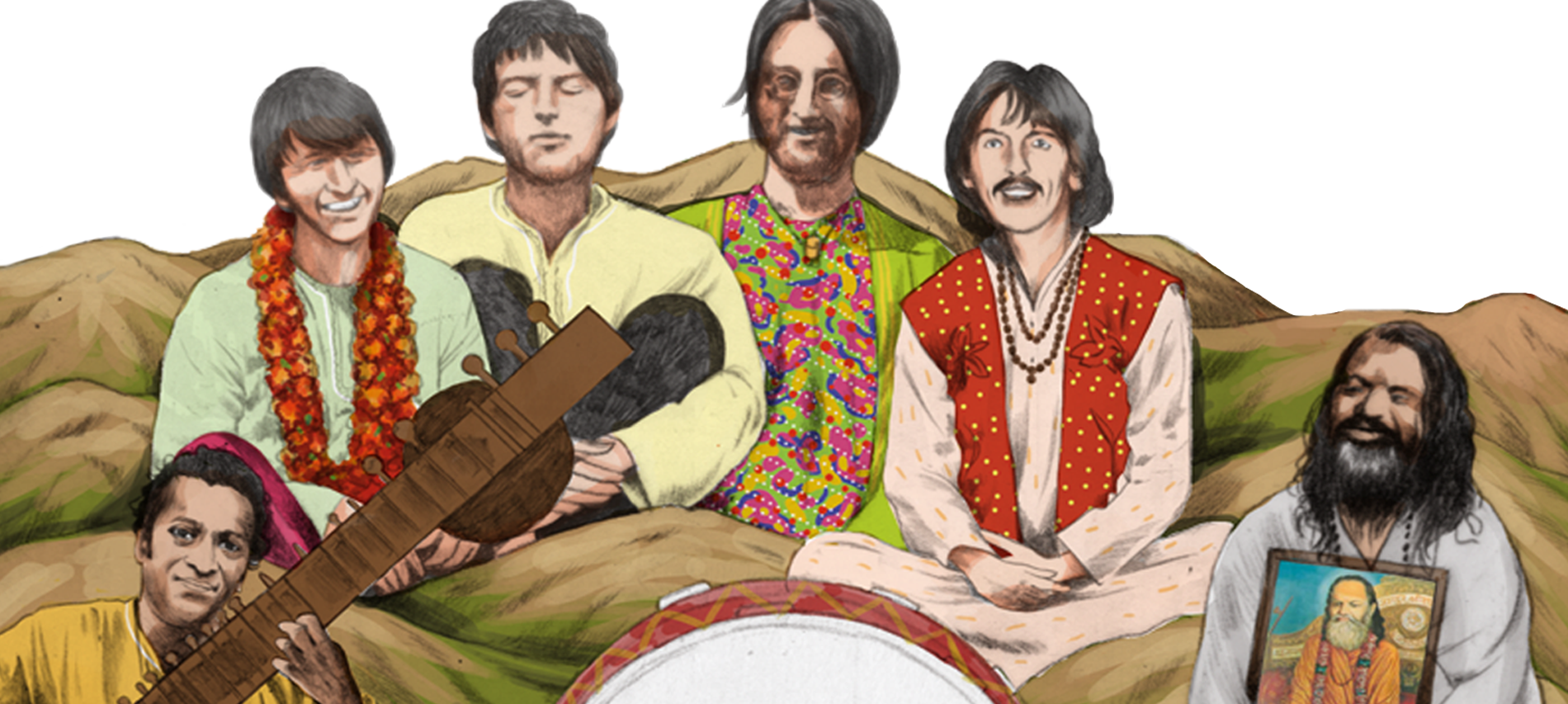
Across the Universe: The Beatles in India by Ajoy Bose – An Excerpt

Ajoy Bose has written a widely acclaimed book on the Emergency, For Reasons of State, and Behenji, the definitive political biography of Dalit leader Mayawati. A leading television commentator and columnist, he now uses his formidable investigative skills to look beyond politics, recreating the fascinating journey of the Beatles to India half a century ago. Full of characters and happenings delightful and evil, of comic excess and dark whimsy, Across the Universe: The Beatles in India, traces the path the Beatles took to India and the dramatic denouement of their sojourn at the Himalayan ashram.
Here’s an excerpt from this fascinating read.
—————————

Based on a raga recorded by Ravi Shankar some years ago on All India Radio, George’s song seemed quite independent of the rest of the album in its entirely Indian orientation played by Indian musicians with the rest of the Beatles out of the picture. The Indian musicians were recruited from the Asian Music Circle in Finchley, north London. They were Anna Joshi and Amrit Gajjar on dilruba, Buddhadev Kansara on tanpura and tabla player Natwar Soni. The song also featured lyrics that were overtly spiritual, seeking to explain the Hindu concept of maya, a veil of illusion that needed to be cast aside to find spiritual truth and happiness ‘within you’. The passion with which George played the sitar and the distinctive quality of the song impressed both Paul and John who were getting quite annoyed with his lack of enthusiasm towards the album. Both thought the song was great and did not appear to mind George having Indian musicians take over their studios and, for the first time, leaving them out of a Beatle song. Describing the song as ‘a great Indian one’ John said, ‘We came along one night and we had about four hundred Indian fellows playing here and it was a great evening, as they say.’ He would say later, ‘One of George’s best songs. One of my favourites of his, too. He’s clear on that song. His mind and his music are clear. George is responsible for Indian music getting over here.’ No longer the quiet Beatle, George, his imagination fired by Indian spirituality, could not stop talking about his new infatuation. He appeared along with John on the prestigious television show The Frost Report and gave innumerable interviews to a variety of publications declaring his adopted faith. When he was asked to give his choice of iconic personalities that the Beatles had decided to put on the Sgt. Pepper’s Lonely Hearts Club Band album cover, the four he chose were all Hindu seers, starting with his favourite Sri Paramahansa Yogananda and the three gurus who preceded him, Sri Yukteswar Giri, Sri Mahavatar Babaji and Sri Lahiri Mahasaya. On George’s insistence, these unfamiliar holy men from a distant land and an obscure faith brushed shoulders on the Sgt. Pepper’s cover with a variety of popular Western icons including Marilyn Monroe, Edgar Allan Poe, Karl Marx, Carl Jung and the champion swimmer Johnny Weissmuller who played Tarzan in Hollywood movies, among numerous others. In less than a year of meeting Ravi Shankar, George had virtually erased from his life all traces of his English working-class roots in Liverpool. The Harrisons became vegetarians, inspired by ahimsa, the Hindu pledge of non-violence to all living things. Pattie would shop at the local health food store in Esher for grains, pulses, vegetables and fruit, cooking not just nut cutlets and stews but also pakora, samosa, lassi and rasa malai. The scent of hash and joss sticks permeated the house. An ornate hookah sat on a low table in a sitting room which had no chairs, just cushions and rugs, according to George’s biographer Thomson. Thomson paints a compelling portrait of a Beatle who had by now fully embraced the culture and creed of a distant land. At his twenty fourth birthday party at his Kinfauns home, he played the sitar and then watched and recorded a concert performed in his honour by the great sarod player Ali Akbar Khan. No other Beatle attended. George wore a traditional cotton kurta and his guests included photographer Henry Grossman and the Byrds’ David Crosby and McGuinn, each arriving with vegetarian dishes for the buffet-style meal. It was, according to McGuinn, a charged occasion. ‘I remember being at that party with him in 1967 and I could feel the room change, there was something happening in the room. I looked at George and asked what was going on, and he said, “I’m transcending.”’ In 1966, a Vaishnavite Indian seer, Swami Bhaktivedanta Prabhupada, had founded a Krishna cult called ISKCON that would sweep the West captivating thousands of young men and women with its evocative ‘Hare Krishna’ chant. The swami asserted that by merely chanting the name of Lord Krishna, devotees could directly connect to the deity. When George came across a record of this chanting, he immediately fell under its spell. He played it to John who too was mesmerised by the repeated and almost hypnotic intonation of ‘Hare Krishna, Hare Rama’, a mantra that is routinely chanted every day by millions of devotees in India belonging to the Krishna sect of Hinduism. For the two Beatles, however, the ‘Hare Krishna’ chant seemed like a magical stairway to divinity. It was also another step towards the quest of the mantra that would take them to Rishikesh. George and John started chanting together whenever they met, forging a second bond in addition to their earlier connection over their shared first encounter with LSD.
For instance, both acid and mantra came together for the two during a sojourn out in the picturesque Aegean Sea in the month of July, when the Beatles went on a bizarre and ultimately abortive hunt to buy a Greek island to build their own kingdom. ‘Somebody had said we should invest some money, so we thought: “Well, let’s buy an island. We’ll just go there and drop out.” It was a great trip. John and I were on acid all the time, sitting on the front of the ship playing ukuleles. Greece was on the left; a big island on the right. The sun was shining and we sang “Hare Krishna” for hours and hours,’ George would fondly reminisce many years later. In that same month George waxed eloquent about both spirituality and India in an interview with Fifth Estate, a radical underground periodical. It would be his most explicit confession of embracing the Hindu faith and Indian culture and is worth quoting in detail. Answering a question on public curiosity about his new zeal for the chant, George expounded on the Hindu theory of Karma:
‘They get hung up on the meaning of the word rather than the sound of the word. “In the beginning was the word” and that’s the thing about Krishna, saying Krishna, Krishna, Krishna, Krishna, so it’s not the word that you’re saying, it’s the sound Krishna Krishna Krishna Krishna Krishna Krishna and it’s just sounds and it’s great. Sounds are vibrations and the more you can put into that vibration, the more you can get out, action and reaction, that’s the thing to tell the people.’


error: Content is protected !!