Publish with Us

Follow Penguin

Follow Penguinsters

Follow Penguin Swadesh

Michael Burns Gives the Tips to Hack into Your Creativity

Michael Burns is a university teacher, writing coach, actor, editor and storyteller. He has directed five films for international television and his work has been seen in over twenty countries. He moved to India in 2011, and founded Tall Tales, the country’s longest-running, live-storytelling event series. He also conducts popular writing workshops around India.
Here’s what he has to say about his book Hack Into Your Creativity
Everyone has at least one great story. What’s yours?
If you’re reading this book, welcome.
I’m so glad we’ve found each other.
This is a book of story prompts: ideas, questions and thought experiments for you to enjoy and to write on. They’re designed to stimulate, energize and challenge you (the third of these being the most important). They’ve been written in a particular manner so that the maximum number of people can relate to them in some way. The writing that they inspire is best when it’s detailed, original and sourced from deep inside the writer’s heart and mind. There are eight categories of prompts:

  • What Happens Next?
  • Character-Building
  • Incredible India
  • Genres
  • Everyday Magic
  • Two-Parters
  • Integration
  • Every Hair on Its Head

Each of these subjects starts with a mini introduction to the category. Work your way through them or skip around if there’s a particular skill that you need to work on. I’ve added extra pages at the end of this book for you to write in, but I would recommend combining this text with a notebook so that you never run out of room for epiphanies.
This collection differs from other story-prompt resources in a few important ways. First, the prompts that follow are not random, provocative words or phrases designed to stir you to write just anything. While there is something to be said for that style, I’ve elected, instead, to put together prompts that help you to investigate visceral, transformational and pivotal moments in storytelling. This way, your writing is targeted and helps fabricate a tool that you can use on a regular basis and even in the most dramatic points in your future stories. So, there’s a special emphasis on dramatic tension. Second, this collection also readily explores both fiction and non-fiction because both are essential skills. As all writers know, your ability to find depth and nuance in fictional characters is only possible if you’re willing to, at some point in time, turn that high-powered lens back on yourself. Third, in the vast majority of cases I’ve kept the prompts targeted but very simple, steering clear of the types of prompts that shout, ‘Look how clever this story starter is!’ and instead tried to keep the focus right where it should be: getting you started down a path to discover how clever you are. Fourth, and perhaps most importantly, as suggested above, this book offers you a curated sample of many different kinds of prompts that speak to the many different kinds of storytelling that a writer will likely indulge in—from introspective questions and sentence integration to science-fiction plot twists and character development. In other words, there is a substantial selection of varied prompts to suit your particular interest, mood or even work-related priorities.
These prompts are both specific and flexible. Just like an exercise machine at a gym, the prompts are designed to get you to work on a specific skill, but they can and should be adapted as necessary. I have randomly assigned pronouns (he or she) to the prompts, details that are obviously yours to change at will. I have also suggested goals for the amount of writing you should do after each prompt. This is just a minimal suggestion to help you create a proto-story, a foundational core that can give rise to a story over time. (Having said that, obviously, if you’re set on fire by a topic, with sparks flying off the end of your pen, keep writing!) Having a proto-story as a goal is important because a quality story is not something that usually reveals itself in one inspired session. It evolves over time and builds like a snowball. Some ideas are discarded while others are expanded. Therefore, a reasonable goal for yourself should be to meet at least the minimum lengths I’ve suggested and to infuse those seeds with so much love that they’re busting to grow. A more advanced goal might be to pair this book with your understanding of the universal story structure, giving your writing exposition, rising tension, and a satisfying but unexpected resolution. At the very least, consider three short acts for a simple story structure: let the prompts set things in motion, then let disaster strike your scene, and then finally, see if the characters you’ve created will be ingenious enough to survive or be overwhelmed enough to be snuffed out.
Treat this book as a source of inspiration when you need some. Treat it like a partner to help you get under the surface and beyond the barriers that might be temporarily blocking your creativity. Perhaps, above all, treat it as activation energy. Every chemist knows that reactions need a little push to get them going. And once the reactions start and combinations begin to agitate, percolate and transmute in the unpredictable ways that they sometimes do, you never quite know where you’ll end up.
So, as we get started on creating together, peace be the journey—the alchemist’s journey.
This is an excerpt from Michael Burns’ Hack Into Your Creativity.
footer (4)

The Third Way to Innovate

There is a big flaw in innovation thinking today – a false dichotomy. Conventional wisdom says that to survive, companies must move beyond incremental, sustaining innovation and invest in some form of radical innovation. “Disrupt yourself or be disrupted!” is the relentless message company leaders hear. Don’t be fooled. David Robertson in his book, The Power of Little Ideas shows there is a Third Way that is neither sustaining nor disruptive, but is, in its essence, complementary. This low-risk, high-reward strategy is one that all managers and executives must understand and practice in order to achieve competitive advantage in today’s dynamic economy.
The Third Way, isn’t a new concept altogether. Some companies have used the concept in their own way to maneuver their businesses into profit. However, no one has explicitly defined and described this form of innovation as a replicable process. To understand the concept in a concrete way, one should know its three distinctive traits.
First, and most obvious, the Third Way consists of multiple, diverse innovations around a central product or service that make the product more appealing and competitive. We refer to the product at the center of every Third Way project as the key or core product. It is always a key or important product; making a marginal product the focus of so much effort would make no sense. But the product does not always have to be a company’s core product, as its sports drink was for Gatorade and used cars were for CarMax. For Novo Nordisk, its HGH drug was certainly important, but its insulin product was, at least for the period covered in our story, the company’s core product. “Always key and often core” is the way to understand any product that is the focus of the Third Way.
By diverse complementary innovations, we mean that they should fall into a wide range of business categories, such as pricing, marketing, operations, sourcing, and partnerships. Likewise, the innovations should appear in a host of different forms, such as auxiliary products, support services, and social media activities.
Second, what makes this approach work is that all the complementary innovations operate together as a system or family to satisfy a compelling promise to the customer. Gatorade promised peak performance for serious athletes through a complete nutrition and hydration solution. Norditropin promised to make HGH therapy as trouble- and pain-free as possible for all involved. And CarMax promised buyers a hassle- and worry-free experience when they were locating and buying the car they needed.
Third, and perhaps the least obvious in the stories, the family of complementary innovations must be closely and centrally managed. It’s not an ecosystem of interrelated but autonomous companies and products that compete, collaborate, or otherwise co-evolve according to their own needs and priorities. Instead, each complementary innovation is created or selected and then closely managed, usually by the owner of the key product. Indeed, the careful selection and proactive management of this system is crucial to the success of the Third Way.
This is an excerpt from David C. Robertson and Kent Lineback’s The Power of Little Ideas. Get Your Copy here.
Credit: Abhishek Singh
 

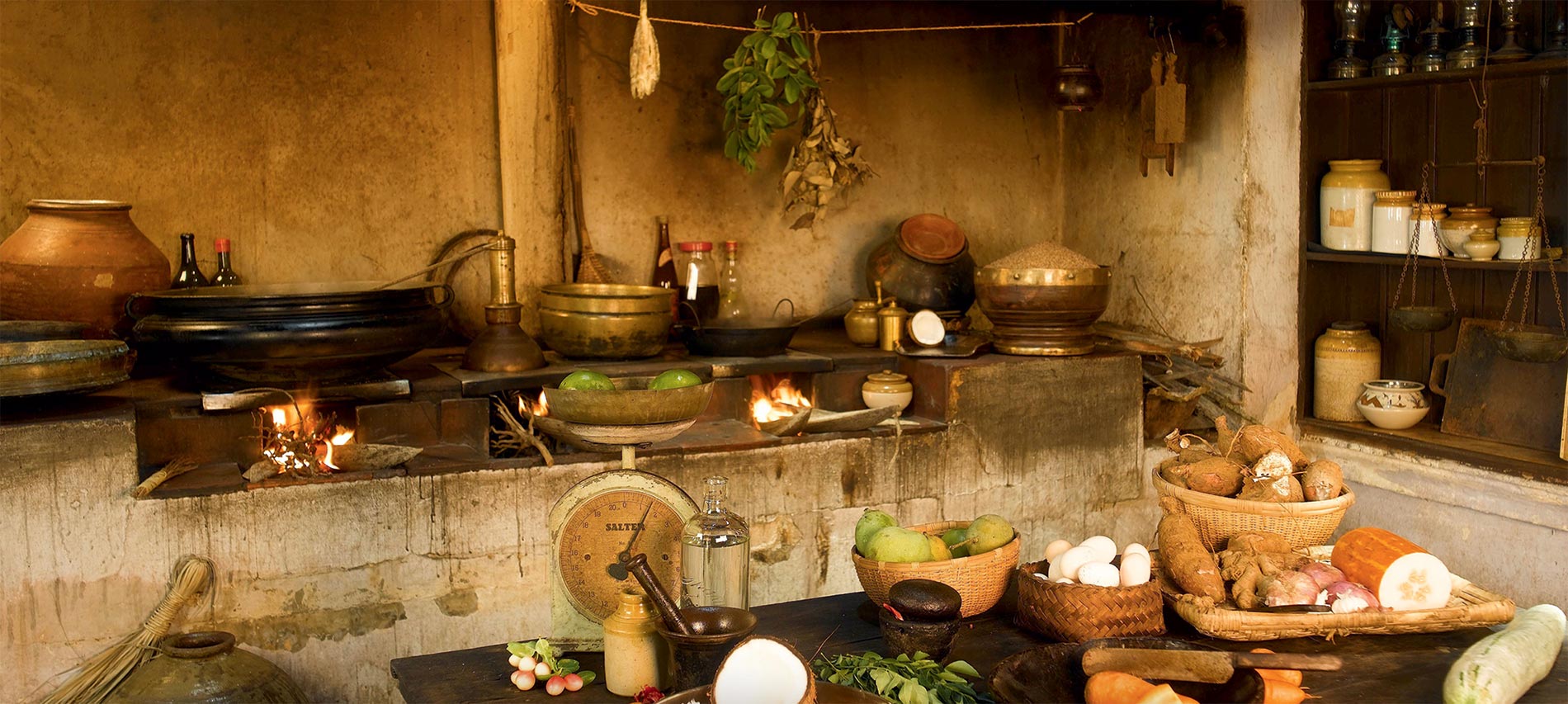
The Beginnings of the Syrian Christian Kitchen in Kerala

Long before the time of Christ, spice merchants and travelers from around the world would visit Kerala. The important seaport of Muziris or Cranganore was populated with Greeks, Syrians, Jews, and Chinese traders who lived in harmony with the people of the region. It was on one of these trading vessels, plying between Alexandria and the Malabar Coast, that Saint Thomas the Apostle is believed to have arrived in Cranganore in AD 52. He began preaching the Gospel to the people of these areas, and eventually established churches in Cranganore, Paravoor, Palur, Kokkamangalam, Niranam, Malayatoor, and Nillackel. Among those early conversions were several Namboodiri Brahmin families, from whom many of the present-day Syrian Christians trace their roots.
As legend has it, the upper caste Brahmins of Palur were converted after a miracle, whereby Mar Thoma (Saint Thomas) suspended water in midair as a testimony of his faith. Most of these early Christians followed the ancient Eastern Nestorian faith and were known as Malabar Christians until the advent of a Syrian merchant—Thomas of Canaan—who arrived in Muziris with four hundred Syrians, including several priests and a bishop. The Syrians were welcomed by the local Malabar Christians as the countrymen of Jesus and Saint Thomas. The two communities eventually intermarried and merged to become Syrian Christians, now recognized as one of the oldest Christian communities in the world.
The present-day Syrian Christians of Kerala are also known as Nazaranis, the followers of Jesus of Nazareth, and though they are now divided broadly into four sects—the Knanaya Christians, Jacobites, Marthomites, and Syrian Catholics—they share many common religious and social practices, and intermarriage is not uncommon. Collectively they retain a distinct identity and remain independent from other Christians in India because of their unique lineage. Life is centered around their liturgy and the observance of days of fasting and abstinence. They follow old Syrian church rites, chanting their singsong Syriac liturgy. The saga of the St. Thomas Christians is narrated in their song and dance forms—Margam Kali (the way of St. Thomas) and the Rabban Pattu (the songs of Rabban).
Syrian Christians are identified by their family names which reflect the profession of a family elder, place of origin, or sometimes nothing but pure whimsy. My own family, a large Syrian Catholic clan from Kanjirapally, is called Pallivathukkal, meaning “at the church gate,” as many centuries earlier my ancestors had settled near a church in Nillackel. My husband’s family name, Thekkekunnel, means “south hill.” Thadikaren, another family name, means “bearded man,” and the poetic Myladi means “peacock dance.” First names are biblical, and customarily the firstborn is named after a paternal grandparent and the secondborn after a maternal grandparent. Thereafter, aunts, uncles, and saints lend their names to the newborns. The second name is taken from the child’s father, but a Joseph George, say, may be anonymous until, when paired with his family name, he can be immediately placed as Joseph, the son of George of the Pottenkulam family. Syrian Christian names are distinctive and a George may also be known as Varkey or Varghese; a Paul can be Peeli or Paulose; and an Abraham can be called Avira or Ittira. Similarly, the female Syrian Christian name Rachel may be Raahel; Elizabeth can be Aley or Elamma; and Bridget, the melodious Uschita.
Most prominent Syrian Christian families are close-knit and connected by an intricate web of marriages. I have vivid memories of my mother and sisters spending hours disentangling family connections, the links being the women who married into each family. With many of these large clans expanding into several hundred members, some families now hold periodic kudumbayogams, family get-togethers which allow members of the family to reconnect.
Christianity in India has long been synonymous with education and the Syrian Christians have made a significant contribution to this field, partly by means of their large number of clergy. Today they have evolved into a distinct, indigenous community of agriculturists, scholars, industrialists, and professionals. A large number have moved to other cities in India as well as to distant lands, and though erudite and cosmopolitan, they are still attached to the traditions and customs of their ancestors.
Described as “Hindu in culture, Christian in religion, and Syro-Oriental in worship,” Syrian Christians enjoy the status of a prosperous and socially prominent community.
Sautéed Squid
Koonthal Varathathu
Squid turns rubbery if overcooked, so once marinated they must be quickly stir-fried and served hot, with a fresh sprinkling of lime juice. Serve with rice and accompaniments or as a snack.
Grind the garlic, chilli powder, turmeric, and pepper- corns to a coarse paste in a mortar and pestle.
Mix the garlic paste with the rice flour, salt, and lemon juice and rub into the squid. Let the squid marinate in the spices for at least 2 hours at room temperature.
Heat the oil in a skillet and add the squid. Stir-fry over high heat for 3 to 5 minutes, removing from the heat when the spices brown.
serves-2.png
This is an excerpt from Lathika George’s ‘The Suriani Kitchen’.
Suriani Kitchen footer.png

Narrating Stories with Data

As director of analytics and A/B testing at Visa, Ravichandran supports executives, leaders, and decision makers in product, marketing, sales, and relationships. He explained to me that “we are the custodians of the data, so our responsibility is to enable our users to have confidence in the decisions they make using that data.”
One of the biggest changes the analytical era of marketing has brought about is that things need to happen much faster than before. “We used to have a very linear approach,” Ravichandran told me. “Now when something is going live, there’s already an immediate need to respond. We need to be able to take action on the fly.” Because of those changes, marketers can no longer think about analytics as something that supports them or a function that just one person, like a chief digital officer, would perform. Rather, analytics is now an integral part of marketing’s value chain.
Ravichandran said that numbers by themselves are historical. That’s why, while data is needed to inform campaigns, at the end of the day, it still comes down to marketers using their gut feelings to make the best decision possible. “And we can use data and analysis to inform and guide us in the right direction,” he added.
Because data and analytics are now so intertwined with marketing strategy, expectations for leadership on the marketing side have changed. “It’s no longer acceptable to say you’re a marketer, but you’re not a numbers person,” Ravichandran said. “Executives are demanding more data literacy as a precursor for being a good marketer.” And it’s not just in the marketing space. He added, “All of our chief executives are comfortable with numbers and data-driven approaches.”
Ravichandran was quick to clarify, however, that a focus on data, numbers, and quantified measures should not replace the value of vision: “I have an enormous respect for data, but I also believe all of it has to be driven by strategy, the business case, benchmarking against the industry, all those things that provide a broader perspective. You have to understand what specific metrics you’re trying to impact with your actions.” He advocates the importance of understanding your company’s business model, applying and measuring the right metrics, and truly understanding your competitive position and your customers’ needs.
The big mind-set shift we need to make, therefore, is recognizing how our intuition is now informed by data and analytics. When someone comes to a marketing manager or leader with a proposal to spend, say, $250,000 on a campaign, she had better come armed with data, analysis, testing plans, and expected outcomes, as well as what her gut is telling her.
This is an excerpt from Adele Sweetwood’s The Analytical Marketer. Get your copy here.
Credit: Abhishek Singh
 

Why Care About Superconsumers?

Superconsumers Beget Superconsumers
The true value of superconsumers lies in their contagious nature. Those you meet are likely to have a crowd of other current superconsumers and potential superconsumers with them. For additional superconsumers, look to their family and friends. Capture and share the superconsumers’ stories, and watch as their knowledge inspires and creates new superconsumers.
Superconsumers Travel in Packs, Creating Super Geos
As the epicenter of demand creation, super geos can be tapped into to drive superior growth in your business. But you must locate and leverage them. The words national average are some of the most misleading in business. Many leaders have an inherent, subconscious belief that demand is spread like peanut butter, evenly and thinly. But the very presence of super geos means that passion for your offering will be patchy, with one set of consumers wild about your product while another group is neither hot nor cold. If you believe that demand is like the flat Midwest, then you’ll be ill prepared to climb the hilly terrain it really is.
Superconsumers Are Superconsumers of Multiple Products
A superconsumer of one category is often a superconsumer of other categories. Cleverly combining two or more important, yet seemingly different categories not only taps into a quest, but can also create a new category—just as American Girl crashed dolls, education, and experiential retail into one category.
Generac, the leading manufacturer of standby generators, found that people who buy three to four times more life insurance and lots of vitamins tend to be great prospects for proactively buying a generator for an extreme event that may never happen. These consumers are superconsumers of proactive protection.
Sometimes the connection between categories is not as clear, as some categories counterbalance one another. For example, superconsumers of milk tend to be superconsumers not of other healthy foods and beverages, but of more indulgent ones like cereal, cookies, and candy. Milk was the perfect accompaniment to sweets—and was probably considered something like an old-school indulgence you could buy from the Catholic Church in advance of a sin you were planning to commit. Counterintuitively, Harvard Business Review reported that shoppers who recycle their grocery bags tended to indulge more in junk food as well.
What Pleasant Rowland created and Mattel helped foster is amazing. American Girl’s remarkable growth may also feel intimidating. But it is more feasible than you might think, especially considering how low the success rates are for innovation in your core business.
The key is to take stock of the state of your business now. Are you hitting your growth goals? How good is your ROI now? What are the odds that your business will still be successful for the next five to ten years?
Of all new consumer packaged goods, 85 percent or more fail. Why? Often, the problem is that they aim too low by trying to solve the same job with a slightly modified product. Companies would do far better aspiring to solve a quest, but falling short slightly and finding that they created a product that consumers wanted to hire for a wholly more important job than its originally intended one.
The most successful businesses today have multiple business models, not just one. How well does a unidimensional business model do against a multidimensional one? Poorly, much like a boxer who runs up against a mixed martial artist who can box, kick, and wrestle. It is an unfair fight. This is both the beauty and the imperative of leveraging superconsumers to create new categories.
Are you looking at transforming your business through an adept use of your consumers? Get Eddie Yoon’s Superconsumers here!
Credit: Abhishek Singh

Raj, an Extravagant Saga about the Maharani of Balmer, Jaya Singh

The land of Jaya’s birth lay beyond the desert known as the Abode of Death.
Even that year, three years before the start of a new century, the small tribe of bards making its way to the kingdom of Balmer saw many auguries of death. Water holes and village wells were dry. The artificial lakes which watered the great desert kingdoms of Jodhpur, Bikaner, Jaisalmer were covered with green slime, their levels sunk so low the foundations of water palaces stood revealed, ringed by brown-scaled crocodiles dozing in shallow water.
There was little food to spare for the storytellers as they converged on village squares at nightfall to tell their tales for a place to rest, and yet they became a caravan. Throughout Rajputana it was known the Maharajah of Balmer awaited the birth of his first child. Families in search of a season’s work, other storytellers and tinkers and acrobats, called to the bards, ‘Do you go to Balmer for the birth?’ Learning it was so, they grabbed sleepy bullocks by their vermilion-painted horns and shouted ‘Hut! Hut!’ urging the animals onto the road.
Once a group of ash-covered sadhus lying naked in a broken pavilion built by a forgotten king waved their iron tridents and clambered into a crowded camel cart.
Sometimes the carts were pushed aside by the crested carriages of rajas who lived in the stone fortifications that outlined the treeless black hills. When the sun was at its height, the fortifications seemed to breathe, expanding and contracting in the haze as though the hills were massive, brooding lizards from the time of mythology and the motion of the stone battlements the sluggish shifting of their spines.
Sometimes the caravan attached itself to the procession of court ministers journeying to Balmer with secret messages from their maharajah to the ruler of Balmer, in defiance of the laws of Imperial Britain. Then an elephant led the way, flanked by cavalry units holding banners. When the processions moved on, a silver coin, embossed with a maharajah’s symbol on one side and the profile of the English Empress on the other, was gifted to each member of the caravan, even the children.
Scrub jungle gave way to sand dunes. At sunset, the sudden darkness brought a feverish chill to the empty landscape. The travellers willed their emaciated animals to reach the shelter of villages spaced farther and farther apart before the demon women who had died in childbirth came howling through the night in search of children to replace the stillborn infants they had never suckled.
Now the caravan was so large no village could contain it, and the travellers pitched their own camps.
While their children slept in the cloth cradles tied between the brass spokes of camel carts, the bards, the gypsy genealogists of royal India, talked through the night, exchanging news of the Rajput kingdoms.
‘Our rulers are preparing to travel to London for the Diamond Jubilee of the White Widow, the Empress Victoria.’
‘The retinues and gifts they must take to impress the British Empire will dangerously impoverish their treasuries.’
‘At least in London they can speak together. Here, Britain still fears conspiracy and will not allow the kings to meet except in the presence of Englishmen.’
‘But court astrologers are reminding their maharajahs that famine has come every twenty years since the rise of British power.’
‘And twenty years have passed since the last famine.’
The bards shook their heads, dismissing astrology for the reality they had witnessed on the road. They had seen the villagers praying for rain. The farmers knew already. Another famine had begun.
This is an excerpt from Gita Mehta’s Raj.
footer.png

Learning from Mistakes

Jeff Bezos, the owner of mighty Amazon constantly features in one of the most successful entrepreneurs of modern time. The way he has steered Amazon through all these years, shows his dedication and skill to make things work against all odds. However, even he failed. A lot of articles have come up post this and many different perspectives have tried to solve this problem from a different angle. Jeff Gothelf and Josh Seiden’s book, Sense and Respond tries to look at such cases from a newer perspective:
‘Amazon’s 2014 Fire Phone disaster is a classic example and, oddly, one that comes from the very same company that developed and frequently uses many of the sense and respond techniques we’re discussing—a company we laud in chapter 1 for that reason.
Motivated by consumers’ increasing use of mobile devices, Amazon began the Fire Phone effort in 2010, just as the iPhone 4 was hitting the market. Mobile users were becoming a more important source of traffic to Amazon, and the company wanted more control of the mobile store than Apple would allow. Apple’s rules about what companies can and can’t do in iOS apps include strict rules about commerce, including one that stipulates that Apple gets a 30 percent share of each in- app sale. 2 (The reason you can’t buy a book on the iOS Kindle app is that Amazon doesn’t want to pay Apple 30 percent of each sale.) So Amazon created the Fire Phone initiative to solve a business problem: it wanted complete control over the store that its customers visited on their mobile devices.
But what would be the value to customers? They struggled to find it, in part because of a strict culture of secrecy around this product. Jeff Bezos, CEO of Amazon, had lots of ideas for cool features. But cool and valuable are not the same thing. Over time, Bezos exerted an increasingly heavier hand in the design and development of the Fire Phone and, according to published reports, ignored feedback from his team that questioned his approach. 3 There was no conversation with the market here, only Bezos talking. He insisted that the phone have a series of fl ashy features like Dynamic Perspective, a 3-D display that didn’t require special glasses and could be seen from all angles; but it delivered little consumer value. Bezos assumed that fl ashy hardware features would make the phone more desirable to consumers than an iPhone. Without a continuous two way conversation with his target audience to guide the development of these features, though, Bezos was making a huge guess.
He guessed wrong. Four years later, in July 2014, the Fire Phone went on sale in the United States. Within days it was clear that consumers were unimpressed— with the design, with the ecosystem, and with the gimmicky features Bezos had pushed for so hard. Priced at $199, the Fire Phone was intended to compete directly with Apple’s iPhone, but consumers didn’t see the value. Instead, they saw it for what it was—a way to easily get to Amazon’s store in a way that was better for Amazon but not significantly better for customers.
After a $170 million write- down of unsold inventory, the Fire Phone was available for 99 cents before finally being sunset in late 2015. The behind- the- scenes stories reveal the arrogance in the top down decision- making process that Bezos led. Although people on the team pushed back, they ended up deferring to the boss. After all, he’d been right many times before. Why wouldn’t he be right again this time?
It might have helped if Bezos had listened to the market. Had he approached some of these decisions as assumptions to be tested and questions to be answered, rather than hunches to be followed blindly, things might have been different.’
You can get your hands at the book here.
This is an excerpt from Jeff Gothelf and Josh Seiden’s Sense and Respond.
Credit: Abhishek Singh

Winning with Superconsumers

Daniel Zein (disguised), the CFO of Great Snacks, thought that Nacho Cheese could be one of the company’s most valuable brands, so he encouraged the team to dig further into the product. The team did some robust analysis, and to their surprise, they discovered that Nacho Cheese’s consumers spanned the entire income spectrum.
From the data, it was obvious that Nacho Cheese could be a much bigger brand. Of all the full meals that consumers eat at home, about 37 percent are consumed hot and include cheese. But Nacho Cheese was used in only a fraction of those meals. To grow its product, the Great Snacks team decided to focus on the twenty-four million or so other consumers who share the same three loves that Laura had—people, cooking, and cheese—but who may not understand the magic of Nacho Cheese and the dozens of life solutions that it could deliver.
Simply put, the team gathered data from their superconsumers, ensured that the resultant insights and inspiration also appealed to the other twenty-four million consumers, and then geared its marketing, innovation, and retail execution to their tastes and behaviors. The immediate challenge was to convince the company leadership that Nacho Cheese could grow through better marketing and innovation—from packaging to product.
Line extensions into other forms of cheese were also a logical action step. Great Snacks drove growth by megabranding Nacho Cheese into other categories. The core business grew steadily faster than inflation, but the extensions in cheese (e.g., slices, shredded cheese) grew by double digits. All told, the brand extensions drove more than $50 million in growth, and the megabrand grew $100 million in three years.
For years, innovation for Nacho Cheese was a challenge. Since the brand was not well understood, innovation concepts yielded mixed results, which made the team hesitant to pursue breakthrough innovation. But with new data, the team revamped its innovation testing process to include both superconsumers (like Laura) and potential superconsumers (folks who could become like Laura).
The group was pleasantly surprised to find that among all the new product concepts it tested, some were off-the-charts positive for superconsumers. The team made a few tweaks, the new concepts tested positive for potential superconsumers as well, and the team finally had the results it needed to proceed.
The team saw that retail activation was inconsistent across retailers. In some stores, Nacho Cheese was placed in the center of the store. In others, it was refrigerated in the cheese and dairy section. So the team did some analysis and found that Nacho Cheese sold faster in the refrigerated section, which consequently produced better results for Great Snacks and the retailer. The team learned that superconsumers strongly preferred the product when it was sold in the refrigerated section. What’s more, potential superconsumers had a much easier time finding it in the refrigerated section.
Finally, the Great Snacks team used big data to uncover meaningful ways of improving marketing ROI. It used big data from Nielsen Catalina Solutions—a joint venture that creates a single-source panel of consumers from the sixty million loyalty-card holders from grocery stores and the Nielsen TV panel of two to three million households. The single-source data gave the team interesting insights on the actual TV shows that Nacho Cheese aficionados were watching. In one test using this data, the team found that superconsumers were fifteen times more responsive to Nacho Cheese advertising than other consumers! The vice president of marketing noted that the brand’s marketing objective was to have a conversation with superconsumers about their love for Nacho Cheese, but to do so in a way that potential superconsumers could listen in.
The beauty of all this was that the data the team used to improve innovation, retail activation, and marketing was already there. Superconsumers gave the marketers a way to synthesize the data into a coherent and coordinated set of actions and metrics. Looking at superconsumers like Laura, the team gained confidence that the strategy had even more upside. And the team saw the potential and ran with it.
Want to know a simple, speedy, and sustainable path to superior growth? Order Eddie Yoon’s Superconsumers here!
This is an excerpt from Eddie Yoon’s Superconsumers.
Credit: Abhishek Singh

The Legal Eagle – An Excerpt

Harish Salve’s name ranks amongst the brightest legal luminaries of India. After an illustrious career of nearly two decades as a Supreme Court lawyer, he served as the Solicitor General of India from 1999 to 2000. A highly sought-after practising lawyer, his client list includes corporate bigwigs like Ratan Tata, Tina Ambani and Lalit Modi, as well as powerful politicians like Mulayam Singh Yadav and Prakash Singh Badal, and also Bollywood actor Salman Khan. He represented Vodafone in the well-known tax case with the Indian government which was finally decided in Vodafone’s favour. He was the counsel of choice for Mukesh Ambani’s Reliance Industries Limited in big-ticket cases like the Krishna Godavari Basin gas dispute and for Ratan Tata in a privacy petition concerning the Niira Radia tapes, as well as for the Delhi Police in the case for its midnight raid over Baba Ramdev’s rally at Ramlila Maidan. Besides representing his high-profile clients, Harish Salve has offered his pro bono services several times as amicus curiae to assist the Supreme Court in cases mostly relating to the preservation of the environment.
It’s a special day when I hear from the country’s pre-eminent lawyer, confirming our meeting in early August in Delhi at his office at ‘White House’ on the premium Bhagwandas Road, a stone’s throw away from the Supreme Court and India Gate in the Lutyens Bungalow Zone. I am excited to meet Harish Salve, though thankfully not for legal reasons!
There are guards posted outside his sixth-floor office. As you go past the reception desk, of the three doors that open into the reception area, the one on the extreme right is Harish’s chamber. It’s elegantly done in dark mahogany wood and expectedly has a wall-to-wall library stacked with gilded books as the backdrop to his revolving black chair. His large glass-top work desk and the set-up around it take up almost one-third of the space.
From a reputed family, with his grandfather being a successful criminal lawyer and father, N.K.P. Salve, a well-known Congress politician of his time, I imagine that Harish would have had success served to him on a platter and I share my view with him up front.
‘Contrary to what you think,’ he says, ‘I had what you may call “a lower-middle-class” upbringing. I come from a life of simplicity and grew up in a house full of relatives. My mother’s elder brother took sanyas (became an ascetic) and left home. His children were virtually brought up by my parents. My mausi (maternal aunt) also lived with us. So my elder sister, five of my cousins, my mausi and I used to sleep in the big living room, with the only bedroom in the house occupied by my parents.’ Harish was brought up by the same mausi, who was a professor of philosophy in a women’s college. Every night, she would put him to bed and read something to him. It was a very down-to-earth upbringing. Sports for Harish in his childhood meant playing football with kids from the chawls behind their house. As he says, ‘So even though I went to a very good school in Nagpur, there was so much learning we had on the football field of different aspects of life while intermingling with children from different backgrounds.’
After school, he chose to do his undergraduation in commerce and joined his father’s chartered accountancy firm for articles. Harish’s father was a practising chartered accountant before he joined politics. He and his partner had a small firm with an annual turnover of about Rs 5 lakh. Remembering those times, Harish says, ‘During my first year of college, I used to travel by bicycle in the sweltering heat of Nagpur.’ Colleges started in the month of March when day temperature in Nagpur is usually above 40 °C and burning. ‘I would come back, have lunch and then leave for office.’ As the peak summer months approached, the temperature would go up to 45 °C and Harish would cycle to office earlier in the morning. ‘There were times when we would be required to go to some factories in the afternoons and do an audit. I remember we used to take a wet towel and put it around our heads to avoid heat stroke and then cycle some 8 kilometres to reach the place,’ he says. ‘The so-called “big entertainment” in college and years after that was to go to a local dairy and have coffee or to go to Hanuman Mandir and have samosas. I usually stayed up the nights and studied. We would go to the railway station and eat at the dhabas there.’ That’s how Harish grew up. He credits these experiences for teaching him some very important values, making sure he’s never lost touch with that part of his life.
‘You switched from commerce to law. How did that happen? Did you complete your chartered accountancy?’
‘The moment I completed my graduation I joined CA, but found it very boring. Though the course was good, I knew that I would not stay in the audit and accountancy field. I was more interested in law and taxation. I completed CA only because it became a matter of prestige. Everyone said, “Yeh toh Salve sahab ka beta hai, ye thodi karega CA” (He is Mr Salve’s son, so he will not do CA) and my reaction was, “Ab toh pass karke chhodunga” (Now I will qualify and prove myself).’ Harish qualified for CA, and within two months gave up his certificate of practice to enrol at the bar. His father was very upset, but Harish was very clear that he wanted to be a lawyer. He had been a (Nani) Palkhivala fan from the age of fourteen as his father’s firm used to consult Mr Palkhivala on taxation matters, and Harish got the opportunity to interact with him a few times on cases wherein his father involved him. Harish thoroughly enjoyed income tax and learnt a lot from Nani, and gradually made up his mind that if he had to pursue taxation, it would be as a lawyer. The time had come for him to chase his dream.
Keen to know more about his relationship with his father, I ask, ‘You completed law from Government Law College, Nagpur, in 1980, and by then you had also managed to complete a couple of years’ internship with a law firm operating out of Nagpur and Mumbai, as well as acquiring the precious experience of working with Nani Palkhivala on the famous Minerva Mill case. Later, Nani recommended that you work as a junior with Soli Sorabjee who was then the Solicitor General of India based in Delhi. At that time, your father was the deputy leader of the Congress in Parliament under the prime ministership of Indira Gandhi and soon went on to hold other important portfolios in the Central cabinet—as minister of state for information and broadcasting (I&B), then minister of state with independent charge for steel and mines. How did the relationship pan out between the father and the son in terms of propriety—you as a budding lawyer and your father as an influential politician?’
‘My father joined politics when I was ten years old. All I have seen is a downslide in the quality of my life from the time he joined politics. His income went down and things didn’t change right through to the time I was doing my CA. I remember my mother telling me, “You cannot eat meat every day.” This is how it was even when my father was a member of Parliament (MP). Though he steadily grew in terms of his political stature, it didn’t translate into financial gains. The sense of righteousness was very strong in him, so he made sure that the boundaries between our professions remained concrete. When my father was inducted as a minister in the Central cabinet in the 1980s, I never attended a single official party. I went to his office only once when he was in the I&B ministry because he wanted me to sign some papers. For several years after my father was the minister of power, I didn’t know that his office was in Shram Shakti Bhawan.’
It was only much later when, as Solicitor General, Harish went to Shram Shakti Bhawan for a meeting with Suresh Prabhu—who was the minister of power then in Atal Bihari Vajpayee’s cabinet—regarding the Dabhol case that he realized that it was his father’s office!
‘When my father was the minister of steel, he called me up one day and said that he wanted to know how much work I had got from the Steel Authority of India in the last year. I totalled it, and it came to about Rs 3000 when I had a practice running into some Rs 40 lakh at that time. When he became the minister of power, he called me and told me that he did not want me to work for any public sector units that came under his ministry.’ Harish assured him he would not and at the same time brought to his father’s attention how there were a bunch of third-grade lawyers whom ministers patronized and that they should be barred from appearing. ‘I ended up becoming the cause for a rumpus that followed in the ministry,’ chuckles Harish and adds, ‘It was only once that I worked for the ministry of power, and then too, instead of getting any benefit, I ended up giving free advice to the government.’
‘You imbibed taxation and law from your family environment. What about politics? Have you ever considered joining politics?’
‘My personal view is that there are two kinds of reactions when you see power and politics very closely—you love it or hate it. I hate it.’ Harish is clear that he has never even considered the idea of joining politics. As a student of public affairs and law, he likes following politics and understanding it because it is important—not in its narrow partisan sense but as an important part of governance.
‘As a renowned constitutional lawyer, what are your observations on India as of today—the way the country is being managed and where it is headed?’
Harish ponders briefly and then very eloquently expresses his key concerns about Indian polity. He cautions and remarks, ‘I think right now India is going through a very negative mindset and if we don’t realize this soon enough and do something about it, we are going to pay a very dear price for it. We have, from about 2011 onwards, created an impression that everybody in power is corrupt, everyone who has a car is a crook, everyone who lives well is a crook. We must realize that India’s biggest fault line is between the haves and the have-nots. In the power game of politics, instead of taking hard decisions for development, people are being pitted as rich or poor—us versus them. In this way, we are gradually cultivating complete disrespect for our constitutional institutions.’
Harish’s analysis is that we are being misled by a wealth-hungry media. The media decides who is corrupt and who is not, and we basically assume if a person is rich and influential, he/she must be corrupt. The reality is that governance comes from institutions, and wealth comes from private capital. By giving them a bad name today, Harish believes we are sawing at the edifice of democracy. This trend is alarming and nothing, nothing appears to be above partisan politics—whether it’s land acquisition, foreign direct investment (FDI), or even the Naga Accord. Not blaming any one political party for it, he points out that everybody does it, with politicians attending to their personal interest first and functioning with a ‘to hell with the nation’ attitude.
However, he acknowledges that we still have a lot of very fine politicians and conscientious MPs, having known them well. ‘There are a lot of lower-middle-class MPs who live in two-bedroom flats and go back to do some good work in their constituencies. But you’ll never hear about those people. On the other hand, if one person makes some communally sensitive statement, it immediately makes for front-page news,’ he says.
What after money and fame (1)

8 Quotes for the Rebel Inside Every Girl

What if Cinderella didn’t want to go to the ball but rather go out with her friends? What if Rapunzel didn’t need ‘saving’? And why didn’t Eric become a merman to have a ‘happily ever after’ with Ariel?
How much, do the stories we tell our little girls, shape their views about being a woman?
Elena Favilli’s Good Night Stories for Rebel Girls introduces us (and our impressionable girls) to one hundred remarkable women and their extraordinary lives. From Cleopatra to Malala, Charlotte Bronte to Serena Williams, these tales are truly empowering for heroines who definitely don’t need rescuing.
Here are a few quotes from the book.
A message that, unfortunately, seems to get lost quite often.
RG 1.jpg
Aiming for the stars is in every girl’s blood!
RG 2.jpg
Your voice isn’t small. Your voice isn’t weak. You were meant to ROAR!
RG 3.jpg
You are perfect the way you are.
RG 4.jpg
Touch the skies. You’re meant to be with the birds.
RG 5.jpg
You are a fighter. No obstacle is ever ‘too big’ for you.
RG 6.jpg
Why be something else when you’re PERFECT.
RG 7.jpg
Be bold. And you will be free.
RG 8.jpg
Feeling like a rebel with a cause? Tell us what you think in the comments below.
Design-Footer-blog-2.jpg

error: Content is protected !!