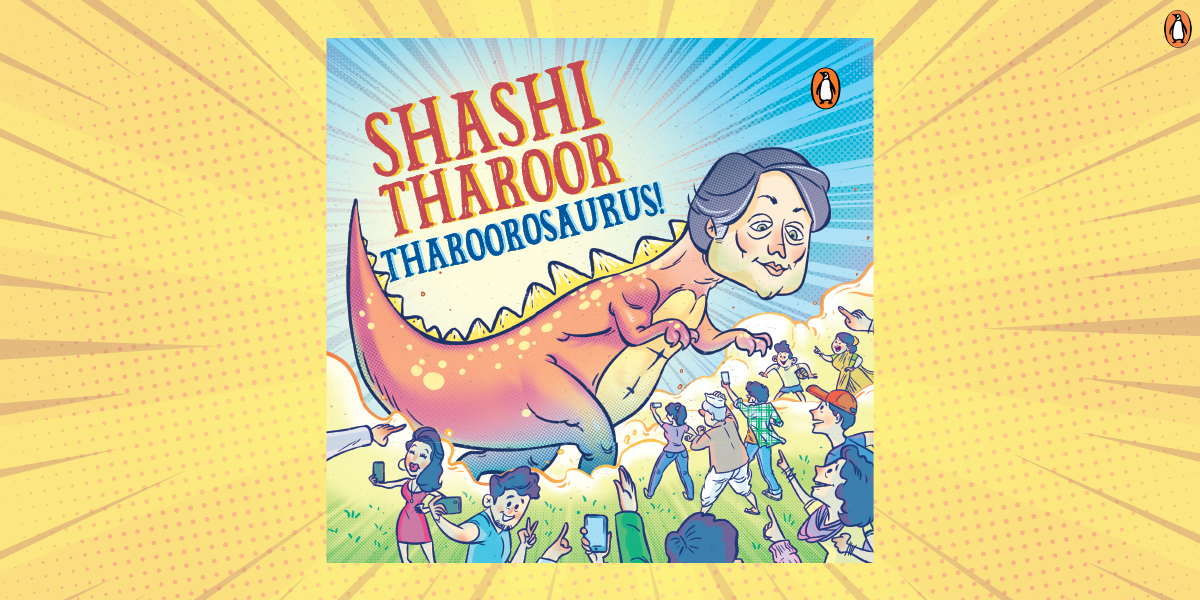
Language can act as a loaded weapon when used with lucidity and eloquence. Shashi Tharoor is the wizard of words, his literary prowess unparalleled. In his book Tharoorosaurus, he shares fifty-three examples from his vocabulary: unusual words from every letter of the alphabet as well as fun facts and interesting anecdotes behind the words.
Today, we are giving you an exclusive glimpse into the exquisite world of Tharoosaurus by sharing five spectacular words from the book with you. Are you ready to impress? Well, here we go!
Agathokakological
Meaning:consisting of both good and evil
Usage: The Mahabharata is unusual among the great epics because its heroes are not perfect idealized figures, but agathokakological human beings with desires and ambitions who are prone to lust, greed and anger and capable of deceit, jealousy and unfairness.
Origin: Coined in the early nineteenth century by sometime British Poet Laureate Robert Southey, best known for his ballad ‘The Inchcape Rock.’
Kerfuffle
Meaning: a disorderly outburst, tumult, row, ruckus or disturbance; a disorder, flurry, or agitation; a fuss
Usage: In view of the kerfuffle around my tweet wrongly attributing to the US a picture of Nehruji in the USSR, I thought it best to tweet some pictures that really showed him in the US.
Origin: Kerfuffle turns out to be quite commonly used in Scots, the language of Scotland, and is an intensive form of the Scots word ‘fuffle,’ meaning ‘to disturb’. The modern word comes from the Scottish ‘curfuffle’ by way of earlier similar expressions that were spelt variously as curfuffle, carfuffle, cafuffle, cafoufle, even gefuffle.
Rodomontade
Meaning: boastful or inflated talk or behaviour
Usage: The politician’s rodomontade speeches sought to conceal his total lack of substance, or indeed of any real accomplishment.
Origin: It originated in the late sixteenth century as a reference to Rodomonte, the Saracen king of Algiers, a character in both the 1495 poem Orlando Innamorato by Count M.M. Boiardo, and its sequel, Ludovico Ariosto’s 1516 Italian romantic epic Orlando Furioso, who was much given to vain boasting.
Snollygoster
Meaning: a shrewd, unprincipled politician
Usage: Though ‘Snollygoster’ is a fanciful coinage in American English slang going back to 1846, it can easily apply to many practitioners of Indian politics in 2020.
Origin: Snollygoster (sometimes spelled, less popularly, snallygaster) was originally, in American English, the name of a monster, half-reptile, half-bird, that preyed on both children and chickens—suggesting rural origins. From its usage in 1846 to describe an unprincipled politician, however, it has come to mean ‘a rotten person who is driven by greed and self-interest’.
Zugzwang
Meaning: in chess and other games, a ‘compulsion to move’ that places the mover at a disadvantage.
Usage: The grandmaster, outwitted by his opponent, found himself in zugzwang and chose to resign.
Origin: Zugzwang, a word of German origin, comes from two German roots, Zug (move) and Zwang (compulsion), so that zugzwang means ‘being forced to make a move’.
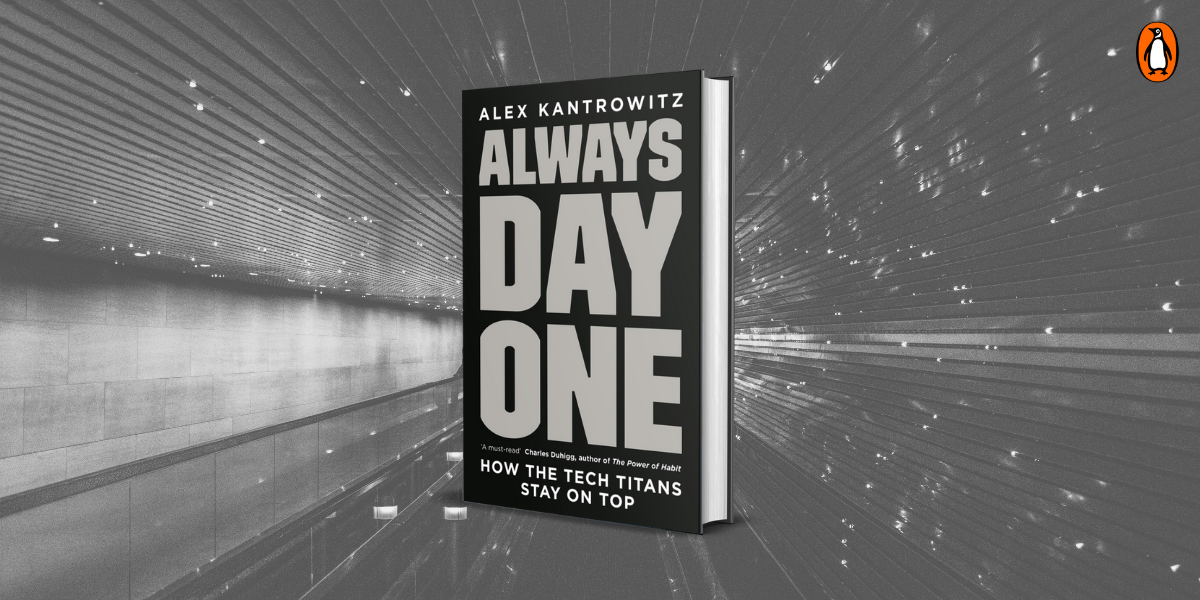
Acclaimed tech reporter, Alex Kantrowitz, gives a fascinating insight into the inner workings of the Tech Titans —Amazon, Google and Facebook, playing with the Amazon mantra of ‘Day One’— code for inventing like a startup, with little regard for legacy and prioritizing reinvention over tradition and collaboration over ownership.
Through 130 interviews with insiders, from Mark Zuckerberg to hourly workers, Always Day One reveals the tech giants’ blueprint for success but also posits how the dystopian alternate reality of the popular series Black Mirror actually anticipates modern technology’s dark consequences.
Here are six quotes from Always Day One that illustrate how the Black Mirror is not far off – being slowly but surely shaped by Big Tech.
*
The pervasiveness of technology is slowly ‘eroding meaning’ in our lives by altering our personal, financial and faith based equations.
In November 2018, Pew released a study looking at where Americans find meaning in their lives. The top three boil down to: (1) friends and family, (2) religion, and (3) work and money. Modern technology is weakening all three. The screen is warping our relationships with friends and family. We have more virtual friends than ever and fewer real ones, and a growing number of us have no friends at all.
The dystopian fantasy of a handful of AI- powered firms dominating the competition and controlling the economy is scarily similar to how big technological firms are operating even now.
“The dystopia is now,” Barry Lynn, director of the Open Markets Institute, told me. “The dystopia is not in the future.” To Lynn and the growing number of big- tech critics, the tech giants have already grown too big and powerful, and are causing real harm. While making this case in 2017, Lynn got himself, and his institute, ousted from the New America Foundation, which counts Google among its donors.
Always Day One || Alex Kantrowitz
Big Tech is shaping our worldview through their management of information enabled by their monopoly over the advertising revenue which funds news.
Advertising revenue declines have hit small and midsize papers especially hard, hollowing out local accountability reporting across the United States, a boon to local officials who would rather not be watched. Facebook and Google earned 60 percent of all dollars spent in US digital advertising in 2018, according to eMarketer, for a total of $65 billion.
Global dominance is empowering firms to shape the very nature of our reality with their monopoly over the products that are integral part of our lived experience.
Amazon has similarly used its platform power to hamper businesses that sell products through its systems, Lynn said. The company has built scores of its own “private label” brands that compete with its independent sellers, placing these sellers in a rough position: If they don’t work with Amazon, they’ll reach far fewer customers. If they do work with Amazon, the company might eventually displace their businesses.
Scientific research that shapes our future is controlled and shaped by big-tech, meaning that the futuristic dystopia of Black Mirror may be nearer than we think.
Tech companies are buying out not only entrepreneurs, but academics with artificial intelligence expertise as well. This practice is depleting the knowledge students will learn from before they head into the broader workforce. Over the past fifteen years, 153 artificial intelligence professors have left academia for private companies, according to a University of Rochester study.
If AI, which is the chief thrust of Big Tech wipes out a considerable number of jobs, the devastation could be destabilizing—and dystopian
Cowie, who’s spent his career studying how a changing economy is impacting workers, said that when people lose the ability to work and the hope to regain it, their lives are devastated. “If you look at these guys in the rust belt, where the jobs have left, nothing’s replaced them, they really have lost the narrative of their lives,” he said.
**
Always Day One gives you a lot to learn about the Tech Titans and what makes them tick!
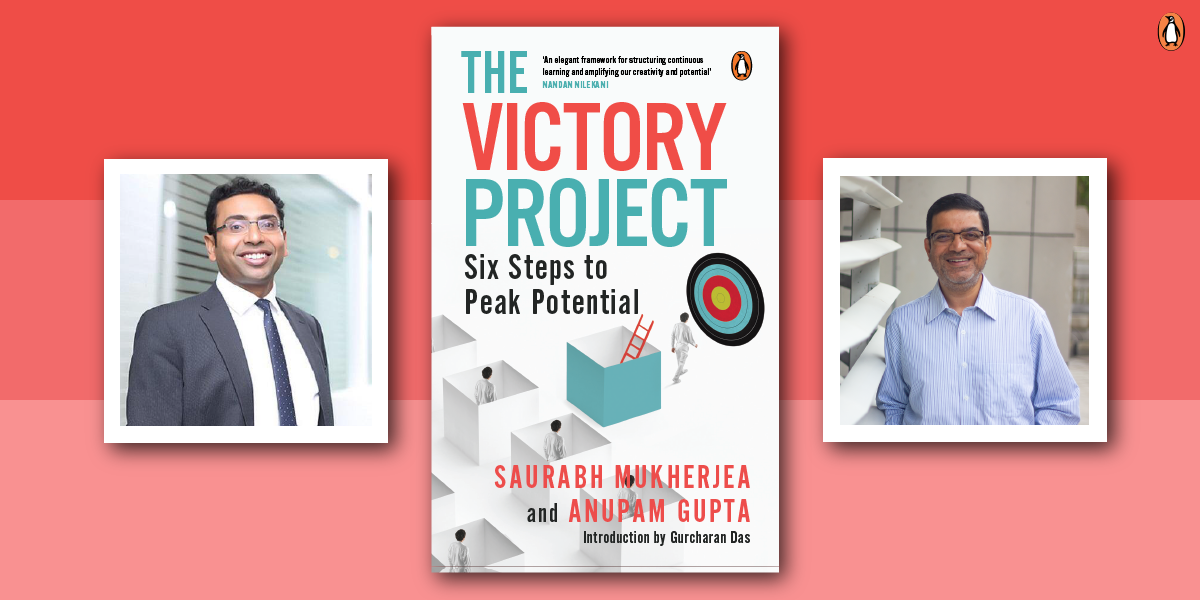
The Victory Project || Saurabh Mukherjea, Anupam Gupta
The Victory Project is the ultimate guide to surviving and thriving in the professional and social domains, which are increasingly becoming tough, competitive, often cutthroat and deeply political. It delves into a treasure trove of material from global gurus as well as from highly successful Indian and American professionals, and it draws on the authors’ own careers to show how readers can apply these principles to the fields of business and investment, even to life itself.
Here’s an insightful Q/A session with Saurabh Mukherjea and Anupam Gupta, the authors of The Victory Project. Saurabh Mukherjea is the founder of Marcellus Investment Managers and a bestselling author and Anupam Gupta is a chartered accountant, investment research consultant and podcast host.
**
Questions we asked Saurabh
What has been your greatest learning while writing The Victory Project?
Saurabh: Every single expert we interviewed for the book spent 1-3 hours with us. During that time period, these experts gave us their undivided attention. For example, we have spoken to Mark Mobius several times over the last couple of years. In some instances our discussions have extended beyond 90 minutes. Not once has Dr Mobius interrupted the meetings to take phone calls or read his Whatsapp messages. In fact, the longer the meeting goes on, the greater the powers of concentration of this 83 year old investment legend who did much to build the asset class that is today called Emerging Market Equities.
When we met Prof Sanjay Bakshi, the managing partner at Value Quest Capital, in Delhi at the Lodhi Hotel to interview him for the book, the meeting lasted for over two hours. Prof Bakshi is a big believer in the idea of intense focus and cutting off all distractions to spend quality time on a single idea. He showed his phone, which had a blank home screen and no notifications. Throughout our meeting, his phone did not beep or light up or ring even once. In those two hours he gave us some of the deepest insights into fierce focus that I have received in my career. Chapter 3 of The Victory Project contains these insights.
Similarly when we interviewed Sanjiv Bikhchandani of Infoedge – arguably amongst the most successful VC investors in contemporary India – for The Victory Project, the meeting lasted for over 90 minutes. During that time, he did not once look at his mobile phone or entertain other visitors.
Do you think there’s an increased acknowledgement of the negative impact of highly stressful professional environments in the present times? What do you think has prompted this awareness?
Saurabh: As we discuss in the Prologue to The Victory Project, divorce and depression rates in our large cities have risen sharply over the past decade. Most Indian professionals can now clearly see that their peers and their friends are at the receiving end of these stressors. Corporate captains can also see that this has an adverse impact on employee productivity. The question is what should be done about it. The superficial corporate response is to organise a helpline for employees wherein they can speak to a counsellor. As our interview with Dr Sharmila Banwat, a psychologist in Mumbai indicates, what is required is a much deeper rethink by employees and employers around how hard working, ambitious professionals can hit peak potential without burning themselves out. This issue is the key focus in The Victory Project and hence the subtitle of the book is ‘Six Steps to Peak Potential’.
How do you relax and recharge after a hectic work day?
Saurabh: My unwind routine is a hot shower followed by dinner with the family which in turn is followed by telling the kids their bedtime story. I usually doze off during the narration of the bedtime story!
How successful have you been in applying the principle of ‘decluttering’ to your own life?
Saurabh: I have had modest success in this regard. I don’t have social media apps on my phone. I make it difficult for people to reach me and for me to reach other people. Other than books, I typically don’t buy anything else for myself. I avoid parties and networking events. It helps that I enjoy sitting by myself and reading for hours on end. The only challenge is that I enjoy writing so much that every other year I end up committing to write another book for Penguin!
Questions we asked Anupam
What changes do you think organisations can introduce at their level to reduce stress at the workplace?
Anupam: The Simplicity Paradigm in our book can work as a guide for organizations as well. If organizations can, for example, find ways to a) help employees towards their specialization b) put them in teams that collaborate cohesively c) encourage creativity among employees – all of this can go a long way in employees and teams working towards common goals and, as a result, reduce stress. Spirituality also plays a vital part here and meditation, as we’ve detailed in our book, can also help in reducing stress and improving productivity.
What role do you think support systems like families, friends, partners, play in ensuring an individual’s professional success?
Anupam: Support systems play an important role within the overall Simplicity Paradigm and hence for an individual’s success. In our book, we’ve written about mentorship as part of honing your skills. Similarly, colleagues and bosses play an important role in collaboration. Friends with whom you can talk on a diverse set of topics can inspire creativity.
What has been your biggest takeaway from writing The Victory Project?
Anupam: Meeting the diverse set of experts has been an inspiration on the power of the Simplicity Paradigm construct. While the books we read for preparing The Victory Project gave us great background material, watching these experts embody the steps of the Simplicity Paradigm and achieve outsized success was truly the biggest takeaway.
Please recommend some of your favourite books to us.
Anupam: I’m a big fan of corporate history so all the books on great companies (mentioned in The Victory Project) are my favourites:
Steve Jobs by Walter Isaacson
The Everything Store: Jeff Bezos and the age of Amazon by Brad Stone
Ambani & Sons by Hamish McDonald
Disrupt and Conquer by T.T. Jagannathan and Sandhya Mendonca
To You, With Love is the story of Sahil and Ayra who are very different from each other, right from childhood. While Sahil is careless, carefree, ‘new money’ and ‘the brat’, Ayra is sensitive, reserved, shy and not easy to talk to. And that is probably what attracts Sahil to her. Their story progresses slowly and delicately, and things gradually take on a love-tinged hue between them.
Today, we are looking at six moments from the book that are sure to make you wish you too had a love story like Sahil and Ayra’s.
**
When Sahil talked about love at first sight and we couldn’t help but nod our heads in agreement
People tell you that love happens in one moment, at ‘one sight’, and the truth is that it actually does! Whether that moment is going to be the first moment when you see her or the hundredth, it cannot be predicted by anyone, but it will happen in one single moment.
When Sahil made us realise that the best love stories start from friendships and we couldn’t help but blush
I realized how we were each other’s first friends, and first friendships are deeper than most bonds in the world.
When Sahil showed us that flaws make us human and loveable
She has her flaws and yet she is the most beautiful person to me, because she is like art—she makes me feel alive whenever I look at her.
When we were reminded that true love isn’t about volatile emotions but a feeling of tranquility
The way she looked at me as she spoke, I felt a calmness sweep over me. The image of her beautiful face was imprinted somewhere deep in my heart.
When Sahil perfectly summed up the feeling of finding the right one
Her entry in my life made something click, like when a key clicks inside a lock and you know that you have found the right one.
And finally,
When we found out the content of Ayra’s heart-breaking love note to Sahil that left us a weepy mess
Life means many things to many people and so does love—neither life nor love can be lived in a way where there is nothing new to add or nothing old to remove. Definitions change with time, place and the people who define it, yet the essence remains the same.
We all have a pre-pandemic people-watching streak! If like us, you miss some casual people watching routines in the café or on the metro – scroll down this post to find out which character you would be like if you were a people-watcher from the (extravagant) world of Kevin Kwan’s latest – Sex and Vanity!
**
The Conversationalist – Charlotte
‘Sizing up his outfit of white and blue striped seersucker trousers, crisp white button down shirt conspicuously monogrammed with the initials “MVE” just above his left midriff, navy polka-dot cravat tied around his throat, and Cleverley wing-tips, Charlotte knew exactly how to engage with him.’
If you are a Charlotte, your people-watching skills actually make you a great conversationalist! You are good at gauging people by watching them, their attire, their movements – and know JUST how to talk to them.
*
The Storymaker – Lucie
‘Lucie glanced covertly at the people seated around her. She loved checking people out and making up stories in her mind about them. On her left was a young attractive Italian couple, looking longingly into each other’s eyes, on their honeymoon, possibly? To her right were two smartly dressed men—an American guy with dark blond hair in a blue striped t-shirt and navy 63 blazer talking to an Asian guy with a goatee wearing a pair of round 1930s retro-style sunglasses. They looked like they worked in fashion and were here on business.’
If you are a Lucie, then you are a (pretty good) storyteller! The world is your oyster, everyone around you a potential character with awesome backstories!
*
Sex and Vanity || Kevin Kwan
The Fashion Critic – Mordecai
‘She’s a Barclay. Of course, only a Barclay can afford to look this unfashionable in Capri.’
‘Who on earth was this woman, and what possessed her to think she could join his group wearing those flamingo pink sweatpants?’
Even if you are not one, we bet you have known at least one Mordecai in your life! A Mordecai will judge your entire lineage, character, ancestry on the basis of your fashion sense.
*
The Clueless – Cecil
For us, Cecil incorporates all the folks who need to learn to read a room, with the number of times he has failed to correctly watch and read people. A mortifying flashmob proposal with him singing into a makeshift hotdog microphone is all the visual is all we need to prove that statement!
All the Cecils are the ones who need people-watching lessons!
___
Drop us a line below on which Kevin Kwan-esque people-watcher you are (honest answers only!) and don’t forget to compare notes with your friend-groups!
Don’t forget to step into the world of Sex and Vanity for more of absolute fun people-watching.
Friendships and companionship have proven to be crucial human bonds, even more so in these socially-distant times. We had a chat with Shubha Vilas, motivational speaker and author of The Magic of Friendships – about friends, friendships and maintaining human bonds in these times.
—
Do you feel friendships have acquired a new and deeper meaning in these times?
Was there a time when friendship was not important? But yes, you could say today it is more important than ever because of nuclear families and working parents. Friends have replaced family too. Friendship is the single most relationship that has the potential to make you or break you.
The Magic of Friendships || Shubha Vilas
As the world has become more virtual and relatively more isolated in the pandemic, how can we maintain and strengthen our friendships today?
The virtual world is an important tool in forming and maintaining friendships. If used judiciously. Imagine your friends are accessible at all times? Isn’t that a boon? We may be physically isolated, but together in consciousness.
Principles of friendship are the same in every era. What changes is the context. You can pick any friendship story from any yuga…any century…any country…any culture…the principles will never change. Friendship as a concept is eternal.
What does it mean to be a ‘good’ friend?
You are a good friend if you can – appreciate the good in others, encourage their potential, respect the differences, tolerate the unchangeable and forgive their mistakes.
Social media is a lot about numbers, but it has also helped us stay connected with the world in these times. What would you say the impact of the digital age has been on friendships and companionship?
The digital age has redefined friendship! Now even though I may not know a person, I can end up being friends on social platforms! Therefore, in my book I mention levels of friendship. Not all friends are in the same category. Some are circumstantial, some are dear while some are soulmates.
What prompted you to write The Magic of Friendshipsand what kind of research went behind writing it?
All my books involve a lot of research because I dabble in non-fiction. The USP of my books is the scriptural connect with contemporary life. That’s the focus of my research.
And why a book on friendship? Because I love people…I love making, keeping and understanding friends – and I thought why not share my insights with the world? There’s nothing more important in life than relationships. And no other relationship as important as friendship. Friendship is the crown of all relationships. Friendship for me personally is what makes life special.
Is making friends easier than maintaining friendships while growing up?
Although it may seem to be easier, it is not really true. Growing up years are full of turmoil and confusion. Kids and teenagers grapple with self-image, self-confidence, identity crisis, bullies, living up to expectations…making friends can become a complex phenomenon. Of course, adults have their own set of challenges. But whichever generation you belong to, friends make life worth living.
Did you have a target reader in mind while writing The Magic of Friendships?
Yes actually I did. This time I wanted to focus only on young adults. But given a universal theme like friendship which crosses all barriers, this book appeals to all those who consider friendship to be important.
As concepts, do friendship and companionship always go hand-in-hand?
As concepts, friendship and companionship are probably merging into each other. Society is changing rapidly and in a world which is a global village today, the distinction between friend and companion is obsolete. Friends are companions and companions are friends. There is no divide.
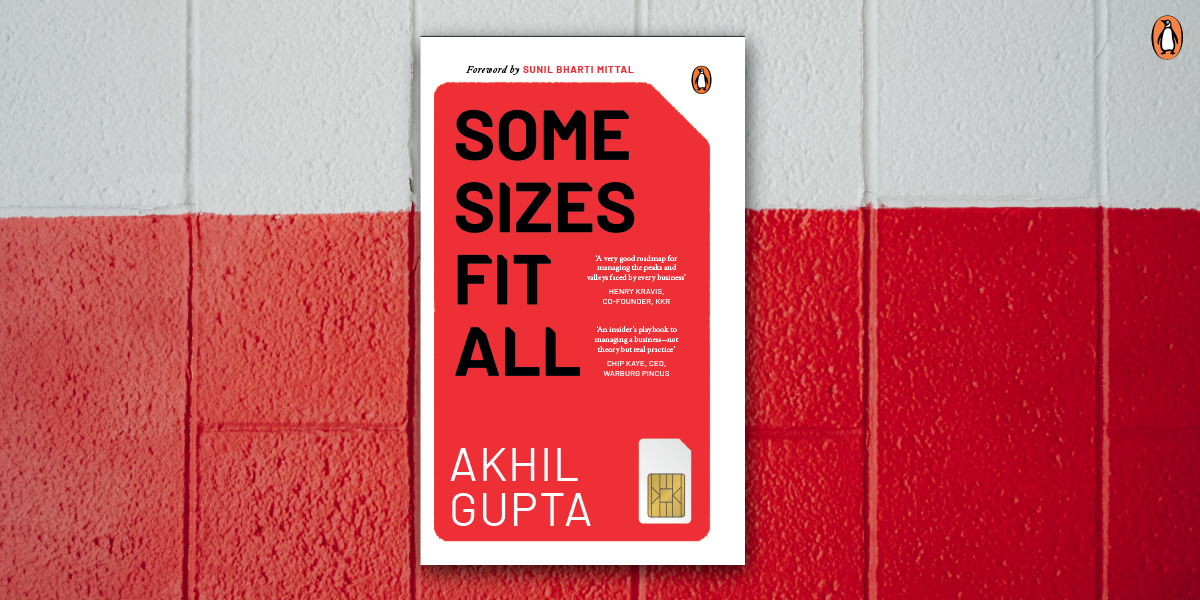
The success of a business depends on many factors, the most important of which is the decision regarding what industry it would like to pursue. In management terms, the blueprint for any business as to which niche it would like to operate in is called a ‘business model’. It is imperative to have a business model in place for it provides focus and direction to the management. Without such a structured approach, a business is likely to falter.
In Some Sizes Fit All, Akhil Gupta explains how the most important pillar for the success of any business is clarity on its business model. There are seven main issues which need to be considered and agreed upon for setting up a solid business model.
1. The line of activity
Almost all industries have multiple segments, referred to as ‘lines of activity’, which the management needs to carefully consider and choose from. In most cases, one would have to choose one or some of them as it may be neither necessary nor possible to pursue all possible lines.
2. Geography
It is important to identify the region in which the management would like to operate. The choice of geography would depend on the resources and ambitions of the management.
3. Target Customer
Companies need to carefully choose the segments of customers they wish to serve since the business strategy and required actions will depend upon this.
4. Sequencing and pacing of expansion
If multiple choices exist in any of the parameters above, it would be prudent to decide on sequencing and priorities and the milestones/time period for the introduction of specific products/services or specific geographies.
5. Revenue and profitability model and timing
It is important to have a clear revenue model, that is, a proper understanding of how and from where the revenue will come in, and also to have a time frame within which the revenue will start coming in. Companies that cannot demonstrate a revenue and profitability model do go out of favour sooner or later.
6. Clarity of objective
Every business needs to be clear as to what its main goal is—is it philanthropy or running a profitable business?Ideally, the objective should be to run a successful and profitable business with rapid scale-up using ethical means.
7. Revisit the business model at regular intervals
It is important for every company to revisit and review all aspects of its business model at regular intervals. These intervals can be time-based, say, annually, or can depend on specific events, such as regulatory changes, new technological innovations, the emergence of new markets, etc.
Some Sizes Fit All is an attempt to explain the fundamental pillars for any kind of business. An authentic and lucid presentation of management concepts and practices-which Akhil Gupta has tried and tested first hand through his illustrious career-this is a must-read for anyone trying to build a robust and financially sound business.
Friendships and sustainable, in-depth human bonds are crucial for survival and individual fulfillment. But like any relationship, friendships also need care and emotional investment for sustenance and strength.
In his latest book The Magic of Friendships, motivational speaker Shubha Vilas explores, in a straightforward, anecdotal manner, some accessible advice on how to sustain strong and magical friendships in your life. We take a look:
**
Growing as an individual
‘Unless we work on our bad attitude and develop the right attitude and mindset, genuine friendship will always elude us.’
The Magic of Friendships || Shubha Vilas
Symbiotic and mutualistic dynamic
‘[A symbiotic relationship] should ideally not be developed with the intention of deriving gains from the other person, but should be born of compassion and empathy towards one another.’
Putting friends at the centre of our lives
‘Friendship begins when we get rid of our self-centred mindset. As long as we remain at the centre of our lives, making good friends is out of the question. […] As long as we are focused on serving our own needs, interests and concerns, there is no time or desire to focus on the needs, interests and concerns of another person.’
Be your own friend first
‘To be a friend to another person, you first need to be a friend to yourself. Before you take on the responsibility of a friendship, you first need to take responsibility for your own self. The responsibility for changing ‘me’
Invest time and effort
‘[Deep friendships] cannot be developed overnight. They need patient nursing, which requires time.’
—-
In these challenging, socially-distanced times, it is more important than ever to keep your friends close. The Magic of Friendships is a testament to the fact that those friendship goals are way more attainable than you think!
1994, twenty-year-old Gunjan Saxena boards a train to Mysore to appear for the selection process of the fourth Short Service Commission (for women) pilot course. Seventy-four weeks of back-breaking training later, she passes out of the Air Force Academy in Dundigal as Pilot Officer Gunjan Saxena.
On 3 May 1999, as the Kargil war begins, the time comes for Saxena to prove her mettle. From airdropping vital supplies to Indian troops in the Dras and Batalik regions and casualty evacuation from the midst of the ongoing battle, to meticulously informing her seniors of enemy positions and even narrowly escaping a Pakistani rocket missile during one of her sorties, Saxena fearlessly discharges her duties, earning herself the moniker ‘The Kargil Girl’.
The Kargil Girl || Gunjan Saxena, Kiran Nirvan
This is her inspiring story, in her words. Read on for some fascinating insights into the meticulous training and strategic testing that goes into the making of an officer of the Indian Defence Forces.
Testing involves almost superhuman levels of co-ordination and dexterity ‘Using one’s peripheral vision, one had to press the buttons on an adjacent panel as they lit up. A red and green light on the screen had to be switched off using one’s left hand. All this had to be done quickly and simultaneously.’
The psychological tests to determine the mental strength of people who will lead in battle form a major chunk of the SSB exam—the Word Association Test (WAT), the Thematic Appreciation Test (TAT), the Self-Description (SD) test and the Situation Reaction Test (SRT). ‘These might just sound like acronyms to many, but for defence aspirants, these are the devils that stand at the gates of any SSB centre, ready to peek into the darkest corners of their minds and reveal their true, hidden selves.’
There is almost no margin for error in even a single applicant-as the strength of the chain is only as much as that of the weakest link. ‘The rate of error has to be zero—one wrong selection and an entire platoon, battalion or even a division may suffer. Someone can be denied for being too young, too old, for having flat feet, anxiety, phobias and so on.’
There are several levels of testing and training that must be passed before one becomes a commissioned army officer ‘Getting recommended was only the beginning. The path to glory was strewn with obstacles, ones that would almost break me.’
Training commences with ordeals designed to engender the highest levels of fitness ‘Introductions began with us—the first-termers—in high-plank position. Some of us couldn’t even remain in the position for thirty seconds. Whenever one of us fell flat on the floor, the others were asked by the seniors to do more push-ups.’
A lack of preparation is simply not an option in the Indian military. ‘I spent the night thinking about what had gone wrong. I knew the answer, but I was not quite ready to accept it—not until the next day, when I finally told the CFI that it was the result of my lack of preparation. A long lecture followed, a lecture that shook me nice and proper, and I decided to pull up my socks after the incident.’
Every possible emergency is thrown at one out of the blue to test your ability to handle difficult situations instantly. ‘In the absence of rudders, which control the nose of the helicopter, it becomes difficult to balance the flight. I had never imagined Group Captain Sapre would ask me to perform this emergency procedure.’
The intense course culminates in a passing out parade that requires even greater levels of rigorous preparation! ‘Exhausted from the morning parade practice, we would hardly be left with any energy to go for it again in the afternoons. The scorching heat of peak summer, mixed with the heat reflected from a metalled parade ground, would leave us drenched in sweat.’
And despite all of this-the brave cadets who undergo this have no regrets in doing their duty. ‘Indian military is one place that is free from any gender bias or discrimination. If I could spend the rest of my life in uniform serving in the armed forces, I would willingly do so.’
There’s nothing like a book that touches your heart and stirs your soul. Coming across such books is often followed by a joyous realisation that we have, perhaps due to sheer serendipity, chanced upon a writer we would keep going back to.
Today, we are celebrating 70 years of Sudha Murty by revisiting some of our favourite quotes by the writer, whose words deeply resonate with us and to whose books we often turn to for comfort and wisdom.
Three Thousand Stitches || Sudha Murty
‘We all lose a few battles in our lives, but we can win the war.’ ―Three Thousand Stitches: Ordinary People, Extraordinary Lives
The Day I Stopped Drinking Milk || Sudha Murty
‘I realized then that only diseases and not honesty and integrity are passed down to the next generation through genes.’
―The Day I Stopped Drinking Milk: Life Lessons from Here and There
How I Taught My Grandmother to Read and Other Stories || Sudha Murty
‘Doing what you like is freedom, liking what you do is happiness.’ ―How I Taught My Grandmother to Read and Other Stories
Wise and Otherwise || Sudha Murty
‘Life is an exam where the syllabus is unknown and question papers are not set. Nor are there model answer papers.’ ―Wise and Otherwise
Grandma’s Bag of Stories || Sudha Murty
‘We should always have some aim in life which we must try to achieve while being of help to others.’ ―Grandma’s Bag of Stories
House of Cards || Sudha Murty
‘Every woman values her freedom to choose— much more than her husband’s money or position.’; ― House of Cards
~
We have a feeling these quotes would make you wish you could delve further into the brilliance of Murty’s elegant prose. To discover more such gems by her, you can simply visit here.