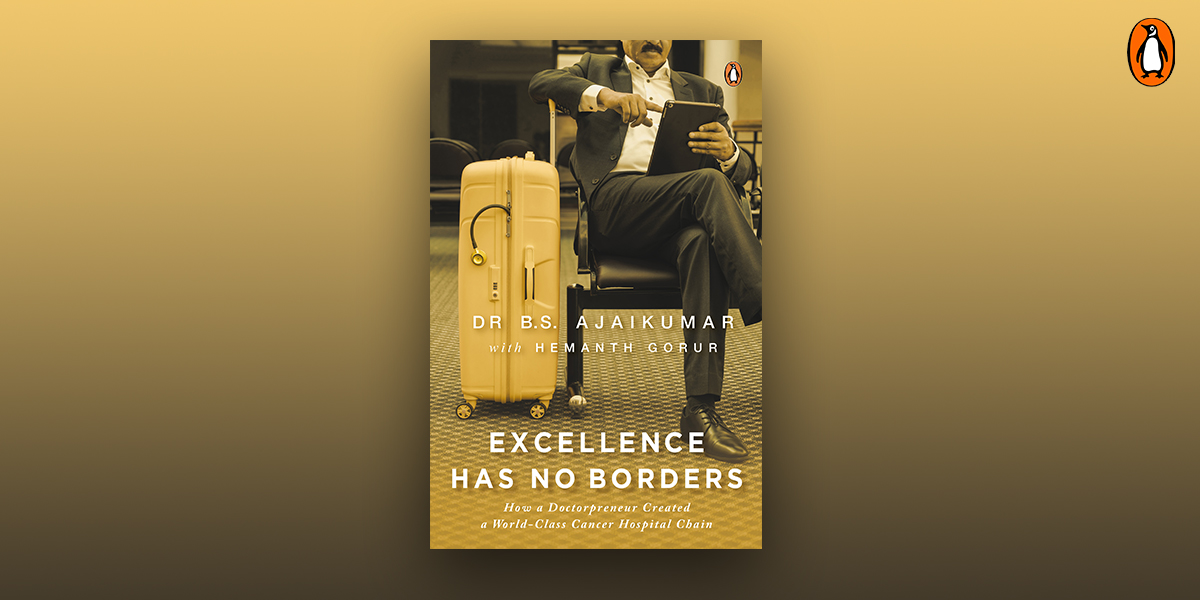
Do you only dream of achieving success one day or are you working towards achieving it? It is imperative to realize that success, which is in the uncertain future, is but a sum of our efforts in the present. Enthralling personal life experiences shared by ‘Doctorpreneur’ Dr B.S. Ajaikumar, in his book, Excellence Has No Borders make you realize that hard work, tenacity and self-confidence can go a long way in attaining the unimaginable.
Read to know more about this doctorpreneur:
Ajaikumar faced many challenges in his childhood and his adult life. In hindsight, the former built him up for the latter. Growing up in the shadows of his superachiever elder brother, Ajaikumar, had learnt to work for his parents’ attention and affection.
*
His upbringing being relatively different from his brother’s seems to have given rise to insecurities within him. This feeling drove him to study hard as he was determined to do well and emerge from the shadow of his older brother. His success in doing so gave rise to him becoming accustomed to taking on challenges with gusto: If something wasn’t a challenge, it wasn’t worth the time or the effort.
*
Losing twenty million dollars in the dot-com bust pushed him into misery. It led him to almost end his life. What saved him was a singularly assertive thought that he was a fighter and he loved challenges. He was confident that he would do whatever it takes to build himself up from ground zero after the dot-com bust.
*
Poor condition of the Indian hospitals and Ajaikumar’s determination to achieve what he put his mind to, pushed him to travel across India and study the cancer situation. He considered this trip as a turning point in his life as he decided to give up the American dream that he’d built for himself and return to his motherland.
*
As an established oncologist, he considered it his moral duty to return to serve his people and help them live a healthy life.
To read more about Ajaikumar’s life experiences and his takeaways from them, read, Excellence Has No Borders. Tell us if it inspired you as much as it inspired us!
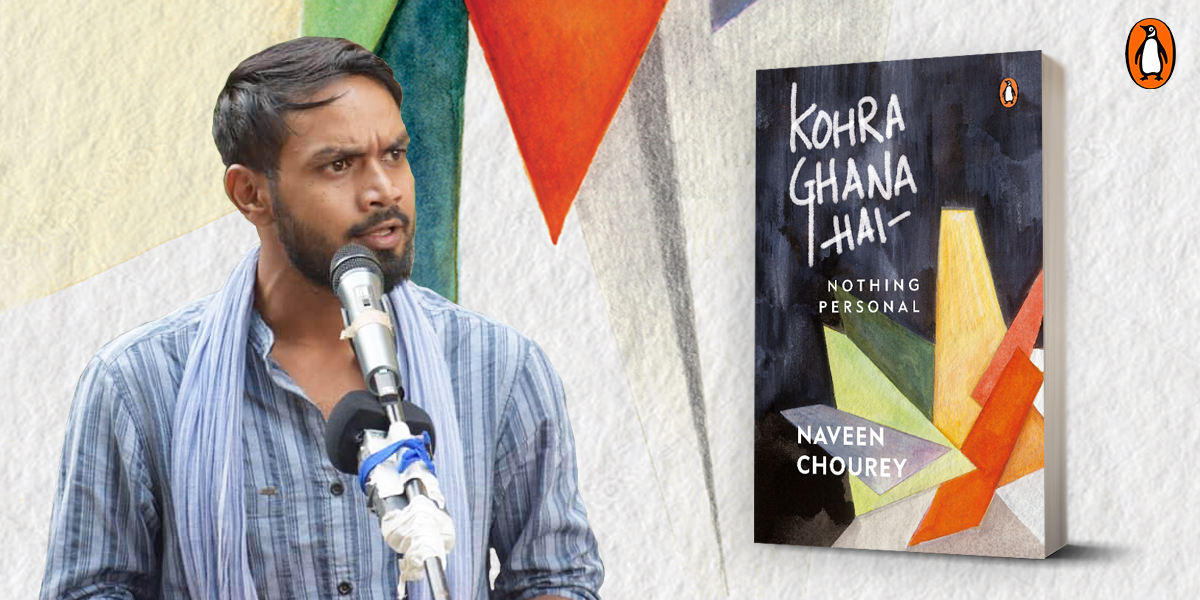
Bold, sharp and amazingly relevant, Naveen Chourey’s impassioned poetry-on mob lynching, Kashmir and the plight of out soldiers among others-will force you to think afresh on nationalism, patriotism and the state of our country.
Naveen’s youthful idealism, vision for an egalitarian world and progressive thoughts make Kohra Ghana Hai one of the most courageous works of our times.
Read on to know more about Naveen:
1. What drew you towards poetry?
It is hard to pin one event that drew me toward poetry. I moved towards it gradually and did not realize how much hold it had over me, till I was in too deep. But a few poets that played a significant role in pushing me towards it are Jagjeet Singh ji and Nukkad Natak.
2. Has your engineering background helped your artistic craft?
Yes, it’s helped me a lot! For me, engineering helped me find patterns in life. I think I can craft my poems with a fresh perspective due to my engineering background.
3. What does mukammal mean to you?
For me, Mukammal is the concept of an ideal human being. Something that I am walking and moving towards everyday. I wish to be that person before I die.
4. Which poem is the closest to your heart?
There are many. Bachchan Sahab’s ‘Us paar na Jaane kya hoga’, Javed Sahab’s ‘Waqt’ and ‘MahisasurMardini’ by Aadi Shankaracharya are few that come to mind.
From my own compositions, I enjoy performing the poem ‘Aham Brahmosmi’ ‘Pinjara’ and ‘Main, Wo aur Main’.
5. Why ‘Kohra Ghana Hai’?
When there is unrest, everything becomes confusing. Like the dense fog, you can see but can not make anything out of it. I felt this book will help people see through the dense fog of unrest and show people what is happening in our society.
Are you ready to go on this journey with Naveen and see through this fog withKohra Ghana Hai?
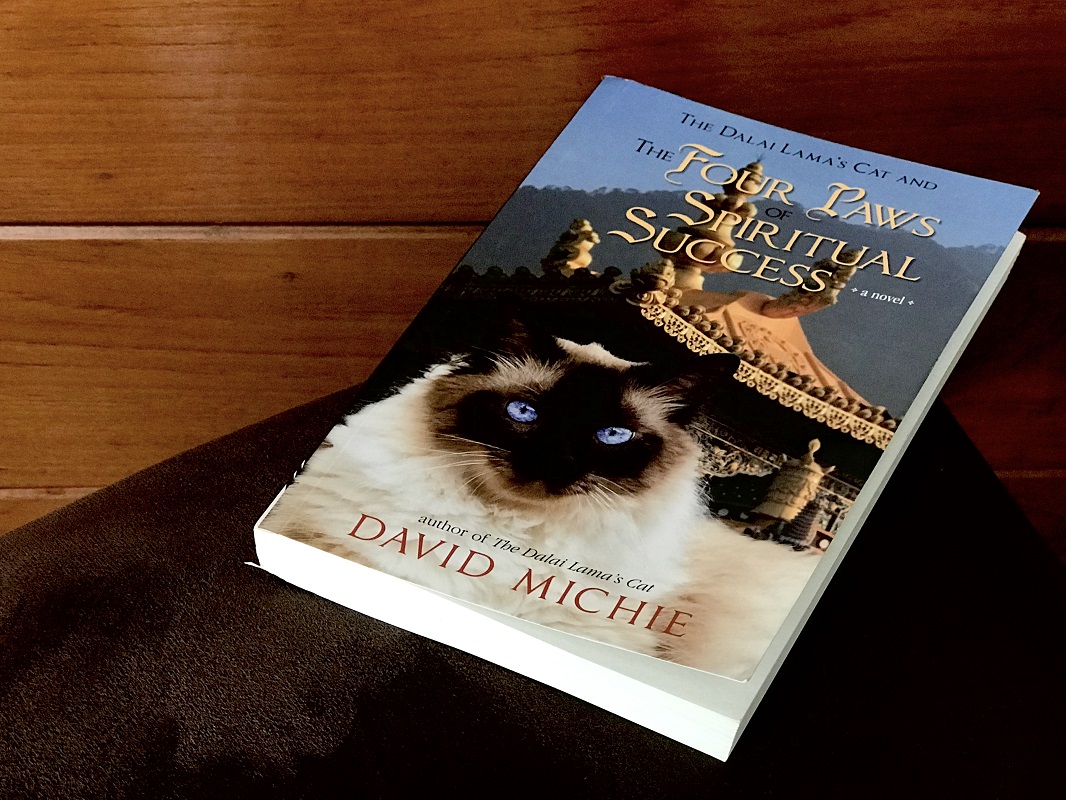
When the Dalai Lama’s inner circle is set the task of providing His Holiness with a book that he can give his visitors, an unexpected volunteer stretches out her paws. The Dalai Lama’s Cat and The Four Paws of Spiritual Success summarises the four key elements of Tibetan Buddhism and, more importantly, communicates how it feels to be in the profoundly reassuring presence of His Holiness. And who better to do this than his much-loved feline?
Read on to know about what these four paws:
First Paw:
Without suffering there was no motivation to seek transcendence.
Our thoughts are like claws. They can be helpful when we turn our mind to things. Develop ideas. Set goals. Express emotions. But if we aren’t careful, these same thoughts can turn on us and become the sources of our greatest pain. They no longer help us take purposeful action, but instead become the cause of self- inflicted misery.
Second Paw:
Compassion has a calming effect on all those that it touched.
‘I am pleased she is offering love and compassion,’ the Dalai Lama continued. ‘Motivated by bodhicitta, this is one of the most important elements of our practice, is it not?’
Third Paw:
Wisdom eliminated the darkness of ignorance.
‘Wisdom is different. It involves the transmission of insights that have the capacity to change us.Only when we understand an insight deeply enough can it create change.At that point, knowledge becomes wisdom.’
Fourth Paw: Everyone has the capacity for enlightenment.
In Find Me, Aciman shows us Elio’s father, Samuel, on a trip from Florence to Rome to visit Elio, now a gifted classical pianist. A chance encounter on the train upends Sami’s visit and changes his life forever.
Elio soon moves to Paris, where he, too, has a consequential affair, while Oliver, a New England college professor with a family, suddenly finds himself contemplating a return trip across the Atlantic.
Find Me brings us back inside the world of one of our greatest contemporary romances to show us that in fact true love never dies.
Read a few beautiful lines from the book:
I’m listening.
And you know, you do know I’ve been floundering all these years.
I know. But so have I.
What lovely music you used to play for me.
I wanted to.
So you haven’t forgotten.
Of course I haven’t
*
We’re still the same, we haven’t drifted. This is how he always spoke to me in such moments, We’re still the same, we haven’t drifted —with a jeering languor inflecting each of his features…I try to remind him each time that he has no reason to forgive me. But he utters an impish laugh…
*
She reminded me of someone who storms into your life…only to remind you, once she’s added flowers to a vase that’s been standing empty for ever so long that, in case you were still struggling to downplay her presence, you wouldn’t dare ask for more than a week, a day, an hour of this. How close had I come to someone so real, I thought.
*
“I don’t want to stop knowing you. So there’s the long and the short of it.”
*
“Everything I have is yours. Not much, I know,” she said.
*
“But you didn’t know you’d meet me.”
“A meaningless detail. Fate works forward, backward, and crisscrosses sideways and couldn’t care less how we scan its purposes with our rickety little befores and afters.”
*
You fool, it takes two of them to make one of me. I can be a man and woman, or both, because you’ve been both to me. Find me, Oliver. Find me.
Fans of Call Me By Your Name, it’s time to get excited for Find Me, Aciman’s newest novel that revisits the world of one of our greatest contemporary romances.
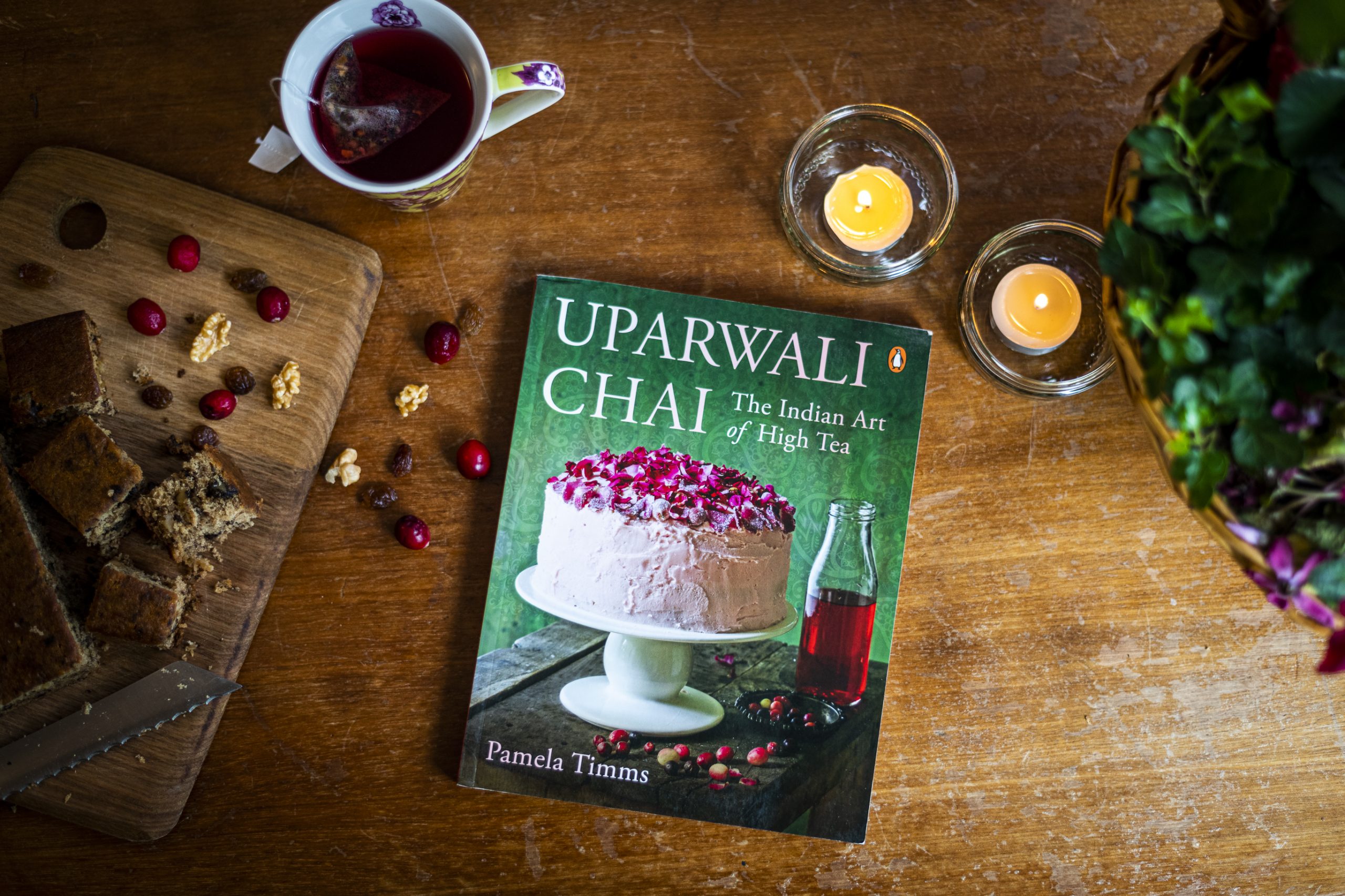
From Saffron and Chocolate Macarons to Apricot and Jaggery Upside Down Cake to a Rooh Afza Layer Cake, Uparwali Chai is an original mix of classic and contemporary desserts and savouries, reinvented and infused throughout with an utterly Indian flavour.
‘The recipes in this book reflect the baking I grew up with, the hug-in-a bowl fare of mothers, grandmothers and aunts.’- Pamela Timms, Author.
Check out this recipe from the book below:
Banana Loaf Cake with Chai-spiced Icing ( Serves 6-8 people)
For me[Pamela Timms], baking is a great stress buster, and in times of need I find I gravitate towards quite specific types of recipes. I’m not looking for complicated, fancy, lavishly decorated cakes. I want something that can be made quickly from a few kitchen staples but will yield something delicious and sustaining—that will help get me back on an even keel quickly.
Banana Bread is one such recipe, a faithful and comforting standby which can be rustled up at almost any time and is the cake equivalent of someone giving you a great big hug. The chai-flavoured icing is like the hugger giving you a bunch of flowers too.
Incidentally, cakes like this are called loaf cakes because they are usually baked in a loaf-shaped tin—you could, of course, use a round cake tin and bake for about 25 minutes.
For the cake:
250 g plain flour
2 tsp baking powder
½ tsp baking soda
½ tsp salt
125 g soft unsalted butter
175 g soft brown sugar
2 eggs, lightly beaten
1 tsp vanilla extract
400 g bananas, weighed without their skins (bananas that have gone a bit soft are ideal here)
For the chai-flavoured icing:
50 g icing sugar
1 tsp ground cinnamon
1 tsp ground cardamom
¼ tsp ground ginger
¼ tsp ground cloves
100 g soft butter
Splash of milk
You will need measuring scales, a 22 x 12 cm loaf tin and baking parchment.
Preheat the oven to 180°C. Line a 22 x 12 cm loaf tin with baking parchment.
Sift the flour, baking powder, baking soda and salt into a bowl and set aside.
In another bowl, cream together the butter and sugar with an electric mixer or wooden spoon until pale and fluffy.
Gradually mix in the eggs and vanilla extract, adding a little flour between additions to stop the mixture curdling.
Mash the bananas in a bowl, then stir into the mixture.
Finally, with a metal spoon, gently mix in the flour mixture.
Spoon into the lined tin and level the surface a little. Bake in the centre of the oven for about 45 minutes or until the loaf has risen, is nicely browned and a skewer inserted in the middle comes out clean. Leave to cool.
To make the icing, mix the icing sugar, spices and butter until soft and fluffy. When the cake is cool, cover the top with the icing.
The cake keeps well for a couple of days.
Uparwali Chaiis the ultimate teatime cookbook, with an Indian twist. The book is available now.
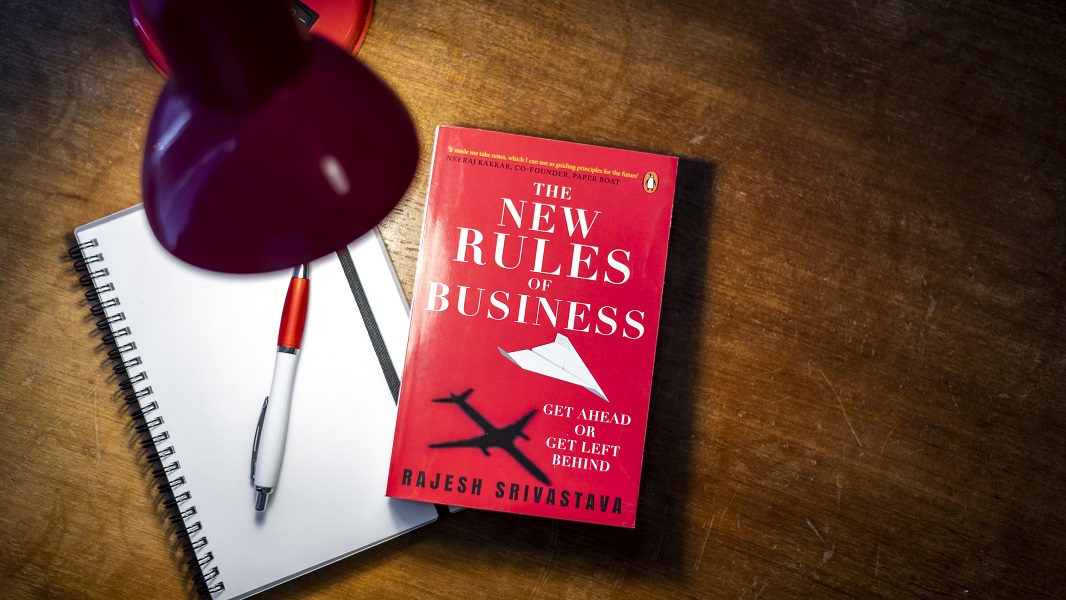
Here’s a fact: Treating your customers well is no longer enough. The new rule is: employees too, have to be treated as well, if not better, than the customers. Happy employees make happy customers, and happy customers tend to be loyal.
And here’s one more: You don’t need to spend money in advertising to create awareness about your product any longer. The new rule is: invest in making your product so good that it does its own marketing. New Age companies, Amazon and Flipkart, Uber and Ola, and Netflix, among others, are dismantling the old rules of business and installing new rules in their place.
Rajesh Srivastava’s new book, The New Rules of Business unfolds the mysteries of these new ways of doing business which most companies try to keep under wraps.
He says, “The rules of business have well and truly changed. The New Rules of Business will introduce you to new thoughts, ideas, tools, techniques, and frameworks which will help you come up with impactful answers to business challenges.”
But first, let’s meet the author!
Rajesh Srivastava is an alumnus of IIT Kanpur and IIM Bangalore, and has over three decades of corporate and academic experience.
~
At United Spirits (now Diageo India), he played a significant role in creating some of India’s most recognized, beloved and enduring alcohol brands that include McDowell’s Signature, Royal Challenge, Bagpiper and Blue Riband Duet.
~
He later became the president of J.K. Helen Curtis Ltd, where he re-energized the company and the deodorant category by relaunching Park Avenue deodorant as a perfume. Today, ‘perfume’ has become a generic benefit for the deodorant category.
~
Since 2008, he has directed his focus towards teaching and conducting corporate workshops. As an educator, he has taught at IIM Indore and S.P. Jain School of Global Management.
~
As a corporate trainer, he has worked with prestigious companies like Siemens India, Mercedes-Benz Research Centre and Rehance Industries, amongst others.
~
Throughout his career, his writings have appeared in various publication, including Outlook, the Telegraph, Mid-Day, Business Standard and Mint.
~
He lives in Mumbai with his wife, Shaily, and their son, Kautuk. This is his first book.
Compellingly written with several anecdotes, The New Rules of Business is a gripping book full of incredible insights. Get your copy now!
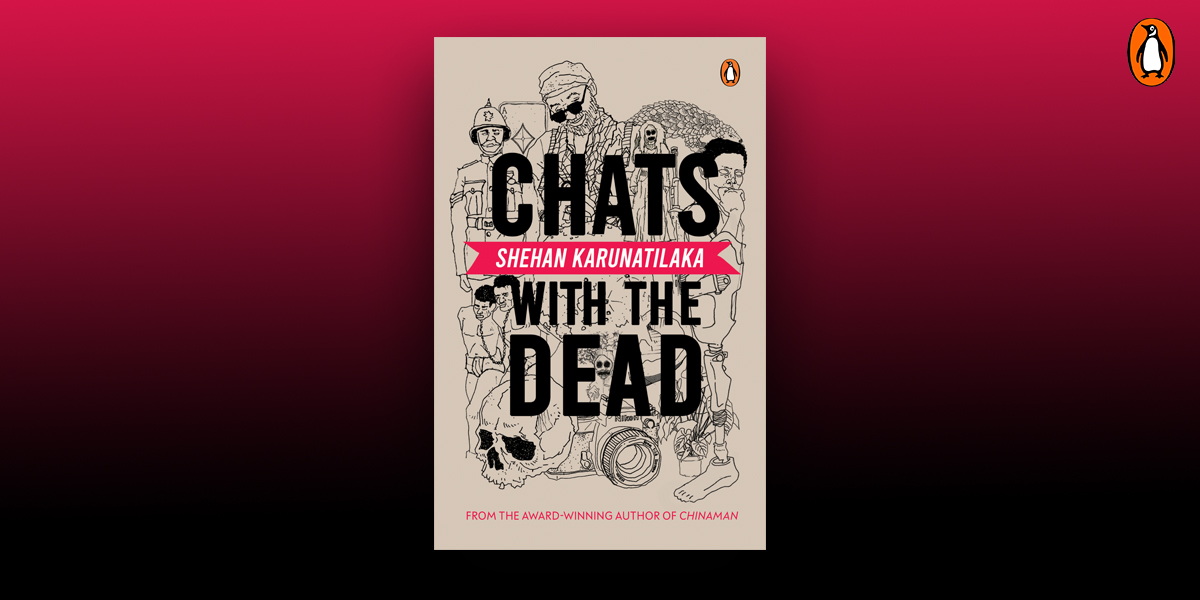
Renegade war photographer Maali Almeida has to solve his own murder. Does that sound fun? It would be if there wasn’t so much bloody red-tape to get through. It’s also doesn’t look like anyone alive is actually missing him. Worst of all, it’s all those goddamn memories of war, constantly interrupted by the overly chatty dead folks breezing through the afterlife. Besides, he’s so busy solving his ethical dilemmas that there’s barely any time to solve a murder-even if it’s his own.
As we meet the photographer in the afterlife in Chats with the Dead, we discover there is so much more to him than just a name. As well as to the stories of all the people who are dead and gone.
Meet (late) Maali Almeida in an excerpt below:
Say My Name
You want to ask the universe what everyone else wants to ask the universe. Why are we born, why do we die, why anything has to be. And all the universe has to say in reply is I don’t know arsehole stop asking. The After Life is as confusing as the Before Death, the In Between is as arbitrary as the Down There. So, we each make up stories because we’re afraid of the dark.
The wind brings your name and you follow it through air and concrete and steel. You float through a Slave Island alley and you hear the whispers in every doorway. ‘Almeida . . . Malinda . . .’ Then the wind blows through busy Dehiwela streets and you hear more voices. ‘War photographer . . . activist . . . Almeida . . . Maali . . . missing . . .’
From slave to Dehiwela in one breath, faster than a helicopter ride. At least death frees you from Galle Road traffic, Parliament Road drivers and checkpoints on every road. You ride past the faces of oblivious people ambling through Colombo’s shabby streets, the mortal brothers and sisters of the dearly departed and quickly forgotten. You are a leaf in a gale, blown by a force you can neither control nor resist.
Lankan visionary Arthur C. Clarke said thirty ghosts stand behind everyone alive, the ratio by which the dead outnumber the living. You look around you and fear the great man’s estimate might have been conservative.
Every person has a spirit crouching behind them. Some have guardians hovering above and swatting away the ghouls, the pretas, the rahu and the demons. Some have distinguished members of these latter groups standing before them, hissing idle thoughts in their faces. A few have devils squatting on their shoulders and filling their ears with bile.
Sir Arthur has spent three decades of his life on these haunted shores and is clearly a Sri Lankan. Austria convinced the world that Hitler was German and Mozart was theirs. Surely, after centuries of armed plunder, courtesy the sea pirates from London, Amsterdam and Lisbon, may we Lankans at least help ourselves to one sci-fi visionary?
At Borella junction, a woman in white walks the edge of your periphery and disappears when you focus; a demon toddler squats in a corner and hisses at the young girls waiting for buses; a clovenhoofed ghoul stands at the headlights looking for a motorcyclist to impale. It appears that too many in Colombo have died unwillingly and too few are ready to leave.
One by one, the figures look at you, each pupil a different shade, each iris with its own sheen. The angry flash greens and yellows, the lost glimmer in browns and in blues. The hungry blink in famished purple, the helpers wink in pretentious white. There are also those with red eyes and black eyeballs whose gazes you dare not meet.
Bestselling author of Chinaman, Shehan Karunatilaka is back with a darkly comedic story of life and death – with a brilliant twist. Infused with moments of staggering humanity, this one is a powerful read that exposes the plight of Sri Lanka in the aftermath of a civil war.
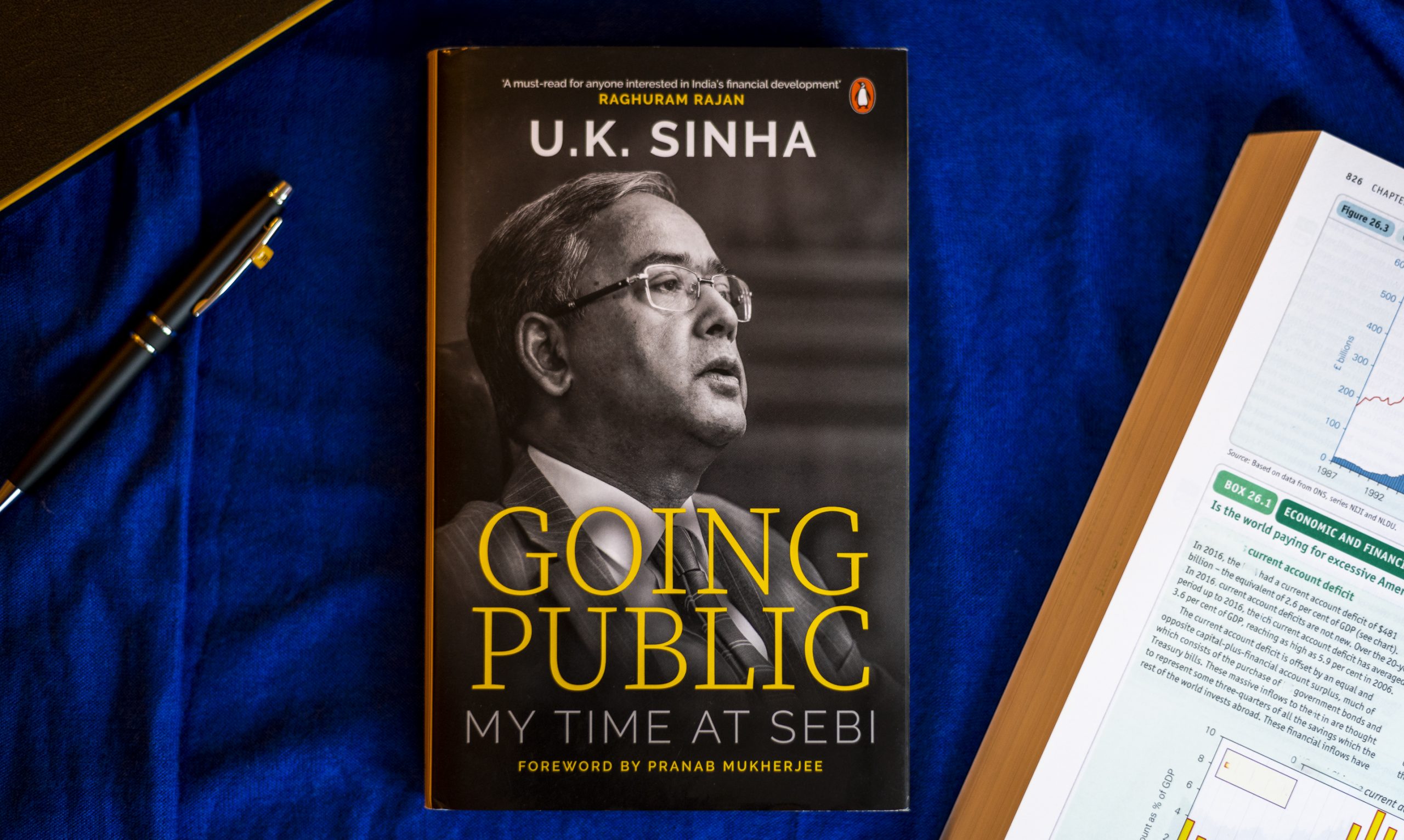
Upendra Kumar Sinha has contributed significantly to shaping India’s capital markets in multiple roles, including as chairman of UTI Mutual Fund and head of the Capital Markets division in the Ministry of Finance. Credited with the revival of the mutual funds industry and bringing in reforms to protect the rights of investors, Sinha has spent decades leading the financial front of the country towards growth and stability. In Going Public, he shares the landmarks on the journey of a nation striving for economic progress and prosperity.
Read on to know about four reforms that shaped India’s financial landscape:
The UTI[Unit Trust of India] Act and the changing role of the government –
Even though the government had no shareholding or operational control in UTI, it was still perceived to be a government institution on account of its association with IDBI, its tax exemption schemes and other contributing factors vis-a-vis the UTI Act, 1963. The already limited role of the government was curtailed further when, in 1997, the practice of having government nominees in the trustee board of UTI was discontinued on the rationale that UTI should be run by a board of experts.
‘Thus, when the crisis developed in 2001, it came to light that the government had no mechanism for timely and first-hand knowledge. In fact, it was the stand of the government that UTI had kept it in the dark. On this, the JPC[Joint Parliamentary Committee] lamented that the government did nothing to emerge from the darkness. After the crisis, Yashwant Sinha reversed the decision over government nominees…’
Amendment to the SEBI[Securities and Exchange Board of India] Act in 2002
The SEBI Act, 1992 allowed the organization to demand records or information from only a limited set of entities but its powers were restricted when it came to prohibiting and investigating misconduct. A game-changing move that strengthened the position of both SEBI and investors was made in the form of the 2002 amendment in the SEBI Act which increased the power of SEBI to deal with misconduct or fraud and led to a crackdown on notorious entities.
‘SEBI could then designate one of its officers as an investigation authority who could not only demand the production of records from “any person associated with the securities market in any manner” but also keep such documents in its custody upto six months. In case of reasonable suspicion that documents may be destroyed, SEBI was also authorized to conduct search and seizure after getting approval from a court.’
Allowing reforms to allow debt to be raised from the market
In order to reduce dependence on banks it is essential to create alternative sources of funds. One way of facilitating growth is making reforms to allow debt to be raised from the market. SEBI, the RBI and the government have been continuously trying to make provisions for the same by simplifying procedures and bringing in uniformity and transparency.
‘Rules regarding credit rating agencies were made stronger and uniformity was implemented in the rating symbols. At the same time, rules about debenture trusts were tightened. Since credit rating agencies and debenture trustees are also supervised by SEBI, better coordination amongst different players in the chain could be established. The government also helped by allowing pension funds to invest in corporate bonds.’
Going Public | U.K. Sinha
Entrepreneurship with Alternative investment funds (AIFs)
Across the world, a popular method of raising funds for start-ups and new generation companies is Alternative investment funds (AIFs). This unique class of investors raise money from different sources and invest in new and promising private companies based on a prediction of future growth potential. To promote this method of funding, SEBI formulated an AIF Regulation in 2012 and saw positive results.
‘In 2016, AIFs invested more than $16 billion in different companies. In 2018–19, the total funds invested were close to $32 billion. Now, even corporates and rich individuals are setting up funds to invest in start-ups. Many of them are also mentoring the assisted companies, besides making financial investments.’
‘It is not unique to India that changes in the laws governing stock exchanges and share market have been enacted only after major incidents of misconduct have taken place, and not preemptively or when these problems were still much smaller and more manageable,’ writes Sinha. However, scams and deficiencies that challenged India’s financial systems led to reforms that strengthened the economy.
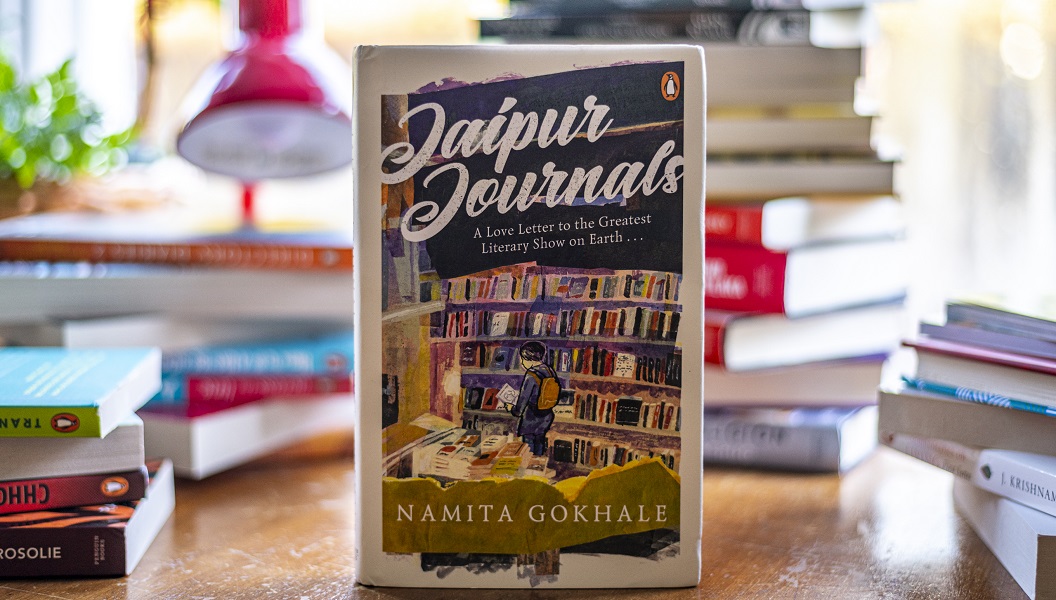
Celebrated writer and festival director Namita Gokhale is back with her latest novel, Jaipur Journals. This time, she offers us a diverse cast of characters whose worlds collide in the Jaipur Literature Festival: an author who receives a threatening anonymous letter, a burglar with a passion for poetry, a twelve-year-old prodigy, an American woman looking for the vanished India of her youth, a lonely writer who carries her unsubmitted manuscript everywhere with her, and a historian who reunites with a past lover.
As rich as the Festival itself, Jaipur Journals is a metafictional ode to literature. A nod to the millions of aspiring authors carrying unsubmitted manuscripts in their bags, the book is an intimate look into the pretensions and pathos of the loneliest tribe of all: the writers.
In the excerpt below, we give you a glimpse of one of these stories.
*
A volunteer with a round smooth face and dark shining eyes stepped forward to address the group. ‘Excuse me,’ she said, ‘please excuse me, but which of you is Ms Zoya Mankotia?’
Zoya swished her mane of grey flecked hair and lifted one grey black eyebrow in interrogation. ‘You mean me?’ she asked, almost girlishly, almost coquettishly.
‘One of your fans was waiting for you—he left this card which he wanted delivered to you,’ the smooth-faced volunteer said. ‘And I must tell you, Ms Mankotia, that I too am a great fan of yours … I would love you to sign a copy of The Quilt for me.’
Jaipur Journals || Namita Gokhale
She handed over a pale purple envelope, which had Zoya Mankotia’s name written with a purple marker, in a neat italic hand. Inside was a card with a photograph of a kitten wearing a purple ribbon around its neck.
The message was written in capital letters, in purple ink. It was brief and brutal. ‘Miaow Ms Mankotia!’ it said. ‘I can see through you. You faithless bich, I know what you have been up to, how many women you have betrayed. And your pathetic intellectual pretenshuns leave me speechless! And your novel, The Quilt, is a copycat version of Ismat Chughtai’s Lihaf. You plagiarizer, you pornographer . . . Your time is up.’
Zoya’s expression did not change when she read this, although the set of her jaw tightened visibly. She put the card back into the purple envelope and passed it wordlessly to Geetha Gopalan.
‘So who is this mysterious fan?’ Geetha asked in her jolly booming voice. ‘May I read it?’
Zoya nodded. Geetha Gopalan opened the envelope. ‘What on earth is this?’ she asked in surprise.
‘It is an anonymous letter,’ Zoya replied, lifting first one eyebrow, and then the other. ‘Or an anonymous card, to be accurate, a deeply critical pretty kitty card.’
‘An antediluvian troll,’ Geetha Gopalan responded. ‘What a nasty man he must be!’
‘He could be a woman,’ Shonali Sen ventured. The card had been circulated to her and Leila Nafeesi as well.
‘I can never make out if men hate women more, or women themselves,’ Zoya Mankotia said.
‘Purple is a woman’s colour, somehow,’ Geetha Gopalan observed thoughtfully.
‘Oh, don’t please get into these tired gender stereotypes,’ Zoya snapped, her voice combining weariness and anger.
Leila Nafeesi had been quiet all this while. She spread out her fingers to display her long nails, which were painted purple. She had beautiful, pale ivory hands with rings set in silver on all her fingers lapis lazuli, turquoise, jade, topaz. ‘The colour purple,’ she said. ‘By the way, I don’t believe someone with such an elegant italic handwriting doesn’t know how to spell—it’s a pose.’
*
To find out more about the letter, and to meet all the other attendees, step into Namita Gokhale’s literary world today!
Is this the scent of flowers, or a flute that plays?
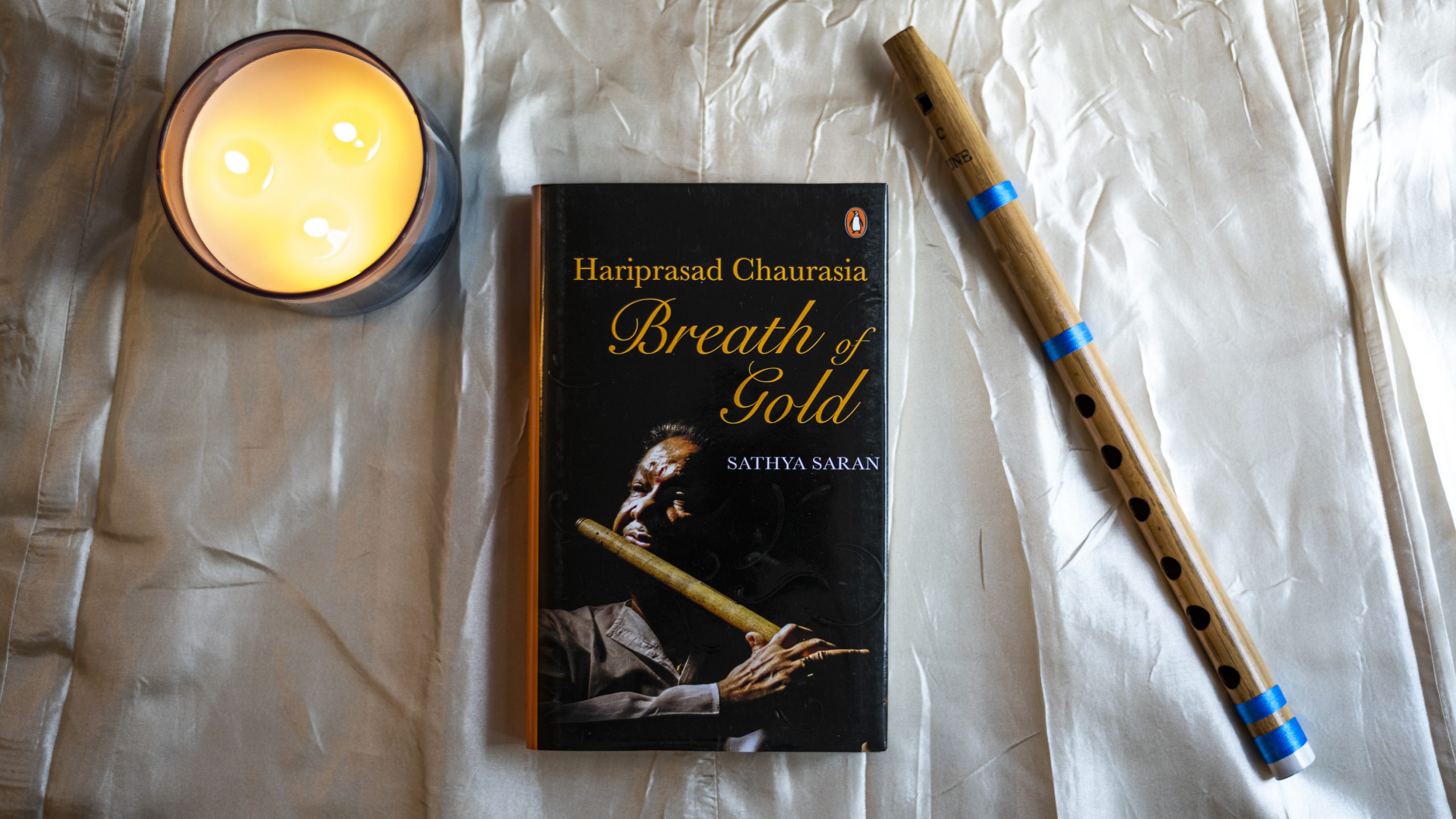
In the age of record stores, it was rare to go into a record shop and not see a recording of Pandit Hariprasad Chaurasia, the master of the bansuri or bamboo flute. One of India’s most popular artistes, he is in Mumbai today, Paris tomorrow and San Francisco the day after.His mesmerizing flute can be heard in many of Hindi cinema’s most popular songs, in a composition by the former Beatle George Harrison, as well as in recordings with renowned musicians from across the world. Sathya Saran’s Breath of Gold will inspire and introduce everyone to the story of this amazing artist.
Not convinced? Read on to know more about Hariprasad Chaurasia:
By combining tradition with innovation, Pandit Chaurasia expanded the scope of expressiveness of the bansuri and was, thus, awarded a plethora of awards, including the Padma Vibhushan. (Source: India Today)
*
If it were up to his father, he would have been a wrestler.Yet, he broke away from the life that was chosen for him and wrote his own destiny.
*
In his early teens, Pandit Chaurasia took lessons in Hindustani classical music from noted Benares vocalist Raja Ram. After hearing one of his performances, Bholanath, a well-known flutist, made Chaurasia his disciple and made him go through eight years of rigorous training. (Source: Britannica)
*
Pandit Chaurasia also studied with Shrimati Annapurna Devi, daughter of Ustaad Allauddin Khan. In Bombay, he also got the additional exposure of performing in one of India’s cultural centers. Through years of experimentation and dedicated practice, Pandit Chaurasia brought global recognition to the bansuri. (Source: IAAC)
*
Hariprasad Chaurasia has also been a guru to innumerable students in his Mumbai and Bhubaneswar gurukuls, and at the World Music Department, Rotterdam Music Conservatory, the Netherlands, where he is artistic director.
*
Hari- ji, as he is fondly called, never gives up, and nothing can keep him from his music. Not the trembling of his hand, not a sudden shortness of breath. He overcomes it all with the strength of his will and his ability to laugh off every hurdle age places in his path.
If you want to know more about this musical genius check out Breath of Gold.