Publish with Us

Follow Penguin

Follow Penguinsters

Follow Penguin Swadesh

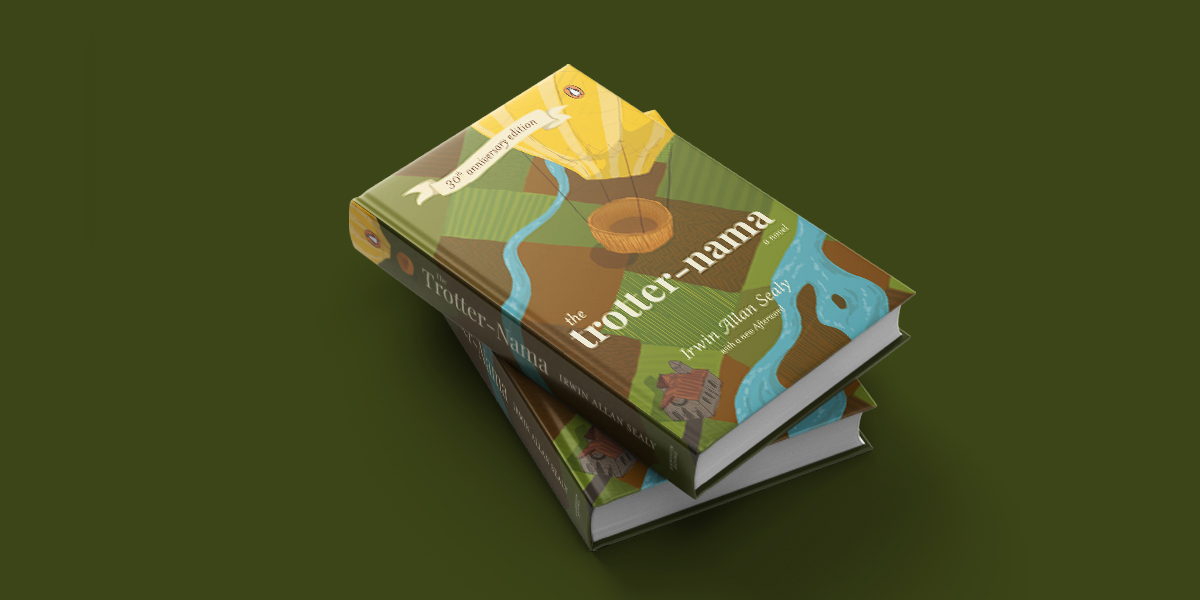
Meet the Trotters from Irvin Sealy’s ‘The Trotter-Nama’

“The nama is a medieval court history, a chronicle. My nama would chronicle a colonial encounter, the overlap of Europe and India, across seven generations of the Trotter family. The Trotters would embody that history, the history of the Anglo Indians, down to Independence and after.” writes Irwin Sealy about his dazzling epic.

The Trotter-Nama meanders around Sans Souci, the Trotter estate near Lucknow, and teems with multi-faceted characters that are looped into the orbit of  the Trotter family as they struggle to hold on to their shifting identities.

Here are 5 unforgettable characters from The Trotter-Nama

  1. The Great Trotter

Justin Aloysius Trotter- the octogenarian with a brown and a blue eye- lords over Sans Souci from the west tower with wives stashed away in the other three towers that form the silhouette of his estate. The Great Trotter straddles two worlds- his wig draws attention to his western roots while his choice of clothes makes him a part of the landscape of Lucknow. Perched above his beloved estate in his prized balloon Salamandre, Justin Trotter gives wings to his ambition-

‘But now—here—in the air above Nakhlau what swept over him was the original lust, that suzerain impulse which once shook to his vitals a younger man. Take this city, then all Tirnab, and who was to say what else might follow? Install the Nawab in some petty principality. Drive the British down….’


  1. Eugene Trotter

Writer by profession and narrator of the Nama, Eugene Trotter- the 7th of the line- is ubiquitous in the numerous asides and interpolations that fill the nooks and crannies of this chronicle. His gaze encompasses the length and breadth of this vast saga as he navigates between space and time and offers a glimpse of the world outside Sans Souci through the slips-

‘The Late Mr Trotter,’ my favourite dentist used to call me. His daughter was less charitable. ‘Lenten Trotter’ was her choice, and when I asked her why, she said: Well, corpu-lent, flatu-lent, indo-lent. She thought the indolent was especially apt even though I said: I’m half Anglo, you know. So. The Late Mr Trotter, Seventh Trotter, pleased to meet you.’


  1. Yakub Khan

The hazel-eyed baker and balloon master flits around the Great Trotter minding the ladder that he stealthily aims to climb. His unchecked advancement and increasing authority indicate the ambition that he nurtures and shapes as vigilantly as his wick-moustache that he trims twice a day. Sunya, the poulterer, observes-


‘…the young Yakub, the apprenticed baker of fifteen years ago. What was the Muslim up to now? He had watched the wiry youth advance from post to post, improve the ovens, outclass the chief baker, perfect past recipes, introduce new ones, oust the chef, trespass on the cooks’ duties, encroach on the bearers’, perfect a new and sensational bread, create offices where none existed before, appoint cronies… and fill every void with his mercurial presence.’

  1. Jarman Begam

Justin Trotter’s consort, ensconced in the south tower, aches for her fatherland Germany as she watches her husband- whom she affectionately calls Trot- take his final and fatal flight in the Salamandre. Unaware of the admiring glances directed at her, she harbours a passion for the barber Fonseca who claims loyalty to the Great Trotter.

‘It was not her own face, though she stood directly before the glass: through a forest of red she made out the face of Fonseca himself. The face hovered just beneath the surface of the glass, caught in a kind of vapour, the dyed black curls crowned with a gold wig; in place of the habitual ironic mask was a look of earnest entreaty. Before she knew what she was doing, Elise bent and kissed the glass once, twice, then repeatedly, without restraint.’


  1. Munshi Nishan Chand

Librarian of Sans Souci and master of fourteen languages, Munshi Nishan Chand sits meditating on the injustice of the glory of the decimal, owed to Indian scholars, having been bestowed upon the Arabs. His soul burns at the ravages his beloved nation has had to suffer at the hand of invaders. The rage at  being reduced from esteemed writer to an administrator propels him toward his mission –

‘At every step recall your mission. Study the circumcised foreigner, barbarian though he be; learn his roughcast languages, school yourself in his childish arts, trace out his tactics, duplicate his strategy, mirror his guile, best his success…Then overwhelm him, and with him his house. And after he is gone, restore once more the bright ancestral home, sweep clean the hearth, rekindle the pure flame. Avenge the violate zero.’


About trotter-nama Irvin Sealy observes, ‘Today I realize it’s a book of hyperlinks, only the term had not yet been invented.’ The characters he creates become the links that are threaded through the narrative to bolster the weighty epic.

There are more trotters sauntering inside the pages of The Trotter-Nama waiting to tell their story. Get your copy to meet them!

Can Love Battle the Forces of the World?

Isha is a girl who loves animals. Away from the confines of her city life, she finds her calling in the Indian countryside when she discovers a sacred grove where a young Bengal tiger has taken refuge from the certain death warranted upon its discovery by the local villagers.

Isha’s arduous journey across the changing landscape of modernizing India begins as her crusade to save the tiger but becomes a gripping story that brings us face to face with man’s unfathomable cruelty towards nature. However, the power of love that fuels a young girl’s determination to give the majestic animal its rightful chance to survive is a force that the world must reckon with.

Here are 5 things The Girl and the Tiger  teaches us about determination and love:

Compassion is a source of strength

The irrepressible urge to help a creature in distress makes Isha defy all odds-

‘A curious paw touched her face. The little tiger’s eyes were full of trust and wonder. No, she would not abandon her post. She could not. “What do we do?” Isha jumped, realizing Pankaj had been standing in the doorway the whole time. She looked up at him, her eyes burning with wild defiant light.’

Love is a journey in self-discovery

In fighting for Kala’s survival, Isha discovers a side to her personality that had remained dormant in her uninspiring city life-

‘Strangely, it was the silence, self-reliance, and agency that she found shocking—not the tiger. To Isha, the wide-eyed cub Kala was no different than the butterflies she rescued—a wild, hunted thing that would perish by flesh or by soul if she did not act.’

A mission helps conquer fears

Fighting the fear that threatens to engulf her in despair, Isha digs deep into her self-belief to achieve what she set out for-

‘Although fear followed her at a distance, she wrapped herself in pages, in stories of journeys. She would become the hero of her own story; she would guard the tiger and find the jungle. She was certain of it.’

An iron will can weaken the strongest opposition

Isha’s firm resolve to fight for the tiger’s right to its place in the jungle strikes a resounding blow at the men who came armed to corner the animal-

‘Isha stood bent and panting, eyes wild as she roared, “If not here then WHERE ELSE CAN SHE LIVE?” Her voice hit such a shrill register that the sound trembled and cracked and it rattled their eardrums. Every man in the field froze.’

Determination helps you surmount all obstacles

Isha’s unwavering commitment towards Kala makes it possible for her to stay afloat even as uncertainty and sheer exhaustion pull her down-

‘But she had also returned. The fact was that no matter how terribly she struggled or how many times she faltered, she continued forward. Forward on a path no one else would dare step.’


Will Isha’s deep and urgent love for Kala be the beacon that will guide them to the last wilderness where the tiger can truly be one with nature? Read The Girl and the Tiger to find out!

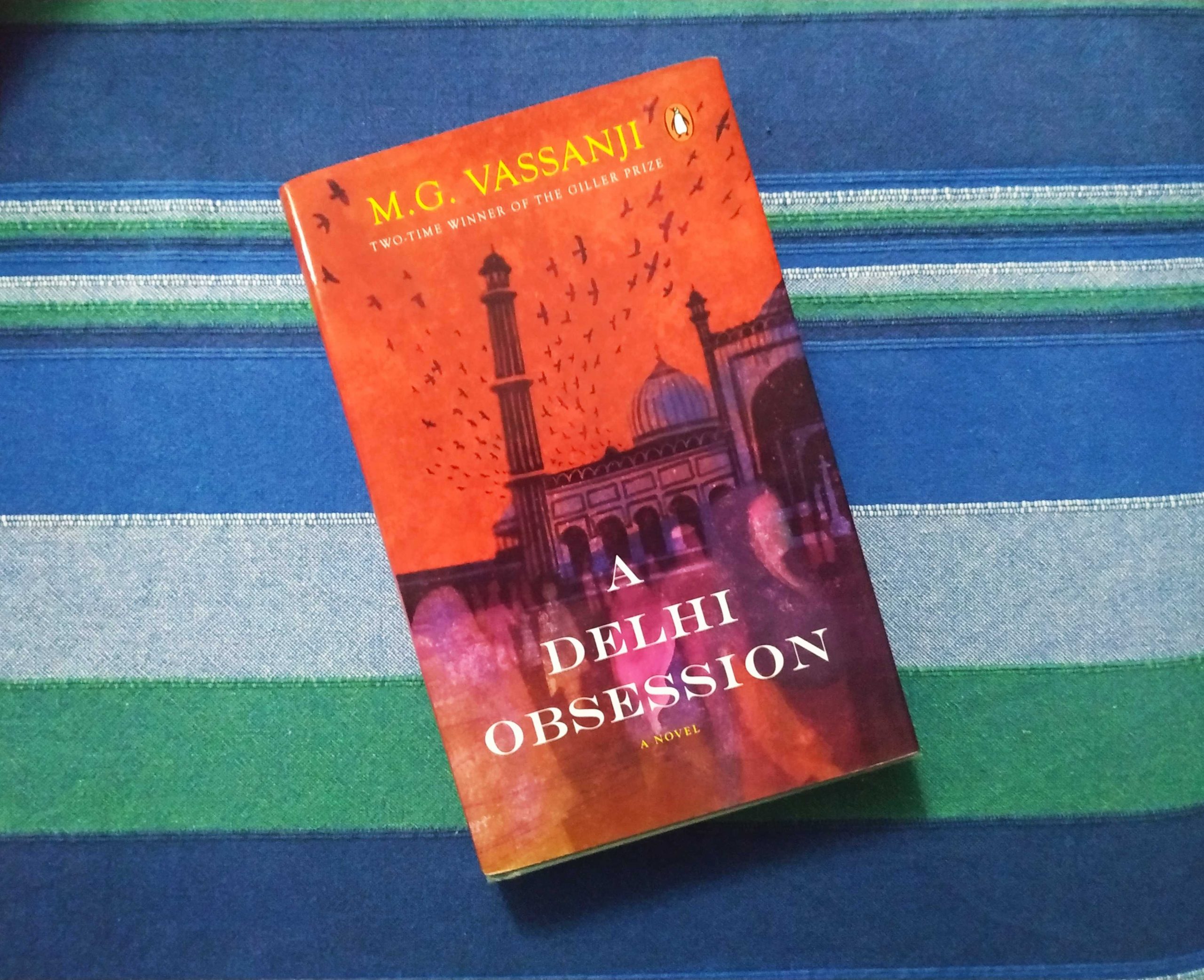
5 Romantic Moments from ‘A Delhi Obsession’

Munir Khan, a recent widower from Toronto, meets the charming and witty Mohini Singh, a married liberal newspaper columnist, in the bar of the high-brow Delhi Recreational Club. An enigma surrounds the Kenya-born, westernized and agnostic Munir, and an inexplicable attraction takes root. Delhi’s streets, monuments and ruins become the setting of their passionate affair.

A terror attack shakes the city just as Jetha Lal and his acolytes, self-proclaimed protectors of cows and Hindu women, raise decibel levels at the Club. Meanwhile, Mohini’s parents’ wounded memory of the Partition and a family trip to Shirdi only serve to exacerbate her anxieties and deep sense of guilt. And even as Jetha Lal’s menacing shadow looms over them, Munir and Mohini cannot let each other go. At what cost their passion?

Set in contemporary times, A Delhi Obsession  unravels an unexpected yet prophetic story of passion, love and faith, amidst the placid environment of an elite Delhi club. Cutting close to the bone, this searing novel will compel you to confront your profoundest dilemmas.

Here are some heart-melting instances from the book!


Munir was standing at the door, casting his eyes about for a place to sit. Without thinking, she waved him over. When he thanked her once more for taking him to the old city, she offered to show him some more of Delhi. Perhaps one or two of her favourite spots.”

~

They sat side by side on his bed, he playing with her fingers, bending them gently, as he liked to do, putting his own strong fingers through hers. He felt warm to her touch. It was a moment of utmost intimacy. He ran a finger down her bare spine, until she gave a shiver and protested, ‘Stop, there.’”

~

Munir escorted her to the driveway. As they shook hands, she let his hand linger onhers, for an extra moment, they stared at each other in silence, and he said, ‘Till next time, then. I’ll write.’”

~

In the vacuum that was absence, there had emerged a longing to hear again that voice, observe that chirpiness, and the tenderness behind it, see that face that was his last sight of her, the large eyes trying to say something, engulfing him, the feel of her hand, her delicate fingers in his, ever so light. Not passion, but something adult, laced with the bitter knowledge of futility, pain.”

~

He felt a pull. Should he call her. But it would be well past midnight there. And there was the husband. It was time to nip it in the bud, this fantasy, this impossibility. It could only cause pain.And yet how could he forget her, the promise they had made. Shall I write to you? Of course you can! Don’t act the Mr Darcy! He had written her a longish email letter, compromising, juvenile, bathetic. And she had replied. I miss you. I think of you all the time. Who had written that? Both of them, probably. After that, a few texts, one hurried phone call.”


Written with trademark sensitivity and a sharp, affecting vision, A Delhi Obsession is M.G. Vassanji’s most urgent novel yet.

The Animal-Whisperers: Explore the Love between Humans and the Nature in ‘The Girl and the Tiger’

‘The story of The Girl and the Tiger is less my own creation and more a collection of moments, truths, and legends I found over the years in the Indian jungle. It is a necklace of a book, a series of seeds and teeth, stones and bones, gathered like beads from the forest floor; I only added the string. It is the result of following elephants, searching for tigers, sitting late into the night around campfires, and becoming acquainted with the tribes of the forest, both human and animal.’, writes Paul Rosolie- a naturalist and award-winning wildlife filmmaker. 

As an author, Paul’s mission is to explore the relationship between humans and nature, wild animals, and our vanishing wild places.

Here are 6 heart-warming instances that speak volumes about the primeval bond that man has with nature-

1. The young orphan Thimma sleepily embraces  the gentle giant , his only family, in a moment where man and nature sway in rhythm with the awakening world –

‘Thimma stood in the nest bed, stretched, and slid down a vine onto the elephant’s back. Straddled on the great neck, he leaned forward to kiss the domed head and rub it roughly with his flat palm. The elephant rumbled and started down the path with the chain-clink of great strides. Rubbing the sleep from his eyes, the boy spoke gentle directions as they went so that Hathi knew when there was a branch or turn.’

2. Kneeling beside the defeated tigress,Isha keens in sorrow as she offers her gratitude to the animal who made the ultimate sacrifice to defend her –

‘She knelt beside the tiger. Her hand moved tenderly on the orange-and-black fur. She stroked the tiger’s ear, her eyes moving in awe and sorrow over the impossibly large body, paws the size of dinner plates, the great sleeping eyes. With her forehead against the warm fur of the tiger’s cheek, she whispered, “Thank you”.’

3. A vein of emotion throbs in man and beast alike when the transformative power of maternal love makes a young girl reach out to comfort a helpless cub-

‘Girl and tiger scrutinized each other. Isha continued to speak to it gently as she extended a hand. The little tiger leaned forward to sniff and tilt its head at the sound of her voice. Isha’s hair still bore the scent of the tigress from the night before, and as the little cub breathed the smell of its mother for the last time, it shivered and drew in close. Ever so slowly, Isha put her hand on the tiger’s head. The tiger trembled as Isha stroked its oversized ears, and then pulled it into her arms. “Don’t worry,” she whispered. “I won’t leave you. I won’t leave you”.’

4. Kala’s playfulness and Isha’s motherly devotion forms a bond between man and predator that defies all reason and challenges accepted notions of love-

‘By now though, Isha was developing a routine. Once the milk bottle was full, she wrapped her arms in the blanket and fit the makeshift nipple into the tiger’s mouth. Kala wrapped her large paws around Isha’s slender arms and sucked on the repurposed cola bottle and cloth nipple.’

5. Embracing the creatures of the land as her own, Sudha- Matriarch of the Budakattu tribe, sits feeding the young in her care. In her own way, she gives back to nature a little of what she receives-

‘Her eyes moved to Sudha, who sat in the flickering shadow against the cracked wall of her house, her own child nursing at one breast, a young wolf nursing on the other. Isha grinned in the firelight, and Sudha could no longer restrain from grinning back.’

6. In a world where animals were another dimension of the human family, the genial coexistence of man and beast reflected a balance in nature-

‘Thimma’s mother told him that Hathi loved him very much and was the source of all the good things their family had, that the elephant was excited for his sibling. In the final month they held a pooja—an auspicious ceremony of choice where flowers and stones were placed on either side of the pregnant woman, and the elephant predicted, based on his choice of item, the sex of the child. Hathi confirmed the child would be a daughter.’


In his challenging mission to protect wildlife habitat in critical areas of The Amazon and India, Paul Rosolie has observed man and nature at close quarters. In The Girl and the Tiger he gives us poignant moments of raw emotion born out of the beauty and brutality of the natural world.

To feel the pulsating beat of the wild, read The Girl and the Tiger!

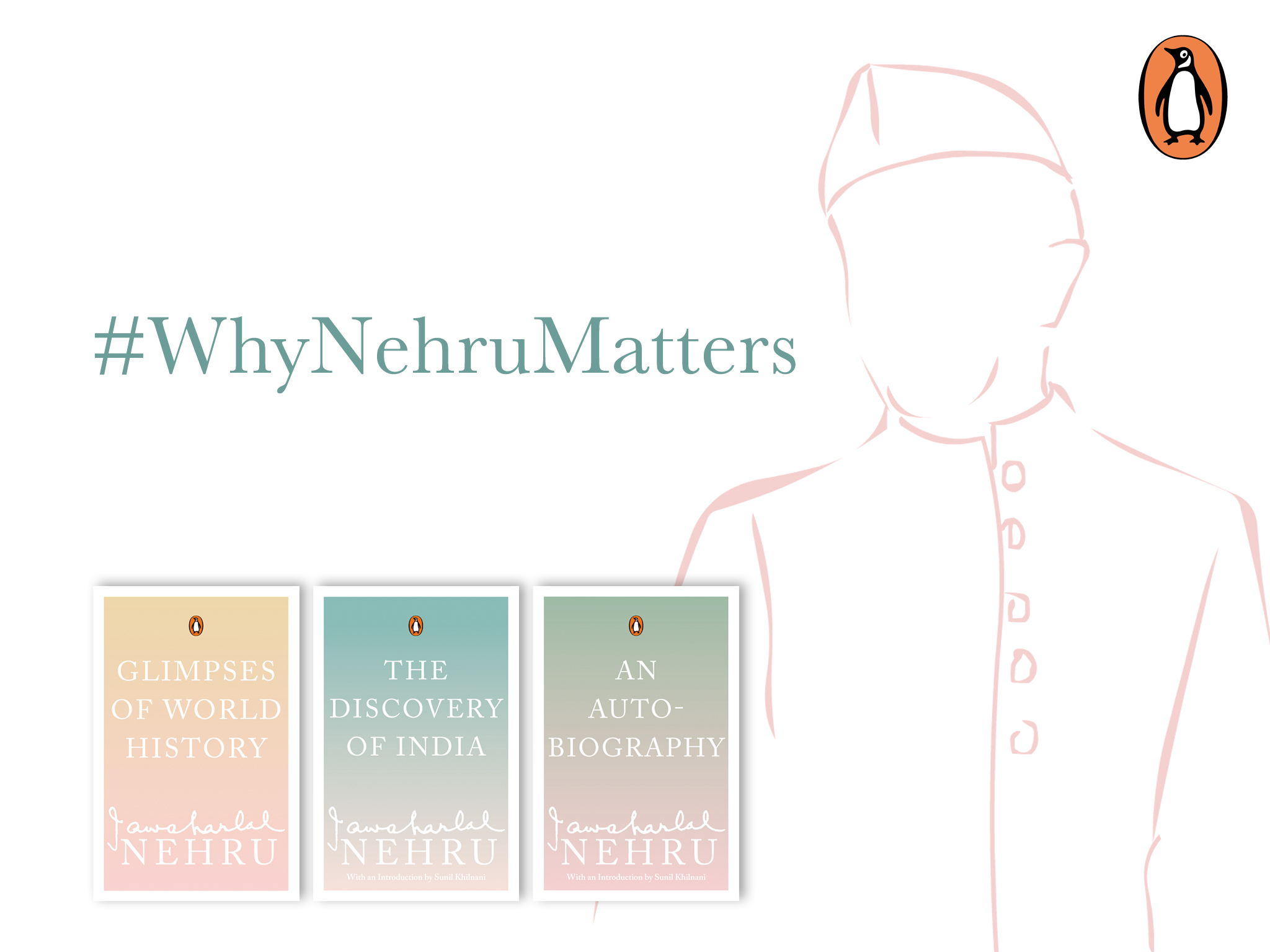
#WhyNehruMatters: Remembering the first Prime Ministers with his words

The first Prime Minister of independent India, Pandit Jawaharlal Nehru was born on November 14, 1889 in Allahabad. He is remembered for being a frontline freedom fighter in India’s struggle for Independence, and a central figure in Indian politics after independence. Along with this, Jawaharlal Nehru leaves behind a legacy of being one of India’s most prolific writers.

In his biography of Nehru, Shashi Tharoor describes him as an ‘aristocrat, socialist, anti-imperialist, foremost disciple of Gandhi, diehard secularist and India’s first prime minister, who sought to educate the Indian masses in democracy by his own personal example’.  These are amongst the many reasons why Nehru matters to India and the world even today.

Today on his 130th birth anniversary, we remember him with words and thoughts from his various books:

‘For only they can sense life who stand often on the verge of it, only they whose lives are not governed by the fear of death.’

― Jawaharlal Nehru, Discovery of India

*

‘Nothing in the world that is alive remains unchanging. All Nature changes from day to day and minute to minute, only the dead stop growing and are quiescent.’

―Jawaharlal Nehru, Glimpses of World History

*

‘Experience of public life showed me that popularity was often the handmaiden of undesirable persons; it was certainly not an invariable sign of virtue or intelligence.’

―Jawaharlal Nehru, An Autobiography

*

‘There is no permanent stability or security or changelessness; if there were life itself would cease…Life is a principle of growth, not of standing still, a continuous becoming, which does not permit static conditions.’

― Jawaharlal Nehru, Discovery of India

*

“Real failure was a desertion of principle, a denial of our right, and an ignoble submission to wrong. Self-made wounds always took longer to heal than those caused by an adversary.”

―Jawaharlal Nehru, An Autobiography

*

“Ignorance is always afraid of change. It fears the unknown and sticks to its rut, however miserable it may be there. In its blindness it stumbles on anyhow. But with right reading comes a measure of knowledge, and the eyes are partly opened.”

―Jawaharlal Nehru, Glimpses of World History

*

‘External events and their consequences affect us powerfully, and yet the greatest shocks come to our minds through inner fears and conflicts. While we advance on the external plane, as we must if we are to survive, we have also to win peace with ourselves.’

― Jawaharlal Nehru, Discovery of India

*

‘Remember always that there is not so very much difference between various people as we seem to imagine. Maps and atlases show us countries in different colours. Undoubtedly people do differ from one another, but they resemble each other also a great deal, and it is well to keep this in mind and not be misled by the colours on the map or by national boundaries.’

―Jawaharlal Nehru, Glimpses of World History

*

“I have always thought that the best way to find out what is right and what is not right, what should be done and what should not be done, is not by giving a sermon, but by talking and discussing, and out of discussion sometimes a little bit of the truth comes out.”

―Jawaharlal Nehru, Glimpses of World History

Read more of Nehru’s work here

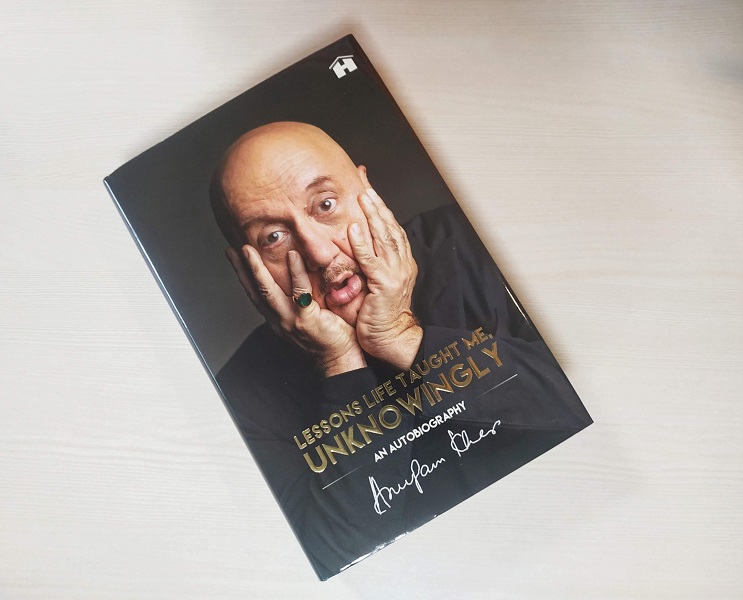
Lessons Life Taught Me, Unknowingly: 7 Inspiring Instances from Anupam Kher’s Life

In his autobiography Anupam Kher acknowledges the truths which set him on the path to success.

A good storyteller starts at the very beginning and Kher has an interesting story related to his birth that leads him to believe that his was not just a routine birth.

This listicle takes us, in Kher’s own words, through a few lessons that have been milestones in Kher’s life and which have made him feel that he is ‘destiny’s special child’!

  1. “My life lesson has always been there is no point in thinking of what could have been—for I lay great store by John Lennon’s quote.”

  2. In contrast to modern nuclear families, I grew up with an assortment of Khers of all ages, which gave me a head start in learning the lessons related to sharing, tolerance and respecting diverse viewpoints and ideas.”

  3. “I think living with grandparents is the most significant factor in the growth of any child. At least, it was for me and my brother.”

  4. “There is no reason why anyone should find it difficult to stay close to their roots and remain grounded even after they taste success.”

  5. “Whatever be the adversities one faces, if one approaches the situation with a humorous perspective, then one is spared the angst, the tension and the stress that are nowadays part and parcel of day-to-day life and living.”

  6. “My own experiences have taught me that tragedy and trauma teach you a lot and makes you aware of who you are if you don’t indulge in self-pity.”

  7. “……I should be prepared for ups and downs but not let anything drag me down.”

  8. “The choice you make can distinguish between the ordinary and the extraordinary.”

  9. “I have learnt that failure is the one thing you should not fear in life. Better to experience it, face it, live it and thereby conquer, it by overcoming it.”

  10. “If you are unable to fake an emotion, don’t fake it. If you are suffocated by loneliness, speak to someone; reach out to a loved one. You don’t need to fit in! You are not alone.”


Get ready to be even more inspired in Kher’s autobiography, Lessons Life Taught Me, Unknowingly.

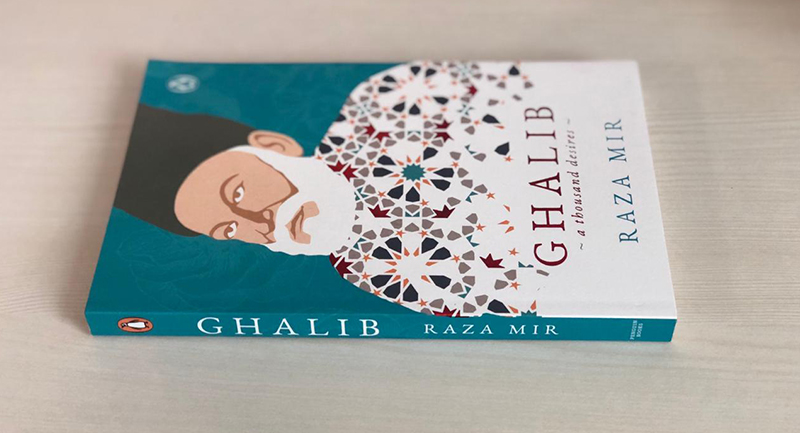
The Bard of Ballimaran- Mirza Ghalib

Emerging from the narrow lanes of Old Delhi, Mirza Ghalib’s couplets took wing on the hallowed reverence of millions of dreamers and became entrenched in public imagination. His words breathed fervour into many ardent professions of love and added depth to sombre musings on life.

Hidden behind the dazzling effulgence of his poetry was a man burnished by adversity. Reflecting the ironic duality that marked his life, Ghalib luxuriated in poetic verse and yet languished in material indigence.

‘Ghalib’s self-presentation was of one who lived a life of affluence and leisure, where he was respected as a thinker and honoured by the powerful. In reality, his poetic prowess was relatively unacknowledged in his own time, and his existence was marked by deep and constant financial insecurity exacerbated by the fact that he all too often backed the wrong horse in the context of a constantly shifting field of power.’ writes Raza Mir.

In Ghalib- A Thousand Desires, Raza Mir presents an illuminating account of Mirza Mohammad Asadullah Khan ‘Ghalib’s life and work. Read on for a glimpse-


    1. Born in 1797 in Agra to Mirza Abdullah Baig, Mirza Asadullah Khan belonged to a family of soldiers of Turkish ancestry. Losing his father in the early years of life left the young Khan and the Baig family in dire financial straits. Riling up contemporaries and benefactors with his sharp wit and cantankerous temper, the comfort of companionship and material rewards eluded Mirza for most of his life.


    1. At the young age of 9, Asadullah Khan began writing poetry in Persian with the pen name ‘Asad’ (lion). He later adopted the name ‘Ghalib’ (dominant) which went on to become synonymous with poetic genius. Lauded for his talent by the incomparable poet Mir, one of the few whom Ghalib admired, he went on to become the poet laureate of the court of Mughal emperor Bahadur Shah Zafar.


    1. Asadullah Khan- a young thirteen year old- married Umrao Begum who was eleven at the time. Setting course in an orbit of separation, the couple experienced the loss of their seven beloved children even as Ghalib gravitated towards the pinnacle of poetic fame. In Delhi, the couple shared their life with Umrao Begum’s family before moving into a house, gifted by Umrao’s cousin, in the charmingly chaotic Gali Qasim Jan of the Ballimaran neighbourhood.


    1. Divaan-e Ghalib, a collection of Ghalib’s poetry, was first published by Syed-ul Akhbar Press in Delhi and saw more re-prints than perhaps any other book of Urdu literature. He went on to write an account of the rebellion of 1857 in Ghalib’s Urdu letters are published in a book titled Ud-e Hindi (Indian Perfume)


  1. After his death in 1869, Altaf Husain Hali published Yaadgaar-e Ghalib (In the Memory of Ghalib), the first definitive biography of Mirza Ghalib. Such was the stature of the great poet that the Indian government issued a ‘Mirza Ghalib’ stamp in his honour while Ghalib’s grave was turned into a memorial and is still a place of reverence in the lanes of Ballimaran.

Mirza Ghalib, the most illustrious Urdu poet in English, continues to delight and inspire as the magic of his poetic genius lifts his words out of the yellowed pages of history to shine like a beam of luminous moonlight onto the harried hordes of our generation.

Read Raza Mir’s Ghalib: A Thousand Desires to capture the essence of Mirza Ghalib!

Your Daily Dose of Motivation: Get Inspired with Marie Forleo!

Inspired by a line uttered by her mother, Marie Forleo’s Everything is Figureoutable is all that it promises to be and more! It makes self help and motivation fun by inserting anecdotes, personal stories and humour in its pages.

We share with you some quick quotes and stories from the book to that continue to inspire us and hope they will give you your daily dose of motivation too!


Oprah’s Story

‘When Oprah Winfrey was sixteen, she saw Barbara Walters on television. She was so deeply moved and inspired that she said to herself, “Maybe I could do that.” Oprah went on to share, “There’s no other woman that deserves more in terms of opening the door for my career.” In that statement, Oprah is not talking about Barbara Walters “opening doors” by recommending her for broadcasting jobs. She’s talking about the fact that merely witnessing another woman on televeision cracked open a possibility within Oprah’s consciousness about what was possible for her. It’s hard to become what you don’t see.’

~

Judging Failures

‘[…]When I bombed [the] Missy Elliott audition years earlier, Nike Elite Dance Athletes didn’t exist yet. There’s no way I could have dreamed to reach that specific goal, because no one had done it before! It simply had not been created.

But my Missy failure spurred a necessary shift in my focus, pushing me to spend the next few years unknowingly training in the exact mix of hip-hop, dance and fitness that prepared me to win that Nike position when it appeared!

Don’t be so quick to judge your supposed failure. A flop might be a cosmic redirect, guiding you to a better, bigger purpose.”

~

On Opinions and Criticism

“Let’s say you love chocolate, but you have a friend who despises chocolate. Does that mean chocolate sucks? No. It means one person doesn’t like chocolate. Chocolate makers don’t lose sleep over that. They’re not campaigning to convert the haters. They focus all their attention on chocolate lovers.”

~

Be You.

“Consider all the things that have brought you value, joy, or growth throughout your lifetime. Every song that’s made your head bop. Every movie that’s made you laugh, cry, or expand your point of view. Every athlete or artist who’s inspired you to reach for more. Every invention that’s made your life easier. Every restaurant that’s served a dish that made you moan with delight. […]

Imagine if all those beautiful people never followed the call of their soul – never “figured out” their dreams and created and contributed and shared. I say this at the end of eve MarieTV episode and I’ll say it to you now:

The world needs that special gift that only you have.

~

Share the Shame

‘Most high achievers struggle with feeling like a fake, but never talk about it. It’s like a dirty little secret everyone’s afraid to admit. I’ll tell you right now – I still feel this way at times and I’ve been doing this work for almost two decades. Brene Brown says, “As a shame researcher, I know that the very best thing to do in the midst of a shame attack is totally counterintuitive. Practice courage and reach out!”

Bronte is on point. You know why? Because shame shrivels when you share it out loud.’


To make life a little more figureoutable, get your copy today!

5 Specific Weaknesses that Have Prevented India from Realizing its Full Potential from ‘India: Still a Shackled Giant’

India is one of the largest economies in the world today and it has been predicted that it would become the third largest economy by 2030. Yet, an average Indian is worse off than his counterpart in other developing nations like Algeria, Indonesia, Mongolia and Morocco. The tethers of corruption and fragility have prevented it from becoming an Asian Tiger.

In India: Still A Shackled Giant, Dev Kar, a former senior economist at the International Monetary Fund shines light on why India is still, even after 70 years of independence, unable to reach its full potential to join democratic giants like the United States, Germany, and Japan.


Fragility

Fragility is a state of affairs, consisting of many economic, social, demographic, political, environmental, and security-related pressure points that either strengthen or weaken a nation state. If fragility is left unchecked, the nation can slide towards civil war and break up. The overall fragile states index (FSI) is derived from twelve sub- indices which are: demographic pressures, economic inequality, economy, external intervention, factionalized elites, group grievance, human flight and brain drain, human rights, public services, security apparatus, state legitimacy, and refugees and internally displaced persons (IDPs). (page 15)

India’s overall fragility increased from the ninety-third rank in 2006 to the seventy-second rank in 2018. India’s slide by twenty-one ranks over this period was mainly driven by uneven development (such as rising income inequality), human flight and brain drain, state legitimacy, demographic pressures and security apparatus.

Dirty Politics

There is no doubt that the source of corruption in India is its rotten politics. If politicians can use black money to get elected, criminals can contest elections and win, and if they can all play vote bank politics, what kind of example do they set for the rest of the country? These days, it seems every political party needs criminals to intimidate the opposition, suppress dissent, and extract rent in order to ensure its hold over power. Under the circumstances, there can be neither raj (rule) nor neeti (ethics) left in rajneeti (politics).

Another way of looking at this sad state of affairs is that many voters perceive the criminal politicians to be more effective in delivering government services. I think, either way, from the supply of criminal politicians to the demand for them, they pose a huge problem for any democracy and its governance.

A Taxing Problem

Ever since Independence, India has had two main problems with taxation—a narrow tax base and significant tax evasion. A narrow tax base means only a small portion of India’s population is paying income taxes. Out of a population of some 1.3 billion people, only about 4 per cent file pay income taxes, which make up the largest part of direct taxes. (page 141)

A country trying to raise adequate tax revenues from a narrow base ends up running large fiscal deficits given increasing government expenditures to meet multiple development objectives. Fiscal deficits in turn hamper economic growth and lead to economic instability through rampant inflation, higher interest rates, or increasing foreign debt. It is the poor who suffer disproportionately.

According to the Centre for Monitoring Indian Economy (CMIE), nearly thirty-one million Indians are unemployed and looking for jobs. While economic growth has been humming along around 7–8 per cent per annum recently, the pace of job creation has been poor. While unemployment is naturally an emotive issue in a country of 1.3 billion people with a young workforce, the capacity to generate jobs is not in the hands of any politician, regardless of their promises. The bottom line is that for unemployment to come down during any period, the number of new jobs created must be greater than the number of people entering the labour market during that period. The problem of employment in India is twofold. First, India needs to invest in more education, vocational training and health. Second, there is a need to shrink the size of the informal sector by helping more workers to switch to jobs in the formal sector.

No Care about Healthcare

Healthcare in India still has a long way to go in terms of access to good facilities and reliable doctors, particularly in smaller towns and villages. While the rich in India can afford to get reasonable treatment at a price they can afford, the poor can’t. The quality of public hospitals is extremely poor and they pose serious risks to the life and well-being of patients. Moreover, the credentials of many doctors are suspect. To make matters worse, there are no independent regulatory bodies to accredit, monitor and disseminate reviews of medical providers.


Grab your copy of this book today to know learn about these barriers in detail and discover how India can find the road to redemption.

Words of the Sage: Excerpt from ‘The Markandeya Purana’

Celebrated author and scholar Bibek Debroy’s masterful translation allows a whole new generation of readers to discover Sage Markandeya’s wisdom. His narrative unfolds as a series of conversations with Markandeya that explore the deep, fundamental questions raised by the Mahabharata.

Join in the conversation through this excerpt:

“The Indra among men must not succumb to desire. The lord of the earth must first control himself, then the ministers, servants and citizens. It is only after he knows this has been done that he acts against the enemy. If a king tries to conquer the enemy without conquering these, he is conquered by advisers who have not conquered themselves. He is then bound down by arrays of the enemy. O son! Therefore, a lord of the earth must first conquer desire and the other vices. When he has conquered them, the king conquers. If he has not conquered them, he is destroyed. A wicked king is destroyed by enemies like desire, anger, avarice, insolence, pride and delight. It is remembered that Pandu was brought down because he was addicted to desire. Since he could not control his anger, Anuhlada killed his own son. Aila was killed because he was greedy. Because of his insolence, Vena was killed by brahmanas. The son of Anayusha was killed because of his pride. Puranjaya was destroyed because of delight. Having conquered these enemies, the great-souled Marutta  conquered everything. Remembering this, a lord of the earth must cast aside the six vices. A king must learn from the conduct of a crow, a cuckoo, a bee, a crane, a snake, a peacock, a swan, a cock and iron. Towards the enemy, a lord of men must behave like an owl. At the right time, the lord of the earth must act like an ant. His acts will be known as much as fire in kindling or seeds in silk-cotton. Like the sun and the moon, he must protect the earth through his policy. He must learn from a courtesan, a lotus, a sharabha, a shulika and a woman with heavy breasts. The lord of the earth must formulate policy on the basis of sama, dana, danda and bheda and protect the earth. Like a chandala woman, he must use his wisdom and serve. If he wishes to protect the earth, the lord of the earth must follow the conduct of the five—Shakra, Surya, Yama, Soma and Vayu. For four months, Indra sustains the earth through his showers. Like that, the lord of the earth must nurture the world through his generosity. For eight months, Surya draws up the water through his rays. In that way, the king must collect taxes through subtle means. When it is the right time, Yama acts against both friend and foe. Like that, the king must be impartial in his treatment of the virtuous and the wicked, regardless of whether he likes them or dislikes them. The sight of the full moon fills a man with delight. Like that, when all the subjects are satisfied, the king has followed auspicious conduct.”


Full of wit and enlightenment about life, Bibek Debroy’s The Markandeya Purana is a must-read for adults and children alike.

error: Content is protected !!