Publish with Us

Follow Penguin

Follow Penguinsters

Follow Penguin Swadesh

Six Things We Learn About the Creative Process From Ramanujan

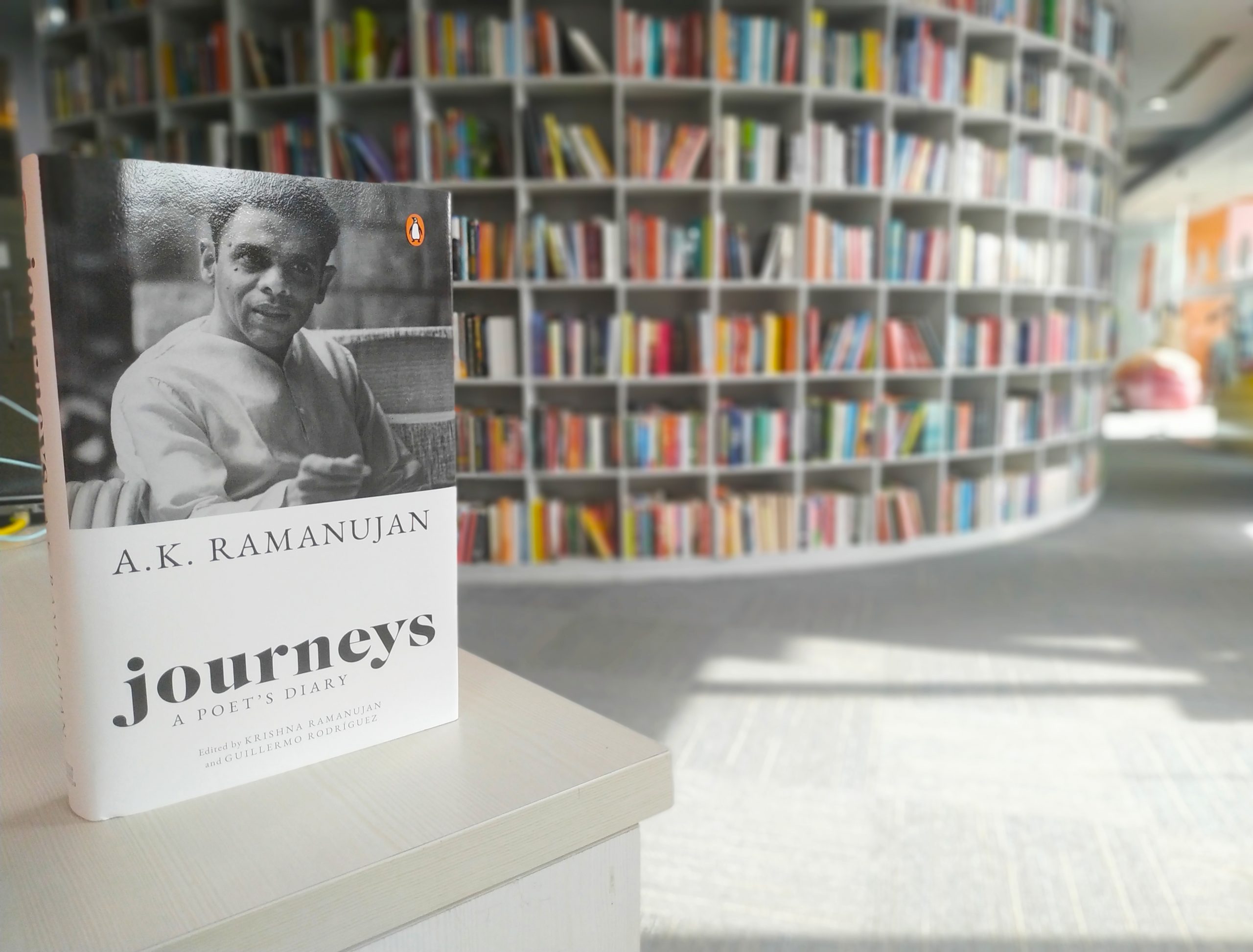
The A.K. Ramanujan Papers, stored since 1994 at the Special Collections Research Center at the Joseph Regenstein Library, University of Chicago, contain hundreds of catalogued files ordered chronologically from 1944 to 1993 in seventy-one boxes. Since 2014 an additional set of personal diaries and journals, kept in series V of the Papers, became accessible to researchers. The book Journeys: A Poet’s Diary includes literary entries from A.K. Ramanujan’s travels, his thoughts on writing, poetry drafts, and dreams. His diaries and journals served as fertile ground where he planted the seeds for much of his published work.

Here are some noteworthy facts about Ramanujan’s creative process!


Ramanujan viewed keeping a diary as part of his creative process; the entries provided a permanent repository for otherwise transient ideas, observations and language.

Ramanujan revised and re-read his notes and diaries now and again in a continuous dialogue with the past and himself; ideas, images and concepts were re-circulated and redistilled.

In all of his work, especially his poetry and translations, Ramanujan was very scientific – as a trained linguist – and almost obsessed with language and form.

He recorded scenes and anecdotes of people and his life. Between entries, he jotted quotes from writers and artists.

By recording his inner and outer life, he preserved experiences for later use; by practising verse, he honed a craft. This was the fertile ground where the seeds of his published work were planted.

He was a writer at work observing the minutiae of life, the ‘ordinary mysteries’; and at the same time the thinker struggling with the larger issues of human relations – psychologies, and our understanding of body and spirit.


Edited by Krishna Ramanujan and Guillermo Rodríguez, Journeys offers access to Ramanujan’s personal diaries and journals, providing a window into his creative process.

6 Lines By Toni Morrison That Are Important For The 21st Century

Mouthful of Blood is structured in three parts and these are heart-stoppingly introduced by a prayer for the dead of 9/11, a meditation on Martin Luther King and a eulogy for James Baldwin. The author  Toni Morrison’s Nobel lecture, on the power of language, is accompanied by lectures to Amnesty International and the Newspaper Association of America. She speaks to graduating students and visitors to both the Louvre and America’s Black Holocaust Museum. She revisits The Bluest Eye, Sula and Beloved; reassessing the novels that have become touchstones for generations of readers.

Here are some path-breaking lines from her new book, that will get you thinking!


“We live in a world where justice equals vengeance. Where private profit drives public policy. Where the  body of civil liberties, won cell by cell, bone by bone, by the brave and the dead withers in the searing heat of ‘all war, all the time’”

“Writers are among the most sensitive, most intellectually anarchic, most representative, most probing of artists. The writer’s ability to imagine what is not the self, to familiarize the strange and to mystify the familiar- all this is the test of her or his power.”

“Complicity in the subjugation of race and class accounts for much of the self-sabotage women are prey to, for it is straight out of that subjugation that certain female-destroying myths have come.”

“The course of time seems to be narrowing to a vanishing point beyond which humanity neither exists nor wants to. It is singular, this diminished, already withered desire for the future.”

“Dream the world as it ought to be,imagine what it would feel like not to be living in a world loaded with zero-life weapons manned by people willing to lose them, develop them, or store them for money, or power, or data,but never for your life and never for mine.”

“The mind really is a palace. Not only for its perception of symmetry and the outrageously beautiful, but also because it can invent, imagine and most importantly, it can delve.”


 Mouth Full of Blood is a powerful, erudite and essential gathering of ideas that speaks to us all.

The Journey of Jugaad 3.0 – an Interview with the Author!

Based on hundreds of interviews, as well as the author’s consulting work within companies, Jugaad 3.0 Hacking the Corporation will prove that every organization’s best chance, to survive and become better than ever, lies within itself. Against the decidedly progressive, action-oriented, and above all restless backdrop of disruption, the DNA of established business is starting to realign. It’s the beginning of a groundswell that has started to make lean entrepreneurship a core competency within big business.

We had a chat with the author, Simone Ahuja. Read all about it below!


What was your favorite part while writing this book? Any particular interview was very interesting/enlightening?

My favorite part of writing is always interviewing intrapreneurs and innovation leaders. This allows for a more authentic and compelling story since I learn from their real experiences, victories, and challenges, and compare notes with experiences I’ve been through with my clients. It’s the anthropologist in me that likes to access practitioners from various backgrounds, and then synthesize and analyze the information they share to help others solve similar issues. My readers come from a diverse range of backgrounds, so it was important for me to provide interviews from an equally diverse range of fields.

One of my favorite interviews was with L’Oreal chemist, Balanda Atis, and Stanley Black and Decker’s PR manager, Sarah Wyndham. They demonstrated key characteristics of successful intrapreneurs (including passion and purpose, being frugal and managing ambiguity) to drive their innovations forward. Both intrapreneurs knew that they could not create their vision alone, so they “enlisted” others in a win-win collaboration to push their ideas into reality since the DIY methodology calls for curiosity, humility, a willingness to experiment and deep collaboration.


One piece of advice for a budding intrapreneur?

Definitley to partner with others. Finding mentors and sponsors in crucial in the innovation process since they can provide intrapreneurs with valuable lessons, networking opportunities, and varied perspectives. High-quality mentors and sponsors can take an intrapreneur to the next level of success because of their previous experience and resources, the air cover they can provide, the doors they can open, and the fingerprints they may be able to help keep off of your initiative. 


 What was your writing routine for this book?

I started this book by searching for intrapreneurs across the world and across industries. We then took deep dives into their journeys to understand their successes and barriers to intrapreneurship until I was fully immersed. Finally, I began to synthesize and analyze my interview data which is what resulted in the principals that I share in Jugaad 3.0.

 Any challenges you faced while writing this particular book?

Writing a book is all consuming and I had two births this year: the birth of this book and the birth of my daughter, Zara. Writing can be an immersive process, so it’s a challenge while also working and raising my two-month-old daughter alongside my 4 and a half-year-old son. This year has been extraordinarily busy and exciting, but these births made my priorities were very clear.  Anything superfluous easily fell to the wayside.


 How was it different from writing Jugaad Innovation?

Writing this book was quite a different experience for me since I wrote this one on my own. My editors and publishers supported me immensely, but in the end, it came down to my judgment and decision making – and at times that can be a lonely road! Being a solo author was unlike writing with co-authors; I enjoyed the camaraderie and collaboration of writing Jugaad Innovation, but I also fully enjoyed the experience of writing this book on my own, especially because it is so closely linked to my work and solving a problem (moving ideas through to execution) faced by so many of my clients.


Jugaad 3.0 Hacking the Corporation offers a spectrum of carefully crafted archetypes to help people see themselves in this trend and allow organizations identify the innovators in their midst.

6 Uproariously Bizarre Situations Sudha Mahalingam Found Herself In!

Putting one’s foot into one’s mouth might seem like an impossible feat of contortion requiring complex manoeuvring skills. How and when the author, Sudha Mahalingam, acquired and honed these enviable skills is of less interest than the fact that she has managed to deploy them time and time again, during her peregrinations through sixty-five countries in the past quarter of a century. And the consequences have ranged from the embarrassing to the confounding, the costly to the inconvenient, and occasionally, to the downright dangerous.

Punctuating her droll stories with breathtaking descriptions and stunning photographs in her book, The Travel Gods Must Be Crazy, Sudha invites readers on an unexpected and altogether memorable tour around the world!

Here are some whacky experiences that defined Sudha Mahalingam’s journeys:

When Sudha found herself locked all alone on top of a minaret, in Yazd

“When I find my way down the spiral staircase, the heavily carved wooden door is shut and seems to be padlocked from outside. I start shouting and pounding on the door hoping someone is still outside. There is no response. Only a sinister silence. Panic begins to well up in me. The prospect of spending the night on the ledge of the minaret under a starry sky may sound romantic in retrospect, but I was terrified. Besides, it was getting chilly too.”

 When an AK-47 was pointed at her son, in Israel

“We see a CCTV camera above our heads just outside the fortified gate. The voice belongs to Israeli security and she is actually yelling at my eighteen-year-old son, asking him to take off his cap so that she can see his face. But even after he does that, she is not satisfied. ‘Where are you from and what is your business?’ calls out the disembodied voice. Terrified, I reply meekly. ‘We are from India.’ She is not satisfied. She barks again, asking us to hold out the first page of our passports to the CCTV camera. Which we do with alacrity just in case the finger on the trigger of the AK-47 on the rafter above got a bit itchy! And troop out hastily when the gate opens, thoroughly shaken, to mingle and disappear into the crowds on the Israeli side of the fence.”

 When hygiene and the call-of-nature were at loggerheads, on Irrawaddy River

“The journey takes all of twelve languorous hours during which you loosen up completely. The only thing that is tightly wound up is your bladder, swelling to capacity and threatening to burst. The two toilets on the deck can put skunks to shame; they dare you to approach them, and naturally, you dare not.”

 When she slept at a railway platform, in Rome

“Around midnight, I am rudely woken by a few limbs tripping over me. There is a mad rush for the station gates as the limbs and backpacks reassemble and head out in haste. Roma Termini closes at midnight and everyone is shooed out. I too stumble my way out of the station and am promptly mobbed by waiting tout with offers of beds for the night. The rate starts at €120 for a night—depends on your level of desperation.”

 When she travelled with a king cobra

“We are travelling with a live, 11-foot-long king cobra, rudely interrupted in its quest for a mate. The bag in which it is coiled up is made of cotton cloth and nothing more. Its fangs can easily reach out to lacerate and inject its infamous venom into any limb that strays close enough.”

 When she was the only vegetarian at a dinner table, in Beijing

“My Chinese neighbour expertly plunges his chopsticks and delicately picks out some gooey squid and stuffs it into his mouth without spilling a drop. Then he uses the same chopsticks to pick up the bok choy and the lotus stem one after the other. So do the others, all of whom seem to be enjoying their meal immensely even as I sit holding my breath to escape the unfamiliar aroma wafting from the dishes. The tips of their chopsticks plunge alternately into the fish, meat and the vegetables with equal ease. This is interspersed with shouts of ‘ganbay!’ as the diners tip tiny glasses of rice wine to wash down the meal. No one even notices that I am the only one not eating.”


Get your copy of The Travel Gods Must Be Crazy today!

 

Prep Your Bookshelf! New Books Coming Your Way!

Summer has finally arrived and so have longer, sunny days, that beckon you to rejuvenate your senses with an all-new reading list to look forward to! Here are some new launches that will help you sail smoothly in this scorching heat.

A glance at some eagerly awaited books, which will be out soon!

Awakening Bharat Mata


The rise of the Bharatiya Janata Party (BJP) was much more than an ordinary electoral phenomenon: it brought to the fore two contrasting views of nationhood: between those who saw modern India in terms of secular republicanism and on the other hand were those who sought to blend technological modernity with the country’s Hindu inheritance.

This collection is an attempt to showcase the phenomenon of Hindu nationalism in terms of how it perceives itself. Many of the concerns that drive the Indian Right are located in the country’s nationalist culture. In trying to locate some of the ideas, attitudes and beliefs that define the Indian Right, Awakening Bharat Mata also seeks to identify the nature of Indian conservatism and identify its similarities and differences with political thought in the West.

A Human’s Guide to Machine Intelligence

Through the technology embedded in almost every major tech platform and every web-enabled device, algorithms and the artificial intelligence that underlies them make a staggering number of everyday choices for us: from what products we buy to where we decide to eat, from how we consume our news to whom we date and how we find a job. We’ve even delegated life-and-death decisions to algorithms-judgments once made by doctors, pilots, and judges. In A Human’s Guide to Machine Intelligence, Kartik Hosanagar surveys the brave new world of algorithmic decision making and reveals the potentially dangerous biases to which they can give rise as they increasingly run our lives. He makes the compelling case that we need to arm ourselves with a better, deeper, more nuanced understanding of the phenomenon of algorithmic thinking.

Human’s Guide to Machine Intelligence is an entertaining and provocative look at one of the most important developments of our time and is a practical user’s guide to this first wave of practical artificial intelligence.

Delhi Darshan

Giles Tillotson provides a fascinating account of Delhi’s built heritage, from the traces of the earliest settlements at Indraprastha, through the grand legacies of the Delhi Sultans and the great Mughals to the ordered symmetries of Lutyens’ Delhi and the towering skyscrapers of Gurgaon. Filled with quirky details and original insights, as well as a section on important monuments, this is a lively and informed account of the many fascinating twists and turns in the national capital’s built history and an original reflection on the many transformations of its urban landscape.

The King of Kings

A mysterious emissary arrives in the port city of Bhrigukachchh. He has been sent by King Jaysinhdev of Patan with a secret message for Kaak, the valiant chieftain of the city. The king seeks to urgently enlist Kaak’s help in conquering the kingdom of Junagadh. However, Kaak has also received crucial summons from two others: Leeladevi, the firebrand princess whose marriage to Jaysinhdev Kaak himself facilitated; and Ranakdevi, the queen of Junagadh.

Caught in a web of conflicting loyalties, Kaak must navigate a treacherous terrain of political machinations where the slightest misstep could lead to grave consequences-where even he will not emerge unscathed.

K.M. Munshi’s magnificent conclusion to his beloved Trilogy, The King of Kings is a panoramic epic filled with adventure and intrigue, and a timeless classic with a nuanced insight into human nature and the complex links between statecraft and violence.

Cities and Canopies


Native and imported, sacred and ordinary, culinary and floral, favourites of various kings and commoners over the centuries, trees are the most visible signs of nature in cities, fundamentally shaping their identities. Trees are storehouses of the complex origins and histories of city growth, coming as they do from different parts of the world, brought in by various local and colonial rulers. From the tree planted by Sarojini Naidu at Dehradun’s clock tower to those planted by Sher Shah Suri and Jahangir on Grand Trunk Road, trees in India have served, above all, as memory keepers. They are our roots: their trunks our pillars, their bark our texture, and their branches our shade. Trees are nature’s own museums.

Drawing on extensive research, Cities and Canopies is a book about both the specific and the general aspects of these gentle life-giving creatures.

Defining India

From Amartya Sen to Aamir Khan, Raghuram Rajan, Sachin Tendulkar, His Holiness the Dalai Lama, Pranab Mukherjee, Arun Jaitley, Nirmala Sitharaman and Sania Mirza among others, in this book eminent journalist Sonia Singh opens a window to the myriad worlds of these stalwarts, who share their idea of India in freewheeling conversations. Chatty, candid and amazingly gripping these 15 interviews uncover the pivotal moments in their lives that have become defining moments in the history of the nation.

The Brotherhood in Saffron

Tracing the growth of the Rashtriya Swayamsevak Sangh (RSS) since its formation in the mid-1920s, the authors examine its ideology and training system. As the first significant book on its internal workings, this book is the prequel to RSS: A View to the Inside. It was for the first time in this book that readers received a glimpse into the inner workings of the RSS. Three decades later, the RSS is one of the most significant cultural organizations in India, making this book a powerful and important read.

The Young and the Restless

The 2014 Lok Sabha elections saw the involvement of India’s youth like never before. They were debating inside classrooms, sitting for dharnas on the street, having conversations in offices and on social media. The election in 2014 saw 150 million young voters—and the highest number of first-time voters in India.

And yet, the average age of our parliamentarians is sixty-three. Our leaders are almost four decades older than the average twenty-five-year-old.

In The Young and the Restless, Gurmehar Kaur, student activist and author of Small Acts of Freedom, follows the journeys of eight youth leaders, their aspirations for the country’s youth, their aspirations for themselves and, most importantly, their aspirations for the nation. She explores whether their politics only mimics that of the older party leaders or if they have the ideas, passion and motivation of the demographic they represent.

The Satapur Moonstone

India, 1922. A curse seems to have fallen upon the royal family of Satapur, a princely kingdom tucked away in the lush Sahyadari mountains, where both the maharaja and his teenage son have met with untimely deaths. The state is now ruled by an agent of the British Raj on behalf of Satapur’s two maharanis, the dowager queen and her daughter-in-law.

When a dispute arises between the royal ladies over the education of the young crown prince, a lawyer’s counsel is required to settle the matter. Since the maharanis live in purdah, the one person who can help is Perveen Mistry, Bombay’s only female lawyer. But Perveen arrives to find that the Satapur Palace is full of cold-blooded power play and ancient vendettas.

Too late she realizes she has walked into a trap. But whose? And how can she protect the royal children from the palace’s deadly curse?

Kidnapped

In 2016, approximately ten people were abducted every hour in India. Of them, six were children. Kidnapping is a crime where it is possibility to save the victim, which makes its treatment and results unique. Documenting ten cases of child abduction from across the country, Arita Sarkar investigates the bone-chilling details of the disappearance of each child. She delves into the trauma that the victims’ families went through, as they waited in the hope that their children would return.

This book brings to life investigations by the police, eyewitness accounts and the perspectives of the accused, recreating each case in painstaking detail. Some of the victims you read about will never come home, but their stories will stay with you.

 Queens of Crime: True Stories of Women Criminals From India

Dysfunctional families, sexual abuse, sheer greed and sometimes just a skewed moral compass. These are some of the triggers that drove the women captured in these pages to become lawbreakers.

Queens of Crime demonstrates a haunting criminal power that most people do not associate women with. The acts of depravity described in this book will jolt you to the core, ensuring you have sleepless nights for months.
Based on painstaking research, these are raw, violent and seemingly unbelievable but true rendition of India’s women criminals.

 Muhammad Bin Tughlaq

When his father dies, Prince Jauna Khan succeeds to the throne of Delhi as Muhammad bin Tughlaq. His reign will prove to be epic and bloody, but unsurpassed in splendour, innovation and defeat. A formidable strategist and remarkable scholar, the Sultan will go down in history for his brutality as well as his brilliance, unfairly remembered only as a cruel tyrant who might have been raving mad. His high-flown aspirations and grandiose ambitions may have met with crushing failure, but even so, Tughlaq was a great hero of the fourteenth century, albeit a tragic and fatally flawed one. In this fictional retelling, Anuja Chandramouli, one of India’s best mythology writers, reimagines Muhammad bin Tughlaq’s life and times in incredible detail to bring to life the man behind the monarch.

 All You Need to Know About Parenting

As parents, we all face fear and doubt about bringing up children. It helps to have a guide who can prepare and take us through every single aspect of the formative years. You can rely on All You Need to Know about Parenting to be your guide, best friend and window into this world, knowing you’re not the only one who’s on this incredibly difficult but also rewarding journey. From the day you step into the hospital and welcome your baby to the time they become toddlers, this book will help you develop your parenting instinct.

With practical, handy tips on topics such as introducing a sleep schedule, travelling with a child, weaning and advice on raising two children together, this book will see you through every sleepless night and temper tantrum.

99 Not Out!


Longevity along with wellness is a process of moving towards a higher equilibrium of physical, mental and emotional well-being to lead a long and fulfilled life, while preventing disease. This book explains the principles that govern each type of well-being: physical, nutritional and emotional-mental, and shares tips on how we can engage each principle to live longer. Finally, and critically, it explains the role stress plays in undermining the wellness equilibrium, and what we can do to heal from stress and prevent its accumulation from hampering our life’s journey.

While ageing and death are inevitable consequences of being alive, there are behavioural practices that can slow down the ageing process while keeping disease at bay. The book acknowledges that to be fully present in our lives and enjoy it without suffering, we need to be proactive and do the groundwork to prevent illnesses before they occur. It shares evidence-based practices-Ayurveda, yoga and Western medicine-that promote longevity, while keeping our bodies healthy and our minds alert.

Chanakya and the Art of War

Each and every one of us wants to become successful. We aim to fight and win in businesses, careers, relationships and, ultimately, in life. However, most of us fail to reach our full potential because of various speed breakers. Chanakya and the Art of War draws upon lessons from the great teacher, philosopher and strategist Chanakya’s masterpiece, Arthashastra, which can help us overcome those speed breakers to become innovative and influential and realize our true potential.
Author of the bestselling Inside Chanakya’s Mind, Radhakrishnan Pillai decodes the war secrets of Chanakya as relevant to our personal and professional lives. Be it an army fighting enemy soldiers across the border, the police encountering internal challenges, a politician who wants to win an election, or the common man fighting for survival, Chanakya has a plan for every situation. In the game of life, Chanakya teaches you the winning strategies by putting into practice the Art of War.

Love Knows No LoC

Zoya, a twenty-five-year-old Pakistani pop star, meets emerging Indian cricketer Kabeer while he is on tour in the country to play a match to promote Indo-Pak friendship.

One thing leads to another and soon Kabeer and Zoya are inseparable. As their love for each other grows stronger, Zoya leaves Pakistan to be with Kabeer, only to return a few months later following a misunderstanding.
In Pakistan, Zoya is gloomy and sulking, rethinking her connection with Kabeer.
In India, a confused Kabeer is still hopeful of meeting Zoya.

As their relationship is put to the test in the wake of mounting tensions between the two countries, they both stumble across a long-buried truth that will forever change the course of their lives.

Maoism: Eight Things You’d Like to Know as a Global Citizen

For decades, the West has dismissed Maoism as an outdated historical and political phenomenon. But Mao and his ideas remain central to the People’s Republic of China and the legitimacy of its Communist government.

In Maoism: A Global History, Julia Lovell re-evaluates Maoism as both a Chinese and an international force. Starting with the birth of Mao’s revolution in northwest China and concluding with its violent afterlives in South Asia and resurgence in the People’s Republic today.

Here are 8 things you learn from this landmark history of global Maoism:


The 1940s was a frightening time for those who were intelligent and liberal

“Those suspected of deviation from Mao’s line were arrested and ‘screened’…Torture and intimidation became commonplace; satire was outlawed.”

~

As entertainment was restricted by Mao, people turned to reading

“There was, quite simply, not much else to do but read and talk: there were no private radios and few film projectors. They were allowed free time on Sundays to wash in the river.”

~


Mao was harsh against intellectuals as he felt inferior to them

“Some of Mao’s closest colleagues listening to his lectures were embarrassed by his bêtises and blatant plagiarism from Chinese translations of Marxist texts. Perhaps as a result of all this, Mao long harboured a sense of inferiority towards intellectuals that no doubt shaped his harshness towards them once in power.”

~


Mao’s second wife was the last to know about her divorce

She only learned that she had been summarily divorced and replaced by Jiang Quing two years later when she heard a translation of an article in the Soviet press referring to ‘Mao and his wife’.”

~

Mao believed rebellion was justified (just not against him!)

 “Mao’s love for rebellion fed also into his passionate belief in voluntarism: that as long as you believed you could do something,you could accomplish it – regardless of material obstacles.”

~

An American journalist wrote about how the Chinese had been brainwashed to accept Communism and many in the US believed him

“…he likened Chinese mind control to ‘witchcraft’, with its incantations,trances,poisons and potions,with a strange flair of science about it all, like a devil dancer in a tuxedo,carrying his magic brew in a test tube.’ ”

~

In the 1950s any connection with China was feared in the US State Department

“‘Connection with China was so feared that even people who were probably giving the sanest,most lucid intelligence in the US about China were driven out of office,’ ”

~

Xi Jinping was the first to give access to the archives of Mao-era China to researchers

“In a move unprecedented for a Communist state, the archives of Mao-era China had opened up in the first decade of the new millennium. Both Chinese and non-Chinese researchers could access vast quantities of government documents from municipal, provincial and country archives…”


Maoism: A Global History is a landmark book that sheds light on the political legacy of Mao.


Meet the Protagonist of this Modern-day Muslim Pride and Prejudice

Ayesha at Last by Uzma Jalaluddin, is a big-hearted, captivating, modern-day Muslim Pride and Prejudice, with hijabs instead of top hats and kurtas instead of corsets. It introduces us to Ayesha, a woman who has a lot going on.

Her dreams of being a poet have been overtaken by a demanding teaching job. Her boisterous Muslim family, and numerous (interfering) aunties, are professional naggers. And her flighty young cousin, about to reject her one hundredth marriage proposal, is a constant reminder that Ayesha is still single. Ayesha might be a little lonely, but the one thing she doesn’t want is an arranged marriage. And then she meets Khalid… How could a man so conservative and judgmental (and, yes, smart and annoyingly handsome) have wormed his way into her thoughts so quickly?

Before you read the story, here are a few things to know about her:

She’s always in a hurry!

“Khalid had seen her several times since he had moved into the neighbourhood two months ago, always with her red ceramic mug, always in a hurry.”

~

She has a very demanding teaching job

They’re not my class, Ayesha thought. They need a circus trainer, not a teacher. She flushed, wiped sweaty palms on her pants and tucked the purple notebook back inside her bag. Mary stood outside, a look of pity on her face.”

~

She likes writing (bad?) poetry

“The other teachers were teaching, not hiding and writing poetry. She squinted at the page, rereading her words. Correction: writing bad poetry.”

~

She’s a little inexperienced but dreams of falling in love

“She remained silent about the other two items – exploring the world, falling in love- the first as impossible as the second. She had no money, and falling in love would be difficult when she had never even held someone’s hand before.”

~

She believes that CHAI is life

“All she wanted now was to go home, drink a cup of very strong chai and reconsider her life choices.”

~

She likes to PARTAY

“But not tonight. Tonight she was going to party like she was still an undergrad. Which meant takeout pizza and old Bollywood movies.”

~

She immigrated to Canada at young age and understands the importance of family

“ When they’d first immigrated from India to Canada, Ayesha and her family had moved into the three-bedroom townhouse with Hafsa’s family. It was a tight fit for everyone, but her uncle Sulaiman insisted on hosting them. He had immigrated as a young man almost two decades before, and he was happy to have his family join him in Canada, despite the devastating circumstances.”

~

She’s willing to make sacrifices for her best friend

“ The only thing she was looking forward to tonight was an early bedtime. But loyalty ran deep in the Shamsi clan, and Clara deserved a best friend who could stay up past eight.”


Ayesha at Last is enchanting, achingly funny and uplifting.

Who are the Characters in Tanaz Bhathena’s New Book?

Susan is the new girl and Malcolm is the bad boy. Susan hasn’t told anyone, but she wants to be an artist. Malcolm doesn’t know what he wants-until he meets her.

Love is messy and families are messier, but in spite of their burdens, Susan and Malcolm fall for each other. The ways they drift apart and come back together are the picture of being true to oneself.

Meet the characters from Tanaz Bhathena’s new book, The Beauty of the Moment


Susan

An academically brilliant young girl born in Saudi Arabia, Susan is living in Canada now. She dreads failing her upcoming driving test as failure has never been an option in her family. Her parents want her to be either a doctor or an engineer but Susan’s real desire and passion is art.

~

Malcolm

Malcolm has been through a rough patch in life when he lost his mother to cancer. As a fifteen-year-old he used to drink, smoke and do drugs, but has now come out of that phase. However, his reputation as a troublemaker still remains. He adores his younger sister, Mahtab, even though his sister teases and annoys him with her chatter.

~

Amma (Susan’s Mother)

Amma is a storyteller. She loves to share with her friends how she ran away to get married to the man who is now her husband and the father of her only child. She lives in Canada with her daughter and refuses to believe that her Happily Ever After is filled with long distance calls, fights and anger and despair.

~

Alisha

Alisha Babu is Susan’s best friend who still lives in Jeddah. She and Susan talk everyday inspite of the distance and the time difference and share every detail of their daily lives. She has strict conservative parents who want her to create a profile on a matrimonial site the year she turns eighteen.

~

Mahtab

Mahtab is Malcolm’s little sister who is very protective of her elder brother. She is the stronger one amongst the 2 siblings who held her grit even after losing their mother. She is the perfect Parsi girl with her daily prayers, her involvement in the ZCC Youth Committee and her perfect Parsi boyfriend Ronnie Mehta.


Find out more about the characters and their story in Tanaz Bhathena’s new book, The Beauty of the Moment!

5 Reasons You Can’t Run Away from Harlan Coben’s’Run Away’

You’ve lost your daughter, and she’s made it clear that she doesn’t want to be found…And then you see her – living on the edge, frightened and clearly in trouble.

You approach her, beg her to come home.

She runs.

And you do the only thing a parent can do. You follow her into a dark and dangerous world you never dreamed existed.

Here are 5 reasons to read Run Away by Harlan Coben:


This is Coben’s 31st Novel. 


Harlan Coben was the first ever author to win all three major crime awards in the US.This makes the new standalone thriller from the master of domestic suspense a must read!

~

The author was inspired to write the first line when he was in the exact same location 

“Simon sat on a bench in Central Park- in Strawberry Fields, to be more precise- and felt his heart shatter.”

~

Coben’s wife is a pediatrician, just like Ingrid, Simon’s wife, in the book. Does art imitate life in more ways? 

“…Ingrid, a wonderful mother,a caring pediatrician who dedicated her life to helping children in need, said, “I don’t want her back in this house.”

~

The book showcases how dealing with the seedier underbelly involves sticking to their unlikely schedules.

” Dave texted him:
11AM today. I never told you. I ain’t a snitch.
Then:
But bring my money at 10AM. I got yoga at 11.

~

Simon is a man on a mission, and that mission is getting his daughter back.

” ‘Is Paige hiding from us?’
‘I’m not going to tell you that.’
‘Would you tell me for ten thousand dollars?’ Simon asked.
That caused a hush.”


Run Away is a brilliant new thriller from the international bestselling author described by Dan Brown as ‘the modern master of the hook and twist’.

Know Sadhguru, the Yogi, Mystic and Visionary –A Spiritual Master With a Difference 

Yogi, mystic, and visionary, Sadhguru is a spiritual master with a difference. His book Flowers on the Path offers insights that spark you with their incisive clarity, delight you with humour, or even render you in profound stillness within. Whether the subject covers social issues and worldly affairs, individual challenges, or dimensions of the beyond, Sadhguru’s ability to delve to the root and look at life in its totality is evident.

Here we give you some interesting facts about Sadhguru:


Get your copy of Flowers On The Path today!

error: Content is protected !!