Publish with Us

Follow Penguin

Follow Penguinsters

Follow Penguin Swadesh

Quotes from Marlon James’ ‘Black Leopard, Red Wolf’

Tracker is a hunter, known throughout the thirteen kingdoms as one who has a nose – and he always works alone. But he breaks his own rule when, hired to find a lost child, he finds himself part of a group of hunters all searching for the same boy.

Drawing from African history and mythology and his own rich imagination, Marlon James weaves a tapestry of breathtaking adventure though a world at once ancient and startlingly modern.

From his book are these seven quotes to give you an essence of the book.


Bi oju ri enu a pamo.

Not everything the eye sees should be spoken by the mouth.”

~

“Life is love and I have no love left. Love has drained itself from me, and run to a river like this one.”

~

“You ever see a man who doesn’t know he’s unhappy, Leopard? Look for it in the scars on his woman’s face. Or in the excellence of his woodcraft and iron making, or in the masks he makes to wear himself because he forbids the world to see his own face. I am not happy, Leopard. But I am not unhappy that I know.”

~

“A man will suffer misery to get to the bottom of truth, but he will not suffer boredom.”

~

“Truth is truth and nothing you can do about it even if you hide it, or kill it, or even tell it. It was truth before you open your mouth and say, That there is a true thing.”

~

“When kings fall they fall on top of us.”

~

“I am content with much. This world never gives me anything, and yet I have everything I want.”


Against the exhilarating backdrop of magic and violence, Marlon James explores the fundamentals of truth, the limits of power, and excesses of ambition, and our need to understand them all. Get a copy of Black Leopard, Red Wolf here!

Aspects of Shiva that we can use in our Daily Life

Shiva led a life of contradictions, unmitigated wonder and beauty. When faced with difficulties, he had to tread gently, take a deep look into himself, sometimes go against his inherent nature, and change, when need be.

In the earliest and rather scant appearances, Shiva seems to have been a marginalized deity among the pantheon of gods, and yet he has become one of the most ubiquitous.

The Reluctant Family Man is a study of reflection, introspection and the necessity for taking responsibility through the life of Shiva.

Here are some aspects of Shiva’s life that we can use in our daily life.


Sati is Shiva’s first spouse, and with both his spouses, he has memorable exchanges and dialogue, illustrating the caring, sharing, quarrelling and forgiveness evident in these associations.

~

The salubrious nature of marital squabbling is shown constantly in Shaivic myths. The fights are remarkable,where both parties threaten, browbeat and try to convince each other so that they can, eventually, come to a rapprochement.

~

Shiva challenges conventionally prescribed gender norms and the patriarchal notion of a man having to always appear strong and resolute. Instead, he weeps copiously, wretchedly mourning his dead wife without caring what the world might think. His vulnerability and pathos are on full display.

~

What is pleasantly surprising is the fact that Shiva can handle such a strong, almost insouciant wife (Parvati). In fact, Shiva is the only god who has an outspoken wife and perhaps the only deity who does not try to be dominant. Only a self-confident male can coexist with such a female.

~

Loving spouses can repeatedly challenge each other if the marital relationship is to serve the function of promoting the mental growth of partners. Shiva and Parvati certainly don’t believe in the silent treatment that many couples have been guilty of from times immemorial. If something troubles them, they address it right away.

~

Through Shiva’s attitude towards his wives, we can see him managing his ego. He is the great yogi, the great knower, and although he knows how to play supreme lord and master to an adoring Parvati, he also knows how to give in when she is his spouse and submit totally to her in her form as Devi.

~

Do not put all your eggs in one basket. Have your own independent relationships other than the one you share with your partner. Shiva is known to go off with his cronies and partake of a relaxing hallucinogen, and indulge in ‘alone time’ and meditation. Parvati has her friends, Jaya and Vijaya, who help her in her ablutions and other aspects of life. They both also have their own ‘portfolios’ in the celestial world and keep very busy, away from each other. They give each other, as they say in today’s times, ‘space’.

~

In a rather unique manner, Shiva epitomizes balance in his life choices, because not only is he Mahayogi, an ascetic, he is also Shankara, the beneficent married one. He balances two opposites.


In The Reluctant Family Man, Nilima Chitgopekar uses the life and personality of Shiva-his self-awareness, his marriage, his balance, his detachment, his contentment-to derive lessons that readers can practically apply to their own lives.

5 Things You Need to Know About GST’s Impact on the Common Man

On 1 July 2017, Goods and Services Tax (GST) became a reality. The government hailed it as the biggest tax reform of independent India which would herald a new freedom for the nation and unify it with ‘One Nation One Tax’. Some of the claims made by the government were that GST would bring about ease of doing business; increase tax collection; lower inflation; increase GDP growth by 1-2 per cent; and check the black economy.  More than a year later, we have more questions than answers.
Why did the economy slow down? Is the government likely to collect more taxes? Why have prices continued to rise? Why has Malaysia withdrawn GST?

It turns out that problems with GST are both transitional and structural. To correct for these there have been a few hundred notifications and orders from the government which have added to the confusion.
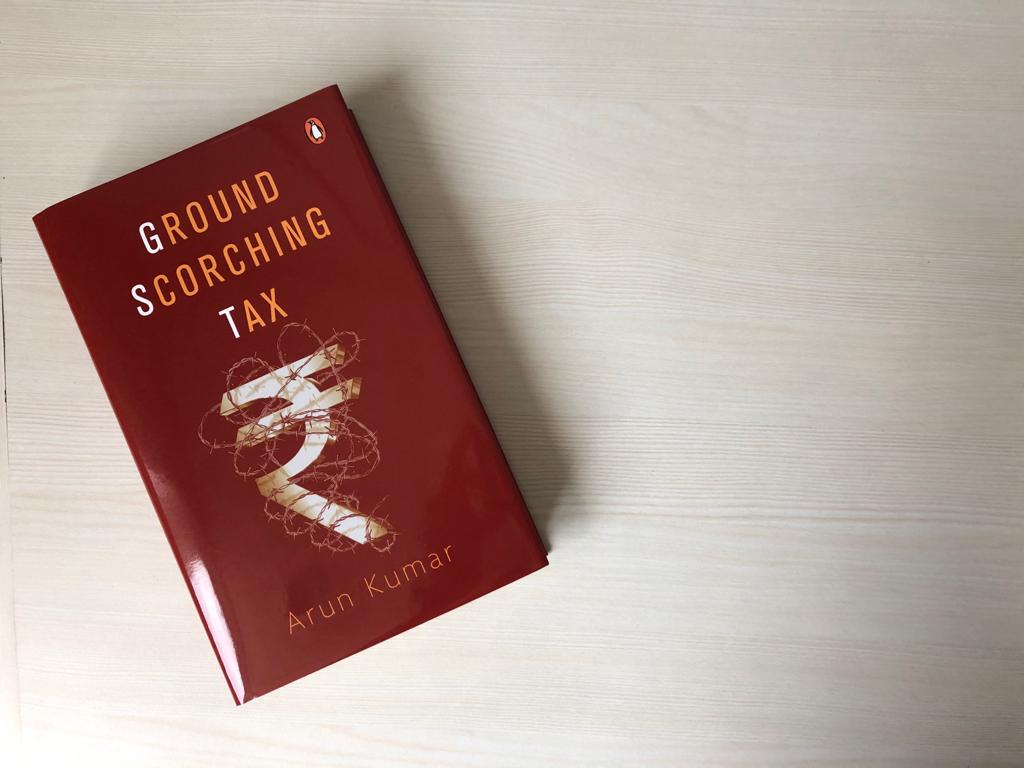
In Ground Scorching Tax, well-known economist and India’s leading expert on the black economy, Arun Kumar systematically and lucidly explains the reality behind GST, demystifying this complex tax for ordinary citizens.

Known for not pulling any punches, the author explains why GST is truly a ‘ground scorching tax’ and  a double-edged sword for the common man, why it will increase inequality across sectors and regions, why it will hurt small businesses – everything the government does not want you to know.

He also proposes an alternative which will convert this tax into a `Ground Nourishing Tax’.

Read on to learn how the common man is affected by the ‘Ground Scorching Tax’


The unorganized sector employs the vast majority of the workforce so the setback caused to this sector by the GST renders a large number of people unemployed and lowers the overall real wage rate

GST and digitization accelerate this ongoing process of marginalization of the unorganized sectors. As pointed out in the previous section, marketization marginalizes the weak in the market—it favours the large over the small businesses. While in economic terms this may seem to be ‘efficient’ with growth being fuelled by the large scale sector, it leads to growing inequality which has political and social implications. Since it is the unorganized sector that employs the vast majority of the work force, any setback to this sector leads to growing under employment and crisis in the lives of these people. With the growth of the organized sector, while wage rate may rise, employment available declines since the large and medium sectors are far more automated than the small sectors. Thus, the overall wage received by workers would fall. The purchasing power of those employed in the unorganized sectors and of workers as a whole would decline. (p. 186)

 ~

Small businesses are financially affected by not being able to receive or offer Input Tax Credit.

The concern for the small suppliers led to their being exempted from registration under GST. So, suppliers with turnover of up to Rs 20 lakh have been exempted. But they will not be able to get input credit (ITC) and if they sell to any other business they cannot offer ITC. A very big disadvantage indeed. Similarly, those with a turnover between Rs 20 lakh and Rs 1 crore will fall under the Composition Scheme and will neither get ITC nor be able to offer ITC. They would also not be able to make inter-state sales. Further, the tax that they should have paid under GST but did not pay since they are exempt will have to be paid by the business purchasing from them. This is the reverse charge mechanism (RCM). Thus, the purchasers’ cost would go up. (Pp. 103-4)

(Subsequently, due to changes announced, units with turnover up to Rs.40 lakh are exempt from registration and the limit for Composition Scheme has been raised to Rs.1.5 crore)

~

Some of the GST rates are higher than the rate they were paying under the earlier system which has increased prices and expenses for the common man

The GST rate on goods and services have been fixed close to the rate they were already paying under the old regime. So, if some good was being taxed at the rate of say, 15 per cent then it was moved largely to 18 per cent under GST. Most services were at the rate of 15 per cent and that has increased to 18 per cent. This has proved to be inflationary. (p. 104)

 ~

Since indirect taxes are applied on goods and services consumed, they affect all sections of society unlike direct taxes which are collected from those who are well off and can afford to pay it. Indirect taxes are also regressive as they typically result in the impoverished sections paying a greater proportion of their income then the well off. The overwhelming focus on GST and indirect taxes as opposed to direct taxes is antithetical to the interests of the common man.

It was argued that indirect taxes are stagflationary while direct taxes are the opposite and hence more desirable. Thus, it would have been more desirable for the nation to collect more of direct taxes than indirect taxes. In 2005, the UPA I government had also talked of the need to introduce the direct tax code (DTC) to reform direct taxes. However, little headway has been made in that direction. The emphasis has been on GST and collecting more of indirect taxes—indicating a political bias. It was also shown that indirect taxes tend to be regressive while the direct taxes can be progressive. Thus going for more collection of indirect taxes increases the regressive component of India’s tax system. It also does not put greater pressure to tackle the black economy and collect more of direct taxes. Again this benefits the elite sections of society. They can continue to earn large sums of incomes through the black economy on which they do not have to pay taxes. (p. 172)

 ~

 The local bodies have been deprived of their sources of revenue from taxation under the new regime.

As some of the important sources of revenue of local bodies (like Octroi and entertainment tax) have been absorbed in GST, they needed to be also provided with independent source of revenue. This has not happened. There is no mention of devolution to the local bodies. It is not clear whether the Centre or the states are to pass on a share of the resource. (p.190)


In Ground Scorching Tax, well-known economist Arun Kumar explains the reality behind GST.

Eight Inspirational Intrapreneurs from ‘Jugaad 3.0’

DIYer n. A disrupt-it-yourselfer; a Jugaad 3.0 innovator; an employee who acts and behaves more like an entrepreneur in the context of an established organization

Dr. Simone Ahuja – consultant, author, speaker and entrepreneur, is the CEO of Blood Orange where her mission is to empower innovators in large organizations and mobilize them with entrepreneurial tools for a single purpose: to transform the corporate culture from the inside out using design and lean principles. In Jugaad 3.0 Hacking the Corporation, she shifts the focus from ‘entrepreneurs’ to ‘intrapreneurs’, the incredible ‘corporate hackers’ who tap into and around the bureaucratic machinery surrounding them to advance their projects. Or we could call them ‘constructive disrupters’,since today’s intrapreneurs often seriously challenge existing business from product offering to business model, yet they do it actively from the inside and, by doing this, help keep the enterprise viable.

Based on hundreds of interviews, as well as the author’s consulting work within companies, Jugaad 3.0 Hacking the Corporation identifies the competencies these corporate hackers possess. It also offers a spectrum of carefully crafted archetypes to help people see themselves in this trend and allow organizations identify the innovators in their midst.

Read on to learn more about eight inspirational intrapreneurs whose passion and innovation transformed organizations from within-


Balanda Atis —As a chemist formulating mascara at L’Oréal USA, she set her sights on formulating foundations that did not look ashy on darker skins.

“Although Atis and her colleagues were not freed from doing their day jobs, L’Oréal gave the trio access to a lab. Fuelled by passion and purpose, they produced and tested foundation samples on their own time. Lacking opportunities for data collection, they tagged along on trips to existing conferences and fairs across the country, collecting skin tone measurements from thousands of women of colour. The big breakthrough came when Atis discovered they could work with an existing colour compound. Ultramarine blue was seldom used in cosmetics and difficult to work with, but it allowed them to create richer, deeper shades without the muddy finish that was so common in existing darker foundations. Atis and her tiny team succeeded in satisfying a massive customer need that had existed for generations.”


Ravi Ramaswamy— He led the innovation team behind the Efficia ECG100 an easy to use ECG after realizing that resource-constrained settings needed medical systems should not only be easy to buy but also easy to use and did not require expensive specialized training.

“The prototype exceeded everyone’s expectations. What is now a diagnostic-quality electrocardiogram started with the team’s purchase of an off-the-shelf mobile device. Any Android phone or tablet could act as the user interface after the simple installation of an app. The team’s energies went into making an ECG acquisition box that was just as compact (the finalproduct weighed fewer than ten ounces) and intuitive to use. ‘We worked on it for about six to eight months,’ Ramaswamy recalled, before asking for a meeting with Philips Healthcare’s business unit leader. After hearing the idea and trying out the prototype, the executive said: ‘This is a fantastic product. It’s going to be the pathway to the future.’ Ramaswamy reported that ‘from then on, there was no looking back. We had the complete support of the business unit in terms of driving this model.’”


TOYOTA US TEAM—They worked on the margins of Toyota’s organization to redevelop the Toyota Avalon.

“Take the wholesale redevelopment of the 2013 Toyota Avalon. Led by designers and engineers working far from the company’s Japanese headquarters, the initiative was culture defying for Toyota. When the US-based team told their story to industry analyst Mark Phelan, they stressed that they ‘worked in the margins of Toyota’s playbook, following the old adage that it’s better to beg forgiveness than permission’”


Doug Dietz—After seeing the discomfort of young children getting CT scans, he developed the GE Adventure Series—which involves turning dark, scary CT scanning tunnels into inviting storybook hideaways for young patients.

“First, it was by visiting a customer’s facility—the paediatric oncology department of a major hospital—that industrial designer Doug Dietz recognized a customer problem crying out for a better solution. He tells the story of how he had just finished working on a CT design project and thought he’d done a wonderful job. He was very proud of himself, and in 2005 he went to one of the hospitals where the equipment was being installed for the first time. But it only took an hour of observation for him to realize how reductively he had pursued his mission. The first people he watched interacting with the new machinery were a family with a young child. The child was so terrified by the machine that she needed to be sedated. Dietz had to be there to get that the key to better outcomes—including better image capture, higher machine utilization and better patient experience—was decreasing the need for sedation. It wasn’t just about making machines more capable; it was about making children—and families—more comfortable.”


Lars Kolind—His spaghetti organization at Oticon allowed employees across the board to choose projects according to their skills or as an opportunity to develop new skills, and share equal responsibility for projects.

“Going back even further to 1990, an executive named Lars Kolind arrived at the Danish company Oticon with a bold new structural idea he called ‘the spaghetti organization’. If you think about the clean boxes and lines on the traditional command and- control organization chart, and then you think about what happens to those lines in a Holacratic or Hollywood system, you see where he got his metaphor. To the great surprise of the engineers working on Oticon’s innovative hearing aids, asvwell as all its functional groups from finance to sales and from HR to PR, Kolind in one fell swoop did away with everyone’s job title and moved them all from their accustomed offices and desks too. Most important, he told them that it was up to them now to decide where their talents could be best applied. No one would be assigned to projects where they would receive topdown mandates from project bosses.”

 
Kishore Biyani—His innovative intra-organization recruitment to create more ‘Kishore Biyanis’ for leadership roles.

“In January 2016, he put the call out across his organization for applicants interested in those leadership roles. Already, this was unusual, since the recruiting did not look outside FCL’s walls: this was a campaign, called Ban Jao Biyani, run wholly within the organization. More interesting still, having received 450 applications from employees, he and his team then ‘shortlisted’ fifty applicants, and put them through a boot camp where they were ‘trained on management aspects and asked to present a business plan for the brand they had bid for’. This was, in effect, the kind of competition some organizations today host for proposed innovation projects—but in this case, it was not intrapreneurial ideas but the intrapreneurs themselves who were being chosen for further development and investment.”


SHARMILA SAHA AT Mindtree—Mindtree’s programme

‘5 X50’ chose five intrapreneurial projects, each of which was judged to have the potential to grow to $50 million in revenues. The five were carefully selected through a competitive process and the winning teams were given the full support of an incubator-style experience of mentoring and resource provision.

“A quick win from that programme was a new line of business: Mindtree’s Digital Surveillance unit, launched in 2013. The team behind it, led by Sharmila Saha, was driven by the new market demand for better public-space surveillance technology in the wake of high-impact terrorist attacks, seen on a global scale by the 11 September 2001 attacks in the United States and the Mumbai attacks of 26 November 2008. It saw that potential clients like US Homeland Security were struggling with conventional CCTV feeds, which required hours of tedious monitoring, and thought it could come up with next-generation capabilities. Prior to the 5 X 50 initiative announcement, Saha and four colleagues had been working for half a year on the concept, which features audio-video analytics and real-time updates. Winning the competition meant that Mindtree invested about $1.5 million (about Rs 9 crore) to incubate it to the point where it was ready for its first client, the Bangalore City Traffic Police.”

Babak Forutanpour—He found himself the accidental founder of a movement Qualcomm. The group acquired a name—FLUX, for ‘forward-looking user experience’.

“This is what Babak Forutanpour was up against as a software engineer at Qualcomm circa 2004. Once he was onboarded and unpacked his laptop, he realized there was no suitable place to bring a new idea to have it vetted and considered for development. ‘No one was listening, and my boss didn’t even want to brainstorm,’ he recalled. Eventually he was so desperate for a sounding board that he pulled together a ‘little biweekly luncheon’ with like-minded people outside his usual circle. ‘If nothing else,’ he figured, they could all ‘eat a ham sandwich with someone interesting’. But that initial group quickly decided to go beyond the sandwich and try to accomplish something more substantial together. In short order they came up with a cool new technical solution for reducing ambient noise. After a thorough vetting of prototypes by subject-matter experts, a patent that eventually produced real value for Qualcomm was applied for and awarded.”


For more, get a copy of Jugaad 3.0!

Eight Signs you are Taking your Partner For Granted

When in love, you tend to take each other for granted, and sometimes, that can cost you a lifetime of togetherness . . .

In the book Something I Never Told You by Shravya Bhinder, Ronnie knew that his first crush was way out of his league, and yet he pursued and wooed Adira. Shyly and from a distance in the beginning, and more persuasively later. He couldn’t believe it when the beautiful Adira actually began to reciprocate, falling in love with him for his simplicity and honesty. Slowly, as they get close and comfortable with each other, life takes on another hue. From truly magical it becomes routine.

Here are some quotes from Ronnie and Adira’s relationship that will prevent you from making the mistake they made:

“Every time we had an argument or a disagreement, or if one did not like anything about the other, she used to go silent, or respond in monosyllables, sometimes even sounds—hmmm . . . ah . . . oh . . . what kind of a response was this?”


“I have learnt only one thing in my life—that we should not stop expressing our love, ever! After some time together, we usually stop telling our beloveds how much they mean to us. We stop saying, ‘I love you’, and start taking each other for granted. The comfort of company creeps in.”


“I took you for granted, I took what was between us for granted as I never knew that all could be lost in the blink of an eye. The few times when I did tell you how much I loved you, I failed to stand by it. I should have told you more often how much you mean to me; I should have not hesitated in saying the three most significant yet sparingly used words in most modern relationships.”


“I never thought that you could go anywhere, that I could lose you. Destiny tricked me and shook my world. When in love, we should tell our beloved how we feel about them; every day, every hour if we can, every minute if we must.”


“How I wish the walls of my ego had crumbled that night and been buried under the immense love I have always felt for you. How I wish I had disobeyed the devil in me, when I planned to make you suffer remorse for one more night.”


“Yes, the mode of communication which is the best for lovers after letters and calls, is email. Not many of us explore that option, but I feel that chatting or texting doesn’t really convey our messages and tone well. I would prefer an email any day to a chat or text.”


“We were both a little broken, entirely messed up and madly in love with the idea of love. ‘Love dies when you stop working on it,’ I told her in a reassuring tone. My mind was running on an overdose of emotions.”


“If your first day with your girlfriend is the most memorable one, it means that you could never really develop the spark you had into a fire. Love is like wine—the older it gets, the better it becomes. It can intoxicate you, make you forget all your worries, and be the relief that you have always been looking for. The passion should increase day by day, hour by hour and minute by minute. People who say that the spark dies after the first few years have never been in love.”


Ronnie and Adira will probably never find their forever after . . Get your copy today to find out more!


Reel vs. Real: Adapting My Story into a Book

by Novoneel Chakraborty

One of the things which makes a reader curious about any story is how real or true it is. When authors pen stories, it is believed that they must have written it after being inspired by real-life incidents, which they have lived or seen closely. Majority of the times this assumption is true. What makes my latest novel Half Torn Hearts, an autobiographical attempt, slightly different in its approach is that I didn’t rely on any incident to make it autobiographical. I created the characters, gave them a relatable milieu and dived deep within myself only for their emotional graph, their outlook towards life and their deep character, fishing out emotions and words which were expressed by me and felt by both myself and the three women in my life. It was while penning down this novel that I realized a story becomes impersonal not only because of the plot points you use but also because somewhere the characters and their inner pathos are straight out of your real-life experiences. And, that a storyline may be fictitious but the characters may very well be real.

Half Torn Hearts has an interesting backstory. This is the only book of mine which took five years to complete. The process not only made me revisit old wounds but also convinced me that an author doesn’t tell a story. A story unfolds itself through an author. Few understand this difference. An author is a medium, not the story. For this story to be complete, it had to make me come in touch with someone who eventually became my muse, not only to finish this book but also for my overall creativity. Patience is a virtue and nobody else can understand this better than a storyteller.

In all my stories that I’ve penned so far, I’ve always fine-tuned the real-life inspirations. By fine-tuning, I mean that sometimes reality isn’t as dramatic as fiction should be. And at times, it is too over-the-top to be used in fiction sensibly. The one major limitation of fiction when compared to real life is that fiction always needs to make sense within the parameters of its self-defined logic, while reality is free of such limitations. And when one writes about something deeply personal, one needs to make sure it doesn’t hurt anyone who is involved in the real story. That’s a reason why I used the plot of this novel to hide the emotions of the characters in such a way that only those involved will be able to understand where certain things in the story are coming from. And for a normal reader, it may just read like an engaging story.

A very important aspect while penning down a personal story is editing. I’m not talking about structural- or copy-editing here. When things happen in real life, they have their own pace of events, and every event seems important. But when one sits to write, one cannot write about each and every event because, in a personal, real story, one will be invested since it’s one’s story, but for a reader, the investment happens only when things they are reading aren’t boring.

I write in the commercial fiction zone. Hence, the most important question that plagued me while writing this was what to keep and what not to. And in ‘what to keep’, there was another sub-query of ‘how much’. I follow a cardinal rule of writing: thou shall not bore thy readers, at least not knowingly. To get to this, one needs certain creative objectivity, which can’t be developed immediately. The more one writes and subsequently, the more one edits, the more one will know what really needs to remain in the final version of the manuscript and what simply needs to go. For example, in my current novel, there was a scene between the protagonists, Raisa and Nirmaan, which for the first time in the story was bringing them intimately close. When I read the manuscript for the third time, I realized that for the sake of the sanctity of the story, the scene should not be happening even though it was one of my favourite scenes in the book. Eventually, I edited it out. As they say: ‘kill your darlings’.

Lastly, I would say: telling one’s own story, in whichever way, involves a lot of responsible writing. Truth has interpretation. It also has misinterpretations as well. Hence, it has to be well-balanced. And, getting into that balance requires a lot of redrafting, personal introspection and revisiting things within oneself, things which we are done with—or maybe never done with—until the story shapes up the way we envisioned. But then, there also lies the magic of storytelling.


Half Torn Hearts is a coming-of-age tale of three layered individuals coming in terms with their first loss.

Novoneel Chakraborty is the bestselling author of many romantic thriller novels and one short story collection, Cheaters. Known for his twists, dark plots and strong female protagonists, he is also called the Sidney Sheldon of India by his readers. Apart from novels, Novoneel has written and developed several TV shows such as Savdhaan India and Yeh Hai Aashiqui.

From the Editor’s Desk: Women Writing for you

by Manasi Subramaniam

MARCH | #ReadMoreWomen

This March, we were excited to be partnering with SheThePeople to curate the Women’s Library, which is an exceptional shelf of books – all of which just happen to be written by women! But as we planned the promotions, I started to realize what an extraordinary range we have in our fiction backlists as well – and I wanted to use this opportunity to bring to your attention some writers and books that we’d love to see you revisit – or even discover for the first time.

So here’s a challenge. Let’s try making a conscious effort to read more women. What a conscious effort to read more women does is redouble any unconscious efforts: it holds us to our commitments, it diversifies our reading, and brings the reader’s attention to books that may have – consciously or unconsciously – slipped through the cracks.

Below are my picks of women’s writing that I’d love for you to read

Shashi Deshpande’s That Long Silence is about Jaya, a failed writer who has identified herself as a daughter, a wife, and a mother for seventeen years. When her husband is accused of business malpractice and his career starts falling apart, Jaya finds herself confronting deeply buried fears, especially her fear of anger. Deshpande’s second novel is about the Indian woman who is taught to suppress her voice, long before she takes her husband’s name.

Other books by the author: The Dark Holds No Terrors, Moving On.

Winner of the 1999 Commonwealth Writers Prize for Best First Book (Europe and South Asia), Manju Kapur’s Difficult Daughters is set in Amritsar around the time of Partition. The protagonist is an independent young woman named Virmati, who wants something more than marriage from her life, but her desire for education lands her in an affair with a married professor. When the professor marries Virmati and brings her home, Virmati finds herself in an ironic situation—the choice she made to be free now imprisons her.

Other books by the author: Brothers, The Immigrant.

Taslima Nasrin’s Lajja was met with radical backlash in her home country of Bangladesh. Since 1994, Nasrin has been in exile but her controversial novel received worldwide acclaim. Lajja is about the Duttas, a Hindu family living in Bangladesh. Sudhamoy, the patriarch of the family is unfazed by rising radical sentiments against the Hindu minority in his country. On 6 December 1992 the Babri Masjid in Ayodhya is demolished, and Sudhamoy’s life takes a drastic turn.
Other books by the author: Exile, Split.

Described as The Virgin Suicides meets Little Women in Pakistan, This Wide Night is Sarvat Hasin’s debut work about four sisters in the progressive and inclusive era of 70s Karachi. Maria, Ayesha, Leila and Beena live with their mother. Their father, Captain Malik, is barely in the house, which encourages the women to create their own unconventional world. The sisters are forced to confront challenges when their country goes to war.

Other books by the author: You Can’t Go Home Again.

Hedonism and political turmoil serve as the background to Nadia Akbar’s Goodbye Freddie Mercury a novel set in contemporary Lahore. Nida seeks to escape her claustrophobic house after her brother dies in the army. Omer is the son of the Prime Minister’s right-hand man, Iftikhar Ali. Omer’s childhood friend is Bugsy, a Freddie Mercury fan who works as a radio jockey and has feelings for Nida, Omer’s girlfriend. While living their life from one drug-fuelled night to another, the three friends soon become a part of a larger, political agenda.

I’m excited to hear what you’ve been reading as well – and if you have suggestions for our women’s library!


Until next month,

Manasi Subramaniam


Photo by Patrick Fore 

Matching The Bhagwaan To The Pakwaan : A Taste of ‘Bhagwaan Ke Pakwaan’

The rice beer bellies of a Christian village in Meghalaya; food fed to departed Zoroastrian souls; a Kolkata-based Jewish community in decline; Tibetan monks who first serve Preta, the hungry ghost; and fifty-six-course feasts of the Jagannath temple-these are the stories in Bhagwan Ke Pakwaan (or, food of the gods), a cookbook-cum-travelogue exploring the connection between food and faith through the communities of India.

Here are some soul-stirring delicacies from the book that explore diverse faiths and unite us with God:

Rongmesek, Meghalaya 

Rice beer is the one true food of the gods…To the Karbi people, rice beer is the fuel that refreshes you with the sweet buzz of life.

Udvada, Gujarat 

 Papra and Bakhra are two of the religious dishes that are made specifically for the Stum ceremony in the death rituals. For us still living, they make great snacks.

Spiti, Himachal Pradesh 

No trip to Kye Gompa would be complete without the breakfast combination of Butter Tea (also known as ‘gur gur chai’ due to the sound it makes when churned) and Puk. There also might not be a more divisive dish than Butter Tea if your idea of tea conflicts with one that is buttery and salty. Very buttery and salty.


There are legends and lore, angsty perspectives, tangential anecdotes, a couple of life lessons and a whole lot of food. Get your copy today!

Meet the Author of ‘The Beauty of the Moment’

Tanaz Bhathena’s The Beauty of the Moment is the story of Susan and Malcolm, and how despite being so different from one another they find themselves irrevocably in love with each other. Despite her parents’ impending divorce Susan is sincere and is driven towards making her parents proud. On the other hand, ever since his mother passed away Malcolm has had a reputation of being troublemaker and a bad boy. His adulterous father contributes further into making his life a mess.

Despite their respective burdens, Susan and Malcolm fall for each other. They confide their dreams and aspirations in each other. Read this book to know more about their unbreakable bond that shows the importance of being true to oneself.

Here we tell you a few interesting things about the author:


Even though Tanaz Bhathena was born in Mumbai, she spent her childhood in many different places like Riyadh, Jeddah and Toronto.

~

Tanaz Bhathena has also authored the young-adult novel A Girl Like That, which was nominated for the 2019 OLA White Pine award and was also name Best Book of 2018 by The Globe and Mail, CBC, Quill & Quire, Seventeen, PopSugar, and The Times of India. 

~

Tanaz Bhathena is fond of travelling, learning bits of foreign languages and taking photographs.

~

Many of Tanaz Bhathena’s short stories have been featured in various journals such as Blackbird, Witness and Room.

~

As a child, Tanaz Bhathena was an avid reader and began writing at the age of eight. By the the time she was thirteen-years-old, she had made up her mind to be a writer.

~

One of the reasons for Tanaz Bhathena to start writing was that she wanted more people like her – Bhathena belongs to the Parsi community – featured in literature, making the readers aware of the South Asian identity and the diaspora in world literature.

~

Tanaz Bhathena currently lives in the Toronto area with her family.


Love is messy and families are messier, but in spite of their burdens, Susan and Malcolm fall for each other. The ways they drift apart and come back together are the picture of being true to oneself. Grab your copy of The Beauty of the Moment now!

Eight Steps to Hacking your Corporation with Jugaad 3.0

Dr. Simone Ahuja – consultant, author, speaker and entrepreneur, is the CEO of Blood Orange where her mission is to empower innovators in large organizations and mobilize them with entrepreneurial tools for a single purpose: to transform the corporate culture from the inside out using design and lean principles. In Jugaad 3.0 Hacking the Corporation, she shifts the focus from ‘entrepreneurs’ to ‘intrapreneurs’, the incredible ‘corporate hackers’ who tap into and around the bureaucratic machinery surrounding them to advance their projects. Or we could call them ‘constructive disrupters’, since today’s intrapreneurs often seriously challenge existing business from product offering to business model, yet they do it actively from the inside and, by doing this, help keep the enterprise viable.

Based on hundreds of interviews, as well as the author’s consulting work within companies, Jugaad 3.0 Hacking the Corporation identifies the competencies these corporate hackers possess. It also offers a spectrum of carefully crafted archetypes to help people see themselves in this trend and allow organizations identify the innovators in their midst.

Read on to find out how to ‘hack’ your corporation from within itself with these eight essential principles

Keep It Frugal

Intrapreneurs actively solve problems and seek opportunities, relying on pre-existing elements and recombining resources for novel uses.

What organizations need now are the right tools and a ready mindset to innovate from within. The Jugaad 3.0 agenda items that follow directly support my main message: deep-six the deep pockets. Simple tools, small budgets and human ingenuity can deliver impressive results, including maximum agility with fewer ‘business as usual’ strings attached. Knowing that nothing innovative

is ever truly linear (or one size fits all), consider these to be á la carte strategies for keeping it frugal:

  1. Remain Asset-Based
  2. Keep It Simple
  3. Encourage Frugal Experiments
  4. Focus on Teams
  5. Rethink Incentives

~

Make It Permissionless

Lets leaders provide support without crushing the creativity and potential of upstart intrapreneurs. Companies need a culture of permissionless innovation a innovation isn’t something that you should be asking approval for.

Making intrapreneurship sustainable requires creating a permission-lite environment for intrapreneurs. It’s autonomy with guardrails. The goal is to establish a network of support rather than a system of tight control by leaders. This ‘support, don’t control’ mantra reinforces frugal funding and has two additional benefits. First, it is an easy fit for intrapreneurs, who want a safe space to pursue new ideas and side projects. Second, it doesn’t oblige large companies and their leaders to bend over backward to manage and measure early-stage projects. Here are the plays that put permissionless to work:

  1. Support, Don’t Control
  2. Say ‘Yes’ More Often
  3. Add Light Structure

 ~

Let Customers Lead

Even though being ‘customer-led’ might sound obvious, it isn’t put into practice by many would-be innovators. Rather than sitting in an ivory tower and thinking about what the customer needs, ask the customer what they want. Look at how the customer is using your product.

Organizations that allow intrapreneurs to take their cues from customers create an instant advantageand avoid many of the barriers that derail internal innovation. These are the plays that I have seen work best in industries and environments across the board:

  1. Create Leading-Edge Customer Focus
  2. Hack Better Access to Customers
  3. Turn Customers into Innovation Partners
  4. Make Intrapreneurship a Sales Priority

~

Keep It Fluid

Since fluid team formation does not happen naturally in most organizations, companies need light structures to enable new levels of information sharing, networking and mobility across their talent pools.

Fluidity delivers more control and autonomy to individual intrapreneurs and small groups, and less to the management layers above them. This tricky little paradigm switch packs a positive punch that promises to increase innovation if managed properly. The trouble is that the type of organizational structure that enables fluidity is less rigid than we are accustomed to today. Just as everything digital tears down existing walls, we need to eliminate artificial, outdated boundaries and allow intrapreneurs some latitude to selfdirect, self-manage and self-organize. Here’s a look at how

to make it work:

  1. Create a Team of Teams
  2. Make Management Fluid
  3. Support Agility Through Structure

 ~

Maximize Return on Intelligence

‘Return on intelligence’ is a reformulation of ROI that puts the short term emphasis on intellectual rather than financial gains.

Intrapreneurs rely on constant learning in an open, agile environment where the culture can balance structure with autonomy and metrics with flexibility as part of these J3.0 principles:

  1. When in Doubt, Test It Out
  2. Make Learning a Priority
  3. Measure Return on Intelligence
  4. Make Failure Feasible

 ~

Create the Commons

The corporation should create ‘the commons’, or a space where information is openly shared, for the whole development community,  involving many more types of people and thinking.


The idea that intrapreneurship should be open and inclusive should not surprise anyone. Still, we are left with the question of how to achieve that goal. My approach throughout this book has been to hold up principles to help you create your own J3.0 playbook. That approach reflects the realities that (a) best practices are forever changing, and (b) the ‘best’ answers will, in any case, never come down to cookie-cutter solutions but will be customized to particular settings. With that in mind, start your playbook with these field-tested, flexible ideas for inclusive intrapreneurship:

  1. Plan for Full Inclusion
  2. Make It Safe to Innovate
  3. Use Technology in Appropriate Measure
  4. Train Future Intrapreneurs
  5. Create Porous Networks

~

Engage Passion and Purpose

Passion is what motivates intrapreneurs to keep going when the work seems thankless or when seemingly insurmountable challenges arise.


Recognizing the passion and purpose parts of intrapreneurship allows companies to think more broadly about how to match their people with the problems they care most about. For employees, having the opportunity to work on passion projects creates greater engagement. For companies, it makes the most of creativity and ingenuity. Here’s how to put this win-win dynamic to work in a Jugaad 3.0 way:

  1. Make Purpose Programmatic
  2. Leverage Passion That Bubbles Up
  3. Push Passion Viral

~

Add Discipline to Disruption

There should be a full spectrum of innovation options for intrapreneurs in any organization, from eye-popping, potentially disruptive innovations to clever little hacks on existing solutions. They are all valid, and companies can create disciplined systems by thinking through three streams of innovation.

 The J3.0 approach requires structure and discipline in the right measure in order to extract the most value from each stream of innovation and install metrics that guide and measure success

without losing the learning or limiting the idea. The prescriptive plays look like this:

  1. Develop Multiple Streams of Innovation
  2. Create a Culture That Enables Hybridity
  3. Manage Disruption with Discipline

Jugaad 3.0: Hacking the Corporation will prove that every organization’s best chance, to survive and become better than ever, lies within itself.

error: Content is protected !!