Publish with Us

Follow Penguin

Follow Penguinsters

Follow Penguin Swadesh

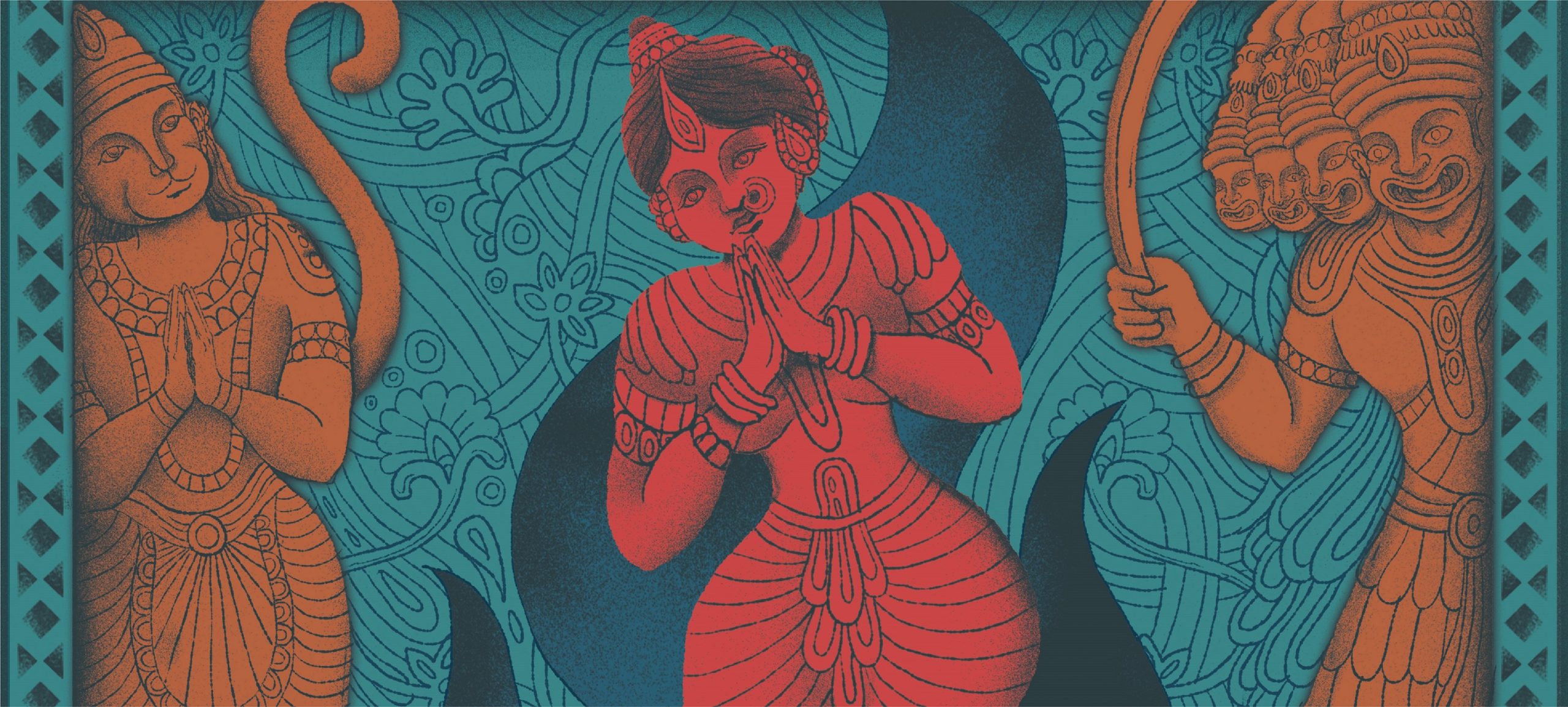
What if the Characters in the Ramayana could tell you their own Stories?

Countless retellings, translations, and reworkings of the Ramayana’s captivating story exist-but none are as vivid, ingenious and powerful as Amit Majmudar’s Sitayana. Majmudar tells the story of one of the world’s most popular epics through multiple perspectives, presented in rapid sequence-from Hanuman and Ravana, down to even the squirrel helping Rama’s army build the bridge, and the medicinal herb Sanjeevani.

Read on to hear from six unusual voices in the Sitayana

 Sita

The daughter of Janaka, the girl who played horsey with Shiva’s own Bow. Daughter of the Earth, found in a furrow. Her fear response never developed properly. That Indian princess-in-exile. Resilient.

“‘You know what the poets call Agni, don’t you? They always refer to it by epithets: “Purifier” and “Bearer Away”. It’s really the same epithet. What the fire “bears away” are impurities. That’s why goldsmiths use fire to test gold. When Agni encounters you, Sita, what can he get a hold of? What can he carry off? He can’t purify what’s purer than he is. You don’t burn, my love, because the Fire finds nothing to burn away”


Hanuman

Vanara. Half wind on his father’s side. No one size or strength by nature. A most metaphysical monkey.


Vibhishana

God’s spy in Ravana’s court. Saboteur in waiting. Brahmin-Rakshasa hybrid. Least monster and most priest. Has an ‘unnatural proclivity for poetry.’

“It was never this way when I was a boy and my stepbrother Kubera was king. He used that aerial chariot to survey the streets for litter each morning, and come nightfall, he patrolled personally for window vandals. Lanka was a much smaller city then, and its epithet ‘golden’ came from the purity of its coinage, not its building materials. Today, our dominant trait is cruelty.”


Indrajit

Firstborn son of Ravana and Queen Mandodari. Formerly known as Meghnad. Warrior who defeated Indra. Next in line for the throne of Lanka.

“Imagine if I’d been one of only four or five sons, coddled and praised and known by name—what an underachiever I would be today! Instead of someone who defeated Indra, chief of the Gods, in one on-one combat. I would still be ‘Meghnad’, which was my birth name, instead of Indrajit. My father gave me that name after I got home from the battle, my head bandaged, my armour so dented it looked like foil crumpled and flattened back out.”


Ravana

Half demon-half Rakshasa hybrid. The ten-headed one—the long-nosed philosopher, the one-eyed soldier, the wavy-maned lover, the square-jawed alpha, the messy-haired poet, the shifty-eyed gambler, the moustached actor, and the thin-lipped sociopath.

“If you think my ten heads are evil, wait till you see what’s coming—the thousand-headed bureaucracies of murder and the murderous million-armed street mobs. What are you trying to accomplish, with all your milquetoast goodness? The age of pious sons and faithful husbands is over. The future is one long dark age until the dancing Ascetic stomps it all flat in his sphere of fire.”


Mandodari

First Queen of Lanka. Ageing wife. Mother of Indrajit and Akshaye. Has pride of place in the household, but is humiliated in her absence by mistress after mistress.

“He will show me his true form again and love me with it. He will be once again what he always was. Temporarily eternally mine.”


Sanjeevani

Green medicinal herb, seven fronds—small pods. All green. Was as common as grass a yuga ago. Now only found on Mount Rishab.

“‘I’m sorry,’ said Vishnu to us plants, ‘but all those several eloquent tongues of yours, always gossiping and poetizing, are going to go still and limp. They’ll be called petals and leaves from now on, and that is that. If the world is getting nastier for the human beings and the animals they’re going to start eating soon, it’s only fair I inflict something on you, too.’”


Countless retellings, translations, and reworkings of the Ramayana’s captivating story exist-but none are as vivid, ingenious and powerful as Amit Majmudar’s Sitayana.

Ustad Ghulam Mustafa Khan’s 10 Favourite Songs

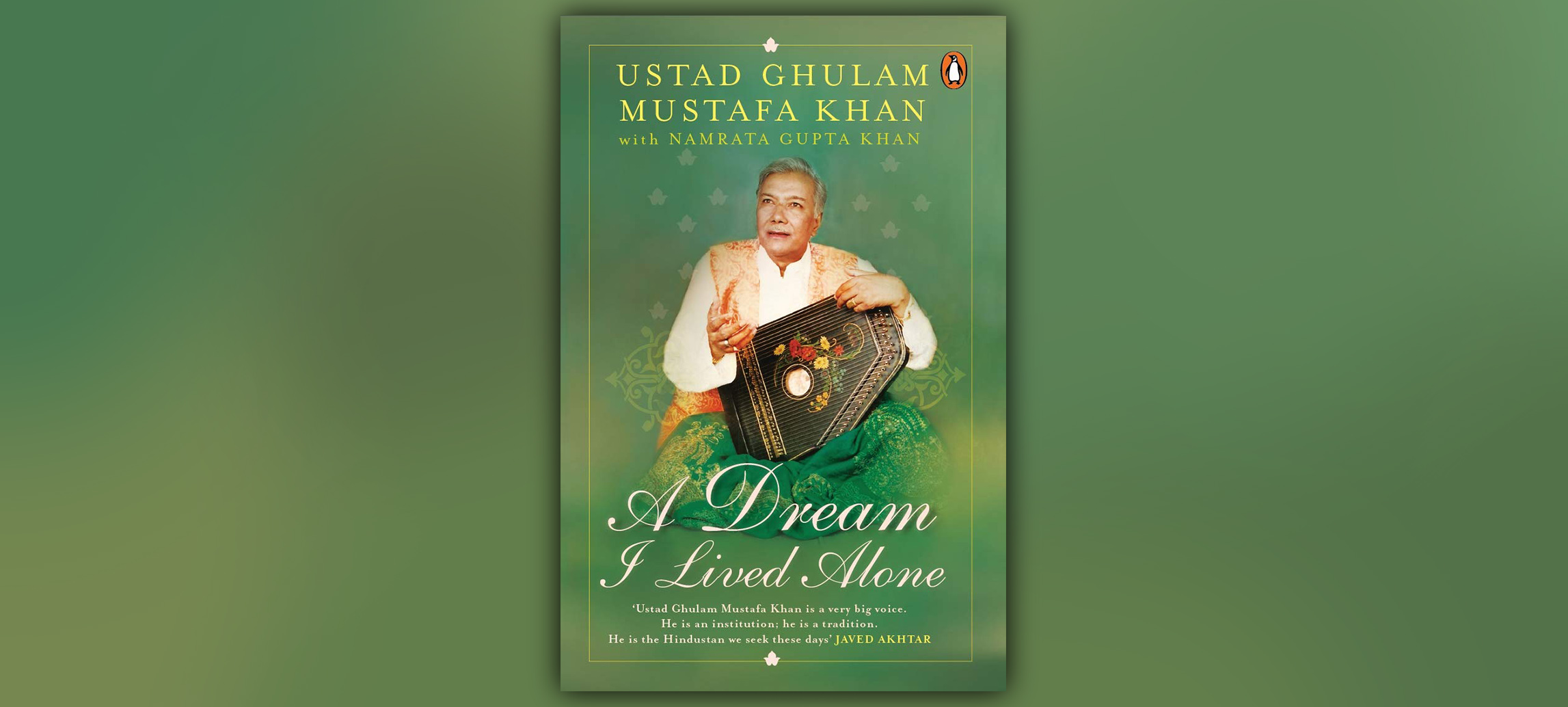
Ustad Ghulam Mustafa Khan is a traditional Hindustani classical vocalist belonging to the illustrious Rampur Sahaswan Gharana, which owes allegiance to the seniya tradition.

Performing since he was eight years old, his career spans over a period of seventy-five years. He has always believed in giving back to the society, be it by identifying and nurturing some of the best musicians in India or mesmerizing the nation through music.

Here is a list of his favourite songs.

Aj hun aaye baalma saawan beeta jaaye by Mohammad Rafi

~

Saathi re bhool na jaana mera pyar by Ravindra Jain Asha Bhosle

~

Yaad piya ki aaye  by Bade Ghulam Ali Khan

~

Piya Haji Ali by A. R. Rahman

~

Jhula Kinne daala re by Shahida Khan

~

Abhi mujh mein kahin by Sonu Nigam

~

Tu hi re by Hariharan and Kavita Krishnamurthy

~

Behti Hawa sa tha woh by  Shaan, Shantanu Moitra

~

Ka karu sajni aaye na baalam by K. J. Yesudas


A Dream I Lived Alone is a heart-warming story of love, riyaz, dedication and the maestro of music, Ustad Ghulam Mustafa Khan.

How Pole-Vaulting Can Help Energy, Environment and Employment Problems in India

An exhilarating manifesto for the future, Leapfrogging to Pole-vaulting by Dr. R.A. Mashelkar and Mr. Ravi Pandit convinces readers to make the shift from reactive leapfrogging to proactive pole-vaulting through radical transformation.

Here are a few pole-vaulting ideas which pose as an example for further development with challenges relating to energy, environment and employment – the 3Es, in India:

One of the most important aspect of pole-vaulting is to not better a sector in order to compete but to genuinely feel the need to develop the sector for a better future. One of the example for this is the White Revolution in India which ended up providing better means of earning for small farmers and milk producers. As in the formation of AMUL where technological improvements of storing and increasing the milk production also played an important role, India needs more of such efficient initiatives in order to generate an all-round development.

With the advent of new-age technological developments today’s common man has come a long way to living a better life as compared to that experienced by the Kings and Queens of the olden days. One such example is the establishment of Uber in India. It has resulted in creating more job opportunities. Such innovative ideas not only help with significant decrease in the fuel consumption per capita but also help in reducing the impact of vehicular pollution on the environment.

One of the main reasons for air-borne health problem in rural India is due to the domestic burning of biomass for cooking purposes in such areas. However, the introduction of electricity on these areas has essentially followed a decrease in kerosene and the polluting biomass-fuel consumption. Thus, the replacement of such methods with clean energy resources could further reduce the risk of high pollution levels in the country.

There is a dire need of alternate sources of clean energy in India. The government could be a great tool in influencing a boosting an innovative and an energy efficient idea. A good example of this is India’s Unnat Jyoti by Affordable LEDs for All (UJALA). While it was a market-driven initiative, the valuable support from the government has lead it to result in reduced carbon emissions and brought in an increased investment in the manufacturing of LED bulbs, thereby resulting in a growth in employment rates.


Dr. Mashelkar and Mr. Pandit ably show in this must-read book that, as an interplay of global issues constantly raise the bar for innovation today, there has never been a better time to use our learnings to pole-vault over those bars into a new future!


Know About A Sting-Op Through The Eyes Of Bhupen Patel

Bhupen Patel in his book, The Anatomy of a Sting allows readers a glimpse into the exciting life of an investigative journalist through these narrative accounts. He has exposed a number of unethical activities during the course of his career, including mental asylums admitting patients without paperwork and investigations as well as illegal agents who provide Arab men with “temporary” wives. In this book, he reveals the process of and the efforts behind the scenes of various discreet investigations.

Here we give you a glimpse into one of the intriguing cases cracked by Bhupen Patel –


“To us, a sting operation is nothing less than a police investigation. The difference is that reporters learn on the job without any specific training. Also, we rarely have backup and definitely don’t have arms for self-defence. I decided to do some groundwork first and stepped out to check if the address provided in the classified ad was legitimate. Since I would be accompanied by a female colleague and it would just be the two of us, it was important to have an idea of the surroundings, the number of people there and the escape routes. I visited the office of Saathi Film International, located on the mezzanine floor of one of the industrial units of Anis Compound on the Andheri–Ghatkopar Link Road, a hub of small-scale industries in Mumbai. The ground floor had a few auto garages and spare parts shops. I was not surprised that the office did not have any nameplates or boards. From the dust on the shutters, it looked as though the premises had been shut for over a month. Apart from the door, a window was the only escape route from that small office.

I made inquiries with the staff of some of the shops in the locality but no one had a clue about the production house. A few things seemed clear to me—the company had hired the office just a few days ago and seemed highly suspect. It was unlikely that they would rent an office in this area, which didn’t have the remotest ties with Bollywood. Without any assistance or support from authorities, I wasn’t sure if the story was worth following up. But when I reported back to office, I realized I had to give it a shot.

The Virtual Spy

Once we decided to go ahead with the story, the next important decision was to pick our third and most important partner: the hidden camera. Back then, spy cameras were relatively new, unlike now when the city’s electronic stores on Lamington Road/DB Marg have a whole range at various prices. One can buy spy cameras for Rs 1500–2000, hidden in buttons, spectacles, watches, ties, etc. The ‘Made in China’ cameras can easily pull off three or four assignments without any glitches. But ten years ago, there was very little choice.

The products available were of inferior quality, and the better cameras had a lot of wiring and were tough to carry on your person. I was reminded of a senior reporter friend’s experience. He had been on a sting operation about bribes taken by policemen, and just when his assignment was about to end, his camera had betrayed him. He put his hand in

his pocket to remove cash but unfortunately unplugged the wires from the batteries, which popped out from his shirt. Since spy cameras were not as popular then, luckily for him, the officer bought his theory that he had unplugged the batteries of his hearing machine. I had to make sure I didn’t repeat this mistake.

The Pre-Production

 As a team, it was important for Ruhi and me to be on the same page. All our research was in place but we had to be prepared for the worst. It was important that we discussed the characters we were about to play—the names, backgrounds, families, experiences, qualifications, likes and dislikes, all of it. We decided that Ruhi would pose as a newcomer who had come to Mumbai to try her luck in the film industry. I became the friend who would accompany her to various casting agencies. We fixed the camera in Ruhi’s bag and I decided to wear a watch camera as a backup. We decided to meet somewhere close to the office of Saathi Film International the next morning.

Acting Begins

Location: Office of Saathi Film International

Posing as Ruhi Ahmed, who had dreamed of becoming the next Madhuri Dixit, and Bhupen Shah, her companion, we called on the office of Saathi Film International.We reached at noon, as decided. After going over the details once more, we tried to call the office number listed in the ad but it was temporarily out of service. So we decided to just knock on the door. We were welcomed by the strong stench of gutkha into a small room that had been divided into two, the walls of which were stained red with the constant spitting. I don’t know how Bollywood’s jhakaas man Anil Kapoor and ‘Aakhri Pasta’ Chunky Pandey continued to smile in the posters on the walls in that grimy room. The small space had a wooden table, four plastic chairs for visitors and a wooden shelf with the idols of Hindu gods and goddesses and lit incense sticks. We tried to sit close to the idols, not to pray for a successful sting or our safety, but for some relief from the unbearable odour in the room.

Two men were sitting on revolving chairs, with posters of many struggling actors around them. They were presented to us as big names in the industry, though both of us, as knowledgeable Bollywood buffs, had never seen them. But we played along and admired how they were transforming dreams into reality. I must credit them for their honesty of taking no credit for the career and success of the only two well-known faces on their wall, Anil Kapoor and Chunky Pandey. However, they did mention that they knew the two very well. Trying to come to the point, Ruhi asked them about the advertisement in the newspaper. Brandishing a broad smile, one of them said, ‘Maiiidumb, pahile intra-ducsun to kijiye’ (Madam, first introduce yourself). As per the plan we gave our fake ‘intra-ducsun’ to the man who identified himself as Mahesh Pancholi and his partner as Salim Sheikh. Since we were lying ourselves, we obviously doubted the credibility of their identities.They boasted about how the advertisement had got a tremendous response, which was clearly a false claim, especially with a defunct phone. Moreover, there was not a soul except for us. They went on to claim that after auditioning a series of actors, they had almost made up their minds to sign on two actors who they identified as Prashant Navle and Vaishali Patel. They were both experienced artists who had already done a couple of low-budget movies in the past. ‘Woh toh dedh lakh rupaya bhi de rahe hain phillam keliye,’ (they were even giving Rs 1.5 lakh for the film), boasted Pancholi. We pretended to be immensely disappointed and almost got up from our seats when he held my hand and said, ‘Sad mat hoiye, kuch karte hain. Phillam mein do lead chahiye . . . doosra jodi ab bhi bacha hai’”


Each account in The Anatomy of a Sting will keep you on the edge of your seat and allow a glimpse into the life of an investigative journalist.

Five Stories From ‘If You See Me, Don’t Say Hi’ That Will Get You Thinking

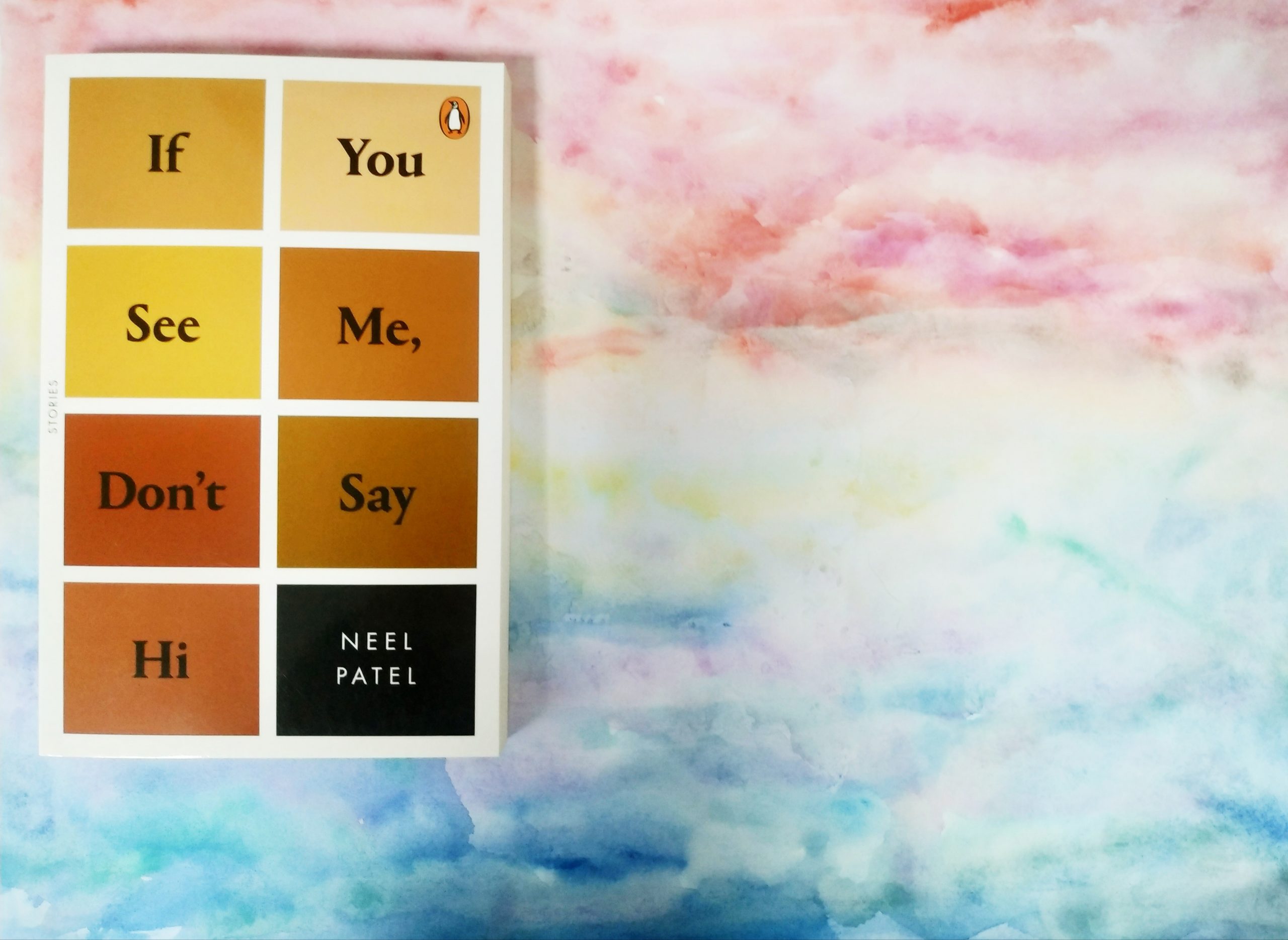
In eleven sharp, surprising stories, Neel Patel gives voice to our most deeply held stereotypes and then slowly undermines them. His characters, almost all of whom are first-generation Indian Americans, subvert our expectations that they will sit quietly by. Ranging across the country, Patel’s stories-empathetic, provocative, twisting, and wryly funny-introduce a bold new literary voice, one that feels timelier than ever.

Here are some evocative lines from the book that will make you want to read more!


If You See Me, Don’t Say Hi examines the collisions of old world and new world, small town and big city, traditional beliefs (like arranged marriages) and modern rituals (like Facebook stalking).


15 Things You Didn’t Know About ‘The Tata Group’

Tata. A name synonymous with Indian industry. A name known to Indians for generations. A name acknowledged for adventure and achievement, excellence and ethics, innovation and integrity, perseverance and performance, reformation and responsibility, struggle and success. A name known for salt, software, cars, communications, perfumes, pesticides, tea, trucks, housing, hospitality, steel and gold. A name that greets every other Indian every single day.

Here are a few surprising facts about Tata Group.


1. By 2018, every single day, 4.5-crore cups of Tetley tea were consumed across the globe, making Tata Global Beverages the world’s second largest tea company.

2. Established in 1868, it is India’s largest conglomerate, with products and services in over 150 countries, and operations in 100 countries across six continents.

3. With nearly 700,000 employees, it is India’s third largest employer after the Indian railways and defence forces.

4. Acknowledged as the founder of the Tata Group, Jamsetji is often referred to as the ‘father of Indian industry’.

5. The Tata Group has over 100 operating companies of which twenty-nine are publicly listed in India.

6. The Tata group has also been a significant contributor to India’s growth story. In 2018, it contributed about 4 per cent to the country’s GDP and paid 2.24 per cent of the total taxation in India, amounting to a whopping ₹47,195 crore—the highest by any corporate group.

7. An important component of the Tatas’ commitment to society and sustainability was employee volunteering, christened as Tata Engage. F In the first four years, over 150,000 volunteers participated from across Tata companies. The Pro-Engage Project gave options to employees to mentor and coach non-profits to build and sustain their capacity for up to six months mainly during weekends,holidays and after-work hours.

8. In 1945, when management as a discipline was not fully developed even in Western countries, the Tatas set up Tata Industries—the first technocratic structure in Indian business.

9. In late-1880s, when there was no electricity in India, Empress Mills – Tatas’ flagship textile company, was providing healthy work environment in its factories through installation of humidifying systems and dust-removing apparatus to protect the health of his employees and machinery; along with provident fund, gratuity and accident compensation schemes, when they were unheard of in India, and several parts of the world.

10. Sir Dorabji Tata (second Chairman of Tata Sons and son of Jamsetji Tata) provided cheap and clean energy to Mumbai through hydro-electric power generation in 1910 under the Tata Hydro Electric Company (now Tata Power), a century before the term ‘clean energy’ first became popular.

11. In 1952, Tatas started the Lakme brand of cosmetics as an outcome of a request from Prime Minister Jawaharlal Nehru’s Office.

12. In 1974, when the Chota Nagpur region had become the epicenter of the smallpox epidemic, the World Health Organization (WHO), requested the collaboration of Tata Steel. The company obliged with resources and manpower. In six months, 20,500 villages and 82 towns were inoculated. By 1975, India was declared free of smallpox, for the first time in history.

13. In 1981, Tata Chemicals became one of the first companies in India to provide employee stock options.

14. Employees were even offered loans on lenient terms to buy debentures, along with special assistance of external agencies, who provided them with investor education.

15. In the 25 years after India’s economic liberalization, the Tata companies have created more wealth for shareholders than large conglomerates in India like Reliance and Aditya Birla and similar conglomerates in other countries including Siemens, Mitsubishi, GE and Berkshire Hathaway.


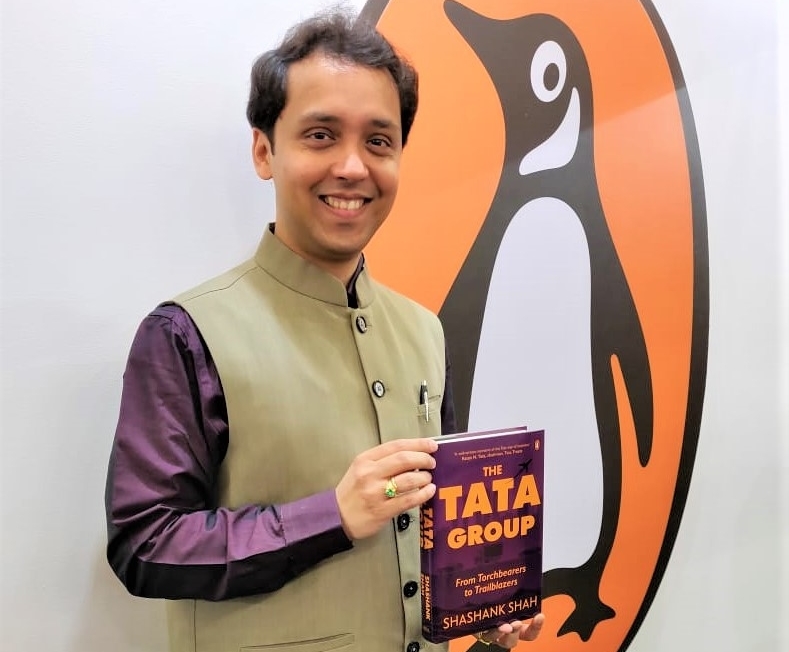
 The Tata Group  decodes the Tata way of business, making it an exceptional blend of a business biography and management classic.



5 Cases from ‘The Anatomy of a Sting’ that Will Leave You Shocked

Bhupen Patel’s book The Anatomy of a Sting sheds light upon various types of rackets, from mental asylums admitting patients without proper medical examinations to the extent of uncovering scandals such as, an illegal network network of agents that arrange ‘temporary’ wives for Arab men. Bhupen Patel has led many undercover operations in the course of his career.

Here are a few accounts as told by the author himself which will leave you stunned!


In December 2006, while working for Mumbai Mirror, Bhupen Patel was given the task of investigating a case of a possible scam of a fake audition where aspiring actors were being robbed of their money. Patel, with the help of a female partner went to the location of the audition with spy cameras and later, wrote a detailed report about the shocking scam such small-time crooks pull to rob innocent people of their money.

In the wake of the the 2003 blasts in Mumbai, Bhupen Patel, who was then working for the Mid-Day, decided to go to Dubai to further investigate the case, as the convicts responsible for the blasts hailed from Dubai and were recruited by a group there. Staying at the same hotel where the convict Mohammad Hanif Ansari used to work as an electrician, Patel began his investigation by asking around the hotel regarding details about the Mohammad Hanif Ansari. Patel was however, arrested by the police in Dubai and later released after an inquiry which was carried out against him. Son after, he returned home with valuable background information about Hanif Ansari. 

During late 2014, Bhupen Patel was asked to investigate the increasing number of cases regarding new-born children getting stolen from hospitals and kids being kidnapped in Mumbai. After a thorough plan of carrying out a sting operation where Patel and his colleague would pose as a couple who are desperate to adopt a baby, he was successful in uncovering the truth behind such disappearances. His article exposed the underbelly of various hospitals and orphanages which aide in conducting such rackets where children are sold to childless couples with an easier way around the adoption process.


While investigating the ugly underside of the film industry, Bhupen Patel ended up exposing the reality of aspiring actresses who have to suffer at the hands of insincere casting agents. Posing as a budding producer and his friend pretending to be a director, Patel unraveled how girls from small towns aspiring to make it big in the film-industry have to ‘compromise’ and are taken advantage of by casting agents with the promise of casting them in their films.


Cyber crimes had been on the rise in the late 1990s when an increasing cases of hacking were filed giving way to the establishment of a cyber crime cell by the police. In a bid to dig deeper into the cyber-crime of hacking, Bhupen Patel single-handedly managed to find out the hacker responsible for hacking the Mumbai police website.


Each account from The Anatomy of a Sting will keep you on the edge of your seat and allow a glimpse into the life of an investigative journalist.


An Interview With Christopher Paolini

Christopher Paolini’s love of fantasy and the natural beauty that surrounds his home in Montana inspired him to begin writing the Inheritance Cycle at fifteen. He became a number one bestselling author at nineteen and spent the next decade immersed in the world of Alagaësia.

Here is an interview with him, where he talks about his new book, The Fork, The Witch and The Worm.


Q: Bring us back to Alagaësia. How did you create such a fantastical world? If you had to describe it in five words, what would they be? 

A: The world of Alagaësia came about as my attempt to pay tribute to all the wonderful fantasy novels that I loved growing up. That and trying to answer, as honestly as possible, all the questions that arose when I first imagined a young man finding a dragon egg. The five words I’d choose are: epic, personal, transformative, draconic, and numinous. Also curious, because—like Eragon himself—I am filled with an inexhaustible font of questions.

Q: How did the idea for The Fork, the Witch, and the Worm originate? What was your inspiration? Was there a particular event, circumstance, or something else that spurred it?

A: This was an unplanned book. A bit over two years ago, I saw a rather bad movie, and discussing the failings of the plot with my sister led to me write “The Worm of Kulkaras.” I was pleased with “Worm,” but by itself, it was too short to publish. It sat on my computer, alone and abandoned, until the summer of 2018. At that point, I got an urge to write a story about Murtagh. The inspiration came from a tweet I’d written to a fan who was curious about what Murtagh was up to. I made a rather offhand comment about him wielding a magic fork . . . and for whatever reason, the image wouldn’t leave my mind. Thus “A Fork in the Road” was born. I sent both that and “Worm” to my publisher. Meanwhile, my sister, Angela, proposed writing a vignette from the point of view of the character Angela the herbalist (whom I based on her). And hey, presto! Before I knew it, we had an actual book-sized object, which I must say, I’m quite proud of. The framing material for the three stories came from my own desire to see what sorts of problems Eragon has been dealing with since the end of the Inheritance Cycle.

Q: What kind of research went into writing The Fork, the Witch, and the Worm?

A: One of the benefits of writing about the world of Eragon—a world that I spent over a decade building—is that I don’t need to do much research. I already know how the magic works. The history of the different races. The likes, needs, and flaws of the main characters. Years and years of work have burned those things so deeply into my brain that I doubt I could ever forget them.

Q: What was the greatest challenge you faced in writing this book?

A: Finding a way to tie together three different stories (four, if one counts the framing material with Eragon) into a cohesive whole. It was a new experience for me, and I enjoyed it. Also, this was the first time my sister and I have officially collaborated on an Alagaësia-related project. It was a learning experience for both of us!

 Q: Do you relate to any of the characters in The Fork, the Witch, and the Worm? How and why?

A: All of my characters are a part of me, even the evil ones. Eragon, of course, is near and dear to my heart, but in this new book, I think I most empathize with the Urgal Ilgra and the challenges she faces. She has to confront the death of a parent and, in her own way, come to terms with it. Without going into spoilers, the emotional journey Ilgra experiences is something I relate to quite closely.

Q: Can you share your favorite scene from the book? Is it the scene that was the most fun for you to write, or is that different?

A: It’s hard to choose! Writing about Murtagh and a magic fork was delightful. The moment when Angela the herbalist opens a door that wasn’t there sent chills down my spine. (Good going, sis!) But for me, I’d say it’s when Ilgra finally confronts the great dragon Vêrmund the Grim and has to make a decision as to how she’s going to live the rest of her life (however long that might be).

Q: In addition to writing the story, you’ve also done the artwork inside the book. Can you tell us about the art and your process? 

A: All four pieces were done with pencil. I’m a big fan of the Staedtler Mars Lumograph series, specifically the 7B and 8B, which are a mixture of graphite and lampblack (allowing for wonderfully dark, non-reflective shadows). For each piece, I tried to think of an object and/or image that could sum up the core of the following story. I’m proud of them all, but my favorite is probably the Urgal horn I drew for “The Worm of Kulkaras.” Since I don’t have any Urgal horns lying around, I ended up sculpting a model from clay in order to give myself some useful reference material.

Q: Is there any particular theme that you continue to come back to in your writing? And is there anything other than format that is new or different about this book?

 A: In all my stories, I find myself returning to the idea of personal transformation (both physical and mental), as well as confrontation with those things we can’t change: life, death, mistakes, achievements, the cruel and unwavering arrow of time. A story that culminates with a character becoming in order to overcome adversity is a story I’ll always enjoy. As for The Fork, the Witch, and the Worm, it differs from the Inheritance Cycle in that its characters are older and the problems they are dealing with are of a different sort now (although they still involve dragons and magic and the occasional monster). My old obsessions are still on view, but at the same time, I’ve branched out into a few new areas that, I hope, readers will enjoy.

 Q: We know this is volume 1. . . . Is there anything you can tell us about what we can look forward to next? 

A: Heh. Right now I’m working hard on finishing up a massive sci-fi novel I’ve been focused on for a few years. After that, there are a whole host of stories I would like to write, including volume 2 of Tales from Alagaësia. In it, readers can expect some very new, very exciting stories, including—I hope—one about a dwarf detective and one about the fate of Oromis’s sword.

 Q: What was it like to go back to writing about the world of Alagaësia, considering it has been seven years since the release of the last book in the series?

A: I’d always imagined returning to Alagaësia with a full-sized novel. However, doing it this way made for a wonderful experience. Getting to dip into the heads of some of the characters from the Inheritance Cycle—as well as a few new ones—was a real treat for me. Writing about Eragon and Saphira after so many years was like returning home after a long journey.

Q: What is the appeal of writing fantasy/sci-fi books? Would you ever write a book in another genre?

 A: I certainly will write books in other genres! A good story is a good story, no matter what the setting or subject material. In fact, I’ve already tried my hand at short stories set in the real world: some drama, some horror, and some speculative fiction. Hopefully, they’ll get to see the light of day at some point.

Q: If you could spend a week in the world of any sci-fi movie, TV show, or book, what world would top your list?

A: That’s a difficult question since most sci-fi worlds aren’t that friendly to the ordinary person. Given that, I think I’d have to choose the world of Star Trek, since the Federation seems to do a decent job of protecting its citizens. (Plus, it would be fun to play around in the holodeck.)

Q: Let’s say that tomorrow Earth has to be evacuated. What are three things you’d make sure you didn’t leave without (aside from friends and family)?

A: My computer, loaded with as much information—including books and movies—as possible. A knife. A pen and paper (I know that’s two, but let’s count them as one). With those things, one could rebuild all of civilization.

 Q: Who has been the greatest influence in encouraging you to write and become a published author?

 A: Definitely my family. They’ve always been there for me with encouragement, editing, and general advice. Even now, they’re my first readers—and more than that, my friends.

 Q: Any words of wisdom or advice to aspiring writers?

A: Mainly, don’t give up! There are plenty of skilled writers who never get published because—for whatever reason—they don’t follow through on either the writing or the publishing side of things. Read, write, study the language you’re writing in, plot your stories out beforehand, find others to edit your work, write about the things you love the most, put words on the page every single day . . . and above all else, don’t give up! We all fail. Everyone makes mistakes. That’s the nature of reality. If you can accept that and say, “Yes, I’m going to write things that are not so good. I’m going to mess up. That’s okay. That’s part of the process,” then you have become unstoppable. It’s far too easy to get discouraged when you hit a stumbling block. So don’t get discouraged. Don’t feel as if you’re a bad person because something you wrote doesn’t work. Who cares? Even the best writers produce bad sentences/pages/chapters/books. It happens. But it doesn’t mean you’re bad.So take a deep breath, stand up tall, square your shoulders, and go forth and be awesome!


Leapfrogging To Pole-Vaulting – An Excerpt

The Cambridge Dictionary defines leapfrogging as ‘making improvements to your position by going past other people quickly or by missing out some stages’.

By definition, pole-vaulting requires you to go over a bar. In innovation, such bars are set by one’s limited aspirations or by the perceived limitations of current technologies. The core idea of ‘pole-vaulting’ as opposed to ‘leapfrogging’ is the only way forward that expresses the deeply felt need for speed, considering our keen awareness of the fact that time is running out fast.

Dr Mashelkar and Mr Pandit ably show in Leapfrogging to Pole-Vaulting: Creating the Magic of Radical yet Sustainable Transformation that-as an interplay of global issues constantly raise the bar for innovation today-there has never been a better time to use our learnings to pole-vault over those bars into a new future! An exhilarating manifesto for the future, this book convinces readers to make the shift from reactive leapfrogging to proactive pole-vaulting through radical transformation.

Here is an insightful excerpt:


In a corporate world, the pole is the supporting talent, technologies and tools. However, the question still remains: Why does one need to go from leapfrogging to pole-vaulting? A shift away from leapfrogging and approaching innovations with an attitude of a pole-vaulter will take us towards progress in the true sense of the word. A 10 per cent increase in performance is an incremental innovation.

It is easy. You are doing what everyone is doing, but only slightly better. A 100 per cent increase in performance in a short time is more difficult. It requires innovation at another level. This is, still, leapfrogging.

When this increase is 1000 per cent however, a 10x improvement, it is then that we are talking of transformational innovation, progress in its true sense. This is what we would call pole-vaulting. We need a 10x change in the demands of ourselves as a community of innovators, creators, sellers, buyers and policymakers.

It is time we stop being happy with a 20 per cent reduction in price, but instead look at twenty fold price improvement.

This is not unachievable. Such aspirations have led to unimagined cost reductions. For instance, until ten years ago an ECG machine used to cost around $10,000.*

When an innovative mind, Rahul Rastogi, applied himself, a $70 version was developed that made ¢8 tests possible. This is not all. This machine is portable and can be used in the remotest corners of the world.

Similarly, a business challenged itself to make high-speed, 4G Internet available at ¢10 per GB, with free voice calls, for a billion people, and did it—that is Jio in India. Only when we set ourselves such lofty aims are today’s successes—such as 1 billion Aadhaar registrations in India—conceivable. This book is all about pole-vaulting towards a new future, a future that is radically and not just marginally different, a future that is radically transformed and is yet sustainable. And this has to be achieved notwithstanding all the formidable obstacles, either perceived or real. We capture the essence of the pole-vaulting innovation processes, products and people, which has made the seemingly impossible, possible.


Leapfrogging to Pole-Vaulting: Creating the Magic of Radical yet Sustainable Transformation is dotted with inspiring case studies that can instil confidence in people from across the world to put this framework into practice for assured success.

5 Reasons Why ‘Emergency Chronicles’ is a Must-read

On the recommendation of Prime Minister Indira Gandhi, the president of India declared a state of Emergency just before midnight on 25 June 1975, claiming the existence of a threat to the internal security of the nation. The declaration suspended the constitutional rights of free speech and assembly, imposed censorship on the press, limited the power of the judiciary to review the executive’s actions, and ordered the arrest of opposition leaders.

It is no wonder that the Emergency is remembered emotively in India. But its onset is also seen as a sudden eruption of authoritarian darkness and gloom.

Gyan Prakash’s Emergency Chronicles explores the challenge of popular politics in India’s postcolonial history and studies Indira’s Emergency as a specific event in its broader experience as a democracy. What follows is an Indian story in the global history of democracy’s relationship with popular politics.

Here are the 5 reasons why you must read this book:

Tells the story and the circumstances of the advent of politics into JNU

‘Founded to embody Nehru’s vision of a progressive, plural, an internationalist India, the university had witnessed no clashes over caste, religion, or region characteristic of national politics. The Emergency’s disruptive arrival on campus served notice that it would no longer be exempt from the convulsions of Indian politics.’

Explains how and when politics came out of the parliament and government offices and entered the streets

‘In framing the Indian Constitution, the lawmakers had assumed that adult suffrage, Fundamental Rights, and the social policies outlined in the Directive Principles would keep politics off the streets and in the institutions. This was not to be.’

It tells the story of the birth of the ‘Ambassador’ car in India

‘Faced with these impediments, Sanjay turned his access to power into his capital. His project failed, but it signaled that the Ambassador was destined to become an object of nostalgia, “a way into India” and its economy and culture of control.’

Highlights how exceptional and uncontrolled power can change and impact state and social relations and status

‘The lines between politics, law, and personal ambitions and opinions became blurred. This exceptional power remapped state–society relations and coerced the poor into complying with the revamped elite-driven modernization.’

Introduces and tells the story of Prabir Purkayastha and his resistance and criticism of the Emergency

‘When morning broke on September 25, 1975, PrabirPurkayastha had no idea that his life was about to change.’

On the day Prabir was abducted, Maneka arrived on campus just before 9:00 a.m. for her class in the School of Languages. She got out of her black Ambassador and walked to the elevator to go up to her classroom. As she waited, Tripathi, accompanied by other students including Prabir, asked her to heed the strike call and boycott classes. “You are one of us, Mrs. Gandhi Junior!” Maneka exploded in anger. “Just you wait and see. Your heads will roll on the ground!”19 Then she stomped off. An hour later, another Ambassador entered JNU, and Prabir was whisked off.


Every year on 26 June Indian newspapers publish articles remembering the day in 1975 when Indira Gandhi declared the Emergency. Writers recall the midnight knock and press censorship. Lest we forget, readers are reminded of the suspension of constitutional rights and the restrictions imposed on the judiciary. The commemoration of the day, however, portrays the Emergency as a momentary distortion in India’s proud record of democracy. Gyan Prakash’s book aims to explore how the present times are also reflective of an Emergency-like situation without the actual declaration of one.

Today, there is no formal declaration of Emergency, no press censorship, no lawful suspension of the law. But the surge of Hindu nationalism has catapulted Narendra Modi into the kind of position that Indira occupied only with the Emergency. When she could not get the constitutional democracy to bend to her will, Indira chose to suppress it with the arms of the state. Today, the courts, the press, and political parties do not face repression. But they appear unable or unwilling to function as the gatekeepers of democracy in the face of state power spiked with Hindu populist ressentiment. Like Indira, Modi is his party’s undisputed leader.

With a powerful leader like Narendra Modi at the helm of Indian democracy, the last words belong to B. R. Ambedkar.


error: Content is protected !!