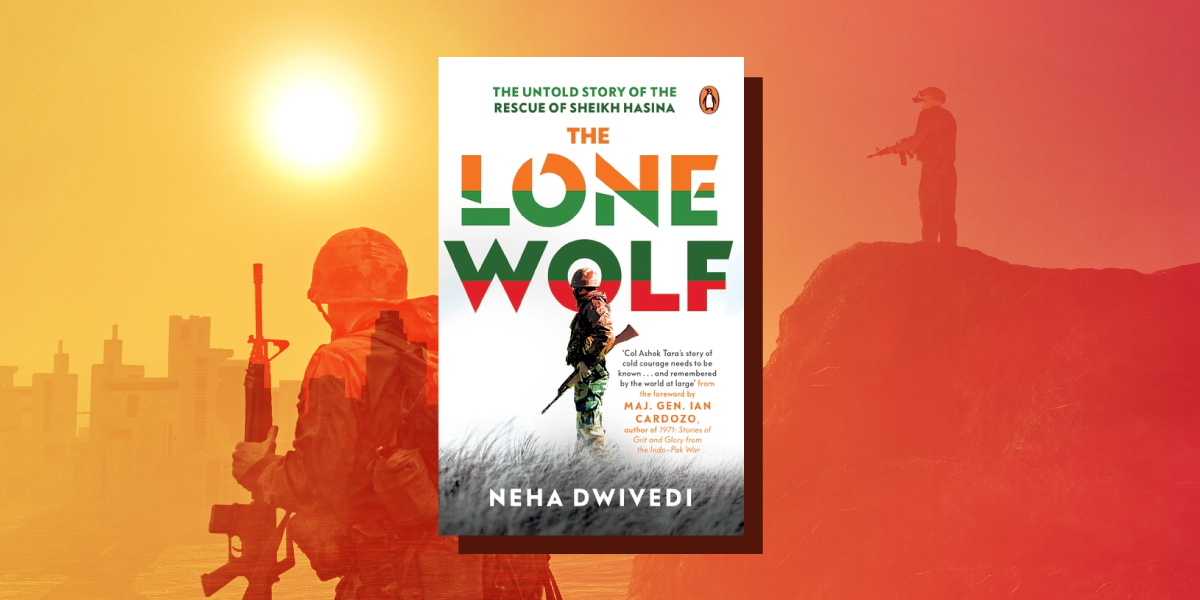
The Lone Wolf intersects Col Tara’s childhood and adolescence against the background of political tensions caused by linguistic hegemony in Pakistan. This eventually explodes into a full-fledged war that we now know as the Bangladesh Liberation War of 1971 and that India specifically remembers as the Indo-Pak War. On the very day that the war ended, Col Tara was at the centre of a high-profile hostage crisis. He was tasked to negotiate the release of Pakistani Army hostages, who were none other than the family of Sheikh Hasina.
Col Ashok Tara led the high-profile rescue mission as was his duty, but his tact and bravery are emblematic of India’s own diplomatic role in the conflict between East and West Pakistan. Neha Dwivedi’s book spotlights the side of war requiring strategy, a level of wit and composure that many rarely identify as a strength of the military.
The Lone Wolf || Neha Dwivedi
A childhood encounter formed the foundation for these skills. For Col Tara, The Lone Wolf is more than just a metaphor. At the young age of nine years old, Ashok Tara found himself face-to-face with a wolf, while walking through a forest ridge along the Yamuna. Back then the undergrowth was wilder and for Ashok and his brother Kirti, the walk to and from school was an adventure. On that fateful day, Ashok was all by himself. With a wild wolf standing in his path, the young Ashok Tara remembered the words of his grandfather, a former shikari:
. . . when confronted by an opponent, even if it’s a wild animal, stare at your opponent with a confident and stern expression. This show of courage will effectively deter them from launching an attack.
These words saved his life, not just on that day, but twenty years later, as he stood unarmed in front of a group of hostile Pakistani soldiers.
To read Col Ashok Tara’s story, get your own copy of The Lone Wolf from your nearest bookstore.
Inspired by the sincere words, here is a kaleidoscope collating the responses and a few stories from #KindnessMatters.
*
‘Kindness matters because this is the only way to live and let other live in peace.’
Lisa’s act of kindness was inspired by the personal experience of unwavering hospitality. Being an international student in Morocco, it wasn’t enough to simply know the textbook language. The locals teaching her the nuance in local dialects made a huge difference in bringing her closer to the community.
Returning to Switzerland, Lisa saw the refugees going through a similar plight. She then created the ‘voCHabular’ book and app, which succeeded not only in teaching the local language to refugees but also in creating a hybrid community of offline-online volunteers. Their work has now expanded to refugee awareness campaigns, food banks, and more around the borders of Europe.
Kindness, as proven by Lisa’s story in the chapter No Language Barrier, is what helps build trust with strangers.
‘Inner peace.’
It began with one family. Now when there’s a death in La Guajira, Sonia Bermúdez is the only one people can call.
Sixty-five-year-old Bermúdez’s story begins in 1996 when authorities informed her that there were no more spaces for unidentified victims of Colombia’s fifty-year-long conflict and drug-related violence. With neighbouring Venezuela’s political and economic crisis, Bermúdez’s focus has shifted to refugees who ran away from home but did not make it. Since municipal cemeteries are not free, the daily wage of a migrant labourer does not allow them to bury their dead with dignity.
To date, more than 300 Venezuelan refugees have been laid to rest in her cemetery, a 5.5-hectare land in Riohacha.
Sonia Bermúdez’s story in A Resting Place is a living example of how peace, if not found, can be built with one’s own hands.
‘So that the world is a better place for our kids.’
Not able to find the love and community they need, it’s not uncommon to find queer youths in Manipur, fall victim to addiction.
Sadam Hanjabam was one of them until a tragedy changed his life and set him on his current path. A core member of Ya-All, which means ‘revolution’ in Manipuri, Hanjabam is part of the collective creating queer-focused spaces, something he needed while closeted. Known as Meitram, the co-working, social space is more than just a location. Hanjabam and others are using his experience as a reference to integrate recovery and sex education programs for the youth.
Hanjabam wants the kids to have the support system he never had. Of Rainbows and Revolution shows how kindness, for the queer youth of Manipur, comes to the simple desire for a better future.
#KindnessMatters || Inspiring stories of empathy, compassion and kindness.
‘Kindness heals oneself and the world.’
In 2001, Bucharest’s mayor Traian Băsescu ordered all stray dogs to be killed. This was the moment that created Adăpostul Speranța. That night, the foundation rescued 300 dogs who would have otherwise been euthanized under the new orders. In 2020, twenty among those rescued dogs continue to live in, and because of, the shelter.
The shelter’s motto of Leave no dog behind inspires them to take care of every dog. Paraplegic and injured dogs, usually treated with despair, are taken care of by providing them with wheels and safe homes.
The kindness that the Speranța Foundation give their canine friends fuels more gifts of kindness from donations and volunteers. A New Lease of Life teaches us how one act of kindness can start a beautiful cycle of compassion, and save the lives of those who join it.
‘Our kindness towards others inspires them to be kind to everyone else.’
With COVID-19 enforcing lockdowns and restricting indoor dining in Barcelona, Faouzia Chati, the president of the Catalan Association of Moroccan Women, had to find alternative spaces for Ramadan prayers. It was then Father Peio Sanchez, Santa Ana’s rector, offered the Church’s open-air cloisters. This gesture of empathy encouraged many volunteers to come forward and cook the iftar (fast-breaking) meals for no less than Muslims, who were mostly homeless.
What started as a single act of kindness became the foundation for an inclusive community in the stone passages of Santa Ana. United by Religion echoes the tenet that is taught in all religions, across all languages: treat others as you want to be treated.
‘It makes me feel like a fellow human.’
At seventeen, Joséphine Yameogo did the unthinkable by refusing to marry the sixty-year-old groom chosen for her. Instead, she married a man of her own choice, facing banishment from her community. After becoming a mother of three, she picked up on the skills needed to become a mechanic and opened her own shop on the outskirts of the capital city.
Today, the Center Féminin d’Initiation et d’Enseignement aux Métiers (CFIAM) runs an organization helping girls and young women from disadvantaged backgrounds train in automotive electronics, bodywork, mechanics and more. For these women, technical education is a much-needed escape from coerced paths like forced marriage. They find it easier to be confident while seeking employment with such skills in hand and learn to establish financial security for themselves.
For young girls and women mentioned in Fixing Stereotypes, what the CFIAM did was not just about empowerment, but about emancipation. An act of kindness is the most important way to remind someone of their value as a human being.
In the second volume of his landmark book, Discordant Notes, Rohinton Nariman brings to light ground-breaking cases and judgements which made remarkable additions to our Constitution, improved and improvised some laws and most importantly, gave the space to the citizens of this country to be able to think, re-think and re-learn freely.
Charting out the history of the dissenting judgements in the history of the Supreme Court of India, Nariman begins by quoting Professor Allan Hutchinson’s Laughing at the Gods: Great Judges and How They Made the Common Law, where he speaks of ‘judicial greatness’ as:
‘Great judges seek to make a critical accommodation with the legal tradition by combining heresy and heritage in a playful judicial style; they refuse to be hampered by customary habits of judicial mind. For them, law is not something to be mastered. It is a sprawling tableau of transformation in which experimentation and improvisation are valued as much as predictability and faithfulness to existing rules and ideas. They see possibilities and make moves that others overlook. Great judges flaunt conventional standards in the process of remaking them; their judgements are the exceptions that prove the rule. And, once they have done what they do, others are less able to view the world in the same way again.’
Discordant Notes || Rohinton Nariman
He then mentions that it is in this sense that he chose the four great dissenters for this book. Overlooking other prominent judges who wrote numerous dissents in their lifetime, he chose to write about the ones who might have given only six dissents, for example, but had brilliant oversight packed in them, insights that changed the course of future judgements in India.
Nariman named these four dissenters, the ‘Four Horsemen of the Apocalypse’ because just like in Book Six, ‘Revelation’ of the New Testament in the Bible, these are the people who give the world a chance to repent before they are consigned to the ashes. He states how each one of these four dissenters fulfills this role, some of them prophesying doom if their dissents do not become the law, and others offering a chance of redemption, if in the future, their view is accepted in preference to that of majority.
One of the first cases discussed in the second volume of Discordant Notes is the Keshava Madhava Menon v. State of Bombay (1951) case dissented by judge Sir Saiyid Fazl Ali. What came up for consideration before the Supreme Court was the interpretation of the expression ‘void’ contained in Article 13 (1) of the Constitution of India. The majority judgement, delivered by S.R. Das, J., on behalf of the three learned judges of the court, held that Article 13 (1) does not make existing laws which are inconsistent with fundamental rights void ab initio, but only renders such laws ineffectual with respect to the exercise of fundamental rights on and after the date of commencement of the Constitution, Article 13 (1) having no retrospective effect. Therefore, if prosecution for a criminal act was commenced before the Constitution came into force, it can be proceeded with according to that law, even after the commencement of the Constitution.
Fazl Ali, J., joined Mukherjea, J., dissented. For reference, Article 13 (1) reads as follows:
‘All laws in force in the territory of India immediately before the commencement of this Constitution, in so far as they are inconsistent with the provisions of this Part, shall, to the extent of such inconsistency, be void.’
Fazl Ali, J referred to the original draft of the Constitution, in which the words ‘shall stand abrogated’ were used instead of ‘shall be void’ in Article 13 (1). He then observed that the Constitution makers used various expressions to convey precisely and thoroughly what they meant. While some articles used ‘invalid’, ‘ceased to have effect’ and ‘shall be inoperative’, ‘void’ is used only in two articles 13 (1) and 154 – and both of them deal with cases where laws are repugnant to other laws. Hence, the learned judge concluded that there is a precision and thoroughness of the framers of the Constitution with the strong sense in which the word ‘void’ has been used and cannot be completely ignored.
Nariman noted that this case is an important judgment, which was later followed in Behram Khurshid Pesikaka v. State of Bombay (1955) and Bhikaji Narain Dhakras v. State of M.P. (1955), as forming the foundation for what became known as the ‘Doctrine of Eclipse’, i.e. that pre-constitutional law cannot be said to be void from inception, but only ineffective if it violates a fundamental right, the fundamental right casting a shadow over such law.
Rohinton Nariman discusses and analyses many more such interesting cases and judgements and enlightens us with the kind of roads they fractured, mended and laid the foundation of, in this remarkable book. It speaks to anyone who decides to speak for themselves or for others, who decides to obtain knowledge in multi-dimensional spheres and most notably, for someone who decides to learn and re-learn.
Alok Ranjan, the former Chief Secretary of the Government of Uttar Pradesh, has had the career that most people dream of. So, he has put together the information that every aspiring officer should know. While sharing his own experiences, he has provided a deep understanding of the IAS as an institution, valuable tips and insight for cracking the daunting UPSC exam, and how to build a successful career in the services.
*
Making a Difference || Alok Ranjan
Dear Readers,
It was a difficult decision after having done my MBA from IIM Ahmadabad to resign from my job and write the IAS examination. I was fortunate to succeed in the exam in my first attempt and secured 4th position in India in the IAS and was allotted to the Uttar Pradesh cadre. I retired in 2016 after 38 years of a very fulfilling and satisfying career. I can say with complete confidence that no other service or job can provide the diversity and richness of experience that a career in the IAS provides.
I often meet young boys and girls embarking upon a career and find that most of them have dreams of joining the IAS or the civil services. Despite the numerous alternative career opportunities that are available, civil service is still the preferred choice of many. Students prepare for years to get through the hallowed portals of the civil service. For those who succeed it is a realization of their cherished aspirations while others keep making honest efforts year after year hoping that one day they shall succeed.
This book is for those young boys and girls who nurture the desire to join the IAS. I want to communicate through this book that it is possible to get selected in the IAS provided you have the right kind of motivation and are prepared to put in the requisite amount of dedicated hard work. This book is also about the challenges and opportunities that an IAS officer faces during his service period. it is not an autobiography but I have used interesting anecdotes from my career to illustrate the situations that an IAS officer faces and the leadership principles which are essential for him to ensure quality public service delivery and good governance. It is for this reason that this book would be of interest to the serving IAS officers as well as all those who are concerned in any way with issues related to public policy. A student must think of joining the IAS if she wants to bring about a positive change in society and contribute to the development of the country. Issues of power, position, and status cannot be ignored but they should not be the prime motivation for joining the IAS. This service gives you the opportunity of touching numerous human lives. You can bring about a transformation in the quality of life of the citizens. This book is all about making a difference to society which should be the main goal of an IAS officer.
A person interested in joining the IAS should prepare herself mentally for at least three to five year before the IAS exam. He should take a keen interest in current affairs and also read widely on all possible subjects. This is an extremely tough exam where you have to compete against thousands for a hundred seats and therefore your preparation has to be that much more solid and deeper. It is best to devote at least one year of single-minded focus and effort to this exam. You need to develop your personality as well as your communication skills as well as a logical and analytical way of thinking. This book will give those preparing for IAS some very useful tips for both the written exam and the personality test. I have talked about the experiences of an IAS officer as a District Magistrate which is, perhaps, the most rewarding and exciting posting in the service. A young IAS officer gets the opportunity of leading the entire team at the district and he is the voice of the government at the District level. Any scheme gets implemented if the District Magistrate takes it up. There is tremendous authority attached to this post but along with this comes a great sense of responsibility and accountability. It is, indeed, a thrilling assignment and most IAS officers never tire of talking about what they achieved in the Districts.
State Government provides a tremendous opportunity to make policies that could influence the life of the ordinary citizen. You could be looking after education and make a mark by improving the quality of education or you could be looking after the health and can make a difference by reducing infant and maternal mortality. Every post in the IAS has the potential of giving you an opportunity to bring about a positive change in the lives of people. A great experience at the State level is the post of the Chief Secretary who leads all the government officers and employees in fulfilling the ideal of good governance. IAS gives an opportunity of working with the Government of India where you get National and International experience and the policies you make impact the entire nation.
I have also discussed some of the common myths and beliefs about the IAS like the need for domain specialization, promotion on the basis of seniority, political interference, corruption, professional integrity, and lack of promptness in decision making. I have tried to show how some of these could be individual attributes but the system also plays a great role in molding the personality and administrative style of an IAS officer.
It is my fervent belief that a career in the IAS can be hugely satisfying but the relevance of the IAS for the future requires the service to introspect and reinvent itself and for this, it has to look within and make itself responsive to the changing needs of the 21 st century. The IAS is not merely a job but is a service to society and the Nation. The greatest reward that an IAS officer can get is when the common man on the street feels that a positive difference has been made in his life.
All the best!
**
Read Making A Difference to know more about IAS from an insider.
Sita, the beloved princess of Mithila, is one of the most revered women in Indian history; so well known, yet probably the least understood. At every crossroad of her life, she chose acceptance and grace over self-pity. Her life was filled with sacrifice yet wherever she was, there was abundance. It was as if she was carved out of an intense longing for Rama, yet she had infinite patience.
Sita||Bhanumathi Narasimhan
Sita’s story has something to offer to everyone. In her, we find someone who is so divine yet so human. Today, we are looking at some of the lessons from her life that can help us become better individuals.
Devotion
Sita’s devotion for Lord Rama was unparalleled. She stood by him like a pillar when he was banished from the kingdom of Ayodhya and followed him like his shadow to the forest, happily abandoning all comforts and luxuries of the palace.
‘Sita’s eyes closed and she dived deep within as the gentle touch of the petals enveloped her being in waves of beauty. And in that inner silence, the soundless vibration of the sacred word ‘Ram’ rose in soft ripples of bliss. A single tear flowed from Sita’s eyes, sweetened by her devotion and longing for her beloved.’
‘Sita’s eyes captured every detail but nothing left an impression on her mind, just as the lotus leaves, though they were in the water, remained untouched by it. There was only one impression in her consciousness, her beloved Rama, and he filled her completely.’
‘She wondered if Rama was looking at the night sky too. The very thought that they might both be gazing together at the same stars sent a rush of joy into her heart. There were many barriers that separated them physically, but these little twinkling relatives of hers connected her instantly to her beloved. She closed her eyes with a smile on her face. She mentally dwelt upon every detail of her beloved and found deep solace in the image.’
Courage
Sita was the beloved princess of Mithila who had been brought up with all the luxuries that a kingdom can afford. Yet, when Lord Rama was banished to the forest she followed suit, with no qualms or complains. It was not merely her love for Rama, but a sense of indomitable courage that allowed her to take such a valiant step.
‘She patiently waited for Rama to complete what he had to say. As soon as he was done, she fell at Kaushalya’s feet. ‘Mother, what use is the lotus without the sun, a flower without nectar, a river without banks or a body without the soul? I have heard in detail the descriptions of all the hardships that you foresee but I assure you that even a moment of separation from my lord is far worse than any of these difficulties. The birds and animals will be my family. The flowers of the wild will add colour and fragrance wherever we are. Sleeping on the earth, I will feel that I am resting on my mother’s lap. A hut of leaves in the company of my lord will be far more comfortable than the heavenly abode of gods. The majestic mountains all around will be akin to the palaces of Ayodhya.’
Grace
Be it the way Sita perceived Ravana after he abducted her or the way she treated Kaikeyi when the Queen visited her in Chitrakuta, Sita’s graciousness remained untarnished no matter what the circumstance.
‘For Sita, everything beautiful in creation was Rama. She felt the presence of her lord even in the music of the enemy. Ravana was not an opponent or adversary to Rama anymore. He had loomed large in Trijata’s mind when she placed him opposite Rama. But now Ravana seemed very small because she saw him from Sita’s point of view. Rama was bigger than any individual. There was nothing that could come between Sita and Rama because they were not two.’
‘Kaikeyi burst out when Rama came to her, ‘I thought I would never be able to speak to you again! Even if you forgave me, I would never be able to forgive myself. I was wondering what I would even say to you. But that darling wife of yours—she is just like you! She has patiently consoled me ever since our arrival and made me feel so honoured. She has no spite, not even a trace of doubt in her mind. She still treats me like her very own mother! I am sure Kaushalya and Sumitra must be wondering why Sita is spending all her time with me after all that I have done to you and to her!’’
Loyalty
The songs of Sita’s loyalty to Lord Rama are sung till date. When the mighty Ravana tried to win her over, her refusal of him remained as stern and unyielding as ever. Even in captivity, her heart and mind were solely devoted to the thought of Rama.
‘Though Sita was being held captive in Ravana’s garden now, they would bring her food in a golden plate every day. And every day, the plate would remain untouched. Sita never took even a sip of water from the palace kitchens. The Rakshasis who guarded her did not care. They would enjoy the food themselves and return the plates as if Sita had eaten everything.’
‘At first, Sita had thought of her new-found love as a beautiful feeling, a powerful emotion. But years later, as she sat watching the flowing waters of the stream in Ashoka Vatika, she was very clear that this love was her very existence.’
‘Trijata, wait!’ said Ravana. Trijata was his niece. He could speak to her a little more freely than he could to anyone else at the moment. He knew that Sita had softened towards Trijata. ‘Yes, my lord,’ said Trijata and retraced her steps into her uncle’s chamber. ‘Trijata, does she still yearn for that mortal husband of hers? Does she believe that he is actually going to find her?’ ‘Yes, my lord. Though separated physically, her heart knows no other. Whoever Rama may be, he is fortunate to have such a wife. I cannot imagine an ordinary man inspiring this kind of resilience and love.’
Living in harmony with nature
Sita’s love for all of nature’s beings was boundless. The various birds and animals in Ashoka Vatika became her companions in solitude. In turn, these creatures would bring her food and try to uplift her mood, considering themselves lucky to be in the presence of divinity.
‘When the Rakshasis were asleep, little squirrels would run down the trunk of the simsupa tree and drop nuts into her lap. They would wait to see if Sita accepted their offering or not. The sparrows and sunbirds would carry tiny berries in their beaks and place them on the ground near Sita, just as if they were bringing food for their young ones. Sita could not refuse their offerings. She would wash those berries and nuts in the water from the nearby stream and eat them. This was all the food that she consumed throughout her confinement in Ashoka Vatika.’
*
Rediscover the immortal story of Sita from her perspective in Bhanumathi Narasimhan’s Sita: A Tale of Ancient Love.
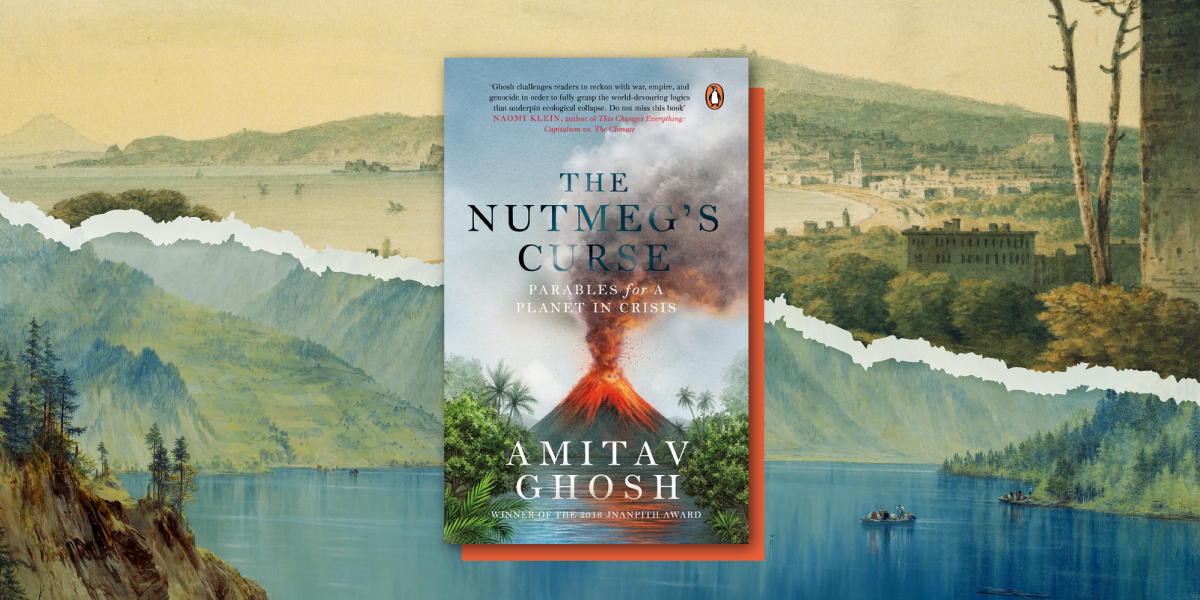
The Nutmeg’s Curse is a compelling read that talks about the now ubiquitous spice, and how it was once so rare that wars were fought over its possession. In his latest masterpiece, Amitav Ghosh explores and explains the connection between nutmeg and climate change, and how its tragic history can be traced back to the Middle Ages. As we follow the tumultuous tale of nutmeg, we are introduced to colonial genocide, eco-fascism, philosophy of science, and military emissions.
The Nutmeg’s Curse||Amitav Ghosh
This intriguing novel kicks off with a bewildering story set in Selamon, a village in Banda islands in present-day Indonesia. The Dutch invasion, led by Martijn Sonck, a ruthless tyrant, is in full swing, while the natives of the island are still comprehending what is happening to their homeland and why. Nutmeg’s history is a tainted one, and its association brings up tragedies and horrible crimes committed during different colonizations across the globe, especially in Asia. Let’s dive into the gruesome legacy of Nutmeg: how it once was one of the most valued spices in Eurasia and how it’s connected to climate change, an irreversible problem we face today.
In the Middle Age, the spice race was the space race of its time, and so the involvement of Dutchmen such as Sonck was hardly surprising. The Europeans, however, were not the first ones to discover nutmeg. Known as the gift of Gunung Api, a part of the volcano mountains in Maluku, nutmeg had traveled the world long before the first Dutch colonizers set their ravenous eyes on it. Unlike the tree it originates from, nutmeg has been described as a tireless traveler. Interestingly, since every single nutmeg originated in and around the Bandas before the 1700s, any mention of the former in texts around the world automatically forms a link with the latter.
In India, a carbonized nutmeg was found in an archaeological site that dates back to 400-200 BCE. In Chinese texts, mentions of this infamous spice date back to the first century before the Common Era, and in Latin texts, nutmeg appears a century later. Hence, it is obvious that nutmeg has traveled thousands of miles before Europeans reached Maluku. However, one of the most peculiar aspects of these spice voyages across Asia and Europe was the astounding consistency through which nutmeg rose steadily in both volume and value.
But why nutmeg in particular? Why did this simple, yet difficult to procure spice rise above the others in the spice race? One of the reasons could be its medicinal properties, especially in the 16th century. The value of this spice rose when doctors in Elizabeth England declared that nutmeg could be used to cure the infamous plague that was sweeping rapidly through Eurasia. In fact, in the late Middle Ages, it became so expensive and exclusive in Europe that a handful of this household spice could buy a house or even a ship! The frenzy for spices like nutmeg in this era surpassed their terms of value in utility alone. Nutmegs manifested into something much bigger: fetishes and envy-inducing symbols of luxury and wealth. As Ghosh rightly states, they conformed impeccably to Adam Smith’s insight that wealth is something that is “desired, not for the material satisfactions that it brings but because it is desired by others.”
Be it to establish a monopoly by European voyagers such as Christopher Columbus himself, or to harness this chic spice’s actual potential, nutmeg was in the center of the storm of crusades and colonizations that became a norm for the centuries that followed. The Nutmeg’s Curse is a riveting account of how some of our modern problems, mainly climate change, are a consequence of these events, and how nutmeg’s story draws parallels with our current reality.
If only the world had no boundaries and we could move about without having to produce passports and documents everywhere, it really would be a great wide beautiful, wonderful world’, says Ruskin Bond.
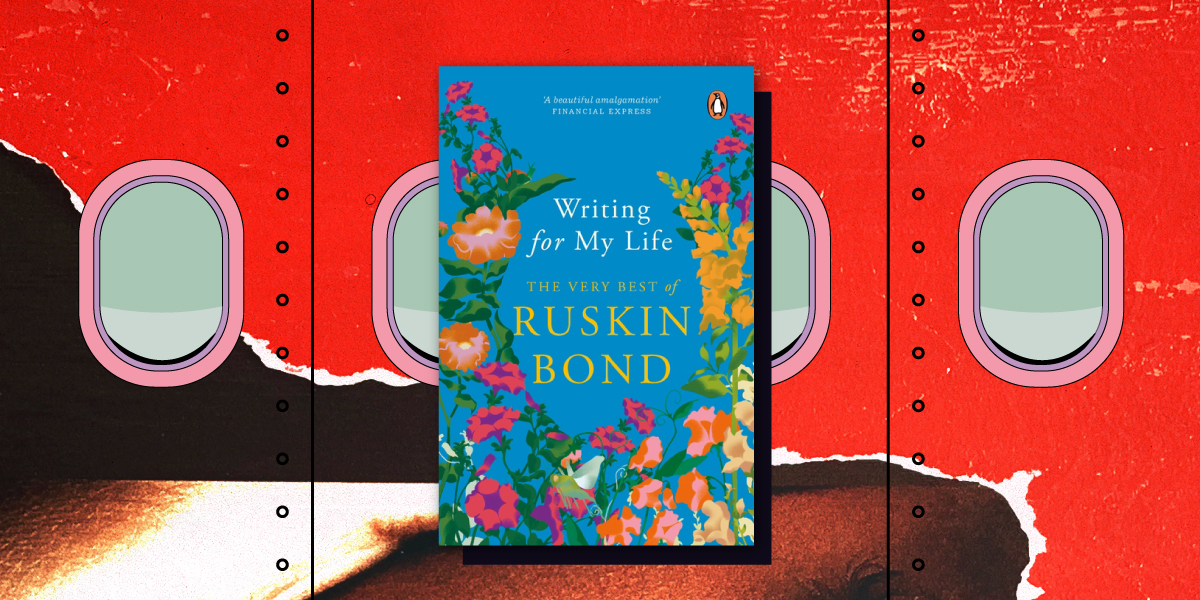
From his most loved stories to poems, memoirs, and essays, Writing for My Life opens a window to the myriad worlds of Ruskin Bond, India’s most loved author. This book is full of beauty and joy – two things Ruskin’s writing is mostly known for.
Writing for My Life||Ruskin Bond
Ruskin’s writing is greatly inspired by the places he lived at. His first book The Room on the Roof was published when he went away to London but was inspired by Dehradun. Here are some excerpts from stories based out of Dehradun, Jersey, and London
Dehradun: The Window
I came in the spring and took the room on the roof. It was a long, low building that housed several families; the roof was flat, except for my room and a chimney. I don’t know whose room owned the chimney, but my room owned the roof. And from the window of my room, I owned the world.
But only from the window.
The banyan tree, just opposite, was mine, and its inhabitants my subjects. They were two squirrels, a few mina, a crow, and at night, a pair of flying foxes. The squirrels were busy in the afternoons, the birds in the mornings and evenings, the foxes at night. I wasn’t very busy that year; not as busy as the inhabitants of the banyan tree.
There was also a mango tree but that came later, in the summer, when I met Koki and the mangoes were ripe.
At first, I was lonely in my room. But then I discovered the power of my window. I looked out on the banyan tree, on the garden, on the broad path that ran beside the building, and out over the roofs of other houses, over roads and fields, as far as the horizon. The path was not a very busy one but it held variety: an ayah, with a baby in a pram; the postman, an event in himself; the fruit seller, the toy seller, calling their wares in high-pitched familiar cries; the rent collector; a posse of cyclists; a long chain of schoolgirls; a lame beggar…all passed my way, the way of my window…
*
Jersey – A Far Cry from India
It was while I was living in Jersey, in the Channel Islands, that I really missed India.
Jersey was a very pretty island, with wide sandy bays and rocky inlets, but it was worlds away from the land in which I had grown up. You did not see an Indian or eastern face
anywhere. It was not really an English place, either, except in parts of the capital, St Helier, where some of the business houses, hotels, and law firms were British-owned. The majority of the population – farmers, fishermen, councillors – spoke a French patois which even a Frenchman would have disowned. The island, originally French, and then for a century British, had been briefly occupied by the Germans. Now it was British again, although it had its own legislative council and made its own laws. It exported tomatoes, shrimp, and Jersey cows, and imported people looking for a tax haven.
During the summer months, the island was flooded with English holidaymakers. During the long, cold winter, gale-force winds swept across the Channel and the island’s waterfront had a forlorn look. I knew I did not belong there and I disliked the place intensely. Within days of my arrival, I was longing for the languid, easy-going, mango-scented air of small-town India: the gul mohur trees in their fiery summer splendor; barefoot boys riding buffaloes and chewing on sticks of sugarcane; a hoopoe on the grass, bluejays performing aerial acrobatics; a girl’s pink dupatta flying in the breeze; the scent of wet earth after the first rain; and most of all my Dehra friends.
So what on earth was I doing on an island, twelve by five miles in size, in the cold seas off Europe? Islands always sound as though they are romantic places, but take my advice, don’t live on one – you’ll feel deeply frustrated after a week.
I was in Jersey because my Aunt E (my mother’s eldest sister) had, along with her husband and three sons, settled there a couple of years previously. So had a few other financially stable Anglo-Indian families, former residents of Poona or Bangalore, but it not a place where young people could make a career, excerpt perhaps in local government.
I had finished school at the end of 1950, and then for almost a year I had been loafing around Dehra Dun, convinced that I was a writer on the strength of a couple of stories sold to The Hindu’s Sport and Pastime (now there was a sports’ magazine with a difference – it published my fiction!) and The Tribune of Ambala (Chandigarh did not exist then). My mother and stepfather finally decided to pack me off to the U.K., where, it was hoped, I would make my fortune or become Lord Mayor of London like Dick Whittington. There really wasn’t much else I could have done at the time, except take a teacher’s training and spend the rest of my life teaching As You Like It or Far from the Madding Crowd to schoolboys (in private schools) who would always have more money than I could earn.
Anyway, my aunt had written to say that I could stay with her in Jersey until I found my bearings, and so off I went, in my trunk a new tweet coat and two pairs of grey flannel trousers; also a packet of haldi powder, which my aunt had particularly requested. During the voyage, the packet burst, and most of my clothes were stained with haldi.
*
London – And Another in London
Although for my first six months in London I did live in a garret and an unhealthy one at that, I did not really see myself in the role of the starving poet. The first thing I did was to
look for a job, and I took the first that was offered – the office job at Photax, a small firm selling photographic components and accessories. A little way down the road was the Scala Theatre, and as soon as I had save enough for a theatre ticket (theatre-going wasn’t expensive in those days), I went to see the annual Christmas production of Peter Pan, which I’d read as a play when I was going through the works of Barrie in my school library. This production had Margaret Lockwood as Peter. She had been Britain’s most popular film star in the forties and she was still pretty and vivacious. I think Captain Hook was played by Donald Wolfit, better known for his portrayal of Svengali.
My colleagues in Photax, though not in the least literary, were a friendly lot. There was my fellow clerk, Ken, shared his marmite sandwiches with me. There was Maisie of the auburn hair, who was constantly being rung up by her boyfriends. And there was Clarence, who was slightly effeminate and known to frequent the gay bars in Soho. (Except that the term ‘gay’ hadn’t been invented yet.) And there was our head clerk, Mr. Smedly, who’d been in the Navy during the War, and was a musical-theatre buff. We would often discuss the latest musicals – Guys and Dolls, South Pacific, Paint Your Wagon, Pal Joey – big musicals which used to run for months, even years.
The window opposite my desk looked out on a huge cinema hoarding, and it was always an event when a new poster went up on it. Weeks before the film was released, there was a poster of Judy Garland in her comeback film, A Star is Born, and I can still remember the publicity headline: ‘Judy, the world is waiting for your sunshine!’ And, of course, there was Marilyn Monroe in Niagara, with Marilyn looking much bigger than the waterfall, and that fine actor, Joseph Cotton, nowhere in sight.
My heart, though, was not in the Photax office. I had no ambitions to become a head clerk or even to learn the intricacies of the business. It was a nine-to-five job, giving me just enough money to live on (six pounds a week, in fact), while I scribbled away of an evening, working on my second (or was it third?) draft of my novel. The title was the only thing about it that did not change. It was The Room on the Roof from the beginning.
How I worked at that book! I was always being asked to put things in or take things out. At first, the publishers suggested that it needed ‘filling out’. When I filled it out, I was told that it was now a little too descriptive and would I prune it a bit? And what started out as a journal and then became a first-person narrative finally ended up in the third person. But editors only made suggestions; they did not tamper with your language or style. And the ‘feel’ of the story – my love for India and my friends in particular – was ever-present, running through it like a vein of gold.
Much of the publishers’ uncertain and contradictory suggestions stemmed from the fact that they relied heavily on their readers’ recommendations. A ‘reader’ was a well-known writer or critic who was asked (and paid) to give his opinion on a book. The Room on the Roof was sent to the celebrated literary critic, Walter Allen, who said I was a ‘born writer’ and likened me to Sterne, but also said I should wait a little longer before attempting a novel. Another reader, Laurie Lee (the author of Cider with Rosie), said he had enjoyed the story but that it would be a gamble to publish it.
Fortunately, Andre Deutsch was the sort of publisher who was ready to take a risk with a new, young author; so instead of rejecting the book, he bought an option on it, which meant that he could sit on it for a couple of years until he had made up his mind!
Experience the very best of Ruskin Bond’s writing in one book, Writing for my Life!
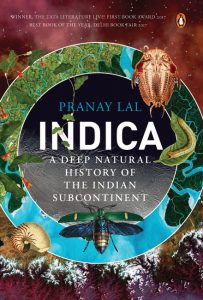
One of the recent discoveries readers have made is an author who is a biochemist working in the field of public health, the rather extraordinary, Pranay Lal.
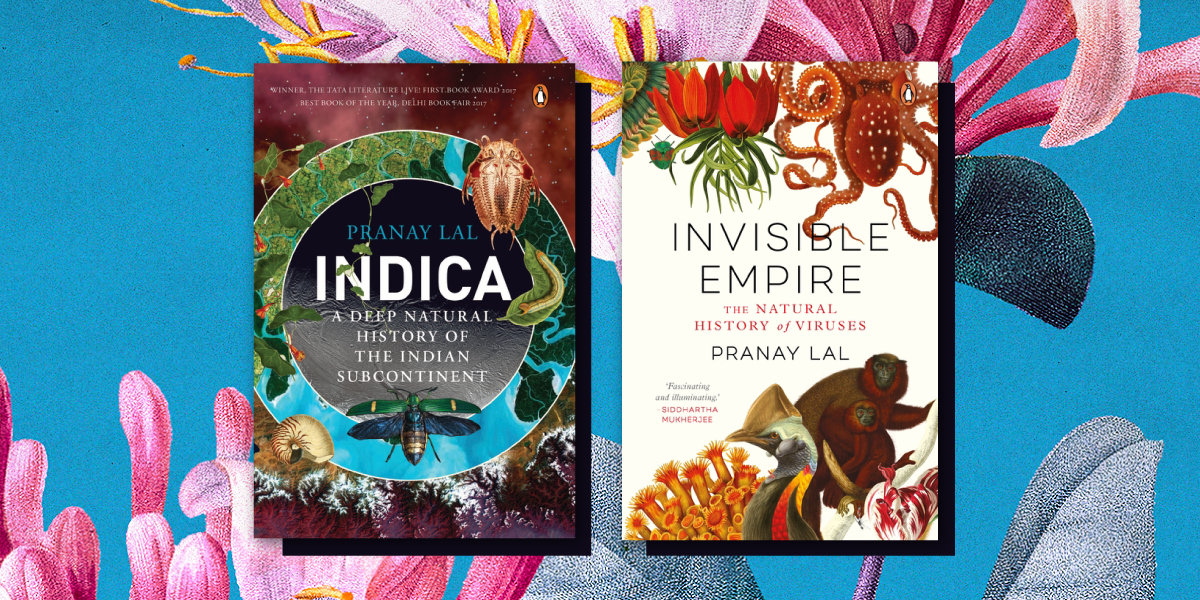
His first book, Indica: A Deep Natural History of the Indian Subcontinent won the hearts of so many people along with bagging the 2017 Tata Lit Prize and the World Book Fair Award. Indica managed to document facts and history from the world of nature in the geographical boundaries of the Indian Subcontinent that the world wasn’t aware of. This exclusive document turned out to be a huge success because it managed to do something never done before with such extent and elegance.
Indica || Pranay Lal
It speaks about an Indian dinosaur more ferocious than T rex called Rajasaurus, about the Ganga and Brahmaputra sequestering nearly 20 per cent of global carbon, and their sediments over millions of years have etched submarine canyons in the Bay of Bengal that are larger than the Grand Canyon! From caves to crocodiles and gargantuan mammals, this book holds secrets to the tributaries of the natural world inside it!
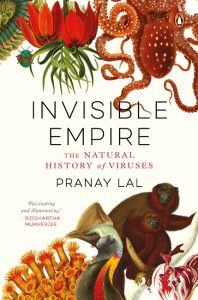
And after years of waiting, Pranay Lal has returned with more facts and stories and secrets to be revealed in his latest release, Invisible Empire: The Natural History of Viruses.
Invisible Empire || Pranay Lal
Virus, the word our ears have been hearing without a pause for the past few years. A virus dominated our lives in a big way and now Pranay Lal takes a dive deep into the history of viruses and gives us the much-needed context, information and detailed accounts of the plethora of viruses that have occupied earth through the years.
The author shows us how everything about viruses is extreme, including the reactions they evoke and how for every truism about viruses, the opposite is also often true. The book takes us into the complex world of viruses, so diverse that it deserves to be called an empire.
Whether we see them as alive or dead, as life-threatening or life-affirming, Pranay Lal makes sure we see the ineluctable beauty, even a certain elegance about the way viruses go about their lives.
Lately the news cycle has been a whirlpool of trauma, scandal, and sensationalism. Far from facts, a new genre of tabloid truths has now changed the face of journalism. What most people do not know is that journalism originally started off with human stories. The world’s oldest newspaper started in the 17th century in Strausbourg and was a chronicle of daily lives. Harking back to the roots is The Book of Hope: Extraordinary Stories of Ordinary Indians, a special project between The Better India and Penguin India. Whenever we hear inspirational and motivational stories, we often treat them as the exception. Instead of creating empathy and seeing how one can spread awareness. It is time for the focus to shift towards stories that show humanity without a filter. Here are a few people at the centre of stories that fit that very description.
The Book of Hope||
Stories about resilience
Stories of injustice are directly tied to assumed pillars of society. Take the rampant problem of female infanticide and acid attacks. One is a clear symptom of gender discrimination, while the other is an example of misogyny and male entitlement. We are often so discouraged by the statistics that we rarely consider the true stories of survivors. Like Jasbeer Kaur (He Tried to Kill Me), who was forced to choose between being a wife and a mother. Kavita (Left Blind, She Now Helps Others), who is not just another victim of an acid attack, but a beacon of light for the marginalized. Stanzin Saldon (An Agent of Change in Kargil) is a young woman who stood up for herself and her chosen family against hearsay and is now changing the face of education in a forgotten part of Ladakh.
Stories about self-discovery
There are some decisions we make in our daily routine, like when to set the alarm, what clothes to wear, which traffic route to follow, etc. Then there are the decisions that unwittingly put us on the path of our life purpose. Like Kaushik (Middle-Class and Gay), who always knew he was gay but was never confident about his sexuality. It was only when he decided to pursue his PhD that a turning point put him on the path of self-love. Jasmine (This Kerala Trainer is an Inspiration), who hails from the small village of Mukkam in Kerala burns her bridges and takes up a simple job, only to find herself going viral. COVID-19 recalibrated Sameer’s (His Biryani Took Off!) original plans and had him return to his true passion. Now he has clients like actors Swara Bhasker and Mrunal Thakur.
Stories that offer perspective
We grow up hearing oversimplified tales of black-and-white, good-and-bad, but a lot of society’s moralizing is being called out today through the power of storytelling. In For Love for Their Children, Farida and Roopmati tell their story from the margins of society, despite being in the oldest profession in the world. In Did I Not See the Signs? Raashi Thakran shines a light on the reality of mental health awareness as the one who is left behind. In Tongawala to Masala King, Mahashay Chunni Lal Gulati steps out of the MDH packets on our kitchen shelves, telling us how there is no such thing as an overnight success.
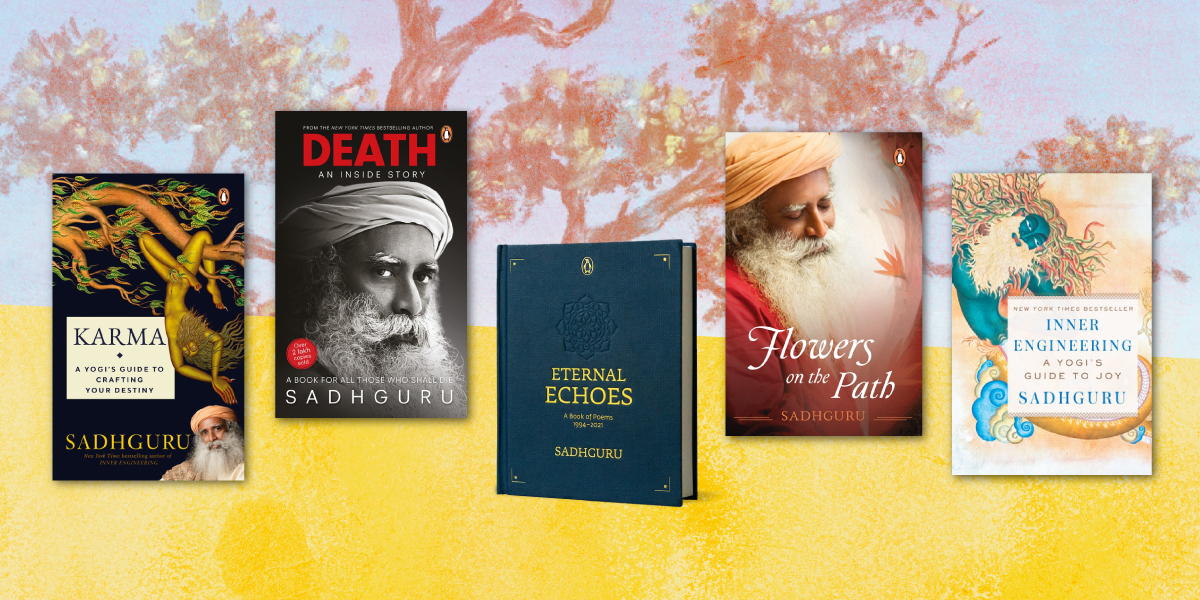
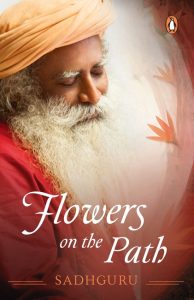
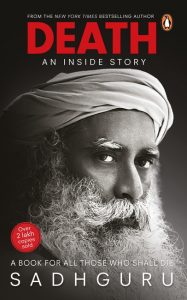
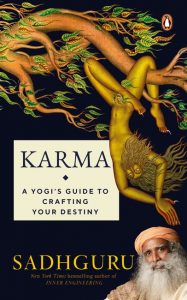
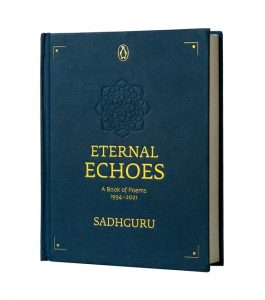
Absolute clarity of perception places Sadhguru in a unique space, not only in matters spiritual but in business, environmental and international affairs, and opens a new door on all that he touches. At the dawn of the book launch of Sadhguru’s latest release, Eternal Echoes, we bring to you some other books penned by him that will help you walk on the path lit by this ‘spiritual master with a difference’.
Inner Engineering || Sadhguru
INNER ENGINEERING: A YOGI’S GUIDE TO JOY
According to Sadhguru, the term guru means ‘the dispeller of darkness, someone who opens the door for you…’ As a guru, he says he has no doctrine to teach, no philosophy to impart, no belief to propagate. And that is because he believes the only solution for all the ills that plague humanity is self-transformation. Hence, by talking about yoga through his book, he helps one create inner situations exactly the way you want them, turning you into the architect of your own joy. A yogi lives in this expanisve state and he narrates the story of his own awakening, from a boy with an unusual affinity for nature to a young daredevil who crossed the Indian continent on his motorcycle.
Flowers on the Path || Sadhguru
FLOWERS ON THE PATH
As a flower can confound you with its brilliance and beauty, so too does each article in this book hold the possibility to confuse you out of your conclusions, and pave the way towards true knowing. Whether the subject covers social issues and worldly affairs, individual challenges, or dimensions of the beyond, Sadhguru’s ability to delve to the root and look at life in all its totality is evident. These essays will render you in profound stillness within and might even delight you with humour.
Death, An Inside Story || Sadhguru
DEATH: AN INSIDE STORY
Death is a taboo in most societies in the world. But what if we have got this completely wrong? What if death was not the catastrophe it is made out to be but an essential aspect of life, rife with spiritual possibilities for transcendence? In this unique treatise-like exposition, Sadhguru dwells extensively upon his inner experience as he expounds on the more profound aspects of death that are rarely spoken about. From a practical standpoint, he elaborates on what preparations one can make for one’s death, how best we can assist someone who is dying and how we can continue to support their journey even after death.
Karma || Sadhguru
KARMA
Recommended by the likes of Tom Brady and Deepak Chopra, this book deals with the often-used but loosely understood word, Karma. It elaborates on how the grossly over-simplified understanding of it as a system which ensures that one gets what one deserves, has created many complexities in our lives and taken away from us the very fundamentals of the joy of living. Through this book, not only does Sadhguru explain what Karma is and how we can use its concepts to enhance our lives, he also tells us about the Sutras, a step-by-step guide to navigating our way in this challenging world. In the process, we get a deeper, richer understanding of life and the power to craft our destinies.
Eternal Echoes || Sadhguru
While all these books are written in prose and serve as guides to connect, live and be one with ourselves, his new book, Eternal Echoes is a book of verse full of poems Sadhguru wrote between 1994 and 2021. It has hundreds of poems, one for every day, spread out amidst themes such as life, death, time, yoga, love and devotion, nature, Shiva and more.