



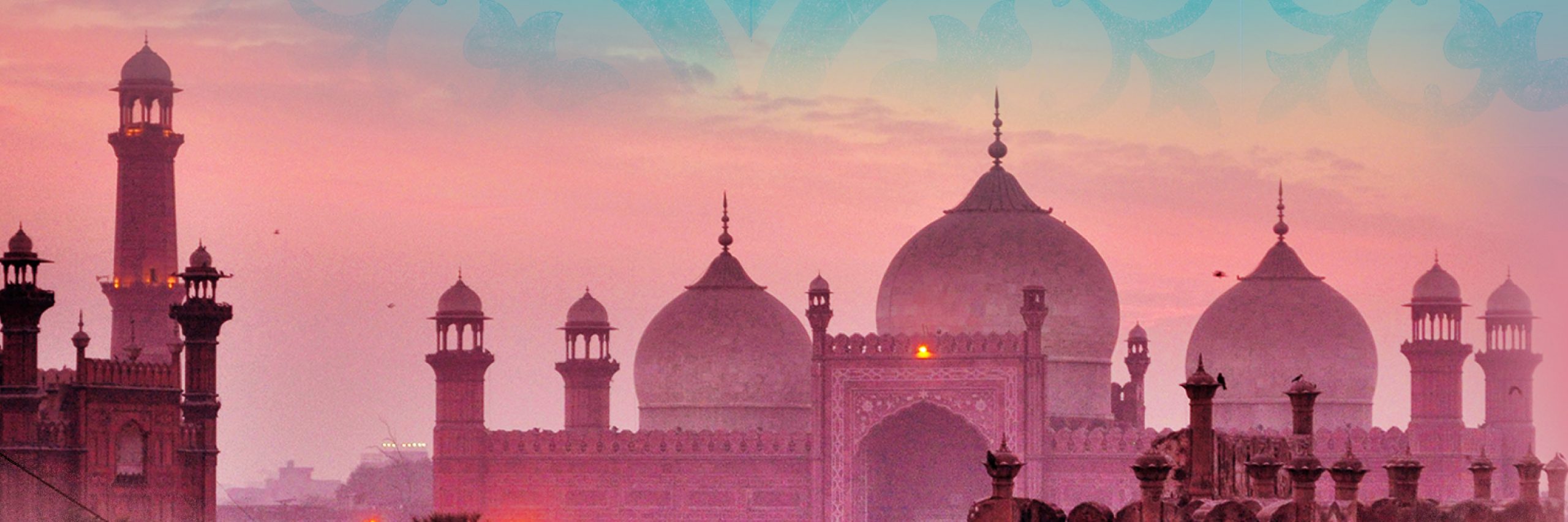
Imagining Lahore by Haroon Khalid is an anecdotal travelogue that talks about the city of Lahore and its origin. From its emergence under Mahmud Ghaznavi to recasting it as the capital of Maharaja Ranjit Singh’s Khalsa empire, Lahore has influenced the subcontinent’s political, social and social atmosphere time and again. The city continues to cast its influence on the country of Pakistan.
The city has lived many lives and its monuments depict its many stories. Here are some of the precious landmarks:
1. The smadh of Ganga Ram.

The small roads leading up to the smadh of Ganga Ram in Lahore holds great importance. The modern Lahore owes its current state to Ganga Ram. He changed the city’s physical landscape to the glory of the modern colonial state that it reflects today.
2. The smadh of Ranjit Singh

Maharaja Ranjit Singh reigned on the historic land of Lahore in the nineteenth century. When the city was under attack from between three Sikh warlords, it was Maharaja Ranjit Singh who rid the city of this unrest.
3. The mausoleum of Mian Mir

Holding great historical importance, the mausoleum of Mian Mir, consists of Mian Mir’s grave at the centre of the shrine. He was a sixteenth-century Sufi saint and had risen to prominence after the Mughal crown prince, Dara Shikoh became his follower.
4. The grave of Shah Hussain

The dervish poet of Lahore, Shah Hussain belonged to a particular Sufi sect that challenged conventional normative societal practices. His songs have been immortalized in his verses as folk singers and other dervishes sang them from one generation to another.
5. The grave of Dulla Bhatti

Dulla Bhatti was a landlord from Pindi Bhattian, a town 150 kilometers from Lahore. He rebelled against the political organization of the increasingly centralized Mughal Kingdom and the religious hegemony. He was thus, hanged outside the Delhi Darwaza of Lahore by the Mughal Emperor Akbar in 1599. One of Dulla Bhatti’s strongest supporters was Shah Hussain.
6. The mausoleum of Qutb al-Din Aibak

Qutb al-Din Aibak, the founder of the Slave Dynasty, only managed to rule for four years, from 1206 to 1210 CE. His reign marked the Muslim rule over north India in the twelfth century. It was in his reign that Qubbat-ul Islam, the oldest mosque in north India, was constructed.
7. The tomb of Malik Ayaz

Deep within the Shahalami Bazaar in Lahore is the mausoleum of Malik Ayaz. He was the governor of Lahore during the Ghaznavid Empire. Historical sources suggest that he was a trusted supporter and loyal slave of Mahmud Ghazni.
An anecdotal travelogue about Lahore – which begins in the present and travels through time to the mythological origins of the city.
AVAILABLE NOW
Category: Specials
The Best Growth Hacking Brands

Master Growth Hacking by Apurva Chamaria notes the secrets of success and the role of creativity, smart data analysis, and agility that is required for growth hacking. Emerging as the preferred mode of growth for start-ups and entrepreneurs in India, growth hacking is a blend of coding, data intelligence, and marketing. The book includes interviews from the founders of Zomato, Hotmail, ShopClues, UrbanClap, Paisabazaar, WittyFeed, UpGrad and many more brands.
Here is a sneak-peek of a few of the best growth hacking brands as listed in the book:
1. Hotmail
The founder of Hotmail, Sabeer Bhatia, incorporated a simple strategy of including a tag line in at the end of each users’ outgoing mail – ‘PS: I love you. Get your free email a Hotmail’, clicking on which would direct the users to a user-acquisition landing page where they could set up their Hotmail account.

2. WhatsApp
The founder of WhatsApp Jan Koum adopted a plan which was different from what most similar applications would use. Instead of bombarding the users with targeted advertisements, he charged each user a dollar for downloading the application and relied on established telecom infrastructure with internet access, making it the most popular messaging application.

3. Zomato
The co-founders Deepinder Goyal and Pankaj Chaddah, focused extensively on below the line (BTL) marketing, thereby making stickers and tent cards in restaurants, strengthening their online communities, as well as building organic social media. This also resulted in their being able to scale rapidly due to their zero customer acquisition cost.

4. UrbanClap
The web -and app-based platform launched for hiring home and local services, follows the principle of making a personality for itself which represents virality. By creating digital ad films which touched the popular topics of women empowerment and social awareness, they were successful in reaching a larger demographic.

5. WittyFeed
Vinay Singhal, the co-founder and CEO of WittyFeed recounts one of the very first instances of growth hacking. When they were faced with the trouble of generating traffic for their website, they came up with Viral9 to manage that traffic and avoid complacency.

Full of riveting stories, Master Growth Hacking lets you learn from the pioneers of the field in India.
AVAILABLE NOW
It's Time for a Solo Trip: Here is the Inspiration You Need

Shivya Nath quit her corporate job at age twenty-three to travel the world. She gave up her home and the need for a permanent address, sold most of her possessions and embarked on a nomadic journey that has taken her everywhere from remote Himalayan villages to the Amazon rainforests of Ecuador.
Her adventures are now recorded in her new book, The Shooting Star: A Girl, Her Backpack and the World. From it, we extracted these quotes that are bound to inspire you to go on your first (or second or third) solo trip!


With its vivid descriptions, cinematic landscapes, moving encounters and uplifting adventures, The Shooting Star is a travel memoir that maps not just the world but the human spirit. For more posts like this one, follow Penguin India on Facebook!
The Life of Munshi Premchand

Munshi Premchand is regarded as one of the most important writers of Hindi-Urdu canon. His prolific style of writing widely contributed towards the shaping of the genre of short stories in India. Writing these short stories, Premchand used this opportunity to critique social issues such as moral bankruptcy, the plight of women, caste injustices, blind faith, patriarchy and many more.
Read on to know more details about the life of Munshi Premchand!
—————–
Premchand was born of Kayastha parents in a village called Lamahi, on the outskirts of Benaras. His mother passed away when he was eight years old and his father, a postal clerk, remarried soon after. He first went to school in Gorakhpur where his father was posted. Born Dhanpat Rai Shrivastav, Premchand was fondly called Nawab and published his early writings under the name ‘Nawab Rai’.
After passing his class 10 examinations in 1898, Premchand began a long career as a teacher and school administrator, during which he passed as a non-formal candidate in the class 12 examination. This was in 1916. Three years later, he did a BA with English literature, Persian and history as his subjects.
He published his first collection of five short stories in 1908 in a book called Soz-e Watan. The stories were all patriotic and the British government interpreted these as seditious. He had to appear before the district magistrate who told him to burn all copies and never write anything like it again. This incident gave birth to the new pen name Premchand. It was only the first of Premchand’s many brushes with authority though and he was required to deposit a security of Rs 1000 many times in the 1930’s.
Indian history and mythology, Indo-Muslim cultural history, contemporary society and his own wide readings of literature from across the world influenced Premchand’s work. He was the first Hindi and Urdu to writer to write in depth of the lives of the deprived sections of society. As a rule, he wrote on contemporary themes of immediate social and political relevance, after experimenting with a few short stories set in the historical past. His work became a vehicle for his socially engaged agenda of social reform.
In 1918, Gandhi had declared Hindi to be the national language and Premchand had, between 1915 and 1924 begun to write in Hindi instead of Urdu.
In 1921 he resigned government service at the call of Gandhi during the Non-Cooperation Movement. He bought a press in 1923 and started the publishing house Saraswati Press. Due to low income, he also worked as the editor of the Hindi journal Madhuri in Lucknow in 1924-25 and again from 1927-32. In 1930 he started a journal called Hans and two years later, took over another journal called Jagaran.
Premchand died on 8 October 1936, at the age of fifty-six. He had returned to Benares four years before, and lived in Lamahi in a bigger pukka house that he had built, which still stands. He had written what are now reckoned to be close to 300 short stories and published thirteen novels, including one left unfinished. At least four of his novels, Sevasadan, Rangbhumi, Karmabhumi, and Godaan are considered among the greatest written in Hindi.
——————

The Beauty of All Ruskin's Days: 5 of Our Favourite Things about the Author

Ruskin Bond is a favorite across generations. He has authored over 500 short stories, essays and novels, more than 50 books for children and two volumes of autobiographies.
As he himself says, The Beauty of All My Days is “a memoir in which each chapter is a remembrance of times past, an attempt to resurrect a person or a period or an episode, a reflection on the unpredictability of life.”
From it, we extract 5 of our favourite things about him to help you get to know him better!
Ruskin Bond meets his ‘fans’ at Mussoorie’s Cambridge Book Depot on Saturday afternoons.

He believes the qualities of intellect and sensuality he inherited from his parents are what shaped him into a writer.

Coming home from boarding school when he was ten, Ruskin demanded (and eventually got) a tiny room of his own. Under his bed, he kept his school trunk, which accommodated the following:

His first ‘novel’ was confiscated by his Housemaster (of the boarding school that he attended) in 1946.

Ruskin Bond discovered London by walking all over the city. He did the same in Delhi and other places back in India.

Each chapter of this memoir is a remembrance of times past, an attempt to resurrect a person or a period or an episode, a reflection on the unpredictability of life. For more posts like this, follow Penguin India on Facebook!
The Four Pillars of Beauty

Whoever said that great skin is purely genetic has obviously never harnessed the power of beauty foods. While it is possible to fake great skin with make-up, you can only be truly radiant when you nourish your body from within.
From basic garden-variety fruit and vegetables to potent Ayurvedic herbs, Glow by Vausdha Rai tells you what to eat to ensure beauty inside and out.
Here are four pillars of beauty as talked about by the author which will help you get that glow back:
- Vitality

Vasudha Rai emphasizes the importance of a strong immunity system in order to have a strong foundation for a beautiful body and skin. Having the energy to make strong decisions reflects a healthy mental and physical state, thereby boosting your appearance.
- Clarity

Here Vasudha Rai makes a relation between one’s habits, moods and the physical appearance. Therefore, she says that purifying one’s body is of utmost importance.
- Radiance

Once you achieve spotless skin, Vasudha Rai talks about radiance as another important aspect towards getting a luminous skin. She stresses on the beneficial properties of anti-oxidants for a radiant skin.
- Peace

Focusing on the larger effects of one’s lifestyle over one’s health and consequently the skin, Vasudha Rai here explains the disadvantages living a stressed life. Peace is an important component for one’s skin’s and body’s health and should not be taken lightly.
After all, outer beauty is only a symptom of inner health.
AVAILABLE NOW
Meet the author of The Last Englishmen: Deborah Baker

Deborah Baker is the author of Making a Farm: The Life of Robert Bly, In Extremis: The Life of Laura Riding, A Blue Hand: The Beats in India and The Convert: A Tale of Exile and Extremism, which was a finalist for the National Book Award in the nonfiction category in 2011.
The title of her new book is The Last Englishmen: Love, War, and the End of Empire.
Let’s get to know the author better!


The Last Englishmen is an engrossing and masterful story that traces the end of empire and the stirring of a new world order. For more posts like this, follow Penguin India on Facebook!
Make Money the Chanakya Way!

Radhakrishnan Pillai’s latest book, Chanakya and the Art of Getting Rich is a holistic study, written for anyone and everyone. The book is the result of his fascinating insight and research into the master diplomat, administrator and economist (before the term existed) and the man behind the Mauryan empire, Chanakya- the ancient author of the Arthashastra. Pillai has deftly extracted the maxims most relevant to wealth-creation from the Arthashastra’s vast scope of statecraft, economic policy and military strategy, and interspersed it with modern examples, bringing practical wisdom from the 4th century BC to guide contemporary ambitions!
Chanakya and the Art of Getting Rich begins with the simplest of questions-‘Do you want to be rich? If you replied in the affirmative to the most basic of all ambitions read on for some tips from the Guru of all gurus.
Aanvikshiki, the science and art of thinking.
‘Clear thinking is the foundation of all good decisions. According to Chanakya, clear thinking and calculated decision-making are the first qualities a person needs to develop. A person who cannot think clearly will always have great difficulty assessing a situation, evaluating the scenario and taking a decision that is the best in the given circumstances.’
Keep your spiritual and material life distinct
‘“No business in charity, and no charity in business” is a well-known adage in the business world. What this means is that one should never do charity for profit nor run a business as a charitable activity.’
Eternal Vigilance
‘One has to fulfill one’s duty of keeping an eye on the wealth one already has. If we are not alert and vigilant about the wealth we already own, it will deplete and eventually ebb away.
Ethical wealth is long-term wealth
Remember, the key to ‘big money’ is to understand the ‘right money’. One can become rich very fast too, but mostly through shortcuts. . Ethics are very important when it comes to amassing wealth. Illegal and immoral wealth does not stay for long.
Channel your ‘wealth potential’
Everybody cannot make money in every field. The smart ones are those who can identify which field is meant for them. Chanakya has a formula for that. In the first book of the Arthashastra, Chanakya talks about finding your swadharma. Swa means ‘your own’ and dharma is nature. If you come to know what your true nature is, wealth will come to you naturally.
Find your guru
‘You may have all the potential to become rich. But, the fact is that you still require a mentor and guide to become rich.’
Know your political environment
‘If you want to expand your business and become rich, think about the place you are in. Read about the government policies that affect your area, your city, your business, your country.. Any changes in policy have a ripple effect—if they don’t touch you directly they will affect other things that will affect you in return.
Keep your Equanimity and carry on
‘Equanimity Is of Paramount Importance A person who desires to become wealthy should also develop another important quality—equanimity. This state of mind is comparable to a lamp which is steady and calm, and the flame does not flicker.’
The Blueprint of Success
‘As the famous saying goes, ‘If you fail to plan, you plan to fail.’ So if you want to put into action any roadmap of wealth creation, then plan the whole strategy. It is like drawing your blueprints before you start the construction. Thinking is the blueprint required before you get into action’
Money attracts money.
‘Wealthy people become wealthier. But if you do not take care of the wealth you own, it will slip away. So learn the art of managing your wealth well so that it can grow, not deplete.’
Accountability in Accounting
‘Chanakya says, “He [the leader] should check the accounts for each day, group of five days [week], fortnight, month, four months [quarterly] and a year.”’
Partnership Is a Way to Wealth
‘No one person can have all the qualities required for success. Therefore, to succeed, it is good to have partners. Partnerships are about complementing each other. Partners make up for each other’s weaknesses and support each other’s strengths.’

Words of Wisdom from our Beloved, Ruskin Bond

Ruskin Bond has been capturing hearts with his writing for many years now. Most of us who grew up reading his work are happy to read almost anything by him especially as we realize how beautiful and relevant his quotes always are. Here are four quotes by him, that we hold close to our hearts from his new book, The Beauty of All My Days.


The Beauty of All My Days is Ruskin Bond’s latest book. Each chapter of this memoir is a remembrance of times past, an attempt to resurrect a person or a period or an episode, a reflection on the unpredictability of life. For more posts like these, check out our Facebook page!
Facts on the Formative Years of the Most Powerful Corporation in the History of the World

The East India Company controlled half of the world’s trade and deployed a vast network of political influencers at home and abroad. Yet the story of the Company’s beginnings in its formative years remains largely untold.
In A Business of State, Rupali Mishra offers critical insights into the rise of the early modern English state and the expansion and development of its nascent empire.
Here are some interesting facts about the Company’s inception, the way it maintained secrecy and access to information and how it managed its reputation in its initial years:
The formation


Secrecy and Access


Reputation


Drawing on a host of overlooked and underutilized sources, Rupali Mishra’s account of the East India Company reconstructs the inner life of the Company, laying bare the era’s fierce struggles to define the difference between public and private interests and the use and abuse of power. Available Now.
For more posts like these, follow us on Facebook!