Publish with Us

Follow Penguin

Follow Penguinsters

Follow Penguin Swadesh

Medha Deshmukh Bhaskaran on Writing Frontiers

Frontiers by Medha Deshmukh Bhaskaran, is the story of Shivaji’s quest to establish freedom in the Maratha region. Born to a Jagirdar, Shivaji shunned his noble status to fight for Swaraj against the Mughal forces of Aurangzeb. The battle that ensues between the two enemy forces makes for a riveting read.
Here we have Medha Deshmukh Bhaskaran talking about how the book came to be and how she researched about Shivaji. Talking about her journey in the making of this book, she explains the challenges that she overcame in order to know about the man Raja Shivaji.
——————-
After publishing more than three hundred articles on ‘health and disease’ in the Weekend Magazine of the Khaleej Times – a very popular newspaper in the gulf, I realized that people appreciated what I wrote. In that small little and cosy world of United Arab Emirates, I got some recognition and it was followed by big dreams. Soon I wanted to write a book on something not related to medicine. It took me a while to find that ‘something’ which turned out to be an uphill task.
I realized that there are hardly any books written on Chhatrapati Shivaji in English. I am a Maharashtrian born in Ahmednagar.  Love for Raja Shivaji is in our DNA, like the right to ancestral property; we are born with extreme loyalty to Raja Shivaji.
The first task was – that loyalty did not turn blind.
It was year 2000 and at that time I had a very demanding schedule. My boys were growing up and soon I would also have a high pressure marketing job in the healthcare industry in Dubai. Nonetheless I announced my desire on impulse and my parents bought about fifty reference as well as fiction books written on Maratha History (mostly in Marathi) and presented to me. The impulse soon became a passion and passion soon turned into madness! Those books became my time-machine to travel into the past. The most valuable reference book (about 1000 pages) was written in English by Mr G Mehendale, ‘Shivaji: His Life and Times’.
Since then every holiday in India meant visiting mountain forts.
Little did I know at that time that writing articles in a magazine is totally different from writing a book, especially a historical fiction.
Agreed that there were already hundreds of ‘fiction, nonfiction’ books in Marathi on the subject. When a Marathi reader starts reading a book on Raja Shivaji she/he is already in love with the protagonist. That love makes them pick up the book from the store in the first place. My book written on the subject would be for people who did not know Raja Shivaji, and they were not necessarily, already in love with him. I had a task to recreate history scene by scene, what would have happen, what could have taken place, what was said in conversations and by whom and what body-language of the people might have been. And I also wanted to remain very truthful to history. First it looked like a foolish waste of time. Many thought who would read a historical fiction written by a microbiologist who had failed in ‘English’ and ‘history’ in school with remarkable consistency? Only my closest family, my parents, brother and husband stood by a person like me who mostly lived in the 17th century!
Battle scenes were the most difficult part when it came to descriptions.  Here I took help of non-fiction books written by Col. Palsokar and Sir Jadunath Sarkar written in English. Mr Girish Jadhav, a famous weapon (17th century) collector, too came to my rescue. I met him when he had held an exhibition in Ahmednagar. He demonstrated how sword fights were fought. Dr Ajit Joshi who has written a reference book on Shivaji’s escape from Agra, explained to me with logic and insight how Shivaji must have escaped and how old theories could possibly be not true at all. Late Mr Ravindra Godbole who has written Aurangzeb’s biography in Marathi discussed for hours about how men of power must have ruthlessly played politics.
In one of the books referred, I came across a foreword written by a famous history analyst (late) Mr Narhar Kurundkar. He strongly held that a portrayal of Shivaji could only be completed by showing not just who he was but what he was up against. Thus I took a detour from the Maratha history and started studying the Mughal history, especially about Aurangzeb, who turned out to be a very interesting protagonist. I decided to give him equal space as Raja Shivaji in ‘Frontiers’.
From then I started hitting the keyboard whenever I had the time. When I look at the initial manuscript I realize that I did need years (more than ten to be precise) just to get the story together. A single conversation would take months and then I would scrap it. I became possessed by Raja Shivaji and Emperor Aurangzeb – so much so that when I drove lovely cars at the speed of 120 kilometers per hour on the fantastic roads of the UAE, I missed being a cavalryman riding a horse through forests of western Maharashtra! When I visited the Fort in Shahjahanabad in old Delhi I felt the uncanny presence of Emperor Aurangzeb’s in now-bare-and-orphan-like-Khaas-Mahal.
Having lived in three places on the planet earth, India, Europe and the Middle East, life has taught me that there are good as well as bad people, irrespective of their religion. It helped me as an author to be totally and completely unbiased as far as religions and castes were concerned.
It was 2011, time to come back to India to take care of my aging parents. My boys were grown up and were independent.  I had quit my job and was back in Mumbai with bag, baggage and my manuscript. But the real problem was getting a publisher or an agent.  A hundred emails containing query letter, sample chapters, synopsis and blurb were sent. Since the story was vast (1656 to16 80), I thought it would best be told in a trilogy – with each book ending into a shocking event. One thing was clear – I would not self or vanity-publish my work. After many rejections and heartbreaks, one publisher in Kolkata offered to publish part 1 (1656 to 1659) of the trilogy. And as any new author I jumped. They did a fairly good job in editing and it was published – under the name ‘Frontiers of Karma – The Counterstroke’ There was a problem though; the distribution was extremely weak. It was then I had taken a copy to Crossword Bookstores head office requesting them if they could distribute ‘The Counterstroke’. They agreed and more. Anup Jerajani asked me to write a 300 page biography of Chhatrapati Shivaji –thus ‘Challenging Destiny’ was born in 2016. The biography turned out to be Crossword Bookstores bestseller and was nominated in two categories for Raymond Crossword book awards 2017. It is translated in Marathi (Zunz Niyatishi) and in Hindi (Niyati ko Chunauti). Its audible edition is available on Amazon’s audible.com.
My heart was still pining for my historical fiction.
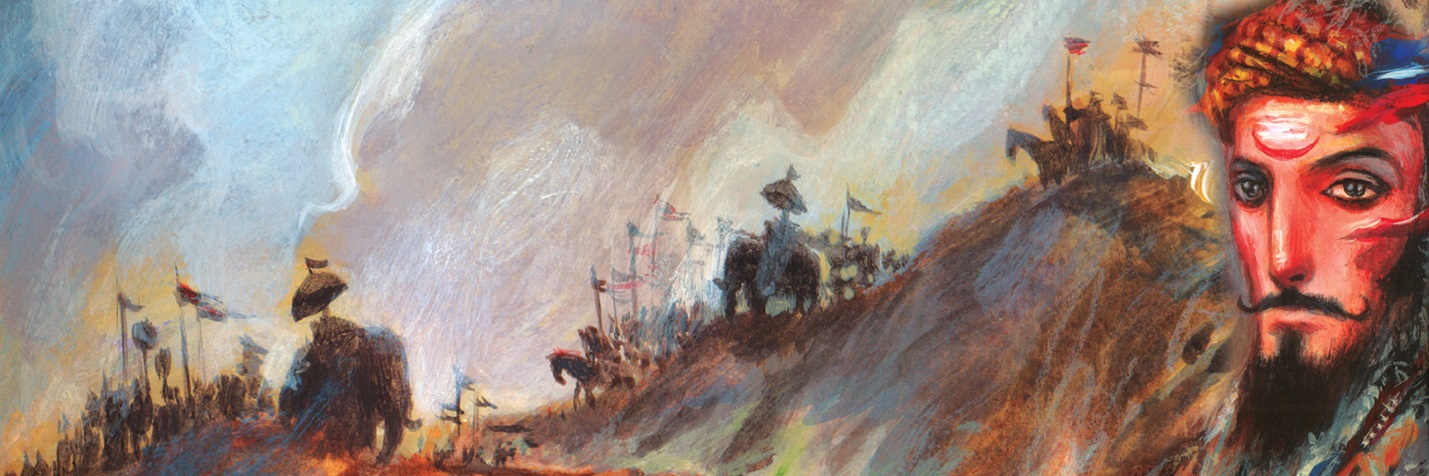
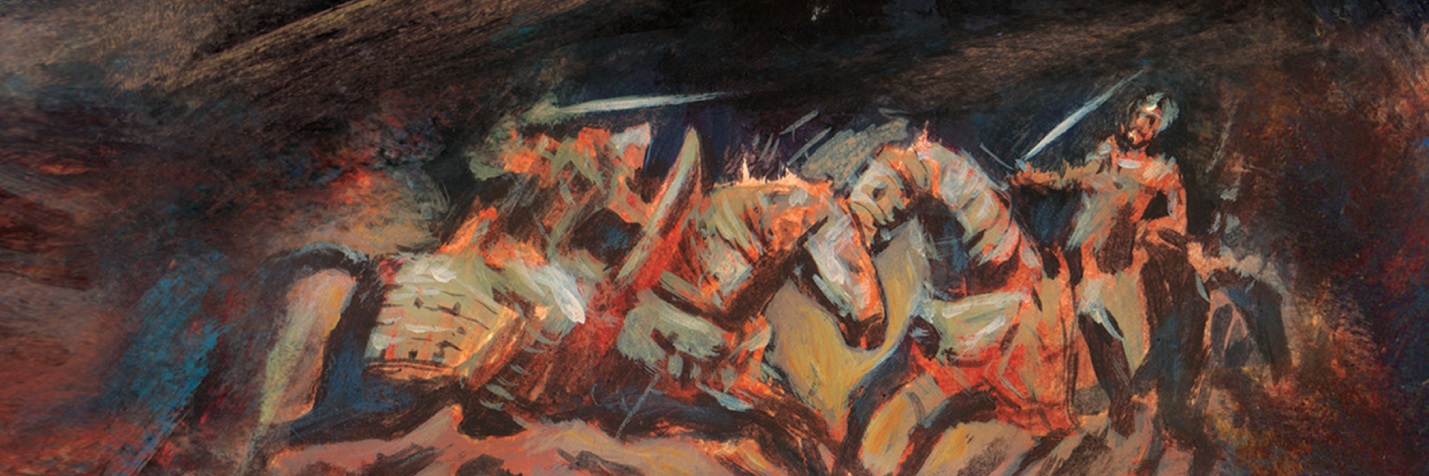
Meanwhile the Kolkata publisher was closing down. Part 2 (1659 to 1666) was written and ready, languishing in the files of my desktop. It was early 2017 I got the most important call from Vaishali Mathur, Editor in Chief of Language Publishing at Penguin India saying that she had found my manuscript in her old mails and she wants to take up the project. She said Penguin will publish both the parts in one book – that would end showing Raja Shivaji’s escape from Agra. Then stared the editing on warpath. First Vaishali Mathur trimmed to story making it fast paced and racy, Mriga Maithel Negi did the English editing, scrutinizing each word of the monster manuscript. At the end, Penguin’s senior editor, Paloma Datta looked at it through fisheye lens. The name was decided – FRONTIERS’. A very attractive cover was designed by Ahlawat Gunjan and illustration showing protagonists in their warrior avatar with a backdrop of battle chaos was created by Sankha Banerjee.
I would say the last words while telling you the story of ‘Frontier’s birth in a verse penned by me
 

Footprints get buried

Even the tracks erode

But the past still pulsates

Like lava

With unbearable load

 
——————
Frontiers, a historical saga, bring to life the complex and ever-shifting dynamics between these two arch nemeses.
AVAILABLE NOW

Technology on a Leash

Venkat Iyer is the author of Moong Over Microchips and a certified project management professional. In this piece Iyer discusses how technology could be “a useful servant but a dangerous master”. Vivek Wadhwa and Alex Salkever talk about technology on similar lines in their book Your Happiness was Hacked.
The book Your Happiness was Hacked encounters various problems that are caused by engaging with technology to an extreme and how it could be kept under check. This book exposes how tech companies entice us to overdose on their products, thereby hindering our daily lives.
—————-
I worked in the Information Technology (IT) industry for 17 years and that is enough to be immersed in the addictive tech world. Starting from the humble desktop to mighty servers with the latest software and technology, there was not a moment I did not think of IT.
Steven Spielberg once said, “Technology can be our best friend, and technology can also be the biggest party pooper of our lives. It interrupts our own story, interrupts our ability to have a thought or a daydream, to imagine something wonderful, because we are too busy bridging the walk from the cafeteria back to the office on the cell phone.”
I was to understand what he meant only in 2003 when I quit my job in IBM and decided to start my own organic farm near Mumbai. Moving to the village, only over 100 km from Mumbai, I found that there was no telephone connectivity, let alone internet. I soon realised what an impact technology had on our lives. Right from the initial dotcom boom to the introduction of smartphones and social media, technology had touched almost everyone’s lives and changed it. While it brought the world closer and made access to information easier, it also transformed our social and cultural fabric.
Way back in the nineties, one could rattle off a long list of telephone numbers, while now even for their own number, people tend to search in their mobile phones. Simple addition and multiplication need a calculator. Many would say technology makes our lives easy, but what about using our brains to perform simple tasks which will keep it alive and ticking. To counter this, Sudoku or a crossword   puzzle are recommended daily to keep the grey cells from disuse.
With the growing popularity of Facebook, I was tempted to open an account.  I could access the internet only on the weekends when I went to Mumbai from the farm, and I could not relate to many posts. Most of them were of little interest to me.  Once, when I checked my timeline I found a post by a niece in USA, describing a terrible stomach pain. I stared at the post for a while: it seemed strange that you would get up and log on to a social networking site to inform people across the world of an ailment while in so much pain. I also could not figure out why 21 people had liked the post. What exactly did they like? Her pain and trauma or the fact that they had read the post. It did not take me much time to delete my profile and I vowed never to be on Facebook again.
While the insane desire to share the humdrum realities of one’s life in public was growing thanks to Facebook, another application was gaining ground, Whatsapp. This free new app with calling facility made it possible to chat with others all over the world.  Suddenly, I was added to groups of old school friends, ex-colleagues, cousins, farmers’ groups and other of like- minded people coming together to share information. The popular activity was to forward and share as many posts as possible. It was left to the imagination if the posts were true and verified. Lately, these indiscriminate posts, sometimes circulating falsehoods or old videos have been fuelling lynch mobs and claiming the lives of people in our country. But who cares. To forward and share is our motto.
It is reported that almost 200 million people use Whatsapp in India and sadly most people believe the often scurrilous posts, sometimes proved to be patently false. It is a common sight to see people staring at the phone all day either reading or forwarding what they have received. Besides, the addiction to online games, music and videos cuts across ages.  It has become difficult to have a sane conversation with anyone.
Sometime back, I had a visitor from Mumbai who wanted to learn about organic farming and discuss the complex marketing of organic produce. In between a serious discussion, her phone beeped and soon she was lost staring at it for the next ten minutes, while I was holding forth on the topic. A while later, she returned to the physical world and said, “I am sorry, Where were we?”  I just looked at her and said, “Maybe you should send me your questions on Whatsapp and I can reply to them at leisure.” The comment did the trick and she switched off the phone for the rest of the meeting. But, sadly everyone does not react the same way and some continue to smile and stare at their phones.
Technology is not bad; it is a useful servant but a dangerous master. It is the indiscriminate use and over dependence on it that is not good for us. It is faster to email than post a physical letter and there are many other advantages. But, is there a need to stare at the phone and jump at every sound notifying you of something, tweet every moment or Facebook your aches and pains to complete strangers?  So that I am not addicted to my phone, I have fixed timings daily to read my mail and reply. Anyway if it is something urgent, I presume one would have got a call and not an email. Even when it comes to taking calls, I don’t take them all the time, especially during mealtimes or while driving.
I probably find it easier to have these restrictions since I live on the farm and not in a city with a fast- paced job. In the corporate world, there is no question of being delinked from technology.  There could be a time when you need to step back and look at your life: is this incessant use of the phones, social media and technology having an impact on your health, life, peace and your mental state? Can we strike a balance between life and technology, so we enjoy the best of technology and reclaim a life that we can truly enjoy? It is not impossible.
 
 
Your Happiness was Hacked turns personal observation into a handy guide to adapting to our new reality of omnipresent technology.
AVAILABLE NOW!

5 Signs of a Dead Relationship

Samah’s latest book, Familiar Strangers, tells the story of Priya and Chirag who like several other modern couples, are living life at breackneck speed and are unknowingly stuck in the rut of a marriage that is dying, if not already dead.
A marriage usually doesn’t go from “‘I am yours forever” to “drop dead, we’re getting divorced”. It does have a plethora of red flags in between. But would you recognize these warning signs if you saw them? Priyan and Chirag’s relationship starts to change when Chirag’s ex-girlfriend returns when they least expect it. Was that a sign of their dying relationship?
Here we have 5 warning signs most couples miss out on:
 
1. When you two no longer communicate
A sign of a healthy and loving relationship is an open and honest communication. If you and your partner are not talking or communicating with each other, then you should be worried. Failing marriages lose interest in solving problems or resolving arguments. There are fewer meaningful discussions or mutual goals and challenges to look forward to.

 
2. Intimacy is non-existent
Intimacy not only refers to sex but could also include gestures like holding hands, hugging, cuddling or holding each other. Lack of intimacy is the easiest way to know that a relationship is in trouble. If you and your partner feel more like roommates rather than a couple sharing a beautiful marriage, you seem to have lost a building block of your relationship.

 
3. You don’t fight at all
In a relationship, partners are bound to have expectations from each other. If those expectations aren’t met, couples tend to fight. But those fights take place because the relationship is worth fighting for. If couples start to avoid conflict and refuse to share their true feelings, they run the risk of repressing their feelings which ultimately leads to resentment, bitterness and anger.

 
4. When your partner stops making you feel special
Every couple has a tradition or an activity they love indulging in. Think watching movies,  cooking for one another or travelling together. When you see a sharp decline in your partner’s efforts to make you feel special or a complete disinterest in doing things they once did for you, you should be wary.

 
5. The entry of the dreaded ex
Your marriage is most likely over if your partner is speaking to their ex. Marriage is serious business and requires full dedication and commitment. If you are truly into your partner, you wouldn’t feel the need to talk to your ex-lover. So when your partner is suddenly in touch with their ex, then that’s probably the tell-tale sign that they want out.


5 Things You Should Know About the Daughters with a Legacy

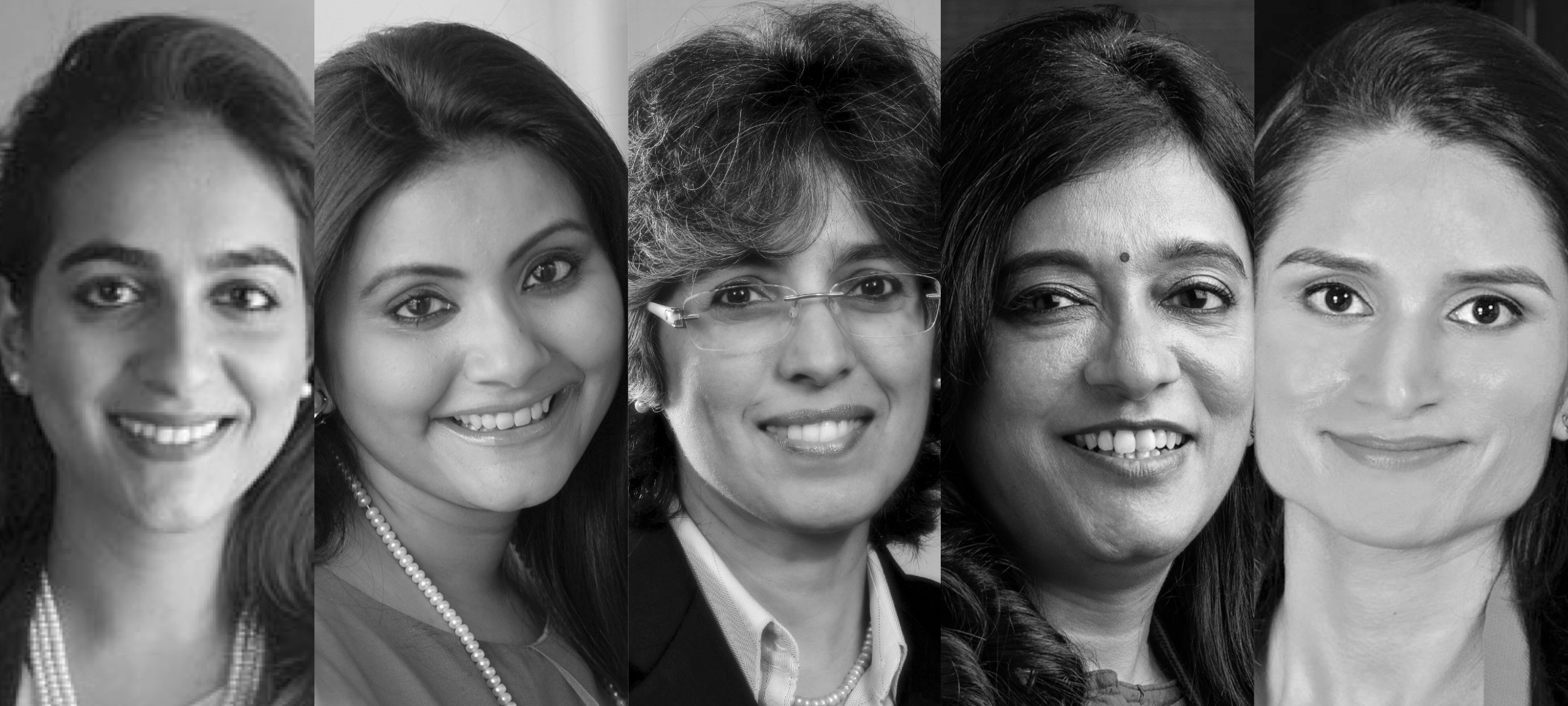
Daughters of Legacy by Rinku Paul and Puja Singhal tells the stories of twelve successful women who grew up with strong business lineages.
Chosen from a wide cross section in terms of scale of business, roles and hierarchy, these women have not only kept the legacies alive but also gone on to carve a niche for themselves as individuals beyond their famous last names. Clearly for all of them legacy is far more than mere inheritance.
Let’s meet 5 of these Daughters with a Legacy and take a look at some of the key moments in their business life.
1. Meher Pudumjee
Non-executive Chairperson, Th ermax Global, a leading energy and environment engineering company.

 
2. Priti Sureka
Whole-time Director, Emami Limited

 
3. Tara Singh Vachani
Managing Director, Antara Senior Living; Nonexecutive Director, Max India Limited

 
4. Bhairavi Jani
Executive Director, SCA Group with business interests in warehousing, supply chain technology, cargo handling and freight forwarding and shipping.

 
5. Divya Modi Tongya
Co-founder, Smart Global Group (previously Spice Global), that has interests in telecommunications, healthcare, finance and real estate.


5 Things All High School Sweethearts Will Relate To

In Durjoy Datta’s book, The World’s Best Boyfriend, Dhurv and Aranya spend a good part of their lives trying to figure out why they want to destroy each other, why they hurt each other so deeply and, why they can’t stay away from each other. 
Here are a few things you will relate to if you fell in love during school. Get ready to take a trip down the memory lane!
1. When love games determined your love for each-other:


2. Lunch breaks = spending quality time together!

3. The belief that your first love would be your last love:

4. Dreaming about the future together:

5. The first time you held hands and said ‘I love you’:


The answer to Dhruv and Aranya’s  problem is just as difficult each time because all they’ve wanted is to do the worst, most miserable things to one another.
AVAILABLE NOW!

Know About the Cyber Security of India in Five Points

A large part of the Indian economy today rides on digital networks. Broadband connectivity is provided by the optical fibre network called BharatNet which has already reached 100,000 panchayats in rural areas and is growing. India is also getting ready to launch 5G which will unleash a boom in connectivity. With the coming of the Internet of things, it is expected that tens of billions of devices will be connected to the Internet by 2020. E-commerce is expanding rapidly with foreign companies occupying the top slots in the sensitive market.
With this feverish pace of digitization comes the security risk to networks, devices and individuals. Cyber security is an ever-growing national security challenge for India. With the pace of digitization accelerating, India needs to pay urgent attention to cyber security challenges.
So how does cyber security work in India? Here are 5 points to understand it from Arvind Gupta’s new book, How India Manages Its National Security. The book explains with great clarity and thoroughness the concept and operation of India’s national security apparatus.
 
1. India is dependent on imported products and software apps which may have inbuilt vulnerabilities. Indian infrastructure for testing software and equipment is virtually non-existent.

 
2. India was among the first countries to enact a law for regulating the use of ICT for e-commerce purposes.

 
3. In 2004, the government created the CERT-In, a technical body under the Ministry of Electronics and Information Technology (MEITY).

 
4. In the evolution of cyber security institutions in India, 2013 was an important year as MEITY announced a comprehensive, forward-looking National Cyber Security Policy (NCSP) for five years.

 
5. Also in 2013, a post of National Cyber Security Coordinator (NCSC) was created with the aim of improving coordination and providing strategic guidance to other departments, by the National Security Council Secretariat (NSCS)


7 Tips to Overcome Your Tech Addiction

Incessantly browsing through our grams, checking our Slack notifications and Whatsapps, has become the new social norm. It has taken over the different tables we occupy in our day-to-day. The dining table, the meeting room table and the restaurant table, these tables were once a place exclusively for fun conversations and communal bonding. But now they’re merely another touchpoint where our phone rules our lives.
It’s high time we take back the table.
 
In Your Happiness Was Hacked, authors Vivek Wadhwa and Alex Salkever explain how tech companies entice us to overdose on tech interaction by taking advantage of vulnerabilities in the human brain function. The book discusses how to define and control the roles that tech is playing and could play in our lives.
 
Here are 7 tips and tricks from the book to avoid getting hooked on tech:


Your Happiness Was Hacked is a timely book that can act as a handy guide to help us adapt to our new reality of omnipresent technology.
AVAILABLE NOW!

5 Unforgettable Gifts from Lahore

 
Lahore is one of the most breathtakingly beautiful cities in the world but you won’t find it in most travelers’ dream destinations list. But if you are brave enough to keep the negative press aside, fight for the hard-to-get visa and save up for an expensive flight, you will be rewarded with a city known for its unwavering hospitality, rich culture and delicious delights.
 
There is a famous Punjabi saying, ‘Jinney Lahore nahin vekhiya, O jamyai nai’ (The one who hasn’t been to Lahore, hasn’t taken birth) and anyone who has visited Lahore can validate the same. Keeping in mind all the greatness of this city, we have curated a list of 5 things that the world is forever grateful to Lahore for!
1. Fawad Khan
While India may have first laid eyes on the dashing Fawad Khan as Sonam Kapoor’s lover in the bollywood film, Khoobsurat, the actor has been Pakistan’s favorite man for decades now. It’s not only because of that flawless face, but also his charming personality that can unarguably win most hearts.

 
2. Badshahi Masjid

A breathtakingly beautiful mosque, built by Aurangzeb in 1673, this is Mughal architecture at its finest. The red sandstone shaped into vast arches and sky-piercing minarets, is delicately inlaid with marble and offset by intricate stone carvings.

 
3. Nihari
Even though Karachi and Faisalabad offer a great variety of foods, it’s Lahore that draws food lovers from all over the world; and no foreigner returns from Lahore without tasting its mouthwatering, rich and spicy food. One dish that holds a special spot in every Lahori’s heart is the majestic nihari! Nihari is a thick, brown, spicy gravy with tender pieces of meat.

 
4. The Lahore Zoo
The zoo houses a collection of 1380 animals and over 136 species. The children can enjoy the electronic rides while the adults can relax by indulging in a perfect alongside the picturesque waterfall.

 
5. Goodbye Freddie Mercury by Nadia Akbar
Nadia Akbar’s audacious debut novel, Goodbye Freddie Mercury gives readers a juicy slice of Lahore by effortlessly breaking the perceived stereotypes of life in urban Pakistan. This book takes us inside the mansions of Pakistan’s ruling elite where we are revealed a life rarely thought existed in Pakistan- think drugs, sex and political plots.


Business Management Books That Will Help You Thrive

Answering some fundamental questions, from signing your first contract to the complex management of VC funding, these brilliant business books are a must read for every working professional.
In this carefully curated list of books by highly accomplished authors, you will learn about the successes and failures of the oldest, most powerful company in the world (East India Company) and the newest multi-million dollar startups (like Zomato).
—————–

Contract Terms Are Common Sense: IIMA Series by Professor Akhileshwar Pathak
It is crucial for managers to understand the terms of the contract that they work with. This exceedingly effective guide helps readers explore and master the many terms and conditions set up for conducting businesses. The book makes the subject readily accessible by employing easy-to-understand and discover-yourself techniques.
 

Business Law for Managers: IIMA Series Paperback by Anurag K. Agarwal
Even though most business managers have diverse academic qualifications-engineering being the most common, followed by chartered accountancy, economics, medicine, etc.-few come from a law background. However, it is crucial for a manager to understand the nitty-gritty of law. This hands-on guide to understanding business law is for anyone and everyone looking to run a legal-hurdle-free business.
 

A Business of State by Rupali Mishra
Around 1800, the English East India Company controlled half of the world’s trade and deployed a vast network of political influencers. Yet the story of its 17th-century beginnings has remained largely untold. Rupali Mishra’s account of the Company’s formative years sheds light on one of the most powerful corporations in the history of the world.
 

Master Growth Hacking: The Best-Kept Secret of New-Age Indian Start-ups by Apurva Chamaria and Gaurav Kakkar
Growth hacking is a combination of coding, data intelligence and marketing. It doesn’t take a lot of investment-just a whole lot of creativity, smart data analysis and agility. It has now emerged as the preferred term for growth used by start-ups and entrepreneurs in India and across the world-the new mantra they swear by, but don’t want you to learn about.
Full of riveting stories, Master Growth Hacking lets you learn from the pioneers of the field in India.
 

Chanakya and the Art of Getting Rich by Radhakrishnan Pillai
Chanakya’s Arthashastra is an unrivalled political treatise that has been used by scholars, academics and leaders across the world. In Chanakya and the Art of Getting Rich, Radhakrishnan Pillai brings out the inherent lessons from Arthashastra to present a strategic and practical way of wealth creation. This is a holistic study, written for anyone and everyone.
——————-
 

On translating Shekhar: A Life

Snehal Shingavi is associate professor of English at the University of Texas, Austin, where he specializes in teaching South Asian literatures in English, Hindi and Urdu. He is the author of The Mahatma Misunderstood, and has translated to wide acclaim the iconic short-story collection Angaaray as well as Bhisham Sahni’s memoir Today’s Pasts. Most recently, he has co-translated Agyeya’s Shekhar: A Life with Vasudha Dalmia.
In this special piece written by him, he talks to us about translating Shekhar: A Life. Let’s take a look!
————————————————————————
‘Agyeya’ (‘the unfathomable‘) is the pen name of Sacchidanand Hiranand Vatsyayan, perhaps one of the most important figures in Hindi literature in the 20th century.  He wrote widely—novels, short stories, poetry, journalism, literary criticism—and left a distinct stamp on the character and quality of literary Hindi.  As the story goes, he received his moniker from Premchand; Premchand received copies of Agyeya’s short stories from Jainendra Kumar.  S.H. Vatsyayan was in prison at the time, and the stories had been smuggled out, so Premchand gave him the title ‘Agyeya.’  In a letter to Jainendra, Premchand wrote: ‘Agyeya’s story was superb . . . People say his stories and prose-poems are better than his poetry’ (as quoted in Nikhil Govind’s Between Love and Freedom).
This exchange between the greatest Hindi novelist of the 20th century and perhaps the greatest Hindi poet in the 20th century is important, as it marks a very clear passing of the torch from a generation about to be eclipsed to a generation that would have to contend with the new challenges of independent India.  If Premchand is considered the pre-eminent realist writer of the 20th century, then Agyeya is clearly the most important modernist writer, not only because of his editorship of the various poetry collections called Saptaks that launched the prayogvadi (experimentalist) movement in Hindi poetry, but also because his most important novel, Shekhar: Ek Jeevani, announced the shift in Hindi prose in completely new directions.  Incidentally, Premchand’s most important novel, Godan, is written around the same time as Shekhar; Premchand published his novel in 1936, while Agyeya composed his between 1930 and 1932, and then published it in two parts, the first in 1940 and the second in 1942.
While I was a graduate student at the University of California, Berkeley, I worked on and eventually published a translation of Premchand’s first Hindi novel, Sevasadan.  The novel was originally written in Urdu and titled Bazaar-e-Husn and then translated into Hindi, in part because Premchand thought the novel would have a better chance of a wider readership in Hindi than in Urdu.  The Urdu version of the novel came out soon afterwards.  Once I was done with Sevasadan, I began work on translating Shekhar.
There are two things that I think are interesting about this relationship between Premchand and Agyeya.  The first thing, at least anecdotally, is that when I talk about translating Premchand, Hindi speakers remember having read something by him at least in school.  When I talk about having translated Agyeya, very few people outside of either the literary world of Hindi or the academic world seems to know of whom I am speaking.  This has always seemed to me to be a shame, since the quality of Agyeya’s prose is really quite stunning.  There is a reason for this difference, and I will come back to it shortly.
The second thing is that even though they are considered to be very different novelists with very different styles, Premchand begins a process of considering the interior life of his characters that is only completed once Agyeya writes a novel almost entirely in the first person.  Premchand was always interested in characters that had been deemed unfit for novels (courtesans, peasants, Dalits), but there was a limit to how far he could enter into their imaginations.  It takes the changing circumstances of the movement for independence, and even Agyeya’s more radical politics, before the novel can be established on a different footing.  When it was published, Shekhar was considered to be an iconoclastic, even scandalous, novel.  It took up a number of questions—sexuality, atheism, and perhaps most famously, incest—that novels up to that point had shied away from.  The novel’s frank discussion of these questions spoke to a generation of people that were trying to deal with the limitations of social conservatism and religious restrictions as well as the possibilities contained in revolutionary politics.
The thing that has been less considered, however, is the relationship between this new interest in character psychology and development and the transformation of the novel more generally.  This is all the more surprising since Agyeya’s novel explicitly talks about the relationship between the narrative of the development of the self (what in German is called the Bildungsroman) and the transformation of the novel in general.  What does it feel like to document or to account for the transformation that an individual undergoes?  Agyeya’s main character seems to ask the question: how do we account for ourselves?  This is even more poignant since the novel is told as a sort of flashback while the main character is awaiting execution by the British for his involvement in revolutionary activism.  In the opening pages of the novel, Shekhar wonders: ‘What kind of realization—to what end? What will my death realize—and what realization did my life produce?’  The question is not simply existential—it is the crux of the experience of modernity, when individuals no longer have recourse to religion as explanations for their choices.
In the middle of the second chapter of Agyeya’s Shekhar: A Life, the narrator (Shekhar) wonders about whether his life contains enough adequate material to form a novel.  He ruminates about the issue:
But it seems to me that all the challenges that I could remember in my life were mine, were original, were complete stories in themselves, and my life was a brilliant novel. I may have been the only one who felt this way; fascination with one’s own life turns it into something unique. But at the same time I realize that it wasn’t so unique, so idiosyncratic that others couldn’t derive pleasure from it; my private experience contained enough of a germ of collective experience that the collectivity would be able to understand it and see a glimpse of itself in it. My life is a solution in which individuality and ‘type’ are mixed together, without which art is impossible, and without which the novel is impossible.
This description of the relationship between private experience and public understanding is in many ways the core of the novel’s interest: how do we reconcile our almost complete alienation from society, its almost total unwillingness to accept our tiny rebellions, and our deep desire to merge completely into it, to find in it some solace, some understanding of our own angst.
In Shekhar, Agyeya tries to merge the genres of autobiography and novel.  He was constantly annoyed, as he describes in his introduction to the novel, that people confused him with the main character, even as he repeatedly drew on his own memories for material for the novel.  But he wanted to maintain a separation between himself and Shekhar; the character, Agyeya maintained, had a life and a consciousness that developed according to literary plans rather than the ones he had followed.  The novel was written under brutal conditions, while Agyeya was awaiting trial for his involvement in the revolutionary movement against British colonial rule (he had been a part of Bhagat Singh’s Hindustan Socialist Republican Association).  Agyeya had been responsible (though the courts eventually dropped the charges) for helping the HSRA build the bombs that they used to try and blow up the train carrying Viceroy Lord Irwin.
Agyeya’s collaborator, Yashpal, described his time in the HSRA this way:
The story I tell is a personal one.  It cannot be called history—no individual’s recollections can.  But the relationship between the experiences of individuals and the history of society is the same as that of beads to a necklace but without them the necklace cannot be made.  While these reminiscences cannot be called history, they do offer profound insights into the events of the revolutionary movement and the thinking which led to the events. (As translated by Corinne Friend in ‘Yashpal: Fighter for Freedom—Writer for Justice’)
Shekhar describes something similar:
The order of my memories has come undone, like when a necklace of pearls falls apart and the spilt pearls are rethreaded haphazardly. I see another scene at the same time that I see this one. It has the same characters, the setting is the same, but its essential theme is completely different. This scene has the same point of view as the other, but in the course of my life it seems as if this scene bears no relation to the other, and if there is a connection then it is that the two scenes are symbols of the simultaneous development of very different feelings . . .
It is this focus on memory—as incomplete, haphazard, chaotic, but still meaningful—as the foundation of narrative that makes Shekhar such a marvelous novel.  These were questions that were being asked more generally as India sought to make itself into an independent nation.  The novel is remarkable in that it takes independence to be a foregone conclusion.  But it is the radical bent of the novel that draws us in.  It makes the novel philosophical and introspective, and it also forces us to ask certain questions of ourselves: how authentic are we; what do we intend our lives to mean; when we tell stories about ourselves, how much of these are true; and can we find beauty in even the most insignificant of moments?
 

error: Content is protected !!