




The holidays are here, and to add to the excitement and cheer, we’ve got another great set of books for you! Dive in to see the books to look forward to, this December.
Healed

Healed is the powerful, moving and deeply personal story of actor Manisha Koirala’s battle against ovarian cancer. From her treatment in the US and the wonderful care provided by the oncologists there to how she rebuilt her life once she returned home, the book takes us on an emotional roller-coaster ride through her many fears and struggles and shows how she eventually came out triumphant.
Delusional Politics: Brexit and Political Disorder

Delusional Politics looks at some of the tallest political leaders with the highest standing-in China, the USA, the UK, Pakistan and Sri Lanka, among others-to bring to light how these evolved statesmen are responsible for the rise of a new world [dis]order.
Of Counsel

In Of Counsel: The Challenges of the Modi-Jaitley Economy, Arvind Subramanian provides an inside account of his rollercoaster journey as the chief economic advisor to the Government of India from 2014-18, succeeding Raghuram Rajan as captain of the ship. With an illustrious cast of characters, Subramanian’s part-memoir, part-analytical writings candidly reveal the numerous triumphs and challenges of policymaking at the zenith, while appraising India’s economic potential, health and future through comprehensive research and original hypotheses.
Flowers on the Path

This book is a compass which will lead you to that path of peace and enlightenment. It is a collection of articles by Sadhguru which have, for several years, healed many through their beauty, humour, clarity and wisdom. And like flowers, these articles have inspired and stimulated readers, wafting into their lives as a gentle fragrance on some mornings, and on others, startling them awake with fresh perspectives on age-old ideas and beliefs.
God of Sin: The Cult, Clout and Downfall of Asaram Bapu

Asaram originated the business model of branding goods and selling them to followers, using faith as a marketing tool-which other godmen emulated to great success. His commercial empire, now being investigated by economic offences agencies, was built on unaccounted donations, loans given on hefty rates of interest, investments in dubious companies, money laundering and dodgy real estate deals.
God of Sin pieces together Asaram’s journey to spiritual godhood, his fall from grace and the long and arduous road to bring him to justice.
The Hungryalists

This is the never-told-before story of the Hungry generation (or the Hungryalists)-a group of barnstorming, anti-establishment poets, writers, artists and activists in Bengal in the sixties. Braving social boycott, ridicule, and arrest, the Hungryalists changed the literary landscape of Bengal forever. Along the way, they also influenced iconic poets such as Allen Ginsberg who struck up a lifelong friendship with the Hungryalists.
If You See Me, Don’t Say Hi: Stories

In eleven sharp, surprising stories, Neel Patel gives voice to our most deeply held stereotypes and then slowly undermines them. His characters, almost all of whom are first-generation Indian Americans, subvert our expectations that they will sit quietly by. If You See Me, Don’t Say Hi examines the collisions of old world and new world, small town and big city, traditional beliefs (like arranged marriages) and modern rituals (like Facebook stalking). Ranging across the country, Patel’s stories-empathetic, provocative, twisting, and wryly funny-introduce a bold new literary voice, one that feels timelier than ever.
The Anatomy of a Sting

Bhupen Patel takes us through the entire process of a sting and reveals the amount of hard work it takes to not just uncover a story that requires further discreet investigation but also gather enough evidence to bring it to the notice of the public and authorities concerned. Each account will keep you on the edge of your seat and allow a glimpse into the life of an investigative journalist.
A Dream I Lived Alone

Padma Vibhushan-awardee Ustad Ghulam Mustafa Khan narrates his life’s story-from practicing music in a graveyard as a young boy to teaching stalwarts of the music industry, his journey is as lyrical as his songs. Captured in its essence by Namrata Gupta Khan, his daughter-in-law, A Dream I Lived Alone is a heart-warming story of love, riyaz, dedication and the maestro of music, Ustad Ghulam Mustafa Khan.
And Now and Here

Most of us look for security in our relationships and in our choice of living and working conditions. Underlying this search for security is a deep, instinctive fear of death, which continually colours our lives and drives our focus outward, toward survival.
But we also have a longing to turn inward, to relax deeply within ourselves, and experience the sense of freedom and expansion this brings. With this book the reader can start an exploration of his or her inner world.
Leapfrogging to Pole-vaulting

From Leapfrogging to Pole-vaulting looks at the extraordinary challenges of creating disruptive solutions to burning problems in energy, environment and employment in India. We are guzzling expensive, exhaustible energy resources and precipitating enormous environmental crises in order to drive an economic engine that ultimately creates no jobs.
In this original and ambitious book, Dr Mashelkar and Pandit lay out a comprehensive roadmap to a new future, notwithstanding all the formidable obstacles, either perceived or real.
Crash

In this book, the author shows that great leaders continue to excel not just because of their skills and intelligence but also by connecting with others using emotional competencies like empathy and self-awareness.
Filled with anecdotes, analysis of various situations CEOs may find themselves in and unconventional advice to help them, Crash: Lessons from the Entry and Exit of CEOs is for veteran leaders as well as for those who aspire to start their own ventures.
Bhagavata Purana Vol. 1 + 2 + 3


A seamless blend of fable and philosophy, the Bhagavata Purana is perhaps the most revered text in the Vaishnava tradition. It brings to life the legends of gods, asuras, sages and kings-all the while articulating the crucial ethical and philosophical tenets that underpin Hindu spiritualism.
Partitions of the Heart: Unmaking the Idea of India

There was one partition of the land in 1947. Harsh Mander believes that another partition is underway in our hearts and minds.
How much of this culpability lies with ordinary people? What are the responsibilities of a secular government, of a civil society, and of a progressive majority? In Partitions of the Heart: Unmaking the Idea of India, human rights and peace worker Harsh Mander takes stock of whether the republic has upheld the values it set out to achieve and offers painful, unsparing insight into the contours of hate violence.
Finding Radha: The Quest for Love

Namita Gokhale and Malashri Lal, who brought us In Search of Sita: Revisiting Mythology, now present an anthology on the mysterious Radha, the epitome of love, who defies all conventional codes yet transcends social prohibitions through the power of the spiritual and the sensual, the sacred and the erotic. Finding Radha is the first of its kind: a collection of poetry, prose and translation that enter the historical as well as the artistic dimensions of the eternal romance of Radha and Krishna.
Trial by Silence

At the end of Perumal Murugan’s trailblazing novel One Part Woman, readers are left on a cliffhanger as Kali and Ponna’s intense love for each other is torn to shreds. What is going to happen next to this beloved couple?
In Trial by Silence-one of two inventive sequels that picks up the story right where One Part Woman ends.
A Lonely Harvest

At the end of Perumal Murugan’s trailblazing novel One Part Woman, readers are left on a cliffhanger as Kali and Ponna’s intense love for each other is torn to shreds. What is going to happen next to this beloved couple?
In A Lonely Harvest-one of two inventive sequels that pick up the story right where One Part Woman ends. But it has a different ending.
The Tata Group: From torchbearers to trailblazers

With over 100 companies offering products and services across 150 countries, 700,000 employees contributing a revenue of US$100-billion, the Tata Group is India’s largest and most globalized business conglomerate. The Tata name is known for salt, software, cars, communications, housing and hospitality.
How did they come so far? This book will tell you!
The Line of Control: Travelling with the Indian and Pakistani Armies

This vividly told, fast paced narrative brings the border area to life. Jacob was given unprecedented access by the Indian and Pakistani armies and he explores how the border is seen-both in the popular imagination and by those who exist in its shadow. He chronicles the lives of civilians and soldiers, their courage and resilience in the face of constant danger and the extraordinary similarities between the two sides.
Category: Features
articles features main category
Meet the Characters from Anand Neelakantan's 'Vanara'

Baali and Sugreeva of the Vana Nara tribe were orphan brothers who were born in abject poverty and grew up as slaves like most of their fellow tribesmen. Sandwiched between the never-ending war between the Deva tribes in the north and the Asura tribes in the south, the Vana Naras seemed to have lost all hope. But Baali was determined not to die a slave. Aided by his beloved brother, Sugreeva, Baali built a country for his people. For a brief period in history, it seemed as if mankind had found its ideal hero in Baali.
But then fate intervened through the beautiful Tara, the daughter of a tribal physician. Loved by Baali and lusted after by Sugreeva, Tara became the cause of a fraternal war that would change history for ever.
The love triangle between Baali, Tara and Sugreeva is arguably the world’s first. Written by Anand Neelakantan Vanara is a classic tale of love, lust and betrayal. Let’s meet the characters.
Baali – the chief of Vana Naras, an indomitable warrior, a noble savage, and straight as an arrow. He loves his brother Sugreeva deeply and would give him anything he asks for – except Tara, who is the love of his life.
~
Sugreeva – The greatest warrior in Vana Nara tribe after Baali. He loves his brother and would do anything for him. He has always been the second man and for him, the end justifies his means. If he wasn’t lusting after Tara, his devotion to his brother was incomparable.
~
Tara – Daughter of an impoverished but principled and kindhearted tribal doctor. She was considered to be the wisest of all and the most desirable women as per Baali. She was deeply in love with Baali, her husband. If Baali had not been there, perhaps Sugreeva had a chance of marrying her.
Shakespearean in its tragic depth and epic in its sweep, Vanara gives voice to the greatest warrior in the Ramayana-Baali.
100 years of Sai Baba: His Journey on Life, Death and Everything in Between

Rabda has attempted suicide and chances are that he is going to die. Sai Baba of Shirdi enters the hospital room and awakens the spirit body of Rabda. The two, Master and musician, begin to converse about life, death and everything in between.
Set in the present, Rabda by Ruzbeh N. Bharucha takes the reader to the past, to when the Sai lived in His physical body and the life and philosophy of Sai Baba of Shirdi are revealed.
Here are seven quotes from the book that will show you Sai Baba’s path:
“ Each moment, every single moment, we either create a dream or a nightmare, as each moment we either choose to live or we choose to kill the opportunity to live.”
∼
“Either you believe that God does not exist, there is no Supreme Power running this grand show, or you believe in a just God.You cannot believe in a God who exists but is unjust.”
∼
“The more selfless your love,the greater the happiness all around.”
∼
“You may pronounce the words immaculately but if the words aren’t coming from the very breath of your essence, the very sigh of your soul,then those prayers might as well be verbalized by an intelligent parrot.”
∼
“One needs to be careful of desires as once you have your desires under control,you shall move into the region of the heart.”
∼
“When your thoughts rule you, you are like a slave in your own house.”
∼
“So the only wise and commonsensical way of going through life is calmly,giving your best, and leaving the rest to Him.”
A powerful spiritual read, Rabda is a journey you really do not want to miss.
Five Modern Homages to Jeeves!
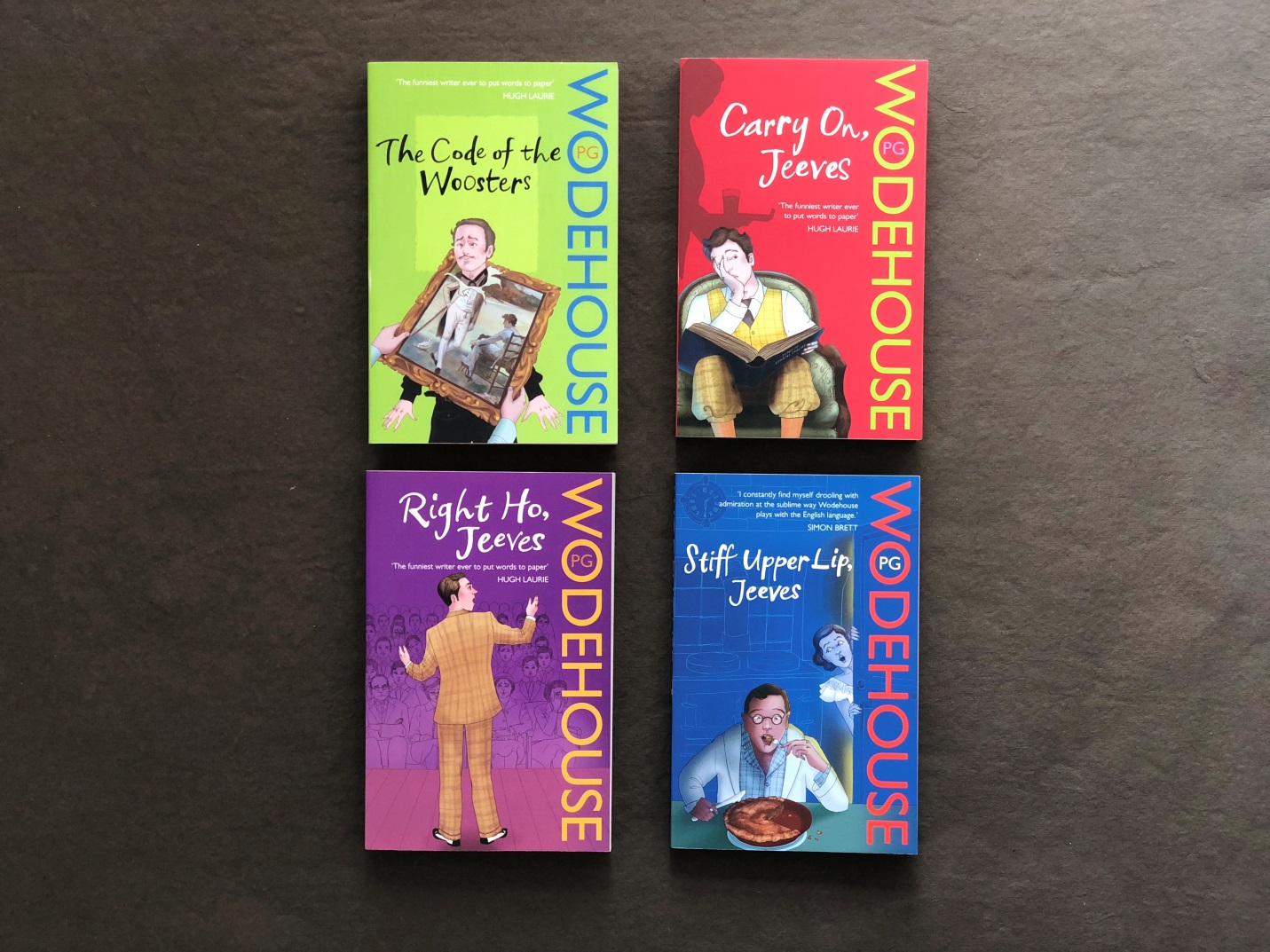
PG Wodehouse’s memorable creation, is a highly implausible pairing—not romantic, not quite friendship but something immeasurably greater—that of that incomparable lounger and shining light of the Drones Club, Bertie Wooster and his valet, Jeeves.
‘Valet’ may be his official job designation, but he is so much more—father figure, nurse, guardian angel and all-round messiah to Bertie and his many bumbling friends, extricating them from multiple capers and bad decisions-money, thievery and marriage.
Jeeves and Wooster live on through modern literary tributes, TV shows and through the ‘bumbling master-supremely efficient staff’ trope still used in so much modern media.
Jeeves and the King of Clubs-Ben Schott
This is a magnificent new homage to Jeeves and Wooster, that leads them through an uproarious adventure of espionage through the secret corridors of Whitehall, the sunlit lawns of Brinkley Court, and the private clubs of St James’s. As storm clouds loom over Europe and the very security of the nation is in peril-it seems that Jeeves has long been an agent of British Intelligence, but now His Majesty’s Government must turn to the one man who can help . . . Bertie Wooster. We encounter an unforgettable cast of characters – old and new – including outraged chefs and exasperated aunts, disreputable politicians and gambling bankers, slushy debs and Cockney cabbies, sphinx-like tailors, and sylph-like spies.
Jeeves & the King of Clubs is essential reading for aficionados of The Master, and a perfect introduction to the joys of Jeeves and Wooster for those who have never before dipped their toe.
(Read more about this story here)
The classic television adaptation-Jeeves and Wooster
This is the show that made Laurie and Fry one of the ultimate dream-teams, almost as perfect as Jeeves and Wooster, Laurel and hardy or (as Wodehouse would have put it) eggs and b. The episodes keep the deliciously Jazz-Age nonchalance of the novels while the irresistible charm and chemistry of Stephen Fry and Hugh Laurie is the perfect recreation of the eternal chemistry of Jeeves and Wooster.
(Read more about this story here)
Wake-Up, Sir! by Jonathan Ames
From the creator of the HBO series Bored to Death, the story of a young alcoholic writer and his personal valet, a hilarious homage to the Bertie and Jeeves novels of P.G. Wodehouse.
Alan Blair, the hero of Wake Up, Sir!, is a young, loony writer with numerous problems of the mental, emotional, sexual, spiritual, and physical variety. He’s very good at problems. But luckily for Alan, he has a personal valet named Jeeves, who does his best to sort things out for his troubled master. And Alan does find trouble wherever he goes. He embarks on a perilous and bizarre road journey, his destination being an artists’ colony in Saratoga Springs. There Alan encounters a gorgeous femme fatale who is in possession of the most spectacular nose in the history of noses. Such a nose can only lead to a wild disaster for someone like Alan, and Jeeves tries to help him, but…well, read the book and find out!
(Read more about this story here)
Jeeves and the Wedding Bells-Sebastian Faulks
A gloriously witty novel from Sebastian Faulks using P.G. Wodehouse’s much-loved characters, Jeeves and Wooster, fully authorised by the Wodehouse estate.
Bertie Wooster is staying at the stately home of Sir Henry Hackwood in Dorset. He is more than familiar with the country-house set-up: he is a veteran of the cocktail hour and, thanks to Jeeves, his gentleman’s personal gentleman, is never less than immaculately dressed.
On this occasion, however, it is Jeeves who is to be seen in the drawing room while Bertie finds himself below stairs – which he doesn’t care for at all. His predicament is, of course, all in the name of love …
(Read more about this story here)
A film homage to the master-valet pairing-Arthur (1981)
Featuring Sir John Gielgud as Hobson- a Jeeves-esque valet to Dudley Moores’s Arthur, the classic ‘happy drunk’ playboy-the movie takes one through a crazy ride of finding love amid wealth, prostitution and substance abuse in the hedonism and excess of 1980s America.
The film won writer Steve Gordon an Oscar nomination for Best Original Screenplay and the Writer’s Guild of America award for Best Comedy Written Directly for the Screen.
(Read more about this story here)
Home Remedies to Strengthen Your Lungs – Handy Tips from 'The Asthma Cure'

Given the levels of pollution in many metropolitan cities and states in India, most of us are able to identify the impact on our lungs. But did you know that many a times the medicines and bronchodilators prescribed to asthmatics to temporarily relieve the symptoms actually weaken the lungs over a period of time?
Using authentic remedies and principles from Ayurveda and macrobiotics, The Asthma Cure is a step-by-step practical guide with natural remedies, easy-to-follow wholesome recipes and daily food plans to help a person heal bronchial asthma, wheezing and other lung-related conditions naturally.
Listed below are a few quick home remedies and tips to strengthen your lungs:


Asthma is a curable disease. This is the primary reason Tarika Ahuja chose to write The Asthma Cure and she hopes to work as an asthma revolutionary through workshops and awareness campaigns in order to break the myth that it is incurable.
6 Instances Highlighting the Pervasiveness of Caste in Everyday India
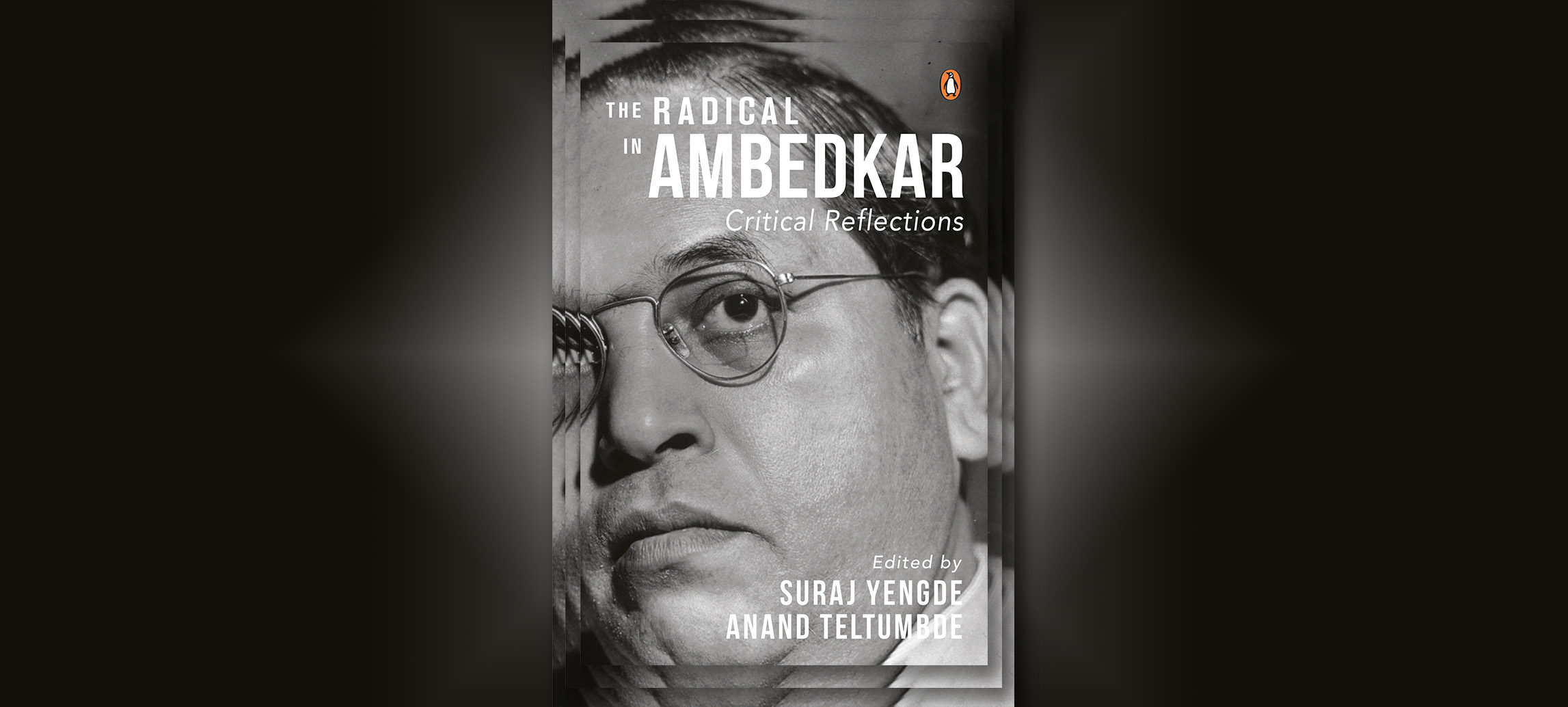
The Radical in Ambedkar: Critical Reflections , edited and introduced by Anand Teltumbde and Suraj Yengde, establishes B.R. Ambedkar as the most powerful advocate of equality and fraternity in modern India. Critically evaluating his thought and work, the essays in this book—by Jean Drèze, Partha Chatterjee, Sukhadeo Thorat, Manu Bhagavan, Anupama Rao and other internationally renowned names—discuss Ambedkar’s theory on minority rights, the consequences of the mass conversion of Dalits to Buddhism, Dalit oppression in the context of racism and anti-Semitism, and the value of his thought for Marxism and feminism, among other global concerns.
Read on to learn why Ambedkar deemed it essential to demystify the traditional terminology of caste oppression
Economic problems intertwine with social discrimination
“The problems of untouchability and caste discrimination and atrocity, however need to be top priorities in government policy and programmes, and in high-caste civil society. Presently, they are low in the pecking order. The removal of untouchability has not become a state-level issue of prime concern, importance and urgency. But it is as important as the problem of poverty. If poverty is the daily experience of hunger, discrimination is the daily experience of humiliation and contempt. It is a day-to-day experience which is absorbed by Untouchables under suppression and dominance.”
The history of caste took roots from skin colour
“The term ‘caste’ is not of Indian origin. Formulated by the Portuguese in the 16th Century, the word has roots in the Portuguese word casta, which literally refers to breed. Varna, which finds mention in the Rig Veda, the oldest of the Vedas, referring to class, also means colour in Sanskrit and is essentially a colour system construct.”
Marginalisation is entrenched deep within our society
“Both African-Americans and Dalits have been segregated and terrorized, denied education, economic opportunity, healthcare and political participation over centuries, and both continue to be exploited economically and psychologically for the benefit of those the elites in their respective societies have ranked above and against them.”
Misogyny and lack of agency in women is a byproduct of casteism
“The structural reproduction of caste occurs in a systematic alliance of unfair gender norms and sexual violence. In other words, the caste system is grounded in gender discrimination and sexual violence. The system operates through a complete control over the being-body of the woman, reducing her to a sub-human category. One can outline the caste-gender-sexuality system as a birth-related graded hierarchical structure of purity pollution and division of labour manifested in distinct ritual status and style of life.”
The practice of segregation does not even spare cremation grounds
“The most widespread and blatant practice of untouchability in the public secular sphere relates to water and cremation or burial grounds—the bare necessities of life and death. Despite being common amenities that are managed and maintained by local governments, access to them continues to be governed by the notion of caste-based pollution and untouchability.”
Educational institutions influence casteist attitudes amongst children
“The practice of untouchability continues to pervade the public sphere, including a host of state institutions and the social interactions that occur within them. In one out of four primary schools in rural India, Dalit children are forced by their teachers or by convention to sit apart from non-Dalits. As many as 40 percent of schools practise untouchability while serving midday meals, with Dalit children being made to sit in a separate row while eating.”
An extraordinary collection of immense breadth and scholarship that challenges the popular understanding of Ambedkar, The Radical in Ambedkar is essential reading for all those who wish to imagine a new future.
5 Facts You Did Not Know About Paulo Coelho

Bestselling author Paulo Coelho has just released his long awaited semi-autobiographical work, Hippie, adding to the literary legend’s incomparable bestselling history. Coelho’s titles have been bringing people across the world solace and wisdom for decades, and his latest title is no different. This book is a rare glimpse into Coelho’s life itself, giving readers insight into what made Coelho the writer he is today. Along with the heartbreaks of his own life, we travel with Paulo through his formative years, and through revolutionary days of modern Western philosophy – the 70’s.
So what do you need to know about Hippie?
Paulo Coelho Loves India:
While never having visited India yet, Paulo believes that Indian culture has been a huge influence on both himself and western philosophy.
As quoted in this interview with the Hindustan Times, Coelho talks about how he has been critically influenced by Rabindranath Tagore. He quotes a few lines from the Gitanjali at the beginning of Hippie, saying “Poetry is another way of seeing the world. These days people don’t pay enough attention to poetry. By quoting Tagore at the beginning of the book, I wanted to bring back attention to his work.”
Coelho first wanted to title this book ‘And where the old tracks are lost’, from the same Tagore poem. He decided against it as he was unsure as to whether it would translate across languages, and settled instead for Hippie.
~
Paulo Coelho’s Parents Did Not Understand Him:
Paulo Coelho’s parents, worried that he wanted to become a writer and an artist, put their son in an insane asylum three times before the age of 20. He says, “My parents thought I was psychotic. That was the diagnosis. I used to read a lot, I was very shy and I didn’t socialise very easily. They were desperate. It wasn’t that they wanted to hurt me, but they didn’t know what to do.
“I have forgiven them. They did not do that to destroy me, they did that to save me. And it happens with love, all the time – when you have this love towards someone else, but you want this person to change, to be like you. And then love can be very destructive. It is up to you to say, ‘Stop, I love you but I’m going to do what is better for me and at the end of the day, you’re going to realise that I was right.”
After some therapy, he came to the conclusion that everyone must live out their madness a little bit. Now, he says, “If madness means being other than “normal” that is fine with me. If it is threatening for oneself and society, there is a problem. My motto is: A little bit of madness is quite healthful.”
~
Paulo Coelho Wrote Radical Songs That Sent Him To Jail:
After years of hedonism on the road, Paulo returned to Brazil to pursue a career writing songs. He built a strong and lucrative career doing this – in 1974, he was even arrested for ‘subversive’ activities by the ruling military government for writing revolutionary lyrics. He went through torture in jail at the time. He says, “I think I was more frightened when I was in jail than I have ever been, and afterwards I was frightened for seven years… it is a traumatic experience, but then after seven years, time heals everything and today I’m engaged in several projects of civil rights, Amnesty International included. Every time that I see there is something wrong, I think it is my responsibility to voice my opposition. It may not work, but at least I am not silent. I’m not a coward. I have my fears, but I am not a coward.”
~
Paulo Coelho Has a Fascinating Writing Ritual:
The theme of omens has influenced Coelho’s work from the Alchemist onward, and it is a facet of his writing influenced from his life. Coelho pays a great deal of attention to omens, and one in particular – he will start writing a new book only after finding a white feather.
“The white feather thing started before my first book, The Pilgrimage. I asked myself, shall I write that book? I was not sure and I said if I see a feather today, I’m going to write; if I don’t see it it’s not in my destiny. I found it so I said I have to write. And the next book, I followed the same ritual and then it became a tradition and now I cannot write unless I find a white feather.” This has since become more specialized, as white feathers grew increasingly easy to find. As of 2005, his challenge was to find a white feather in the January of an odd year.
~
Paulo Coelho’s Spiritual Journey began at Age 42:
For those with a taste for literary laughs, this might be the answer to life the universe and everything – when did Paulo Coelho gain enlightenment? At the age of 42.
In 1986, Coelho took a walk down Road of Santiago de Compostela, a 1000+ km walk of pilgrimage in Northern Spain. He would say, “I was very happy in the things I was doing. I was doing something that gave me food and water – to use the metaphor in The Alchemist, I was working, I had a person whom I loved, I had money, but I was not fulfilling my dream. My dream was, and still is, to be a writer.” He decided he had to do it and never looked back. Today, nearly thirty years later, he’s bringing us another exquisite walk through his life and soul, in Hippie.
In Hippie, his most autobiographical novel to date, Paulo Coelho takes us back in time to re-live the dream of a generation that longed for peace and dared to challenge the established social order-authoritarian politics, conservative modes of behavior, excessive consumerism, and an unbalanced concentration of wealth and power.
The Non Violent Struggle for Freedom – an Excerpt
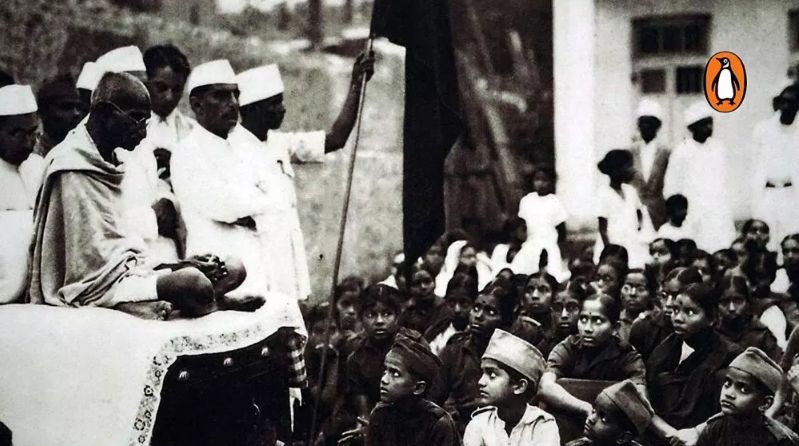
It was Gandhi, first in South Africa and then in India, who both evolved a technique that he called ‘satyagraha’ that he characterised in terms of its ‘non-violence’. In this, ‘non-violence’ was forged as both a new word in the English language, and as a new political concept.
The Non-violent Struggle for Freedom by David Hardiman brings out in graphic detail exactly what this entailed, and the formidable difficulties that the pioneers of such resistance encountered in the years 1905-19.
Here is an excerpt from the book:
The idea of nonviolence as a form of political strategy was theorised by Gandhi in India during the second decade of the twentieth century. The Oxford English Dictionary states that the first recorded usage of the word – in its hyphenated form – was in the nineteenth century as a medical term describing either a certain type of surgical procedure (Britain) or the failure of the body to resist the violence that is inflicted on it by disease (USA). Only in 1914 did it appear in a political context when a Wisconsin newspaper contrasted ‘rumpus and riot’ with ‘the tenets of moderation, orderly thinking and non-violence’. The next usage recorded in the dictionary was by Gandhi, who stated in 1920: ‘I believe that non-violence is infinitely superior to violence, forgiveness is more manly than punishment.’ Despite the preceding appearances of the word in Britain and the USA, the dictionary gives its etymology as a translation of the Sanskrit word ahimsa, which is a combination of a- (non-) and himsa (violence). This indeed was how Gandhi was to project the idea – namely that nonviolence was a major philosophical principle that was rooted in ancient India. If, however, we look at the nineteenth-century Sanskrit- English dictionary by Monier-Williams, we find that the term – spelt here as ahinsa – is translated as ‘not injuring anything, harmlessness (one of the cardinal virtues of most Hindu sects, but particularly of the Buddhists and Jains; also personified as the wife of Dharma)…security, safeness’. Ahinsa-nirata is defined as ‘harmlessness or gentleness’, ahinsana as ‘not hurting’, and ahinsra as ‘innocuous, harmless behaviour’. The term thus suggested passivity, rather than a principled resistance to wrong-doing that avoids the use of violence – as Gandhi understood it.
***********************************
In the past, ahimsa was hardly deemed to have any applicability to popular protest, or be some sort of political technique. This only became possible in the epistemic space that we associate with modernity, with its emphasis on the need of states to enjoy popular legitimacy and with acts of mass civil protests becoming one major way in which popular feeling may be expressed. In emphasising the need for peaceful means, dissent could be expressed without the need for that violence that could threaten both civil tolerance and even civil society itself. Although such a principle was conceived initially conceived in terms of the secular method of ‘passive resistance’, with peaceable methods being deployed tactically rather than as a matter of principle, it was Gandhi who first tried to make ahimsa-cum-nonviolence into an imperative principle for all forms of civil protest. In doing so, he claimed a compelling power to a moral stance that was, as he understood it, invested with divine power – that of ‘truth force’. In this, God/Truth was accorded agency. Secular notions of ‘passive resistance’, ‘civil resistance’, ‘people power’ and the like never made such a daring claim.
Gandhi only began to talk about ahimsa as an informing principle of his method of resistance after his return to India from South Africa in 1915. Gandhi only began to talk about ahimsa as an informing principle of his method of resistance after his return to India from South Africa in 1915. Although Gandhi had already forged his method of satyagraha, he had never previously described it as a form of either ‘ahimsa’ or ‘nonviolence’. There has been some confusion on this matter, as the Collected Works of Mahatma Gandhi gives the impression that he deployed the concept when he launched his first campaign of passive resistance in 1906. In this source, Gandhi had allegedly asserted: ‘This is for us the time for deeds, not words. We have to act boldly; and in doing so, we have to be humble and non-violent.’ If we examine the original version in Gujarati, we find that he is quoted as saying ‘…narmash vaparvani che’ which literally means ‘make use of softness’. In fact, the root of ‘narmash’ is the noun ‘naram’, which means soft and smooth, gentle, tender, humble, soft, weak, effeminate. In other words, it suggests passivity, a connotation that Gandhi was soon to distance himself from.
Although non-violence is associated above all with the towering figure of M.K. Gandhi, David Hardiman shows – in his book, The Non Violent Struggle for Freedom – that civil forms of resistance were already being practiced by nationalists in British-ruled India under the rubric of ‘passive resistance’.
Seven Things You Didn't Know about A.R. Rahman

Who really is A.R. Rahman? We know his music. We know him as a nation’s pride, winner of multiple national film awards, Oscars and Grammys. But what about the man? In this intimate biography, Notes of a Dream, by Krishna Trilok, Rahman opens up about his life like never before.
Here are seven interesting facts you didn’t know about A.R. Rahman: the man behind the music, and the music that made the man:
‘A.R. Rahman is obsessed with all things tech, and one look around his hall is enough for someone to get the idea. Even the creamy curtains covering the windows are automated. And there are numerous laptops, tablets and other devices, including at least one virtual reality headset and a drone, strewn across the room. As there are in all his studios.’
‘He’s a man interested in a million things. He’s very aware of what’s happening in the world, right from politics to warfare. He goes on to the Net and gets information all the time. He’s interested in visual media; cameras, drones and all that. He knows more about these than most directors even.’
‘He wants to produce films. To guide films. He has so many stories written. He is looking at media as a whole. He is extending his talent beyond music.’
‘His father, R.K. Shekhar, was also a very talented musical pioneer. Rajagopala Kulashekhara Shekhar was born on 7 November 1933. Shekhar’s own father, K. Rajagopal, was a school dropout who became an electrician and part-timed as a bhagavathar, composing and singing Hindu religious songs. Shekhar inherited the musical talent. He learnt to play the harmonium from a paternal uncle and eventually mastered the instrument. He went on to play at Carnatic concerts in the halls of Mylapore in Chennai, the stronghold of Carnatic music. Shekhar was eventually picked up by a famous drama troupe named R.S. Manohar. He was the first person to introduce electronic music instruments – which he brought in from abroad, Singapore mainly – to South Indian music.’
‘A.R. and his family did not convert from Hinduism to Islam until long after Shekhar’s death. Only towards the end of the 1980s, shortly before the advent of Roja, did AR and his mother and sisters turn to Islam as a source of hope, faith and guidance. Their relating to the religion, however, definitely began with Shekhar’s death and the hard days leading up to it.’
‘As a child, AR did receive some formal musical training. A man named Joseph used to teach him and his sister how to play the guitar. And AR also started learning Indian classical music from Nithyanandam and from Dakshinamoorthy, the man who “discovered” his father. He also learnt Western music from Dhanraj, who had taught some of the biggest names in Chennai’s film music scene, including Shekhar.’
‘Whenever he got some time to himself, AR would jam with other musicians he had met at recording sessions or came to be acquainted with socially: John Antony, Sivamani Anandan, (the late) Jojo and many others. They were the closest things he had to friends. With them, he could channel all his creative energy and actually make music. At recording sessions, he was just playing the notes someone else had conceived.’
From his early days as a composer of advertisement jingles to his first big break in feature films, Notes of a Dream captures Rahman’s extraordinary success story with all the rhythm and melody, the highs and lows, of a terrific soundtrack by the man himself.
How to Save a Life – an Excerpt from Sohaila Abdulali's Book on Rape

Sohaila Abdulali was the first Indian survivor to speak out about rape. In her book, What We Talk About When We Talk About Rape, writing from the viewpoint of a survivor, writer, counsellor and activist, and drawing on three decades of grappling with the issue personally and professionally and her work with hundreds of survivors, Sohaila Abdulali looks at what we-women, men, politicians, teachers, writers, sex workers, feminists, sages, mansplainers, victims and families-think about rape and what we say.
She also explores what we don’t say.
Here is an excerpt from the chapter in the book titled How to save a life
When Audrey phoned from Rome and told her friends what had happened to her, they flew straight to her from different parts of the world without a moment’s hesitation.
When an unnamed woman (#LionMama) in South Africa heard that her daughter had been raped, she killed the rapist.
When a High Court judge in Punjab and Haryana read a victim statement about the men who raped her, he decided she was promiscuous and rescinded their sentences.
When a twelve-year-old in Pakistan told her mother she had been raped, her mother went to the village elders, who ordered the rape of one of the rapists’ sisters.
When my father found me, he wrapped me in his arms, carried me up four sets of stairs to the roof, and said, “What do you want? We’ll do whatever you want.”
Four years later, when I was counseling survivors, training professionals, and speaking at schools, I found myself using my father—a middle-aged Muslim man who had never
studied psychology, sociology or gender dynamics—as the textbook model for how to behave with a survivor.
It’s a simple formula. Give unstinting control, acceptance and support. That’s it.
A couple of days after the rape, I got ready to go take a bus to a different part of town. My father came in, saw my bright pink and blue silk shirt, and said, “Don’t wear that on the bus!”
“Arre, why not?”
“I don’t know … people might see you!”
We stared at each other, both horrified at what he had said. I understood that he wasn’t ashamed of me. He wanted to protect me, to make me invisible so that nobody could see me, and hurt me.
“Let them see me!” I said.
“Yes, let them.”
Then there was the uncle who first didn’t want to call the police, then didn’t want to tell my mother, then didn’t want anyone to talk about it, ever. Once again, my father, usually the decisive one, turned to me for a cue.
“It’s not a secret,” I fumed. “Why should I hide it, why?”
He took that and ran with it, much to many people’s discomfiture. All he wanted was for me to feel better and get whatever I needed. A few days later, we were paying a social call to some people we didn’t know very well, who had no idea what had so recently happened. In the middle of tea and biscuits and a totally unrelated conversation, my father suddenly broke in with, “My daughter was raped!” Talk about a conversation-killer … I still laugh when I think about that moment.
Despite the simple formula, it’s not always easy to decide what to do. We are always looking for reasons to play down sexual assault. And one of the easiest reasons is plain old discomfort. One woman told me about an uncle groping her, and how she still socialized with him until he died many years later. Shunning him would have meant hurting her aunt, whom she loved. Always making sure there was a table between her uncle and her was easier than creating a huge schism in the family. She and her parents agreed on this. But it’s a slippery slope—suppose she had not been able to bear family gatherings? For her, it was not a huge deal to see the creepy old man. For someone else, it might have been.
Get your copy of What We Talk About When We Talk About Rape now!